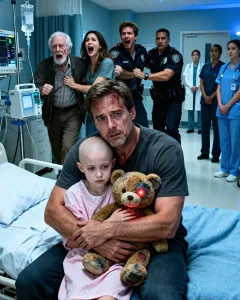
I sat on the edge of my daughter’s bed with her stuffed rabbit clutched in one hand and a tiny digital recorder balanced in the other like an armed explosive.
For several long seconds, my lungs simply stopped working.
The bedroom still carried traces of children’s shampoo, hospital disinfectant, and the raspberry hand cream Emma used to make me rub into her fingers every night before sleep. Her shoes remained lined neatly beneath the window. One pair was covered in silver glitter. Another had faded Velcro straps she’d outgrown months earlier but refused to surrender because she insisted they made her faster.
My daughter was dead.
And hidden inside her old stuffed rabbit, Winston, she’d left me directions leading straight to the monsters who had smiled beside her hospital bed.
My thumb trembled as I pressed pause.
Part of me wanted to throw the recorder through the wall.
I wanted to scream until every person in the apartment complex woke up and understood that my grief had just transformed into something far uglier.
But Emma’s last request repeated inside my head.
Her small voice.
Thin.
Breathless.
“Listen to Winston, Daddy. Only you.”
So I pressed play again.
This time, I forced myself to listen to everything.
Emma’s voice came through first.
“Daddy went to work today. Aunt Melissa said I need to be a good girl. Uncle Grant came back. They talked in the kitchen because they thought I was asleep. Winston heard them too.”
Fabric rustled against the microphone.
Then she coughed softly.
I pulled the rabbit against my chest.
It was irrational, but I wanted to protect her backward through time.
I wanted to reach into the static, lift her from that bed, and carry her somewhere none of them could touch her.
Then Grant’s voice entered the recording.
Smooth.
Professional.
Annoyed.
“As long as the contributions continue, we remain on schedule. The story works because people respond to a dying child. Put a deadline on tragedy and wallets open twice as fast.”
I closed my eyes.
Something cracked through the center of my chest.
A dying child.
Not Emma.
Not my little girl.
Not the kid who drew crooked hearts on my work lunches or gave every stuffed animal a full legal name and birthday.
Melissa answered in a whisper.
“David can’t find out about the second account, Grant. He’s going to start questioning the hospital expenses.”
“He won’t,” Grant replied.
His voice held casual contempt.
“He’s drowning in grief. Grieving people are simple to direct. We keep showing up. We keep acting like the devoted family.”
My fingers tightened around the recorder until my knuckles turned white.
Melissa sounded more frightened now.
“What about the documents from Philadelphia? If David sees—”
“They’re gone,” Grant cut in. “I handled it. He believes the trial treatment led nowhere. By the time David understands what happened, the kid will be dead.”
I stopped the audio.
Then I bent forward over Emma’s bed.
Both hands covered my mouth.
Nothing came out at first.
Then a sound tore loose from somewhere deep in my body.
It wasn’t exactly crying.
It wasn’t screaming.
It was something helpless and animal.
Emma hadn’t simply died.
She had died surrounded by adults who turned her failing body into a business model.
I was thirty-nine years old.
I worked as a commercial refrigeration technician.
I understood systems.
I understood overheated circuits, failed compressors, electrical diagrams, pressure warnings, and the burnt smell of insulation seconds before ignition.
What I had never learned was how betrayal looked when it wore my sister’s face and carried homemade casseroles into a children’s hospital.
Melissa had always been the dependable one.
After our parents died, she became the person I leaned on.
When Emma became ill, Melissa organized charity drives.
She washed clothes.
She brought meals.
She held me upright when I had gone two days without real sleep.
I had trusted her with my apartment key.
My bank records.
My daughter.
That was the fact currently choking me.
I wrapped the recorder inside one of Emma’s old pajama shirts and locked it in a steel tool case beneath the kitchen sink.
Then I sat at the table until morning.
Across from me was Emma’s empty cereal chair.
By sunrise, my grief was still there.
Heavy.
Paralyzing.
But something new had taken a seat beside it.
Purpose.
Cold and frightening.
I needed to know precisely what Melissa and Grant had done.
I reached for my phone, planning to contact the only hospital employee who had ever looked at my sister with visible distrust.
Before I could dial, my phone vibrated.
Unknown number.
I answered carefully.
“Hello?”
“David.”
The voice was low and frantic.
It was Evelyn, Emma’s hospital social worker.
“Listen very carefully. Do not contact Melissa. And don’t go to the police yet.”
My spine stiffened.
“You need to come to the hospital’s service entrance immediately. There are things about Grant you don’t know.”
At 8:43 that morning, I parked behind Mercy Children’s Medical Center.
The hospital rose above me like a factory built to manufacture hope in carefully rationed quantities.
I’d spent the worst months of my life inside those halls.
I knew which vending machine accepted wrinkled bills.
I knew which fourth-floor window showed the pinkest sunrise because Emma loved looking at the morning sky.
Now every window looked barred.
Evelyn waited beside the loading entrance.
Her normally tired, kind eyes were sharp with fear.
She didn’t speak.
She simply motioned for me to follow.
We entered through a staff corridor and descended into a cramped basement office packed with dented filing cabinets.
A woman I had never met sat at the small table.
Tall.
Charcoal suit.
Leather briefcase.
Eyes hard enough to cut glass.
“David,” Evelyn said, “this is Laura Bennett. She’s an attorney specializing in healthcare fraud and patient rights.”
I stared at the woman.
“I don’t have lawyer money.”
Laura didn’t react.
“Excellent. Then neither of us has to waste time discussing my hourly rate.”
She nodded toward me.
“Evelyn says you found something.”
I pulled the recorder from my jacket and placed it on the table.
Laura listened.
Her expression didn’t move once.
Evelyn covered her mouth.
Tears filled her eyes.
Then Grant’s voice echoed through the speakers.
“By the time David understands anything, the kid will be dead.”
When the recording ended, Laura closed her laptop.
Soft click.
“David,” she said carefully, “what I’m about to tell you is going to destroy your life a second time.”
I gripped the edge of the table.
“Tell me.”
Laura opened her briefcase and removed a thick beige folder.
“Evelyn identified irregularities in the hospital billing records this morning. We started checking names.”
She slid a photograph across the table.
“Grant Holloway is not a patient services consultant.”
My stomach tightened.
“He’s a professional fraud operator. He locates families with terminally or critically ill children, creates LLCs around fundraising campaigns, redirects donations, then disappears after the child dies.”
Laura leaned back.
“He has operated in four states under at least three names.”
I swallowed.
“And Melissa?”
Laura’s eyes remained on mine.
“Your sister owed more than eighty thousand dollars in gambling debt.”
I felt the floor shift.
“Grant met her through a casino contact. He discovered her niece was seriously ill and recognized the opportunity.”
Evelyn looked down.
“He initially promised to eliminate Melissa’s debts if she helped him control the fundraising structure.”
Laura’s voice hardened.
“Eventually, she stopped being someone under pressure. She became a partner.”
Nausea rose into my throat.
I had sold my work truck.
Skipped meals.
Worked sixteen-hour days.
And my sister had been settling gambling debts with money strangers donated to save my child.
Evelyn pushed a document across the table.
“David, there’s more.”
It was a letter from a pediatric rare-disease research organization in Philadelphia.
I read the first paragraph.
Then the second.
My vision blurred.
Emma had been accepted into a fully funded experimental treatment program.
Travel covered.
Housing covered.
Treatment covered.
“No,” I whispered.
My mouth went dry.
“I never received this.”
“The doctors here told me we weren’t eligible.”
“Because this never reached you,” Laura said.
She placed another page beside the letter.
A declination form.
My name.
My signature.
Except I had never seen it.
“They intercepted the approval,” Laura said. “Then someone forged your signature declining treatment.”
“Why?”
The word left me like a gunshot.
I slammed one fist against the table.
“Why would they do that?”
Laura’s answer was clinical.
Her eyes were not.
“If Emma traveled to Philadelphia, the treatment foundation would pay nearly all major expenses.”
I stared at her.
“The local fundraising story would collapse.”
She continued.
“No dying child at home. No urgent medical bills. No ticking clock. No emotional campaign.”
My chair scraped backward.
“They needed her sick.”
Laura said nothing.
I understood.
“They needed her here.”
Evelyn nodded.
“And they had help inside the hospital.”
I looked at her.
“A billing coordinator named Kevin Marshall. He redirected incoming foundation correspondence to Grant and altered parts of the insurance record.”
“How much?”
“Twenty percent.”
My hearing became distant.
Money.
They hadn’t only taken money.
They took days.
Weeks.
Possibility.
They stole a chance.
My daughter had been killed by signatures and redirected mail.
I stood so violently my chair crashed backward.
“I’ll kill him.”
Laura immediately rose.
“I am going to his house.”
I moved toward the door.
“I’ll tear him apart.”
Laura stepped directly into my path.
“If you do, you go to prison.”
“I don’t care.”
“You will.”
Her voice cut sharply through mine.
“Because they will destroy every record, transfer the money, and tell everyone you’re a violent father having a psychotic collapse after losing his daughter.”
I was breathing hard.
“They’ll win, David.”
I stared at her.
“What am I supposed to do?”
Laura’s expression changed.
Not softer.
More dangerous.
“We make them comfortable.”
I said nothing.
“We put Melissa and Grant in a room filled with the people they defrauded.”
Laura folded her arms.
“We let them believe they’ve already won.”
Her eyes narrowed.
“Then we take everything.”
I looked at her.
“How?”
“You invite them over.”
She paused.
“And you convince them to organize a memorial fundraiser.”
Melissa arrived at my apartment that Friday carrying baked pasta and a carefully rehearsed personality.
Black cardigan.
No makeup.
Tired eyes.
She looked like a woman performing grief for a camera nobody else could see.
Grant stood beside her in a perfectly fitted blue suit.
A suit I now knew had probably been purchased with donations intended for my seven-year-old daughter.
“Davey,” Melissa said softly.
The childhood nickname made my teeth hurt.
“You shouldn’t sit alone in the dark.”
Every instinct in my body told me to attack Grant.
I wanted my hands around his throat.
I wanted to ask whether Emma had been scared while he checked account balances.
But Laura’s voice remained in my head.
Broken brother.
Grateful father.
Know nothing.
I stepped away from the doorway.
“I’m tired, Melissa.”
“I made baked ziti.”
She placed the glass dish on my kitchen counter.
I looked at it and wondered how much gambling debt had gone into that performance.
Grant placed one hand on my shoulder.
“How are you doing, man?”
I stared at his fingers.
He eventually removed them.
“The apartment is quiet,” I said.
“That’s grief,” Grant replied with artificial sympathy. “It comes in waves. You ride them.”
We sat at the kitchen table.
Behind a stack of unopened mail, a concealed camera provided by Laura’s investigator recorded us.
Grant sipped coffee.
“Have you decided what you’re doing with Emma’s fundraiser?”
I looked down.
“People are still commenting. Leaving messages.”
He shrugged.
“It might be appropriate to close the page. Give the community some emotional closure.”
“How much money remains?”
Grant barely paused.
“I’d need to calculate final expenses. Hospital costs. Funeral costs. There may be a small remaining balance.”
Small.
I nodded.
“I want to do something with it.”
Melissa leaned forward.
“For Emma?”
“Yes.”
She placed her hand over mine.
“Of course. Whatever you need.”
Her hand felt cold.
“I want a memorial event.”
Grant’s eyes moved toward me.
“A dinner. Maybe a gala.”
I forced my voice to tremble.
“Invite the large donors. Local businesses. Everyone who helped Emma.”
Melissa exchanged one quick glance with Grant.
Less than a second.
The hidden camera saw it.
Predators calculating.
“I want to thank everyone personally,” I continued. “Then announce that whatever remains will go to childhood cancer research.”
Melissa hesitated.
“Davey, are you sure you’re emotionally ready for something that public?”
Grant interrupted her.
“Actually, it’s a great idea.”
His eyes brightened.
He saw the money.
One last event.
One last wave of sympathy.
One final collection before he disappeared.
“We could establish an Emma Dawson Memorial Fund,” Grant said. “Silent auction. Corporate sponsorships. Donation pledges.”
He leaned closer.
“Melissa and I can handle everything. You just give a speech.”
I lowered my eyes and wiped fake tears.
“I don’t know what I’d do without both of you.”
“We’re family,” Melissa replied.
“We take care of each other.”
They relaxed.
They believed I was still blind.
Then Melissa made a mistake.
She looked toward Emma’s bedroom.
“It was so unfair.”
I held my mug.
“But at least she was peaceful in the end. Her breathing slowed and she just drifted away.”
Silence.
My heart hit my ribs.
When Emma died, I held her right hand.
Evelyn sat beside her left shoulder.
Melissa had told me she couldn’t bear to witness the final moment.
She claimed she’d gone downstairs for coffee.
But she knew how Emma’s breathing stopped.
She had been there.
Watching.
Ensuring her investment reached its conclusion.
“Yeah,” I said.
My voice nearly broke.
“It’s good you were in the cafeteria, Melissa.”
Her eyes met mine.
“I don’t think you would’ve survived seeing it.”
All color left her face.
She understood instantly.
Before she could speak, my phone vibrated on the table.
A text notification.
Laura.
We located the storage unit. Come immediately.
The self-storage building in Newark smelled of metal, mildew, and old rain.
Laura stood outside unit 318 with two private investigators and a bolt cutter.
Earlier that day, she and Evelyn had confronted Kevin, the hospital billing coordinator, in an employee parking structure.
Laura barely had to threaten him.
The moment she mentioned federal conspiracy charges, Kevin collapsed.
He cried.
Then he talked.
Grant had used Melissa’s gambling debt to control her initially.
Later, Melissa became greedy.
She demanded higher percentages from the donations.
Designer clothes.
A condominium deposit.
Casino debts.
Kevin gave Laura the storage facility address.
The lock broke.
The metal door rolled upward with a violent screech.
Inside were wooden pallets covered with cardboard boxes.
Emma’s medical files.
Letters from research organizations.
Insurance records.
Offshore banking statements from accounts in Bermuda.
Then I saw a small carved wooden box resting on a metal cabinet.
I walked toward it.
My fingers shook when I opened the brass latch.
Inside was a silver bracelet.
Tiny charms hung from it.
Beneath the bracelet was a laminated card carrying the logo of the Philadelphia Children’s Research Center.
Handwriting filled the bottom.
For our brave girl, Emma. We cannot wait to help you fight. See you in Philadelphia!
My chest stopped.
“They mailed this eight days before she died,” Laura said behind me.
I couldn’t move.
“After receiving the forged refusal, the center assumed you had chosen comfort care.”
I lifted the bracelet.
The silver was cold.
I thought about everything stolen from me.
Morning waffles.
Bedtime stories.
Middle school.
Driving lessons.
First love.
Graduation.
They sold my daughter’s possible future for gambling chips, luxury clothing, and a leased sports car.
My knees hit the concrete.
I pressed the bracelet against my chest.
Then I cried.
Not quietly.
My body folded in on itself.
I choked on air.
It was the sound of a father realizing he had trusted the wolves enough to hold the door open for them.
Eventually, I stood.
The sadness had changed shape.
Something empty and cold remained.
Laura watched me.
“When is the memorial gala?”
“Tomorrow night.”
My voice sounded scraped raw.
“Downtown Hilton.”
Laura reached into her coat pocket.
She handed me a small black USB drive.
“My audio technician restored the teddy-bear recording.”
She looked directly at me.
“Every word is clean.”
I closed my hand around the drive.
“Financial investigators froze Grant’s offshore accounts ten minutes ago.”
“He knows?”
“No.”
Laura’s eyes hardened.
“Tomorrow night, David, you stand on that stage.”
A pause.
“And you burn the illusion down.”
I didn’t sleep.
I sat in the dark living room holding Winston.
I practiced my speech.
My breathing.
My expression.
And I practiced looking at my sister while mentally cutting the final thread between us.
The Hilton ballroom was decorated in white linen and pale lavender lighting.
Emma’s favorite color.
I wanted to vomit.
Three hundred people filled the room.
Donors.
Business owners.
City officials.
Families who had followed Emma’s illness online.
I stood behind the stage curtain adjusting my tie.
Grant was already speaking.
He looked impressive.
Confident.
A professional manipulator at work.
“We are gathered tonight,” he announced, “not simply to mourn a remarkable young girl, but to ensure Emma’s legacy continues through meaningful action.”
He paused perfectly.
“The Emma Dawson Memorial Fund—”
My phone vibrated.
Laura.
We’re set. AV is controlled. Give us the signal.
I inhaled.
Then I walked onto the stage.
Applause began.
It grew.
People stood.
Several wiped tears from their faces.
They saw a grieving father.
A survivor.
Grant stepped aside.
He gave me the microphone with a solemn nod.
Then he placed a supportive hand against my back.
Melissa sat at the front VIP table.
She touched a tissue to completely dry eyes.
“Thank you.”
My voice echoed across the ballroom.
The room quieted.
I looked at the audience.
Good people.
People who gave money because they wanted a child to live.
Then I looked at Melissa.
She smiled encouragingly.
“When Emma died, I believed I had lost everything.”
My hands closed around the podium.
“I believed the world was random and cruel.”
I swallowed.
“I was grateful for the support. For every donation.”
I turned slightly.
“And especially for my sister, Melissa, and her partner, Grant.”
Scattered applause.
Grant lowered his head with manufactured humility.
“But grief is strange,” I continued.
My voice dropped.
“It makes people blind.”
Grant looked up.
“It makes them easier to steer.”
His face tightened.
I continued.
“People love a dying child, don’t they?”
Grant’s eyes widened.
“They open their wallets faster when tragedy comes with a deadline.”
He recognized the sentence.
“David,” he whispered.
He stepped toward me.
“What are you doing?”
I ignored him.
I looked toward the AV booth.
Then I nodded once.
“Emma didn’t necessarily have to die.”
A wave moved through the room.
“She had been accepted into a fully funded experimental treatment program in Philadelphia.”
Melissa’s face changed.
“But someone intercepted the documents.”
Gasps.
“They forged my signature and declined the treatment.”
I looked directly at my sister.
“Because a child receiving free treatment in another city doesn’t create urgent local fundraising.”
People started whispering.
“They needed Emma sick.”
My voice grew louder.
“They needed her here.”
Grant suddenly shouted toward the back.
“Turn off his microphone!”
Nobody touched it.
Instead, the ballroom speakers came alive.
Emma’s voice.
Small.
“Daddy went to work today. Aunt Melissa said I need to be good…”
Melissa dropped her tissue.
Then Grant’s recorded voice thundered across the ballroom.
“As long as the contributions continue, we remain on schedule. The story works because people respond to a dying child.”
Chairs scraped.
Someone screamed.
Then Melissa’s recorded voice.
“David can’t know about the second account, Grant. He’s going to start questioning the hospital bills.”
Melissa stood.
Her chair crashed backward.
Hundreds of donors stared at her.
“It isn’t real!” she screamed.
She pointed at me.
“He’s insane! David made this up!”
Then Grant’s voice came through the speakers again.
“They’re gone. Everything is handled. By the time David understands anything, the kid will be dead.”
Grant didn’t defend himself.
He ran.
Five steps.
That was all he managed.
Two plainclothes investigators came from behind the stage curtain.
They drove him onto the ballroom floor.
Grant cursed.
Kicked.
His expensive jacket tore at one shoulder.
Handcuffs closed around his wrists.
The ballroom descended into chaos.
Sirens sounded outside.
I walked down from the stage.
Melissa had backed herself against the VIP table.
Her entire body shook.
When she saw me approaching, fear transformed into rage.
“You were never there!” she screamed.
People turned.
“You were always working!”
Her face twisted.
“I sat in that hospital smelling bleach every day!”
She pointed at herself.
“I deserved some of that money!”
The room became silent around us.
“You were a weak father, David! An absent father! I did everything!”
I stopped two feet from her.
I didn’t raise my voice.
“You didn’t do anything for Emma.”
Melissa’s breathing was violent.
“And you didn’t do it because of me.”
I stared at her.
“You did it because there is nothing inside you that is ever enough.”
Her eyes filled.
“Now everyone knows.”
Uniformed officers entered.
One officer took Melissa’s arm.
She didn’t fight.
As they led her away, she looked over her shoulder.
Her lips formed two words.
I’m sorry.
I turned away.
I didn’t want her apology.
I didn’t want the money.
I wanted to go home and hold my daughter’s stuffed rabbit.
As I approached the lobby, someone grabbed my shoulder.
I turned.
Kevin.
The hospital billing clerk.
His face was gray.
He clutched a thick envelope.
“David, wait.”
He pushed it toward me.
“Grant did this before.”
I stared at him.
“There are other families.”
His hands shook.
“I brought the transaction ledgers. All of them.”
I looked down at the envelope.
The nightmare had not ended.
It had expanded.
The trial lasted three weeks.
The jury deliberated for less than four hours.
Guilty.
Wire fraud.
Forgery.
Conspiracy.
Theft by deception.
Reckless endangerment.
Grant Holloway remained perfectly still when the federal judge sentenced him to twenty-two years.
Men like Grant rarely cry.
They calculate.
Even when they’re looking through bars.
Melissa’s hearing was different.
Her attorney described her gambling addiction.
Grant’s manipulation.
The blackmail.
Laura dismantled the argument with one document.
The forged Philadelphia declination form.
Blackmail can explain stolen money.
It cannot explain deliberately denying a sick child a possible treatment so fundraising remains profitable.
Melissa received twelve years.
No parole eligibility for eight.
At sentencing, the court allowed me to speak.
I carried Winston to the podium.
“My daughter was not a tragic story to monetize.”
Melissa cried silently in her prison uniform.
“Emma was a child.”
I held the rabbit against my side.
“She loved raspberry lotion. She drew cats with wings. She believed glitter shoes made people faster.”
My voice tightened.
“You didn’t only steal money from generous strangers.”
I looked directly at my sister.
“You stole time.”
The courtroom remained silent.
“You stole mornings.”
“Birthdays.”
“My future.”
Then the part that hurt most.
“You made a dying seven-year-old frightened of adults she should have trusted.”
Melissa lowered her head.
“You broke my heart.”
I breathed.
“But Emma’s love was stronger than your greed.”
I lifted Winston slightly.
“She recorded you.”
A tear ran down my face.
“She protected me.”
My voice steadied.
“And now she’s going to protect other children.”
After the trial, investigators recovered millions of dollars Grant had hidden from several fraudulent campaigns.
With Laura and Evelyn’s help, I established the Emma Dawson Patient Protection Foundation.
We helped parents review complicated medical documents.
We funded independent patient advocates.
We audited fundraising structures.
We taught families how to verify charity consultants.
And we made sure desperate parents never had to trust a single gatekeeper blindly.
I never wanted to operate a foundation.
I wanted to be Emma’s father.
But fatherhood had nowhere else to go.
So it moved forward.
Carrying her name.
Five years later, I stood in the cemetery on a cold October afternoon.
Emma’s grave rested beneath a broad maple tree.
Golden leaves moved across the grass.
I knelt.
Placed pink roses beside the headstone.
Then I set Winston against the granite.
His fur was worn.
Matted from years of being held in dark rooms.
But to me, he still looked brave.
I removed my phone.
An email from Laura waited on the screen.
David,
We closed case number 500 today.
A family in Michigan received full funding for a second medical opinion after our auditors caught a fraudulent consultant redirecting their fundraiser.
The child made it to surgery.
He’s going to live.
Emma did this.
I read the email repeatedly.
Eventually, the words blurred.
People often ask how I survived betrayal like mine.
I never offer a beautiful answer.
I don’t tell them time heals everything.
It doesn’t.
Time builds calluses over places that still hurt.
I don’t tell people justice creates closure.
A judge’s gavel never placed Emma back at my kitchen table.
What I tell them is this:
Grief is a dark house.
Sometimes you learn to walk through it without turning on the lights.
I touched Emma’s name carved into the stone.
“Five hundred, baby.”
My voice was barely louder than the wind.
“Daddy listened.”
I looked at Winston.
“The whole world is listening now.”
A breeze moved through the tree.
One pink rose petal lifted from the bouquet and traveled across the grass.
And for the first time in five years, the weight inside my chest became slightly easier to carry.