Part 1: The Sunburn and the Soil
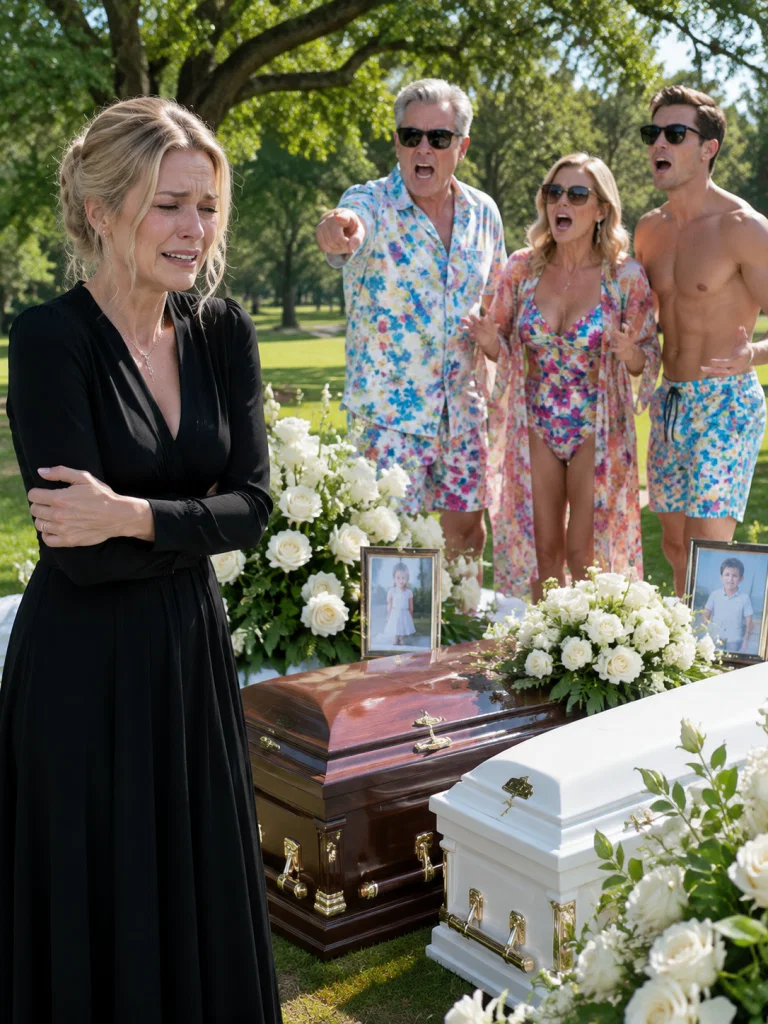
I laid my husband and my seven-year-old daughter into the damp earth on a relentlessly gray Tuesday. The sky hung low, matching the suffocating weight in my chest, while two thousand miles away, my parents were actively perfecting their tans beneath a vibrant sun in Aruba.
They had sent a single, sterile text message just an hour before the mahogany coffins were lowered into the ground.
“Sorry, honey,” the message read. “Flights are just astronomically expensive right now, and honestly, this is a bit too trivial to ruin your brother’s much-needed vacation, so we are there in spirit.”
I stood in the cemetery holding my phone. For three agonizing seconds, the oxygen completely vanished from my lungs, and I forgot how to inhale.
Johnny’s casket was heavy mahogany, buffed to such an immaculate, mirrored finish that when I stepped close, I could see the trembling, distorted shape of my own pale face reflected in the wood. Directly beside him was Gemma’s, which was stark white and so cruelly small that the mere sight of its dimensions was enough to fracture every single bone inside my body.
She was only seven years old, and she had harbored a fierce, unyielding devotion to blueberry pancakes and gaudy glitter shoes that left a trail everywhere she went. She loved begging Johnny to slow-dance with her in the kitchen while dinner burned on the stove, and now those memories were all I had left.
My parents, Judith and Ricky, should have been standing directly behind me in the wet grass. They should have been holding my elbows to keep my knees from buckling under the immense weight of my grief.
Instead, later that evening, while I sat alone in a silent house, my mother uploaded a photograph to her social media feed. It featured a pristine white beach where my older brother, Jared, had his sunburned arms draped casually around both our parents while they raised vibrant, neon-colored cocktails toward a breathtaking sunset.
Beneath the image, she had typed a caption that read, “Family is absolutely everything.”
I sat on my living room floor in Richmond and stared at those five words until the letters dissolved into a meaningless, blurry smear.
In the immediate aftermath of the funeral, the community orbited around me as if I were constructed of spun glass. Johnny’s colleagues from his law firm wept openly, mourning him with a raw intensity that my own blood relatives could not manage to summon.
My elderly neighbor, Mrs. Forbes, silently pressed warm containers of chicken soup into my shaking hands every evening. My pastor squeezed my shoulder at the gravesite and murmured, “Naomi, you do not have to be strong today, so please just let yourself exist.”
But strength was not a choice for me, because it was an armor that had been violently forced onto my shoulders very early in life.
I was the designated beast of burden in my family, the daughter who secured academic scholarships so they would not have to pay tuition. I was the one who quietly fixed their mounting debts, managed their overdue utility bills, and endlessly manufactured polite excuses for parents who treated parental love as a transactional invoice.
Jared, conversely, was the undisputed golden son and the prodigy who never produced. He had effortlessly failed upward his entire adult life, leaving a trail of wreckage through three bankrupt businesses, two bitter marriages, and a perpetual string of temporary financial loans that were never repaid.
Johnny had seen right through them from the very beginning of our relationship.
“Naomi, your family does not actually ask you for help,” he had told me once, holding my face after a particularly brutal Thanksgiving dinner. “They run a stress test to see exactly how much of your soul they can extract before you break.”
I had not listened closely enough to his warning, because I foolishly thought my love could eventually balance the ledger.
Exactly three days after I buried my entire world, the doorbell rang.
My parents stood on my front porch, dressed in breezy resort linen and emanating the faint, sickeningly sweet scent of coconut sunscreen. Jared loomed in the background, aggressively scrolling through his smartphone and not even bothering to look up at me.
My mother did not offer a hug or condolences, and her eyes immediately darted past my shoulder to inventory the interior of my home.
“Good lord, Naomi, you look absolutely terrible,” she announced, wrinkling her nose. “Anyway, we do not have time to linger, because we need forty thousand dollars immediately.”
I had honestly believed that the grief had scraped me entirely hollow, leaving nothing left inside me to feel. I was wrong, because a glacier of pure, ancient ice was still waiting in the dark.
“For what?” I asked, my voice completely devoid of any human inflection.
Jared finally peeled his eyes away from his screen and let out a loud, impatient sigh. “It’s a massive emergency, Naomi, so please do not make it dramatic today.”
My father pushed past my mother, his jaw set in a tight, entitled line. “Your brother’s new restaurant is facing a sudden tax lien issue with the state, and they are threatening to freeze his operating accounts, so we need a cashier’s check today.”
I slowly turned my head, and my eyes drifted to the stark black mourning dress still draped over the dining room chair. Next to the staircase sat Gemma’s bright pink, glittery backpack, exactly where she had dropped it the afternoon before the drunk driver crossed the center line.
“You completely missed their funeral,” I stated, presenting a fact as cold as the morgue.
My mother’s face instantly hardened, and her features sharpened into weapons. “Do not you dare try to guilt-trip us right now, Naomi, because you owe us this after everything we sacrificed for you.”
I looked the three of them dead in the eye as a strange, terrifying calm washed over me. I reached out and picked up a heavy blue folder resting on the entryway console table.
For the very first time in my thirty-two years of existence, these parasites had come knocking on the wrong door.
Part 2: The Ghost’s Ledger
The folder I held was a deep, navy blue, and it was thick enough that my father’s eyes involuntarily flickered toward it with a flash of sudden suspicion.
“What exactly is that?” my mother demanded, gesturing to the file with a manicured hand.
“It’s a project Johnny started a few months ago,” I replied smoothly, gripping the cardboard edges.
Jared let out a harsh, derisive snort from the porch steps. “What, your dead husband left you homework, because that is just so romantic.”
My knuckles turned white around the folder, but my voice remained a perfectly serene, glassy surface. “Yes, you could call it that.”
Johnny had been a senior corporate insurance attorney, and he was meticulously careful, pathologically methodical, and functionally impossible to intimidate. Approximately six months prior to the catastrophic car crash, a strange letter had arrived in our mailbox.
It was a formal rejection notice for a massive commercial business loan that I had absolutely never applied for.
I vividly remembered Johnny’s face as he sat at our kitchen island, reading the letter under the pendant lights. He had not looked angry, but he looked intensely, terrifyingly focused, which was the kind of focus a predator exhibits right before a strike.
“Naomi, your parents’ names are legally tethered to this application,” he had murmured, tracing a line on the paper with his pen. “And your brother’s restaurant business is listed right beside them.”
I had let out a weak, nervous laugh, brushing it off as a clerical error because denial is often the very last blanket you have to keep you warm against the truth.
Johnny had not laughed, and he went to work immediately.
Over the next few months, he quietly utilized his vast professional resources to gather documents, unredacted bank records, and forensic analyses of forged signatures. He even unearthed copies of cashed checks written from a shadow bank account my parents had secretly opened when I was just a nineteen-year-old college student.
They had used my Social Security number and my mother’s maiden name as the backup security verification to bypass the fraud alerts.
They had not just borrowed money, because they had systematically constructed a second, parasitic life out of my stolen identity.
There were maxed-out credit cards I never authorized, shadowy business loans that defaulted, and fraudulent tax filings to obscure Jared’s losses. Every single time I genuinely believed I had finally established independence, they had stealthily buried another financial hook deep into my skin.
Johnny had meticulously built a bulletproof case, and he was planning to confront them with the evidence the weekend after Gemma’s spring school recital.
He never made it home from that recital.
While I was sitting in the funeral director’s office, numbly selecting the internal lining for my husband’s casket, my phone had buzzed. It was Mr. Fletcher, who was Johnny’s senior paralegal.
“Mrs. Hart,” he had said gently, his voice thick with uncharacteristic emotion. “I am so profoundly sorry, but Johnny left strict, written instructions for me to contact you immediately if anything ever happened to him before the family fraud file was resolved.”
Those words, family fraud file, abruptly became the concrete floor beneath my free-falling grief.
Johnny had not stopped at just gathering basic documents, because he had hired an aggressive independent forensic accountant. Her finalized report was absolutely brutal, proving that my parents and Jared had not merely stolen my credit score.
They had brazenly forged Johnny’s signature, listing him as the primary legal guarantor on Jared’s latest, failing restaurant loan. When the shady lender had recently started asking aggressive questions about missed payments, my father had desperately fabricated fake income invoices using Johnny’s law firm letterhead to stall them.
And then, while reading the file, I discovered the final, unforgivable insult.
Exactly two days before the funeral, while they were literally posing for sunset photographs on a Caribbean beach, my mother had emailed Johnny’s law firm. She had set up a fake email address and pretended to be me, explicitly claiming that I was far too emotionally unstable and heavily medicated to handle financial matters.
She was actively trying to siphon the death benefits before my husband’s body was even cold in the morgue.
Standing in the doorway, I looked at the three of them.
“Come inside,” I said, stepping back to clear the threshold.
They eagerly flooded into the foyer, because they mistook my invitation for capitulation and thought the broken beast of burden was finally ready to carry the yoke again.
My mother swept grandly into the center of my living room, her eyes critically assessing the vaulted ceilings. “Honestly, Naomi, this house is entirely too massive for just one person now, so you need to sell it immediately, give Jared the equity he needs, and start over somewhere smaller.”
Jared did not wait for an invitation, and he carelessly dropped his body onto Johnny’s favorite leather armchair. “Grieving in a mansion is still grieving, Naomi, so do not be greedy.”
My father pointed a thick finger at the blue folder I was still clutching. “Enough of this emotional theater, because we are on a tight schedule, so just go write the cashier’s check.”
I walked over and sat down on the sofa directly across from them. I set the heavy folder on the glass coffee table, knowing that identical, notarized copies of this entire file had already been couriered that morning to the restaurant’s lender, the IRS Criminal Investigation Unit, the county prosecutor’s fraud division, and Johnny’s aggressive probate attorney.
“Before we discuss money,” I said, leaning back and crossing my legs. “I want you to look me in the eye and tell me exactly why you did not come to bury them.”
My mother let out a loud, theatrical sigh and dramatically rolled her eyes. “Oh, for God’s sake, Naomi, because death happens, and we could not change the outcome by standing in the mud when the living still have urgent, pressing problems to solve.”
“Gemma was seven years old, Mom,” I said.
“And Jared is currently alive!” she snapped, her voice rising to a shrill crescendo. “He is standing right in front of you, and his livelihood can still be saved if you just stop being so incredibly selfish!”
Something deep inside my chest finally stopped shaking, and the grief receded, leaving only executioner’s steel.
I leaned forward and slowly flipped open the blue cover of the folder.
Jared leaned forward, a smug, punchable smirk painting his face. “What is that, Naomi, some pathetic little grief journal where you are going to read us some sad poetry?”
“No,” I replied, my voice dropping to a terrifying, quiet register. “It’s evidence.”
The temperature in the living room seemed to plummet twenty degrees.
Part 3: The Prosecutor’s Referral
I peeled back the cover sheet, revealing a high-resolution photocopy of a commercial loan agreement where Johnny’s signature was written right on the bottom line.
Except it was not his signature.
My father leaned forward, his eyes locking onto the document as his mouth fell open slightly, though no sound emerged.
“This is a certified handwriting analysis from an independent forensics firm, confirming the signature is a clumsy forgery,” I narrated, keeping my tone as light as a museum tour guide. “Here we have security video stills, subpoenaed directly from the bank, showing you, Jared, physically depositing the fraudulently acquired funds into your personal account.”
I flipped to the next exhibit. “Oh, and this one is my favorite, which is a printed transcript of an email where Mom brilliantly impersonated a grieving widow to try and intercept my husband’s life insurance payout while you were drinking piña coladas.”
I slid the final sheet of paper across the glass coffee table so it rested directly in front of my father.
“And this,” I said, tapping the center of the page with my index finger, “is the official intake referral number from the county prosecutor’s office.”
My mother stared down at the black ink on the white paper as if it were a venomous snake preparing to strike her face.
Jared shot up from Johnny’s leather chair, his smugness instantly replaced by frantic, sweaty panic. “You are bluffing, Naomi, because you cannot prove criminal intent, and all of this is just circumstantial!”
I did not even look at him, but kept my eyes fixed on my father. “You sent a text message to Dad three months ago, Jared, and we recovered the data where you wrote that you should just use my name on the application again because I never check anything.”
All the blood violently rushed out of Jared’s face, leaving him looking like a sick ghost.
My father suddenly lunged across the coffee table, his thick hands grasping desperately for the blue folder.
I did not flinch, but simply pulled the folder back an inch out of his reach. “I strongly advise against touching that,” I warned, my voice like crushed ice. “If you touch it, the police officer sitting in the patrol car outside will come through that front door with his weapon drawn.”
All three of them froze perfectly still, paralyzed like deer in headlights.
They slowly turned their heads toward the large bay window, and idling quietly at the curb was indeed a marked county sheriff’s cruiser. As they watched, the passenger door opened, and Johnny’s probate attorney, Mr. Fletcher, stepped out onto the sidewalk, holding a thick stack of manila envelopes.
My mother’s voice cracked, and a hysterical, reedy sound escaped her throat. “Naomi, did you actually call the police on your own flesh and blood?”
“No, Mom,” I corrected her softly. “I didn’t, but Johnny did, and I just finalized the paperwork he started.”
The front door opened, as I had left it unlocked, and Mr. Fletcher walked into the living room, flanked by a uniformed sheriff’s deputy. He did not offer a greeting, but simply walked around the coffee table and began handing the manila packets to each of them.
“You are being officially served,” Mr. Fletcher announced, his professional voice booming in the quiet house. “The charges currently pending include multiple counts of wire fraud, aggravated identity theft, conversion of funds, and felony financial abuse.”
He paused, looking directly at my father. “Specifically, financial abuse involving the unauthorized liquidation of Mrs. Hart’s grandmother’s estate.”
My father’s knees physically buckled at the mention of my grandmother, and he collapsed heavily back onto the sofa.
When Grandmother Rosemary had passed away ten years ago, my parents had sat me down with solemn faces and told me she had died completely destitute, leaving me nothing but a box of tarnished costume jewelry and a worn leather Bible.
Johnny’s forensic accountant had found the hidden trust.
Grandmother Rosemary had left two hundred and eighty thousand dollars in a locked educational trust, which was legally designated specifically for my college tuition, the down payment on my first home, and any future child I might have.
When Gemma was born, her name had been legally amended into the trust as a secondary beneficiary.
My mother, acting as the executor, had methodically drained every single penny of it. She bled my dead grandmother’s gift dry to fund Jared’s lavish weddings, their luxury Caribbean vacations, and the failing restaurant that now desperately required a forty-thousand-dollar bailout just to keep the lights on.
“That money was legally ours to manage as we saw fit,” my mother whispered, her voice trembling with a mixture of terror and lingering entitlement.
“It was Gemma’s money,” I said, the ice in my voice finally cracking to reveal the raw, burning rage beneath.
Jared backed away from the deputy, bumping into the wall. He threw his hands up in a placating gesture. “Naomi, come on,” he pleaded. “Please, because we are family, and we can fix this quietly.”
I looked at my brother, and then I looked at the man who had laughed and drank cocktails on a white sand beach while the tiny white casket holding my daughter was lowered into the cold, wet earth.
“No, Jared,” I stated clearly. “We are not family, because you are defendants.”
My mother, realizing that intimidation and logic had failed, resorted to her ultimate, final weapon of manufactured tears. She let out a loud, theatrical sob, burying her face in her hands.
“Naomi, please!” she wailed, looking up with perfectly orchestrated misery. “Your daughter, your sweet little girl, would not want you to do this to us because she loved us!”
I stood up from the sofa, and the sudden movement was so sharp it made Jared flinch.
“Do not ever,” I hissed, my voice dropping to a demonic, vibrating whisper, “say her name again.”
She snapped her mouth shut, and the silence in the room became absolute.
Part 4: The Harvest of Ashes
The collapse of their empire was shockingly rapid, playing out with the brutal efficiency of a demolition.
Within a month, the state tax authority formally shuttered Jared’s restaurant, and the heavy chains and padlocks on the front doors made the evening news. The defrauded lender immediately seized all of his personal and business operating accounts.
My father was unceremoniously fired from his executive position when the corporate board was notified of the pending felony fraud charges. Their sprawling, heavily mortgaged suburban house was sold at auction under a strict court order to partially satisfy the massive civil judgments piling up against them.
Then came the criminal proceedings, the grand jury indictments, and the desperate, humiliating plea deals to avoid maximum sentences. There were ankle monitors tracking their every movement and degrading mugshots printed in the local paper, representing a level of public humiliation that my mother had always arrogantly believed belonged exclusively to other people.
I did not celebrate their ruin, because there was no joy in the destruction.
I simply did what I had to do, testifying under oath in sterile, fluorescent-lit courtrooms and signing endless stacks of legal forms. I sat stoically through exhausting sentencing hearings, wearing Johnny’s heavy gold wedding band on a silver chain resting against my collarbone, and Gemma’s cheap, plastic glitter bracelet tightly around my wrist.
Six months later, the brutal, endless winter finally broke, and spring returned to the city.
The courts had successfully clawed back a significant portion of Grandmother Rosemary’s stolen trust money through asset liquidation, and I did not keep a dime of it for myself.
Instead, I took the recovered funds and established the Gemma Hart Memorial Foundation. Its sole purpose was to provide fully funded educational scholarships for young children in the county who had lost a primary caregiver to sudden tragedy.
The very first recipient was a quiet, fiercely intelligent eight-year-old girl who had lost her mother to cancer. When she walked onto the stage at the launch event, I saw that she was wearing a pair of incredibly loud, obnoxious glitter shoes, and she had the bravest eyes I had ever seen.
On the afternoon of the foundation’s launch, after the crowds had dispersed, I drove out to the cemetery.
I did not bring flowers, but instead brought a small, insulated container packed with warm, fresh blueberry pancakes. Gemma had always stubbornly insisted that heaven probably had terrible cafeteria food, and she wanted to make sure she had a backup plan.
I sat down on the damp, newly grown grass, positioning myself exactly in the small space between the two granite headstones.
I unpacked the pancakes, and then I touched the cool, polished stone of Johnny’s marker before resting my hand on the small, carved lamb atop Gemma’s.
“I did it,” I whispered into the quiet air. “I finished your homework, Johnny, and they cannot hurt us anymore.”
A warm spring breeze moved gently through the branches of the ancient oak trees lining the cemetery paths.
For the very first time since that gray Tuesday, I felt a tear slip down my cheek. But this time, it did not feel like I was drowning in the ocean.
It felt like rain falling on a forest after a massive, devastating fire, where the old, rotten wood had been burned completely away, leaving the soil rich and ready for new growth.
And as I sat there in the fading light, I made a silent vow to the two people I loved most. I was still alive, and this time, absolutely no one was ever going to be allowed to steal my life again.
THE END.