Chapter 1: The Threshold of Illusion
The leather grip of my luggage dug into my palm, heavily weighted by the tokens of affection I had painstakingly collected over eight grueling months in Chicago. I was a man returning to his sanctuary, or so I believed. My bones ached from the fourteen-hour flight, but my spirit was buoyed by a singular, sustaining vision: the warmth of my family. I had envisioned a hero’s welcome. I had imagined the aroma of home-cooked meals, the joyous embrace of my wife, Clara, and the gentle, proud smile of my mother, Evelyn.
Instead, the first anomaly struck me before I even crossed the threshold. The heavy oak front door of the house I had bled to pay for stood ajar, a careless crack that let the humid evening air seep into the air-conditioned pristine interior.
A cold dread, inexplicable but potent, coiled in my gut. I stepped onto the foyer’s polished marble, the silence of my rubber-soled shoes masking my arrival.
Then, the second anomaly hit me—an auditory fracture in my perfect world. It was my mother’s voice. It was not the warm, resonant tone that had sung me to sleep as a child, nor the encouraging cadence that had pushed me through university. It was small. It was broken. It was the sound of a cornered animal pleading for mercy.
“Please…” her voice trembled, carrying a raspy exhaustion that made my chest tighten. “My hands… they hurt so much today.”
I froze in the shadowy hallway. My breath hitched, trapped behind a sudden, suffocating wall of confusion.
“Faster. Don’t act old and pathetic in my house.”
The retort was a whip-crack. Cold, sharp, and laced with an aristocratic venom. It was Clara. My beautiful, sophisticated wife, whose voice I had played on loop in my mind to survive lonely nights in foreign hotel rooms.
The suitcase handle slipped from my slick palm, landing silently on the thick hallway rug. I moved toward the kitchen like a ghost haunting my own life. Through the half-open mahogany double doors, the tableau of my domestic reality revealed itself, shattering my heart into a thousand jagged pieces.
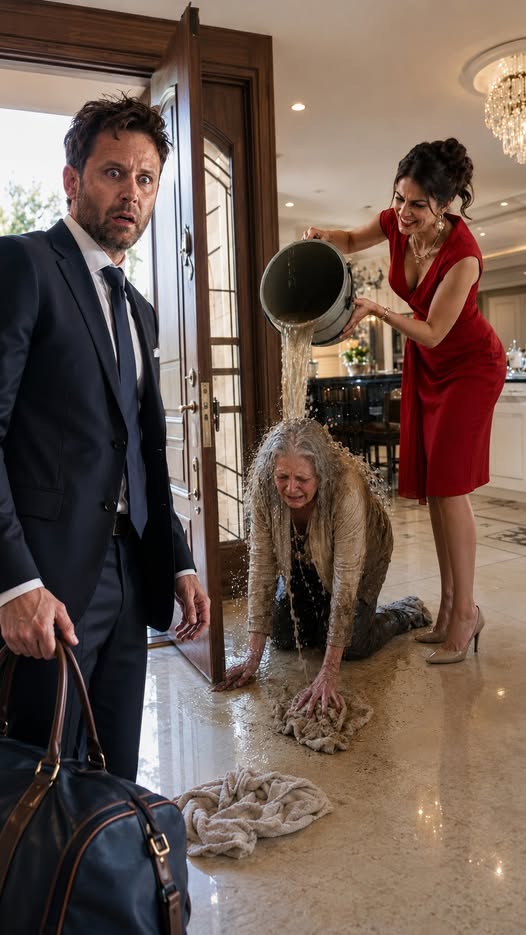
My seventy-year-old mother was on her hands and knees. She was hunched over a bucket of soapy water, scrubbing the marble floor with a frayed rag. Her frail shoulders shook with every agonizing rotation of her arm. I could see the inflamed, swollen joints of her knuckles—a harsh red against the grey water.
Standing over her, sipping sparkling water from a crystal glass, was Clara. She was draped in the emerald silk pajamas I had bought her for our anniversary, casually scrolling through her pristine smartphone. She looked less like a daughter-in-law and more like a cruel overseer watching a hired servant clean a hotel lobby.
A roaring sound rushed into my ears—the sound of eight months of trust and sacrifice collapsing in an instant.
I nudged the door open wider. The hinges gave a soft, betraying creak.
Clara’s head snapped up. For a fraction of a second, the mask slipped. Raw, unfiltered panic flashed across her meticulously contoured face. Her eyes widened, darting from the bucket to my face and back again. But Clara was a chameleon. Within a heartbeat, the panic evaporated, replaced by a smooth, rehearsed smile that didn’t quite reach her eyes.
“Oh, baby…” she purred, setting her phone on the kitchen island. “You’re early.”
My mother jerked upward at the sound of my name. When she turned to look at me, the expression on her face nearly broke me in half. It was profound, paralyzing shame. She looked like a child caught stealing, hastily trying to hide her swollen, raw hands behind her back.
I didn’t look at Clara. I walked slowly across the freshly scrubbed floor, my eyes locked on the woman who had once sold her grandmother’s jade pendant—her only possession of value—to pay for my college tuition.
“Mom,” I said, my voice dangerously hollow. “Stand up.”
She tried. She braced her trembling hands against the cold marble, but her arthritic knees buckled. I dropped to a crouch, wrapping my arms around her fragile frame, and hoisted her up. She felt terribly light, like a bird made of hollow bones and sorrow. I guided her to one of the velvet dining chairs and eased her down.
Clara let out a loud, theatrical sigh, folding her arms across her silk-clad chest. “Oh, Daniel, please don’t be dramatic. She insisted on helping out. You know how she is.”
My mother immediately lowered her head, staring at the floor. She insisted.
I slowly turned to face my wife. I looked at the gleaming, thousand-dollar espresso machine on the counter. I looked at the massive refrigerator, undoubtedly stocked with imported delicacies. The kitchen smelled of expensive lilies and sterile citrus cleaner. My mother was being treated like dirt beneath the very roof I had sacrificed my youth to build.
“She insisted,” I repeated, keeping the volcanic rage bubbling in my chest completely out of my voice. I stepped closer to Clara, invading her space. “Look at her knuckles, Clara. Look at the raw skin. How long?”
Clara blinked, taking a half-step back, clearly unsettled by my chilling calm. “What?”
“How long has this been happening?”
She let out a light, breathy laugh—a condescending sound meant to make me feel small. “You literally just walked through the door and already you’re interrogating me? Is this how you say hello to your wife?”
That laugh. That dismissive, arrogant little laugh told me everything I needed to know. This was not a one-time occurrence. This was routine. This was sport.
Clara leaned in, lowering her voice so my mother wouldn’t hear, her breath smelling of mint and malice. “Don’t embarrass me, Daniel,” she whispered, her eyes hardening into obsidian stones. “And don’t forget whose name is on the deed to this house.”
I stared into the eyes of the woman I thought I loved.
“Yes,” I replied quietly, my voice dead. “I remember exactly whose name is on the house.”
She smiled, a triumphant smirk, convinced she had put me back in my place. Convinced she had won the opening skirmish.
But as I looked at her smug face, a dark, calculating clarity settled over my mind. She believed she held all the cards. What Clara didn’t know was that the house she was so proud to own was never the real prize, and the man standing in front of her was no longer the blind, obedient husband she thought she could control.
Chapter 2: The Midnight Ledger
That evening, I did not shout. I did not hurl the crystal glassware against the walls. I did not utter a single word to Clara about the violent fantasies of retribution currently writing themselves across my mind. I played the exhausted traveler, taking a long, scalding shower to wash away the scent of airplanes and the sickening stench of my own naivety.
When Clara finally went to our master suite to sleep, I crept back downstairs. I found my mother still sitting in the darkened living room, staring blankly at the wall. I gently lifted her into my arms—she protested weakly, but she had no strength left—and carried her to the guest bedroom on the ground floor.
It was there that the true depth of Clara’s depravity revealed itself, piece by piece, like a gruesome mosaic.
I laid my mother on the bed and pressed my hand against the mattress. It was alarmingly thin, a cheap foam pad that offered zero support for her aching back. I pulled the blanket over her; it smelled faintly of damp mildew, as if it had been left in the washing machine for days before being dried.
I went to the nightstand to find her painkillers. I opened the drawer. Three prescription bottles sat there. I shook them.
Empty. All of them.
“Mom,” I whispered, kneeling beside the bed. “Where is the new cardigan I sent you from Chicago? The cashmere one?”
My mother kept her eyes tightly shut, a single tear leaking into her grey hair. “Clara said… Clara said it was too nice for wearing around the house. She put it in her closet for safekeeping.”
I walked out of the room, stormed up the stairs, and quietly opened Clara’s massive walk-in closet. There, stacked neatly in the corner, were the care packages I had meticulously mailed from America every month. The premium joint supplements, the cashmere sweaters, the orthopedic slippers. The boxes were still sealed with the original packing tape. She hadn’t even let my mother open them.
I returned to the guest room. The rage inside me was no longer a fire; it was liquid nitrogen.
“Why didn’t you tell me, Mom?” I asked, my voice cracking for the first time. “We spoke every Sunday. Why didn’t you say anything?”
Her lips quivered. She reached out with a battered hand and touched my cheek. “You were working so hard, Daniel. You looked so tired on those video calls. I didn’t want to cause trouble in your marriage. A mother is supposed to bear burdens, not create them.”
“Did she ever hurt you physically?” I demanded, needing to know the absolute worst.
My mother looked away, staring at the damp blanket.
That silence was a guillotine dropping on the last soft, merciful part of my soul. In that moment, the husband Daniel died, and the architect of Clara’s destruction was born.
At exactly 1:00 AM, while the house was dead silent save for the rhythmic humming of the central air, I began my audit. I walked through the corridors like a phantom. I noticed the security camera in the main hallway—the one Clara knew about—had its power cord neatly snipped.
But Clara, in all her arrogant vanity, had forgotten my background in home security systems. She had forgotten about the secondary, microscopic lens I had covertly installed inside the kitchen smoke detector three years ago, back when we were experiencing package thefts.
I went to my study, locked the door, and opened my encrypted laptop. I accessed the cloud storage linked to the hidden camera. By 3:00 AM, I had downloaded three months of high-definition, audio-synced footage.
I sat in the dark, the blue light of the screen reflecting in my cold eyes, and watched my wife’s true nature unfold.
I watched Clara forcing my mother to scrub the floors, threatening to withhold dinner if she didn’t finish.
I watched Clara mocking my mother’s provincial accent while talking on the phone to her wealthy friends.
I watched, with bile rising in my throat, as Clara took my mother’s expensive arthritis medication—the pills I worked overtime to afford—and flushed them down the kitchen sink, laughing as she did it.
I watched Clara host lavish luncheons for her brother, Mason, and their parents, making my mother serve them hors d’oeuvres with shaking hands, treating her like a Victorian scullery maid.
But the final nail in her coffin came from a clip recorded just two weeks ago. Clara was sitting at the kitchen island, drinking wine with Mason.
“You need to get him to sign the deed to the vacation plot,” Mason urged, stuffing his face with imported cheese.
Clara laughed, twirling her wine glass. “Relax, Mase. Daniel sends money home like a dumb dog chasing a bone. He thinks he’s buying my love. When he gets back, I’ll turn on the waterworks, complain about how stressed I am, and he’ll sign everything over just to keep the peace. Once he does, we throw the old hag in a state-run facility.”
I replayed that specific clip three times. I memorized the greedy glint in her eyes. I memorized Mason’s approving chuckle.
Then, I closed the media player and opened my secure email client.
For the past eight months, Clara had proudly told all her socialite friends that her husband was overseas doing grueling, blue-collar contract work, dutifully wiring his paycheck back to her kingdom. She loved the narrative of being the beautiful wife supported by the exhausted laborer.
What Clara spectacularly failed to realize was the nature of my “contract.” I was not a laborer. I was a senior logistics consultant. I had spent the last eight months in Chicago closing a multi-million dollar infrastructure deal with Horizon Global, a titan in the shipping industry that wanted a Southeast Asian partner to anchor their new supply chain.
Six months ago, when Clara had first aggressively pressured me via video call to sign over the rights to our investment portfolios, an alarm bell had rung in my head. I didn’t confront her. Instead, I quietly hired a forensic accountant and a ruthless corporate lawyer based in the city.
While Clara was busy playing the queen of the manor, I had legally registered a massive new logistics firm. I moved the entirety of my substantial overseas bonuses and liquid savings into heavily protected, offshore trusts. And the new company, the one holding the exclusive Horizon Global contract?
It was registered under a single name: Evelyn Holdings. My mother was the sole proprietor.
I looked around the luxurious study Clara had decorated with my money. The deed to this house? I had quietly remortgaged it to the absolute hilt to fund the initial startup capital. The matching luxury SUVs in the driveway? Leased under Clara’s personal credit.
The opulent lifestyle she enjoyed was a house of cards, built on a foundation of maximum debt, temporarily sustained only by the monthly remittances I chose to send her. And the faucet was about to be turned off permanently.
My phone buzzed on the desk. A text from my lawyer, Mr. Sterling: The final trap is set. The financial dossier on Mason is complete. Awaiting your signal.
I replied with a single word: Tomorrow.
Chapter 3: The Feast of Vipers
The next morning, the sun rose over a battlefield disguised as a suburban utopia. Clara awoke in a remarkably chipper mood, entirely oblivious to the executioner’s axe hovering over her neck.
She glided into the kitchen wearing the exact perfume I had brought her—a sickly sweet, overpowering floral scent she had clearly scavenged from my unpacked suitcase while I was in the study.
“Good morning, baby,” she cooed, wrapping her arms around my waist from behind and pressing a kiss between my shoulder blades. “About yesterday… it was just a silly misunderstanding. Your mother was so eager to clean, I just couldn’t say no. I’m sorry if it looked bad.”
I turned around and offered her a smile that felt like cracking ice. “It’s fine, Clara. I was just jet-lagged. Overreacted.”
My mother sat silently at the small breakfast nook in the corner, staring at a cup of plain hot water. Clara pranced over to the stove and plated two lavish servings of eggs benedict and smoked salmon. She placed one in front of me and sat down with the other. She didn’t offer my mother a single crumb.
“Your mom is just so sensitive lately,” Clara whispered loudly enough for my mother to hear, cutting into her eggs. “She exaggerates things. It makes me look so cruel, Daniel. It’s really affecting my mental health.”
I took a slow, deliberate sip of my black coffee. The bitterness grounded me. “You know, Clara, you’ve been under a lot of stress. Maybe we should invite your family over for dinner tonight. We can open that expensive Bordeaux I brought back. Talk openly about the future.”
Clara’s eyes lit up with predatory excitement. She interpreted “talk openly about the future” as “discuss signing over the property.”
“Really? You’d want to do that?” she asked, her voice dripping with fake sweetness.
“Absolutely,” I said, putting my hand over hers. “Family is everything. Everyone should hear the truth tonight.”
By 7:00 PM, the house was transformed into a stage, and Clara was the star. She had spent the entire afternoon at the salon and had hired a private chef to prepare wagyu steaks.
Her brother, Mason, was the first to arrive. He swaggered through the door wearing a designer watch I knew he couldn’t afford on his meager salary. He clapped me on the back, loud and smug. “Dan! Good to have the ATM back in the country!” he joked, though the malice beneath his laughter was palpable.
Shortly after, Clara’s parents, Arthur and Helen Bennett, arrived. They were dressed to the nines, dripping in jewelry, walking into my home like victorious generals surveying conquered territory. They barely acknowledged my mother, who sat quietly on a stool near the kitchen, looking smaller than ever.
The dinner was an excruciating display of vanity. The Bennetts drank my wine, ate my food, and loudly discussed their upcoming vacations. I sat at the head of the table, nodding, eating little, and watching the clock.
As the dessert plates were cleared, Clara initiated the performance she had practiced. She placed her wine glass down, let out a shaky breath, and produced a perfectly timed, glistening tear.
“I just… I’ve sacrificed everything to keep this family afloat while you were gone, Daniel,” she sobbed, dabbing her eyes with a linen napkin. “And it’s been so hard. His mother…” She pointed a manicured finger at Evelyn. “…she hates me. She refuses to help with the chores. She lies to you about me. I’m living in constant anxiety!”
Helen Bennett gasped, clutching her pearls. “Oh, my poor darling. You shouldn’t have to live like this.”
Mason slammed his empty wine glass onto the mahogany table. The sharp crack made my mother flinch violently in the corner. “Listen to me, Daniel,” Mason barked, pointing an accusatory finger at my chest. “You need to control your mother. Clara isn’t your family’s personal maid. She’s a high-society woman, and she deserves respect.”
I maintained my absolute stillness. I looked at my mother. She was shaking, her eyes wide with terror, bracing for me to take their side.
Clara reached out and placed her hand over mine, her tear-streaked face a mask of manipulative sorrow. “Daniel… maybe it’s best if your mother moves out. Just for a little while. So we can heal.”
The dining room plunged into a thick, expectant silence. The Bennetts stared at me, waiting for my compliance.
I leaned back in my chair, folding my hands over my stomach. “Moves out?” I asked, my voice dangerously soft. “Where exactly?”
Clara’s fake tears vanished instantly. Her voice turned crisp and businesslike. “There’s a state-run senior home three towns over. Or we can find her a cheap, small rental apartment. We simply cannot build our financial and marital future with her poisoning our home. Once you sign the vacation property over to me tomorrow, we can use the liquid assets to arrange her transport.”
Arthur Bennett nodded sagely, taking a sip of his port. “A man must eventually choose his wife over his mother, Daniel. It is the natural order of things. You need to protect your assets.”
I looked at Arthur. I looked at the smug, punchable face of Mason. I looked at Clara, whose eyes were alight with greedy anticipation.
I felt a genuine smile spread across my face. It was not a nice smile.
“You know what, Arthur?” I said, standing up slowly. “You’re absolutely right. A man must make a choice. And tonight, I choose.”
I turned and walked toward the credenza, picking up the HDMI cable I had prepared earlier, and plugged it into my encrypted laptop.
Chapter 4: The House of Cards
“Daniel, what on earth are you doing?” Clara frowned, genuine confusion finally breaking through her composed facade. “We are having a serious discussion.”
“We are,” I replied, typing in my password. “I just wanted to provide some visual aids for our future planning.”
I mirrored my laptop screen to the massive seventy-inch OLED television mounted on the dining room wall. I clicked the first file.
The high-definition video filled the screen. The hidden smoke-detector camera provided a perfect, panoramic view of the kitchen.
There was my mother, on her knees, desperately scrubbing the floor. And there was Clara’s voice, booming through the surround sound system, crystal clear: “Faster. Don’t act old and pathetic in my house.”
The color instantly drained from Helen Bennett’s face. Arthur’s mouth dropped open.
Nobody moved. Nobody breathed.
I didn’t pause. I clicked the second clip.
The screen showed Clara, standing by the sink, holding my mother’s expensive arthritis medication. She opened the bottle, dumped the pills down the drain, and turned on the garbage disposal, laughing. “That’ll teach the old bat to ask for water,” the digital Clara sneered.
My mother let out a small, muffled sob from her stool.
I clicked the third file.
It was the footage from two weeks ago. Mason and Clara sitting at this very island.
“Once Daniel signs the new property papers, his mother can disappear,” Clara’s voice echoed through the room. “When he gets back, I’ll turn on the waterworks… and he’ll sign everything over.”
Mason, who had been sitting puffing his chest out moments before, suddenly looked like he was going to vomit. His arrogant smirk collapsed into a mask of pure terror.
Clara sprang up from her chair so fast it tipped over, crashing onto the hardwood. “That’s… that’s edited!” she shrieked, her voice pitching into hysteria. “It’s fake! It’s AI! He’s trying to frame me!”
I slowly closed the laptop with a decisive click.
“My lawyer, Mr. Sterling, has the full, unedited, time-stamped recordings,” I stated, my voice echoing in the dead silence of the room. “As does Adult Protective Services. And as of an hour ago, the local police department.”
Clara staggered backward, clutching the edge of the table. “Daniel, baby, please, listen to me—”
“No,” I cut her off, the roar of my anger finally breaking through the ice. “You listened to my mother beg for mercy, and you enjoyed it. You tortured the woman who gave me everything, and you thought I was too stupid to see you in the dark.”
Mason suddenly stood up, trying to salvage his shattered ego. He puffed out his chest and marched toward me. “Listen here, you little prick. You can’t threaten my sister. I’ll ruin you. I’ll take everything you have!”
I reached into my blazer pocket and pulled out a thick, manila folder. I didn’t flinch as Mason approached. I simply slid the folder across the smooth surface of the dining table until it stopped right in front of him.
“That,” I said calmly, “is your invoice, Mason.”
He stopped. He looked at the folder, then at me, before hesitantly opening it.
His eyes scanned the first page, and whatever fight he had left in him evaporated like mist. His hands began to shake uncontrollably.
“Every single dollar Clara illicitly transferred to you from my joint account,” I narrated, pacing slowly around the table like a shark circling a life raft. “Every fake home renovation bill you generated for your phantom contracting company. Every wire transfer labeled ‘medical expenses’ that went straight to your gambling debts in Macau. My forensic accountant spent three months tracing every single cent. It constitutes grand larceny, wire fraud, and conspiracy.”
Clara dropped to her knees. Real, unadulterated tears of panic streamed down her ruined makeup. “You investigated me? Your own wife?”
“I protected my mother,” I corrected coldly.
Right on cue, the front doorbell rang.
Before Clara or her parents could react, the heavy door opened. In walked Mr. Sterling, flanked by two uniformed police officers. Clara had been so engrossed in her own performance, she hadn’t noticed the cruiser pulling up to the driveway.
Mr. Sterling, a man whose resting expression was one of severe distaste, walked directly to Clara. He placed a thick stack of legal documents on the floor in front of her kneeling form.
“Mrs. Clara Bennett,” Mr. Sterling announced, his voice devoid of any emotion. “You are being formally served with divorce papers, a civil suit for severe financial misconduct, and an immediate emergency restraining order on behalf of Mrs. Evelyn Bennett. You are legally required to vacate these premises within the next sixty minutes.”
Clara let out a primal scream. She grabbed the papers and tore at them. “You can’t do this! You can’t kick me out! The deed to this house is in my name! MY NAME!”
I crouched down so I was eye-level with her.
“You’re right, Clara. The house is in your name. But the house is mortgaged for three times its actual value. I pulled the equity out months ago. The luxury cars in the driveway? The leases are solely under your social security number, and the payments are due next week. The credit cards? Maxed out. You wanted the golden cage so badly, Clara. You fought tooth and nail for it. Well, congratulations. The cage is yours. But the gold is gone, and you’re drowning in debt.”
Arthur Bennett rushed forward, grabbing his chest. “Daniel, be reasonable! We can discuss this. We are family!”
“I was reasonable,” I said, standing up and turning my back on them. “I was reasonable every month I wired money. I was reasonable when I trusted your daughter. I stopped being reasonable the moment my mother’s hands bled on my marble floor.”
Clara crawled toward me, grabbing the hem of my trousers, sobbing uncontrollably. “Daniel, please! I love you! I’m your wife!”
I looked down at her. I smelled the heavy floral perfume on her wrist. I thought of the heavy gold bracelet still sitting in my suitcase upstairs—a gift I had saved for two months to buy her, a gift she would now never see. I looked at a woman who equated kindness with weakness, and love with access to a bank account.
“No, Clara,” I whispered, pulling my leg free from her grasp. “You never loved me. You only loved the access.”
Chapter 5: A Legacy Forged in Gold
Three months is a remarkably short amount of time for an empire to fall and a new world to be built.
Clara’s descent was swift and merciless. Without my income to service the astronomical debt she was saddled with, the bank foreclosed on the house within sixty days. The luxury cars were repossessed in the middle of the night. She was currently living on an air mattress in Mason’s cramped apartment—which was fitting, considering Mason was currently under federal investigation for wire fraud and fighting tooth and nail to avoid prison time.
Last I heard, Clara was attempting to sell her designer handbags on social media marketplaces just to afford the retainer for a bargain-bin defense attorney. Arthur and Helen Bennett, realizing there was no money left to salvage and desperate to distance themselves from the scandal, had stopped taking Clara’s phone calls entirely.
As for me and the woman who truly mattered?
My mother and I moved a hundred miles away, leaving the toxic suburbs behind. We relocated to a beautiful, single-story home nestled against the serene shores of a quiet lake. It had no stairs to hurt her knees, no marble floors to scrub, and it was purchased outright, in cash, under the protective umbrella of Evelyn Holdings.
On a crisp Tuesday morning, the culmination of my American exile finally came to fruition. The Horizon Global logistics contract had officially closed, and we were inaugurating the first regional headquarters in the city’s financial district.
I stood in the massive, sunlit lobby of the new glass skyscraper. The walls were sleek slate, and the floors were polished granite. But the centerpiece of the room was not the corporate logo.
It was a large, beautifully commissioned oil portrait of my mother, capturing her warm, resilient smile, hung prominently behind the reception desk.
I heard the soft shuffle of orthopedic shoes. My mother walked up beside me. She looked entirely different from the broken woman I had found on her knees three months ago. The swelling in her hands had drastically reduced thanks to premium medical care. She was wearing a tailored, emerald-green cashmere cardigan—the very one Clara had tried to steal. Her eyes were bright, and her posture was straight.
Together, we looked at the wall beneath her portrait. I had called in a specialist to install it that very morning.
It was a small, solid gold plaque. It read:
Evelyn Bennett — Founder and Matriarch.
My mother reached out with her slightly scarred hands and traced the engraved letters. Her breath hitched, and a stray tear escaped, catching the morning sunlight pouring through the floor-to-ceiling windows.
“Daniel,” she whispered, her voice thick with emotion. “I… I don’t deserve all this. I’m just an old woman.”
I gently took her hands in mine, feeling the rough history of her sacrifices against my skin. I kissed her knuckles, right where the raw skin used to be.
“Mom,” I said softly, looking into her eyes. “You deserved the world long before I could afford to give it to you.”
And for the first time since that terrible evening I came home, my mother looked at me and smiled—a true, radiant smile, completely devoid of fear.
Disclaimer: This story is a work of fiction created for entertainment purposes. Any resemblance to real persons, events, or places is coincidental.