The Porcelain Lie: Chronicle of My Own Coup d’État
“Your timeline is measured in months, not years,” the doctor stated, flattening his broad palm over my manila medical file.
I didn’t immediately process the gravity of the syllables dropping from his mouth. Beyond the frosted glass of his office window, a bleak April rain battered the Pittsburgh skyline. Dr. Richard Sterling, a fifty-five-year-old oncologist whose heavy jaw and silver-streaked hair projected an air of absolute authority, removed his reading glasses. He delivered my death sentence with the casual indifference of a man reading a bus schedule.
“Exactly how many months?” I asked, my voice terrifyingly steady.
“Four to six. Occasionally more, if the cellular response to chemotherapy is robust. However, given the aggressive nature of the pathology, I wouldn’t bank on miracles.”
I am Eleanor Sullivan. At forty-six, I was accustomed to absorbing catastrophic reports without flinching. As the owner of a massive ceramic tile manufacturing plant, crisis was my daily bread. Right then, a primal instinct urged me to dig my fingernails into the polished mahogany of his desk, but I kept my hands folded neatly in my lap.
“Are you entirely certain?”
Sterling flipped the folder open, spinning the pathology report so it faced me. “The core biopsy confirmed a highly malignant mass. Given its complicated location, the metastatic cascade has already initiated. Surgical intervention at this juncture would be akin to putting a band-aid on a bullet wound.”
The text on the page swam. I recognized my surname, my date of birth, the clinic’s embossed letterhead. Below that lay a minefield of clinical terminology I had previously only skimmed in tragic obituaries.
How did I not feel this rotting inside me?
Such diseases are notorious for their stealth. A dull ache after meals, bouts of insomnia, a persistent lethargy—I had attributed all of it to the grueling eighty-hour work weeks. It was my husband, Harrison, who had forcefully insisted on this comprehensive screening two weeks ago. He had noticed my pale complexion and chronic fatigue, ultimately booking this private, exorbitant clinic himself.
“What are my options?” I forced the words past the dry lump in my throat.
Sterling paused, tenting his fingers. “There is a highly experimental protocol at a specialized facility in Switzerland. It isn’t a cure, Eleanor. But it has been known to buy patients an extra year or two of quality life. It requires immense capital, and the window to enroll is closing rapidly.”
He scribbled a dollar amount on a sticky note and slid it across the desk. I stared at the zeroes. For that exact sum, I could upgrade two entire manufacturing kilns at the plant. The factory simply didn’t have that kind of liquid cash sitting idle.
“I need time to evaluate this,” I murmured.
“Of course,” Sterling replied smoothly. “Just do not linger. In your condition, time is counted in weeks. I assume your husband is aware of the preliminary concerns?” The doctor’s brow furrowed in rehearsed sympathy. “You will need a robust support system.”
“I will inform Harrison myself.” I folded the papers, sliding them into my leather tote. “And if I request a second opinion? To verify the pathology?”
A microscopic twitch disrupted the calm musculature of Sterling’s face, but he smoothed it over instantly. “That is your legal right. I must caution you, however, that a secondary extraction will consume precious time and subject your compromised body to unnecessary trauma. This laboratory is globally renowned. False positives of this magnitude are statistically nonexistent.”
I left his office in a daze. Down in the lobby, people rushed past with wet umbrellas, completely oblivious to the fact that the woman standing by the elevator bank had just been handed her expiration date. My phone vibrated against my hip. Harrison’s name illuminated the screen. I let it ring out. A text immediately followed: How were the scans? Call me the second you are out.
Stepping out into the freezing Pennsylvania rain, I climbed into my SUV but couldn’t bring myself to turn the ignition. When I closed my eyes, I didn’t see my life flashing before me. I saw my factory. The towering red brick smokestacks. The faded sign bearing my late father’s name. I had inherited a bankrupt disaster twelve years ago and clawed it back to profitability, saving one hundred and eighty local jobs in the process. Now, I had to figure out how to untangle my legacy before I turned to ash.
I needed to secure the supply chains and draft succession documents. I resolved not to tell Harrison a word until I had a concrete plan. Any crisis always sent him into a frantic, overbearing spiral of making decisions on my behalf. I craved just one night of silence before the pity began.
I arrived at the plant just past one o’clock. The familiar, comforting scent of damp clay and ozone washed over me. My floor manager, Mike Kowalski—a broad-shouldered man with a weathered face—intercepted me, explaining a critical bearing failure on assembly line three. I threw myself into the logistics, coordinating the repair and redirecting the glaze shipments. For a few hours, the rhythmic clanking of the conveyor belts drowned out the ticking clock in my blood.
By five, the collar of my silk blouse felt like a noose. Mike noticed my shallow breathing. “Go home, boss,” he said, wiping grease from his hands. “We’ve got the line under control. You look like you’re running on fumes.”
I agreed, grabbing my bag. The envelope containing my death warrant rested against my wallet.
Harrison rarely left the finance department before seven, so I anticipated an empty house. I planned to take a scalding shower, bury the medical file, and figure out how to script the worst conversation of my life. But as I pulled into our driveway, his black sedan was already parked near the garage.
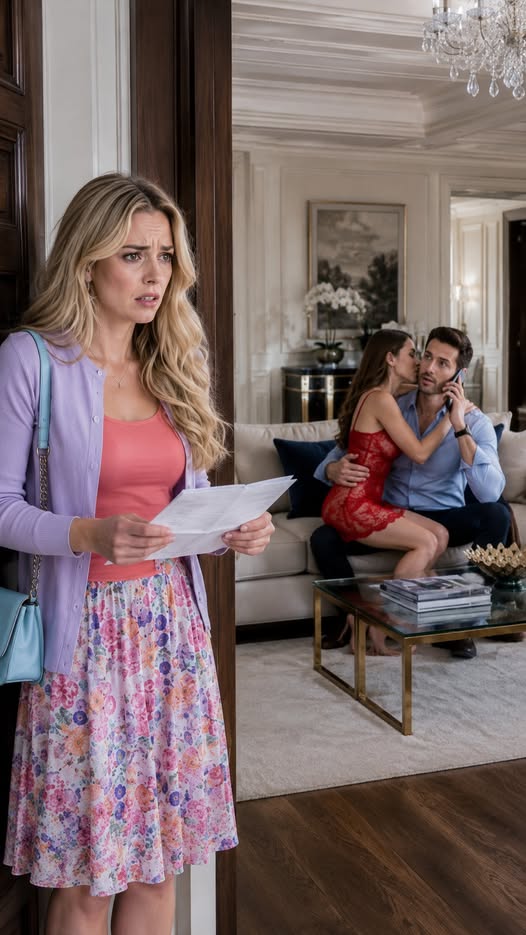
The house was eerily silent. I slipped my heels off, hung my damp trench coat in the foyer, and walked toward the kitchen. As I passed his home office, a voice drifted through the slightly ajar mahogany door.
“I said, she bought it completely.”
Harrison was speaking in a hushed, vibrating tone. I froze on the hardwood floor, my breath hitching.
“No, Khloe, we cannot push the sale today,” my husband murmured into his phone. “Let the shock marinate. Tomorrow, she’ll come to me with the diagnosis, and I will play the devastated, supportive husband.”
A glacial spike of adrenaline pierced my chest. I slowly lowered my purse to the floor.
Harrison let out a low, victorious chuckle. “The stupid woman actually swallowed his prognosis hook, line, and sinker. Everything is tracking perfectly. Sterling delivered the performance of a lifetime. He has such a dictatorial bedside manner, she’ll probably end up writing him a thank-you note for the privilege.”
My palm flattened against the hallway wallpaper to keep my knees from buckling. The paper felt like ice. With trembling fingers, I retrieved my phone and activated the voice recorder.
“The critical objective right now is to ensure she doesn’t get a wild hair and consult another oncologist,” Harrison continued, pacing behind the door. “I’ll feed her the narrative that we have no time. I’ll make her choose between saving the factory and saving her own life. She’ll choose her life.”
A tinny, indistinguishable female voice murmured through the receiver.
“The buyer is lined up,” Harrison confirmed. “Your brokerage will acquire the parcel at our manufactured distress price. We flip the commercial zoning to the developers, and the capital from her ‘Swiss medical treatment’ vanishes straight into our offshore accounts. In thirty days, Eleanor will be stripped of the company, drained of her liquid assets, and legally paralyzed.”
I squeezed my eyes shut, a wave of profound nausea washing over me. The man I had shared a bed with for fifteen years was orchestrating my total annihilation, and he was giddy about it.
“Once the ink is dry on the deed, we seize the corporate archives,” he added smoothly. “If she starts getting suspicious, it won’t matter. Sterling has a cocktail of heavy sedatives waiting. She’ll be a walking zombie, far too drowsy to audit a spreadsheet.”
More muffled words from the woman.
“I know, my love. Patience. The empire is almost ours. Don’t call me tonight, she might check my logs. I’ll see you tomorrow at your place. Yes, I love you too.”
I didn’t wait to hear the click of the receiver. I snatched my purse, backed down the hallway with the silence of a ghost, and let myself out the front door, pulling it shut with a soft click.
I practically sprinted down the driveway to my car, my lungs burning for oxygen. Once inside, I locked the doors and hit playback on the recording. The audio was slightly muffled, but the words factory, Sterling, offshore, sedatives cut through the static like shards of glass.
I pulled the crisp medical envelope from my bag, staring at the fabricated diagnosis. The clinic’s seal, the oncologist’s signature, my impending death—it was nothing but a theatrical prop in a million-dollar heist.
The tears came then. Not tears of sorrow, but a violent, scalding eruption of rage. I let the tremor shake my body for a full three minutes. Then, I pulled down the visor mirror, wiped away the mascara streaks, and stared at the ferocious gray eyes looking back at me.
I wasn’t the one who was going to die. Harrison was about to dig his own financial grave, and I was going to hand him the shovel.
I drove around the block for twenty minutes, stopping at an artisanal market to buy fresh sourdough, aged gouda, and a box of Harrison’s favorite dark chocolates. I needed an alibi for my tardiness.
When I finally turned my key in the lock, I made sure to rattle the door handle and drop the grocery bags heavily onto the marble entryway table. “Harrison! Are you home?” I called out, my voice laced with manufactured fatigue.
He appeared from the living room almost instantly. Tall, sporting graying temples and a tailored cashmere sweater, his face was arranged into a mask of deep, agonizing concern. On his left wrist caught the light of the Patek Philippe watch I had purchased for his fortieth birthday.
“Why are you home so early? Did the checkup take this long?” he asked, crossing the space to kiss my cheek. He pulled back, his eyes narrowing. “Ellie, you’ve been crying.”
I carried the groceries into the kitchen, using the physical task to buy myself three seconds to build my facade. “There was a massive bearing failure on line three,” I lied effortlessly. “We fixed it.”
“Forget the machinery,” he said, gently taking the bread from my hands. “Tell me what Sterling said.”
I turned around, leaned against the granite counter, and pulled the white envelope from my bag, letting it drop onto the island. “I have cancer.”
The performance he delivered was worthy of an Academy Award. Shock violently widened his eyes, followed by a tremor in his jaw, and finally, a desperate, breathless denial. “No. No, Ellie, they made a mistake.”
“The core biopsy confirmed it.”
He lunged forward, wrapping his arms around me and burying his face in my neck. “We are going to fight this. We will run every test in the state. We’ll hire the best specialists on the East Coast. I am not letting you go, do you hear me?”
I stood entirely rigid in his embrace, inhaling the scent of his expensive cedarwood cologne, sickened by the proximity of his skin. “Sterling says my timeline is incredibly short. There is a foreign experimental program. In Switzerland.” I quoted the astronomical dollar figure exactly as Sterling had written it.
Harrison pulled back, gripping my shoulders with reassuring strength. “We will find the capital.”
“From where? Our combined investment portfolios won’t even cover half of that.”
He looked away, staring at the kitchen floor as if a brilliant, painful idea was just dawning on him. “We have the factory.”
I remained perfectly silent.
“I know it’s your father’s legacy, Eleanor,” he said softly, tracing my jawline. “But brick and mortar cannot be valued above your heartbeat. The acreage is prime commercial real estate. If we move aggressively, we can secure a cash buyer. You have no obligation to lay down your life to save a ceramic tile business.”
I walked over to the dining table and sat down, dropping my head into my hands. “I’m not ready to process this.”
Harrison knelt beside my chair, covering my cold hands with his warm ones. “Of course not. Tonight, we banish the logistics. Tomorrow, I will personally handle Sterling and the clinic. You just rest.”
I stared at his long, manicured fingers—the same fingers that had dialed his mistress to celebrate my impending ruin. “I just want to sleep,” I whispered.
“I’ll bring you some chamomile tea.”
Once I was safely behind the closed door of the master bedroom, I retrieved my phone. I forwarded the encrypted audio file of his conversation to my secure corporate server and backed it up to a cloud drive.
Then, I scrolled to the contact for Sarah Jenkins, my razor-sharp corporate attorney who had navigated the factory through a dozen labor disputes.
I typed: Meet me at my office tomorrow at 7:00 AM sharp. Total confidentiality required. It concerns an active hostile takeover and a criminally forged medical diagnosis.
Her reply materialized thirty seconds later: I will be there.
When Harrison entered with a steaming mug, I was lying perfectly still under the duvet. He sat on the edge of the mattress, stroking my hair with sickening tenderness. “We will survive this, Ellie.”
I looked up at him, noting how his eyes flickered, refusing to hold my gaze for more than a second.
“Tomorrow, you can begin organizing the appraisals,” I said, my voice deliberately fragile. “I will sell the factory.”
I felt the sudden, involuntary hitch in his breathing before he leaned down to kiss my forehead. “You are making the bravest choice.”
As he walked out of the room to return the mug to the kitchen, I smiled into the darkness. It was a feral, jagged thing. Enjoy your victory tonight, Harrison. You are going to remember my lesson for the remainder of your natural life.
At exactly 7:00 AM, Sarah Jenkins locked the door to my executive office. Sarah was a petite, fierce woman of forty-eight with a sharp blonde bob and a mind like a steel trap.
“Play it,” she demanded, dropping her leather briefcase on the couch.
I set my phone on the desk and hit play. Harrison’s hushed voice filled the room. The mention of Sterling, the name Khloe, the flip strategy, and the sedation cocktail were crystal clear.
Sarah listened twice, her face hardening into an expression of lethal focus. She then carefully opened the medical envelope, donning a pair of reading glasses to study the pathology report.
“Did you open the patient portal they sent to your email?” she asked.
“No. When I registered at the front desk, Harrison intercepted the clipboard and provided his own email address. He claimed it would streamline the prescription management.”
Sarah looked up, her eyes gleaming. “Which establishes premeditation. He wanted sole control over the digital flow of information. Let him keep that delusion. Do not alter any passwords. However, a clandestine audio recording is legally complicated in this state. The defense could claim it was digitally altered or a roleplay. We need indisputable, biological proof of the fraud.”
“If I’m perfectly healthy, how did they generate a pathology report with my name on it?” I asked, pacing the length of the office. “Did they swap my blood? Hack the database?”
“Speculation is useless. We require an independent forensic medical examination.” Sarah pulled a fresh legal pad from her bag. “Let’s establish the battlefield. The factory and the deed to the land are solely in your name, correct?”
“Yes. My father transferred the LLC to me entirely before I ever met Harrison. He only holds a limited power of attorney to authorize payroll and routine vendor payments. He cannot liquidate real estate without my physical signature and a notary.”
“Excellent. We let him sprint toward the cliff,” Sarah advised, her pen flying across the paper. “Let him bring this mysterious buyer. Let him draft the contracts. Do not sign a single page without my physical presence.”
“Yesterday, I gave him verbal consent to sell.”
“Verbal consent doesn’t transfer title deeds. He will likely try to isolate you today, urging you to stay home and ‘rest.’ Do not let him sever your communication lines. And Eleanor? Keep every pill, every blister pack, every prescription slip Sterling gives you. We need the chemical evidence.”
Sarah tore a sheet from her pad and handed it to me. “I’ve booked you under an alias at Steel City Memorial, the public hospital downtown. The Chief of Oncology is expecting you. Go now.”
Twenty minutes later, I bypassed my usual manufacturing floor inspection, told Martha I was following up on lab work, and drove straight to the public hospital.
Dr. Emily Carter, a formidable woman in her sixties with piercing blue eyes behind wire-rimmed glasses, scrutinized the forged paperwork I handed her.
“What are your physical symptoms, Ms. Sullivan?” she asked, her tone clinical and sharp.
“Occasional heaviness after large meals. Insomnia. General fatigue.”
“Significant weight loss? Jaundice? Radiating spinal pain?”
“None.”
Dr. Carter performed a thorough physical examination, palpating my abdomen, before returning to her desk. “According to Dr. Sterling’s report, you have Stage IV metastasis. With a spread of this magnitude, the patient is typically symptomatic in highly visible ways. I note the pathology summary is present, but where is the surgical extraction protocol? The chain of custody for the biopsy?”
“It wasn’t provided. Sterling claimed they extracted the tissue during an endoscopy under twilight sedation.”
Dr. Carter removed her glasses, tapping them against the desk. “I see absolutely no empirical reason to discuss terminal timelines today. We operate on facts, not photocopies.”
She swiftly drafted orders for a comprehensive blood panel, a pelvic ultrasound, and an immediate CT scan with intravenous contrast. “You must formally demand the original tissue blocks from Sterling’s clinic. In writing, stamped and dated. They may attempt to stonewall you, but federal medical law dictates the patient owns their biological material.”
By noon, I had submitted to the blood draws and the ultrasound. At eleven-thirty, my phone rang. Harrison.
“Where are you?” he demanded, his voice tight with manufactured anxiety.
“At the hospital. Sterling left a voicemail demanding a few extra baseline labs.”
“Why didn’t you tell me? I would have canceled my supplier calls to drive you.”
“You had a busy morning, darling. Sterling said he can see us this evening to finalize the Swiss paperwork.”
A pause on the line. “Okay. Come straight home. You need to conserve your energy. I’ll bring the preliminary factory appraisal to you.”
“I’m actually heading back to the office,” I countered smoothly. “If I’m selling the company, I need to quietly organize the severance packages before the rumor mill starts.”
“Eleanor, let me handle the logistics—”
“I’ll see you at home, Harrison. Thank you.” I hung up, my pulse steady.
At two o’clock, I was slid into the humming, claustrophobic tunnel of the CT scanner. The contrast dye flooded my veins, creating a bizarre, metallic heat that started in my chest and radiated to my toes. I lay perfectly still, staring at the white plastic above me, wondering how many lies a man could tell before he forgot what the truth looked like.
An hour later, Dr. Carter pulled up my high-resolution scans on her dual monitors.
“Look here,” she pointed to the grayscale cross-sections of my internal organs. “The pancreas is pristine. No masses, no lesions. Your liver margins are smooth, and the lymphatic system is clear. Based on today’s empirical imaging, you do not possess the malignant tumor described in Sterling’s report.”
I stared at the screen, a profound, dizzying wave of relief crashing into the shoreline of my anger. “I am completely healthy.”
“You have mild gastritis and elevated cortisol levels likely due to stress. We will wait for the blood cultures to finalize, but this terminal diagnosis is medically unverified. Which begs a very dark question, Eleanor: where did this pathology report originate?”
I stood up, securing my purse. “That is exactly what my lawyer and I are going to find out.”
I met Sarah at a crowded diner across from the hospital. She slipped the clean CT report into an evidence sleeve.
“The contradiction is now documented,” Sarah said, sipping black coffee. “We need to force Sterling to produce the physical evidence. I want you to hand-deliver a formal request for your tissue slides today. Tell him the Swiss clinic requires the raw material for their own genetic sequencing. It fits Harrison’s narrative perfectly.”
Sarah drafted a legally binding request on a napkin, which I transcribed into my notepad.
“Can I take the audio to the police now?” I asked, impatient for the kill.
“Not yet,” Sarah cautioned. “We need to establish intent to defraud via a paper trail. Otherwise, Sterling’s high-priced lawyers will claim a clerical mix-up. When you demand the slides, they will likely panic and attempt a cover-up. The cover-up is the crime we can prosecute.”
I returned to my factory at 4:30 PM. Harrison was already occupying my desk. Spread across my blueprints were three thick dossiers containing property appraisals, equipment liquidation values, and a shockingly rapid timeline for the sale.
“You move like lightning,” I observed, leaning against the doorframe.
Harrison stood, projecting efficiency. “Time is our enemy right now. I reached out to a commercial broker I used a few years ago. Her name is Khloe Preston. She is incredibly aggressive, and she claims she already has an institutional buyer circling the property.”
Khloe. Hearing her name spoken aloud by my husband, pretending she was merely a professional acquaintance, made my skin crawl.
“They are only interested in the dirt,” Harrison continued, opening a folder. “They intend to bulldoze the manufacturing floor. Because it’s an expedited, all-cash closing, the offer is severely discounted.”
I looked at the number. It was insulting—barely a third of the assessed value. “Why so low?”
“Urgency dictates the market, Ellie. But it’s enough to cover the Swiss wire transfer with room to spare. Do not let sentimentality kill you. I want to save your life.”
I closed my eyes, rubbing my temples to simulate a migraine. “Have this Khloe draft the Letter of Intent. But Sarah reviews everything before my pen touches paper.”
Harrison’s jaw clenched imperceptibly. “Sarah is a corporate bulldog. She bills by the hour to find imaginary liabilities. She’ll drag this out for weeks.”
“She protects my interests, Harrison.”
“I am protecting your interests!” he snapped, before instantly catching himself and softening his tone. “I’m sorry. I’m just terrified of losing you. Every delay feels like a death sentence.”
“Then you have nothing to fear from a legal review,” I replied quietly.
That evening, Harrison drove us to Sterling’s private oncology clinic. I leaned heavily on his arm as we navigated the sterile, white-tiled corridors.
Sterling greeted us in his opulent office. “How are the symptoms, Eleanor?”
“The fatigue is overwhelming,” I lied, slumping into the leather guest chair.
I retrieved the formal written demand from my bag and slid it across his desk. “The coordinators in Switzerland require the original biological materials. The physical tissue blocks, the glass slides, and the surgical extraction protocol. I need to collect them tomorrow morning.”
Sterling’s hand paused over his keyboard. The silence in the room thickened. “Which specific clinic in Switzerland?”
“My contacts translated the international requirements. The name is irrelevant. I need my tissue.”
Sterling read the document, his adam’s apple bobbing slightly. “Preparing biological material for international transport requires a complex chain of custody. It will take significant time.”
Harrison leaned forward, playing the anxious husband. “Richard, please expedite this. Eleanor has agreed to liquidate her business. The capital will be secured.”
Sterling caught Harrison’s gaze. A silent, frantic communication passed between them. “Understood. Register this demand at the front desk. The administrative files will be ready tomorrow, but the laboratory slides are housed off-site at Apex Clinical Labs.”
“Who performed the extraction?” I asked suddenly, staring directly into Sterling’s eyes. “Why is the surgical protocol missing from my file?”
Sterling shifted in his chair. “Dr. Delgado performed the procedure. He is currently attending a symposium in Denver. The clerical omission of the protocol is an oversight. You were heavily sedated; you wouldn’t recall the staff.”
He swiftly opened a drawer and produced a heavy amber pill bottle. “In the meantime, your cortisol levels are causing the fatigue. Take one of these in the morning, one at night. It will force your nervous system to rest.”
I read the warning label: May cause severe drowsiness. Do not operate heavy machinery. Reflex impairment.
Sterling didn’t hand the bottle to me. He handed it directly to Harrison.
On the drive home, I remained largely silent. The pills burned a hole in my purse.
“Take the medication now,” Harrison ordered as soon as we entered the kitchen, pouring a glass of filtered water.
“I need food in my stomach first. The label explicitly warns against taking it on an empty stomach,” I bluffed.
Harrison hesitated, checking the bottle, before shrugging. While he was in the living room adjusting the thermostat, I snapped a photo of the label, texted it to Sarah, and discreetly wrapped a single pill in a paper napkin, hiding it in my pocket.
Around 2:00 AM, the creak of the floorboards outside our bedroom woke me. I watched the sliver of light beneath the door disappear as Harrison stepped into the hallway.
I slipped out of bed, grabbed my phone, and crept barefoot to the edge of his home office. The door was cracked open an inch.
“…she submitted a formal legal request for the slides,” Harrison was hissing into his phone. “Yes, I know it’s a disaster. Alert Apex Labs to freeze everything.”
A pause as he listened.
“I don’t care how you do it, Sterling!” Harrison whisper-shouted. “Find a replacement block! Use anyone’s cancerous tissue. Just slap her medical ID barcode on it.”
My blood ran cold.
“Does the actual patient know about the mix-up?” Harrison asked, his voice dropping lower. “Good. Let the poor woman keep believing she has a benign cyst. We just need to buy five days.”
I backed away, my hands shaking violently. Let the poor woman keep believing she has a benign cyst.
The sheer, sociopathic evil of their scheme fully materialized. Behind my forged death sentence, there was a living, breathing woman walking around the city, entirely unaware that her cancer was metastasizing, all because my husband needed a prop for his real estate scam.
The next morning, Harrison sat on the edge of the bed, handing me a fresh mug of coffee and the amber pill bottle. “You slept like the dead,” he noted, his eyes scanning my face for signs of cognitive impairment.
“The pill knocked me out entirely,” I murmured, rubbing my eyes. “I don’t even remember getting into bed.”
A flicker of dark satisfaction crossed his features. “Take another one with your coffee.”
I placed the pill on my tongue, took a sip of the hot liquid, and when he turned to check his smartwatch, I smoothly spat the dissolving capsule into a tissue concealed in my palm.
“I have to go to the factory,” I announced, pushing the duvet back. “Khloe is arriving at ten with the Letter of Intent.”
“You are in no condition to drive. I will chauffeur you, and I will conduct the meeting. The buyer just needs to hear your verbal consent,” Harrison commanded.
We arrived at the plant. Harrison immediately instructed the security booth to lock down the executive floor, claiming I was immunocompromised. When we reached my office, my secretary, Martha, took one look at my pale, un-makeuped face and rushed forward.
“Ms. Sullivan, should I call a paramedic?”
“I’m fine, Martha. When Khloe Preston arrives, send her straight in.”
Harrison closed the blinds, plunging the office into a gloomy twilight. I sank into my leather executive chair. He opened his laptop, pulling up the settlement statement. I noticed a massive six-figure line item categorized as a “Broker Expedite Fee.”
“Who receives this commission?” I asked, pointing a trembling finger at the screen.
“Khloe’s brokerage. Liquidating commercial property in under a week requires aggressive incentivization.”
At exactly ten o’clock, Khloe Preston strutted into my office. She was thirty-eight, dressed in a tailored cream pantsuit, her blonde hair perfectly blown out. She exuded the predatory confidence of a woman accustomed to taking what she wanted.
“Eleanor, I am devastated we are meeting under these tragic circumstances,” Khloe purred, taking a seat across from me.
I recognized the tinny voice from the audio recording instantly. “I’m sure you are, Khloe.”
She slid a glossy folder across my desk. “Harrison briefed me on the urgency of your medical situation. You have my absolute discretion.”
“He disclosed my private medical records to a real estate broker?” I shot a sharp look at Harrison.
Khloe faltered for a fraction of a second. “He… provided the necessary context to justify the fire-sale price to the investors.”
“Who exactly is the investor?” I demanded, flipping open the folder.
“Keystone Property Holdings LLC,” Khloe stated smoothly.
I scanned the corporate registry documents she provided. The LLC was a ghost. Registered barely five months ago, utilizing a virtual mail drop in Delaware, with minimum stated capital.
“How is a shell corporation with zero verifiable assets going to wire millions of dollars in cash?” I asked, leaning heavily on the desk to maintain my ‘weakened’ state.
“They represent a syndicate of high-net-worth developers who prefer anonymity during initial acquisitions,” Khloe deflected. “The capital will be deposited into a secure escrow account the moment you sign the LOI.”
“I am not signing away a multi-million dollar asset to a ghost. Provide proof of funds and reveal the ultimate beneficial owners.”
Harrison stepped in, placing a reassuring hand on my shoulder. “Ellie, you’re exhausted. I have vetted Khloe’s contacts. We don’t have thirty days for a forensic audit. They are threatening to pull the offer by this afternoon.”
“Then let them pull it,” I snapped, letting my head loll back against the chair. “I can’t focus. I need a break.”
Harrison sighed dramatically, escorting Khloe into the hallway. I immediately crept to the door and pressed my ear against the wood, activating the recorder.
“She is entirely too lucid,” Khloe hissed. “I thought you said the sedatives would neutralize her?”
“Sarah must have coached her to be paranoid,” Harrison muttered. “I’m cutting Sarah out. I’ll double the dosage tonight. Have the final purchase agreement ready for Friday.”
When Harrison returned, I was slumped over my desk. “Take me home,” I whimpered. “I feel awful.”
As soon as he went to fetch the car, I slipped down the rear fire escape and bolted into the adjacent building, which housed the title company. Sarah was waiting in a vacant conference room.
I rapidly signed the formal police complaint detailing medical fraud and attempted grand larceny, handing her a flash drive containing the new audio.
“The police are mobilized,” Sarah said, reviewing the documents. “We also filed an emergency injunction with the state medical board regarding Sterling. Furthermore, I ran a background check on Keystone Property Holdings.” Sarah turned her laptop around. “The sole managing member is Margaret Preston. Khloe’s sixty-nine-year-old aunt.”
“It’s a complete inside job,” I breathed.
“Worse. My forensic accountant pulled your factory’s general ledger. Three months ago, Harrison authorized two massive retainer payments to Khloe’s firm for ‘Land Usage Consultation.’ He used your own corporate funds to finance the blueprint for the theft of your company.”
When I returned to my office, Harrison was frantically searching the hallway. “Where were you?” he demanded, panic edging his voice.
“I needed fresh air. I was in the loading dock,” I lied seamlessly.
At home, Harrison tucked me into bed, drawing the blackout curtains. “Sleep. Sterling is coming over tonight with the Swiss medical contracts.”
Once the house was silent, I utilized a burner app on my phone to call Khloe’s direct line.
“Khloe? It’s Eleanor.”
“Oh, hi Eleanor. How are you feeling?” she asked, clearly startled.
“Confused. Harrison just informed me he intends to put the final purchase agreement solely in his name. He claims my cognitive decline requires him to hold a general power of attorney to manage the wire transfers.”
Silence echoed on the line.
“Why would he need that?” Khloe asked, her voice tight. “Your signature is legally sufficient.”
“He also mentioned he would personally disperse the commissions after the sale clears, rather than utilizing the escrow agent. I just wanted to verify this with you.”
“I… I will need to review the escrow instructions with him,” Khloe stammered.
I hung up. The seeds of paranoia were planted. The thieves were about to start questioning each other.
At 4:00 PM, Dr. Carter sent me an encrypted text: Come to the hospital immediately. We tracked the biopsy barcode. It involves a third party.
I waited until Harrison went to the basement to fetch a bottle of wine before slipping out the back door and calling a cab.
In Dr. Carter’s office, a woman in her early forties sat clutching a worn canvas purse. She wore a faded gray peacoat, her dark hair pulled into a messy knot. Deep, bruised circles shadowed her eyes. Beside her sat a lanky teenage boy in a faded hoodie.
“Eleanor,” Dr. Carter said gently. “This is Jessica Miller. And her son, Tyler.”
Jessica looked at me, her eyes wide with a terrifying cocktail of hope and devastation. “The doctor just told me that my biopsy results were mistakenly placed in your medical file.”
I stepped forward, taking the empty chair beside her. “My name is Eleanor. Two days ago, a corrupt doctor told me I was dying of terminal cancer. Today, I found out I am perfectly healthy, and that the diagnosis he handed me actually belongs to you.”
Jessica let out a choked sob, pressing her hands over her mouth. “They called me last week. They said it was just a benign cyst. I celebrated. I took my son out for pizza.”
Tyler gripped his mother’s arm, his face pale. “Mom, what’s happening?”
A profound, white-hot fury eclipsed any lingering sorrow I felt for my marriage. While Harrison was popping champagne and calculating his offshore deposits, this single mother was being robbed of the critical weeks needed to fight for her life.
“Who referred you to Sterling’s clinic?” I asked.
“My boss,” Jessica whispered. “He’s friends with a man named Harrison Sullivan.”
The room spun. Harrison had deliberately sourced a vulnerable employee from a contact to use as his biological pawn.
Before I could speak, my phone vibrated violently. Harrison was calling. I ignored it. Then, a text: Your GPS shows you at Steel City Memorial. I am walking into the lobby right now.
“Sarah,” I looked at my lawyer, who had just arrived. “He’s here. He realized I slipped the leash.”
Down the hall, the elevator dinged. Harrison’s voice boomed through the quiet corridor. “I am looking for my wife! Eleanor Sullivan!”
Jessica flinched. I turned my phone off. “It is time to see how well he improvises.”
Harrison burst through the office doors, his face flushed with panic. “Eleanor! What are you doing here?” He froze as he registered the crowded room—Sarah, Dr. Carter, and the weeping stranger.
“I felt dizzy,” I said weakly, slumping into the chair. “I came to get my blood drawn.”
Harrison rushed forward, gripping my wrist tightly. “I told you to stay in bed! Why is Sarah here?”
“I requested her presence to draft my living will,” I lied effortlessly.
Harrison eyed Jessica. “Who is this?”
“A patient,” Dr. Carter intervened like a shield of ice. “We do not violate HIPAA protocols in this office.”
I stood up, leaning heavily on Sarah. “Take me home, Harrison. I’m so tired.”
That evening, Sterling arrived at the house. He produced a sleek black folder containing forged documents bearing the letterhead of a fictitious Swiss clinic, complete with a wire transfer authorization for $1.2 million.
“The funds must clear by Friday,” Sterling instructed, adjusting his tie nervously.
“I noticed the wire is routing to an LLC in the Caymans, not a medical facility,” I observed, pointing at the banking details.
Harrison slammed his palm on the coffee table. “Are we really doing this, Eleanor? Are you going to interrogate the very people trying to save you from a grave?”
I cowered perfectly. “I’m sorry. I’m just scared.”
Sterling pulled a blister pack from his bag. “I am upping the dosage. Two pills tonight.”
When the men stepped into the hallway to say their goodbyes, my hidden recorder captured their hushed panic.
“She’s too alert,” Sterling hissed. “And you didn’t tell me the real patient was pulled back into the public hospital. The medical board is going to audit me!”
“Hold your nerve!” Harrison snarled. “I’m forcing the closing on Friday at 4:00 PM. Just have your Cayman account ready. You get your cut the minute the escrow clears.”
Friday arrived. The day of the execution.
I arrived at my factory office at 3:40 PM. Harrison had already transformed my boardroom into a grotesque celebration. An ice bucket chilled a bottle of Dom Pérignon. Three expensive Montblanc pens lay perfectly aligned next to the towering stack of legal contracts.
I had strategically placed two digital recorders—one taped beneath the conference table, another in the lining of my purse. In the adjacent, soundproofed viewing room, Detective James Callahan and two uniformed officers stood silently behind the two-way glass.
At 4:00 PM sharp, Khloe Preston entered, followed closely by Sarah Jenkins.
“Let’s make this painless,” Harrison said, checking his watch. “Khloe has the finalized Purchase Agreement and the wire authorizations.”
I sat at the head of the mahogany table, folding my hands. “Before I sign away my father’s legacy, I want everything stated aloud for the record.”
Khloe opened her binder, her eyes darting nervously between me and Sarah. “Upon execution of these documents, Keystone Property Holdings will assume immediate operational control of the facility. The escrow agent will disperse the funds—”
“Stop right there,” I interrupted. “Khloe, you are representing the buyer. Provide the corporate resolution from the managing member authorizing this purchase.”
Khloe swallowed hard. “That will be provided at the county recorder’s office.”
“No. We need it now. Because the sole managing member of your ghost LLC is Margaret Preston. Your aunt.”
The silence in the room was absolute. Harrison’s head whipped toward Khloe.
“Furthermore,” I continued, my voice gaining lethal velocity. “I want an explanation for the addendum Harrison slipped into this stack. A General Power of Attorney granting him total control over my remaining assets, under the guise of my impending ‘cognitive decline.’”
Khloe stared at Harrison, her jaw dropping. “You told me you were just handling the medical wires. You’re trying to take the entire escrow payout yourself?”
“Shut up, Khloe!” Harrison barked, his sophisticated veneer shattering. He turned to me, his eyes wild. “Eleanor, you are sick! Your brain is misfiring! Sign the damn papers so we can get you to Switzerland!”
“To Switzerland?” I reached into my purse and pulled out the crisp, white envelope from Steel City Memorial. I slammed it onto the glass table. “Or to the Cayman Islands LLC registered to Dr. Richard Sterling?”
Harrison stared at the envelope as if it were a live grenade.
“I don’t have cancer, Harrison,” I said, my voice echoing off the glass walls. “My pancreas is perfect. My liver is pristine. The biopsy tracking number on your forged pathology report belongs to a woman named Jessica Miller. A woman who is currently lying in an oncology ward because you stole her diagnosis to steal my factory.”
Harrison stumbled backward, knocking over his leather chair. Khloe scrambled to her feet, clutching her briefcase.
“You’re insane!” Harrison shouted, sweat beading on his forehead. “Sterling ran the tests! It’s a lab error!”
“No, Harrison. A lab error is accidentally swapping a vial. A criminal conspiracy is you texting Khloe to flip the zoning laws, paying her a retainer with my own corporate funds three months before I ever set foot in a clinic, and bribing a corrupt oncologist to slip me heavy sedatives so you could rob me blind while I slept!”
“It was his idea!” Khloe shrieked, pointing a manicured finger at my husband. “He orchestrated the whole thing! I have the text messages! He promised me forty percent of the flip!”
“You greedy bitch, you set up the shell company!” Harrison lunged across the table toward her.
The door to the adjacent room slammed open. Detective Callahan and his officers flooded the boardroom.
“Harrison Sullivan and Khloe Preston,” Callahan announced, his voice booming with the authority of the state. “You are under arrest for conspiracy to commit wire fraud, grand larceny, and medical endangerment.”
The color completely drained from Harrison’s face. He looked at the handcuffs glinting in the officer’s hands, then looked at me. The arrogant financial director was gone, replaced by a pathetic, trembling coward.
“Ellie… Ellie, please,” he begged, falling to his knees as an officer wrenched his arms behind his back. “I was just trying to secure our future. I loved you!”
I calmly unclasped the diamond wedding band from my left hand. The metal felt heavy and cold. I tossed it onto the table, right next to the chilled champagne.
“You loved my assets, Harrison. But you vastly underestimated my accounting.” I looked down at him with absolute zero-degree indifference. “Get this trash out of my factory.”
The fallout was swift and merciless.
Dr. Sterling was arrested in his clinic parking lot later that evening. The digital trail of encrypted messages between the three of them provided the District Attorney with an airtight RICO case. Facing twenty years in federal prison, Khloe immediately flipped, providing the prosecution with every illicit bank routing number.
I fired Harrison, revoked all his corporate access, and initiated a hostile, fault-based divorce. He attempted to barter for a lighter sentence by waiving his claim to alimony. Sarah Jenkins ensured he left the marriage with nothing but the clothes he wore to his arraignment.
But my true victory wasn’t found in a courtroom. It was found in a hospital room.
I funded Jessica Miller’s comprehensive medical care, ensuring she had access to the top oncological surgeons in the state. I paid for a private tutor for Tyler so he wouldn’t fall behind while sitting by his mother’s bedside.
Four months later, the aggressive treatment yielded miraculous results. The scans showed the tumor shrinking rapidly.
In the spring, I sold a small, unused acreage at the back of the factory plot to a legitimate commercial developer for double the price Khloe had offered. I used the capital to install a state-of-the-art assembly line, upgrade the ventilation systems, and grant every single one of my employees premium healthcare benefits.
On the morning we inaugurated the new machinery, Martha buzzed my intercom. “Ms. Sullivan, you have a visitor.”
Jessica walked into my office. Her hair was growing back, her cheeks flushed with returning health. Beside her stood Tyler, clutching a small object wrapped in tissue paper.
“We wanted to bring you something,” Tyler said shyly, placing the object on my desk.
I unwrapped it. It was a custom ceramic coaster, fired in one of our own kilns. Stamped awkwardly into the center was a slightly crooked, uneven letter ‘E’.
“I carved it myself,” Tyler said proudly. “So when you drink your coffee, you remember that you saved my mom.”
I felt a genuine, unguarded smile break across my face. I placed the coaster perfectly in the center of my desk, right next to the framed photograph of my father.
As they left, I walked over to the massive floor-to-ceiling windows. Down in the courtyard, delivery trucks were lining up, the engines roaring with commerce and life. My factory—my legacy—was operating at maximum capacity.
Harrison had tried to bury me alive. But he forgot one fundamental truth about ceramics: you have to push them through the fire before they become unbreakable.