My Son Said: “Mom, You’re Just A Flower Stall Lady. You Don’t Know How Anything Works.” He Never Knew The Woman He Dismissed Owned A $38 Million Greenhouse Empire. I Didn’t Argue. I Made Two Calls. And His Wife Lost Everything.
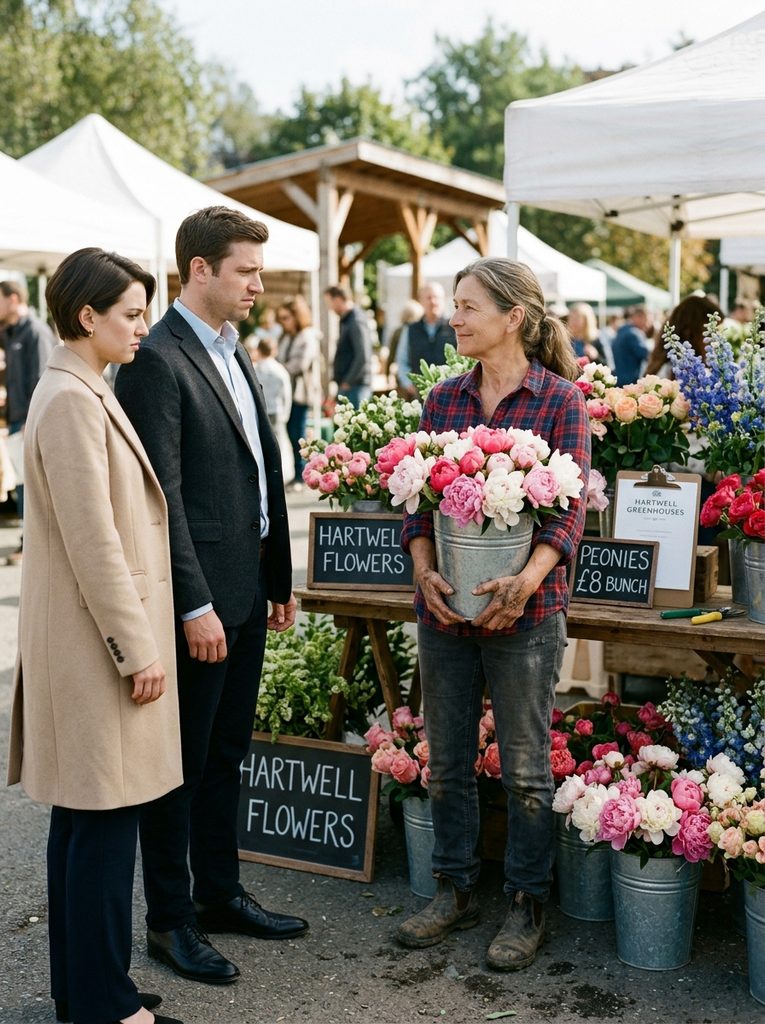
My son looked me straight in the face and told me I was embarrassing his wife because I sold flowers in old jeans with dirt under my fingernails. What he didn’t know was that the flowers he mocked were connected to six commercial greenhouse operations worth nearly $38 million—and his wife’s glamorous business depended on products my company supplied. I didn’t argue with him. I didn’t reveal anything. I simply called my attorney, made one business decision, and waited for Saturday night.
### Part 1
The first time my son told me I was embarrassing him, I was carrying three galvanized buckets of peonies across the Maple Creek Farmers Market with mud dried across the knees of my jeans. It was barely ten in the morning, sunlight was bouncing off the white vendor tents, and the air smelled like strawberries, fresh bread, damp soil, and the coffee stand two booths down. My name is Eleanor Hartwell, I was sixty-four that spring, and for eleven years I had spent three mornings a week selling flowers for ten to twenty-five dollars a bunch because I enjoyed watching people choose something beautiful for no reason other than wanting it on their kitchen table.
My son, Caleb, had stopped beside my stall wearing a charcoal jacket and shoes too clean for a farmers market, while his wife, Vanessa, waited twenty feet away pretending to study handmade candles. “Mom,” he said quietly, glancing over his shoulder, “you could at least dress a little better when people we know are around.” I looked down at my faded jeans, checked flannel shirt, and work boots, then back at him. “These clothes were clean at six this morning,” I said, and Caleb sighed as though I had deliberately misunderstood him.
That was the strange thing about my life: Caleb believed the flower stall was my livelihood because his father and I had spent decades making certain he never understood how much money existed behind it. My late husband, Samuel, and I had started Hartwell Greenhouse Group in 2003 with one six-acre property outside Dalton, two secondhand propagation tables, a borrowed forklift, and enough confidence to make up for everything we didn’t know. By the time Samuel died four years earlier, we owned six large commercial greenhouse and nursery operations across Georgia, Tennessee, the Carolinas, and Kentucky, supplying live plants to regional grocery chains, landscape companies, and major home-and-garden retailers throughout the Southeast.
Last year, revenue had crossed fourteen million dollars, and the last valuation Carolyn Pierce—my attorney and longtime adviser—had shown me put the company near thirty-eight million. Yet I still drove an eighteen-year-old pickup with a cracked passenger mirror, clipped coupons when they were useful, and carried sweet tea from home because three dollars for bottled water offended me on principle. Samuel and I had never pretended to be poor; we simply refused to start spending money merely because we had learned how to make it.
We had wanted Caleb to understand work before inheritance, usefulness before status, and people before appearances. Somewhere along the way, however, our lesson had twisted into something neither of us anticipated: because Caleb never saw wealth attached to me, he slowly learned to believe there was nothing worth respecting there. I first recognized it two Easters earlier, when Vanessa brought her parents to dinner and her father, Grant Mercer, spent twenty minutes evaluating my kitchen as though I had asked him to inspect it.
“The grout dates the entire room,” Grant said, running one finger along the tile behind my stove. “You open this wall, replace the peninsula, put in stone, and suddenly the house belongs in this decade.” His wife, Judith, nodded while mentioning her hospital board position for the third time that afternoon, and Vanessa offered me the polished smile she used online. “It has good bones,” she said, which sounded suspiciously like something people said when they disliked everything they could actually see.
Vanessa had built an online lifestyle business around immaculate interiors, garden styling, and what she called intentional living. Nearly a hundred and twenty thousand people followed her carefully lit breakfast tables and color-coordinated planters, and she had recently landed a lucrative promotional arrangement with Alder Ridge Home Centers, a large home-improvement retailer that sold everything from lumber to patio furniture. Caleb had shown me her campaign proudly, never realizing the hanging baskets, herbs, flowering annuals, and patio containers in Vanessa’s photographs had been grown in three Hartwell facilities.
I said nothing that Easter. I served ham, passed the potatoes, listened to Grant discuss property values, and watched Caleb laugh when Vanessa joked that one day she was going to “rescue” my backyard from my chaotic planting style. But I remembered every word, particularly the way my son joined their laughter without once looking at me to see whether I was laughing too.
The real breaking point arrived six weeks ago on a Tuesday morning. Caleb called and asked whether he and Vanessa could come over Friday because they had “something practical” to discuss, so I made beef stew, baked cornbread in Samuel’s old cast-iron pan, and set the table with the cream-colored dishes we had received as wedding presents forty-two years earlier. What Caleb neglected to mention was that Vanessa’s parents were coming too.
Two sets of headlights came up my driveway shortly after seven. By seven-thirty, four people were sitting at my table eating my food while Grant Mercer explained why I should sell my own house to my son for $280,000 when comparable homes in the area were selling near $460,000. He spoke calmly, almost kindly, which somehow made the insult worse.
“Eleanor, you have to think practically about this stage of life,” Grant said, folding his napkin beside his plate. “This is a significant property for someone living on a limited income, and maintaining it will only become more difficult.”
I set my spoon down. “Where exactly do you imagine I would live?”
Judith leaned toward me. “There are wonderful active senior communities nearby.”
I looked at Caleb. He stared at his hands.
Behind my house stood a guest cottage on a separately deeded parcel, a small two-bedroom place Samuel and I had renovated years earlier. Caleb and Vanessa had been living there essentially rent-free for nearly two years while supposedly saving for a house, yet somehow they had decided the natural next step was not to buy their own property but to acquire mine at a discount. Grant explained they wanted children, needed more space, and could “do something meaningful” with the main house and half-acre garden.
Then he opened a leather folder.
That was when the smell of my stew suddenly made my stomach turn.
“I had an attorney friend prepare preliminary options,” Grant said. “Nothing binding. Just documents concerning future transfer, maintenance responsibilities, and possible questions regarding long-term competency of ownership.”
I heard the refrigerator humming behind me. I heard rain beginning against the kitchen window. Mostly, though, I heard Caleb saying absolutely nothing while another man sat in Samuel’s chair and suggested I might soon be too incompetent to control my own home.
“Caleb,” I said, keeping my voice even, “is this what you want?”
He finally looked up. “I think it could be best for everyone.”
Something inside me went very quiet.
I nodded, finished dinner, and told them I needed time to think. Grant warned me not to take too long, Vanessa started describing how beautiful the kitchen could look once a wall came down, and Caleb helped himself to another piece of cornbread.
After they left, I washed every dish by hand, dried them, and put them back into the cabinet where Samuel had installed the shelves twenty years earlier. Then I sat alone at my kitchen table with Grant’s folder in front of me and called Carolyn Pierce.
She listened until I was finished.
Then she asked one question.
.
“What do you want to do, Eleanor?”
For the first time that evening, I smiled.
“I want them to learn exactly whose house they were sitting in.”
### Part 2
Carolyn had handled my legal affairs since Hartwell Greenhouse Group was still operating from one property and Samuel and I were arguing over whether we could afford a second delivery truck. She knew every deed, operating agreement, insurance policy, succession plan, and trust document connected to my life, which meant I didn’t have to explain why Grant’s mention of competency bothered me so deeply. “Send me everything he brought,” she said. “And do not sign a scrap of paper, even if it looks like a dinner napkin.”
The next morning, I drove to our Dalton headquarters instead of the farmers market. Caleb had never been there; as a teenager he had occasionally visited the original greenhouse with Samuel, but the modern office complex had been built after he moved away for college, and he never showed enough interest to ask about it. I walked past a row of shipping schedules, listened to forklifts whining behind the warehouse doors, and smelled that familiar mixture of wet peat, fertilizer, warm plastic, and thousands of living plants reaching toward the glass.
My operations director, Denise Holloway, met me near the conference room with three folders tucked under one arm. “Alder Ridge wants final spring volume confirmation by Friday,” she said. “They’re pushing hard in Georgia and the Carolinas because Vanessa Mercer’s campaign is outperforming projections.” Hearing my daughter-in-law’s name inside my own business made the whole situation suddenly feel almost ridiculous. Vanessa had been smiling beside Hartwell begonias online while helping her father plan how to move me out of my house.
I spent an hour reviewing the Alder Ridge contract before calling their regional account manager, Thomas Reed. Hartwell had supplied the company for six years, but the agreement contained a restructuring provision allowing us to withdraw certain regional capacity with notice, subject to a financial penalty if we accelerated the change. I could afford the penalty comfortably, and more importantly, I had another buyer prepared to absorb most of the capacity before summer.
“Thomas,” I said, “we’re reallocating Georgia and Carolina spring production.”
There was a pause. “How much production?”
“All of it under the current Alder Ridge seasonal program.”
Silence.
Thomas knew exactly what that meant. Replacing millions of units of consistent live goods midway through spring was not like switching paper towel vendors; growers planned months in advance, and color mixes, container sizes, delivery schedules, and store allocations were already in motion. “Eleanor, Vanessa Mercer’s entire regional promotion is built around that assortment.”
“I know.”
“Is this about her?”
.
“No,” I said, because technically the decision wasn’t being made to damage Vanessa’s campaign. It was being made because I no longer wished to maintain a business relationship that placed my products at the center of a woman’s profitable public image while she privately helped treat me as disposable. “It’s about where Hartwell wants its capacity.”
Thomas exhaled slowly. “We’re going to have a problem.”
“I know that too. Send the penalty calculation directly to Denise.”
I hung up and felt neither triumphant nor guilty. Business decisions have consequences, and for six years Alder Ridge had benefited from reliable Hartwell supply; they would survive without us, and Hartwell would survive without them. The difference was that Vanessa had built her campaign around access she didn’t realize came through the woman she was embarrassed to introduce by name.
Carolyn called that afternoon. By Thursday morning, the main house, land, driveway, and my surrounding garden had been placed inside an updated revocable family trust under my control. The guest cottage remained outside it because it occupied its own deeded parcel, and Carolyn prepared a formal sixty-day notice ending Caleb and Vanessa’s occupancy arrangement.
“They will be furious,” she warned.
“They were comfortable suggesting I move into senior housing.”
“That’s not what I asked.”
I leaned back in my chair. Through the office window, workers were rolling racks of white petunias toward a loading bay. “Yes,” I said. “They’ll be furious.”
Caleb called eleven times after receiving the notice. I ignored the first ten because I was trimming hydrangeas behind the market stall and refused to let his panic ruin a perfectly good morning, but I answered the eleventh call while drinking iced tea beside my truck.
“What are you doing?” he demanded before I could say hello. “You can’t just throw us out.”
“You have sixty days.”
“We live there.”
“You occupy property I own without rent under an arrangement I am ending.”
“This isn’t legal.”
“Carolyn Pierce’s number is on the notice. You’re welcome to call her.”
His breathing changed. “You’re doing this to punish us because Dad had a practical conversation with you.”
I almost laughed. Caleb had started calling Grant “Dad” around three years earlier, although he had never called Samuel anything except Dad while Samuel was alive. That tiny detail landed harder than I expected.
“Grant discussed questioning my competence,” I said. “In my kitchen.”
“He was giving you options.”
“No, Caleb. He was giving himself options.”
Caleb was quiet for a moment, then his fear turned into anger. “Mom, you don’t even understand this stuff. You sell flowers three days a week. That’s what you do. You’re just a woman who sells flowers at a market. You don’t understand property structures or contracts or any of this.”
There it was.
Not only contempt, but certainty.
I stared at the rows of buckets beside me—the snapdragons I had cut before sunrise, the roses from one of our smaller specialty houses, the zinnias a little girl had just begged her father to buy. “I understand enough,” I said.
“Vanessa has clients coming Saturday,” Caleb continued. “Please don’t create a scene. She’s announcing our plans for the house, and this whole thing is already embarrassing enough.”
“Your plans for my house?”
He paused. “You know what I mean.”
“No,” I said. “I don’t think I do.”
He told me to dress appropriately because Vanessa’s brand partners would be there. I told him I would see him Saturday and ended the call.
The irony was almost beautiful. Vanessa had scheduled a dinner party in my house to celebrate a future she had already designed without my permission, and Caleb believed the only unpredictable element was whether his flower-selling mother would arrive wearing decent clothes.
Saturday evening, I put on clean jeans, polished my boots, pressed my nicest flannel shirt, and stopped at a gas station for a six-pack of ginger beer.
Then I drove home.
There were eleven unfamiliar cars lining my driveway.
And when I opened my own front door, I heard Vanessa telling a room full of strangers, “Once the transfer is finished, we’re taking everything down to the studs.”
### Part 3
For a few seconds, nobody noticed me. Vanessa stood near the fireplace in a cream-colored dress, one hand wrapped around a wineglass while the other traced an imaginary line through the air where she apparently intended to remove one of my walls. Caleb wore a navy blazer and laughed beside two men I vaguely recognized from photographs on Vanessa’s account, while Grant and Judith occupied the kitchen island as comfortably as though they already had their names on the deed.
Then Caleb saw me. His gaze dropped to my flannel shirt, paused at my boots, and tightened just enough to tell me I had failed his dress code.
“Mom,” he said, coming toward me with a smile that never reached his eyes. “You made it.”
“I usually make it home eventually.”
He ignored that and took the ginger beer from my hand as though removing evidence. Vanessa swept over, kissed the air beside my cheek, and immediately guided me toward a couple standing near the windows. “This is Caleb’s mother,” she said. “She’s been living here forever.”
Not Eleanor.
Not the homeowner.
Not even my mother-in-law.
Just a woman who had been living there.
I shook hands with the couple and noticed the wife studying me with unusual intensity, but before she could speak, Vanessa pulled me toward someone else. For the next forty minutes, I moved through rooms Samuel and I had painted ourselves while people discussed changing the floors, opening walls, redesigning my garden, and turning the back lawn into a small event space where Vanessa could film commercial content.
I said very little. I wanted to hear exactly how far this fantasy had gone.
Near eight o’clock, Caleb tapped a spoon against his glass. Conversations faded and everyone turned toward him.
“I grew up in this house,” he began. “There are a lot of memories here, and Vanessa and I are excited about creating the next chapter.”
I stood beside my own bookshelf and watched my son publicly announce possession of something he did not own.
Vanessa took over with practiced ease. She described raised vegetable beds, a cutting garden, new stone paths, an outdoor studio, and a greenhouse-inspired entertaining space. When someone asked about the existing garden, she laughed.
“It’s charming in an old-fashioned way, but honestly, it’s completely overgrown and unstructured. We’re going to clear most of it and start fresh.”
Forty-three varieties.
That was how many perennials and seasonal plants I had worked into those beds across eighteen years. Samuel had planted the dogwood near the east fence after Caleb graduated from high school, and I had put in the climbing rose beside the back steps during the first spring after Samuel died because I needed something new to keep alive.
Judith dabbed her eyes as though Vanessa had just announced a pregnancy. Grant lifted his glass. “To new beginnings.”
That was when the woman from the window stepped forward.
Her name, I later learned, was Meredith Lane, and she owned a landscape architecture firm specializing in hotels, corporate campuses, and high-end residential developments. She had been staring at me because she had attended an industry conference in Charlotte two years earlier where I sat on a supplier panel.
“Excuse me,” she said carefully. “Are you Eleanor Hartwell?”
I looked at her. “I am.”
“Eleanor Hartwell from Hartwell Greenhouse Group?”
The quiet came slowly at first. A few people near us stopped talking, then others noticed, until the silence spread through the room like a ripple crossing water.
Vanessa laughed softly. “Eleanor sells flowers at the Maple Creek market.”
Meredith’s expression didn’t change. “She may. But Hartwell Greenhouse Group supplies nearly every large installation my company manages in this region.”
Caleb turned toward me.
I remember his face more clearly than anything else from that night. It wasn’t shock at first; it was resistance, as though his mind was trying to reject information that did not fit the person he had already decided I was.
Meredith continued. “Six commercial operations, if I remember correctly?”
“Six,” I said.
Grant lowered his wineglass.
Someone near the kitchen asked, “How large is the company?”
I could have avoided answering. Instead I said, “Last year’s revenue was a little over fourteen million.”
Caleb stared at me. “Fourteen million?”
“Revenue,” I corrected. “Not income.”
His lips parted, but nothing came out.
Vanessa was already looking at her phone. Her face changed when she saw whatever was on the screen, the bright practiced confidence draining away as she scrolled. “Alder Ridge contacted my manager,” she said. “They said the spring assortment I’m promoting is being replaced regionally because the supplier pulled out.”
I took a bottle of ginger beer from the pack Caleb had hidden on the counter and twisted off the cap.
“They source that assortment from Hartwell,” I said.
Vanessa looked at me. “Your company?”
“Two Tennessee facilities and one in South Carolina.”
“You cancelled it?”
“Reallocated it.”
“Because of me?”
“No. Because I control my company’s contracts, just as I control my property.”
Grant found his voice. “This is vindictive.”
I turned toward him.
He stopped talking.
“You came into my house,” I said, “with an attorney’s paperwork suggesting I might not be competent to manage property I own. You encouraged my son to buy a $460,000 house from me for $280,000 and move me into senior housing so your daughter could use my garden for photographs. I would be extremely careful about accusing someone else of improper conduct tonight.”
Grant’s face went colorless.
Caleb stepped closer. “Mom, why didn’t you tell me?”
That question hurt more than I expected.
Not why did I treat you badly?
Not how could I have done this?
Why didn’t you tell me you were rich enough to deserve respect?
So I gave him the only answer I had.
“Because I wanted to see who you were when you thought I had nothing you wanted.”
His shoulders dropped.
I opened my purse, removed two envelopes Carolyn had prepared, and placed them on the coffee table. One contained confirmation that the property had been transferred into my trust. The other was a copy of the sixty-day notice already delivered to the cottage.
“The house is not being transferred,” I said. “There will be no renovation, no event space, and no garden demolition. Caleb and Vanessa will also be leaving the guest cottage by the date stated in the notice.”
Vanessa’s mother whispered her name.
Nobody else spoke.
I looked around the room at the clients and strangers standing beneath the ceiling Samuel had once spent an entire weekend repairing after a pipe burst upstairs. Suddenly, I was exhausted.
“Enjoy the rest of the evening,” I said. “But please finish by ten. I have market in the morning.”
I went upstairs, closed my bedroom door, and sat on the edge of the bed while voices below rose and fell.
Ten minutes later, I heard the first car leave.
By eleven, the driveway was empty.
I thought the worst part was over.
I was wrong.
By Monday morning, Vanessa’s biggest sponsor had terminated her campaign—and that was only the first thing she lost.
### Part 4
Vanessa’s business did not collapse because I made a phone call demanding that anyone fire her. I never contacted her clients, never posted about the dinner, and never told a single reporter or follower what had happened. She lost the Alder Ridge campaign because the products she had been hired to promote were no longer reliably available in the region, and once that deal disappeared, other clients began looking closely at the woman behind the polished photographs.
The dinner guests did the rest without my help. People talk, especially people whose businesses depend on reputation, and within two weeks three of Vanessa’s private design clients ended their retainers. One apparently told her he could tolerate vanity but not watching someone publicly plan renovations to a house she did not own while the owner stood ten feet away.
Her follower count fell sharply after vague rumors started circulating. Vanessa tried posting cheerful photographs for another week, then disappeared from her account almost entirely. The perfectly arranged breakfasts, matching garden gloves, sponsored planters, and expensive-looking rooms went silent.
Caleb’s job survived, although his life became noticeably less comfortable. He worked in commercial lending, and Grant Mercer had introduced him to several important clients through his dealership network, but Grant’s enthusiasm cooled once it became clear I would neither reverse the eviction nor provide money. Caleb later moved into a smaller role after two accounts followed another manager, and with it came a smaller salary.
They left the guest cottage on day fifty-one.
I watched through the kitchen window as Caleb carried boxes into a rented truck. He did not ask me to help, and I did not offer.
At one point he stopped beside the cottage steps and looked toward the main house. For a second I thought he might come over, but Vanessa called his name from inside and he turned away.
That evening, I entered the empty cottage.
The rooms smelled faintly of dust, cardboard, and the vanilla candles Vanessa burned constantly. There were pale rectangles on the walls where framed photographs had hung, and one deep scratch across the dining floor from a table they had dragged out carelessly.
I stood in the bedroom that had once belonged to Samuel’s mother when she visited and felt something I had not expected.
Grief.
Not because Caleb had moved out.
Because I finally understood that my relationship with my son had been damaged long before that Friday dinner, and money had merely exposed the cracks.
Six weeks later, Caleb knocked on my back door on a Sunday morning.
He came alone.
The confident jackets were gone. He wore an old gray sweatshirt and jeans, his eyes shadowed as though sleep had become something he negotiated with rather than received automatically.
“I was wondering if we could talk,” he said.
I let him in.
That surprised him.
I poured coffee into two mismatched mugs and sat across from him at the same kitchen table where he had silently allowed Grant to discuss my supposed incompetence. Caleb wrapped both hands around his cup but did not drink.
“I keep replaying that dinner,” he said eventually. “The first one. With Grant.”
“So do I.”
“I told myself we were helping you.”
“No, you didn’t.”
His eyes lifted.
“You told yourself you were helping me because saying, ‘I want Mom’s house cheaply,’ sounds ugly when you hear it spoken plainly.”
He nodded once.
“I know.”
There was no argument, and that made me listen.
Caleb told me he had spent years gradually measuring people by the visible things around them—job titles, houses, clothing, connections, invitations. Vanessa’s family had accelerated it, but he did not blame them. “I liked feeling like I belonged with people who seemed important,” he said. “And somewhere in there, I started acting like you weren’t.”
That sentence sat between us.
I told him about Samuel and the promise we had made when Caleb was young. We had wanted him to earn his own life before knowing there was a successful company behind ours. We wanted him to choose work because he cared about it, friendships because they were real, and a spouse because he loved her rather than because our family assets looked appealing.
“Did it work?” he asked.
“No,” I said.
He flinched.
“And part of that is on your father and me. We confused secrecy with teaching. We thought hiding money would automatically teach values. It didn’t.”
Caleb looked relieved for perhaps half a second, until I continued.
“But our mistake does not excuse yours.”
“I know.”
“You sat there.”
His eyes reddened.
“I know.”
“You let another man suggest I wasn’t competent to manage my own home.”
“I know.”
“And afterward, when I protected myself, you called me a flower lady as though that made me stupid.”
He looked down at the coffee.
“I’m sorry.”
I believed him.
That was the difficult part.
People think believing an apology means forgiveness should follow immediately, as though remorse is a key that automatically unlocks every door the offender closed. It isn’t.
“I accept that you’re sorry,” I said. “But I do not trust you the way I used to.”
Caleb nodded slowly.
“I understand.”
“You and Vanessa are not moving back into the cottage. You will not receive a position at Hartwell. You will not be added to company ownership because you are my son. And nobody is getting this house because they believe biology gives them first claim.”
He swallowed. “I didn’t come here to ask for any of that.”
“Good.”
For the first time that morning, something almost like a smile crossed my face.
Vanessa appeared two weeks later carrying a rosemary plant in a clay pot.
She looked nervous standing on my porch without makeup arranged for a camera, her hair pulled into a plain ponytail. “I grew this from a cutting,” she said. “It survived, which is more than I can say for the first four.”
I took the pot but did not invite her inside.
She apologized for the dinner, for the garden, for introducing me as though I were an inconvenience, and for helping Grant push the house plan. Unlike Caleb, she cried.
I still did not forgive her.
But I told her something that made her wipe her face and listen.
“If you really regret who you were,” I said, “stop asking the people you hurt to make you feel better about becoming someone else.”
She stared at me.
Then she nodded.
For once, Vanessa had nothing polished to say.
Three days later, I heard she had taken a part-time job at a local nursery.
And for the first time in years, nobody was paying her to photograph it.
### Part 5
Four months after the dinner party, the rosemary Vanessa brought me was still alive on my kitchen windowsill. I turned the pot every few days so it wouldn’t lean too hard toward the morning sun, and sometimes I caught myself thinking that survival is less dramatic than people imagine. Most things do not heal because of one grand apology; they survive because someone remembers to water them on ordinary Tuesdays.
Vanessa kept the nursery job. At first I assumed it was another performance, something temporary she could later package as a humble comeback story, but she never posted about it. The owner, whom I had known casually for years, mentioned that Vanessa spent her shifts unloading soil, watering inventory, cleaning trays, and learning botanical names she once pretended to know.
She asked twice whether she could visit my garden.
I said no the first time.
The second time, I told her she could come Saturday morning for one hour.
She arrived at seven carrying an inexpensive notebook and wearing boots covered in actual mud. We spent most of that hour dividing hostas, and she asked why some beds looked deliberately loose rather than symmetrical.
“Because gardens aren’t furniture,” I said. “You don’t have to force every living thing into a matching position.”
Vanessa wrote that down.
I almost told her not everything needed to become a lesson, but decided she would discover that eventually.
Caleb came by occasionally too. He fixed the back gate latch, replaced a loose hinge on the shed, and cleaned leaves from a gutter I had been meaning to reach for weeks. He never mentioned inheritance, Hartwell, or the cottage.
I noticed.
I also did not reward him for it.
That distinction mattered.
For most of my life, I had believed family meant endless chances, but I had come to understand that a second chance does not have to look like restoration. Sometimes the second chance is simply permission to show you can behave differently while accepting that what you broke may never return to its original shape.
Carolyn and I updated my estate plan that summer.
Caleb did not lose everything, but he no longer stood to inherit direct control of Hartwell Greenhouse Group. I arranged for professional management to continue the company, established an education trust for any future grandchildren, and created a foundation in Samuel’s name that would fund horticulture scholarships and small grants for young growers trying to start independent nurseries.
When Carolyn finished reading the changes, she removed her glasses.
“You know Caleb may eventually find out.”
“I expect he will.”
“And if he’s genuinely changed, you might feel differently someday.”
“Then someday I can change the documents.”
She smiled. “That’s why we use pencils before signatures.”
I laughed.
That evening, I sat on the back steps with iced tea and looked across the garden Vanessa had once called overgrown. Bees moved heavily through purple salvia, the dogwood cast a long shadow across the lawn, and the climbing rose beside the steps had produced more flowers than it had in years.
Samuel would have loved that.
I still spoke to him sometimes when the house was quiet.
“You were half wrong,” I told him aloud. “So was I.”
We had believed keeping wealth invisible would protect Caleb from becoming entitled. Instead, it had revealed something more complicated: character is not created by ignorance of money any more than it is automatically destroyed by having it. People learn what we teach, what others reward, what culture praises, and what they decide for themselves when nobody is watching.
In September, Caleb called and asked whether he could stop by.
He and Vanessa arrived together.
They stood in my kitchen awkwardly until Vanessa finally laughed from nerves and said, “This is starting to feel like a disciplinary meeting.”
“It depends,” I said. “What did you break?”
Caleb looked at her, then back at me.
“Vanessa’s pregnant.”
For one second, I forgot every carefully maintained boundary.
My hand went to my mouth.
Vanessa smiled, frightened and happy at once. “Due in April.”
I hugged her because I wanted to.
Then I hugged my son.
That did not erase anything.
It did not make the dinner disappear, return her contracts, restore his place in my trust, or transform our relationship into the easy thing it had once seemed to be. It meant only that new life had entered the story, and I refused to make an unborn child responsible for the failures of the adults waiting for it.
“There’s good morning light in the east bedroom,” I said before remembering myself.
Caleb gave me a cautious look. “Mom, we’re not asking to move back.”
“I know.”
“We found a place closer to my office. It’s small, but we can afford it.”
“Good.”
Vanessa rubbed one hand over her stomach. “We’re staying there.”
That answer pleased me more than if they had asked for the cottage.
Before leaving, Caleb paused beside the kitchen counter.
“I know you don’t trust me yet,” he said.
“No.”
“I’m going to keep trying anyway.”
“That’s what you should do.”
He nodded.
He no longer needed me to reassure him.
After they drove away, I stood at the sink looking at the rosemary plant in the window. Vanessa had written something in her notebook months earlier while working in the garden, and she had accidentally left the page open on my potting bench.
The morning light is best when you stop trying to control where everything grows.
I had pretended not to read it.
Maybe that was true of people too.
Vanessa never recovered the glamorous business she once had. Some clients returned eventually, but the sponsorships that had made her feel important were gone, and she never again reached the audience she once commanded. What she built afterward was smaller: private garden consultations, honest nursery work, and eventually a modest service helping homeowners choose plants they could actually keep alive instead of arranging them for photographs.
Caleb never received an executive title at Hartwell.
He never got my house.
Neither of them received the lifestyle they once believed I owed them.
And I never gave them the words they occasionally seemed to wait for: “It’s all forgiven.”
Because it wasn’t.
Forgiveness, to me, would have meant pretending the wound had closed exactly where it opened. Instead, I chose something less sentimental and more useful: I stopped carrying anger every morning, but I remembered what happened. I let them rebuild a relationship with me one decision at a time, while keeping ownership of my home, my company, my money, and my future exactly where they belonged.
With me.
The following spring, I was back at the Maple Creek Farmers Market before sunrise, sliding buckets of tulips from the bed of my battered pickup. A young woman bought a yellow bunch for her mother, an older man spent ten minutes choosing flowers for his wife, and by nine my jeans already had dirt across one knee.
Then Caleb appeared pushing a stroller.
Vanessa walked beside him carrying coffee.
Inside the stroller slept my granddaughter, Nora Samuel Hartwell, wrapped in a pale green blanket with one tiny fist beside her cheek.
Caleb looked at my muddy clothes and smiled.
“You know,” he said, “for just a woman who sells flowers, you stay pretty busy.”
I stared at him.
His smile disappeared immediately.
“Too soon?”
“About twenty years too soon.”
Vanessa burst out laughing.
A second later, despite myself, I laughed too.
Then a customer asked for two bunches of peonies, so I turned back to my buckets and went to work.
Because that was the part Caleb had misunderstood from the beginning.
There was never anything shameful about being a woman who sold flowers.
The mistake was believing that was all I was—and worse, believing “all I was” could ever determine how much respect I deserved.
I still own six greenhouse operations. Hartwell is still worth somewhere around thirty-eight million dollars, depending on which accountant you ask and what month the question is asked. My house remains mine, Samuel’s foundation awarded its first seven scholarships that year, and the guest cottage now provides temporary housing to horticulture students completing internships at our Dalton facility.
Caleb knows all of that now.
But when he visits on Sundays, I do not discuss valuation reports.
We drink coffee at the kitchen table.
Vanessa sometimes brings rosemary.
And when my granddaughter is old enough to understand what I do, I am going to take her to the farmers market first.
Not the corporate office.
Not the largest greenhouse.
Not the conference room where contracts worth millions are signed.
I want her first memory of my work to be galvanized buckets, damp earth, white morning light, and ordinary people spending ten dollars to carry something beautiful home.
Then, someday, I will teach her the lesson her father had to learn the painful way.
Never decide what a person is worth by what they wear, what they drive, where they work, or what you think they can give you.
And if someone shows you contempt when they believe you have nothing?
Believe them the first time.
They may change.
They may become better.
You may even make room for them again.
But you never have to hand them the keys to the house they once tried to take from you.
THE END!