My Daughter-in-Law Pulled Up With a Moving Truck and Said, “We’re Taking Over the House Once You Sign.” My Son Wouldn’t Look Me in the Eye. Then the Bank Manager Saw Me Walk In—and Went So Pale She Finally Asked Who I Really Was.
For three months, my son and his wife treated me like a confused widow who needed rescuing from my own house, my own money, and apparently my own judgment. They brought brochures, advisers, forms, and eventually a moving truck, certain I would surrender because I was tired of fighting. What they never knew was that my late husband had left behind more than memories—and by the morning the bank manager saw my name on their paperwork, I finally understood why he had spent years preparing for exactly this moment.
### Part 1
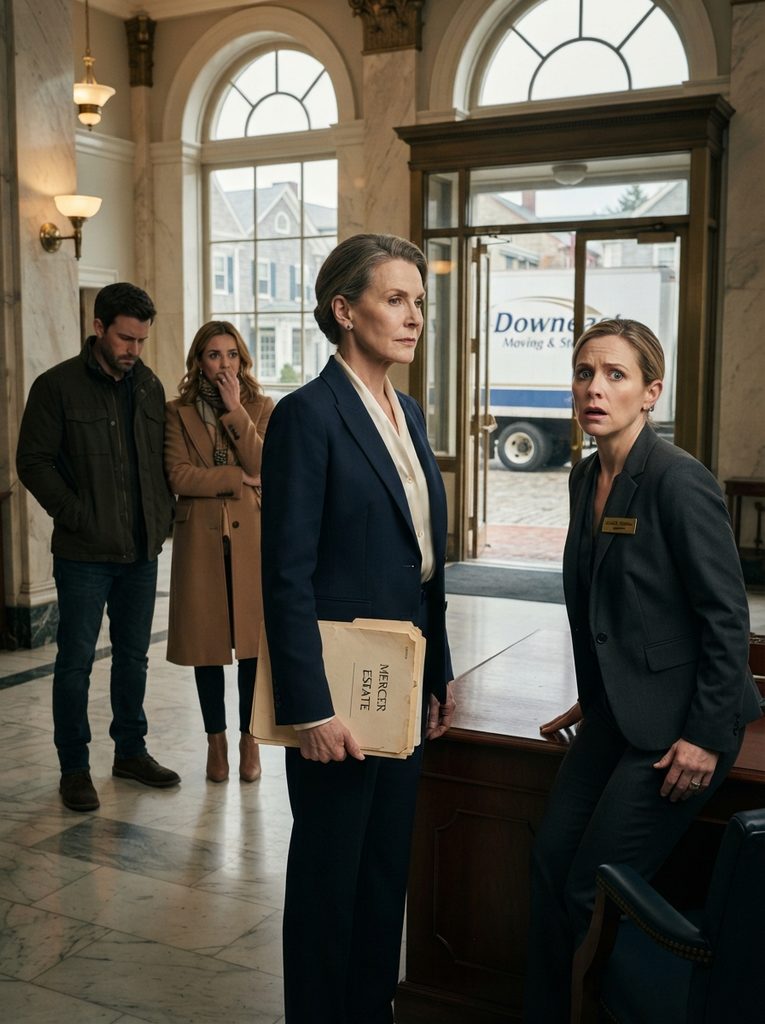
The morning Nathan Cole saw me cross the marble lobby of Grayhaven Savings, the color disappeared from his face so quickly that my daughter-in-law, Sabrina, stopped smiling.
I noticed because Sabrina had been smiling almost constantly for three months. It was a careful smile, pleasant enough for witnesses and photographs, but there was always something underneath it that reminded me of a person waiting for a lock to click open. My son, Ryan, stood beside her with both hands shoved into his coat pockets, studying a framed painting on the opposite wall as if Maine seascapes had suddenly become the most important subject in his life.
Nathan had come through the back office carrying a folder. He glanced down at the first page, looked up, saw me in my late husband’s navy blazer, and simply stopped in the middle of the floor. “Mrs. Mercer,” he said quietly, and something in the way he said my name made Ryan turn around.
Sabrina’s smile tightened. “You two know each other?”
Nathan looked from her to me, then toward the folder beneath my arm. “Mrs. Mercer and this bank go back a very long way.”
That was when I knew the morning was not going to unfold the way my son and his wife had planned.
They believed they were bringing an aging widow to sign routine paperwork. They believed my house was my largest asset, that grief had made me inattentive, and that enough talk about winters, maintenance, emergencies, and “simplifying things” would eventually exhaust me into cooperation. What they did not understand was that six nights earlier, while looking for an old fishing box in my attic, I had discovered that almost everything I believed about my financial life was incomplete.
But that came later.
Three years earlier, before paperwork and bank meetings and moving trucks, my life had been smaller and kinder.
My husband, Thomas, and I moved to Grayhaven, Maine, when we were thirty-one with a used pickup, a mattress tied down beneath a blue tarp, and $280 in a coffee tin. Grayhaven was the kind of coastal town where the air smelled of salt and diesel near the docks, where people remembered what truck you drove twenty years ago, and where news sometimes arrived at your front door before the telephone rang. Thomas had been offered work as a marine engineer at a repair yard outside town, and I had accepted a bookkeeping position at a hardware supplier.
We bought our house five years later. It was a weathered white Cape with uneven pine floors, a stubborn chimney, and enough backyard for Thomas to plant the roses he had promised me when we were newly married. The first summer, he ordered bare-root bushes from a nursery farther inland, dug every hole himself, then spent weeks pretending not to worry when they looked like dead sticks.
They bloomed the following June.
For thirty-three years, that house held our ordinary life. Ryan learned to ride a bicycle in the driveway, Thomas rebuilt our porch twice, and I burned Thanksgiving rolls so regularly that it became a family joke. Every morning Thomas drank black coffee at the kitchen table while reading tide charts and local news, folding the paper into exact rectangles because disorder irritated the engineer in him.
Then one February morning, seven months after he retired, he collapsed beside the half-finished wooden dory he was building in our garage.
There had been no long illness and no warning worth naming. One moment he was discussing whether he needed another piece of cedar; less than an hour later, I was sitting beneath fluorescent hospital lights with sawdust still caught in the cuff of his work shirt. He was sixty-four.
People talk about grief as if it comes like weather, something dramatic sweeping through before gradually clearing. Mine felt more like losing electricity in winter. Everything remained where it had always been, but nothing worked properly anymore.
I survived through routine. I woke at 6:30, heated water, and made tea in Thomas’s blue ceramic pot with the chipped spout. I watered the roses, walked to the mailbox, paid bills, answered condolence cards, and kept the half-built dory exactly where he had left it.
Ryan lived about forty minutes away in a town called Larkin, where he ran a dental practice. He had married Sabrina four years before Thomas died, and although I had always tried to welcome her, I never quite knew what to do with the feeling that she was measuring every room she entered.
She was attractive, polished, and remarkably quick at identifying who held influence. At restaurants, she remembered the owner’s name but rarely the waitress’s. At family gatherings, she could make a compliment sound generous while somehow leaving you wondering if you had just been insulted.
Thomas had watched her differently than I did.
He never criticized her directly. Instead, he became quieter whenever she asked unusually specific questions about retirement accounts, property values, or whether we planned to leave the house to Ryan. I assumed he was being protective because no father believes anyone is quite good enough for his only child.
I would learn later that Thomas’s concern had not begun with Sabrina.
For the first year after he died, Ryan called every Sunday. Sabrina sent casseroles in neat containers with masking-tape labels and reheating instructions, and when October arrived, Ryan helped me put up the storm windows. I was grateful enough that I ignored the occasional question about whether maintaining the house was “getting to be too much.”
The questions became more frequent during the second year.
“Have you thought about somewhere easier?”
“Wouldn’t it be nice to have people nearby?”
.
“What happens if you fall when no one’s around?”
Individually, none sounded cruel. Together, they began to feel like drops of water finding the same crack.
Then, one Wednesday in March, Sabrina arrived carrying a glossy brochure.
She sat across from me at the same table where Thomas had drunk his coffee for thirty-three years and placed it carefully between us. On the cover, three silver-haired women were laughing around a card table beneath unrealistically perfect sunshine.
“We’ve been worried about you,” Sabrina said. “And I think it’s time we talk practically.”
Ryan stood by the counter instead of sitting down.
I touched the brochure but did not open it. “Practically about what?”
Sabrina folded her hands. “About the house. About your finances. About what comes next.”
Outside, March wind scraped bare rose branches against the fence.
I looked at my son.
He looked into his coffee.
And before Sabrina said another word, I understood that whatever conversation they claimed we were beginning had already been happening without me.
### Part 2
Sabrina had prepared her presentation carefully.
The community she had chosen was in Larkin, fifteen minutes from Ryan’s practice, with private apartments, communal meals, transportation, and what she repeatedly called “a better safety net.” She talked about snow removal, property taxes, icy steps, heating bills, and how difficult it could become to manage a large house alone, moving from one point to the next with the smooth confidence of someone presenting quarterly results.
.
I let her finish.
Then I asked, “What happens to this house?”
“The market is strong,” she said immediately. “Selling now makes sense.”
“And the money?”
“We’d consolidate everything.”
“We?”
She glanced toward Ryan. “You, obviously, but Ryan and I could help oversee things so you don’t have to carry all that responsibility.”
That word stayed with me.
Responsibility.
For thirty-three years, I had balanced grocery budgets, managed our household, helped raise a child, worked, cared for my mother through her final illness, and buried my husband without collapsing. Yet somehow my bank account had become a burden I needed Sabrina to lift.
“I am not selling my home,” I said.
Ryan finally looked up. “Mom, nobody’s forcing you.”
“Good.”
Sabrina’s expression barely shifted. “No one’s saying today. We’re saying you should think about what makes sense.”
“I have.”
She closed the brochure. “Then we can revisit it.”
What bothered me most was not that she disagreed. It was that she opened the calendar on her phone before leaving.
Two weeks later, they returned with a man named Derek Voss.
Ryan introduced him as a financial consultant. Derek wore an expensive-looking camel coat and shoes too delicate for Maine mud, and before he had been in my house ten minutes, he was staring through the kitchen window at my backyard as though evaluating property from a listing photograph.
“Great lot,” he said.
I was pouring coffee. “Thank you.”
“Kitchen’s dated, but buyers forgive that if the bones are good.”
I stopped pouring.
Sabrina said lightly, “Derek works with real estate planning too.”
He walked toward the window. “Those roses might need to go. Opens the yard visually.”
I set the coffeepot down harder than I intended.
Thomas had planted those roses thirty years earlier. Every spring he had pruned them with a pair of red-handled clippers, muttering at aphids and talking to the plants when he thought I couldn’t hear him.
“They stay,” I said.
Derek turned, surprised, then smiled. “Of course. It’s your decision.”
But the four words sounded temporary.
After they left, I remained at the table until sunset turned the windows gray. The brochure was still near the fruit bowl, Derek’s business card beside it, and for the first time I allowed myself to ask a question I had been resisting because the answer felt ugly.
Were they worried about me—or waiting for something from me?
Around six, my neighbor Marjorie Abbott knocked once and let herself into the mudroom.
Marge had lived three houses down for twenty-six years and believed locked doors between friends were evidence of declining civilization. She found me staring at the brochure, read the cover, and without asking permission filled Thomas’s kettle.
“Who brought that?”
I told her.
By the time I finished, her mouth had become a thin line.
“You’re not signing anything, are you?”
“There isn’t anything to sign.”
“Yet.”
“Marge.”
She put two mugs on the table. “Eleanor, people don’t bring a financial consultant to admire your wallpaper.”
I laughed despite myself, but she didn’t.
“Promise me,” she said. “No papers until somebody who works for you reads them.”
“I promise.”
That promise mattered eleven days later when Ryan came alone.
It was raining hard enough that his shoulders were wet by the time he stepped inside. He looked tired, and seeing him without Sabrina softened something in me immediately because no matter how old your child becomes, part of you remembers the feverish five-year-old who once slept with his head in your lap.
He apologized for Derek.
“He can be blunt.”
“He was appraising my kitchen, Ryan.”
“I know.”
“And my roses.”
Ryan rubbed both hands across his face. “Sabrina got ahead of herself.”
“That seems to happen often.”
He sat down. This time, he had brought a folder.
My stomach tightened.
“Mom, I really am worried about you.”
“I know that’s what you keep saying.”
He opened the folder. “This isn’t about selling today. It’s just protection in case something happens.”
He slid three pages across the table.
At the top were the words DURABLE POWER OF ATTORNEY.
I had done enough bookkeeping in my life to understand that phrase.
I read the first page slowly. Ryan began explaining before I reached the middle, telling me that it was standard, that nobody intended to take control away from me, that it would simply allow someone to act if I became unable to manage things myself.
“Someone meaning you?”
He hesitated. “Me and Sabrina.”
I looked up.
His eyes moved away.
“Why does Sabrina need authority over anything I own?”
“She handles most of our finances.”
“That isn’t an answer.”
“We’re married, Mom.”
“So were your father and I. I still didn’t need authority over his mother’s accounts.”
Ryan pushed his chair back slightly. “You’re making this adversarial when it doesn’t need to be.”
“No. I’m reading something you brought me to sign.”
His expression changed, and for a second I saw irritation beneath the concern. It vanished quickly.
“We just want to help.”
I studied my son and felt an ache deeper than anger. I remembered school lunches packed before sunrise, braces we paid for by delaying a new car, rainy soccer games, tuition checks, his wedding, Thomas adjusting Ryan’s tie with hands that had shaken only slightly.
“I need time.”
“Of course.”
He left the papers.
That evening, I put them in the kitchen drawer instead of the trash because Marge’s warning was still in my head.
Two nights later, I climbed into the attic looking for Thomas’s fishing tackle.
Marge’s grandson had become obsessed with striped bass, and I had promised him some of Thomas’s old lures. The attic smelled of cedar, dust, and cold wood, and I had already moved two Christmas boxes when I noticed a small gray metal case pushed behind a stack of folded blankets.
Thomas’s initials had been scratched into the lid.
T.M.
I had seen the box before.
For years, I had assumed it contained old tax records.
That night, for reasons I still cannot fully explain, I carried it downstairs.
The box was locked.
It took me twenty minutes to find the key.
Thomas had taped it behind our framed wedding photograph.
I sat on the edge of the bed holding that tiny brass key in my palm, laughing and crying at the same time because hiding it there was so completely like him.
Then I opened the box.
Inside was a leather notebook, bundles of documents, and one cream-colored envelope.
My name was written across it in Thomas’s handwriting.
Eleanor.
Nothing prepared me for what I found beneath it.
### Part 3
I opened Thomas’s notebook first because I was afraid of the letter.
That sounds backward, but grief makes cowards of us in strange places. A ledger was something I understood; an envelope addressed by a dead man’s hand felt like opening a door I might not be able to close.
Thomas was not a journal keeper. His entries were short, dated, and written in block letters, often with numbers in the margins, so at first I thought I was looking at repair notes or investment records.
Then I saw Ryan’s name.
The first entry was dated almost seven years before Thomas died.
“Three withdrawals again. Same pattern.”
The next listed amounts.
$900.
$1,400.
$750.
A month later: “Asked Ryan generally whether business is tight. Said no.”
My hands became cold.
Years earlier, during a surgery Thomas had needed, we had added Ryan as an authorized user on one household account in case bills needed paying while I was at the hospital. Thomas recovered, life resumed, and neither of us thought much about the arrangement again.
Apparently Ryan had.
The withdrawals started small enough to disappear among ordinary expenses. A thousand dollars here, eight hundred there, then several thousand during the year Ryan opened his practice.
Thomas had traced every one.
By the final entry, the amount taken without asking had passed $40,000.
I closed the notebook.
For several minutes, I simply listened to the refrigerator humming in the kitchen and rain tapping the window over the sink. I wanted to find another explanation because Ryan was my son, and mothers can become highly skilled lawyers when defending their children to themselves.
Maybe Thomas had misunderstood.
Maybe Ryan had permission I had forgotten.
Maybe the money had been repaid somewhere else.
But Thomas had attached statements.
Numbers do not care how badly you want them to be wrong.
I kept reading.
Thomas had considered confronting Ryan. One entry said, “Eleanor would insist we solve it together. Not sure together is possible until Ryan admits there’s a problem.”
Instead, Thomas removed Ryan from the account and began shifting assets.
At first, I thought that meant he had simply protected our retirement savings. Then I found references to something called Mercer Harbor Holdings.
I had heard the name once or twice, usually when Thomas was discussing taxes with our accountant. I assumed it was a small investment entity attached to one building he had purchased years ago with another engineer.
The documents told a different story.
There were deeds.
Lease agreements.
Insurance statements.
Property summaries.
A commercial building on Dock Street.
Another on Anchor Lane.
A warehouse near the eastern marina.
Two small office properties in neighboring counties.
Everything had been reorganized into my name through the holding company before Thomas died.
I did not understand the full value, and at that hour I did not try.
Then one address caught my attention.
18 Dock Street.
I knew that address.
Ryan’s dental office was on the second floor.
I read the page twice.
Mercer Harbor Holdings owned the building where my son had practiced dentistry for six years.
Ryan was a tenant.
He had been mailing rent every month to a management company without knowing that the money ultimately belonged to his parents.
I lowered the papers into my lap.
The room seemed suddenly too small.
Thomas had not been a secretive man in ordinary things. If he bought a new drill, I knew what it cost. If he lost fifty dollars playing cards with friends, he complained about it for two days.
Yet an entire financial structure had existed beneath our marriage without me understanding its purpose.
That hurt.
It also frightened me.
I finally picked up the envelope.
The paper inside smelled faintly of the cedar box.
“My dear Eleanor,” it began.
I stopped.
Nobody had called me “my dear” the way Thomas did. From anyone else, the phrase would have sounded old-fashioned. From him, it felt like hearing his boots at the back door.
“If you’re reading this, I’m not there to explain any of it, and I am sorry.”
My eyes blurred.
He wrote that he had hidden the details because he did not want Ryan’s betrayal to contaminate the years we still had together. He knew I would look across every Christmas dinner wondering whether our son had changed, whether he was ashamed, whether I should confront him.
Thomas had wanted to spare me that until sparing me was no longer possible.
“I don’t know what kind of man Ryan will become,” he wrote. “I hope he becomes better than what I saw.”
The next paragraph mentioned Sabrina.
“If his marriage makes him steadier, then perhaps these precautions will never matter. But if she encourages the part of him that thinks love and access are the same thing, you need to have choices.”
I pressed my fingers to my mouth.
Thomas explained that every asset he could legally and cleanly separate had been placed beyond anyone else’s reach. The house had no debt. Mercer Harbor Holdings belonged entirely to me after his death. The managed investments, property accounts, and reserve funds could not be transferred by Ryan, Sabrina, or anyone else without my direct authorization.
Then came the sentence that broke me.
“I spent my working life fixing machinery when something failed. A family isn’t machinery. I couldn’t repair this the ordinary way, so I built you an exit instead.”
Below that he wrote, “If you never need it, I will be grateful. If you do, don’t apologize for using it.”
I sat in Thomas’s chair until after midnight.
At 1:20 in the morning, I opened every quarterly statement I had been filing without reading.
For three years, I had assumed the statements represented modest retirement investments.
They did not.
The number at the bottom of the consolidated report made me take off my glasses and clean them.
Then I read it again.
I was not fantastically rich. I did not own yachts or private planes.
But I owned several million dollars in property and investments, almost all of it producing steady income.
My house was not the financial prize Sabrina apparently believed it was.
It was one small piece.
And Ryan’s office building was mine.
At 8:05 the next morning, I called the telephone number on the statement.
A receptionist answered, “Alcott Financial and Property Management.”
“My name is Eleanor Mercer.”
There was a pause.
“Mrs. Mercer?”
“Yes.”
Another pause, longer this time.
“Mrs. Mercer, may I place you on hold for just a moment?”
Less than thirty seconds later, a woman came onto the line.
“Eleanor, this is Vivian Alcott.”
I had met Vivian twice during Thomas’s life.
Her voice was gentle but serious.
“I’ve been hoping you would call.”
Something in my chest tightened.
“Why?”
Vivian exhaled.
“Because your husband asked me to watch for certain things after his death.”
I looked toward the drawer where Ryan’s power-of-attorney papers lay.
“What things?”
There was silence on the line.
Then Vivian said, “I think you should come to my office, and I think you should bring anything Sabrina has asked you to sign.”
That was the moment fear stopped feeling vague.
Because Thomas had been dead three years.
And somehow he had known enough to leave people watching.
### Part 4
Vivian Alcott’s office overlooked Grayhaven Harbor from the second floor of an old brick building that smelled faintly of coffee and floor wax.
I arrived carrying the power-of-attorney forms in a grocery tote because I had not yet accepted that I was the kind of person who needed a legal folder. Vivian met me at reception, hugged me once, then guided me into a conference room where three binders were already waiting.
“Thomas made me promise not to overwhelm you unless it became necessary,” she said.
“I think we’ve reached necessary.”
Her mouth tightened. “So do I.”
For the next three hours, she showed me the financial life my husband had built quietly around us.
Thomas had started with one distressed commercial property during a downturn when Ryan was in college. He repaired it, rented it, refinanced carefully, and used the income to purchase another.
Then another.
Nothing flashy.
Nothing reckless.
By the time he retired, Mercer Harbor Holdings owned six properties and minority interests in two more.
“He could have lived much larger than you two did,” Vivian said.
I almost laughed. “Thomas wore the same winter coat for nineteen years.”
“I remember.”
She showed me records of donations, too.
Small tuition payments made anonymously for children of dockworkers.
Medical travel expenses for a former coworker’s family.
A loan to a fisherman after a boat fire that had technically been repaid at ten dollars a month even though Thomas had stopped cashing the checks.
I felt grief rise fresh and sharp.
Then Vivian opened a red folder.
“This part is less pleasant.”
Inside were copies of emails.
Sabrina had contacted a real estate broker months earlier asking for an informal valuation of my home.
She had contacted someone about independent-living availability before discussing it with me.
That alone could have been dismissed as overplanning.
The next documents could not.
There were draft transfer instructions involving two investment accounts.
There was language authorizing liquidation of assets.
There were questions about how quickly a property could be sold after authority had been established.
Then Vivian slid one page toward me.
My name was written at the bottom.
Eleanor Mercer.
I stared at it.
“I didn’t sign this.”
“I know.”
The signature resembled mine.
Not perfectly.
But enough to frighten me.
“Where did this come from?”
“Our compliance review caught it when someone asked preliminary questions about moving funds. Nothing went through.”
“Someone?”
Vivian hesitated. “The contact trail points to Sabrina.”
My hands trembled for the first time.
“Does Ryan know?”
“We don’t know what Ryan knows.”
That distinction mattered.
It did not absolve him.
But it mattered.
Vivian had already contacted the attorney Thomas designated in his estate plan, but the attorney had retired. She recommended Rebecca Sloan, an estate and financial-fraud lawyer in Camden.
I called her that afternoon.
Rebecca was in her late fifties, with silver-streaked hair and the unnerving habit of becoming quieter when information became worse.
She read everything twice.
When she reached the questionable signature, she removed her glasses.
“Did you sign any similar document?”
“No.”
“Did you authorize anyone to sign for you?”
“No.”
“Has anyone suggested you are mentally incapable of managing your affairs?”
I thought about Sabrina’s comments.
“You’ve been forgetting things lately.”
“Winters are dangerous at your age.”
“You don’t need to worry about complicated accounts.”
I had dismissed them as manipulation.
Now they sounded like groundwork.
“Yes.”
Rebecca leaned back.
“All right.”
That was all she said for several seconds.
Then she began making a list.
First, every account would be locked behind additional verification.
Second, no transfer involving me would be processed without direct confirmation through Rebecca or Vivian.
Third, we would document every conversation.
Fourth, I would not confront Sabrina yet.
“Why not?”
“Because right now we know what you know. We don’t know what she thinks you know.”
That sentence changed how I saw the next two weeks.
Sabrina called twice to ask whether I had reviewed the power-of-attorney papers.
I told her I was still thinking.
Her voice remained sweet.
“Of course. No rush.”
Three days later, Ryan asked whether I had toured the living community.
“No.”
“Want us to take you?”
“Not yet.”
He sighed, and I heard Sabrina say something in the background.
Then came the strangest development.
A moving company called me.
The man who answered sounded confused when I said I had not requested a quote.
“I’m looking at the request right now,” he said. “Pickup from 41 Bayberry Lane.”
My address.
“Who made it?”
He hesitated. “It says family relocation consultation. Contact name Sabrina Mercer.”
For several seconds, I said nothing.
“When is this supposed to happen?”
“No date confirmed. It’s only an estimate.”
“Cancel it.”
I hung up and called Rebecca.
She told me not to call Sabrina.
That Friday, Vivian discovered something else.
Sabrina had apparently learned Ryan’s practice was struggling.
Ryan had expanded too quickly eighteen months earlier, adding expensive equipment and a second treatment wing during a period of unusually strong business. Revenues later softened, debt payments did not, and the financial pressure had become severe.
“Could he lose the practice?” I asked.
“Possibly.”
“Does he know I own his building?”
“No.”
“Does Sabrina?”
“We don’t believe so.”
That made the entire plan both clearer and stranger.
Sabrina thought the solution was my house and whatever savings she imagined sat behind it.
She did not know that the person she was trying to move out of a three-bedroom Cape owned the roof over her husband’s business.
A week later, Ryan called.
“Mom, I made an appointment at Grayhaven Savings.”
My grip tightened around the phone.
“For what?”
“To simplify the accounts. Nothing gets done unless you agree.”
He sounded tired.
I wondered whether exhaustion explained him.
Then I remembered that cowardice often arrives disguised as fatigue.
“When?”
“Tuesday at ten.”
“I’ll be there.”
He sounded relieved.
After we hung up, I called Rebecca.
Then Vivian.
Then Grayhaven Savings.
By Monday evening, every relevant document had been copied and organized.
At 7:14 Tuesday morning, I was fastening Thomas’s pearl earrings when an engine rumbled outside.
I looked through the bedroom window.
A white moving truck was backing into my driveway.
Sabrina climbed out of the passenger side carrying coffee.
Ryan got out of the driver’s side.
For one stunned second, I thought they had lost their minds.
Then Sabrina looked up, saw me in the window, and smiled.
She had brought a moving truck before the bank appointment.
And suddenly I understood exactly how certain she was that I would surrender.
### Part 5
I opened the front door before they reached the porch.
Sabrina was wearing cream-colored trousers, a camel coat, and the same bright expression people use when they arrive to help someone celebrate a surprise they arranged for themselves. Ryan followed several steps behind her, and when he saw my face, he immediately looked uncomfortable.
“What is that truck doing in my driveway?”
Sabrina’s smile faltered only slightly.
“We thought we’d get ahead of things.”
“Ahead of what?”
“Your transition.”
I looked at Ryan. “Did you authorize this?”
He rubbed the back of his neck. “It’s just here in case.”
“In case I sell my house at a ten o’clock bank appointment?”
“No one’s saying that.”
I pointed toward the truck. “That is saying it rather loudly.”
Sabrina stepped forward. “Eleanor, you’re turning everything into a confrontation.”
“No. I woke up and found a commercial moving vehicle on my property.”
“We’re trying to save you stress.”
“The truck is causing stress.”
Her eyes hardened.
Only for a second.
Then the smile returned.
“We heard the apartment at Willow Ridge can be held if we act quickly. We thought after the bank meeting we could start with the things you definitely want to keep.”
I stared at her.
She had already selected the destination.
She had already requested an estimate.
Now she had brought the truck.
Not because anything had been agreed upon.
Because she believed agreement was inevitable.
“Send it away.”
Ryan stepped closer. “Mom.”
“Send it away.”
“We already paid the deposit,” Sabrina said.
“That sounds like your problem.”
Her face changed.
The sweetness drained out of it, leaving something flatter beneath.
“You can’t stay here forever.”
The sentence landed between us.
Ryan whispered, “Sabrina.”
She ignored him.
“This house needs constant work. You’re alone. Your finances are scattered. We’re trying to make sure everything doesn’t become a disaster.”
“My finances are scattered?”
“Yes.”
“How would you know?”
She opened her mouth.
Stopped.
That was the first genuine mistake I saw her make.
Ryan turned toward her.
I smiled for the first time that morning.
“Exactly.”
Sabrina looked away.
I stepped back inside.
“We leave for the bank in twenty minutes. The truck leaves now.”
Ryan told the driver to go.
The man was embarrassed enough that I almost felt sorry for him.
At 9:35, we drove separately to Grayhaven Savings.
I wore Thomas’s navy blazer, pearl earrings, dark slacks, and low shoes. Beneath my arm was a folder Rebecca had prepared containing copies of every questionable document, account notice, valuation inquiry, and communication we had been able to identify.
When I entered the lobby, Sabrina was already there.
Her composure had returned.
Ryan stood beside her.
“Feeling better?” he asked.
“No.”
He flinched.
Sabrina touched my arm. “Let’s just have a calm meeting.”
I looked at her hand until she removed it.
Then the back door opened.
Nathan Cole walked into the lobby.
Nathan had worked at Grayhaven Savings for more than two decades. When he was young, Thomas had helped him through a difficult professional period by recommending him for a management position after several senior community members considered him too inexperienced.
What Ryan and Sabrina did not know was that Nathan had also worked with Thomas for years on the banking side of Mercer Harbor Holdings.
He knew the properties.
He knew the accounts.
He knew exactly who controlled them.
And by that morning, he knew that compliance staff had flagged documents bearing a signature I denied making.
Nathan saw me.
Stopped.
“Mrs. Mercer.”
Sabrina’s mouth tightened.
Ryan looked between us.
Nathan walked directly over and shook my hand with both of his.
“It’s been far too long.”
“It has.”
He lowered his voice. “I’m sorry we’re seeing each other under these circumstances.”
Ryan heard that.
“What circumstances?”
Nathan’s eyes moved to him.
Professional expression.
Measured tone.
“I think we should discuss everything inside.”
Sabrina laughed lightly. “Everything sounds dramatic. We’re just consolidating some accounts for Eleanor.”
Nathan looked at her for a moment.
“Yes,” he said. “About that.”
He led us through a frosted-glass door into a conference room.
There were already two people seated inside.
One was the bank’s compliance officer.
The other was Rebecca.
Sabrina stopped walking.
“What is she doing here?”
Rebecca stood. “Good morning, Mrs. Mercer.”
Ryan looked at me.
“Mom?”
I pulled out a chair.
“Sit down.”
Sabrina remained standing.
“This is ridiculous.”
Nathan closed the door.
“I don’t believe it is.”
The compliance officer introduced herself as Denise Ward and placed several folders on the table.
Sabrina stared at them.
Ryan looked increasingly pale.
Denise began calmly.
“Before any discussion of asset transfers, we need to address documentation submitted or circulated in connection with Mrs. Mercer’s accounts.”
Sabrina’s chin lifted.
“I haven’t submitted anything.”
Denise slid forward a page.
“Do you recognize this?”
Sabrina did not touch it.
Ryan leaned closer.
I watched his eyes move across the text.
Then downward.
Toward the signature.
My signature.
Except it wasn’t mine.
His face changed.
“What is this?”
Sabrina said, “It’s a draft.”
Ryan turned toward her. “Why is Mom’s name signed?”
“Ryan—”
“Why is her name signed?”
“It was never filed.”
“That isn’t what I asked.”
For the first time in three months, Sabrina had no prepared smile.
The room became quiet enough that I could hear the ventilation system.
She looked at me.
Something passed across her face then—not shame.
Calculation.
“How much have you told them?” she asked.
And with that one question, my son finally understood that his wife had been operating far beyond anything he could call concern.
### Part 6
The meeting lasted forty-seven minutes.
I know because the digital clock above Nathan’s shoulder changed from 10:03 to 10:50 before anyone stood.
For the first fifteen minutes, Sabrina tried to maintain control.
She described the signed page as a working draft.
She called the property valuation “preliminary planning.”
She said the independent-living inquiry had been intended as a favor.
She insisted the moving truck was a misunderstanding.
Rebecca let her talk.
So did I.
There is tremendous power in allowing a person to fill silence when they have spent months assuming nobody else possesses the facts.
Denise eventually slid forward another document.
“This one contains instructions regarding liquidation authority.”
Sabrina’s shoulders tightened.
Ryan read it.
His lips parted.
“I never saw this.”
“Ryan,” she said quietly.
He looked directly at her.
“I never saw this.”
She reached for his arm.
He moved it away.
Something inside me hurt at the sight, because I knew my son well enough to recognize genuine shock.
But shock did not make him innocent.
He had brought me forms.
He had stood in my kitchen while a stranger discussed removing Thomas’s roses.
He had allowed his wife to arrange housing before I had agreed to leave my home.
He had looked at his coffee instead of at me.
Sabrina leaned back.
“Our finances have been under pressure.”
Ryan closed his eyes.
She continued because there was nowhere else to go.
“The practice expansion cost more than projected. Revenue dropped. We refinanced twice. I was trying to create options.”
“My mother’s house is not an option,” Ryan said.
“You’ve said yourself she doesn’t need that house.”
His head snapped toward her.
“That is not the same thing.”
“It is when you’re drowning.”
Then she looked at me.
“You have no idea what it’s like trying to keep everything afloat.”
For the first time that morning, I almost laughed.
Instead, I asked, “How much did you think I had?”
She stared at me.
“What?”
“When you started this plan. How much did you think I had?”
Her eyes shifted toward Ryan.
He looked confused too.
Sabrina finally said, “The house is probably worth seven hundred thousand. Your retirement accounts maybe another four or five. Thomas was careful.”
Nathan looked down.
Rebecca did too.
I realized they were trying not to react.
Sabrina noticed.
“What?”
I folded my hands.
“Do you know who owns 18 Dock Street?”
Ryan frowned.
“My landlord.”
“Which landlord?”
“North Coast Property Management.”
“That’s the management company.”
He stared at me.
I continued.
“The building is owned by Mercer Harbor Holdings.”
Silence.
Ryan’s face emptied.
I watched him connect the name to our family.
“No.”
“Yes.”
His eyes moved from me to Nathan.
Nathan gave one small nod.
I said, “Your father purchased the property years ago.”
Ryan whispered, “Dad owned my building?”
“Your father and I did. Now I do.”
Sabrina’s expression changed so quickly that I finally understood what people mean when they say someone’s mask slipped.
Not anger.
Fear.
I continued.
“Along with five other commercial properties and the investment accounts you assumed were ordinary retirement savings.”
Ryan sank back.
Sabrina blinked several times.
“How much?”
Rebecca cut in.
“That is not relevant to today’s matter.”
But the damage had already been done.
For three months, Sabrina had treated me like a woman sitting helplessly on one appreciating house.
She had not known the woman she intended to displace was also her husband’s landlord.
Ryan looked sick.
“Why didn’t Dad tell me?”
I reached into my folder and removed a copy of Thomas’s journal entries.
“I think you know.”
He looked at the pages.
At first, confusion.
Then recognition.
His shoulders dropped.
Sabrina frowned. “What is that?”
Ryan did not answer.
I did.
“Withdrawals.”
He shut his eyes.
Sabrina stared at him.
Apparently, that was one secret she had discovered later but never heard directly from him.
I told Ryan Thomas had tracked approximately $40,000 taken from our account over seven years.
His face reddened.
“I meant to replace it.”
“How much did you replace?”
No answer.
“Ryan.”
“Almost none.”
My throat tightened.
There are betrayals you can prepare for intellectually and still feel in your body when spoken aloud.
Sabrina leaned forward. “That was years ago.”
I turned toward her.
“And you found out.”
She froze.
Ryan looked at her.
I continued.
“You found the statements. You saw that Ryan had taken money before, and instead of deciding that was a reason for him to repay us, you decided it meant he was entitled to more.”
“That is not what happened.”
“It is exactly what happened.”
Sabrina pushed her chair back.
“You don’t know what I was thinking.”
“No. But I know what you were doing.”
Her eyes flashed.
“I was protecting my family.”
“I was your family until my signature became useful.”
The sentence landed harder than I expected.
Nobody spoke.
Nathan finally explained that no transfers would take place and that the bank had preserved all relevant records. Rebecca added that further issues surrounding the signatures would be handled outside that room.
Sabrina stood.
Ryan said, “Where are you going?”
“I’m done being interrogated.”
He stared at her.
“You forged my mother’s name.”
“I created drafts.”
“With her signature.”
“I was trying to save our business.”
“My business.”
“Our life.”
Ryan shook his head slowly.
“And the moving truck?”
Sabrina grabbed her bag.
“I’m leaving.”
She walked to the door.
Before opening it, she looked back at me.
For a second, I saw the woman who had sat in my kitchen describing my future as if she had already purchased it.
“You could fix all of this,” she said.
Ryan looked horrified.
I felt strangely calm.
“Yes,” I said. “I could.”
Hope flickered across her face.
Then I added, “I am choosing not to.”
She left.
Ryan remained seated.
The door closed.
For a long time, my son stared at the forged signature.
Then he covered his face with both hands.
“Mom,” he whispered.
I waited.
“I’m sorry.”
I believed him.
That was the worst part.
Because belief did not mean forgiveness.
And sorry was only a word until I saw what he was willing to do after saying it.
### Part 7
Ryan came to my house two days later.
This time there was no brochure, folder, consultant, or moving truck.
He stood on the porch in jeans and an old gray sweater, looking more like the twenty-two-year-old who used to come home from college than the polished dentist who had spent months discussing my life as a logistical problem.
I let him inside.
I made tea in Thomas’s blue pot.
We sat at the kitchen table.
Ryan looked toward the roses beyond the window.
“I owe you the truth.”
“You owe me more than that.”
“I know.”
For once, he did not argue.
He told me the practice had begun struggling after he expanded. Sabrina had pushed for growth, but he had signed every loan himself.
He had hired too quickly.
Bought equipment too soon.
Ignored warning signs because business had been good and he wanted to believe good meant permanent.
Then interest costs rose, patients became more cautious, and suddenly they were paying for a larger operation with smaller margins.
“So you decided my money would fix it.”
Ryan shook his head.
“Not at first.”
“At what point did it become acceptable?”
He stared into his tea.
“When Sabrina started talking about you moving closer, I actually thought it made sense.”
“That isn’t what I asked.”
He took a breath.
“I knew selling the house would free up money. I knew she was thinking about that. I let myself believe it was fine because eventually I’d inherit whatever was left anyway.”
There it was.
No forged signature.
No grand conspiracy.
Something more ordinary.
Entitlement.
I felt colder hearing that than I had in the bank.
“You considered my money yours before I was dead.”
His eyes filled.
“I know how that sounds.”
“It sounds accurate.”
He wiped his face.
“I didn’t know she forged anything.”
“I believe you.”
His shoulders loosened.
I stopped him before relief could become absolution.
“But you knew she was pressuring me. You knew Derek walked through this house like it belonged to him. You brought me the power of attorney. You stood here while your wife planned my move.”
“I know.”
“And every time you had a chance to look closely, you decided not to.”
He nodded.
“Yes.”
That was the first honest answer he had given me without decoration.
We talked about the $40,000.
He admitted taking it.
At first, the withdrawals had been emergencies.
A lease deposit.
Payroll.
A tax bill.
Then using the account had become easy.
He always planned to replace the money after a better month.
Better months came.
Other expenses came with them.
Years passed.
Thomas noticed.
Ryan never confessed.
“I was ashamed,” he said.
“Your father gave you seven years to choose honesty.”
“I know.”
“He died still waiting.”
Ryan cried quietly then.
I did not comfort him.
That might sound cruel.
It wasn’t.
For most of his life, I had rushed to reduce every pain I could reach.
This one belonged to him.
When he calmed down, I explained the consequences.
First, the $40,000 would be treated as an advance against anything he might otherwise inherit from me.
Second, his practice lease would no longer receive the favorable terms Thomas had quietly approved.
If Ryan wanted to remain at 18 Dock Street, he would pay market rent on a formal contract.
Third, I would not invest in the dental practice.
Not one dollar.
He nodded at each point.
Then I gave him the hardest one.
“I am not going back to the relationship we had.”
His face tightened.
“I know.”
“No, I don’t think you do. You don’t get to apologize on Friday and start dropping by for dinner next week as if nothing happened.”
He looked down.
“If we have a relationship, you rebuild it from the beginning.”
“How?”
“I don’t know. That’s your problem to solve.”
He accepted that too.
Sabrina moved out of their house the same week.
She stayed with her sister in Portland while attorneys dealt with the financial and legal mess created by the documents.
Ryan did not ask me to intervene.
That mattered.
Their marriage did not survive.
I heard through Ryan months later that Sabrina continued insisting she had done everything to protect their future. Perhaps she even believed it.
People can build surprisingly comfortable homes inside stories where they are always the reasonable one.
I had no interest in entering hers.
Rebecca asked whether I wanted to pursue every possible avenue against her.
I told her I wanted the forged documents handled appropriately and my assets protected, but I did not want my remaining years consumed by revenge.
Consequences were enough.
I did not need spectacle.
The moving company returned Sabrina’s deposit after Ryan explained the situation.
Marge laughed so hard when I told her that she had to sit down.
“Imagine losing money trying to move somebody who never agreed to move.”
Then she grew serious.
“You all right?”
I looked around my kitchen.
At Thomas’s chair.
At the blue teapot.
At the drawer where Ryan’s power-of-attorney forms had once sat.
“Yes,” I said.
And for the first time since opening the gray metal box, I meant it.
Months passed.
Ryan paid his rent.
He sold some equipment, reduced staff, and downsized his practice rather than asking me to rescue it.
Once a month, sometimes less, he called.
He stopped giving advice unless I asked.
He stopped using the word “we” when discussing my property.
The first time he came over after our kitchen conversation, he brought replacement boards for the back steps.
“Can I fix these?”
I studied him.
“You can.”
He worked for three hours.
We did not discuss forgiveness.
I had none to offer.
But I watched him measure carefully, cut twice when he made a mistake, and finish the work without once mentioning money.
That was not redemption.
It was one honest afternoon.
There is a difference.
Around the same time, Vivian asked me something that caught me off guard.
“What do you want all of this to become?”
We were sitting in her harbor office with Mercer Harbor Holdings spread across several reports.
“What do you mean?”
“Thomas spent years building protection. You’re protected. Now what?”
I looked out at the fishing boats rocking against their lines.
For weeks afterward, that question followed me.
Then one morning, while pruning the roses, I remembered something Thomas used to say whenever people praised him for becoming an engineer.
“I didn’t get out alone.”
His father had worked fishing boats.
His mother cleaned rooms at a summer inn.
Thomas had attended college because teachers helped him fill out applications, a local mechanic gave him weekend work, and an older fisherman loaned him the final tuition payment without asking for interest.
Standing in the damp grass with Thomas’s red-handled clippers in my hand, I finally knew what I wanted his money to do.
Not protect me forever.
Open doors for someone else.
And for the first time since his death, I had a plan that felt less like surviving his absence and more like continuing something he had started.
### Part 8
The scholarship began with four students.
Vivian helped me structure it, Rebecca reviewed everything, and the Grayhaven school superintendent nearly cried when I explained who would qualify.
Children from working fishing, shipyard, harbor-service, and marine-trade families could apply for tuition assistance at any public university, community college, or technical program in Maine. Grades mattered, but they were not the only thing that mattered; work history, financial need, practical goals, and character mattered too.
I named it the Thomas Edward Mercer Scholarship for Practical Learning.
Marge hated the name.
“Sounds like something printed on the side of a toolbox.”
“Exactly.”
“Then Thomas would approve.”
The dedication took place the following June in a small hall overlooking the harbor.
I had expected maybe thirty people.
More than a hundred came.
Former coworkers told stories about Thomas quietly repairing equipment after hours.
A widow told me he had covered her heating bill one winter after her husband died.
A man I barely knew said Thomas once loaned him money for an engine repair and refused to accept repayment after learning his daughter was starting college.
None of those stories had ever reached me.
At first, that bothered me.
Then I understood.
Thomas did not help people in order to become the man everyone knew helped people.
He simply helped.
Ryan attended.
He sat in the second row alone.
By then, his divorce from Sabrina was underway.
He had moved into a modest apartment above a bakery in Larkin and reduced the practice to three treatment rooms.
He looked older.
Perhaps he was.
Perhaps I had simply stopped looking at him through a mother’s flattering lens.
After the reception, he found me outside near the harbor rail.
The evening sun flashed white on the water, gulls screamed above the pier, and somewhere behind us people were stacking folding chairs.
“That was good,” he said.
“Your father would have hated giving a speech.”
Ryan smiled.
“He would’ve pretended he had a stomach bug.”
“Absolutely.”
We stood quietly.
Then he said, “He was a good man.”
“Yes.”
“I wish I’d understood him better.”
I looked at my son.
“You understood enough.”
He swallowed.
“I let him down.”
“Yes.”
He did not expect me to soften the answer.
That, more than anything, showed me he was changing.
After a moment, I added, “You let yourself down too.”
He nodded.
“I’m trying not to keep doing that.”
“I know.”
He hesitated.
“Do you think you’ll ever forgive me?”
There it was.
The question I had known would eventually come.
I looked at the boats.
For months, I had imagined that conversation and wondered whether I would feel anger.
I didn’t.
I felt clarity.
“I don’t think forgiveness means what you want it to mean.”
He waited.
“I don’t wake up angry with you. I don’t want you punished forever. I don’t want you miserable.”
His eyes lifted.
“But?”
“But the mother you had before this is gone.”
He looked down.
“She trusted you automatically. She defended you before she knew the facts. She believed being your mother meant making room for you regardless of what you carried into that room.”
I touched the harbor rail.
“I won’t be her again.”
Ryan’s eyes filled, but he nodded.
“I understand.”
“I hope so.”
“I still want to be in your life.”
“Then be someone worth having there.”
That was all.
No embrace.
No cinematic reconciliation.
No promise that everything would someday return to normal.
Some things should not return to normal.
Sometimes normal was the problem.
Ryan left shortly afterward.
Before getting into his car, he raised one hand.
I waved back.
That was enough.
The following year, six students received scholarships.
One studied marine electrical systems.
Another wanted to become a nurse.
A young woman whose father repaired lobster boats enrolled in civil engineering.
A boy who had spent summers unloading bait trucks chose welding and fabrication.
I read every application.
Thomas would have loved them.
Mercer Harbor Holdings continued operating, but I changed how some profits were distributed.
A portion went into the scholarship.
Another supported emergency grants for working waterfront families.
I kept enough reserves to protect myself because Thomas had not spent years building security so I could immediately give it all away out of guilt.
That balance took time to learn.
Security was not selfish.
Neither was generosity automatically wise.
Thomas had understood both.
I remained in my house.
I hired a local teenager to shovel snow after large storms and a contractor to repair the chimney.
I installed better railings on the back steps Ryan rebuilt.
The independent-living brochure disappeared into recycling.
Nobody mentioned it again.
Sabrina never came back.
About eighteen months after the bank meeting, I received a short letter from her.
She wrote that she regretted how events had unfolded.
Not what she had done.
How events had unfolded.
She wrote that fear had driven her, that financial pressure changed people, and that she hoped someday I would understand.
I read it once.
Then I put it through the shredder in Thomas’s old office.
Understanding is not the same thing as reopening a door.
I understood perfectly.
She had been afraid.
She had decided her fear mattered more than my autonomy.
She had looked at my home, my savings, my age, and my grief and seen available resources.
Whatever pain produced that thinking belonged to her.
I did not need to carry it.
Ryan and I built something smaller than the relationship we once had.
Perhaps more honest too.
He called every few weeks.
Sometimes we had lunch.
He never asked about inheritance again.
On the anniversary of Thomas’s death, he began joining me in the garage.
The old dory was still there.
For three years after Thomas died, I could not bear to touch it.
Ryan asked one February afternoon whether he could finish it.
I said no.
He accepted the answer.
A year later, I changed my mind.
We worked on it slowly.
Not as a symbol.
Not because repairing a boat repaired a family.
It didn’t.
We simply sanded wood, replaced damaged planks, argued about varnish, and sometimes drank coffee without speaking.
When it was finally launched, I named it Second Tide.
Marge said that was sentimental.
I told her she was welcome to swim instead.
Every morning, I still wake around 6:30.
I still heat water.
I still use Thomas’s blue teapot, though the chip in the spout has grown slightly larger.
In summer, I walk into the backyard while the grass is wet and check the roses.
They have spread farther along the fence than Thomas intended.
Some branches grow crooked.
Others reach through the slats toward the neighbor’s yard.
Every year, I consider cutting them back more aggressively.
Every year, I decide against it.
People sometimes ask whether discovering Thomas’s secret accounts changed the way I remember our marriage.
It did.
For a while, I was angry that he had protected me without trusting me with the truth.
Then I read his letter enough times to understand that he had not hidden wealth because he doubted me.
He had hidden disappointment because he loved me.
I am not sure I would have made the same choice.
Marriage does not require two people to become identical.
It asks them to carry what they can for one another.
Thomas carried something ugly until he no longer could.
Then he left me the tools to carry myself.
I think about the morning at Grayhaven Savings sometimes.
Sabrina smiling.
Ryan staring at the floor.
Nathan going pale when he saw me.
For months, my son and his wife thought the important question was whether I understood how vulnerable I was.
They were wrong.
The important question was whether I understood how much of my life still belonged to me.
Now I do.
My house is mine.
My money is mine.
My time is mine.
Even my grief belongs to me, and I no longer allow anyone else to turn it into evidence that I am weak.
One June morning, several years after Thomas died, I carried my tea into the garden just after sunrise.
The first roses had opened overnight.
Deep red.
Pink.
One pale yellow bloom near the gate.
I touched a petal, smelled the cold sweetness, and thought about the stranger with the clipboard who had once said the entire row should be ripped out because buyers liked cleaner landscaping.
I laughed.
There would be no buyers.
There would be no moving truck.
There would be no signature placed beneath someone else’s plan for my life.
The roses stayed.
So did I.
THE END!