My mother has never been the kind of woman who wastes things. She never wasted food, she never wasted money, and she certainly never wasted time or energy trying to impress people whose opinions held no real value. I didn’t understand that fundamental truth about her when I was young, because it took many long years to truly see it. You learn the most important things about your parents slowly over time, not because they sit you down and explain themselves, but because you watch them long enough to finally comprehend what you have been witnessing all along.
My mother’s name is Theresa Gallagher, and she grew up in a small, weathered industrial town near Wheeling, West Virginia. By the time she turned eighteen, the local manufacturing plant that had once sustained nearly every family in the valley was rapidly collapsing. She understood immediately that staying behind meant accepting a quiet, predictable life that someone else had already designed for her, so she chose to leave.
She moved to the city with almost nothing to her name and found work in a busy accounting office, answering phones, filing paperwork, and keeping schedules organized. That was the place where she met my father, who was intelligent, quick-witted, charming, and eventually restless. When I was four years old, he simply decided to walk away.
There was no dramatic confrontation between them, no screaming match in the hallway, and no slammed door. He had merely concluded that the quiet life he had built with us was no longer what he wanted, so he moved out west to Tucson, remarried, and sent a polite Christmas card once a year.
My mother raised me entirely on her own after that. During the week, she worked long hours at the accounting office, and on the weekends, she waited tables at a busy neighborhood diner until nearly eleven o’clock at night. On Saturday evenings, I stayed down the hall with our neighbor, Mrs. Kowalski, a gentle seventy-year-old widow who smelled of floral talcum powder and allowed me to watch television as long as I remained quiet.
I was very good at being quiet back then, because children always understand far more than adults give them credit for. I knew our fragile little household functioned solely because my mother kept every single detail balanced perfectly, and the absolute best thing I could do was to avoid making her burden any heavier.
Every Saturday night, she came home completely exhausted from her double shifts. Yet every Saturday night, right before going to sleep, she gently pushed open my bedroom door. She never woke me, but she simply stood in the doorway and looked in at me for a few silent seconds.
Sometimes I was actually awake, lying still in the dark and pretending to sleep, and I would feel the air in the room shift the moment she stepped inside. She did that every weekend for years, and I still think about it often now, realizing how a woman could work two jobs until she could barely stand, yet still need to make sure her child was safe before allowing herself to rest.
That was Theresa Gallagher in her truest form. Now she is fifty-nine years old, and she has worked at that very same accounting firm for twenty-two years, though she is no longer answering phones or managing files. She manages the financial accounts of dozens of small businesses, and she happens to be exceptionally brilliant at her job.
She owns her apartment outright, maintains a healthy savings account, and never spends money on unnecessary luxury items. But she is definitely not cheap, because there is an important distinction between being stingy and being intentional. My mother buys fewer things, but she insists on buying items that are built to last.
She still wears a tailored navy wool coat that she bought fourteen years ago because the stitching was executed flawlessly. Her work shoes are made of real leather, which she carefully polishes and repairs whenever they show signs of wear. She knows precisely when money is being spent wisely and when it is being thrown away.
Which is precisely why I nearly fell off my chair when she walked into Bellevue Bistro wearing an old, faded yellow floral dress that I hadn’t seen since I was fourteen years old.
PART 2: THE DINNER AT BELLEVUE BISTRO
My name is Hannah, and I am twenty-nine years old, working as an administrator at a regional healthcare system. For the past two years, I have been in a relationship with Luke Davenport, who is thirty-one. Luke is thoughtful, calm, and grounded, possessing a deep seriousness about the things that truly matter without being needlessly intense about everything else.
He grew up in Edina, the kind of affluent suburb where the lawns are manicured by professional landscapers and the local public schools feature Olympic-sized swimming pools. His father, Charles Davenport, is a senior partner at a corporate law firm, while his mother, Standish, manages an upscale contemporary art gallery.
The Davenports are genuinely wealthy people, but they are not loudly wealthy in a tacky way. They do not wear clothing plastered with giant designer logos or spend their time bragging about their assets, but financial security surrounds them so completely that they seem entirely unaware of its presence. It permeates their house, their frequent international vacations, and the places they casually refer to as simple neighborhood restaurants.
Bellevue Bistro, for example, was a venue they considered a comfortable, casual spot for a weeknight dinner. In reality, the establishment featured an elaborate seven-course tasting menu, the wine list was bound in a leather booklet, and every time you left the table, a suited waiter appeared to refold your cloth napkin.
I had looked up the menu prices online a full week beforehand, and I subsequently spent three straight days worrying about how the evening would unfold. It was going to be the very first time our parents met each other, and since Luke and I had recently gotten engaged, this felt immensely more significant than simply sharing a meal.
I had called my mother twice during the days leading up to the reservation to express my anxiety. “Mom, you need to understand that this dinner is a really big deal,” I told her over the phone.
“Hannah, it is just a dinner,” my mother replied calmly, her tone entirely unbothered.
“It is the very first meal between our two families, Mom,” I emphasized, pacing around my living room. “It sets the tone for everything.”
“Yes, it does,” she agreed smoothly. “Which means his parents are being carefully evaluated tonight as well.”
I let out a nervous laugh at her confidence. “Evaluated by whom, exactly?”
“By me,” she answered without a hint of hesitation.
“Mom, please,” I pleaded softly. “Just promise me you will be on your best behavior.”
“I will behave myself, Hannah,” she said, using that familiar, steady tone that signaled she believed I was asking a question she had already answered. “I promise you that I will be completely fine.”
I believed her in that moment, but what I deeply regret is that I failed to ask the one critical question that actually mattered. I should have asked her what she was planning to wear to the restaurant, but I never did.
I arrived at Bellevue Bistro at exactly seven o’clock, and I found that Luke and his parents were already seated at a round table near the center of the main dining room. Charles wore a sharp dark blazer paired with an open-collar linen shirt, while Standish wore tailored trousers and a soft cream silk blouse. They both looked effortlessly elegant without appearing to have tried hard at all.
They immediately stood up to greet me as I approached the table. Charles shook my hand warmly, and Standish gave me a gentle, fragrant hug. “We have been looking forward to this evening for so long, Hannah,” Standish said with a gracious smile.
I genuinely believed her when she said it, because Standish was not a cruel or malicious person by nature. She simply moved through the world from a position of absolute social privilege, and people who have occupied that status long enough often assume that everyone else either belongs to that same world or desperately wishes they did.
We sat down, ordered our initial drinks, and began chatting pleasantly about our engagement details and the apartment Luke and I were planning to rent together. Luke kept resting his hand reassuringly over mine beneath the table because he knew how incredibly nervous I was feeling.
Then, at precisely seven-fifteen, the heavy front doors of the restaurant swung open, and my mother walked inside.
I saw the dress before I even took in her face. It was a cream-colored cotton fabric covered in small, muted yellow and blue flowers, and the bright colors had faded significantly from dozens of cycles through a washing machine over the years. The garment was not inherently ugly, and fifteen years ago, it had probably looked quite nice for a summer picnic.
However, inside the grand room of Bellevue Bistro, surrounded by dark velvet booths, tailored jackets, candlelight, and expensive wine glasses, the dress looked utterly out of place.
She carried her well-kept wool coat over one arm and handed it to the host at the front podium. Beneath it was that unmistakable faded floral dress.
I watched Standish notice her entrance immediately. Her eyes swept down briefly from my mother’s face to take in the worn fabric of the dress, and then returned quickly to her eyes. She managed to recover her composure almost instantly, standing up with a tight, polished smile. “Oh, welcome,” Standish remarked smoothly. “How remarkably comfortable you look.”
My stomach tightened into a hard knot at the subtle jab.
My mother simply returned the smile pleasantly, completely unphased. “It is wonderful to finally meet you both,” she said smoothly. “Luke has told Hannah and me so many wonderful things about your family.”
She pulled out her chair, sat down, placed the cloth napkin across her lap, and picked up the heavy menu. Then she said in a bright, perfectly relaxed tone, “Oh, look how lovely this is. They have sea scallops on the menu tonight.”
She acted as though Standish’s patronizing comment had never even occurred, but I found myself entirely unable to brush it aside.
PART 3: REVEAL AT THE MARBLE COUNTER
The rest of the dinner proceeded under a cloud of unspoken tension, at least from my perspective. Standish continued to drop subtle, condescending remarks throughout the courses. She mentioned specific wine vintages in a manner that casually assumed everyone at the table possessed an extensive cellar knowledge, and she spoke at length about their private country club before unnecessarily explaining the precise structural layout of the facility to my mother.
At one point during the main course, Standish tilted her head and asked my mother, “Have you ever had the opportunity to dine somewhere quite like this before, Theresa?”
The question was delivered in a tone that sounded polite on the surface, but the underlying condescension was undeniable.
My mother answered without displaying the slightest hint of discomfort or defensive anger. “I certainly enjoy a well-prepared meal,” she replied simply, before steering the conversation back toward Standish’s gallery work.
She asked probing questions about Standish’s recent art exhibitions and inquired about Charles’s corporate legal practice. She listened with quiet focus, contributing sharp, thoughtful observations based on her decades of managing financial accounts for her own business clients.
If anyone bothered to actually pay attention to what she was saying, it was overwhelmingly obvious that my mother was a brilliant, highly experienced, and deeply perceptive woman. But that faded dress remained at the table like an uninvited guest, and I could clearly see Standish quietly placing my mother into a very specific, limited social box.
By the time the dessert menus were handed out, I had barely managed to eat three bites of my meal. My mother excused herself to use the restroom, and I waited two seconds before standing up to follow her down the hallway.
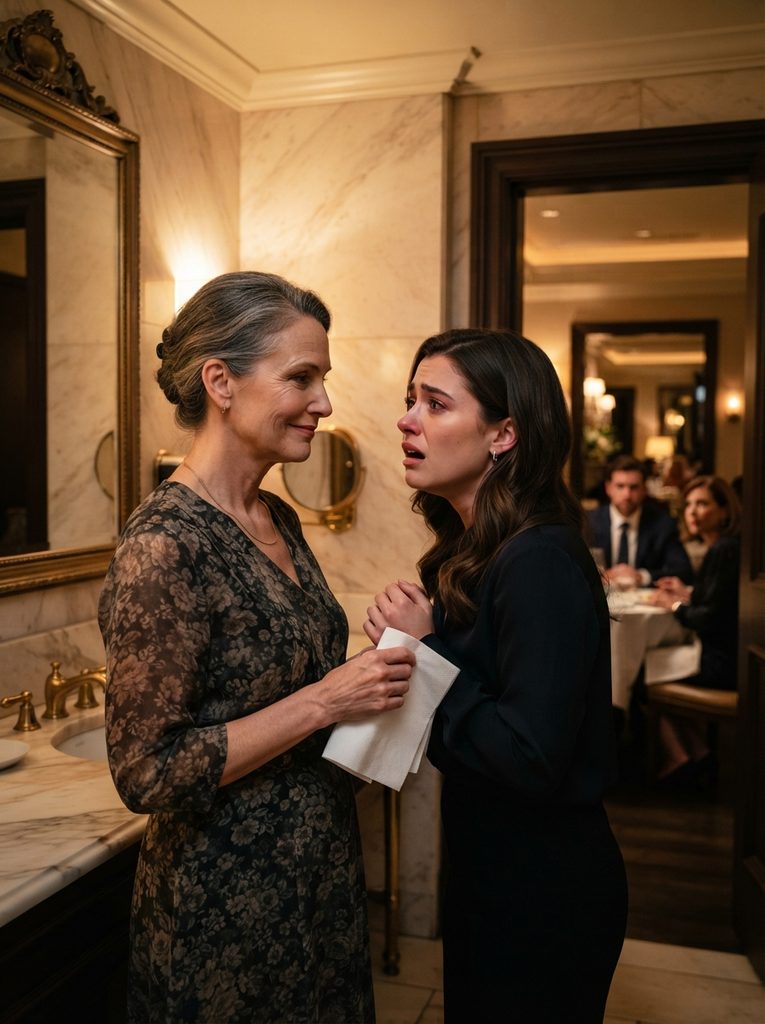
Even the restroom at Bellevue Bistro was absurdly luxurious, featuring floor-to-ceiling Italian marble and polished brass fixtures. Somehow, that surrounding grandeur made the confrontation I was about to have feel infinitely more stressful.
My mother was standing at the mirror, washing her hands carefully. She met my eyes in the reflection as I pushed the door shut behind me. “You haven’t eaten a single full course tonight, Hannah,” she observed quietly.
“Mom,” I started, my voice tight.
“The roasted lamb was prepared exceptionally well,” she added, turning on the towel dispenser.
“Mom, please listen to me,” I pressed, keeping my voice down.
She turned around to face me directly. “What is troubling you so much?”
I lowered my voice to a harsh whisper. “You have so many better clothes in your closet. You know you do. Why on earth would you choose to wear that specific old dress tonight?”
Her expression remained perfectly composed. She paused for a moment before asking, “Are you embarrassed of me right now?”
The question hit me like a blow to the chest, and I hesitated before answering truthfully. “A little bit,” I admitted, feeling a sharp pang of guilt immediately after the words left my lips. “I just wanted tonight to go perfectly, Mom.”
She looked back at her reflection in the mirror. My mother has a very specific expression she uses whenever she is deciding how much of a situation she needs to explain to someone. She never hesitates about what she wants to say, because she always knows her own mind, but she takes a second to calculate the best way to deliver it.
Then she smiled, not the polite, customer-service smile she had used at the dinner table, but her genuine, sharp smile, the one that meant she knew something fundamental that everyone else had missed.
She leaned in slightly closer to me. “Hannah, I did not wear this old dress by accident tonight,” she stated clearly. “I chose it with absolute intention.”
I stared at her in total disbelief. “What are you talking about?”
“Before I explain my reasoning, I want you to tell me what you have actually observed at that table tonight,” she instructed softly, leaning her back against the marble counter.
I folded my arms tightly. “I noticed Standish making subtle, passive-aggressive comments the entire evening. I noticed that she judged you the very second you walked through the front door of the restaurant.”
“Yes, she did,” my mother agreed smoothly. “What else did you notice?”
I paused to process the evening’s interactions. “Luke didn’t care at all.”
My mother nodded approvingly. “Exactly right.”
“Luke has watched you sit there worrying all evening long,” she continued. “He noticed that you were feeling self-conscious and embarrassed, but he has not spared a single critical glance toward my clothing tonight. He did not give his mother a knowing look, he did not smirk, and he did not participate in any subtle shared joke at my expense.”
I stayed quiet, listening to her breakdown.
“He is sitting at that table thinking entirely about your feelings, Hannah, not about the fabric of my dress,” she said firmly. “Now, what did you observe about Charles?”
I thought back to the conversation during the main course. Charles had asked my mother about her work with local businesses, and when she explained how she managed financial structures for small companies, he had mentioned a client of his who was currently struggling with complex cash-flow bottlenecks.
My mother had given him two distinct, practical strategies to resolve the issue, and Charles had immediately taken out his phone to jot down her notes.
“Charles respected what you had to say,” I realized out loud.
My mother nodded again. “Because Charles is a practical man who respects genuine competence. He respected my professional knowledge even while I was sitting across from him wearing a faded twenty-dollar dress.”
I stared at the pale yellow flowers on her fabric, feeling my brain try to reframe the entire night. “What exactly were you trying to accomplish tonight, Mom?”
She gestured toward a plush leather bench against the wall. “Sit down with me for a moment.”
We sat side by side on the bench. “I have been studying Standish all night,” my mother explained calmly. “And now I possess the exact information I needed to discover.”
“What information?”
“Standish is the kind of person who organizes people into neat little social categories,” my mother said. “She looks at a category first, and then she assumes she already completely understands the individual standing inside it.”
She reached down and lightly touched the worn fabric of her skirt. “This dress told her instantly which category she thought I belonged in, and she spent the entire evening talking to that predefined category instead of actually talking to me as an individual.”
The strategy began to take shape in my mind.
“That means I now know something critical about her character,” my mother continued. “She is capable of being fair and gracious when someone exists inside a category she respects, but she becomes patronizing and condescending the moment they do not.”
She paused, looking deeply into my eyes. “And more importantly, I now know something essential about the man you are about to marry.”
“What do you know about Luke?” I asked softly.
“Luke sees you, Hannah,” she said with absolute certainty. “He does not see your economic background, he does not see my old dress, and he does not calculate your family’s net worth. He sees you.”
I stared at her, overwhelmed by the depth of her calculation. “You have been planning this specific strategy for two weeks?”
“I did not plan it out of anxiety,” she corrected gently. “I planned it strategically. I sat down two weeks ago and asked myself what I truly needed to learn about these people before my only daughter tied her life to their family.”
She held up three fingers to tally her points. “First, I needed to know whether Luke truly sees you as an equal partner. Second, I needed to know whether his father evaluates human beings by their practical value and intellect or merely by their superficial presentation. And third, I needed to see what kind of woman Standish becomes when she believes she is standing socially above someone else.”
My mouth opened slightly in shock. “You wore an outdated dress to test my future in-laws?”
“No,” she replied, shaking her head. “I did not wear it to test them. I wore it so that I could see them clearly without their polished masks.”
She looked at her reflection in the mirror once more. “If I had shown up tonight wearing my finest tailored suit, Standish would have adjusted her behavior accordingly. She would have treated me with careful, practiced politeness, and I would have learned absolutely nothing about how she treats people she considers beneath her.”
I sat in complete silence, processing the masterclass in human observation she had just laid out.
“Now I know the truth,” my mother concluded softly. “Luke is precisely the honorable man you believe him to be. Charles is far more open-minded and grounded than his social standing suggests. And Standish…”
She paused, picking her words with extreme care. “Standish is going to be difficult whenever she feels her social standing or expectations are being challenged. But she is not inherently malicious; she is simply rigid in her categories. And people who rely on rigid categories can easily be managed once you understand the specific framework they use.”
I looked down at the tile floor, feeling a remaining trace of anxiety. “She thinks I am beneath Luke too, doesn’t she?”
“At this precise moment? Yes, she probably does,” my mother answered honestly, touching my hand with warmth. “But that perception will change.”
“How can you be so sure?”
“Not because you will spend your life performing to impress her,” my mother said firmly. “You will change her mind simply by being yourself consistently, until she is forced to see that her initial category was completely incorrect.”
She offered a small, knowing smile. “Charles changed his mind tonight in less than twenty minutes. The second he heard me offer practical, high-level financial solutions, the dress immediately ceased to matter to him. Standish will take longer to adjust, but she will get there eventually.”
I shook my head in awe. “Have you always approached the world like this, Mom?”
“Ever since I stepped off the bus in this city at eighteen years old with no money and no family to protect me,” she answered plainly. “You pay close attention to your surroundings, Hannah, and you never let people know just how carefully you are studying them. People always reveal their true nature when they believe no one is paying attention.”
I looked at the dress once more with entirely new eyes. “So the dress was basically camouflage.”
“Exactly,” she confirmed. “You allow yourself to be underestimated so that you can remain unobserved.”
“Is there a difference?”
“There is a massive difference,” she smiled gently.
“You are easily the smartest person I have ever known,” I said softly.
“No, I am not,” she replied, shaking her head. “I have simply spent forty years paying close attention to human behavior. That is very different from raw intelligence, but sometimes, it is vastly more useful.”
I let out a soft laugh, feeling the immense tension in my chest finally dissolve. “What are we supposed to do now?”
“We are going to walk back out to that table, we are going to order dessert, and when Standish drops another passive-aggressive remark, we are going to smile politely and keep moving,” she declared.
Then she pointed an authoritative finger at me. “And you are actually going to eat your food this time. That dark chocolate tart on the menu looked magnificent, and you have spent the last two hours merely pushing vegetables around your plate.”
I laughed again, feeling grounded for the first time all evening.
Just before she turned the brass door handle to exit the restroom, my mother stopped and looked at me through the mirror one last time. “You are going to be completely fine in this marriage, Hannah.”
“How can you be so certain?” I asked.
“Because Luke is a good man in the exact ways that actually matter,” she said softly. “He sees you for who you are, not for a version that fits neatly into his family’s social world. That is the rarest thing, and everything else can easily be managed.”
PART 4: RECALCULATION AND REALITY
When we returned to the dining room, Charles immediately looked up from the table and gestured toward my mother’s chair. “Theresa, I actually just sent a quick email to my client regarding those cash-flow strategies you outlined earlier.”
My mother sat down smoothly, placing her napkin back onto her lap. “And how did he respond?”
“He replied almost instantly saying those two structural adjustments are precisely what his accounting team needed to implement,” Charles said, leaning forward with genuine professional interest. “Have you managed many corporate structures facing similar scaling issues?”
“I currently manage twelve business accounts experiencing those exact growth transitions,” my mother replied smoothly.
From that moment on, the dynamic at the table shifted dramatically. Charles and my mother began engaging in a detailed discussion regarding tax filing regulations, capital allocation strategies, and financial management for growing enterprises. Charles asked targeted questions, and my mother answered each one with effortless authority and incredible clarity.
Finally, Charles shook his head in genuine admiration. “Theresa, would you be open to having coffee with me sometime next week? I have several prominent clients who could desperately benefit from your operational perspective.”
“I would enjoy that very much, Charles,” my mother answered with graceful poise.
I turned my head slightly to observe Standish, and I watched the exact moment the mental recalculation occurred behind her eyes.
The woman she had initially dismissed as unsophisticated because of a faded cotton dress was currently holding a sophisticated masterclass in corporate financial strategy with her husband, and her husband was hanging on every word. Standish’s rigid social box began to shift. It did not vanish overnight, but the boundaries moved significantly, precisely as my mother had predicted.
When the dessert arrived, the chocolate tart was indeed magnificent, and I ate every single bite.
Luke leaned over toward me, whispering softly near my ear. “I thought you told me last week that you didn’t particularly care for rich chocolate desserts.”
“I decided to reconsider my position,” I whispered back with a smile.
He smiled, then glanced warmly across the table at my mother before leaning back toward me. “Your mother is an absolutely extraordinary woman, Hannah.”
“I know she is,” I agreed.
He hesitated for a second, looking down at his napkin. “My mother has been being…” He trailed off, searching for the right word. “Look, I want to apologize for her comment about your mother’s dress looking ‘comfortable’ earlier.”
“It is alright, Luke,” I assured him softly.
“No, it really isn’t alright,” he insisted quietly. “I love my mother dearly, but sometimes her social rigidness drives me completely insane.”
“I think I am finally beginning to understand how her mind works,” I admitted.
Luke looked at me with genuine curiosity. “How so?”
“My mother explained her personality structure to me while we were in the restroom,” I said. “She told me that your mother is a category person.”
Luke stared at me for a split second, and then he let out a quiet sigh of agreement, nodding his head slowly. “That is painfully accurate. She understands social types long before she ever bothers to understand individuals.”
“Yes, exactly,” I agreed.
“I love my mother, but I am fully aware of what she is,” Luke said quietly.
Something about the specific phrasing he used reminded me instantly of my mother. He didn’t just evaluate who someone was on the surface, but what their underlying behavioral patterns were when they weren’t actively performing.
Luke glanced back toward my mother, a subtle smirk forming on his face. “She wore that faded floral dress on purpose tonight, didn’t she?”
I smiled back at him. “Yes, she did.”
“She was testing my family,” he realized softly.
“She would reframe it by saying she was gathering crucial intelligence,” I corrected gently.
“So tell me,” Luke asked, tilting his head. “Did I pass her test?”
“You passed with flying colors,” I confirmed.
He looked genuinely confused for a moment. “What on earth did I do to pass?”
“You did absolutely nothing,” I replied. “That was the entire point of the test.”
“I still don’t quite understand,” he admitted.
“You didn’t react to her dress at all,” I explained. “You didn’t look uncomfortable, you didn’t make a joke, and you didn’t look at your mother for validation.”
Luke frowned slightly, as if the concept of judging someone by their clothing was entirely alien to him. “Why on earth would I react to her dress? It is just fabric, Hannah. Your mother’s clothing is easily the least interesting thing about who she is as a human being.”
I stared at him, feeling a sudden surge of warmth in my chest.
“There are going to be plenty of situations in our marriage where superficial details are thrown around,” Luke continued thoughtfully. “I want us to always be the kind of people who look past the surface to find what actually matters.”
“I want that too,” I said softly.
Luke nodded subtly toward his father. “My dad is going to remember the brilliant financial advice she gave him tonight for months. My mom is going to remember the old dress first, but eventually, she will remember the advice too. It will simply take her a little bit longer to process it.”
I laughed quietly at his sharp insight. “You are significantly more perceptive than I gave you credit for.”
“I have been watching your mother all evening,” he admitted with a warm smile. “She might genuinely be the most fascinating person sitting at this table.”
“She would probably tell you that she is simply paying attention,” I replied.
“That is precisely what makes her so fascinating,” he said.
I looked across the table and noticed that my mother was now conversing directly with Standish. They were no longer discussing corporate accounting; my mother was asking Standish detailed, highly specific questions about a contemporary sculptor whose work Standish had briefly mentioned earlier in the evening.
I watched Standish’s body language transform entirely. Her stiff shoulders relaxed, she leaned forward over her glass, and she began speaking with genuine passion and enthusiasm about her gallery’s upcoming exhibition.
In that moment, I understood the final piece of my mother’s wisdom. She had not worn that old dress out of malice or a desire to punish Standish, nor was she trying to make anyone feel foolish. Once she had gathered the information she needed regarding Standish’s character, she immediately extended the dignity and warmth that Standish had failed to grant her at the beginning of the night.
Beneath all her sharp observation and tactical strategy, my mother was fundamentally a generous soul. She understood that people who rely heavily on social categories often do so because those boundaries make them feel secure in a unpredictable world.
My mother had spent her entire life disrupting those very categories. People looked at her and saw a single mother, a diner waitress, a clerk, or a woman in a faded dress, but the moment she spoke, they were forced to realize that their narrow boxes could never contain her.
By the end of the evening, Standish’s entire disposition had softened. As we gathered in the marble lobby to say our goodbyes, Standish stepped forward and gave me a warm, genuine hug. “Hannah, we are so truly thrilled to welcome you into our family,” she said, and this time, the warmth in her voice was entirely real.
She then turned to my mother with a polite, respectful smile. “Theresa, it was an absolute pleasure meeting you tonight.”
She used the word pleasure, not comfortable.
My mother smiled gracefully. “The sculpture exhibition you described sounds magnificent, Standish. I would love the opportunity to visit the gallery sometime.”
“Please do,” Standish urged warmly. “I will personally send you all the event details tomorrow.”
And I genuinely believed she would.
PART 5: WHAT ACTUALLY MATTERS
When we stepped outside the restaurant, the cold March wind whipped down the city street. My mother pulled on her well-kept wool coat and buttoned it up to her collar. “You need to make sure you eat a proper meal next time we go out,” she instructed gently.
I laughed, wrapping my scarf tightly around my neck. “Are you implying there is actually going to be a next time?”
“There are going to be dozens of family dinners over the coming years, Hannah,” she stated plainly, heading toward her car parked near the curb. “It will get significantly easier for you from now on.”
“Because Standish is going to change her personality?” I asked teasingly.
“No,” my mother corrected, offering a soft smile under the streetlights. “Because you now understand her. Understanding how someone operates is vastly easier than constantly being surprised by their actions.”
I stepped forward to stop her before she reached her car door. “Mom.”
“Yes, sweetheart?”
“Thank you,” I said sincerely. “Thank you for the dress.”
She raised an eyebrow playfully. “I thought my dress made you feel embarrassed earlier.”
“It did at seven o’clock,” I admitted. “But it doesn’t anymore.”
“Good,” she said softly.
She stood quietly in the cool night air for a moment, her eyes reflecting the glowing streetlights. “There is something I probably should have articulated to you years ago, Hannah.”
“What is that?”
“I have spent forty long years paying close attention to the people in this world,” she said gently, looking directly into my eyes. “Ever since I arrived in this city at eighteen with absolutely nothing to my name. And the most valuable lesson I have ever learned is this: the people who are truly worth knowing in this life are always vastly more complex than the narrow social categories others place them in.”
She paused, letting the weight of her words settle between us. “And the only people worth holding close to your heart are the ones who are capable of seeing that truth.”
She gestured back toward the restaurant entrance. “Luke sees it. That was the single thing I came here tonight to discover. I did not care whether he knew which formal fork to use, I did not care how much money his parents possess, and I certainly did not care whether Standish approved of my vintage clothing. I wanted to see how Luke would behave while his mother was dropping those condescending remarks. And now I know.”
I swallowed against the lump in my throat. “He looked at what actually mattered.”
“He looked at you,” she confirmed softly. “That was the entire point of the evening.”
I smiled through the slight mist in my eyes. “What about Charles’s client? Was giving him that financial advice part of your grand master plan too?”
She let out a bright laugh. “No, that happened completely naturally! But Hannah, I really do manage twelve business clients who faced that exact cash-flow bottleneck. If someone asks me a direct question about a subject I have mastered, I am going to give them an accurate answer, regardless of whether I am wearing a designer suit or an old faded dress.”
I laughed with her. “So the dress was camouflage, but you were still completely yourself inside it.”
“Always,” she stated firmly. “That is the critical lesson. You never transform into someone else just to be underestimated by ignorant people. You simply allow them to see whatever superficial surface detail they desperately want to see first, and then you allow reality to arrive right behind it.”
She patted my arm affectionately. “Some people update their thinking rapidly when reality arrives, like Charles did tonight. Other people require a bit more time to process it, like Standish will. But neither type of person is impossible to manage once you understand their framework.”
I looked at my mother with immense pride. “I truly hope I am half as perceptive and wise as you are when I turn fifty-nine.”
“You are already miles ahead of where I was when I was twenty-nine,” she assured me.
“How could I possibly be ahead of you?”
“Because you asked me why,” she answered with a tender smile. “You asked me why I chose to wear the dress tonight. I spent far too many of my younger years simply watching people in silence without asking questions. You ask questions, Hannah, and that gets you to true understanding so much faster.”
She reached up, kissed my cheek gently, and said, “Now go home and get some rest.”
She turned, unlocked her sedan, climbed inside, and pulled away into the night traffic.
I remained standing on the sidewalk for another minute, watching her taillights disappear down the avenue. I thought about her working those relentless double shifts when I was a little girl. I thought about those Saturday nights when she would stand silently in my bedroom doorway just to ensure I was safe before allowing her exhausted body to rest. I thought about the luxurious marble restroom at Bellevue Bistro, the faded yellow floral dress, and the profound wisdom she had shared with me.
People worth knowing are always so much more than their assigned categories, and the people capable of recognizing that truth are the only ones worth being seen by.
Luke’s car was idling near the edge of the valet ramp. He had told his parents earlier that he would call them in the morning, choosing to stay behind specifically to wait for me. He rolled down the passenger window as I walked over. “Your mother is an absolute marvel, Hannah,” he said softly.
“I know she is,” I replied, leaning against the doorframe.
“I really want to invite her out to dinner again next week,” he said.
“You know she will probably devise another clever test for you, right?” I teased gently.
He smiled warmly. “Good. I would love to find out what else she discovers about me.”
“She already told me her final conclusion about you tonight.”
Luke tilted his head, looking up at me with genuine interest. “And what did she conclude?”
“She discovered that you always look at what actually matters in life,” I answered softly.
He looked into my eyes without a moment’s hesitation. “And what actually matters?”
“Me,” I whispered.
“Yes,” Luke answered immediately, his voice filled with absolute conviction. “You are what matters. Are you ready to head home now?”
“Yes, I am,” I said.
I opened the door and climbed into the passenger seat beside him. Luke shifted into drive, and the car glided smoothly onto the street. The bright lights of the city flashed past our windows under the cold March sky, and my thoughts drifted right back to my mother.
She was a woman who had spent four decades walking into rooms where people systematically underestimated her worth. But instead of growing bitter or angry, she simply paid close attention. She listened carefully, she learned constantly, she waited patiently, and she mastered the art of seeing right through people.
That old faded floral dress was never a mistake or an accident. It might very well have been the single smartest thing inside that entire high-end restaurant tonight.
Because that was Theresa Gallagher in her truest essence: underestimated, immensely observant, incredibly patient, and always paying close attention.