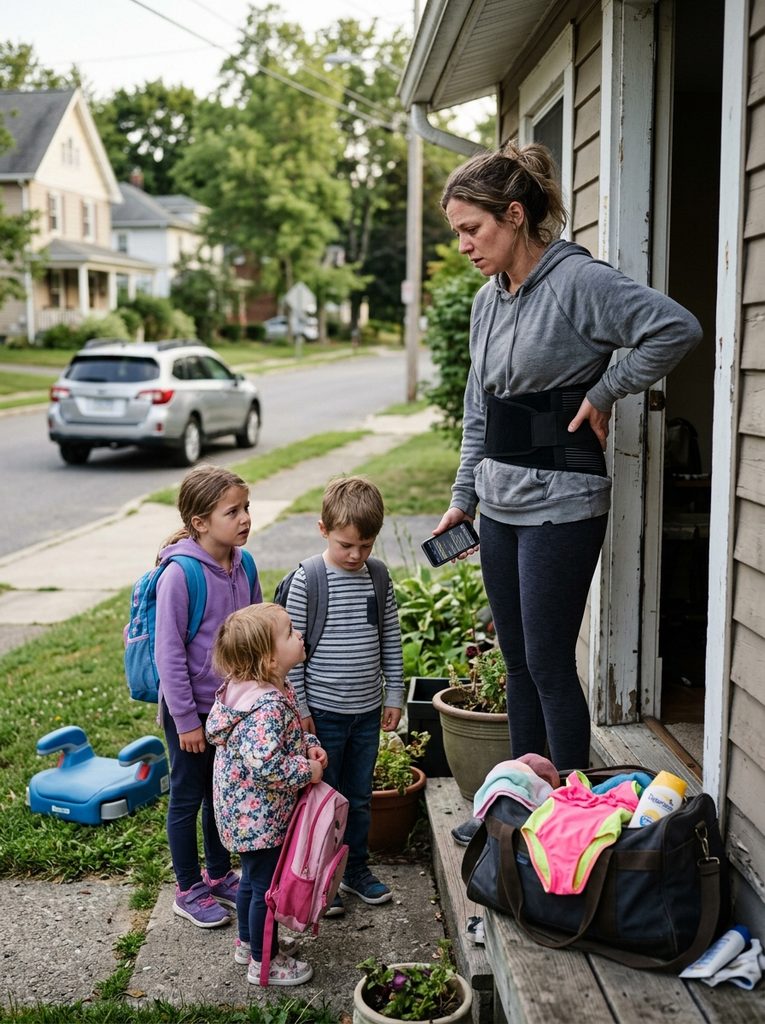
They say you never truly understand how much of your existence relies on the simple act of lifting until the very foundation of your body decides to wage war against you. My name is Jody Lewis, and I am thirty-four years old. For the better part of a decade, my entire identity has been wrapped up in being the sturdy one, the reliable spine of a family that preferred to lean rather than stand. But on a Tuesday afternoon, my literal spine finally mirrored my emotional one: it snapped under a weight it was never meant to carry alone.
I work as a certified nursing assistant at Cedar Ridge Care Center. It isn’t glamorous work, but it is deeply human. I have spent eleven years hauling the fragile parents of strangers out of hospital beds, rotating their bruised bodies so their skin doesn’t tear, and gripping trembling, papery hands at two in the morning when the people who were supposed to love them couldn’t be bothered to answer the phone. I am the proxy daughter for the forgotten.
It was a man named Mr. Ledbetter—eighty-nine years old and possessing the stubborn pride of a rusted tractor—who finally brought me down. He was shuffling down the linoleum corridor when his knees simply vanished beneath him. His entire frame tipped precariously sideways. Instinct overrides protocol in this line of work. I did what every training manual explicitly forbids you to do without a mechanical hoist or a second set of hands: I lunged and caught him.
You simply do not let an eighty-nine-year-old man shatter against hard hospital tile if your body can intervene. He didn’t hit the floor. But I did.
The tear in my lower back was not a dull ache; it was a bright, electric detonation. It felt as though a hot wire had snapped near my pelvis, radiating a blinding agony down my legs. I managed to guide him safely to a sitting position, but when I tried to stand, my breath abandoned me. I walked out of the double glass doors of Cedar Ridge that evening shuffling like a woman three decades my senior, every step sending tremors of nausea into my throat.
The specialist, Dr. Callahan, was a pragmatic man who pointed a silver pen at the luminescent MRI scan displayed on his monitor. He circled a darkened, compressed area near the base of my spine.
“Herniated discs,” he murmured, his tone devoid of sugar-coating. “L4 and L5 are compromised. I’m going to be very clear with you, Jody. No lifting anything over ten pounds. No bending at the waist. No twisting your torso. You will rest this back, or I guarantee you will be looking at a surgical table before the spring thaw.”
Ten pounds. For context, a standard gallon of milk weighs eight. I nodded slowly, writing the number down on a prescription pad as if it were a passcode to my survival.
He wrote me off work indefinitely. I drove back to my house—a place that was more sanctuary than shelter—taped his medical mandate to the humming refrigerator, and surrendered to my living room couch. I spent forty-eight hours with a bag of frozen peas wedged against my lumbar region, learning the agonizing calculus of how to shift from a sitting to a standing position without weeping.
To understand the sheer audacity of what happened next, you must first understand the house I was sequestered in. The property on Cypress Lane belonged to my grandmother, Opal Lewis, long before my name was on the deed. Opal had raised three children within its walls and buried a husband from its parlor. When cancer eventually claimed her vitality, I was the one who packed my life into cardboard boxes and moved in to administer her palliative care. I didn’t do it out of a sense of grim obligation, nor did anyone in my family dare to ask me. I did it because that is simply who I am.
I gave Opal the exact same dignity I afforded my residents at Cedar Ridge, but with her, it wasn’t a profession. It was pure, unadulterated devotion. Opal was the sole figure in my messy family tree who would look me in the eyes, ask, “Are you okay, honey?” and actually have the patience to wait for my honest answer. When she passed away two years ago, she bequeathed the house to me.
My mother, Sandra, bitterly called it an act of blatant favoritism. I called it the only inheritance I would ever require: the profound proof that somebody in this world had finally chosen me.
But I hadn’t managed to purchase her a proper headstone yet. Keep that specific detail locked in your mind, because the weight of that unbought stone is the anchor of this entire tragedy. Out at Winslow Memorial Cemetery, Opal’s resting place was still marked by a flimsy, temporary tin stake provided by the funeral home. Her beloved name was printed on a faded cardboard slip, shielded by cloudy, yellowing plastic. Every week, I drove past the iron gates and whispered an apology to the wind, promising her I would fix it soon.
There was one room in my inherited sanctuary that I absolutely refused to utilize. The spare bedroom at the end of the hall had devolved into my mother’s personal dumping ground. For years, she had used it as an external filing cabinet, dropping off taped boxes of ancient bank statements and obsolete appliances she didn’t want to look at, perpetually adding to the cardboard mountain whenever the whim struck her. She treated my physical space the exact same way she treated my emotional bandwidth, and up until that week, I had been too blind to recognize the pattern.
My mother had spent thirty-four years grooming me for a very specific role. I was designated as the “strong one.” My younger sister, Shelby—four years my junior—was christened the “sensitive one.” This rigid family constitution was drafted before I possessed the vocabulary to veto it. Shelby was permitted to feel the world; I was expected to manage it. My mother keeps a framed photograph in her hallway of me at eight years old, holding newborn Shelby the day she arrived from the maternity ward. I am barely larger than the swaddled infant in my arms. My mother always cooed over that picture, claiming it showcased my innate maternal instinct. Looking at it now, I realize it didn’t capture a sisterly bond; it captured the exact moment I was assigned an unpaid, lifelong career.
I mistook being perpetually useful for being genuinely loved. It is a dangerous illusion, and nobody in your circle will ever correct a misconception that works out so marvelously in their favor.
On the morning of my third day of medical confinement, I was staring at the ceiling, waiting for the anti-inflammatory medication to take the edge off, when my phone vibrated violently against the sofa cushion. A single, ominous word illuminated the glass screen.
Mom.
The text message beneath it was brief and devoid of punctuation.
We have an emergency out of town. Watch them.
I blinked at the screen, the audacity of the demand momentarily overriding my physical pain. I typed back the only unassailable truth I possessed.
I can’t. I am injured. The doctor forbade it.
Three gray typing dots rippled on the screen, signaling her presence. And then… nothing. Absolute digital silence.
I sat there, gripping the warm phone, when the unmistakable crunch of heavy tires on gravel echoed through the walls. Before she had even deigned to reply to my refusal, her vehicle was in my driveway.
I forced myself upward, violating every mechanical rule Dr. Callahan had outlined, bracing my body weight entirely on my forearms as I dragged myself toward the front window. Peeling back the sheer curtain, I saw my mother’s silver SUV already reversing toward the street.
Standing abandoned on my front porch were three incredibly small figures.
Harper, my eight-year-old niece, was gripping the handle of a rolling suitcase that came up to her ribcage. Beside her stood Cooper, a feral six-year-old, his Spiderman backpack strapped securely to his shoulders. And at the bottom of the concrete steps sat Piper, the three-year-old baby, her thumb in her mouth, looking utterly bewildered because no adult had bothered to give her instructions.
The passenger side window hummed down a mere three inches. My sister, Shelby, leaned her head toward the gap.
“They’re good kids, Jode! They won’t be a lick of trouble!” she shouted over the idling engine. The tinted glass was already rising back up to seal her inside. “Mom will text you the details! Love you!”
The tires spun in the loose gravel, kicking up a cloud of pale dust as the SUV rocketed away. Left behind on my manicured lawn was a plastic booster seat, carelessly tossed into the grass like discarded trash. That was my official handover protocol.
By the time my trembling hands managed to unbolt the front door, the red taillights were disappearing around the bend of Cypress Lane. My phone buzzed in my pocket. It was my mother’s delayed response.
Save the selfish excuses. Family helps family.