“Is he asking you for money?”
Mom’s smile disappeared.
For a moment, she looked so startled that I wished I could take the question back. Then her expression changed. Her eyes narrowed, and she folded her arms across the front of her sweater.
“Why would you ask me that?”
“Because I’ve seen him before.”
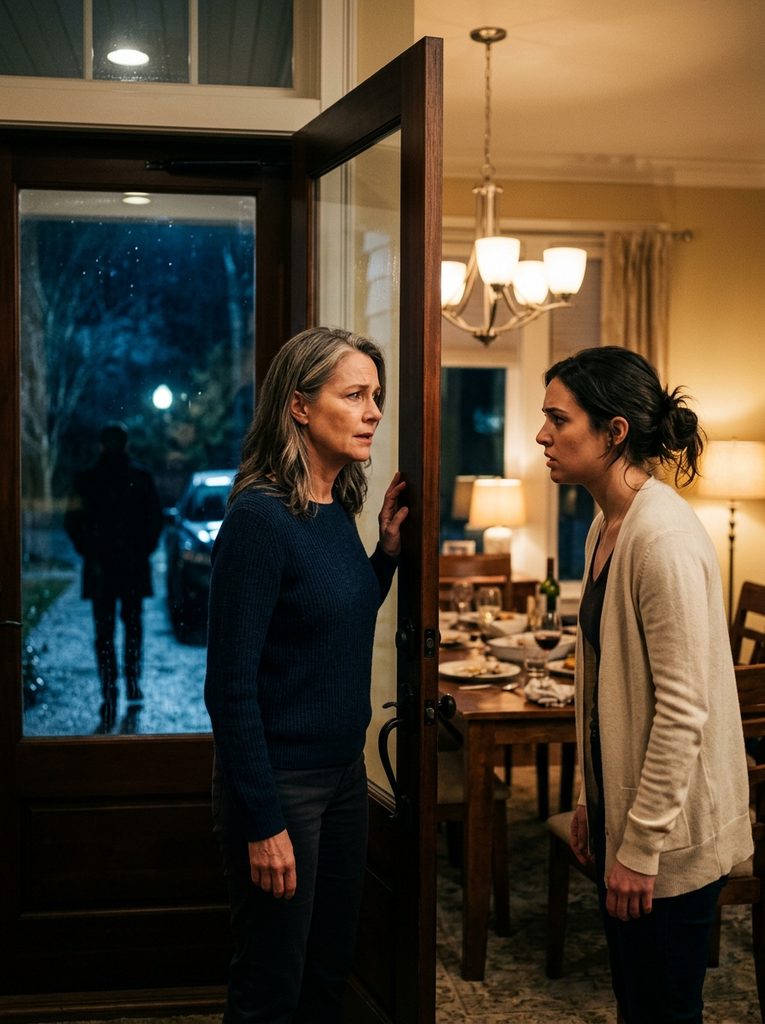
The dining room still smelled of roasted garlic. Three plates sat on the table, and Marcus’s coffee cup was beside the chair he had left empty. Mom had spent all afternoon making dinner. I had spent most of it watching her smile.
Now she glanced toward the front window, where his car had been parked.
“Where?”
“At the county courthouse. Three weeks ago.”
She said nothing.
“I was there for work,” I continued. “He came out of a hearing with a man named Thomas Reed.”
The color left her face.
Thomas Reed was my father.
I had not spoken his name inside that house for years. Mom had never forbidden it. We had simply built a life in which his absence took up less room than everything else.
She pulled out a chair but did not sit.
“What did you hear?” she asked.
“Enough to know they were discussing this house.”
Her fingers tightened around the chair back.
That afternoon at the courthouse, Marcus had been carrying a thick brown folder. My father walked beside him, talking loudly enough for half the corridor to hear.
“She can’t keep pretending I have no claim,” he said.
Marcus had answered in a low voice. I caught only one sentence.
“Then you’ll need to prove it.”
My father had spotted me before I could step away. He smiled, though I doubted he would have recognized me anywhere else. I had recognized him from photographs Mom kept in a drawer she rarely opened.
Marcus saw my reaction. He took my father by the elbow and guided him toward the stairs. Later, when I checked the public hearing schedule, I found a property dispute bearing my parents’ names.
I had wanted to call Mom that day. Instead, I drove to her house and watched her laugh while she told me about a weekend trip with Marcus. She seemed safe. I persuaded myself I had misunderstood what I had seen.
Then Marcus opened her door tonight, smiled politely, and sat down to eat at the table my father was trying to claim.
“Mom,” I said, “why was Marcus with him?”
She finally sat. Slowly, as though her knees hurt.
“I knew you might see the hearing.”
“You knew about the hearing?”
“Yes.”
“And you didn’t tell me?”
“I wanted to understand what Thomas was doing first.”
I looked at Marcus’s empty place. “Does he know you’re dating him?”
“He knows.”
That answer made the room feel smaller.
“How long have you known?”
“Since before the hearing.”
“And you were going to let me sit through dinner without saying anything?”
“I was going to tell you after dinner.”
“You had a whole afternoon.”
“I know.” She looked down at the table. “I kept losing my nerve.”
Outside, headlights passed across the curtains and vanished.
I pulled out the chair opposite her. I had come here ready to protect her. Sitting down felt strangely like surrendering the only advantage I had.
“Start with the house,” I said.
Mom took a breath.
Two months earlier, a letter had arrived from an attorney representing my father. It claimed he still had an ownership interest in the house because his name appeared on an old document signed before he left. Mom had believed that document was settled when they separated. The letter demanded payment for his share or a sale.
She called a lawyer. He told her the claim had serious problems, but resolving them would take time and money. The first hearing had been procedural. The case was still open.
“What does Marcus have to do with it?” I asked.
“He introduced me to the lawyer.”
“Why was he walking with Dad?”
“I don’t know exactly what you saw.”
“I saw Dad tell him you couldn’t keep the house.”
Mom looked toward the dark window again. “Marcus was there because I asked him to come.”
I pushed back from the table.
“Why would you ask your boyfriend to stand beside the man suing you?”
“Because Thomas wanted to speak to me after the hearing. I didn’t want to be alone with him.”
“Marcus looked like he was helping him.”
“I’m sure it did.”
She sounded exhausted, and that frightened me more than anger would have.
“What aren’t you telling me?”
Mom rubbed her thumb over a small mark on the table, one I had made with a hot pan in high school. She had scolded me for it then. Later, she always said it helped her remember how often I had tried to cook for her.
“Thomas called me before the letter came,” she said. “He wanted money.”
“Did you give him any?”
“No.”
“Did Marcus?”
“I don’t think so.”
“You don’t think so?”
“He’s been going over the old records with the lawyer. Thomas tried to speak to him outside the courtroom. Marcus listened. That’s probably what you saw.”
“Why would Dad speak to Marcus?”
“Because he knew we were together.”
I stared at her. “How?”
“Thomas found out about him through someone we both know.”
I had not thought of my father as someone who knew anything about her current life. The idea of him watching from a distance made my skin crawl.
Mom reached for her coffee, then remembered the cup was empty.
“He called Marcus before that hearing,” she said. “He told Marcus I had lied about how our marriage ended. He said there were things about me that Marcus should know.”
“What things?”
“Whatever he thought would make Marcus leave.”
“And Marcus came to dinner without mentioning that to me?”
“I asked him not to.”
I could hear the clock above the sink ticking. For years, Mom had been the person I told everything to, including things I was ashamed of. I had imagined she did the same with me.
“When Dad walked out,” I said, “you told me he didn’t want to be a father.”
Mom’s face tightened.
“He left,” she said.
“That wasn’t my question.”
“It’s still the truth.”
Her phone lit up on the counter. Marcus’s name appeared, followed by a short message. Mom glanced at it and turned the screen facedown.
“Did you ask him to text you?” I asked.
“Yes. When he got home.”
A familiar tenderness crossed her face before she seemed to remember our conversation. That made it harder to decide what I felt about him.
“I know what it looked like at the courthouse,” she said. “But Marcus has helped me. He drove me to the lawyer when I was too upset to drive myself.”
“He should have told me.”
“He wanted to. I stopped him.”
“Why?”
“Because Thomas was already using this to frighten me. I didn’t want him frightening you too.”
“You don’t get to decide whether I can handle it.”
“No,” she said quietly. “I don’t.”
I expected another explanation. Instead, she let the words stand.
I got up to clear the plates because I could not sit still. When I lifted Marcus’s cup, I noticed a small folded note beneath the saucer. My name was written on the outside.
“Did you know he left this?”
Mom shook her head.
I opened it.
I should have spoken to you when I saw you at the courthouse. Ella asked me to wait, but that was my mistake too. I’m sorry. Call me if you want to ask what happened.
A phone number followed.
It was an ordinary note. Its lack of excuses made me feel a little less certain of myself.
“I need to know whether the house is safe,” I said.
“So do I.” Mom stood and took a folder from the kitchen drawer. “The lawyer says we have a strong case. I can show you what she gave me.”
She opened it on the table. There were copies of letters, a hearing notice, and pages covered in notes in Mom’s careful handwriting. I had come expecting to discover she was being fooled by a man she barely knew. The folder showed me she had spent weeks doing work I never knew existed.
At the bottom lay an old envelope with my name on it.
It was yellowed and worn along the edges.
“What’s that?”
Mom went still. “I didn’t mean to put it in there.”
The handwriting was unfamiliar. Across the front, in blue ink, someone had written my first name and the address of this house.
“Is it from Dad?”
“Yes.”
I had grown up believing my father had vanished without trying to reach me. My hands began to shake.
“Why didn’t you give it to me?”
Mom pulled out the chair again. She did not sit until I did.
“It arrived when you were twelve,” she said. “He’d been gone almost seven years. You had just stopped asking whether he was coming home.”
“That wasn’t your choice.”
“I know.”
“What does it say?”
“I’ll let you read it. But I need to tell you something first.”
She held the envelope by one corner.
“When it came, I thought it might be an apology. I opened it. He wanted you to ask me to sell the house and give him money. He wrote that if I refused, it would be because I didn’t care what happened to him.”
I looked at the envelope. My father had known the address. He had known how old I was. He had known I might do anything to bring him back.
Mom’s voice was thin. “I was furious. I put it away. Then I kept putting off telling you.”
“You should have told me when I was older.”
“Yes.”
“You let me believe he never wrote.”
“I did.” Tears filled her eyes. “I’m sorry.”
I slid the letter out. It said what she had described. There was one affectionate sentence near the beginning, enough to make the request that followed hurt more. I read it twice, hoping I had missed something.
Mom waited.
I had imagined, at different ages, that somewhere there might be a letter explaining his absence. Now one sat in my hands, and it explained almost nothing.
“Is this why he’s after the house?” I asked.
“Partly. He’s asked for money before. This is the first time he’s taken me to court.”
I folded the letter along its old creases.
“Why keep it?”
“I thought one day you might want to see it.”
“And when one day came, you were afraid.”
“Yes.”
She had kept it to give me a choice, then denied me that choice for years. Both things were true. I did not know how to forgive the second just because I understood the first.
My phone buzzed. It was an email from a client I could ignore until morning. I set it facedown beside hers.
“How did you meet Marcus?” I asked.
Mom wiped her cheeks. “At the community garden.”
I remembered her mentioning the garden in spring. She had started going on Saturday mornings with a friend and had come home proud of three small tomatoes.
“He was repairing the raised beds,” she said. “I accused him of putting one together backward.”
“Had he?”
“He had. He claims I could have been kinder about it.”
A smile escaped her and faded.
“We became friends. He knew about Thomas before we started dating. I told him when the first call came.”
“What does Marcus do?”
“He restores old houses. He has his own business.”
At the courthouse, his folder and dark jacket had made him look like an attorney. I had never thought to ask who he was. Neither, apparently, had I asked Mom much about the man she loved.
She closed the legal folder.
“There’s something else,” she said.
I braced myself.
“Last month, I got an offer on the house.”
“From who?”
“A couple looking for a place to raise their children.”
I stared at her. “You’re selling it?”
“I haven’t decided.”
“After everything Dad is doing?”
“That’s part of why I’m considering it.”
“Mom, you can’t give him what he wants just to make him go away.”
“I won’t. The lawyer says the case has to be resolved before any sale.” She paused. “I looked into moving before Thomas sent the letter.”
That surprised me more than the offer.
She glanced toward the living room, toward the photographs lined along the mantel. I was in almost all of them. There I was missing my front teeth, wearing a graduation gown, holding the keys to my first apartment.
“This house was right for us,” she said. “I’m trying to decide whether it’s still right for me.”
“Of course it is.”
“You don’t live here.”
“I know that.”
“I know you do.” Her voice was gentle. “But every time I talk about leaving, you look like I’m tearing down your childhood.”
I opened my mouth and closed it.
She was right. I had never said she must stay. Whenever she mentioned downsizing, though, I asked what would happen to the kitchen doorway where she had marked my height. I talked about the tree we planted when I turned ten. I reminded her how much work she had put into the place.
“I thought you loved it here,” I said.
“I do. I also climb those stairs with laundry baskets I don’t need to carry anymore. I spend weekends fixing rooms I hardly enter.” She looked at the photographs. “Sometimes I feel as if I’m keeping a home ready for a child who already grew up.”
The words stung because I knew how hard she had worked to make that home for me.
“Did Marcus suggest you sell it?”
“No. I told him I was thinking about it. He asked where I would want to live.”
“And?”
“I didn’t have an answer. He told me I could take as long as I needed.”
I picked up Marcus’s note again. He had apologized for waiting to tell me about the courthouse. He had left room for me to call. I wanted to believe those were good signs. I was still afraid of how much Mom had hidden.
“Would you have told me about the offer if I hadn’t recognized him?” I asked.
“Yes. Soon.”
“You said that about the hearing.”
“I know.”
Neither of us spoke for a while. The food cooled on the table.
Then Mom said, “Thomas tried to speak to you at the courthouse, didn’t he?”
“He saw me. Marcus led him away.”
“Marcus told me afterward. He said you looked frightened.”
“I was.”
“He wanted to call you that night. I asked him not to.”
“Why?”
“I wanted to call you myself, once I knew what Thomas could actually do. Then the days passed. Every time your name came up, I thought about telling you, and I couldn’t bear to make him part of your life again.”
“He became part of it anyway.”
“Yes.”
I looked at her and saw how tired she was. She had spent years managing crises before I noticed them: unpaid bills, broken appliances, the flu she worked through because she had already used her sick days. I used to think that meant she was never frightened. Tonight, the papers scattered between us said otherwise.
“I’m angry you kept the letter,” I said.
“You should be.”
“I’m angry about the hearing too.”
“I know.”
“But I’m here.”
Her mouth trembled. “I know that now.”
She told me the lawyer’s name and offered to let me come to the next meeting. I said I would, if she wanted me there. She did.
Before I left, I called Marcus from her kitchen.
He answered on the second ring.
“Are you home?” I asked.
“Yes.”
“Mom showed me the note.”
“I’m glad.”
I could hear traffic beyond him and the click of a door closing. He was probably standing in his driveway, still holding his keys.
“I saw you with my father,” I said.
“I know. I recognized you after Ella showed me your photograph. I should have stopped.”
“Why did you walk with him?”
“He approached Ella outside the courtroom. She asked me to stay beside her. When she went to get the car, he followed me and kept talking. I told him the claim had to be proved. Then I saw you.”
“That’s it?”
“That’s it.”
“Mom says you wanted to tell me.”
“I did. She was scared, and I let her decide when. I wish I’d pushed harder to do it together.”
I leaned against the counter. In the dining room, Mom was gathering the plates, giving me privacy in her own house.
“Are you buying this house?” I asked.
“No.”
“Are you lending her money?”
“No. I offered to help with the lawyer’s bills. Ella said she would ask if she needed it.”
“She’s thinking about selling.”
“I know. She was thinking about it when we met.”
He did not try to convince me she was making the right choice.
“I love my mom,” I said.
“I can see that.”
“She’s given enough to other people.”
“I agree.”
It would have been easy for him to say more. I was grateful when he waited instead.
“I’m going with her to the lawyer,” I said.
“I’m glad she asked you.”
After we hung up, I helped Mom put away the leftovers. She handed me a container, as she always did, and watched me fit the lid over it.
“Marcus asked if I wanted to visit the coast next month,” she said. “Just for a weekend.”
“Do you want to go?”
“I do.”
“Then go.”
She studied my face, checking whether I meant it. I did, though I was not ready to tell her I liked him. I was not ready to talk about the house again either.
At the door, I picked up my coat. Mom came over and straightened its collar, an old habit she seemed to notice only after she had done it.
“I wish I’d told you sooner,” she said.
“Me too.”
We stood there with the hallway light between us. I thought about the letter in the folder, the meeting ahead, and how much there was still to sort out. Then Mom took her hand from my collar and let me go.
Everyone Laughed at Olivia’s Empty Scoreboard Until the Chief Referee Checked the Targets Beyond It.
“Still nothing on the board?”
Marcus Reed’s voice carried across the Colorado shooting range as Olivia Hayes lowered the borrowed rifle. Above the scoring station, the display beside her name showed a bright red zero.
A few spectators laughed. Someone near the front raised a phone higher.
Olivia eased her finger clear of the trigger and kept the muzzle pointed downrange. Her oversized hoodie tugged in the mountain wind.
Marcus glanced at the scoreboard, then at the people watching him.
“You sure you can shoot?”
Olivia opened the rifle’s action. The small metal click sounded sharper than the laughter.
She did not answer. She watched a flag snap beside the distant targets.
Marcus took another step toward her firing position. His black competition jacket rustled, its sponsor patches catching the daylight.
“Come on,” he said. “You heard me.”
Olivia placed her palm beside the rifle’s stock. Her worn white sneakers remained planted on the concrete line.
Behind Marcus, a woman lowered her phone slightly. She seemed disappointed that Olivia would not argue.
At the scoring station, Chief Referee Ethan Cole lifted his eyes from a clipboard. A burst of radio static interrupted the wind.
Olivia felt Marcus waiting for her to look at him. She kept her attention downrange.
The metal targets stood beyond a stretch of pale gravel and dry grass. Past them, almost lost against the mountains, were smaller fixtures.
The crowd could see the official targets clearly. That was all most of them had come to watch.
Marcus spread his hands toward Olivia’s empty score.
“You’ve got everybody curious now,” he said.
Olivia closed the action carefully. She heard Ethan’s clipboard shift against his hand.
For a moment, the laughter faded enough that she could hear a loose plate rattling far away.
Marcus mistook her silence for embarrassment. His grin widened.
Olivia knew what the scoreboard said. She had watched it after every shot.
She also knew where she had aimed.
A young range assistant stepped toward Marcus, then hesitated. Marcus stood beside Olivia’s lane, close enough to pull every spectator’s attention toward her.
“Give her room,” Ethan called from the scoring station.
Marcus lifted both hands, smiling as he backed half a step away.
“Plenty of room, Chief.”
Olivia kept her eyes on the far end of the property. A white range flag turned, stalled, then snapped hard to the east.
The rifle belonged to the range. Its stock felt unfamiliar against her cheek, and its trigger broke later than she preferred.
None of that mattered to the people laughing. They had seen her lower it after three shots and watched her score stay at zero.
Across the aisle, a competitor in a red cap studied his own score before glancing toward Olivia. He looked away when she caught him.
Marcus leaned toward him. “At least somebody’s hitting steel today.”
Another scattered laugh followed. It was quieter this time.
Ethan looked from Olivia’s firing position to the official targets. He had spent twenty years watching shooters miss in every imaginable way.
Most missed shots brought a reaction. A curse, a frown, a hurried adjustment.
Olivia had done none of those things. After each shot, she had waited with the rifle steady, listening downrange.
Ethan glanced at the paper in his hand. Olivia’s lane assignment was correct. The borrowed rifle had passed its morning check.
He watched her left hand rest near the stock. It was still.
At the edge of the crowd, a teenager stopped filming and whispered something to his father. His father shook his head.
Marcus noticed Ethan watching.
“She knows the targets are up there, right?” Marcus called.
Ethan did not smile. “Stay behind her line.”
Marcus returned to the spectator side of the painted boundary. The soles of his shoes scraped against the concrete.
Olivia took one slow breath. She had expected the scoreboard to remain empty, but she had not expected so many people to gather.
A phone shutter clicked behind her. Another followed.
She thought of the folder she had handed over at registration. The clerk had placed it beneath a stack of waivers without opening it.
The elderly official who needed that folder had been out in the calibration area. Olivia had seen his navy windbreaker near the fence earlier.
Now she could not see him.
Marcus pointed toward her rifle.
“Is it broken?”
“No,” Olivia said.
Her answer seemed to please him. A working rifle made the empty scoreboard more entertaining.
“Then we agree on one thing.”
Olivia closed her mouth. The wind pressed a loose strand of hair against her cheek.
Ethan heard the answer and looked again at her posture. He had expected her to blame the equipment if she spoke at all.
Olivia rolled her shoulder once, easing a knot beneath the hoodie. She had carried heavy cases across the gravel before sunrise.
She had also asked a technician to confirm which sensors were active. He had told her the official score system was ready.
She had asked about the auxiliary system next. He had looked surprised, then said its diagnostic feed was running.
That was enough for her to take the firing position.
Marcus folded his arms. “I’d quit while there’s still ammunition left.”
Olivia glanced at him, then back downrange. “I’m finished shooting.”
His eyebrows rose. “That much is obvious.”
Several spectators laughed again. Ethan heard a technician’s keyboard tapping inside the control booth.
Olivia’s final shot had gone out minutes earlier. She had remained at the line because the check was not finished.
Her cheeks warmed under the crowd’s attention. She disliked being watched, even when she understood why people had gathered.
A gust rolled through the range. The nearest flags snapped together, one after another.
Ethan stepped closer to the edge of the scoring station.
“What are you waiting for, Ms. Hayes?”
Olivia looked at him. He had used her name without looking down at his clipboard.
“A reading,” she said.
Marcus gave a short, disbelieving laugh.
“From what?”
Olivia’s gaze returned to the mountains. She did not answer him.
Ethan followed her line of sight past the official targets. A narrow maintenance road crossed the far end of the range.
Beyond it stood the auxiliary calibration fixtures. Range staff used them to check equipment, and competitors rarely had reason to notice them.
Ethan felt the first pull of concern.
“Everyone saw those misses,” Marcus said.
Olivia turned toward him at last. Her face was flushed by wind and attention, but her voice stayed even.
“Maybe you watched the wrong thing.”
The words settled over the firing line. Marcus’s grin held for another second, then tightened.
Ethan lowered his clipboard.
“Hold the range,” he called.
A horn sounded once. Conversations broke off as the range assistants signaled the other lanes to stop.
Olivia stepped back from the rifle. Ethan crossed the gravel toward the control booth, his khaki pants brushing against the tall grass.
Marcus moved to follow him. Ethan raised one hand.
“Stay there.”
The booth door stood open. Inside, two technicians looked up from the official scoring monitors.
Ethan pointed past them. “Check the auxiliary sensors now.”
One technician turned in his chair. “Those aren’t feeding the scoreboard.”
“I know. Pull the diagnostic record.”
His fingers began moving over the keyboard. The other technician leaned toward a second monitor.
Marcus heard enough to turn back toward Olivia.
“What were you doing?” he asked.
She rested both hands at her sides. “Waiting.”
“For what?”
“The reading.”
He searched her face for a smile and found none.
Inside the booth, a diagnostic tone sounded. The technician leaned closer to the screen.
Ethan moved beside him. The first entry showed a registered impact on a distant calibration plate.
The time matched Olivia’s first shot.
A second entry appeared beneath it. Then a third.
Ethan checked the times against the official lane log. They matched the moments when Olivia’s scoreboard had stayed at zero.
He looked through the booth window toward the mountains. At that distance, the fixtures were barely distinguishable from the pale ground.
“Run the raw data,” he said.
The technician typed again. The monitor changed.
Outside, Marcus watched the booth. He could no longer see Ethan’s expression through the glare.
“What’s taking so long?” he asked.
No one answered. Olivia saw the woman who had filmed her check her screen, then lower the phone.
The second technician pulled another set of readings onto the monitor. His chair creaked as he leaned forward.
“Chief,” he said, “this data looks strange.”
Ethan studied the display. Each impact appeared on a different auxiliary fixture, yet all three aligned with Olivia’s lane.
He checked the sensor identifiers twice.
“Could be a fault?” the first technician asked.
“Could be,” Ethan said. “Send officials downrange.”
He lifted his radio. Two officials answered from the maintenance road.
Marcus watched them begin the long walk beyond the competition targets. Their boots kicked gravel into the bright afternoon air.
The wait gave him time to reconsider his jokes. He looked toward the official scoreboard.
Olivia’s zero still glowed above the crowd.
“That display’s accurate,” Marcus said.
“It is,” Ethan replied as he came out of the booth. “For the official targets.”
Olivia met his eyes.
Ethan stopped a few feet from her. “Where exactly were you aiming?”
She raised her hand and pointed past the competition field.
The movement drew every gaze with it. Marcus turned, squinting into the distance.
“The calibration area?” Ethan asked.
Olivia nodded. “Three fixtures.”
A murmur moved through the spectators. The official targets stood far enough away to challenge experienced competitors.
The calibration fixtures were farther.
Marcus shook his head. “You expect us to believe that?”
Ethan kept watching Olivia. “Did you know the auxiliary feed was active?”
“I asked this morning,” she said. “Your technician confirmed it.”
The first technician came to the booth doorway. “I did. She asked before the range opened.”
Marcus looked between them.
“Why would a competitor ask that?”
Olivia did not answer. Ethan noticed her eyes move toward the maintenance road.
The two officials were approaching the first fixture. One lifted an arm to shade his eyes.
Ethan’s radio crackled.
“We’re at the west plate,” an official said. “Give us a minute.”
The crowd drew closer to the painted spectator line. A range assistant reminded them to stay back.
Marcus stepped aside, letting a couple move ahead of him. For the first time that afternoon, he seemed content to be out of the center.
Ethan spoke into the radio. “Confirm the plate and its sensor tag.”
More static followed. One official knelt beside the fixture.
Olivia folded her arms against the breeze. Her hands had begun to feel cold.
She knew the impacts were there. She had seen the faint movement through the rifle’s optic after each shot.
The electronic reading mattered for another reason. A person could inspect a plate and see damage. A safety system needed to report it reliably.
Ethan looked at her again. He understood why she had waited, though he still did not understand who had asked her to perform the check.
The radio came alive.
“West plate has a fresh strike,” the official said. “Tag matches the first sensor.”
A low sound passed through the crowd. Marcus’s jaw tightened.
“Check the other two,” Ethan said.
One official moved toward a second fixture while the other photographed the first. Their progress was slow across the uneven ground.
Olivia watched without speaking.
Marcus found his voice. “Anybody could have hit that plate earlier.”
Ethan glanced at the booth. “The record is timed.”
“Records can be wrong.”
“That’s why they’re inspecting it.”
Marcus looked away. The woman with the phone stood near him. She made no move to raise it again.
At the second fixture, an official bent close to the metal. A moment later, he waved toward the booth.
The radio crackled. “Fresh strike on the center fixture. Sensor tag matches.”
Ethan pressed his lips together. He had seen remarkable shooting at this range, including some of Marcus’s.
What unsettled him was Olivia’s patience. She had let the scoreboard announce zero while she waited for proof of a different result.
The third official check took longer. The fixture stood at the far edge of the calibration area, where the ground rose toward the mountain.
A loose plate rattled in the wind. Olivia recognized the sound from her firing position.
“Why didn’t you tell me?” Ethan asked her quietly.
“I tried at registration,” she said. “The official I needed was already downrange.”
“You could’ve told me.”
“You were running the competition.” She glanced toward the spectators. “I planned to wait for him.”
Ethan remembered the early morning rush. He had been settling a scoring dispute while people lined up at the desk.
Olivia had passed within a few feet of him, carrying a sealed folder. He recalled it only now.
Marcus heard the exchange.
“What’s in the folder?”
Olivia looked at him. “You’ll hear when Ethan does.”
Her calm answer made him shift his weight.
A burst of static broke the silence. The third official had reached the last fixture.
“Hold on,” he said.
Ethan raised the radio. “What do you see?”
The official did not answer immediately. Metal scraped faintly through the speaker.
He asked the other official to come over. Their voices faded as they moved away from the radio.
The crowd waited. Even Marcus kept his eyes downrange.
Olivia knew the last plate had moved after her shot. She had held the rifle steady long enough to see it turn.
She wondered whether its sensor had recorded the same clean impact as the first two. The delayed check gave her no answer.
Inside the booth, a printer started and stopped. A technician brought Ethan a narrow sheet of diagnostic results.
The third entry remained on it. A reading could still be wrong.
Ethan folded the paper once and kept it in his hand.
“You shot at all three?” he asked.
“Yes.”
“With the range rifle?”
“Yes.”
Marcus made a small sound in his throat. The borrowed rifle lay open and untouched on the bench.
Ethan studied her. She wore a faded hoodie and old sneakers. Her ponytail had nearly come loose in the wind.
Nothing about her clothes explained her aim. Nothing required them to.
Marcus had treated those details as evidence, and Ethan had allowed the crowd to take its cue from the scoreboard.
The radio clicked again.
“Third fixture has a fresh strike,” the official reported. “Sensor tag matches the final entry.”
No one laughed. The range assistant nearest Olivia looked down the long field, then back at her.
Marcus opened his mouth. He closed it when Ethan turned toward him.
Ethan did not say anything yet. He checked the three entries on the folded sheet.
All three times matched Olivia’s shots.
Olivia let out a breath she had been holding. Confirmation felt quieter than she had expected.
The officials began walking back, but another figure was already coming along the maintenance road.
He wore a navy windbreaker and carried a sealed folder beneath one arm. His silver hair moved in the wind.
Olivia recognized him. She stepped away from the firing bench to meet him.
Ethan recognized him too. “Mr. Whitaker.”
James Whitaker had helped establish the range’s safety procedures years before Ethan became chief referee. He still oversaw equipment reviews.
He approached without hurrying. His face looked tired from the walk, and dust covered the edges of his shoes.
“I heard the hold call,” James said. “The officials found the plates?”
“All three,” Ethan replied.
James looked at Olivia. “I’m sorry you had to wait.”
“You were doing the field inspection,” she said.
“I was.” He touched the folder under his arm. “The desk finally got this to me.”
Marcus looked at the seal. “What is that?”
James turned toward him. For years, he had watched Marcus shoot, improve, and collect trophies at this range.
He had also heard the laughter over the radio while he walked back.
“You should ask who she is,” James said.
Marcus turned toward Olivia. His face had lost its color.
Far downrange, an official lowered a loose metal plate into place. It struck its mount with a clear ring.
James opened the folder.
“Olivia Hayes is the engineer overseeing the auxiliary sensor review,” he said. “She came to test these fixtures under live conditions.”
Ethan looked at the diagnostic sheet in his hand.
James continued. “The range requested an independent shooter. Olivia designed the validation procedure and chose to perform it herself.”
Marcus glanced at the scoreboard. The zero was still there.
“She never shot at the competition targets,” James said. “The official display recorded exactly that.”
Ethan turned the folded paper over. “And the auxiliary system recorded all three impacts.”
“Which is why she came,” James said.
Olivia felt the crowd watching her again. This time, the attention carried a different weight, and she still disliked it.
A spectator asked how far away the fixtures were. Ethan gave the distances listed for the calibration area.
The man looked back downrange and fell quiet.
Marcus rubbed a hand over his mouth. “You could have said something.”
“I could have,” Olivia said. “I was waiting for James to confirm the test.”
“You let everyone think you missed.”
She held his gaze. “You decided what the zero meant.”
Marcus looked toward the phones. Several people had recorded his remarks, along with her silence.
His eyes returned to Olivia. “I was out of line.”
“Yes,” she said.
The word landed without force. Marcus nodded once and stepped back.
James gave Ethan the folder. Inside were the test request, Olivia’s credentials, and the procedure she had filed before arriving.
Ethan scanned the first page. The authorization was signed by the range director.
He remembered seeing the request on his morning schedule. He had expected the review later, after the competition lanes closed.
James noticed his expression. “I moved the field inspection forward. I should have told you.”
Ethan shook his head. “I should have opened the folder at registration.”
“We can fix the handoff,” James said.
Olivia watched Ethan read the remaining page. She appreciated that he finished before speaking.
“The recorded impacts are valid,” he told her. “My technicians can preserve the data for your report.”
“Thank you.”
One of the technicians came out of the booth. “All three sensors reported correctly. I saved the raw files.”
Olivia nodded. “Please include the time log.”
“Already attached.”
The easy exchange eased something in her chest. She had spent weeks preparing the procedure, and the test had produced the evidence she needed.
Ethan turned to the range assistant. “Leave the scoreboard as it is for now.”
Marcus looked up sharply. Olivia did too.
Ethan explained, “It shows no competition hits. That’s accurate. The diagnostic record tells the rest.”
Olivia studied the red zero. She had feared Ethan might erase it to spare her embarrassment.
She had not come for a score. She had come for a reliable reading.
The range assistant closed the firing position while the officials returned from the calibration area. The crowd began to break apart.
The woman who had filmed Olivia came forward. “I’m sorry I laughed.”
Olivia saw the phone in her hand. “I heard you.”
The woman looked down. “I’ll take the video down.”
Olivia considered her answer. “You can decide what to do with it.”
The woman nodded and walked away slowly.
Marcus remained near the spectator line. Other competitors greeted him as they passed, but none stayed.
He looked toward Olivia’s rifle, then toward the distant fixtures.
“I thought you were trying to enter the round,” he said.
“I know.”
“I saw the hoodie, the borrowed rifle, the score.” His voice roughened. “I filled in everything else.”
Olivia bent to lift her rifle case. The handle had left a red mark on her palm that morning.
“You said it out loud,” she replied.
Marcus took that in. He did not reach for another explanation.
“I’m sorry, Olivia.”
She met his eyes. “I accept the apology.”
Relief flickered across his face, then faded when she picked up the case and turned toward Ethan. An apology had settled their conversation. The afternoon had still happened.
James walked with them toward the booth. Gravel crunched under their shoes.
Ethan asked Olivia whether the delayed inspection affected her report.
“No,” she said. “I needed the sensor readings and the plate checks. Both are there.”
“Would you have fired again if a sensor failed?”
“Yes. After finding out why.”
Ethan glanced at her. “You were sure of the shots?”
“I was sure where I aimed.” She paused. “The readings were what I came to verify.”
James smiled faintly. Ethan understood the distinction.
Inside the booth, the technicians displayed the three sensor records together. Olivia leaned toward the monitor while they explained the readings.
The first two were clear. The third showed a slight delay, followed by the confirmed impact.
Olivia pointed to the time difference. “That needs a note.”
The technician enlarged the entry. “Could be the sensor mount.”
“Let’s inspect it before anyone adjusts it,” she said.
Ethan wrote the instruction on his clipboard. The work gave everyone something practical to do.
Outside, competition officials prepared to reopen the other lanes. The horn sounded twice, and voices returned to the range.
Olivia signed the diagnostic printout. James signed beneath her name.
Then she carried her case toward the parking lot. The afternoon sun lit the pickup trucks, the gravel, and the mountain road beyond them.
Ethan caught up beside the gate. “I’m sorry I didn’t ask sooner.”
“You asked when you noticed something was wrong,” Olivia said.
“I should have noticed before the crowd did.”
She stopped by her car. Through the fence, the official scoreboard still showed her zero.
Ethan followed her glance.
Olivia said, “Keep the diagnostic record with it.”
“I will.”
James reached them a moment later with the signed folder. Olivia took it and slid it into her case.
She looked down at the worn white sneakers she had bought for another long workday. Fine gravel had collected around the soles.
From the range came the distant sound of a shot, then a clean strike on metal. She listened until the sound faded.
Olivia opened her car door and set the case inside. The folder rested beside it, carrying the proof she had come for.
Before she got in, she looked once more toward the far plates. They were almost impossible to see from the gate.
In the clear mountain air, one of them gave a soft rattle. Olivia smiled to herself, closed the door, and drove home.