Chapter 1: The Price of Blood
For eight exhausting, relentless years, I had quietly deposited $8,000 into my mother’s bank account on the first of every single month. It was a silent sacrament, a financial tithe meant to bridge the chasm of grief that had swallowed our family whole. Then, on a chaotic Monday morning, I asked her to watch her seven-year-old grandson for three days.
Her response was a casual, unblinking demand. “Five thousand dollars a day.”
I actually pulled the smartphone away from my ear, staring at the glowing screen as if the device itself had malfunctioned. I pressed it back to my cheek. “Mom, what? Five thousand a day?”
“Fifteen total,” she repeated, her tone as crisp and unbothered as freshly ironed linen.
It was a little after seven in the morning. I was standing in my kitchen in Columbus, Ohio, balancing on one foot as I tried to jam my heel into a stiff leather pump, simultaneously attempting to spread thick peanut butter onto a piece of burnt toast. My son, Ethan, sat perched at the marble island, blissfully ignorant of the escalating tension. He was methodically munching on colorful cereal rings, reading the nutritional information on the back of the cardboard box with the intense scrutiny of an investigative journalist uncovering breaking news.
Just twenty minutes prior, the fragile architecture of my week had collapsed. My boss had phoned with a crisis. One of our senior commercial underwriters had been rushed to the hospital overnight. A massive corporate client we had been courting for eighteen grueling months had abruptly moved a crucial meeting forward. Somebody needed to be sitting in a high-rise boardroom in Chicago by Tuesday morning.
That somebody was me.
Under any normal circumstance, I would have dialed Denise. Denise was the saintly woman who had been helping me navigate the turbulent waters of single motherhood since Ethan was in preschool. She was a rare, magical entity who possessed the uncanny ability to locate a missing left sneaker in the dark, coerce a stubborn child into consuming steamed broccoli, and recall library return dates without ever glancing at a calendar. Tragically, Denise was currently somewhere in Nashville, drinking mimosas and celebrating her younger sister’s wedding.
Panic had set in. I had frantically cycled through two backup sitters. One was violently ill with a stomach bug; the other was utterly incapable of staying overnight past eight in the evening due to her own familial obligations. I was standing at the edge of professional failure, seriously contemplating calling my boss to resign myself to the fact that I simply couldn’t go.
Then, the thought of my mother, Patricia, drifted into my mind.
I had intentionally avoided asking her to keep Ethan overnight when he was an infant. While she professed a deep love for her grandson, the fragility of babies made her visibly anxious. Toddlers, with their erratic, destructive energy, left her utterly depleted. Furthermore, anything tangentially related to diapers apparently violated several international treaties of personal comfort she had established for herself.
But Ethan was no longer a chaotic toddler. At seven years old, he was a small, relatively functional human. He could dress himself in somewhat matching clothes, meticulously pack his superhero backpack, recite his school bus schedule, and forge his own peanut butter toast—provided you accepted a culinary methodology that concluded with leaving the sticky knife standing perfectly upright in the center of the Jif jar.
Three days felt entirely manageable. So, swallowing my lingering apprehension, I had made the call.
“You need me for all three days?” she had inquired, her voice cautious.
“Tuesday morning straight through to Thursday evening,” I pleaded, rushing to smooth over the logistics. “I’ll leave absolutely everything prepped and ready. His school clothes, his homework folder, pre-packed lunches in the fridge. You can just stay here at the house if it’s more comfortable for you.”
A heavy, suffocating pause had descended over the cellular connection.
Then came the invoice. Five thousand a day.
A short, breathless laugh escaped my lips because my brain, desperate for logic, assumed she was deploying a deeply cynical brand of grandmotherly humor.
She did not laugh back. The silence stretching between us was absolute.
“For… what exactly?” I stammered, the peanut butter knife hovering uselessly in the air.
“For my time, Laura.”
“Mom, I’m asking you to stay with Ethan. I’m asking you to watch your grandson.”
“I fully comprehend what you are asking,” she countered. And that singular, clinical phrase bothered me far more than it probably should have. She plowed forward, adopting that agonizingly patient cadence people reserve for explaining basic arithmetic to a stubborn child. “You make a very lucrative salary, Laura. And you still have Daniel’s money. If I am forced to surrender three entire days of my life, that is three days where I am stripped of my ability to make my own plans.”
My mother was sixty-nine years old and had been fully retired for over a decade. I bit my tongue so hard I tasted copper, barely suppressing the urge to ask precisely which vital corporate board meetings or international summits I was so rudely disrupting.
Instead, a cold numbness washed over me. “You’re completely serious?”
“Why on earth wouldn’t I be?”
I shifted my gaze to Ethan. He was currently, and with profound concentration, attempting to balance three plump blueberries on the convex back of his silver spoon.
My mother’s voice pulled me back. “If you hired a professional service, you’d have to pay a stranger, and it certainly wouldn’t be fifteen thousand dollars.”
“Well, I’m not a stranger,” I shot back, a desperate edge creeping into my voice. “I’m your daughter.”
“My time isn’t free, Laura.”
I cannot articulate exactly what fractured inside my psychological architecture in that precise fraction of a second. There was no theatrical lightning strike, no swelling orchestral soundtrack indicating a shift in the protagonist’s journey. Primarily, I was just bone-deep, soul-crushingly tired. I was exhausted from the relentless grind of corporate underwriting, exhausted from the solitary burden of raising a child entirely alone, exhausted from the perpetual mental gymnastics of calculating who could retrieve him from after-school care when client negotiations ran late.
And suddenly, with a terrifying clarity, I realized I was utterly exhausted from negotiating basic human decency with my own mother.
“Fair enough,” I whispered.
She abruptly went quiet, clearly thrown by the lack of resistance. “What? Fifteen thousand. Do we have a deal?”
Her tone had pivoted instantaneously from aggrieved victim to eager merchant.
“Oh. Well, alright then,” she stuttered slightly, recovering her composure. “I’ll… I’ll come over today. Just make absolutely certain you send the transfer before you board your flight. I don’t want any administrative confusion.”
That naked greed should have ignited a blazing inferno of rage within me. Instead, it merely calcified the coldness spreading through my veins. “There won’t be any confusion,” I said flatly, and severed the connection.
I executed the wire transfer via my banking app before I even ate lunch. By the time dinnertime rolled around, Patricia had called the house twice to eagerly inquire about Ethan’s favorite television shows, suddenly sounding downright euphoric about the prospect of indulging in grandmotherly duties.
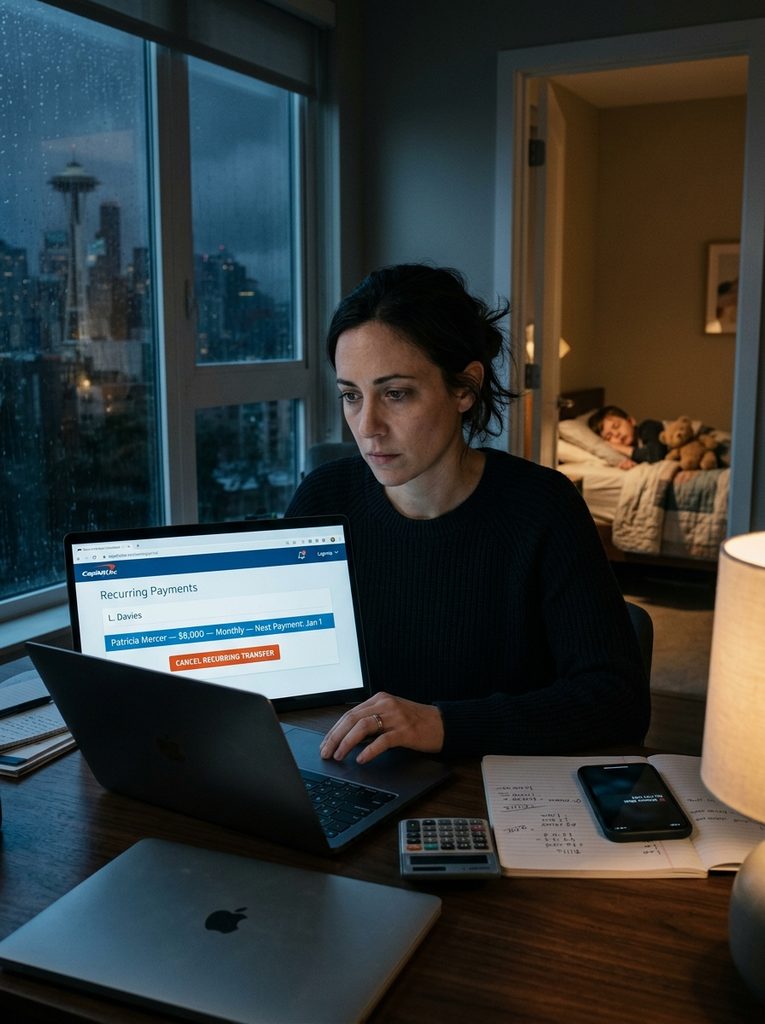
Later that night, after I had read Ethan a story and tucked him into the soft fortress of his blankets, I descended the oak staircase and flipped open my sleek silver laptop on the kitchen island. I wasn’t plotting revenge. At least, that was the lie I whispered to the dark kitchen.
I navigated through the security portals of my primary bank account and accessed the automated recurring transfers tab.
There it sat, glowing softly on the high-definition screen.
Patricia Mercer: $8,000 — Monthly.
The inaugural payment had been initiated eight long years ago, shortly after the devastating cardiac event that claimed my father’s life. In the foggy, grief-stricken aftermath of that era, the financial arrangement had seemed undeniably logical. My mother had wept openly, confessing that my father had left behind a mountain of concealed debt, far more bills than she had ever anticipated. The aging suburban house required immediate structural work. Her fixed income was terrifyingly inadequate. She was drowning.
I, conversely, had liquid capital.
My husband, Daniel, had passed away from a brutal, aggressive pancreatic cancer just twelve months prior to my father’s death. Between Daniel’s comprehensive life insurance policies, his robust retirement portfolios, our entirely paid-off mortgage, and my own aggressive ascent up the corporate ladder, Ethan and I were enclosed in a fortress of absolute financial security.
I possessed the capacity to rescue my mother from ruin. Therefore, I acted.
That eight thousand dollars a month was initially framed as a temporary crutch, a six-month bridge to help her restructure her life. Yet, through a slow, insidious creep of unspoken expectations, “temporary” had mutated into an eight-year permanent installation.
And that monthly stipend was merely the baseline. There had been the lavish European vacations she claimed she needed for her mental health, the extravagant Christmas presents, the milestone birthdays, the emergency roof repairs, the sudden need for a newer vehicle.
With a trembling finger, I opened the digital calculator application.
Eight thousand, multiplied by twelve.
Ninety-six thousand dollars a year.
I typed the number eight into the multiplier field to represent the years.
My lungs seized. I slammed the laptop shut before the final sum could materialize on the screen. I was entirely unequipped to perceive that number. It felt like staring directly into the sun.
Instead, I sat in the suffocating silence of my immaculate kitchen, staring blindly at the brushed metal casing of the computer. And for some inexplicable reason, a memory of Daniel breached the surface of my mind.
It was a mundane, remarkably ordinary recollection. Nothing cinematic. My mother had phoned us late one rainy Tuesday evening, her voice trembling, pleading for an injection of cash for some manufactured crisis I couldn’t even specifically recall anymore. I had ended the call with a heavy sigh and immediately logged into my accounts, frantically shifting funds from savings to checking.
Daniel had been standing by the sink, methodically loading dinner plates into the dishwasher. He paused, wiping his hands on a damp towel, and looked across the granite counter at me. His eyes, usually so warm, were uncharacteristically serious.
“You know you don’t have to fix every broken thing in the world, right?” he had asked gently.
I had bristled, my defensive walls snapping into place. “She is my mother, Daniel.”
He had simply nodded, turning back to the porcelain plates. That was the entirety of the exchange. No screaming match, no protracted debate. Daniel possessed a profound, quiet wisdom; he always knew when my mind was locked in a vault of its own making, impenetrable to outside logic.
I hadn’t unearthed that specific conversation from the archives of my memory in years. Now, sitting alone in the dark, his voice echoed off the tile walls as clearly as if his ghost were leaning against the counter beside me.
Slowly, deliberately, I opened the laptop once more. The screen illuminated my face in a pale, ghostly blue.
My mother’s next eight-thousand-dollar injection was queued up, scheduled to deploy on the first business day of the impending month. Hovering directly adjacent to the bold text was a small, unassuming gray button.
Cancel Recurring Transfer.
My right hand, gripping the wireless mouse, remained paralyzed for a small eternity. The cursor hovered over the digital precipice.
This is the juncture in the narrative where I wish I could declare that a surge of righteous, feminine empowerment washed over me. I wish I could say I felt like a warrior. I did not.
I felt wicked. I felt undeniably mean.
My mother had been absorbing this financial lifeblood for nearly a decade. She felt entitled to it. She had undoubtedly architected her entire existence, her social calendar, her standard of living, around its guaranteed arrival. And buried deep beneath my corporate armor, a frightened, deeply conditioned child still believed that if a parent demanded a sacrifice and you possessed the means to provide it, you simply bled.
Then, cutting through the static of my guilt, her clinical voice replayed in my ears.
My time isn’t free.
I depressed the mouse button. The click sounded deafening in the empty room.
A sterile confirmation dialogue box bloomed on the screen, demanding final authorization.
I clicked again.
It was finalized. There was no triumphant monologue delivered to an empty room, no blistering, expletive-laden text message sent into the ether. I didn’t spitefully cancel her upcoming cruise, nor did I demand my fifteen thousand dollars in extortion money be returned.
I simply closed the machine, meticulously checked the deadbolts on the front and back doors, and ascended the stairs to pack my tailored suits for Chicago.
Before retiring to my own empty bed, I lingered outside Ethan’s bedroom. The door was ajar. He was sprawled diagonally across his twin mattress, the victim of a chaotic slumber, one small, socked foot protruding from beneath his Avengers quilt. I stood perfectly still in the doorframe, watching the rhythmic rise and fall of his chest for much longer than was necessary.
Then, I walked away. For the first time in ninety-six months, the pipeline of wealth to my mother was severed. The first of the month was looming, and the woman had absolutely no idea the drought was coming.
Chapter 2: The Sound of Silence
When I dragged my exhausted body through my front door late Thursday night, dragging a roller bag fresh from Chicago O’Hare, I discovered my mother and Ethan seated at the kitchen table, locked in a fierce, high-stakes game of Uno.
The fragrant, savory aroma of homemade meatloaf lingered heavily in the air. The dishwasher was humming its rhythmic, cleaning cycle, and a quick glance toward the mudroom confirmed Ethan’s homework folder was already securely tucked inside his backpack. No, Patricia had not neglected her grandson. It is crucial for the integrity of this record to state that.
My mother, when properly motivated, possessed a bottomless well of performative generosity. She truly loved Ethan. Whatever deeply rooted, toxic rot had infected the soil between her and me, I never harbored the delusion that she would actively harm him.
“Mom let me eat a bowl of mint chocolate chip ice cream on Wednesday night!” Ethan announced, slamming down a Draw Four card with triumphant glee.
I pointed a stern, accusatory finger at him. “Traitor.”
“And we consumed giant chocolate chip pancakes this very morning,” Patricia chimed in, shuffling her hand. “I can see you suffered terribly in my absence.”
Ethan flashed a gap-toothed grin that sustained itself for a solid ten minutes. Everything in the house felt terrifyingly, seductively normal.
Eventually, Mom enveloped Ethan in a tight embrace, gathered her monogrammed overnight tote, and pressed a dry, perfunctory kiss against my cheek.
“Thank you for ensuring the funds were transferred promptly,” she murmured, her voice low enough that Ethan couldn’t catch the transactional nature of her gratitude.
Not, I was so glad I could spend this quality time with him. Not, You are welcome to call me anytime.
I forced a rigid smile onto my face. “Drive safe, Mom.”
After the taillights of her sedan vanished down the suburban street, Ethan trailed behind me like a shadow as I hauled my luggage upstairs. I was in the process of hanging a silk blouse in the closet when he spoke, his tone dripping with the casual innocence only a child possesses.
“Grandma said Uncle Jason needs to get another loan.”
My hands froze on the velvet hanger. “I’m sorry, what did you just say?”
He was cross-legged on my duvet, methodically extracting complimentary hotel ballpoint pens from the depths of my leather tote bag. Apparently, these plastic trinkets were his primary inheritance. “She was talking on her cell phone to Uncle Jason yesterday while I was trying to do my math worksheets.”
I forced my vocal cords to relax, projecting an aura of absolute nonchalance. “Oh? And what did Grandma say to him?”
Ethan offered a careless shrug, uncapping a blue pen. “She told him, ‘Don’t stress out about it. Laura always comes through in the end.’”
I stared blankly at the floral pattern of the blouse trembling in my grip. “Did she happen to say anything else, buddy?”
“I don’t really know. Hey, can I keep this pen? The clicker is really loud.”
“Sure. It’s yours.”
And for Ethan, the conversation evaporated. But for me, the words ignited a slow-burning fuse.
Laura always comes through.
I had endured variations of that exact sentence echoing through the corridors of my adult life for decades. Laura can handle the pressure. Laura secured a fantastic corporate job. Laura is the responsible one. Laura can easily afford it.
Being perpetually labeled as “the one who can afford it” masquerades as a flattering compliment regarding your competence, right up until the agonizing moment you calculate the hidden tax it levies upon your soul. Nobody ever pauses to inquire what your limitless capacity costs you.
My mind began connecting the fragmented dots of the past three years.
There was the incident with Mom’s aging SUV. She had called me, her voice trembling with manufactured terror, claiming the vehicle was emitting a “horrific grinding noise.” When I pressed her on whether a certified mechanic had inspected it, she deflected. The mechanic claims it’s a money pit. I just don’t feel physically safe operating it on the highway anymore, Laura.
She had driven that particular SUV for over twelve years. I hadn’t perceived replacing it as an outrageous request for an elderly woman. She located a significantly newer, premium model she adored. I blindly wrote a check to the dealership for twenty-seven thousand dollars to cover the difference.
Exactly six months later, I navigated my car into my brother Jason’s driveway for our annual Thanksgiving gathering. Parked gleamingly beside his garage was Mom’s supposedly “unsafe, grinding” old SUV.
My Aunt Rose had parked simultaneously. She stepped out of her sedan, adjusted her glasses, and squinted at the vehicle. “Pat, isn’t that your old Ford?”
My mother hadn’t missed a single, deceitful beat. “Oh, yes. Jason was in desperate need of something reliable to transport the children.”
Jason, my older brother, had sired two energetic children. Therefore, according to the twisted Mercer family constitution, his lack of reliable transportation immediately qualified as a Level One Family Emergency.
I distinctly recall staring at my mother across the frost-covered lawn. “You just gave it to him?”
She had furrowed her brow, looking at me as if I had aggressively questioned the laws of gravity. “Well, what else was I supposed to do, Laura? The dealership was going to offer me practically pennies for a trade-in.”
“You explicitly told me the car wasn’t safe to drive.”
“I told you I didn’t feel safe driving it.”
That semantic gymnastics routine had arrived half a year too late. Aunt Rose had shot me a fleeting, penetrating look. I recognized the burning questions etched into her expression, but I possessed absolutely zero desire to transform our Thanksgiving feast into a vicious courtroom interrogation before the turkey was even carved. So, I swallowed the bile and let the issue die on the frozen grass.
That was my superpower. I was an Olympic gold medalist at letting things go.
Then, my mind drifted to the basement debacle. Mom had called me on a bleak winter morning, practically hyperventilating, claiming she had discovered standing water in her lower level following a torrential downpour. She wept, lamenting that the necessary contractor repairs were going to obliterate her meager emergency savings.
I wired the funds without a second thought.
A mere three months later, my sister-in-law, Melissa, was gleefully scrolling through her phone, shoving photos of her newly remodeled kitchen into my face. Custom oak cabinetry, gleaming quartz countertops, high-end stainless appliances. We finally pulled the trigger, Melissa had beamed. That ancient kitchen was severely depressing my mood.
The timeline had felt oily and wrong. Later that week, I had gently probed my mother, asking if, perhaps, any of the “basement flood money” had mysteriously migrated to Jason’s household renovation fund.
Her entire facial structure had hardened instantly, morphing into a mask of pure, offended martyrdom. “Do you seriously, genuinely believe I would look my own flesh and blood in the eye and lie?”
“No, Mom, I was merely asking a logistical question—”
“That is a horrific, vile accusation to hurl at your own mother, Laura!”
“I am not accusing you of a crime!”
“You most certainly formulated the question to sound like an indictment!”
By the conclusion of that miserable phone call, I was the one apologizing. That was the most sickening detail. Not the vanished thousands, but the groveling apology. I had posed a fundamentally reasonable inquiry regarding capital I had generously provided, and somehow, through her masterful emotional alchemy, I was the one left feeling profoundly ashamed.
During those years, I had manufactured elaborate justifications for my willful blindness. At least, that was the narrative I fed myself to sleep.
When the monthly payments commenced, Daniel had been in the ground for a little over a year. My father followed him into the earth shortly thereafter. Enduring two funerals in such a compressed, agonizing timeframe fundamentally rewires your psychological relationship with conflict. You begin whispering toxic mantras to yourself in the mirror: It’s only paper. It’s only money. You convince yourself that you would much rather embrace generosity than suffer the agonizing regret of being stubborn after someone is forever gone.
More than anything, I desperately desired for Ethan to experience the warmth of an extended family. I craved the chaotic Sunday dinners, the overflowing living rooms on Christmas mornings, the presence of a doting grandmother clapping in the folding chairs at elementary school pageants.
If lubricating the friction with my mother cost me ninety-six thousand dollars a year, well… I could afford it.
There was that cursed phrase again.
The first of the month finally arrived. For the first time in nearly three thousand days, eight thousand dollars remained securely anchored within my own checking account.
And absolutely nothing happened.
There was no frantic phone call. No furious, all-caps text message. I found myself obsessively refreshing my phone’s notifications throughout the workday, my stomach tied in a knot of anticipated dread.
By the time the sun dipped below the horizon, the reality of the situation crystalized. My mother was still sitting on the vast majority of the fifteen thousand dollars I had transferred to her for three days of childcare. Apparently, in a twist of cruel irony, I had personally financed my own grace period.
I barked a harsh, solitary laugh in my living room when the realization struck. It wasn’t born of humor. Sometimes, the life choices you make are so profoundly, absurdly self-destructive that manic laughter is the only viable alternative to a psychological breakdown.
Three agonizing days later, the digital silence was broken. A text message vibrated against my desk.
Did something bizarre happen with your banking institution this month?
I stared at the black text bubbling on the bright screen for a full five minutes. The cursor blinked, demanding a response. Finally, my fingers moved.
Everything is functioning perfectly on my end.
On the screen, three gray dots appeared, indicating she was typing. Then they vanished. They appeared again. Vanished.
I shoved the phone face down beneath a stack of actuarial reports. That tiny, digital dance felt infinitely worse than a screaming match. More than once during that tortuous week, I launched my banking application, my thumb hovering over the reactivation switch. Thirty seconds. That was the totality of the effort required to make the suffocating, unspoken tension evaporate.
But I didn’t press it. The dam had cracked, and the water was beginning to rush through.
Chapter 3: The Grocery Store Tribunal
By Wednesday, the mounting psychological pressure had begun to visibly manifest. At the office, my closest colleague, Maya, finally decided to intervene.
Maya leaned her frame against the glass door of my office, holding a steaming cup of herbal tea. “You have been staring blankly at that exact same PDF page for fourteen minutes, Laura.”
I blinked, breaking my trance. “It’s a highly complex commercial liability document.”
Maya arched an eyebrow, pointing a manicured finger at my monitor. “It’s a company-wide email detailing the new parking garage protocols.”
I looked at the screen. She was entirely correct. Defeated, I rubbed my temples and invited her in. Over lukewarm coffee in the breakroom, I unloaded a highly sanitized, abbreviated version of the crisis.
When my frantic monologue concluded, Maya didn’t offer platitudes. She studied me intently. “Have you ever genuinely attempted meditation?”
I scoffed, a bitter sound. “Maya, my anxiety is so high I can barely tolerate sitting motionless at a red traffic light without checking my emails. I would implode.”
“Then you might actually despise this,” she replied, a small smile playing on her lips. “Excellent sales tactic.”
She proceeded to describe an introductory Vipassana meditation weekend she had recently endured at a retreat center nestled in the dense woods an hour outside the city limits. The rules were draconian: absolutely no cellular devices permitted during sessions, strict vows of silence, and predominantly spending hours sitting on a hard cushion, merely observing whatever agonizing thoughts surfaced without immediately leaping to fix or react to them.
“That sounds like a meticulously designed form of psychological torture,” I observed.
“Oh, it was sheer agony for the first twenty-four hours,” Maya admitted. “And then… eventually… it became slightly less terrible.”
Operating entirely against my own better judgment, and desperate for any mechanism to quiet the screaming in my head, I registered for the weekend.
The initial morning of the retreat was a physical and mental catastrophe. My knees throbbed with a dull ache, my lower back screamed in protest against the posture, and a burly gentleman seated directly behind me breathed through his nose with the concussive force and rhythmic consistency of a heavy-duty shop vacuum.
Instead of achieving some profound state of inner tranquility, I spent nearly ninety consecutive minutes engaged in a blistering, imaginary, screaming argument with my mother inside the theater of my mind.
However, somewhere deep within the oppressive silence of that cavernous room, I observed something profoundly useful. A deeply distressing thought would materialize. It would peak, burning hot in my chest. And then… if I simply did nothing… it would eventually dissipate. An uncomfortable, suffocating emotion would arrive, demand my attention, and if I refused to feed it with action, it would inevitably recede like the tide.
I realized, with staggering clarity, that I was not obligated to immediately fix either the thought or the feeling.
Late Sunday evening, I navigated my car back to civilization, retrieved Ethan from Denise’s warm, chaotic house, and discovered another digital missive waiting like a landmine on my phone.
Laura, it is imperative that we discuss the financial situation.
I read the words. The ancient, deeply ingrained urge instantly flooded my nervous system. Explain yourself. Grovel. Apologize. Fix the discomfort.
Drawing on the weekend’s grueling lessons, I placed the phone face down on the cool quartz countertop. I did not reply.
Moments later, Ethan wandered into the kitchen, clutching a crumpled, neon-green piece of paper he had miraculously forgotten to present to me three days prior.
“Mom, this field trip permission slip is due first thing tomorrow morning.”
I looked at his earnest, completely oblivious face. He offered me his most devastatingly innocent, gap-toothed smile.
I couldn’t help but laugh, a genuine sound that startled us both. Some things, it appeared, I was still fundamentally required to fix.
Over the subsequent three weeks, Patricia’s digital communications abandoned all pretense of subtlety.
The first escalation was cloaked in aggressive politeness. I am operating under the assumption that you will promptly rectify whatever technical glitch occurred with the monthly transfer.
Seventy-two hours later: Laura, this silent treatment is becoming utterly ridiculous.
And finally, a command: Call me. Now.
I did initiate a call. I simply refused to engage with her predetermined agenda. I would cheerfully inquire about her garden, her health, the weather. She would enthusiastically demand updates on Ethan’s soccer league. We would navigate perhaps four minutes of a superficially normal, pleasant conversation before the inevitable pivot occurred.
“So,” she would sigh heavily, “regarding the banking situation…”
“There is no banking situation, Mom,” I would reply, my voice perfectly level.
“Then when precisely are you intending to fix it?”
“Mom, Ethan’s spring choral concert is scheduled for next month. Are you planning to attend?”
A sharp intake of breath. “You are deliberately changing the subject, Laura.”
“Yes. I am.”
She terminated the call by slamming the receiver down on me twice in one week.
The most disturbing revelation of this entire ordeal was that I still harbored a deep, pathetic desire to call her. That realization shocked me. I had spent weeks convincing myself that I was fueled entirely by righteous fury. But anger was a remarkably easy companion to live with. Missing my mother’s voice while simultaneously, deliberately choosing to upset her was a far more agonizing existence.
Every time my phone remained silent for more than forty-eight hours, a corrosive doubt would eat at my resolve, whispering that perhaps I was the villain of this narrative, that I had pushed her too far.
Then, Saturday detonated.
I was navigating the chaotic aisles of the local mega-grocery store, manning a shopping cart piled high with frozen chicken breasts, bulk laundry detergent, organic cereal, and approximately forty dollars’ worth of vibrantly colored, heavily processed snacks that Ethan had passionately argued were critical to his continued survival.
My phone began violently vibrating against my hip. Mom.
I ignored it, tossing a bag of apples into the cart.
Thirty seconds later, the device vibrated again. Then, a call from my brother, Jason. Then, Mom again. The sheer velocity of the calls signaled a breach of protocol.
I wrestled my cart out of the congested center aisle, seeking refuge near the dairy coolers, and swiped to accept the call.
“Mom? What exactly did you do?”
She was speaking at a volume so piercing I had to hold the speaker an inch from my ear. “What in God’s name are you talking about?”
“My debit card, Laura! What about it?”
Through the receiver, I could discern the unmistakable acoustic signature of a public space. Muffled announcements, the rhythmic beep of a barcode scanner, the low hum of impatient shoppers. She sounded as if she was in the epicenter of a crisis.
“Where exactly are you, Mom?”
“I am at the Easton Town Center!” she hissed, naming the sprawling, high-end outdoor shopping complex.
“Of course you are,” I muttered, pressing two fingers hard against my eyelids. “What, pray tell, were you attempting to purchase?”
“That is entirely irrelevant to the situation at hand!”
Which meant, without a shadow of a doubt, she was not attempting to buy essential groceries or life-saving medication. She was likely at a boutique.
She abruptly lowered her voice to a furious, venomous whisper. “I am currently standing at a register, a line of people staring at me, and my card has been brutally declined.”
“I am still failing to comprehend what you expect me to do about that.”
A brittle, crackling silence stretched across the cellular network. When she finally spoke, her voice was glacial. “The money, Laura. It hasn’t arrived. Do not play these childish games with me.”
I knew exactly what she was referencing. I also recognized, with a pang of guilt, that I shouldn’t derive a sick sense of satisfaction from forcing her to articulate the demand aloud.
“So, I stopped the automated monthly transfer,” I stated clearly.
“Yes, you stopped it!” she shrieked softly.
Another beat of silence. “I stopped it.”
“Until when?!” she demanded.
“I stopped it permanently, Mom. What does that signify to you?”
“It signifies…” Her voice faltered. “It means there won’t be another one?”
For a fleeting moment, the only audio feed was the generic, upbeat pop music piping through the boutique’s ceiling speakers. Then, she released a short, breathy laugh. It contained zero amusement. It was the specific auditory reaction people emit when they believe reality itself has committed a gross administrative error.
“You can’t just… do that,” she stammered.
“I have already done it.”
“Why?!”
I inhaled deeply. I hovered on the precipice of screaming, Because you demanded five thousand dollars a day to watch your own flesh and blood. I teetered on the edge of unleashing the meticulously crafted, blistering monologue I had rehearsed in the shower twenty different times.
Instead, I chose the most impenetrable armor available. “Because I am simply not doing it anymore.”
Her tone hardened into diamond. “That is my money, Laura.”
I slumped against the cold metal of the shopping cart, oblivious to the woman trying to access the milk behind me. “Your money? Are you listening to yourself?”
“You know perfectly well what I mean!”
“No, Mom. Actually, I don’t.”
“I have fixed monthly bills structured entirely around that incoming capital!”
“Then I strongly suggest you begin adjusting your fixed bills to match your actual income.”
“Laura, I am sixty-nine years old!”
“You possess a robust pension. You collect maximum Social Security benefits. Your mortgage was paid off a decade ago.”
“That is not the point!” she wailed.
Apparently, the laws of mathematics and logic were entirely irrelevant unless they aligned with the reality she demanded I validate. Sensing she was losing ground on the financial front, she seamlessly executed a tactical pivot to emotional warfare.
She began reciting a weaponized litany of her maternal sacrifices. She aggressively reminded me of the expensive piano lessons she funded when I was nine. She weaponized the orthodontia bills that straightened my teeth, the college application fees she had mailed, the agonizing nights she had spent sleeping in a hard plastic chair beside my hospital bed when I contracted severe pneumonia at age fourteen.
She cataloged the things mothers are biologically programmed to do, transforming them into a ledger of outstanding debts.
And because familial guilt is a ruthlessly efficient assassin, a small, dark part of her strategy succeeded. A familiar tightness gripped my throat.
Sensing the hesitation, she moved in for the kill. “After every single thing I sacrificed to build your life, you are genuinely going to nickel and dime your own mother? Nickel and dime?“
I nearly barked a laugh at the sheer audacity. “An influx of ninety-six thousand dollars a year has somehow been downgraded to loose change?”
“I am not demanding you return anything to me! You possess more wealth than you could ever spend. That abundance doesn’t magically make it all yours to hoard.”
And then, she deployed the nuclear option.
“And let us not conveniently forget, Laura… over half of the wealth you are currently sitting on came directly from Daniel’s death anyway. It is not as though you earned every single dollar with your own two hands.”
That sentence struck me with the kinetic force of a physical blow. The air rushed from my lungs. She knew instantly that she had drawn blood.
Daniel had labored relentlessly, sacrificing weekends and evenings, to build the financial fortress he left for us. The life insurance payout wasn’t some miraculous, joyful lottery windfall. It existed as a blood-soaked consolation prize because a brilliant, kind, forty-three-year-old man had his body ravaged by mutated cells and was robbed of the privilege of watching his only son grow into a man.
My voice dropped to an unrecognizable, hollow whisper. “I have to terminate this call.”
“Laura, do not act like this. I will speak with you later.”
“I am hanging up.”
“Don’t you dare—”
I tapped the red icon. The phone went dead.
I navigated my cart to the front of the store, checked out in a robotic haze, and drove home. It wasn’t until I began unpacking the bags on the kitchen island that I realized I had left the store without purchasing the chicken breasts.
Apparently, establishing firm emotional boundaries was catastrophically detrimental to effective meal planning.
That evening, after I had checked on Ethan three times, I sat alone in the gloom of the living room and authenticated into my banking app.
I navigated to the transfer portal. I input the data.
Patricia Mercer. $8,000.
Every digit was entered. The system was primed. All that was required to extinguish the raging inferno consuming my family was the depression of a single, glowing blue button.
I sat immobilized in the darkness for what felt like hours. Part of my brain wasn’t even analyzing my mother’s abhorrent behavior at the boutique. I was mourning the future. I was visualizing the impending Thanksgiving without a turkey, Ethan’s school concert with an empty folding chair, Sunday afternoons devoid of chaotic family dinners. I was grieving all the mundane, beautiful, ordinary rituals that instantly evaporate when two stubborn adults decide that neither will be the first to surrender.
Then, the phantom echo of Daniel leaning against the kitchen counter returned.
You know you don’t have to fix every broken thing, right?
When he had originally spoken those words, I had arrogantly assumed he was referencing the mechanics of my bank accounts. Sitting alone in the dark, the crushing weight of realization settled over me. He wasn’t talking about money at all. He was talking about my soul.
I deleted the pending transfer.
When the sun rose, I typed out a single, definitive text message.
Mom. I love you deeply, but I will no longer be supporting you financially. The arrangement is permanently over.
I tossed the device into a designated desk drawer and spent the next hour helping Ethan concoct an elaborate, flour-dusted batch of waffles.
When I finally retrieved the phone late that afternoon, the screen displayed seventeen unread messages.
I refused to read them until the house was asleep. When I finally scrolled through the vitriol, I found a chaotic spectrum of emotion. Some missives were laced with pure, unadulterated venom; others played the role of the mortally wounded victim.
But one specific message snagged like a fishhook in my heart.
I look at you now, and I do not recognize the cold, heartless person my daughter has become.
That single sentence broke me. I sat at the kitchen table, a mug of chamomile tea growing ice-cold between my hands, and I wept. It wasn’t a dramatic, cinematic breakdown. It was a quiet, agonizing leak of sorrow. I stared blindly at the wall, torturing myself with the possibility that I had just annihilated my relationship with the woman who gave me life, all over a sum of money that, technically speaking, I could afford to surrender without altering my lifestyle.
There was absolutely no rush of triumphant vindication. There was no empowering music. Mostly, there was just an ocean of corrosive doubt.
Chapter 4: The Triangle of Deceit
The ensuing evening, the doorbell chimed a harsh, discordant note through the house while I was upstairs wrangling Ethan into his pajamas.
I hurried down, flipped the porch light on, and peered through the peephole. My brother, Jason, was standing on the welcome mat, his shoulders hunched against the evening chill, looking as though he were preparing to breach an enemy bunker.
I unbolted the door and stepped out onto the concrete porch, pulling the heavy door mostly closed behind me to shield Ethan from the impending blast radius.
Jason didn’t bother with pleasantries. “What the absolute hell is transpiring between you and Mom?”
“Keep your voice down,” I hissed, glancing nervously at the neighborhood windows.
“She called me three hours ago, completely hysterical. Sobbing.”
“Then I suggest you continue speaking with her. I’m not her therapist.”
“I did speak with her, Laura. That is precisely why I drove over here.”
I crossed my arms tightly across my chest, shivering slightly in the cool air. “Jason, this is an internal dispute between Mom and me. It doesn’t involve you.”
“The hell it doesn’t.”
Something in the raw, desperate timber of his voice caught my immediate attention. The aggressive posture faded slightly, replaced by genuine panic.
“She claims you just arbitrarily halted the monthly payments,” he accused. “No warning. No transition period. Just cut the cord.”
“It was capital I voluntarily chose to gift her for eight consecutive years, Jason. Yes, I stopped.”
“And now you are executing a punitive strike against an old woman just because she had the audacity to ask to be compensated for babysitting?”
I let out a harsh breath. “If you honestly believe this is merely about a fifteen-thousand-dollar babysitting invoice, you haven’t been paying attention.”
“Then what is the true motive, Laura?”
I studied my older brother’s face, the deep lines of stress etched around his eyes. A devastating realization began to bloom in my mind. There was never going to be an acceptable limit. There was no magical dollar amount that would finally quench the thirst.
He shook his head violently, frustrated by my silence. “You possess absolutely zero comprehension of what this reckless action is doing to Mom. What it’s doing to everybody.”
I furrowed my brow, genuinely perplexed. “What exactly does ‘everybody’ mean?”
Jason began pacing the narrow confines of the porch, running a hand through his thinning hair. “She has established financial commitments, Laura! Obligations!”
“As do I.”
“You generate significantly more revenue than any of us combined!”
And there it was. The Mercer family motto, resurrected by a new speaker. You can afford it.
“I never once flaunted my income, Jason.”
“You don’t have to announce it; the math speaks for itself!” He stopped pacing and whirled to face me, his eyes blazing. “You cannot simply wake up one random Tuesday, decide you are bored with being the benefactor, and abruptly sever our lifeline without a shred of advanced warning!”
The ambient noise of the suburban night seemed to instantly vanish. The crickets went silent. The wind died. Everything within my physical form went deadly quiet.
Jason’s jaw clamped shut. He seemed to process the catastrophic weight of the specific pronoun he had just deployed a fraction of a second too late.
I stared at him, my gaze unwavering. “Our lifeline?”
He physically flinched, looking away toward the glow of the streetlamp at the end of the driveway. Neither of us dared to breathe. The temperature on the porch seemed to plummet ten degrees. I could see the condensation of his panicked breath pluming in the air. For several agonizing seconds, the only audio was the distant rumble of a pickup truck navigating the cross street.
Finally, my voice cut through the frost. “Explain what you meant by us.”
“It was just a figure of speech. Nothing.”
“You did not drive across town, vibrating with rage, to confront me over a figure of speech. What did you mean?”
He aggressively rubbed the back of his neck, a telltale sign of his extreme discomfort. “Mom… occasionally steps in to assist us. Financially.”
“How frequently does ‘occasionally’ occur?”
“I don’t maintain a meticulous accounting spreadsheet, Laura!”
“Neither did I, Jason. And that, it appears, was a fatal error.”
He released a long, defeated sigh, his shoulders sagging. “Things just pile up, okay? The mortgage slipped past due a couple of times. Major automotive repairs. The kids’ expenses. Emma’s university tuition gap.”
I stared at him as if he had just spontaneously sprouted a second head. “She paid for those things… utilizing the exact funds I was wiring her?”
Jason threw his hands up in exasperation. “How am I supposed to trace the serial numbers on the bills? Money is money. I don’t know which specific dollars went where!”
“That isn’t what I asked you, and you know it.”
His expression morphed from defensive anger to genuine bewilderment. “You knew she was funneling support to my house.”
“No. I absolutely did not.”
“Oh, come off it, Laura! You knew about the SUV transfer!”
“I was under the impression the SUV was an isolated act of impulsive charity. I had zero knowledge she was operating a shadow banking system for your household with my money.”
Jason looked at me, a profound confusion twisting his features. “But… Mom explicitly told me that you wanted her to do it.”
That sentence landed with a sickening, heavy thud, fundamentally different from every other lie I had unearthed.
“I wanted her to do what?”
“To act as the distributor. To help us out whenever we hit a wall.”
My voice was barely a whisper. “I never, ever uttered those words.”
He shot me a deeply skeptical, almost pitying look. “Not even once, Laura?”
“Not once, Jason. Not a single time in eight years.”
For the first time since he had stormed onto my property, the righteous indignation drained from his face, replaced by a pale, sickly pallor of embarrassment. He looked like a man who had just realized the bridge he was standing on was constructed of rotting timber.
“That… that is not the narrative she fed me,” he mumbled.
A fierce, burning desire to retrieve my phone and scream at my mother until my vocal cords shredded consumed me. But I forced the impulse down. I remembered the grueling lesson of the Vipassana retreat. I remembered how every previous confrontation with Patricia had predictably devolved. Within ten minutes, she would brilliantly pivot the argument, and I would find myself desperately defending my actions against a bizarre accusation nobody had originally brought to the table.
So, I did not call her.
Jason slowly backed down the porch steps, retreating to his vehicle without offering an apology, and I did not demand one. We were both casualties of the same war.
I retreated inside, aggressively threw the deadbolt, and immediately booted up my laptop. I wasn’t launching an espionage operation against my mother; her financial records were legally hers, and I harbored no desire to commit a felony to unearth the truth.
But I possessed unfettered access to my own ledgers.
I initiated a deep dive, starting with the massive, glaring monthly transfers, then meticulously hunting through years of digital check images and direct invoices I had foolishly covered.
When viewed through this new, horrifying lens, isolated incidents suddenly formed a sickeningly clear mosaic.
I recalled the basement flood. Mom’s hysterical phone call regarding catastrophic water damage had occurred precisely seven weeks prior to Jason and Melissa launching their lavish, top-tier kitchen remodel. While it wasn’t empirical proof that would hold up in a court of law, the proximity of the dates made my stomach churn.
Then, I unearthed a massive, irregular transfer from four years prior. Eighteen thousand dollars. I had repressed the memory of it. Mom had hysterically branded it a “retirement portfolio emergency,” rambling incoherently about market fluctuations and unexpected tax liabilities simultaneously draining her liquidity.
I cross-referenced my memory. That exact same summer, Jason had been agonizingly vocal at every family gathering about drowning in crippling credit card debt.
Again, it was circumstantial evidence. But once you realize the stage magician possesses a hidden pocket in his sleeve, you never watch the wand again; you watch the hands.
The SUV debacle required no speculation. I had financed the replacement of her perfectly functional vehicle under false pretenses, only to watch the original asset slide directly into Jason’s garage.
I sat immobilized before the glowing screen for hours, my eyes burning, until I finally comprehended the futility of my actions. I was attempting to retroactively solve eight years of complex emotional and financial fraud in a single evening.
So, I closed the laptop.
Because sitting in the quiet of my home, there was another, far more uncomfortable truth I could no longer evade.
My mother had not embezzled the funds. She hadn’t forged my signature or hacked my accounts. I had willingly surrendered the capital. Every single wire transfer, every cleared check, every funded emergency. Perhaps she had fabricated the underlying crises. Perhaps she hadn’t. I lacked the omnipotence to know for certain.
But I was the one who consistently said yes. I was the enabler. That bitter pill belonged entirely to me.
Jason phoned two days later. The conversation disintegrated almost immediately.
“I confronted Mom,” he announced, his tone defensive. “She insists you are maliciously twisting the narrative to make yourself the victim.”
“Did she, or did she not, funnel capital to you from the funds I provided?” I asked directly.
A heavy pause. “Yes.”
“What was the total volume, Jason?”
“I don’t know the exact figure.”
“Give me a rough estimate.”
“I said I don’t know!” he shouted. Then, he pivoted to attack. “You sit up in your ivory tower acting as if my family was financing some extravagant, luxury lifestyle off your hard work.”
“I never made that accusation, Jason.”
“You were absolutely thinking it.”
The tragic reality was that I wasn’t. I was thinking about my niece, Emma, grinding through college. I was thinking about my young nephew, remembering the terrifying year Jason’s factory hours had been drastically slashed. Actual, breathing human beings whom I deeply loved had directly benefited from my blind transfers.
That fact made the betrayal infinitely more complex to navigate.
Jason’s voice cracked. “You have significantly more resources than we do, Laura.”
I closed my eyes, pressing my fingertips against my throbbing temples. “When exactly did my success transform into a mandatory tax assessment for the rest of the family?”
He went dead silent. “You have absolutely no concept of what it is like to lie awake every single night, paralyzed by terror, wondering which utility bill gets skipped this month so the kids can eat.”
I nearly bit my tongue off. The rebuttal formed instantaneously on my lips. I nearly detonated on him, eager to vividly describe what it was like to bury the love of your life while simultaneously attempting to potty-train a toddler. I nearly painted a picture of myself sitting utterly alone at the dining room table at 3:00 AM, surrounded by a mountain of impenetrable medical billing and life insurance claim forms just three days after Daniel’s funeral, learning the horrifying truth that catastrophic grief is accompanied by an avalanche of bureaucracy.
But Daniel’s memory was sacred. He was not a weapon to be swung in a petty sibling dispute.
So, I swallowed the fire and spoke with lethal calm. “Mom successfully manipulated you into believing my personal wealth was a communal family treasury. It is not.”
Jason abruptly terminated the call.
I was sitting in my car, parked in the cavernous, concrete echo chamber of my office building’s garage. I rested my forehead against the leather steering wheel and finally allowed myself to cry. I wept not because I harbored any doubt that I was in the right. I cried because being fundamentally right didn’t make the reality of the situation any less agonizing.
For the first time in my life, the fog lifted, and I clearly understood why I had perpetuated the payments for nearly a decade.
Writing a check was the path of least resistance. Hit ‘transfer,’ and the volatile waters of the family dynamic remained placid. The moment you began asking logistical questions, you were immediately branded as selfish and cruel. Say the word ‘no,’ and the people you desperately wanted to love you simply vanished from your life.
A week later, seeking solace, I returned to the meditation center for an extended session. I was still remarkably inept at the practice. Apparently, spiritual enlightenment had not reviewed my frantic corporate schedule.
But that afternoon, sitting cross-legged on a stiff cushion with my eyes squeezed shut, I felt the deeply familiar, suffocating sensation arrive. The guilt bloomed first, a heavy pressure in the center of my chest. Then, the insidious thought manifested: Maybe I should just reactivate the transfer. Make the pain stop.
Historically, that fleeting thought would have bypassed my critical thinking centers and translated directly into action before I even recognized it.
This time, anchored to the cushion, I simply sat. I observed the discomfort rise like a floodwater. It crested, held its terrifying peak, and then, miraculously, it began to recede.
And in the vacuum left by the retreating panic, a new, profound question materialized in my consciousness.
Does my mother actually desire a relationship with her daughter, or does she merely require a relationship with my checking account?
I possessed no immediate answer. That sensation of unresolved ambiguity was entirely novel for me. I was slowly internalizing the terrifying reality that not every crisis required an immediate, finalized solution before dinner was served.
My Aunt Rose called the following Tuesday afternoon. We hadn’t engaged in a private, substantive conversation in months.
She bypassed the customary pleasantries entirely. “Did you genuinely terminate your mother’s financial stipend?”
“Yes, Rose. I did.”
“What was the exact figure you were sending her?”
“Eight thousand dollars a month.”
Rose went completely silent. The line hummed. “For how long, Laura?”
“Eight years.”
“Good lord.”
I released a dry, humorless chuckle. “That’s certainly one way to summarize it.”
She hesitated, her voice dropping a conspiratorial octave. “I’ve harbored deep suspicions regarding certain events for a very long time. The sudden appearance of that new SUV… that was a glaring red flag.”
I immediately recalled the piercing, questioning look she had shot me across the lawn at Thanksgiving. “Why didn’t you ever pull me aside and voice your concerns?”
“I did attempt to query your mother about it directly,” Rose admitted. “Patricia nearly bit my head off. It was terrifying.”
“That sounds highly accurate to my experience.”
Then, Rose’s tone shifted from gossip to genuine warning. “Laura, you are aware that your mother’s seventieth birthday dinner is scheduled for this coming Saturday, correct?”
“I have it on my calendar.”
“She has been aggressively working the phones. Spreading her gospel.”
“Also highly predictable.”
“She is telling the extended family that you ruthlessly abandoned her in her twilight years. She is claiming that Daniel’s insurance payout fundamentally corrupted your character. That wealth changed you.”
That specific barb penetrated my armor, stinging far more deeply than I wanted Rose to perceive.
“Furthermore,” Rose continued, her voice grim, “I have it on very good authority that she is meticulously plotting to ambush you with this narrative in front of everyone at the dinner.”
I slumped back into my ergonomic office chair, staring at the ceiling tiles. “Then perhaps the most strategic move is for me to decline the invitation.”
It would undeniably be the easiest path.
I waited for Rose to validate my retreat. Instead, she added a crucial piece of intelligence. “You could do that. But you know Patricia. She has always been exceptionally skilled at crafting the historical narrative when the opposing party isn’t physically present in the room to object.”
That stark truth haunted me for forty-eight hours. I actively debated feigning a severe flu.
But as Thursday bled into Friday, a profound realization anchored me. I had squandered a decade of my life desperately evading uncomfortable confrontations simply because I was terrified of the emotional toll they might exact. I had literally paid hundreds of thousands of dollars to fund that cowardly habit. I had paid enough.
So, I contacted the restaurant, confirmed my RSVP, and prepared for war.
I wasn’t attending the dinner to gleefully expose my mother’s fraud. I wasn’t hauling a briefcase full of highlighted bank statements. I had not prepared a vindictive monologue. My sole objective was to consume a plate of pasta, politely wish the woman who birthed me a happy seventieth birthday, and exit the premises with my dignity intact.
At least, that was the initial operational strategy.
Chapter 5: The Seventy-Six-Thousand-Dollar Dessert
The milestone seventieth birthday celebration was hosted within a dimly lit, violently expensive private dining room tucked in the rear of Trattoria Rossi, a highly regarded Italian establishment on the affluent north side of Columbus.
Approximately twenty extended family members and close acquaintances were already mingling when Ethan and I crossed the threshold. The air was thick with the scent of roasted garlic, expensive perfume, and unspoken tension.
Jason and his wife, Melissa, were already seated near the head of the long oak table. As I approached, Jason offered me a microscopic, tight-lipped nod. Melissa, visibly radiating anxiety, suddenly discovered an all-consuming fascination with the woven texture of the complimentary breadbasket.
Aunt Rose immediately intercepted me, pulling me into a fierce embrace. “You actually showed up,” she whispered into my ear.
“I’m currently drafting a contingency plan to develop a highly contagious strain of the flu,” I muttered back.
“There is still time to fake a coughing fit.”
That coaxed a genuine, desperately needed laugh from my chest.
For the initial hour, Mom’s performance was nothing short of a theatrical masterpiece. She was radiant, charming, and terrifyingly composed. She enveloped Ethan in a suffocating hug, loudly proclaiming how handsome he was growing. She effusively thanked me for making the effort to attend, and seamlessly introduced me to a wealthy, pearl-draped friend of hers as “my brilliant daughter, the high-powered insurance executive.”
As the appetizers were cleared, I genuinely began to question Rose’s intelligence gathering. Perhaps Mom had merely vented her frustrations in private, successfully purged the venom from her system, and consciously decided against transforming her milestone celebration into a public execution.
I should have trusted my instincts. I knew the woman better than that.
Following the main course, my friend Maya materialized at the restaurant entrance to extract Ethan. We had meticulously coordinated this exfiltration plan days in advance; Trattoria Rossi was merely blocks from Maya’s townhouse, and I possessed zero desire to subject my seven-year-old to the psychological crossfire of a prolonged adult evening.
Ethan threw his arms around my mother’s neck. “Happy birthday, Grandma!”
“Thank you, my sweet angel,” she cooed, kissing his forehead.
He bounded over and hugged my waist. “Can I stay up past my bedtime and play video games at Maya’s house?”
“Absolutely not.”
He pivoted his pleading eyes toward Maya. Maya merely smirked. “We will enter into intense negotiations during the car ride.”
“Traitor,” I smiled.
The heavy, mahogany doors of the private room clicked shut behind them. Almost immediately, the waitstaff materialized bearing trays of elaborate desserts.
As the espresso was poured, my mother gracefully rose to her feet, tapping a silver spoon against the rim of her crystal wine glass. The room fell into a respectful hush.
She began with grace. She thanked everyone for their presence, waxed poetic about the bittersweet milestone of turning seventy, and delivered a moving, albeit rehearsed, soliloquy on the paramount importance of family bonds and the fleeting nature of time. It was, objectively speaking, a beautifully constructed speech.
Then, the tone shifted. The velvet glove came off, revealing the iron fist.
“As you age,” she intoned, her voice dropping an octave to convey solemn wisdom, “you learn very clearly who truly remembers the sacrifices you have made for them.”
Across the table, Aunt Rose shot me a terrified, wide-eyed look. I kept my gaze firmly locked on the swirling dark liquid in my coffee cup.
Mom continued, her voice gaining volume and theatrical resonance. “A parent… a mother… gives, and gives, and gives until she is hollow. And you never, ever keep a ledger. You don’t keep score, because supporting your blood is simply what a family is designed to do.”
There was the trap, meticulously set and baited.
She turned her body, locking her eyes directly onto mine across the table. “Unfortunately, it seems that some individuals acquire a modicum of financial wealth, and they conveniently suffer amnesia regarding the very woman who sacrificed everything to raise them.”
The entire room seemed to stop breathing collectively. Forks hovered mid-air.
“Mom,” I warned, my voice a low, vibrating whisper meant only for her. “Do not do this here.”
“Why not here, Laura?” she challenged loudly, ensuring the entire room caught the exchange.
“Because it is your birthday celebration. It isn’t the venue.”
“Precisely! It is my seventieth birthday. And I believe that surviving seven decades on this earth grants me the unalienable right to speak the unvarnished truth to my family!”
Jason abruptly dropped his gaze, staring intensely at the remnants of his veal parmesan.
“I am begging you, please stop,” I said.
Mom barked a sharp, incredulous laugh. “Stop what, Laura? Stop informing my closest friends and family that my own daughter abruptly, without a shred of human decency, ceased helping me survive?”
At the far end of the table, one of my older cousins shifted uncomfortably in his chair, the leather squeaking loudly in the dead silence.
Mom was fully committed to the performance now, playing to the back row. “I have never in my life demanded luxury! I gave my children absolutely everything I possessed. Now, I have reached an age where I should be permitted to feel a sense of security. Instead, I am lying awake terrified, wondering if I am going to be forced to liquidate my home just to afford groceries!”
That specific fabrication ignited a spark of pure fury in my chest. Her mortgage had been fully satisfied for ten years.
But I still attempted to de-escalate. “Mom, we can schedule a time to discuss this privately tomorrow.”
“No!” she snapped. “I am utterly exhausted from being manipulated into feeling ashamed simply because I require a little assistance!”
And then, intoxicated by her own perceived martyrdom, she delivered the fatal blow—the sentence that instantly incinerated any remaining desire I possessed to protect her reputation from the very inferno she had ignited.
“After every single thing I have done for you, Laura, you have ruthlessly left me with nothing.”
Slowly, deliberately, I reached into my purse and retrieved my smartphone. I hadn’t prepared a dramatic slideshow. I had no printed dossiers. I simply utilized facial recognition to unlock the device, launched my primary banking application, and navigated to the comprehensive transfer history logs I had been obsessively analyzing for weeks.
“Eight thousand dollars a month,” I stated. My voice wasn’t raised, but it cut through the room’s acoustics like a scalpel.
Mom’s triumphant expression faltered, the color draining slightly from her cheeks. “Laura, do not—”
“For eight consecutive years,” I continued, speaking over her objection. “Not a single payment was ever missed. Nobody in this room said a word.”
Aunt Rose, sitting to my left, tilted her head back slightly, staring blankly at the ornate ceiling molding. I could practically see the gears turning in her head as she processed the arithmetic.
A moment later, Rose’s voice sliced through the silence. “That is seven hundred and sixty-eight thousand dollars.”
The private dining room went completely, terrifyingly quiet. The only sound was the distant clatter of pots from the kitchen down the hall.
I nodded slowly, holding my mother’s panicked gaze. “Yes. It is.”
Mom’s face flushed a violent, mottled crimson.
“And for the record,” I added, my voice steady, “that figure merely represents the automated monthly baseline. It completely excludes the European vacations I funded, the brand-new SUV, the supposed emergency roof repairs, the college application fees, the milestone birthdays, and a decade of Christmas presents.”
“Laura, that is enough!” Mom shrieked, slamming her palm against the table.
“I completely agree,” I replied calmly. I placed the phone face down on the linen tablecloth. “I provided that capital willingly. The responsibility for enabling this dynamic rests entirely upon my shoulders. I am not demanding a single penny be returned to me.”
Mom aggressively crossed her arms over her chest, assuming a defensive posture. “You are deliberately framing this narrative to make it appear as though I selfishly squandered all of that wealth exclusively on myself!”
I remained silent, allowing her words to hang in the air.
Desperation clouded her judgment, and she snapped. “That money was not exclusively for me!”
The quality of the silence in the room fundamentally shifted. It morphed from shocked to predatory.
Jason’s head snapped up. Rose slowly, deliberately lowered her wine glass to the table. Mom seemed to physically shrink as her own brain caught up to the catastrophic confession her mouth had just broadcasted.
Rose, functioning as the merciless prosecuting attorney, seized the opening. “Then who, exactly, was the money for, Patricia?”
“Oh, for the love of God, Rose, do not start your interrogations!”
“I am merely asking a mathematical question,” Rose pressed.
Jason rubbed his forehead violently, looking physically ill. “Mom funneled support to us,” he confessed, his voice barely audible.
Several heads pivoted sharply toward Jason’s end of the table. Melissa looked as though she was actively praying for a sinkhole to open beneath her chair and swallow her whole.
“Mortgage relief,” Jason mumbled, addressing the tablecloth. “Occasionally covering the kids’ extracurriculars. A few other miscellaneous crises.”
Sensing a desperate opportunity to recast herself as the selfless matriarch, Mom lunged back into the fray. “I assisted them because they were in desperate need of help, Laura! Jason is your brother!”
“That,” I said firmly, “is not the issue at hand.”
“Then what is the issue?!”
“You explicitly lied to Jason. You assured him that I was fully aware of the arrangement, and that I wanted you to serve as the distributor of those funds.”
Jason looked up, locking eyes with Mom.
She panicked, scrambling for a defense. “You… you never voiced an objection!”
“I never voiced an objection because I possessed absolutely zero knowledge the shadow transfers were occurring!” I fired back.
“You would have financially assisted him regardless!” she argued.
“Perhaps I would have,” I countered, my voice dropping to a dangerous register. “But that was my fundamental right to decide. It was not your decision to unilaterally make with my resources.”
Mom wildly scanned the faces assembled around the long table, desperately searching for a sympathetic ally willing to throw her a life preserver. Not a single person moved.
Then, Jason spoke up. His voice was laced with a tired, bitter resignation. “Since we have apparently decided to air every skeleton in the closet tonight… why don’t you illuminate Laura regarding the property taxes, Mom?”
Mom whipped her head toward him, her eyes wide with betrayal. “Jason, stop.”
I looked at my brother, my heart pounding. “What property taxes, Jason?”
He let out a hollow sigh. “Immediately after you terminated the monthly stipend last month, Mom called me in a total panic. She claimed she was dangerously delinquent on her county property taxes. She demanded twelve thousand dollars. I was already experiencing severe cash flow bottlenecks at my business.”
Melissa, who had been completely mute for the entire evening, finally found her voice. “The property taxes had already been paid in full.”
Mom glared daggers at her daughter-in-law.
Melissa merely shrugged, entirely unapologetic. “I accessed the county auditor’s public website and verified the records myself. She owed nothing.”
“I had already transferred four thousand dollars to her account before Melissa discovered the lie,” Jason admitted, looking utterly defeated.
Aunt Rose leaned heavily on the table, a predatory gleam in her eye. “Is that the true reason you abruptly canceled your upcoming Mediterranean cruise, Patricia?”
Mom’s eyes narrowed into terrifying slits. “What does my travel itinerary have to do with any of this?”
“Well,” Rose purred, taking a delicate sip of her wine, “you tearfully informed me on Tuesday that you were forced to cancel the voyage because Laura had financially abandoned you.”
“I explicitly stated I might be forced to cancel it!”
“No, Patricia. You explicitly stated you did cancel it.” Rose paused for dramatic effect. “Yet, my travel agent confirms you are still fully booked for the premium suite. Aren’t you?”
The question required no verbal response. The truth was plastered across my mother’s humiliated features.
Suddenly, Mom threw both hands into the air, a theatrical gesture of absolute surrender. “Fine! So, what exactly am I supposed to do now? Who is going to assume the responsibility of taking care of me?”
Rose didn’t miss a single, devastating beat. “Apparently, whoever charges a daily rate lower than five thousand dollars.”
Jason let out a sharp, involuntary bark of laughter. It was a single, startled sound. He immediately slapped a hand over his mouth, mortified, but the damage was done. Even I was forced to avert my eyes to suppress a grim smile.
Mom did not find the callback amusing. The fleeting moment of levity evaporated instantly.
Jason turned his attention back to me, his expression earnest. “Laura, I need you to know… Mom constantly assured me that you explicitly wanted her to assist us.”
“I never said it, Jason.”
He nodded slowly, processing the magnitude of the manipulation. “Then… I am forced to reconsider every single thing Mom has ever relayed to me regarding your opinions of my family.”
“Such as?”
“That you deeply resented my career choices. That you firmly believed Daniel had left you with an excessive burden. That you constantly complained behind my back about how I never contributed enough.”
I stared at my brother, absolutely appalled. “Mom told you that I was jealous of your life?”
His expression morphed from resignation to shock. “Wait. What? She told you I said that?”
“She repeatedly told me that you believed I had an ‘easy ride’ because of Daniel’s life insurance payout.”
Jason stared at our mother as if he were looking at a stranger. “I have never, in my entire life, uttered a sentence even resembling that.”
In that suspended moment, the grand architecture of my mother’s deceit became brilliantly, horrifyingly clear.
Mom hadn’t merely been laundering money between our households; she had been acting as a malicious broker of information. She had systematically isolated us from one another. Each of us had been receiving a carefully curated, heavily distorted version of the other sibling’s thoughts and actions.
Jason was struggling financially. Therefore, Mom architected a scenario where she emerged as his indispensable savior.
I was swimming in capital and suffocating under the weight of grief. Therefore, she manufactured crises to ensure I remained tethered to her through obligation.
She had purposefully positioned herself as the vital, irreplaceable linchpin in the center of our fractured family.
I slowly pushed my chair back and stood up. The legs scraped harshly against the hardwood floor.
“Where do you think you are going?” Mom demanded, her voice trembling.
“I am going home to my son.”
“So, when the conversation gets difficult, you are just going to walk out?”
“No, Mom.” I looked down at her, feeling utterly drained, yet lighter than I had in a decade. “I am simply done financing the illusion.”
I offered a polite, generalized expression of gratitude to the stunned table for the meal, turned on my heel, and exited the private room.
I was halfway to my car when I heard the sharp clack of her heels on the pavement behind me. She had followed me into the cold, sodium-lit expanse of the restaurant parking lot. It was nearly empty.
“Laura,” she called out.
I stopped and turned to face her for the final time that evening. To my profound surprise, she didn’t sound angry. The theatrical indignation had vanished. She simply looked incredibly small, and very old, and deeply tired.
She clutched her expensive wrap tightly against the night air. “After your father passed away,” she began, her voice brittle, “Jason… Jason was struggling. He needed me.”
I remained perfectly still, waiting.
“You didn’t.”
There it was. It wasn’t an apology. It would never be an apology. But in the twisted, broken language of our relationship, it was perhaps the closest approximation to the truth she had offered in my adult life.
“I needed you too, Mom,” I said softly.
She looked up at me, her eyes widening slightly. I could physically see that the concept had never successfully penetrated her worldview.
I turned, unlocked my car, and slid into the driver’s seat. Neither of us spoke another word.
As I navigated the dark, winding suburban roads back toward my home, my mind obsessively chewed on those five agonizing words. I needed you too, Mom.
For eight long, expensive years, I had apparently been attempting to purchase the salvation of those words with a monthly wire transfer.
Chapter 6: The Calculus of Belonging
In the wake of the catastrophic birthday dinner, the anticipated apocalypse failed to materialize.
Nobody was foreclosed upon. No one was plunged into absolute ruin. There was no flurry of cease-and-desist letters from aggressive attorneys, no dramatic restraining orders, and no estranged relatives staging tearful protests on my front lawn.
Ultimately, the grand fallout was merely a return to basic arithmetic.
Deprived of my ninety-six-thousand-dollar annual subsidy, my mother was abruptly forced to conform her lifestyle to the reality of her actual income. She possessed maximum Social Security benefits, a healthy retirement portfolio, decent liquid savings, and an entirely paid-off suburban home. By any objective metric, she was far from destitute. She had simply become hopelessly addicted to operating as if she were a woman generating a six-figure salary.
The luxurious Mediterranean cruise was the first casualty, quietly canceled without fanfare. Shortly thereafter, the premium, nearly-new SUV vanished from her driveway. She liquidated the asset and purchased a sensible, gently used domestic sedan.
When Aunt Rose triumphantly relayed this intelligence to me over coffee, a brief, conditioned spasm of guilt twisted my stomach.
Sensing my hesitation, Rose placed a comforting hand over mine. “Laura, the used sedan has heated leather seats and a backup camera. Patricia will survive the winter.”
That pragmatic observation helped immensely.
Jason and Melissa faced a more arduous period of financial recalibration. For nearly two months following the restaurant confrontation, Jason maintained a strict radio silence.
Then, on an unremarkable Tuesday afternoon, my phone rang. It was my brother.
“Can I ask you a question without you immediately assuming the worst and getting furious?” he began cautiously.
“Historically, Jason, that is precisely how people introduce inquiries that make me exceptionally furious.”
He let out a genuine, exhausted laugh. It was the first authentic, unguarded moment we had shared in years. “Fair point. This is regarding Emma.”
My psychological shields deployed instantly. Emma was his eldest daughter, currently twenty years old and navigating the expensive labyrinth of her junior year of college. “What is the situation with Emma?”
“She has some significant, unexpected academic expenses materializing next week. Advanced biology textbooks, exorbitant lab fees, and some bizarre administrative surcharge related to her off-campus housing. Melissa and I are coming up short this month.”
I didn’t respond immediately. A mere six months prior, I would have reflexively demanded the routing number and initiated a blind transfer before he had even concluded his explanation.
Now, my initial, visceral instinct was a hard, impenetrable no.
But sitting in the silence, that absolute rejection bothered me, too. I vehemently refused to allow my mother’s history of manipulation to completely reconstruct my character. I didn’t want to evolve into a cynical, hardened woman who treated every legitimate plea for assistance from someone I loved as an attempted financial mugging.
“What is the exact shortfall?” I asked carefully.
“I’m not entirely certain of the down-to-the-penny figure.”
“Have Emma contact me directly.”
Jason hesitated, a remnant of the old dynamic surfacing. “You want to bypass me and speak directly to the kid?”
“Yes, Jason. I do.”
Three days later, Emma and I occupied a booth at a local coffee shop. She arrived armed with an organized folder containing actual, printed documentation. She walked me through the syllabus requirements. The total shortfall was slightly under $2,800 to cover the specialized textbooks and the lab equipment fees for the impending semester.
“I have a part-time job at the campus library, Aunt Laura. I can establish a payment plan to reimburse you,” she offered eagerly.
“That won’t be necessary,” I replied softly.
Her face illuminated with relief. “But I have the direct portal link. I am paying the university bursar directly. I can show you.”
“Okay,” I agreed immediately.
There was no protracted argument. There was no deployment of weaponized guilt. There was no fabricated, shadowy emergency involving vague threats. There was simply a driven, intelligent young woman who required a temporary bridge to continue her education.
I funded the portal directly from my phone, and for the first time in a decade, the act of giving made me feel genuinely fulfilled.
That brief interaction in the coffee shop illuminated a profound truth I should have grasped years ago. The core rot in our family had never been the concept of generosity itself. The poison was introduced the moment generosity ceased to be a voluntary choice and morphed into a mandatory expectation.
Jason called me later that evening. “Emma informed me the balance was cleared. I hope this transaction helps thaw things out between us.”
“It does.”
A long pause hung on the line. Then, he spoke, his voice thick with emotion. “Thank you, Laura.”
Not, You can easily afford it. Not, Mom assured me you would handle it. Just a simple, unadorned acknowledgment of the act.
“You’re welcome, Jason.”
It was a fragile beginning, but it was a start.
Navigating the new reality with Mom proved significantly more treacherous. She transitioned through a predictable series of psychological stages. Initially, there was blistering anger, followed by weeks of icy silence.
Eventually, she entered a phase I privately dubbed the “Emergency Renaissance.”
Suddenly, her relatively new water heater was allegedly emitting a terrifying, high-pitched screech. Her homeowner’s insurance premium had inexplicably skyrocketed. A massive oak tree in the backyard was supposedly rotting and threatened to crush the roof. Her periodontist discovered a catastrophic issue requiring an outrageously expensive intervention.
Statistically speaking, some of these domestic crises were likely legitimate. That is the tragedy that occurs when trust is eroded to the bedrock. Even the most mundane, ordinary problems begin to sound like elaborate confidence scams.
I refused to outright accuse her of fabricating the issues. But crucially, I also refused to write the checks.
One dreary Sunday afternoon, she phoned to lament yet another catastrophic, unforeseen household expense. She delivered a frantic monologue for several minutes before finally exhaling heavily. “I simply don’t know what I am supposed to do, Laura.”
I felt the ancient, conditioned reflex fire in my brain. Leap into action. Fix the problem. Ask for the invoice total. Make the uncomfortable silence vanish.
Instead, I took a deep breath, anchoring myself. I waited ten full seconds.
“Mom,” I asked softly, “do you actually need me right now, or do you just need money?”
The line went dead silent. The static crackled.
“What kind of horrific question is that?” she demanded, though the usual venom was noticeably absent.
“It is a very real, very necessary question. I need you to answer it.”
“I… I don’t understand.”
“Yes, Mom. I believe you do.”
Another agonizingly long pause stretched across the digital connection. Then, in a voice so quiet I almost couldn’t hear it, she whispered, “I don’t know.”
That terrifying admission might have been the most brutally honest sentence she had spoken to me in twenty years.
“I can drive over this evening,” I offered. “We can share a meal. Have dinner together.”
She didn’t accept immediately. I could hear her struggling to process the offer, calculating the value of my presence devoid of my wallet. Finally, she sighed. “Alright.”
So, I made the drive. I arrived bearing a container of hot soup, not a checkbook. We didn’t solve a single structural issue regarding her plumbing or her profound emotional deficits, but we sat across from one another and consumed the meal.
Six months later, I committed to a rigorous, ten-day Vipassana retreat.
I deeply wish I could conclude this narrative by claiming I emerged from the forest as one of those ethereal, serene entities who smiles benevolently while the world burns around them. I emphatically did not.
My joints still ached on the cushion. I experienced periods of mind-numbing boredom. I grew intensely irritated by the breathing habits of strangers. One afternoon, I spent what felt like an eternity locked in a state of high anxiety, obsessively trying to recall if I had left raw poultry deteriorating in my refrigerator back home. Apparently, my personal path to spiritual enlightenment was forced to detour directly through the anxieties of foodborne illness.
But stripped of my smartphone, insulated from the relentless demands of corporate underwriting, isolated from the chaotic family group chats, and freed from the burden of serving as everyone else’s financial savior, I finally possessed enough profound silence to confront a truth I had spent years running from.
After Daniel’s body gave out, I had developed a paralyzing phobia of empty chairs.
I was terrified of his vacant seat at the head of our dining table. I couldn’t bear to look at the empty expanse of the mattress beside me. I wept at the thought of the folding chair sitting empty next to mine at Ethan’s future high school graduation.
Then, before I could even process the magnitude of that loss, my father died.
Somewhere in the suffocating darkness of all that compounded grief, my brain fundamentally rewired itself. I began to subconsciously equate interpersonal conflict with another form of death.
If my mother was upset with me, I felt a desperate need to immediately resolve it. If she required financial capital, I wired it before she could finish the sentence. If a situation felt illogical or manipulative, I willfully averted my eyes because losing a fraction of my wealth felt infinitely more survivable than risking the loss of another human being.
I had squandered eight years aggressively convincing myself that I was generously supporting my elderly mother. A fraction of that narrative was accurate, but the vast majority of it was a cowardly lie.
I was paying a monthly ransom to perpetually postpone confronting a question that terrified me to my core: If I terminate the financial subsidies, will she still actively choose to be my mother?
The ultimate answer proved to be incredibly messy.
Mom remained a fixture in my life, but the dynamic was fundamentally altered. Her presence was smaller, less demanding, less automatic, and undeniably healthier. She slowly began initiating phone calls with Ethan that didn’t inevitably pivot toward interrogations about my finances. Occasionally, she would extend an invitation for us to visit her home. Sometimes I eagerly accepted; sometimes I politely declined because I was tired.
Crucially, neither response required the authorization of a wire transfer.
The following spring, she attended Ethan’s elementary school band concert. She secured a seat in the auditorium two folding chairs away from mine. We engaged in polite, superficial banter regarding the unseasonably warm weather, Ethan’s progress in mathematics, and Aunt Rose’s latest, escalating feud with her neighborhood homeowners association. We discussed absolutely nothing profound.
Following the chaotic crescendo of the final song, Ethan came sprinting down the center aisle toward us, clutching his clarinet case.
“Grandma!” he beamed, practically vibrating with adrenaline. “Do you want to come over to our house for delivery pizza?”
Mom didn’t answer him immediately. She turned her head and looked directly at me first, silently requesting permission.
That subtle act of deference was entirely unprecedented.
I offered a small, genuine nod. “Sure, Mom. We’d love to have you.”
We consumed greasy pepperoni pizza at my kitchen island. Mom peppered Ethan with questions regarding his complex science fair project involving baking soda volcanoes. He launched into a painfully detailed, meandering ten-minute monologue. She sat perfectly still and actively listened.
Not a single soul mentioned banking, mortgages, or financial anxiety. There was no tearful, cinematic apology for a decade of manipulation. There was no grand, sweeping reconciliation.
And I have come to realize that is profoundly important. Some deeply fractured relationships cannot be miraculously repaired by a single, cathartic conversation. Sometimes, the only viable victory is simply to cease inflicting further damage upon one another, step back, and evaluate whatever fragile foundation remains in the wreckage.
Later that evening, after Mom had driven her sensible used sedan back to her home, Ethan paused on the staircase.
“Hey, Mom?” he asked, leaning over the banister. “Is Grandma still intensely mad at you?”
“Sometimes, buddy,” I answered honestly.
“Are you still intensely mad at her?”
I paused, leaning against the counter, genuinely considering the question. “Sometimes. Yes.”
He offered a dramatic, exaggerated shrug of his small shoulders. “Adults are incredibly weird.”
I laughed, a rich, unburdened sound that echoed in the quiet house. “Kid, you have absolutely no idea.”
After he retreated to his bedroom, I stood alone in the warm glow of the kitchen, methodically wiping down the granite countertops and discarding the greasy paper plates.
I did not regret utilizing Daniel’s legacy to aid my mother in her time of need. I still don’t harbor regrets about the initial impulse. What I deeply, profoundly regretted was allowing my genuine desire to help mutate into her permanent expectation. I regretted allowing that expectation to calcify into aggressive entitlement. And above all, I regretted allowing that entitlement to become the mandatory toll I was forced to pay simply to belong to my own family.
Months prior, during that fateful, infuriating phone call that ignited the explosion, my mother had hissed a sentence designed to make me feel small.
My time isn’t free, Laura.
In a twist of profound irony, she was absolutely correct. It merely required a psychological collapse, a Vipassana retreat, and the near-destruction of my family for me to comprehend that my time, my energy, and my peace were not free either.
I possessed a brilliant, observant son to raise into a good man. I had an older brother I was finally learning how to communicate with honestly, devoid of an intermediary. I had surrounded myself with loyal friends like Maya who desired my presence, not access to my investment portfolios.
And finally, I realized I possessed a beautiful, complex life that I no longer needed to spend desperately proving I deserved a place in.
If you have ever been forced into the agonizing position of establishing a firm boundary with someone you desperately love, you are likely already aware that verbalizing the word ‘no’ is rarely the most excruciating part of the process.
Sometimes, the true test of your survival is learning how to exist in the deafening silence that follows.