“Ruth, I’m going to ask you to go around to the service entrance. By the kitchen.”
Celeste Whitmore said it with a bright, practiced smile. Like she was offering my grandmother a nice parking spot.
We were standing on the front walk of the Brookhaven Country Club. White columns. A fountain splashing behind us. A row of valets in white gloves. My brother was getting married inside in three hours, and the bride’s mother had just come out the front doors in champagne silk and pearls to greet us.
She’d looked my grandmother up and down. Slowly. The navy dress with the little white flowers. The sensible black shoes. The old cameo brooch at her collar. The tin of biscuits wrapped in a clean dish towel, held in both of her hands.
And I’d watched Celeste’s eyes tighten. The exact moment she decided what kind of person she was dealing with.
“Oh,” she’d said. “You must be the grandmother. From the farm.”
My grandmother had held out her hand. “Ruth. It’s a pleasure.”
Celeste didn’t take it.
“The kitchen?” Grandma said now.
“It’ll just be simpler,” Celeste said. “The photographer is set up in the main foyer right now. And the dress is, well. It’s very rustic. I’m sure you understand. Your farm clothes will ruin the photos. The family portraits have a color palette.” She smiled wider. “We’ll find you a nice seat in the back.”
I heard myself suck in a breath. I opened my mouth. I had at least four sentences ready to go, and not one of them was polite.
Grandma touched my arm.
That was all. Two fingers, resting on my sleeve. Light as a moth.
“That’s all right, Megan.”
I looked at her. Her eyes are pale blue. Clear as well water. They met mine.
And I understood, with a strange cold prickle down my back, that she wasn’t hurt. She wasn’t even surprised.
She was choosing.
She turned around and walked off the front walk. Around the side of the building. Down a gravel path between two tall boxwood hedges. Past a row of green trash bins and a delivery van with its back doors open.
She pulled open a screen door with a torn corner. And she went in.
I stood there on the front walk with my fists clenched.
Celeste Whitmore smiled at me.
“Such a sweet old thing,” she said. “I’m sure she’ll be perfectly happy back there.”
I didn’t answer her.
I turned around, and I followed my grandmother.
I had no idea that in about four minutes, an eighty-year-old waiter was going to drop a tray of champagne glasses on the marble floor. And that my whole life was going to turn out to be a story I’d never been told.
I should tell you who I am. Because for most of my life, I thought I knew exactly who we were.
My name is Megan Pruitt. I’m thirty-one years old. I’m a physical therapist in Dayton, Ohio.
My little brother Tyler is twenty-nine. He’s what my grandmother calls “the sweet one.” He teaches high school history. He coaches the debate team. He cries at dog food commercials. Every single one.
Two years ago, Tyler met Sloane Whitmore at a charity fundraiser for the children’s hospital. He fell in love with her so completely, and so visibly, that none of us had the heart to warn him what he was marrying into.
Our parents died when I was fourteen and Tyler was twelve. A car accident on an icy road in January. A semi truck jackknifed on Route 62. They were coming home from a Christmas party.
Grandma Ruth and Grandpa Walter took us in that same night. Nobody had to ask them.
They gave up everything for us. A quiet retirement. A trip to Alaska they’d been saving for, for ten years. The small peace of an empty house.
Their farm sits on ninety acres outside Millersburg, in Amish country. A white farmhouse with a wraparound porch. A red barn. A pasture full of Jersey cows with big brown eyes. And a vegetable garden so big it fed half the Methodist church every summer.
Grandma got up at five o’clock every morning of my life. She baked bread every Saturday. She wore the same blue apron for thirty years and mended it with thread that never quite matched.
She never talked about her past. Never.
When I was little and I asked her where she grew up, she’d always say the same thing.
“Oh, a long way from here.”
And then she’d hand me the spoon from the cake batter to lick. And that was the end of that.
Grandpa Walter died four years ago. In his sleep. With his work boots lined up by the bed, ready for the morning.
At the funeral, Grandma stood at the grave in her navy dress with the cameo pinned at her collar. She didn’t cry. She didn’t say a single word.
I remember thinking she was the strongest person I’d ever known.
I didn’t realize she was also the most hidden.
The Whitmores were a different species.
Sloane’s father, Harrison, is a banker. Fifth Third. He speaks in a low, even voice and never raises it, because he’s never once in his life had to.
Her mother, Celeste, has spent forty years perfecting the art of looking right through people. She chairs the Brookhaven Garden Committee. She sits on the board of the Cincinnati Symphony. She wears pearls to the grocery store.
The first time we met them was at an engagement dinner at their house in the hills above Cincinnati. A huge stone house with a circular driveway.
Tyler wore his old brown corduroy jacket. The one with the leather elbow patches. He’s had it since college.
Celeste took one look at it and said, brightly, “How charming! Did you make it yourself?”
Tyler laughed. He thought she was joking.
I didn’t laugh.
Sloane was kind, to her credit. She’s a pediatric nurse at Cincinnati Children’s. She has a quick laugh and a habit of touching your arm when she talks to you.
She loved my brother. I believed that. I still do.
But she’d grown up in a house where certain things were simply not discussed. And over two years, I watched her learn to look away at exactly the right moments.
When Tyler told the Whitmores that his grandmother would be coming to the wedding, Celeste said, “Of course, darling. We’d love to meet her.”
And then, in the very same breath: “She’ll be wearing her, what do you people call it, her Sunday best?”
“She’ll wear whatever she likes,” Tyler said mildly.
“Naturally,” Celeste said.
That’s how it began.
On the morning of the wedding, I drove up to Cincinnati with Grandma. In her car.
She’d insisted on driving her own car. A 1998 Buick LeSabre, champagne-colored, with rust spots over both back wheels and a faded Jesus fish on the bumper.
“Grandma, let me drive,” I’d said. “It’s three hours.”
“I’m eighty-three, Megan,” she said. “I’m not dead.”
So she drove. Three hours on the interstate. Hands at ten and two. Fifty-eight miles an hour in the right lane. The radio tuned to a gospel station out of Columbus.
She wore her navy dress with the little white flowers. Sensible black shoes, polished that morning. And the cameo brooch Grandpa gave her for their twenty-fifth wedding anniversary. A small ivory woman’s profile on a gold background. Worn smooth at the edges from years of being touched.
On her lap, at every red light, she’d check on a tin wrapped up in a clean white dish towel.
“Biscuits,” she said, when she caught me looking. “Buttermilk. For Tyler. He’s loved them since he was four.”
“Grandma, there’s going to be a whole dinner. Prime rib. Five courses.”
“I know there will.” She smiled out at the road. “But a boy ought to have something from home on his wedding day.”
I looked over at her profile. The soft, creased cheek. The white hair pinned up in its neat bun, the way she’s worn it my whole life.
And I felt my throat get tight.
We turned in at the gates of the Brookhaven Country Club at one o’clock.
A long driveway lined with maple trees, just starting to leaf out. A clubhouse made of pale stone with tall white columns. A big stone fountain in the circle. A brass sign in gold script.
BROOKHAVEN COUNTRY CLUB. EST. 1923.
The valet came over to Grandma’s window. He looked at the Buick. At the rust spots. At the Jesus fish.
He didn’t quite smile.
He took her keys with two fingers. Like a man handling something he’d been warned about.
And then we stepped out onto the front walk. And Celeste found us.
The kitchen was loud. Hot.
Steam and clatter and the smell of roasting beef. A dozen cooks in white jackets moving fast between long stainless steel counters. Somebody was shouting about a sauce. A dishwasher in a black rubber apron stood at a big sink, blasting plates with a sprayer hose.
Grandma walked right through the middle of all of it. Holding her tin of biscuits in both hands.
I caught up behind her. And I watched what happened next.
The line cooks looked up. One by one.
A big man in a stained apron stopped chopping onions. His knife just stopped in midair. A young woman at the pastry station set down her piping bag. The dishwasher turned off his hose.
The whole room went quiet. In a spreading ripple. The way a pond goes quiet around a stone.
They weren’t staring the way people stare at something strange. An old lady in the wrong place.
They were looking at her the way you look at somebody you’d half forgotten. And suddenly remember.
An older woman at the very end of the line had stopped stirring a pot. She was gray-haired, maybe seventy, in a hairnet, with a little gold cross at her throat.
She put her hand over her mouth.
Grandma nodded to her politely as she passed. “Afternoon.”
“Ma’am,” the woman whispered.
Nobody stopped her. Nobody asked who she was or what she was doing back there.
She walked between the stoves and the steam tables. Past the big walk-in freezer. Past a bulletin board covered in staff schedules. And she pushed through a swinging door at the far end of the kitchen.
I followed her. Completely bewildered.
And we stepped out into the main hallway of the club.
It was a long hallway with a very high ceiling. White marble floors. A carpet runner down the middle the color of red wine. Gold sconces on the walls. A tall grandfather clock ticking at the far end.
And along both walls, in heavy gold frames, hung portraits.
Oil paintings. Mostly men. Founders and past presidents of the club. Stern, silver-haired men in dark suits, looking down from a hundred years of money.
Brass plates under each one.
HAROLD P. BROOKHAVEN, FOUNDER, 1923.
EDGAR LINDSTROM, PRESIDENT, 1931–1948.
Grandma stopped walking.
She stood right in the middle of that long marble hallway, with her tin in both hands. Looking at the wall.
I followed her eyes.
Near the far end of the hall, in a frame a little smaller than the others, hung a portrait of a man and a woman.
The man was standing. He wore a gray suit and a silver tie. He had one hand resting on the back of a chair. He had a broad, kind, weathered face. And a look in his eye like he was just about to say something funny.
The woman was sitting in the chair. She was maybe forty. Her hair was dark and swept back. Her eyes were pale blue.
She was wearing a navy dress with small white flowers.
And at her collar, pinned in the hollow of her throat, was a cameo brooch.
I read the brass plate underneath.
WALTER & RUTH CALDWELL. FOUNDING BENEFACTORS, 1962.
I stopped breathing.
I looked at the woman in the painting. Then I looked at the woman standing beside me.
Then I looked at the man in the painting. The man I’d only ever known as a bent, white-haired dairy farmer with oil-stained hands and manure on his boots.
And I saw it.
The jaw. The crooked left eyebrow. The way he held his shoulders, a little forward, like he was leaning into a wind.
“Grandma,” I whispered. “That’s Grandpa.”
She didn’t answer me.
She just reached up, slowly, with one finger. And she touched the cameo on her own chest.
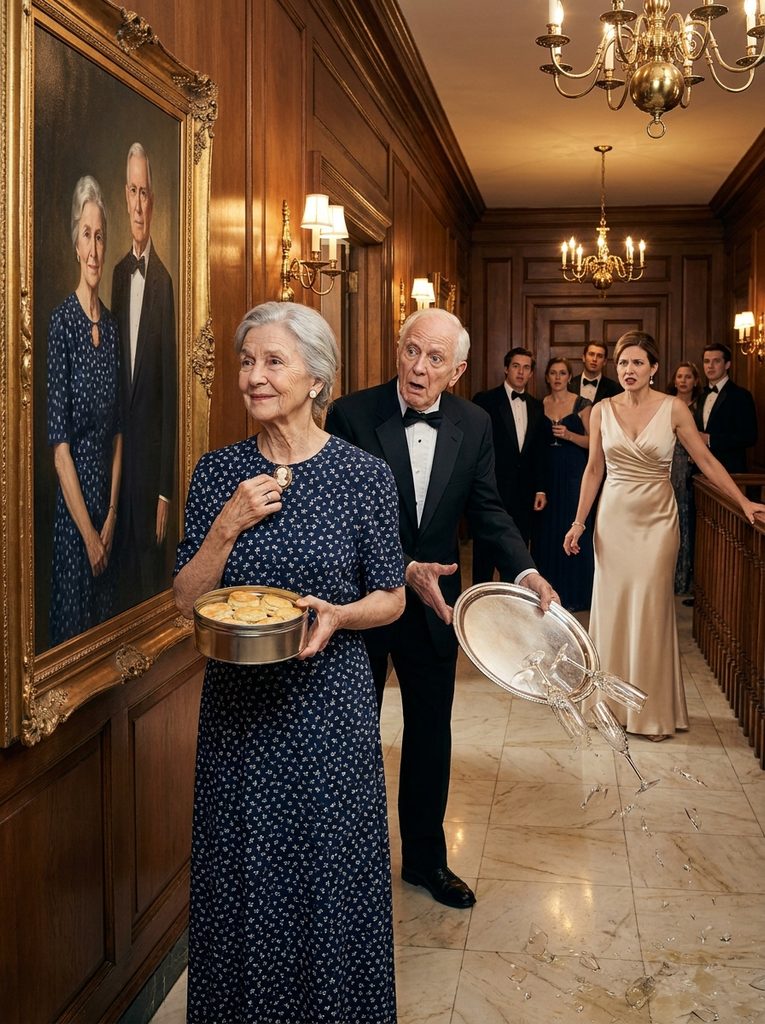
That’s when the waiter came through the door.
He was very old. Eighty, at least.
He wore a starched white jacket and a black bow tie. His hair was a thin silver crown around the top of his head. He came through a side door carrying a big silver tray of champagne flutes. A dozen of them at least, bubbling and gold. Balanced on one hand with the easy grace of sixty years of practice.
He saw her.
I watched it happen. I’ll never forget it.
The tray tilted.
His hand didn’t shake, exactly. It just stopped working. His face went through a whole series of things, one after another. Bewilderment. Recognition. Disbelief. And then something that looked almost like grief.
And then the tray slid right out of his fingers.
It hit the marble floor with a crash like a chandelier falling.
Glass exploded everywhere. Champagne foamed and spread across the white marble. A shard of crystal skittered across the floor and stopped right against Grandma’s black shoe.
She didn’t move.
Every head in the front foyer turned toward us.
Through the big archway at the end of the hall, I could see them all. Wedding guests in pale silk and dark suits, standing around in little groups near a grand piano and a whole wall of white roses. The photographer, frozen mid-flash. A bridesmaid in lavender with her mouth open.
And Tyler. In his gray tuxedo. Laughing at something somebody said.
And then not laughing.
High heels came clicking fast across the marble. Celeste Whitmore came storming down the hallway, her face flushed red, her champagne silk rustling.
“What on earth is going on here? Who let her in here?”
The old waiter didn’t even look at her.
He stepped right over the broken glass in his polished black shoes. He crossed that hallway slowly, with the stiff, careful walk of a man who’d been waiting a very long time.
He stopped in front of my grandmother.
He took her free hand in both of his. And he bowed his head over it.
“Mrs. Caldwell,” he whispered. His voice was shaking. “We’ve been waiting more than thirty years. Why didn’t you tell anyone you were coming?”
Celeste stopped dead.
I have never seen a human face do what hers did.
It didn’t fall. It froze. Like a pond in a hard overnight frost. All at once. From the edges inward.
“Caldwell?” she said. Her voice came out thin. “As in… the Caldwell Room? The Caldwell Cup?”
Behind her, a crowd was gathering in the archway. Harrison Whitmore, tall and silver-haired, with his hand on his wife’s shoulder. Sloane, in her wedding gown, white and shimmering, with her veil only half pinned in. My brother, pale, right beside her.
Grandma turned around.
She stood in the middle of that marble hall. An eighty-three-year-old farm woman in a thirty-dollar dress from the Kohl’s in Wooster. Holding a tin of biscuits.
She looked at Celeste.
And she said, gently, the way you’d talk to a child who just dropped a glass of milk:
“Celeste. You’d better sit down.”
Celeste sat.
Right there. On the third step of the grand staircase. In her champagne silk. With one hand pressed flat against her pearls.
She looked like somebody had pulled a thread loose from the bottom of her whole life.
The hallway had gone completely silent. Broken glass glittered all over the marble. A teenage busboy hurried over with a dustpan. Then he stopped. He just stood there, uncertain. Like sweeping might be disrespectful.
The old waiter was still holding Grandma’s hand in both of his.
“Mr. Alvarez,” Grandma said softly. “Eugene. You’ve gotten old.”
“So have you, Mrs. Caldwell.” His voice shook. “And you’ve never looked better.”
“You always were a liar.”
He laughed. A wet laugh. And he wiped his eyes with a white cloth napkin from his jacket pocket.
I stood there in the doorway with my heart pounding against my ribs.
I had known my grandmother for thirty-one years. I had never once heard anybody call her Mrs. Caldwell.
My grandmother was Ruth Pruitt. She’d been Ruth Pruitt my entire life.
“Grandma,” I whispered. “What is happening?”
She turned to me.
And for the first time in my life, I saw something in her face I didn’t recognize. Not anger. Something older. Something tired. Like a door being opened in a house she hadn’t lived in for a very long time.
“I think,” she said, “it’s time I told you about the portrait.”
I’ll tell you the story the way Grandma told it. Over the next hour. In the Caldwell Room itself.
It was a long, quiet room off the main hallway. Dark wood paneling on the walls. Leather armchairs. A big stone fireplace. And a wall of glass display cases.
In the center of the room stood a silver trophy almost as tall as a child. Engraved all over with names. THE CALDWELL CUP. BROOKHAVEN INVITATIONAL.
On the wall above the fireplace hung a framed document. Yellow with age. Under glass.
The club’s manager, a pale, shaken young man named Mr. Hollis, cleared everybody out of the room. He brought in a silver pot of tea and some china cups. Then he backed out of the room bowing, like he was leaving a queen.
Eugene stood by the door with his white-gloved hands folded in front of him. He refused to sit down. Grandma asked him twice.
“No, ma’am. Not in this room.”
Grandma settled into a leather armchair by the fire. She set the tin of biscuits on her knee. She folded her hands on top of it.
And she began.
“Walter and I didn’t meet on a farm,” she said. “We met in a diner in Cleveland. In 1959. On Euclid Avenue. I was sixteen, and I was waiting tables. He was a young man in a bad suit, with a little money in his pocket and a whole lot of ideas.”
I stared at her. I’d never heard any of this. Not one word.
“Your grandfather was a Caldwell,” she said. “Of the Caldwell Steel Caldwells. His father owned three steel mills. Two in Pennsylvania, one in Youngstown. A rich man. And a very hard one.”
She smiled faintly.
“Walter hated it. He hated the money. He hated the club dinners. He hated the way his father looked at people. Like they were machinery. He wanted to build something with his own two hands.”
“Caldwell Steel,” Harrison said slowly.
He’d come into the room quietly and taken the armchair across from her. He was leaning forward with his hands clasped between his knees.
“My God. That was the largest private steel company in the Midwest. My father used to talk about it.”
“Until Walter sold it,” Grandma said. She nodded. “Walter’s father died in 1961. A heart attack. Right in the middle of a board meeting. Face down on the quarterly report.”
She shook her head.
“And Walter, who was twenty-two, inherited everything.”
“You got married that year,” I said. I knew that much. 1961. I’d seen the wedding photo on her dresser my whole life.
“We did. In March. In a little white church in Cleveland, with six people. And in October, Walter sold the mills.”
Harrison’s eyebrows went all the way up.
“All three of them,” Grandma said. “To a consortium out of Pittsburgh. For eleven million dollars.”
She shrugged.
“Which in 1961 was an awful lot of money. And then Walter did a very curious thing.”
“What?” I said.
“He gave almost all of it away.”
“To who?” I asked.
“Everyone,” Grandma said. She laughed softly. “Churches. Hospitals. Scholarships. A school for blind children in Columbus. And a pension fund for every single man who lost his job when the mills changed hands. Walter made sure every one of them got a check. Every month. Until the day they died.”
She took a sip of tea.
“He kept just enough to buy a farm and a few cows. And a little bit more, to endow one thing that mattered to him. More than anything else.”
She turned her head. She looked at the glass case in the middle of the room. The big silver cup.
“Brookhaven was Walter’s father’s club,” she said. “Walter grew up here. His father used to drag him out here every weekend when he was a boy. And Walter hated every single minute of it. Except for one thing.”
“The golf?” Celeste said faintly.
She’d come into the room last. She was standing against the wall near the door, with her arms wrapped around herself. Like she was cold.
“The caddies,” Grandma said.
Her eyes were bright.
“Walter loved the caddies. They were boys from the neighborhoods down the hill. Mostly Black boys and Italian boys. They carried golf bags for tips. No pay. No benefits. Most of them had quit school to do it.”
She set down her cup.
“And Walter, at fourteen years old, started teaching them to read. Behind the caddy shack. With comic books and the sports page.”
A silence fell over that room.
“When he inherited the money, he endowed a fund,” Grandma said. “The Caldwell Caddie Scholarship. It’s paid for the college education of every single caddie who’s worked at this club since 1962. Two hundred and eleven young men and women. Doctors. Teachers. Engineers. A federal judge in Columbus.”
She turned and smiled at the old waiter standing by the door.
“Eugene was our very first.”
I turned around.
Eugene was standing by the door very straight. His white-gloved hands were folded in front of him. His eyes were wet.
“Mr. Caldwell put me through Howard University,” he said. His voice was low and rough. “I was sixteen years old. I carried bags for a man who called me ‘boy’ every single day for two years. Never once used my name.”
He swallowed.
“And then one evening, your grandfather came walking up to my mother’s front door. On Kenyon Avenue. In his good suit. With an envelope. And he said, ‘Eugene, I’d like you to go to school.’”
“You could have gone anywhere after that,” Grandma said gently. “You had a degree in economics.”
“I came back here.” He smiled. It trembled. “I became a waiter at Brookhaven. Because I wanted to be near the thing that changed my life. I’ve worked these rooms for fifty-eight years, Mrs. Caldwell. And every single day, I’ve walked past that portrait in the hallway. And every single day, I’ve thought, ‘They’ll come back someday.’”
His voice cracked right down the middle.
“You never came back. After you left. More than thirty years.”
Grandma’s smile wavered.
“No,” she said quietly. “We didn’t.”
“Why not?” I asked. My own voice was shaking.
She was quiet for a long moment. Turning her teacup around in her hands. Around and around.
“Because the club asked us to leave,” she said.
Harrison sucked in a sharp breath.
“I’m sorry. What?”
“It was 1994,” Grandma said. “A new board came in. A new membership committee. They didn’t like the scholarship. They said it was ‘a distraction from the club’s mission.’”
Her mouth tightened.
“They didn’t like that a steel heir was living in a farmhouse in Holmes County, milking his own cows. They said it was eccentric. They said Walter was an embarrassment. They said we’d lowered the tone.”
“That’s not possible,” Harrison said.
“They asked us to resign,” Grandma said. “Quietly. In a letter. On club stationery.”
She lifted one shoulder.
“Walter wanted to fight it. He was furious. He wanted to call a lawyer that same afternoon. I told him not to. I said, ‘Walter, the boys will still get their scholarships. The endowment can’t be touched. Let them have their club.’”
“And the portrait?” I whispered.
“It stayed,” Grandma said. “Nobody dared take it down. It’s written right there in the original charter.” She nodded at the yellowed document over the fireplace. “Founding benefactors are to be permanently honored. Forever. In perpetuity.”
A small, dry smile.
“I think they hoped we’d die, and nobody would ever notice.”
“And the name,” I said. “Pruitt. Where did Pruitt come from?”
“Walter’s mother’s maiden name,” she said. “When we bought the farm, he had it changed. Legally. At the courthouse in Millersburg. He said a Caldwell would never be left alone in a small town. People would always want something. But a Pruitt could just be a farmer.”
She smiled at me.
“So he was.”
I looked over at Celeste.
She had slid all the way down the wall. She was sitting on the carpet of the Caldwell Room in her champagne silk, with her knees pulled up to her chest.
“I didn’t know,” she whispered. “I swear to God I didn’t know.”
“I don’t think you did, dear,” Grandma said.
“I’ve walked past that painting a thousand times. A thousand. Every committee meeting. Every luncheon.”
“I’m sure you have.”
“I thought it was just… some old donor. Some old couple nobody remembers.”
Grandma looked at her gently.
“That’s the thing about the people who give, Celeste,” she said. “We tend to get forgotten. That’s rather the point.”
Celeste began to cry.
It wasn’t the polished, dabbing kind of crying I’d seen her do at church. It was sudden and ugly. Like a pipe bursting. She put her face in her hands. Her shoulders heaved. And a sound came out of her that I honestly hadn’t thought she was capable of making.
“I told you to go through the kitchen,” she sobbed. “I told you… I said you’d ruin the photographs. Your farm clothes. Oh, God. Oh my God, I said that to you.”
“You did.”
“I’m so ashamed.”
“I know.”
“I don’t know what’s wrong with me.” She lifted her blotchy, mascara-streaked face. “I grew up in a house just like this. My mother used to tell me, ‘Celeste, it’s not about who you are. It’s about who they think you are.’ And I believed her. I’ve believed that my entire life.”
Grandma looked at her for a long moment.
Then she did something that startled me.
She set her teacup down on the little side table. And she got up out of her chair. Slowly. One hand on the armrest. And she crossed the room to where Celeste was sitting on the floor.
She lowered herself down. I could hear her knees creak. Until she was kneeling on the carpet in her navy dress, right in front of Celeste.
And she set the tin of biscuits in Celeste’s lap.
“Here,” Grandma said. “Eat one.”
Celeste stared at her.
“They’re buttermilk,” Grandma said. “My mother’s recipe. From Kentucky.”
“I can’t.”
“You can. It’s only a biscuit, honey.”
With trembling fingers, Celeste lifted the lid off the tin. Folded back the dish towel.
The smell came up. Butter, and warm flour, and a little bit of salt.
She took one. She bit into it.
I watched her face change.
“Oh,” she whispered.
“They’re good, aren’t they?”
“They’re…” Celeste choked. “My grandmother made these. In Tennessee. Outside Knoxville. When I was a little girl. Before my mother married my father. Before we moved to Indian Hill. Before we…”
She stopped.
“Before you forgot,” Grandma said softly.
Celeste pressed the biscuit against her mouth. And she wept.
Tyler found me in the hallway a few minutes later.
He stood in the doorway of the Caldwell Room in his gray tux. His bow tie was loose. His face was completely blank with shock. Sloane was right beside him, one hand over her mouth, her veil trailing on the floor behind her.
“Meg,” he said hoarsely. “Did you know? Any of this?”
“Not a word.”
“My whole life,” he said. “I thought Grandpa was a dairy farmer.”
“He was.”
“But he was also…”
“A lot of things,” I said. I took his hand. “I think he was a man who decided what he wanted to be. And then he was it.”
Tyler laughed. A shaky laugh. And he wiped his eyes on the sleeve of his rented tuxedo.
Sloane stepped forward.
Grandma had gotten up off the floor, with Eugene’s help, and was brushing biscuit crumbs off the front of her dress. Sloane stood in front of her. Her face was white. Her eyes were red.
“Mrs. Pruitt,” she said. “Mrs. Caldwell. I… I don’t even know what to call you.”
“Ruth will do, dear.”
“Ruth.” Sloane’s voice cracked. “I’m so sorry. About my mother. About all of it.”
“You didn’t do anything, sweetheart.”
“I should have said something. This morning. When she told Tyler where she was going to seat you. In the very back row, behind the pillar. I should have…”
She pressed one hand flat against her chest.
“I looked away. I always look away. That’s what we do in my family. We look away. And I’m so ashamed of it.”
Grandma looked at her. A long, steady look.
Then she reached out and took both of Sloane’s hands in hers.
“Sloane. Look at me.”
Sloane looked.
“I’m going to tell you something Walter told me,” Grandma said. “The day we sold the mills. He said, ‘Ruthie, a person isn’t what she’s born into. She’s what she does the first time somebody’s watching. And the second time, when nobody is.’”
Sloane’s lip trembled.
“You can still do the second one,” Grandma said. “Starting right now.”
The wedding was delayed an hour and a half.
Nobody minded.
The guests had been moved out to the terrace for champagne, and the rumor spread through that crowd like fire through dry grass. By the time the string quartet finally started playing the processional, everybody knew.
The whispers swelled and faded. Old members of the club, men in tweed and women in pearls, kept turning around in their seats to look.
Celeste washed her face in the ladies’ room. She redid her mascara.
She did not ask Grandma to sit anywhere but the front row.
It turned out Harrison was the one who made the arrangements.
Right before the ceremony, he walked across the terrace to where Grandma was standing with me. He was wearing a silver morning coat. He held out his hand.
“Mrs. Caldwell,” he said. “I’d be honored if you’d sit with the family.”
“That’s very kind of you, Harrison.”
“It isn’t kind,” he said. “It’s overdue.” He offered her his arm. “May I?”
She took it.
And they walked together, up the aisle. A tall, silver-haired banker and a tiny white-haired farm wife. Past two hundred guests. Under a white arch wreathed in roses.
When they reached the front row, Harrison pulled out her chair for her. He waited until she was settled. He laid the tin of biscuits gently in her lap.
A murmur went through the whole crowd.
And then, from somewhere way in the back, somebody started to clap.
It was Eugene.
He was standing at the very back of the terrace in his white jacket. His hands raised. Clapping. Slowly. Steadily.
And one by one, the kitchen staff came out behind him and joined in. The cooks. The dishwashers. The busboys. The big man who’d been chopping onions. The gray-haired woman with the little gold cross.
A dozen people in aprons and hairnets. Applauding an old woman in a thirty-dollar dress.
Then the guests stood up.
Members of the club, in all their finery. Old men leaning on canes. Women with tears running down their faces. Sloane’s bridesmaids. Tyler’s debate team kids, who’d come in matching ties.
A standing ovation. In the golden light of a spring afternoon. For a woman who, three hours earlier, had been told to go around the back.
Grandma sat very, very still. Her hands folded on top of her tin. Her cheeks had gone pink.
“Oh, for heaven’s sake,” she murmured. “Sit down, all of you.”
Nobody did.
Not for a long time.
Tyler and Sloane were married at four o’clock.
Tyler cried through his entire vows. Sloane cried through hers. When the minister finally said, “You may kiss the bride,” Tyler picked her right up off the ground and spun her around. To a huge roar of laughter. Her veil flying out behind her like a flag.
At the reception, in the big ballroom, Harrison made a toast.
He stood up at the head table with a glass of champagne in his hand. Tall and serious. And the whole room fell silent.
“I’d like to say something tonight that I should have said thirty years ago,” he said. “Not as a father. As a member of this club.”
He turned toward Grandma.
“When I joined Brookhaven, in 1998, I was told it had always been open to anyone who earned a place here. I believed that. I’ve served on the board for fifteen years. And today, I learned that the finest people who ever walked through those doors were asked to leave. Because they were ’embarrassing.’”
He swallowed hard.
“I intend to correct that. Tomorrow morning, I’m calling for a special vote of the board. Mr. and Mrs. Caldwell will be reinstated as honorary lifetime members. The Caldwell Room will be fully restored. And the scholarship, which has never missed a single year since 1962, will be renamed. Not in anybody’s honor. In memory of the man who built it.”
He raised his glass high.
“To Walter Caldwell. Who taught boys to read behind the caddy shack. And never once asked for a thing in return.”
“To Walter,” the whole room said.
Grandma bowed her head. Her fingers were trembling on the lid of her tin. One single tear slipped down her cheek and into the lace at her collar.
I reached under the table and took her hand.
It was warm and papery. Knobby knuckles. And a gold wedding ring that had worn a groove into her finger over sixty years.
“I miss him,” she whispered.
“I know, Grandma.”
“He’d have loved this,” she said. “And he’d have hated every second of the fuss.”
I laughed. And cried. And held on.
Later that night, after the cake, Tyler came and found her at the table. He knelt down next to her chair in his tux.
She opened the tin and handed him a biscuit.
He ate it in two bites. With his eyes closed.
“Just like when I was four,” he said.
It’s been two years now.
The Caldwell Room has been fully restored. New leather on the chairs. The old silver cup polished until it shines. The yellowed charter rehung in a new frame.
Every month, on the second Sunday, the club hosts a lunch in that room for the scholarship alumni. Two hundred and eleven names. And counting.
Eugene still works the room. He’s eighty-two now. He refuses to retire.
“Who’s going to carry the tray?” he says. And then he winks at Grandma.
Grandma goes to every one of those lunches. She drives herself, in the Buick. She wears the navy dress with the little white flowers. And the cameo. And she sits at the head of a long table, with her biscuits.
Last year, the club’s head chef, a big gruff Frenchman named Armand, came out of the kitchen and asked her for the recipe.
She wrote it out for him on an index card. In her slanting, old-fashioned handwriting.
He framed it.
It hangs in the kitchen now. Right above the swinging door to the dining room. The same door she walked through that day. Next to it, there’s a little brass plaque.
RUTH’S BISCUITS. DO NOT SUBSTITUTE.
Celeste comes to those lunches too.
She gets there early, and she sets all the tables herself. She’s quieter now. Softer. In a way it took me a long time to trust.
She chairs a brand-new committee at the club now. Access and Belonging. Last spring, she organized a free golf clinic for kids from the neighborhoods down the hill. Taught entirely by scholarship alumni.
Eugene’s great-granddaughter, a lanky fourteen-year-old named Imani, sank a forty-foot putt on the very first hole. And screamed so loud every duck on the pond took off at once.
Celeste cried.
She cries easily now. She says it’s a skill she’s relearning.
She and Grandma talk on the phone every Thursday afternoon.
I don’t know what they talk about. It’s not my business.
But once, I walked into the farmhouse kitchen without knocking. Grandma was sitting at the kitchen table with the old yellow phone receiver tucked between her ear and her shoulder. And I could hear Celeste’s voice coming through the line. Small and a little embarrassed.
“I made your biscuits, Ruth. They’re terrible.”
“What kind of flour did you use?”
“Self-rising.”
“Oh, honey. No.”
They both laughed. A long time.
I tiptoed back out.
Tyler and Sloane live in Dayton now. In a little brick house about a mile from mine. Sloane is expecting their first baby in the fall.
Last week, Tyler told me that if it’s a girl, they’re naming her Ruth.
“She’ll hate that,” I said.
“She’ll grow into it.”
“And if it’s a boy?”
“Walter.”
I put my hand over my mouth.
“I’m going to cry,” I said.
“You’re already crying, Meg.”
“I’m fine.”
He grinned. And he hugged me. And we stood there in his little kitchen, which smelled like coffee and fresh paint. Two orphans who grew up in the shelter of a woman who never once told us who she really was.
Last Sunday, I drove out to the farm.
It was a bright, cold morning. The pasture was silver with frost. The Jerseys were standing around in the barnyard with their breath steaming in the air.
Grandma was sitting on the front porch in her old blue apron, shelling peas into a big yellow bowl. She looked up when I came up the steps.
“You’re early.”
“I wanted to talk.”
“Then sit.” She patted the porch swing beside her. “There’s coffee.”
I sat. The swing creaked. The sun was just coming up over the red barn. Somewhere a rooster crowed. Hoarse and half-hearted.
“Grandma? Can I ask you something?”
“You may.”
“Why didn’t you ever tell us? Me and Tyler? In all those years?”
She stopped. A pea pod in her fingers. She looked out at the pasture for a long, long time.
“Because I didn’t want you to think we were special,” she said finally. “Your grandfather and I decided, the day we bought this farm, that we’d live like everybody else. We’d earn our own bread. Work our own land. Get up at five and milk the cows.”
She split the pod with her thumbnail.
“We wanted you two to grow up knowing that what you do matters more than what you have. And you can’t learn that if you know you’ve got eleven million dollars behind you.”
“And the club?” I said. “When they asked you to leave? You could have fought them.”
“I could have,” she said. “I could have called a lawyer. We had the money. We had the charter. We’d have won.”
She shrugged.
“But I thought, why? If a place doesn’t want you, Megan, you don’t have to prove you deserve to be there. You can just go home. And bake.”
Then she smiled at me.
A small, crooked, mischievous smile. And I suddenly, absurdly, recognized it.
It was Tyler’s smile.
“And besides,” she said. “I always figured that someday, somebody would make me walk through that kitchen.”
I stared at her.
“You knew,” I said slowly. “That day. When Celeste sent you around the back. You knew what would happen.”
“I didn’t know,” she said. She dropped a handful of peas in the bowl. “But I hoped.”
“Grandma!”
“I’ve been in that kitchen a hundred times, Megan. Long before I was ever Mrs. Caldwell, I waited tables. Before that, I washed dishes. In a kitchen just like that one. I know the people in that kitchen. And I know they remember who was kind to them.”
She laughed softly.
“I’ll admit, it never occurred to me that Eugene would drop the whole tray.”
“That was the best moment of my entire life,” I said.
“Mine too,” she admitted. “Though I felt just dreadful about all that glass.”
We laughed. Together. On the old porch swing, with the bowl of peas between us and the morning light going gold across the frost.
I leaned my head on her shoulder.
She smelled like flour and lavender and cold air. And her cameo pressed a small, cool circle against my cheek.
“Grandma?”
“Hm?”
“What’s the story with the brooch?”
She was quiet for a moment.
“Your grandfather gave it to me on our twenty-fifth anniversary,” she said. “1986. The same year they painted that portrait. He said it was his grandmother’s. Old Mrs. Caldwell. He’d kept it in a drawer for thirty years. He was afraid to give it to anybody.”
She touched it gently. The way she always does.
“He said, ‘Ruthie. I want you to wear this whenever you need people to know who you are.’”
“And did you?”
“Every single day,” she said.
She went back to her peas.
“I just never needed them to know.”
I closed my eyes.
Down in the barnyard, the cows moved slowly through the frost. The rooster tried again, a little better this time. And from somewhere inside the farmhouse came the thin, sweet whistle of the kettle coming to a boil.
Grandma patted my knee.
“Go get the biscuits out of the oven, sweetheart,” she said. “Before they burn.”
I went.
THE END..!