Her parents laughed and told me she was only trying to get attention. I didn’t argue. I quietly pulled out my phone and called a doctor. Two hours later, one horrifying detail was enough to expose a secret that would tear our entire family apart.
My 5-year-old niece whispered, “the chair hurts”… and then she showed me what was hidden under it.
Her parents laughed and told me she was only trying to get attention. I didn’t argue. I quietly pulled out my phone and called a doctor.
Two hours later, one horrifying detail was enough to expose a secret that would tear our entire family apart.
“If you repeat those lies about your father again, someone is going to come take you away to a place where you’ll never see us again,” I heard my sister-in-law, Elisa, hiss from down the hallway.
I froze in the doorway.
I had driven almost four hours from Chicago to spend Christmas dinner at my brother Marcus’s home in Lake Forest, Illinois. We hadn’t seen each other in eight months, and from the outside, his life looked almost untouchable.
Marcus had built a successful cybersecurity consulting firm with major clients, expensive offices in downtown Chicago, and the kind of reputation people protected carefully. I directed investigative documentaries about corporate fraud and corruption. We were brothers, but for years we had lived more like distant acquaintances.
His house was immaculate that night. Holiday lights lined every window. Crystal glasses gleamed beside a massive mahogany dining table. A Christmas tree nearly touched the vaulted ceiling.
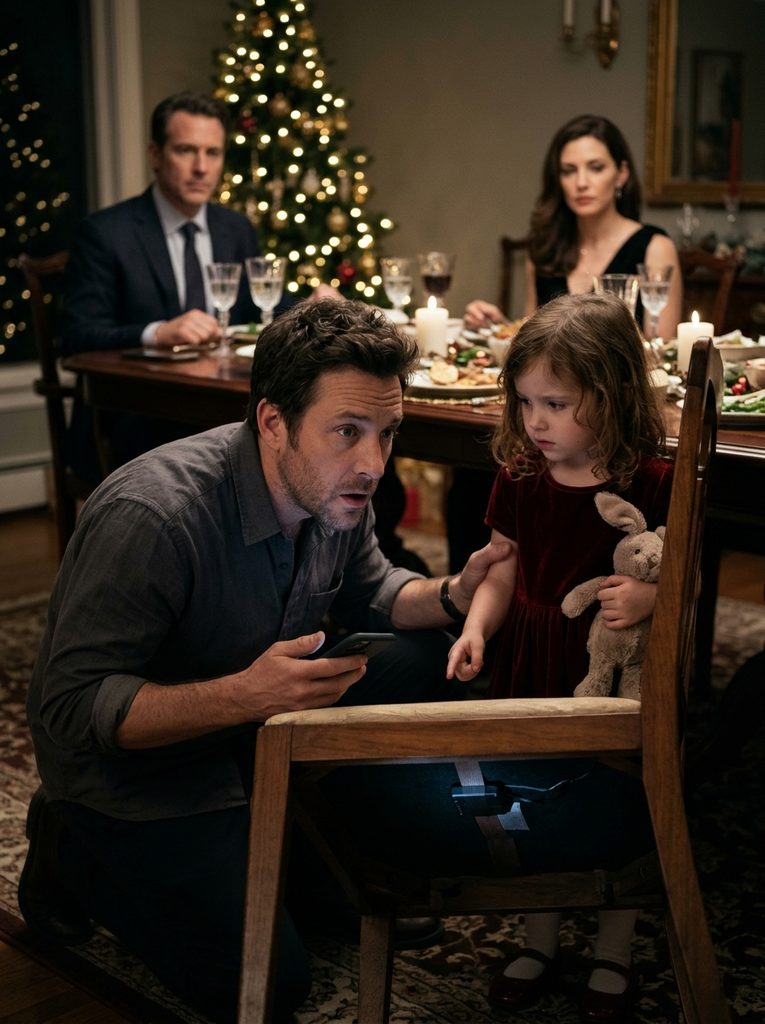
But my five-year-old niece, Sophia, stood beside her chair as if she were afraid of it.
“Sit down, Sophia,” Elisa said.
Sophia hugged her little stuffed rabbit against her chest. “The chair hurts.”
Marcus kept slicing the prime rib. “Not this again. Sit down.”
When Sophia slowly lowered herself onto the wooden seat, her face tightened. Tears immediately filled her eyes, but she didn’t make a sound.
I put down my fork. “What happened to her?”
“Nothing,” Marcus said. “She’s discovered that crying gets attention.”
“She says she’s hurting.”
His eyes snapped toward me. “Don’t interfere, Michael. She’s our daughter.”
Elisa gave a short laugh, as though Sophia’s fear were an embarrassing performance we were all supposed to ignore.
Sophia looked at me once, then quickly lowered her eyes.
I had spent more than a decade interviewing people who were hiding things. I knew what rehearsed calm looked like. I knew what fear looked like too.
And Sophia was terrified.
A few minutes later, she whispered my name so softly I almost missed it.
“Uncle Michael.”
I turned toward her.
She slipped down from the table while Marcus was talking about his company and motioned for me to follow. Near the kitchen doorway, she gripped my hand, brought me back toward her chair, and pointed beneath the seat.
Then she showed me what she had been afraid to show anyone else.
There was something concealed against the underside of the wooden chair.
I didn’t touch it immediately. I crouched low enough to see where she was pointing, then looked back at Sophia.
Her hands were shaking.
“Does that hurt you?” I asked quietly.
She nodded.
Then, as if she had finally decided I might actually believe her, she pulled back the sleeve of her red velvet dress. Dark bruises marked her small arm. When she cautiously lifted the fabric near her knee, I saw more marks—some newer, some already fading.
My stomach dropped.
“Would you believe me?” she whispered.
I knelt until we were eye to eye. “You can tell me anything, little bird.”
That was the nickname I had given her when she was a baby.
Sophia started crying without making a sound.
She told me her father came into her room at night. She said there was a “secret game,” that she had begged him to stop hurting her, and that he became angry when she resisted. When she finally told Elisa, her mother called her a liar and warned that police took bad children away from their families.
For one second, I couldn’t move.
Then Sophia asked the question that decided everything.
“Are you going to help me?”
“Yes.”
“Do you promise?”
I held her trembling hand. “I promise.”
“Sophia!” Elisa shouted from the dining room. “Get in here right now!”
Sophia hurried back before her mother could come looking for her.
I returned to the table too.
I didn’t accuse Marcus. I didn’t threaten Elisa. I didn’t let either of them see what I was thinking.
Marcus understood security systems, lawyers, money, and digital footprints. If I confronted him without anything beyond Sophia’s disclosure, I was afraid he would shut everyone out before anyone independent could examine her.
So when Marcus started talking about a new corporate lease, I nodded. When Elisa refilled her wineglass, I said nothing.
Then I quietly took out my phone.
I contacted a doctor and described only what I had personally seen and what Sophia had told me. The doctor’s tone changed immediately. He told me Sophia needed to be evaluated somewhere safe by professionals trained to handle possible child abuse.
Less than two hours later, Sophia was being examined away from the dining table where everyone had told her to stop seeking attention.
The doctor studied the injuries, asked careful questions, and then went silent.
I recognized that silence.
It was the same silence investigators made when one fact suddenly changed the meaning of everything else.
He looked at me and said the marks were not consistent with a single recent accident. Several were at clearly different stages of healing.
This hadn’t begun that night. It hadn’t begun with that chair.
Someone had been hurting Sophia repeatedly, and the adults responsible for protecting her already knew she had been asking for help.
Then the doctor asked Sophia one final question. Her answer made him reach for the phone.
And that was the moment I realized my brother’s carefully controlled life was about to collide with people he couldn’t intimidate into silence.
The horrifying detail was that Sophia’s injuries were in different stages of healing. The doctor said that meant this could not be explained away as one bad fall or one painful night. Whatever had happened had been happening repeatedly.
Then he asked Sophia whether she felt safe going home with her parents.
She immediately shook her head.
That answer changed everything.
The doctor stepped outside the room to make the required calls while I stayed beside Sophia. She held her stuffed rabbit against her chest and kept asking whether Marcus would be angry with her.
Before I could answer, my phone began vibrating.
Marcus. Then Elisa. Then Marcus again.
I ignored every call.
Finally, a text appeared from my brother:
WHERE IS MY DAUGHTER?
A second message followed before I could put the phone down.
BRING HER HOME NOW.
Sophia saw his name on the screen and grabbed my sleeve.
“Uncle Michael,” she whispered, “don’t tell Daddy what I showed you under the CHAIR.”
That stopped me cold.
Because until that moment, I had assumed the hidden thing beneath the seat was only connected to her pain.
Sophia knew it was connected to something Marcus desperately wanted kept secret.
Her parents laughed and told me she was only trying to get attention. I didn’t argue. I quietly pulled out my phone and called a doctor. Two hours later, one horrifying detail was enough to expose a secret that would tear our entire family apart.
PART 2: The Hidden Truth
The air in the hospital room grew heavy. My eyes shifted from my phone screen to Sophia, whose small fingers were still tightly gripping my sleeve.
“Under the chair,” I repeated under my breath, the words tasting like copper in my mouth.
I had originally assumed that whatever was attached to the chair was a harsh physical punitive device—a cruel tool meant to inflict pain whenever she sat. But Sophia’s panic wasn’t about the pain anymore. It was about discovery. She wasn’t afraid of the seat hurting her; she was terrified of what Marcus would do if he realized his secret had been uncovered.
“Sophia,” I said softly, crouching down so I was level with her tear-stained face. “What is under the chair?”
She bit her lower lip, pulling her velvet dress tightly around her legs. “Daddy told me if anyone looks under there, the monsters will come out and take us away. He said he hid the little black box so the bad people wouldn’t steal his secrets.”
My pulse spiked. A little black box.
Marcus’s entire career was built on cybersecurity—encrypting data, managing top-secret corporate infrastructure, and handling high-stakes corporate espionage. His firm handled classified intelligence for some of the biggest financial institutions in the country. A physical hard drive or a concealed recording apparatus attached to a dining chair wasn’t just bizarre—it was a secure, offline storage method. A cold-storage backup hidden in plain sight, right inside his own home where no cloud scanner or remote hack could ever trace it.
Before I could process the realization, the double doors of the pediatrics wing burst open.
“Michael!”
Marcus’s voice echoed down the sterile corridor, sharp and commanding. He was striding down the hallway in his heavy wool coat, his face flushed red with rage. Elisa hurried behind him, her heels clicking against the linoleum. Her eyes were puffy, but her demeanor was laced with cold hostility.
Two hospital security guards immediately moved to step between Marcus and the examination alcove.
“Sir, you need to stop right there,” one of the guards said, extending an arm. “This is a restricted pediatric area.”
“That is my daughter!” Marcus shouted, his voice cracking with authority. He pulled out his wallet, thrusting his driver’s license into the guard’s chest. “I am Marcus Vance. I own a multi-million-dollar cybersecurity firm. My brother here has abducted my five-year-old child from our family dinner table! I demand you let me through right now!”
“Marcus, stop,” I said, stepping out into the hallway and shutting the door behind me to shield Sophia from his sight.
“Stop?” Marcus snarled, rushing toward me until he was inches from my face. I could smell the faint scent of wine and prime rib on his breath. “You took my daughter out of my house without our permission! Elisa called the police! Do you have any idea what you’ve done?”
“I brought her to a doctor, Marcus,” I replied, keeping my voice dangerously quiet. “Because she was covered in bruises. Because she couldn’t sit on a dining chair without weeping in agony.”
Elisa stepped forward, grabbing Marcus’s arm while glaring at me with raw venom. “She fell off the playground set at school last week! We told you that! She’s an unruly child who makes up stories for attention, Michael! You don’t have children—you have no idea how hard it is! You come in here with your self-righteous documentary maker attitude, acting like you’re saving the world, when all you’re doing is destroying our family!”
“The doctor looked at the bruises, Elisa,” I countered, looking her dead in the eye. “They aren’t from a playground. They are in various stages of healing—weeks apart. Some are fresh; some are yellowing. And she told me what happens when Marcus comes into her room at night.”
The color drained from Elisa’s face in an instant. For a fraction of a second, I saw a flicker of absolute terror in her eyes—not shock, not disbelief, but realization. She knew. She had always known, or at least suspected, and had chosen the comfort of her mansion, her luxury lifestyle, and Marcus’s flawless public reputation over her own child’s safety.
Marcus’s eyes narrowed into slits. “You’re out of your mind. You’re trying to frame me because you’ve always been jealous of my success. You make failing documentaries while I run a corporate empire!” He leaned in closer, his voice dropping to a harsh whisper. “If you take one step further with this lie, Michael, I will destroy you. I have lawyers on retainer that will sue you into bankruptcy before the week is over. You will never work again.”
“Mr. Vance?”
A tall woman in a dark grey suit approached from the end of the hallway, flanked by two uniformed police officers and a Child Protective Services caseworker holding a clipboard.
“I am Detective Ramirez with the Lake County Special Victims Unit,” the woman said, her badge visibly pinned to her belt. “We received a mandated report from Dr. Aris regarding Sophia Vance. Mr. and Mrs. Vance, you are required to step into the consultation room for questioning. Under emergency temporary protective custody, Sophia will remain here under hospital and state supervision until an initial evaluation is completed.”
Marcus instantly shifted into his corporate damage-control persona. He smoothed his coat, forced a calm, aristocratic smile, and held up his hands defensively. “Detective, I am delighted you are here. There has been a terrible misunderstanding. My brother suffers from severe boundary issues and has misinterpreted a minor domestic discipline matter. We are fully cooperative.”
While Marcus engaged the detective with his rehearsed, magnetic calm, I slipped back into Sophia’s room.
The doctor was standing near the window, making notes on a tablet. He looked up at me, nodding solemnly. “Child Protective Services has issued an emergency order. She won’t be returning to that house tonight. But Michael… if you are going to protect her long-term, you need evidence that stands up to a legal team that money can buy.”
I looked down at Sophia, who was clutching her stuffed rabbit so tightly her knuckles were white.
“Uncle Michael,” she whispered, her voice trembling. “Is Daddy going to hurt you now?”
“No, little bird,” I knelt down and kissed her forehead. “Nobody is ever going to hurt you again. I promise.”
I knew what I had to do. Marcus was currently trapped in an interrogation room with Detective Ramirez for at least two hours. Elisa was being interviewed separately. The house in Lake Forest was empty.
I left the hospital through the side exit, got into my car, and drove back toward the dark, gated estate in Lake Forest.
The drive felt like an eternity. Rain began to fall, slicking the tree-lined streets of the wealthy suburban enclave. When I arrived at Marcus’s house, the holiday lights were still blinking merrily against the dark brick facade. It looked like a postcard of American domestic perfection, concealing a nightmare within its walls.
I pulled around to the back driveway, staying in the shadows. I knew the house had an advanced security system—Marcus had designed it himself—but I also knew his habits. He always left the back kitchen patio door unlocked on double-latch manual override whenever he hosted holiday dinners to allow caterers easy access.
I slipped inside. The house was dead quiet. The half-eaten prime rib sat cold on the mahogany table. The crystal glasses still held remnants of red wine.
I walked straight to the grand dining table and pulled out the heavy wooden chair where Sophia had been seated.
I turned the chair upside down.
Taped flush against the underside of the dark mahogany seat, secured with industrial black adhesive, was a small, weatherproof plastic case—no larger than a pack of cards. Beside it was a tiny, pressure-sensitive electronic module wired directly into a micro-SD card reader and a small metallic drive.
My heart hammered against my ribs. It wasn’t just a physical torture mechanism—it was a physical micro-transmitter and cold-storage drive.
I carefully peeled the case away from the wood. As I flipped it over, I saw what made my blood run cold.
It wasn’t just corporate security data. Stenciled on the back of the device was a custom serial code alongside a tiny, concealed lens. It was an offline hidden camera and local storage node, strategically angled to record the room from floor level—and store sensitive, encrypted files far away from any network that could be monitored by federal authorities or cyber-auditors.
Marcus wasn’t just abusing his daughter. He was using his home, his domestic life, and even his daughter’s furniture as an un-hackable, off-grid vault to hide illicit blackmail material, illegal financial ledgers, and evidence of his darkest crimes—knowing no federal agent with a search warrant for a server would ever think to check the bottom of a five-year-old child’s chair. And every time she was forced to sit there, she was sitting on the very instrument of her family’s destruction.
Suddenly, the front door lock clicked.
Heavy footsteps echoed across the marble foyer.
“I told you I left my laptop on the counter!” Marcus’s voice boomed through the hall, sharp and panicked. “We have twenty minutes before Ramirez gets a warrant to search the premises! Get the drive from the chair, Elisa! NOW!“
Her parents laughed and told me she was only trying to get attention. I didn’t argue. I quietly pulled out my phone and called a doctor. Two hours later, one horrifying detail was enough to expose a secret that would tear our entire family apart.
PART 3: The Price of Freedom
I froze in the dim light of the dining room, holding the black case in my hands.
Marcus had managed to pull strings—or his lawyers had posted immediate bail—and he was back before I could escape.
“Where is it?!” Elisa’s frantic voice shouted from the kitchen entrance.
Footsteps rushed toward the dining room. I grabbed the micro-drive, shoved it deep into my coat pocket, and set the chair back upright just as Marcus rounded the corner.
He stopped dead in his tracks.
His coat was gone, his tie was loosened, and his hair was uncharacteristically disheveled. The polished corporate executive was completely gone, replaced by a desperate, cornered predator.
“Michael,” Marcus breathed out, his eyes dropping to the dining chair, then rising to meet mine. “What are you doing in my house?”
“Looking for the truth,” I said, holding my ground near the edge of the table.
Elisa appeared beside him, gasping when she saw me. “Marcus, he knows. He went to the chair!”
Marcus’s demeanor shifted instantly. The manic panic melted into a cold, lethal stillness. He stepped slowly into the room, pacing around the mahogany table like a wolf closing in on its prey.
“Give it to me, Michael,” Marcus said softly.
“You hid it under her chair, Marcus,” I said, my voice shaking with raw disgust. “Your own daughter. You used her terror to keep her away from it. You told her monsters lived under there so she would never touch it, never move it, never tell anyone.”
“You don’t understand how the world works!” Marcus suddenly roared, slamming his fist onto the table, making the crystal glasses shatter on the wood. “That drive contains client data worth fifty million dollars! It contains leverage over politicians, federal judges, and corporate executives! I built an empire! I protected this family! Everything we have—this house, Elisa’s lifestyle, your stupid documentary grants that I secretly subsidized through my non-profit foundations—came from that data!”
“And what about Sophia?” I yelled back, tears of anger stinging my eyes. “What did she pay for your empire? The bruises on her arms? The fear in her eyes every time you walk into a room? You’re a monster, Marcus!”
“She is my daughter!” Marcus screamed, taking a threatening step forward. “She belongs to me! And whatever happens in this house stays in this house!”
“Not anymore,” I said.
Marcus lunged at me.
He was bigger and heavier, tackling me across the dining table. Silverware and fine china crashed to the floor as we fought. He grabbed my collar, slamming my head against the hardwood floor. Pain exploded behind my eyes, but I fought back with everything I had, driving my elbow into his ribs.
“Elisa, get the coat! Search his pockets!” Marcus yelled, pinning my arms down.
Elisa hovered over us, her hands shaking hysterically. “Marcus, stop! The police—”
“SEARCH HIM!”
I kicked out with all my strength, catching Marcus in the chest and throwing him off me. I scrambled to my feet, gasping for air, and sprinted toward the front entrance. Marcus lunged again, grabbing the back of my jacket. We crashed into the heavy oak front door just as red and blue lights began flashing through the frosted glass windows.
Sirens echoed down the quiet suburban street.
The front door was kicked open from the outside.
“POLICE! HANDS IN THE AIR! DON’T MOVE!”
Uniformed officers poured into the foyer with weapons drawn. Detective Ramirez stepped through the threshold, her eyes sweeping over the shattered glass, the overturned furniture, and Marcus pinned against the wall over me.
“Marcus Vance,” Ramirez said coldly. “You are under arrest for child endangerment, felony obstruction of justice, and witness intimidation.”
“He broke into my home!” Marcus shouted, his face pressed against the floor as an officer cuffed his hands behind his back. “He assaulted me! He stole proprietary corporate property!”
I pulled myself up against the wall, reaching into my pocket, and pulled out the small black casing along with the micro-SD card. I handed it directly to Detective Ramirez.
“This was taped under Sophia’s chair,” I panted, catching my breath. “It contains encrypted files… and the reason my niece was terrified to sit down in her own home.”
Elisa fell to her knees in the hallway, burying her face in her hands, sobbing uncontrollably as the reality of her husband’s downfall finally crashed down upon her. Marcus glared at me with pure, unadulterated hatred as the officers pulled him to his feet.
“You destroyed this family, Michael,” Marcus hissed through gritted teeth. “You ruined everything.”
I looked at my brother—the man who had traded his humanity for power, money, and control—and felt nothing but pity mixed with profound disgust.
“You destroyed this family the moment you hurt a child,” I said quietly. “I just ended it.”
Six months later.
The summer sun streamed through the windows of a quiet cottage in rural Wisconsin, far away from the high-rises of Chicago and the cold opulence of Lake Forest.
Marcus’s trial had been swift and brutal. The forensic analysis of the drive revealed not only corporate tax evasion and blackmail networks, but also damning digital records that sealed his fate. He was sentenced to twenty-five years in federal prison without the possibility of parole. Elisa, having accepted a plea bargain for child neglect and failure to report abuse, received probation and surrendered all parental rights.
I stood on the back porch, watching the green grass blow in the summer breeze.
The screen door opened softly behind me. Sophia stepped out, wearing a yellow sundress, holding her little stuffed rabbit. Her skin was warm, the dark bruises long gone, replaced by healthy color and the innocence that had once been stolen from her.
She walked over and slipped her small hand into mine.
“Uncle Michael?” she asked softly, looking up at me.
“Yes, little bird?”
“Are we going to the park today?”
I smiled, crouching down until we were eye to eye—just like I had on that dark Christmas night.
“We can go anywhere you want,” I told her.
Sophia smiled—a real, radiant smile that reached her eyes—and wrapped her little arms around my neck.
The road to healing would be long, and the scars of the past would take time to fade entirely. But as I held her safe in the afternoon sun, I knew the darkness was finally over. The secret had been exposed, the monster was gone, and my little bird was finally free to fly.
Her parents laughed and told me she was only trying to get attention. I didn’t argue. I quietly pulled out my phone and called a doctor. Two hours later, one horrifying detail was enough to expose a secret that would tear our entire family apart.
learned, was an illusion that eroded not through sudden violence, but through the slow, agonizing persistence of memory.
For the first eight months following the trial, our days were anchored by strict, peaceful routines. We woke up to the smell of toasted pine nuts and oatmeal, walked through the dew-kissed meadows behind our rented cottage, and spent long afternoons reading picture books under the canopy of an ancient white oak. Sophia’s laughter, once a rare, choked sound, began to resemble the bright chiming of small silver bells. Yet, underneath the serene surface of our new life, the trauma remained anchored in the deep, silent waters of her mind.
It began again on an uncharacteristically dark Tuesday evening in mid-November. A sudden, violent thunderstorm swept down from the northern lake districts, rattling the loose wooden shutters of the cottage. Power failed instantly, plunging the living room into an oppressive, ink-black gloom.
I immediately struck a match to light a candle, but before the wick caught fire, a high-pitched, frantic scream shattered the quiet.
“Sophia!” I dropped the match and rushed toward the living room rug where she had been drawing moments before.
I found her pressed tightly into the far corner of the room, her small knees pulled up against her chest, her hands clutched so tightly around her ears that her knuckles turned stark white. Her breath came in shallow, ragged gasps, and her eyes—wide, dilated, and unseeing—were locked onto the shadows dancing beneath the nearby dining table.
“Sophia, hey, it’s Uncle Michael. You’re safe. I’m right here,” I whispered, dropping to my knees and keeping my hands open and visible.
“It’s under there,” she whimpered, her voice reverting to that tiny, terrified tremor I hadn’t heard since the night at Lake Forest. “He said if the lights go out, the black box comes back. He said the monsters under the chair grow big in the dark.”
My heart squeezed with a brutal, aching pain. Six months of federal prison had removed Marcus Vance’s body from our lives, but his psychological cruelty remained woven into the fabric of my niece’s psyche. The black drive taped beneath her chair hadn’t just been a physical vault for extortion; Marcus had systematically engineered a psychological prison around it, using dark room conditioning and terrifying threats to ensure his five-year-old daughter would never dare crawl beneath that furniture.
“Look at me, little bird,” I said gently, crawling over and wrapping a warm blanket around her trembling shoulders. “There is no box under the table. There are no monsters. I promise you.”
“He told me… he told me if I ever spoke about the dark, he would find me,” she sobbed into my chest, her tiny fingers digging into my wool sweater. “Even if he’s in the big brick house, he knows when I’m bad.”
That night, as Sophia finally fell into a restless sleep beside my bed, I realized that sending Marcus to prison was only the half-victory. The courtroom battle was over, but the war for Sophia’s soul was still being waged in the shadows of her mind.
The following morning, I contacted Dr. Evelyn Reed, a pediatric trauma specialist based in Madison who worked with victims of severe emotional domestic violence. Three times a week, I drove Sophia through the winding county roads to Dr. Reed’s office—a warm, light-filled space filled with sand trays, watercolors, and soft wooden toys.
“Trauma in young children isn’t a memory stored in words,” Dr. Reed explained to me one afternoon in her waiting room while Sophia painted in the adjoining play therapy area. “It is stored in spatial associations and bodily conditioned responses. To Marcus, that chair was an bank vault. To Sophia, it was an altar of terror. Until we systematically dismantle the associations he built, she will remain trapped in that dining room, regardless of how many miles you put between here and Lake Forest.”
“How do we dismantle it?” I asked, exhausted, the dark circles under my eyes mirroring the stress of running my freelance documentary editing business late at night after Sophia went to sleep.
“Exposure, agency, and rewriting the narrative,” Dr. Reed said calmly. “Marcus took away her power and made objects instruments of fear. You must return the agency to her. She needs to physically redefine the space she occupies.”
The process was excruciatingly slow. For weeks, Sophia could not sit at a standard wooden dining chair without breaking into a cold sweat. Whenever we ate, we sat on soft cushions on the floor. If a shadow lengthened near her seat, she would freeze, her eyes darting frantically toward the floorboards, searching for hidden compartments that didn’t exist.
Every attempt to push her gently forward was met with subtle set-backs. In late December, a parcel arrived in the mail—a heavy legal manila envelope from Marcus’s defense team regarding appellate filings. Even though the paperwork was strictly procedural, seeing his name printed in bold black ink across the return address sent a chill through my spine. I hid the envelope in my desk drawer immediately, but the aura of his reach felt suffocating.
I began to realize that my own trauma was feeding hers. I was vigilant to a fault—checking the door locks three times every evening, scanning every stranger in our tiny town with suspicion, fearing that Marcus’s vast financial network might somehow dispatch someone to recover residual evidence or avenge his ruin. I was living in a state of high alert, and Sophia, observant as ever, picked up on every tense posture and forced smile.
One afternoon, while unloading groceries, I found Sophia sitting on the porch steps, staring down at a pair of small wooden chairs I had bought from a local carpenter to set up a child-sized arts and crafts corner.
She refused to go near them.
“They look like the ones from the old house,” she said quietly, her voice barely audible over the breeze.
I sat down beside her, feeling a profound wave of weariness. I couldn’t eliminate every piece of wooden furniture in the world. I couldn’t erase the existence of dark rooms or quiet corners.
“Sophia,” I said softly, taking her small hand. “Do you remember what Marcus told you about the chair?”
She flinched slightly at his name, but nodded. “He said bad things lived under it to keep the secrets safe.”
“He lied to you,” I said firmly, looking straight into her eyes. “He lied because he was scared. Scared that someone would see who he really was. The chair wasn’t powerful, Sophia. The box wasn’t powerful. You were the one holding all the power, because you were the innocent one.”
I stood up, walked over to the small craft chair, and picked up a bright tube of yellow acrylic paint from her art supply box. I squatted down, turned the little wooden chair upside down, and squeezed a large dollop of yellow paint right onto the middle of the under-seat wooden frame.
Sophia gasped, her eyes wide. “Uncle Michael! What are you doing?”
“I’m changing the rules,” I said, smiling. I held out a paintbrush to her. “Come here, little bird. We’re going to cover the bottom of this chair in yellow suns and green leaves. We’re going to paint every inch of it until there isn’t a single inch of dark left for anything bad to hide.”
She hesitated, looking from the paintbrush to the upturned chair legs. For a long, suspended minute, the ghost of Marcus Vance hung between us—the shadow of his towering presence, his cold commands, his terrible threats.
Then, Sophia took a slow step forward. She took the paintbrush from my hand.
With a trembling stroke, she dragged the bright yellow paint across the raw grain of the wood. Then another stroke. And another. Soon, her movements grew faster, bolder, freer. She dipped her brush into sky blue, cherry red, and vivid emerald green, splattering the underside of the chair until it was a brilliant, chaotic masterpiece of bright color.
When she finished, she wiped her paint-stained hands on her apron and looked down at the transformed chair. For the first time in months, the tense line of her shoulders relaxed completely.
“It’s not scary anymore,” she whispered, a small, genuine smile creeping across her lips.
“No,” I replied, pulling her into a tight hug. “It’s yours now.”
It was a small victory, but it marked the true beginning of our healing. We hadn’t erased the past, but for the first time since that terrible night, we had proved that the light could invade the darkest spaces Marcus had left behind. Yet, as winter settled deeply over the lake country, bringing long nights and frozen roads, I knew that the ultimate test of our resilience was still waiting on the horizon.
Her parents laughed and told me she was only trying to get attention. I didn’t argue. I quietly pulled out my phone and called a doctor. Two hours later, one horrifying detail was enough to expose a secret that would tear our entire family apart.
PART 5: The Gathering Storm
By the spring of 2028, eighteen months after Marcus Vance was sentenced, the tranquil rhythm of our rural existence faced an unexpected and dangerous shock.
I was working in my home office editing a documentary on post-industrial communities when my phone rang. The caller ID displayed an appellate court directory from the Seventh Circuit Court of Appeals in Chicago.
“Michael Vance?” a precise, urgent female voice spoke as soon as I picked up.
“Yes, speaking.”
“Mr. Vance, this is Assistant U.S. Attorney Sarah Lin. I was one of the secondary prosecutors on your brother’s case. I’m calling to inform you of a significant procedural development.”
A cold weight dropped into the pit of my stomach. “What development?”
“Marcus’s legal team filed an emergency interlocutory appeal three months ago challenging the admissibility of the micro-SD card,” Lin explained, her voice tight with frustration. “They argued that your entry into the Lake Forest home constituted an illegal search and seizure acting as an uncommissioned agent of law enforcement, since you had been in contact with Detective Ramirez earlier that night.”
“That’s absurd!” I snapped, gripping the edge of my desk. “I went in there to save my niece! The door was unlocked, and I was looking for proof of child abuse!”
“We know that, Michael, and we fought the motion aggressively,” Lin replied. “However, a three-judge appellate panel ruled two to one this morning that the physical micro-drive itself was seized under ambiguous constitutional circumstances. While the corporate extortion charges remain anchored by independent financial audits, the federal court has granted a partial evidentiary suppression order. They have ordered a evidentiary review hearing for next month.”
“What does that mean in plain English, Prosecutor Lin?”
There was a long silence on the line. “It means Marcus’s defense team is pushing for a bail reinstatement pending a full retrial on the child endangerment and witness tampering counts. Because the micro-drive was the primary physical link establishing his direct knowledge of the hidden room and extortion scheme in the house, suppressing it weakens the immediacy of the physical endangerment charges. His lawyers are angling to get him released on house arrest with electronic monitoring before the summer.”
The phone felt heavy in my hand. The quiet life we had built, the painted wooden chairs, the peaceful mornings—everything threatened to shatter in a single judicial stroke.
“He can’t come out,” I said, my voice barely a whisper. “If he gets out, Sophia will never feel safe again. He’ll track us down.”
“We are doing everything we can,” Lin assured me. “But to ensure the judge denies bail and upholds the core endangerment conviction without relying solely on the physical drive, we need auxiliary corroborating evidence. We need to prove that Marcus’s pattern of terror was premeditated and structural, independent of the digital contents on that drive.”
After hanging up, I sat in the silent office for over an hour, watching Sophia play out in the yard with a stray golden retriever that had adopted our property. She was laughing, tossing a tennis ball across the grass, oblivious to the legal machinery grinding away in Chicago, threatening to unleash her tormentor once more.
I couldn’t let him win. I couldn’t sit passively in Wisconsin while high-priced defense attorneys dismantled the justice we had fought so hard to secure.
That evening, I called Detective Ramirez, who had retired from the force early the previous year but still maintained close ties to the department.
“Michael,” Ramirez sighed when she recognized my voice. “I heard about the Seventh Circuit ruling. It’s an absolute outrage. Marcus’s legal firm spent millions hiring top-tier appellate specialists to exploit every technical loop in the judicial manual.”
“Lin says they need independent corroboration of his premeditated control over the house,” I said. “Ramirez, when Marcus bought that Lake Forest estate six years ago, he renovated it completely. He hired specialized contractors to rebuild the interior walls, install soundproofing, and construct hidden fixtures. The chair under which the micro-drive was taped—that wasn’t just a random piece of furniture. It was part of a custom-designed dining set built specifically for that room.”
“What are you thinking, Michael?”
“I think the physical evidence isn’t just what was taped under the chair,” I said, the realization dawning on me with crystalline clarity. “I think the structure of the house itself—the architectural blueprints, the custom carpentry orders, the hidden wiring—was designed to facilitate his abuse and concealment. If I can find the original contractor records or architectural modifications that Marcus commissioned before he moved the family in, we can prove premeditation without relying on the physical seizure of the micro-drive.”
“Marcus wiped his personal servers before he was arrested,” Ramirez reminded me. “And the bankruptcy court liquidated the Lake Forest house last year. It was sold at auction to an investment group.”
“Then I need to go back,” I said firmly. “I need to find the contractors who built it.”
Two days later, leaving Sophia under the watchful care of Dr. Reed and a trusted family friend in Madison, I drove the three hours back to the suburbs of Chicago. Returning to the high-income enclaves of Illinois felt like plunging back into a bad dream. The manicured lawns, the cold iron gates, the towering oak trees—everything reeked of the opulent silence that had shielded Marcus’s cruelty for so many years.
I started at the Cook County Records Office, digging through land deeds, construction permits, and building alteration logs from 2021. For hours, I sat in a windowless basement room, flipping through dusty physical microfilms and digitized municipal logs.
Finally, I hit a lead: Vance Estate Renovation – 2021. General Contractor: Apex Custom Interiors LLC.
Apex Custom Interiors had gone out of business shortly after Marcus’s arrest, but a quick search revealed that its lead carpenter, an older craftsman named Arthur Pendelton, was living in a small workshop outside Elgin, Illinois.
I drove to Elgin immediately. The workshop smelled of sawdust, linseed oil, and aged mahogany. Arthur Pendelton, a white-haired man in heavy denim overalls, was working at a lathe when I walked in.
“Arthur Pendelton?” I asked.
He turned off the machine and wiped his hands on a rag. “Depends who’s asking.”
“My name is Michael Vance. I’m Marcus Vance’s brother.”
Arthur’s face instantly hardened. “I don’t have anything to say to anyone associated with that man. I gave my testimony to the grand jury two years ago.”
“Wait, please,” I urged, stepping closer. “Marcus is appealing his conviction. His lawyers are trying to get him out on bail because of an evidentiary technicality. If he gets out, my niece—his daughter—will live in constant terror. I’m trying to find proof that he custom-built those fixtures to intimidate her and conceal his extortion network.”
Arthur paused, looking deep into my eyes. The hostility in his expression slowly faded into a grim, solemn sadness. He pulled up two wooden stools and gestured for me to sit.
“I worked on that Lake Forest house for eight months, Mr. Vance,” Arthur said quietly, his voice raspy from decades of breathing wood dust. “I’ve been a carpenter for forty years. I’ve built libraries for billionaires, panic rooms for politicians, and custom vaults for art collectors. But working for your brother made my skin crawl.”
“What did he have you do?”
Arthur walked over to an old steel filing cabinet in the corner of his shop, unlocked it with a key from his belt, and pulled out a thick, blue folder filled with hand-drawn architectural schematics and signed work orders.
“Marcus didn’t just ask for custom furniture,” Arthur said, spreading the blueprints across a workbench. “He specified exact modifications for the dining room set, the baseboards, and the floor joists beneath the primary dining table. Look here.”
Arthur pointed a calloused finger at a detailed cross-section diagram of the dining room chair—the exact chair where Sophia had been forced to sit.
“He had us hollow out a concealed recess inside the central hardwood support frame of that specific chair,” Arthur explained. “It wasn’t just taped under there on a whim, Michael. The chair was custom-engineered with a magnetic locking latch hidden inside the mahogany inlay. He specifically requested that the physical height of the seat frame be altered so a small child sitting in it would have their legs positioned directly over the hidden compartment.”
My blood ran cold. “He didn’t just hide a drive… he built the entire dining experience around maintaining psychological leverage.”
“That’s not all,” Arthur added, turning the page to reveal electrical diagrams. “He had us install low-frequency vibration devices inside the floorboards beneath that chair, wired directly to a remote switch in his study upstairs. Whenever he wanted to terrify that little girl without making a sound or raising his voice, he could trigger a subtle, sickening hum through the floor beneath her feet.”
A wave of nausea washed over me. The horror of what Marcus had done went far deeper than I had ever imagined. He hadn’t just used fear; he had engineered an insidious, mechanical theater of cruelty designed to torture a child while maintaining the appearance of a perfect family dinner.
“Will you testify to this?” I asked, my hands shaking as I held the signed work orders. “Will you produce these original blueprints in court?”
Arthur looked at the schematics, then looked at me with unwavering resolve. “I kept these copies because I knew one day that evil man would try to lie his way out. I’ll stand up in any courtroom in the country and tell them what he made us build.”
With the blueprints and Arthur’s signed affidavit in my hands, I drove back toward Madison through a blinding spring downpour. I felt a fierce, burning determination. Marcus had built a house of horrors using wood, steel, and hidden wires, believing his money and legal maneuvers would forever keep his secrets safe. But he had underestimated the length to which I would go to protect his daughter.
The final battle in the courtroom was set. And this time, we were going to tear down his empire piece by piece, until nothing of his power remained.
Her parents laughed and told me she was only trying to get attention. I didn’t argue. I quietly pulled out my phone and called a doctor. Two hours later, one horrifying detail was enough to expose a secret that would tear our entire family apart.
PART 6: The Light That Remains
The federal courthouse in downtown Chicago was an intimidating monument of granite and dark glass. On the morning of the evidentiary hearing, the marble corridors were packed with reporters, legal teams, and court observers. Marcus Vance’s appellate push had attracted widespread media attention, framed by defense attorneys as a landmark case on Fourth Amendment privacy protections regarding digital storage devices in private residences.
I sat in the front row of the gallery, dressed in a dark suit. Beside me sat Dr. Evelyn Reed and Detective Ramirez. Sophia was not in the building; we had fought successfully to ensure she would never have to step foot inside a courtroom or set eyes on her father again. She was safe in Madison, spending the day with her favorite art teacher.
At 9:30 AM, the side doors opened, and Marcus Vance was led into the courtroom by two armed federal marshals.
He was wearing an orange prison jumpsuit, his hands cuffed at his waist. His signature slicked-back hair was now graying at the temples, and his face was thinner, sharper, marked by the harsh realities of eighteen months in a high-security facility. But as his eyes swept the room and locked onto mine, his expression hardened into that familiar, arrogance-fueled disdain. He didn’t look like a remorseful father; he looked like a deposed monarch plotting his return to the throne.
Beside him sat Julian Sterling, a high-priced appellate attorney known for overturning high-profile federal convictions on technical grounds. Sterling smiled confidently as he arranged his leather binders on the defense table.
Judge Eleanor Vance—no relation to us, though the irony was not lost on anyone—took the bench and slammed her gavel down, bringing the courtroom to an immediate hush.
“We are here to consider the defense’s motion for evidentiary exclusion and emergency bail pending retrial in the matter of United States v. Marcus Vance,” Judge Vance announced, her voice echoing off the high ceilings. “Mr. Sterling, you may present your argument.”
Sterling stood up smoothly, buttoning his tailored jacket. “Your Honor, the core of the government’s case regarding child endangerment and witness intimidation relies entirely on physical evidence seized during an illegal, warrantless entry by Michael Vance on the night of December 14th. The government claims my client operated a home of terror and hidden extortion. Yet, without the fruit of that poisonous tree—the suppressed micro-SD card—the prosecution is left with nothing more than hearsay, subjective emotional interpretations, and circumstantial allegations. My client has served eighteen months based on tainted evidence. We demand his immediate release on bail and the dismissal of the secondary counts.”
“Prosecutor Lin?” Judge Vance looked over her glasses at the government’s table. “How does the prosecution respond?”
Sarah Lin stood up calmly. “Your Honor, while the defense seeks to obscure the truth behind procedural technicalities regarding the digital drive, the government is prepared today to present overwhelming, independent physical evidence of premeditated child abuse, structural intimidation, and systematic cruelty that exists completely separate from the micro-SD card.”
Sterling frowned, leaning over to whisper to Marcus, who scoffed quietly.
“Call your first witness,” Judge Vance ordered.
“The government calls Mr. Arthur Pendelton,” Lin said.
Marcus’s head snapped around toward the rear entrance of the courtroom as Arthur walked slowly down the center aisle, wearing a clean suit and holding a manila folder containing the original 2021 renovation blueprints.
For the next two hours, the courtroom sat in breathless silence as Arthur testified under oath. With meticulous detail, he walked the judge through the schematics of the Lake Forest dining room. He displayed the architectural drawings showing the custom-built recess inside Sophia’s chair. He produced the original work orders, signed in Marcus’s own distinct handwriting, detailing the installation of the low-frequency vibration devices hidden beneath the floorboards.
“Mr. Pendelton,” Prosecutor Lin asked, stepping toward the witness stand. “In your forty years as a master carpenter, have you ever seen a residential dining set constructed with these specific specifications?”
“Never,” Arthur said firmly. “It was not designed for storage. It was designed for psychological control and covert torture. Mr. Vance explicitly instructed us to make the mechanism invisible to anyone sitting in the room, while ensuring the child seated above it would feel the physical resonance whenever the floor switch was engaged.”
Sterling attempted to dismantle Arthur’s testimony during cross-examination, suggesting the modifications were merely for high-end home security and soundproofing, but Arthur held his ground with unshakable authority.
“You don’t put vibration plates under a five-year-old child’s chair for home security, counselor,” Arthur said coldly, looking Sterling dead in the eye. “You put them there to make her afraid to move.”
Next, Prosecutor Lin presented expert testimony from Dr. Evelyn Reed, who presented anonymized psychological evaluations detailing how Marcus’s custom-engineered physical environment had directly caused severe somatic trauma responses in Sophia.
Finally, I was called to the stand.
As I walked to the witness box and took the oath, I felt Marcus’s intense, burning glare fixed on me from the defense table. But I didn’t look down. I looked him directly in the eyes. The fear he had cultivated in me during our childhood, the dominance he had exerted over everyone in his orbit—it had all evaporated, replaced by an iron sense of purpose.
“Mr. Vance,” Lin asked me softly. “Can you tell the court why you went to the house on the night of December 14th?”
“I didn’t go there for corporate drives, money, or evidence,” I said, my voice strong and clear, carrying across the silent gallery. “I went there because my niece was starving for safety. I went there because I saw a little girl who was afraid of her own shadow, who had been taught that the very place where her family ate dinner was a chamber of monsters. I went there to protect a child.”
“And what did you find when you looked under that chair?”
“I found the proof of what my brother truly was,” I said, looking straight at Marcus. “A man who built a palace of wealth and influence on top of the terror of his own daughter. He thought his money, his lawyers, and his secrets made him invisible. But a house built on fear cannot stand.”
Sterling waived his cross-examination of my testimony, recognizing that continuing to attack a uncle fighting for his abused niece was destroying whatever sympathy his defense had left.
Judge Vance spent nearly forty-five minutes reviewing the blueprints, the carpenter’s work orders, and the expert affidavits. The atmosphere in the courtroom was suffocatingly tense as the judge finally aligned her papers and adjusted her microphone.
“The court finds that the defense’s argument regarding the suppression of the digital drive is secondary to the profound body of independent physical evidence presented today,” Judge Vance declared, her voice ringing with stern, unyielding authority. “The original renovation blueprints, the custom construction affidavits, and the structural modifications to the residence clearly establish a premeditated pattern of felony child endangerment, structural torture, and systematic psychological abuse completely independent of the micro-SD card.”
Marcus’s face drained of all color. He grabbed Sterling’s arm, whispering frantically, but the attorney simply shook his head in solemn resignation.
“The defense’s motion for emergency bail is DENIED,” Judge Vance ruled, slamming her gavel down with a thunderous crack. “The defendant will remain in federal custody without bail pending the outcome of the remaining trial counts. Court is adjourned.”
The gallery erupted into a flurry of motion as reporters rushed toward the exit. Federal marshals immediately stepped forward, grabbing Marcus by the shoulders and pulling him to his feet.
As they led him toward the side exit, Marcus turned his head back toward me. For a brief second, the cold, arrogant mask slipped, revealing the terrifying emptiness beneath—a man who had traded his soul for absolute control, only to end up trapped in a cage of his own making.
“Michael!” he called out, his voice desperate, echoing against the marble walls. “You have nothing! You took everything from me!”
I stood by the witness box and watched him be led away into the dark holding cells.
“No, Marcus,” I whispered softly to the empty air. “I didn’t take anything. You destroyed yourself.”
Three days later, I was back in Wisconsin.
The spring air was warm and sweet, filled with the scent of blooming apple blossoms and fresh green grass. The sun was setting over the rolling hills, casting a golden, amber light across the porch of our small cottage.
Sophia was sitting on the wooden steps, wearing her yellow sundress. Next to her on the step sat the small wooden chair we had painted together months ago. She was using a small stick to trace cheerful patterns in the soft dirt beside the porch steps.
I walked out of the house, carrying two glasses of lemonade, and sat down on the step beside her. I handed her a glass.
“Thank you, Uncle Michael,” she said, taking a small sip and smiling up at me.
“How was art class today, little bird?” I asked, gently brushing a stray lock of hair from her forehead.
“It was wonderful,” she said brightly. “We drew pictures of our home. I drew our cottage, and the big tree, and the painted chair.”
She reached into her small pocket and pulled out a folded piece of drawing paper, handing it to me.
I unfolded it carefully. It was a beautiful, vibrant crayon drawing of our cottage under a massive yellow sun. In the center of the lawn were two figures holding hands—a tall man with brown hair and a little girl in a yellow dress. Underneath the drawing, in her neat, unformed child’s handwriting, she had written: My Safe House.
A wave of warmth, deep and overwhelming, filled my chest. The courtroom battles, the shadow of Marcus, the terrifying blueprints, the years of pain—all of it faded away into insignificance against the quiet, radiant beauty of this single moment.
“Do you like it?” she asked softly, looking up at me with wide, bright eyes that held no fear, no hesitation, and no shadows.
“I don’t just like it, Sophia,” I said, my voice thick with emotion as I pulled her close and held her against my heart. “It’s the most beautiful thing I’ve ever seen.”
The wind rustled gently through the leaves of the old oak tree, carrying away the last remnants of the past. Marcus Vance was locked away in a prison of stone and steel, but here, under the open Wisconsin sky, the light had finally won. We were home, we were safe, and my little bird was finally, truly free.
THE END