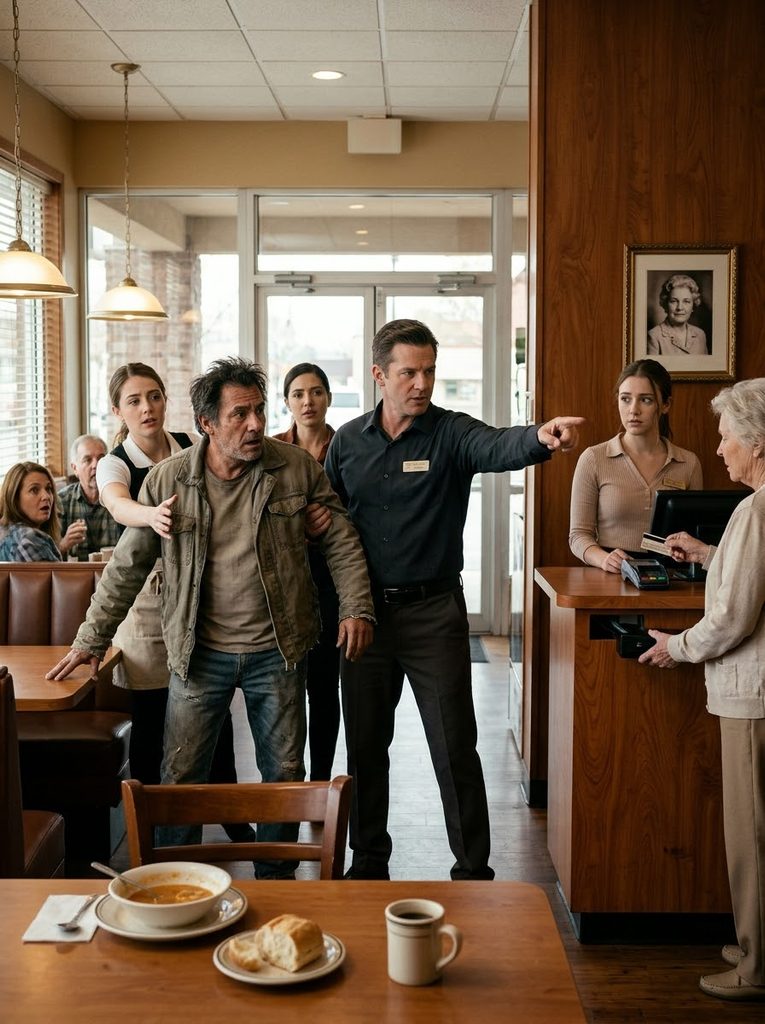
Two cars, ten people, and a family group chat they had secretly kicked me out of. When I called, my daughter-in-law simply said, “We forgot to tell you.”
PART 1
At exactly six o’clock on Christmas Eve morning, I woke up because my house was far too quiet.
For four full years, quiet had been almost impossible to come by in my five-bedroom colonial home in Minneapolis. My son, Lucas, lived downstairs with his wife, Gemma, and their two energetic kids. Gemma’s parents, Douglas and Beverly, seemed to appear whenever there was free food, extra space, or something I was paying for.
“Good morning, Margaret,” Gemma would usually say whenever she bumped into me in the kitchen. She always smiled sweetly while pouring herself the coffee I had bought.
“Did you remember to pick up those organic juice boxes for the kids?” she would ask. I always said yes because I loved my family deeply.
But that morning, there were no footsteps on the stairs. There were no children arguing over breakfast, and no heavy wooden doors slamming shut.
I walked over to the bedroom window and looked down at the driveway. Lucas’s dark blue SUV was completely gone. The spacious twelve-passenger rental van Gemma had insisted we rent for our holiday trip was missing as well.
I walked downstairs to the front entryway and stopped dead in my tracks. Every single suitcase had been moved out. Every thick winter coat was gone from the closet, and all the ski bags were missing from the corner.
My stomach tightened instantly as a cold feeling hit me. I picked up my phone and unlocked it, opening the messaging app to check our family group chat.
The chat was gone. I searched through my active conversations, but it was nowhere to be found. Someone had manually removed me from the group.
I dialed my son’s phone number right away. After four long rings, Gemma answered the line instead.
“Good morning, Gemma,” I said quietly, holding the phone tight against my ear. “Where are you?”
A brief pause followed before I heard an uncomfortable little laugh on the other end. Wind was roaring through the receiver, and I could clearly hear tires humming against the highway pavement.
“Oh, Margaret… we’re already on the road,” Gemma replied casually.
“To the mountain resort in Sun Valley?” I asked, looking at my empty living room.
“Yes,” Gemma explained in a fast voice. “Things got so hectic this morning. The kids were getting restless, and my parents really wanted to hit the road early to beat the traffic, so we figured it would just be easier to get going.”
“And when were you planning to tell me?” I asked, staring out at the empty pavement outside.
“Margaret, please don’t make this dramatic,” Gemma sighed loudly into the phone.
I almost laughed out loud at the absolute absurdity of her response. Ten people had left before sunrise for a luxury mountain vacation that I had spent four months planning. I had paid twelve thousand five hundred dollars out of my own bank account for the entire trip.
“You’ve been so stressed lately,” Gemma continued before I could speak. “Maybe staying home will actually be wonderful for you. You can relax, watch television, and enjoy some true peace and quiet.”
I looked around the sparkling clean kitchen of the home where she had been living rent-free for years.
“I see,” I replied calmly.
“So you’re not upset with us?” Gemma asked, sounding relieved.
“Not at all,” I said with a light tone. “Merry Christmas, Gemma.”
I hung up the phone before she could say another word. For nearly a full minute, I stood completely still in the middle of my quiet hallway.
I walked directly into my home office and opened up my laptop computer. The booking confirmation from the luxury resort in Idaho was sitting right at the top of my inbox.
It was a seven-night stay in a private luxury lodge with premium holiday packages included. The total cost was exactly twelve thousand five hundred dollars.
Before touching the keyboard, I remembered a tiny detail from earlier. I walked back into the kitchen and pulled a crumpled piece of paper out of the trash bin.
I flattened the paper out across the granite kitchen counter. It was the detailed room assignment printout that Gemma had made the day before.
“Primary suite: Lucas and Gemma,” the paper read in neat handwriting. “Guest suite one: Douglas and Beverly. Guest suite two: Gemma’s sister Chloe and her husband Brandon. Bunk room: the four children.”
I read every line on that page twice to make sure my eyes were not deceiving me. My name was not printed anywhere on the sheet.
They had not simply forgotten to wake me up that morning. They had never planned for me to come on the trip in the first place.
I had funded a grand Christmas vacation that was specifically designed to exclude me. A deep sense of absolute calm settled over my shoulders.
I returned to my laptop in the office and brought up the reservation system. My mouse cursor hovered over a bright red button on the screen.
I clicked the button to cancel the entire reservation. A confirmation box popped up on the display, asking if I was sure about my decision.
I clicked the confirmation button a second time without hesitation. A few seconds later, the refund notification landed in my email inbox, confirming that the money would return to my account.
I closed the laptop screen, walked into the kitchen to brew myself a hot mug of chamomile tea, and sat down on the couch to read the novel I had been trying to finish for months.
At two forty-seven that afternoon, my cell phone started ringing loudly on the coffee table. The caller ID showed my son’s name.
I ignored the first call completely. Lucas called again immediately, and then a third time right after that. By the time I finally pressed the green button to answer, there were fifteen missed calls on my screen.
“Mom!” Lucas shouted into the receiver, his voice trembling with pure panic. “We are standing right here at the lodge check-in desk, but they won’t hand over the keys. They are telling us that the reservation was canceled.”
In the background behind him, I could hear Gemma yelling at the top of her lungs. “Tell her to fix this right now, Lucas! My parents have been sitting in the car all day long!”
I slowly turned another page of my book with my free hand.
“Mom, what on earth happened to our reservation?” Lucas demanded frantically.
I took a slow sip of my hot chamomile tea. Then I gave him the simple answer that made the entire line go dead quiet.
“I canceled it,” I stated plainly.
“Why would you do that?” Lucas finally whispered after a long silence.
“Was there a room for me anywhere in that lodge, Lucas?” I asked him directly.
Two cars, ten people, and a family group chat they had secretly kicked me out of. When I called, my daughter-in-law simply said, “We forgot to tell you.”
PART 2
The silence that followed my question stretched out for a very long time. I could hear the cold wind howling on his end of the phone, along with muffled shouting from the rest of the family in the background.
“Mom, that’s not what happened,” Lucas tried to explain, his voice cracking with anxiety.
“It is a very simple question, Lucas,” I said as I laid my hardcover book gently on the armrest. “Primary suite for you and Gemma. Guest suite one for her parents. Guest suite two for her sister and brother-in-law. Bunk room for the four kids. I found the paper in the trash bin this morning. Ten people had reserved beds, but I did not.”
My late husband, Harrison, had passed away five years ago, leaving me alone in our spacious home. When Lucas and Gemma asked to move in temporarily to save up for a house deposit, I agreed right away because I wanted to help them.
However, that temporary stay stretched into four long years. During that time, Gemma’s family began treating my home like their own private resort.
I paid every penny of the property taxes and home insurance, but I also ended up covering massive grocery bills and rising utility costs. I never once asked them to pay rent because I genuinely believed that family should support one another.
“Helena,” Gemma’s voice suddenly cut in as she snatched the phone away from my son. “You need to fix this mistake right now. My parents are completely exhausted, and the children are crying in the lobby. This behavior is totally unacceptable.”
“What is truly unacceptable,” I replied in a firm tone, “is taking twelve thousand five hundred dollars of my money for a trip while deliberately keeping me off the guest list. What is unacceptable is deleting me from the family chat so I wouldn’t see your plans.”
“We just didn’t think you would want to come along!” Gemma argued back defensively. “You’ve seemed so tired lately, so we thought staying home would be a nice favor for you.”
“If your intentions were so kind, why did you feel the need to hide it from me?” I asked her straight out. Gemma had no answer for that question, leaving only heavy breathing on the line.
An hour later, Lucas called me back from the resort parking lot with sheer desperation in his voice.
“Mom, the front desk says the cancellation is completely final,” he pleaded. “We are stuck outside in the snow with all our bags and nowhere to stay. It’s Christmas Eve, and every single hotel in the valley is booked solid.”
“I am sorry you are in that difficult position, Lucas,” I told him honestly. “I really am. But I am not going to reverse my decision just because things became uncomfortable for you. You built this trip on my money while excluding me, and these are the natural consequences of that choice.”
Lucas called me three more times over the next few hours as the situation turned into a complete nightmare for them. The children were exhausted from sitting in the car, Douglas and Beverly were furious about the cold, and Gemma’s sister was threatening to drive back home immediately.
“Mom, please help us,” Lucas begged on his fourth call, sounding like he was on the verge of tears. “I understand why you are angry with us, but the kids are freezing. Can we please talk about the rest of this after we find a warm room?”
I took a deep breath as my maternal instincts kicked in for my grandchildren’s safety. “I will help you book emergency rooms at a standard motel nearby for tonight,” I said firmly. “I am doing this solely so my grandchildren don’t spend Christmas Eve in a cold vehicle, but I am not paying for a luxury vacation.”
They returned home three days later, cutting their holiday short, and the tension in the house was thick enough to cut with a knife.
“We really need to have a serious conversation about what happened,” Lucas said that evening as he sat down across from me at the kitchen table.
“I agree,” I replied, looking him dead in the eye. “For four years, I have provided a home and paid your living costs without asking for anything in return except basic respect. Excluding me from a trip I paid for showed me exactly where I stand in this family.”
Two weeks after that ruined holiday, I handed Lucas and Gemma a formal written agreement that changed everything.
“Starting next month, you will pay a monthly rent that covers your fair share of the property charges and utility bills,” I announced clearly. “Furthermore, Gemma’s parents will no longer be visiting this house without my explicit advance permission.”
“This feels completely harsh and unfair,” Gemma protested, her eyes wide with disbelief. “We are supposed to be family, Margaret.”
“Family does not mean using my money and taking advantage of my home while treating me like I am invisible,” I answered back calmly. “You are welcome to stay under these new terms, or you are free to find your own apartment.”
Over the following months, the dynamic inside our household underwent a massive transformation. Lucas realized how poorly he had treated me, and he began making a real effort to include me in decisions and treat me with genuine respect.
“I let Gemma and her family run over your feelings for years,” Lucas confessed to me months later during a quiet chat in the living room. “I got comfortable using your generosity, and I am so sorry for taking you for granted.”
Gemma’s adjustment was much slower and filled with quiet resentment, but she followed the new house rules because she had no other choice. Her parents stopped coming over uninvited once they realized they could no longer treat my home like a free hotel.
I finally renovated my old craft room into a quiet reading sanctuary, complete with plush armchairs and bright floor lamps. Sitting there in the evenings with my favorite books, I felt a deep sense of peaceful ownership over my life once again.
Taking back my dignity on that Christmas Eve was the hardest thing I had ever done, but it taught my family a lesson they would never forget. Generosity without respect is just exploitation, and I was finally done allowing anyone to take my love for granted.
PART 3: The Slow Shift
The silence that settled over the house in the months after the lease agreement was signed was entirely different from the heavy, suffocating tension that had immediately followed Christmas. It was a quiet born of boundaries—unaccustomed, uncomfortable, but firm. For four years, the house had operated as a free-for-all, a revolving door of relatives, unannounced dinners, and unasked-for opinions. Now, every interaction carried a new layer of deliberation.
Lucas was the first to adapt, though his adaptation came with a palpable weight of guilt. Every evening when he returned from work, he no longer walked straight to the kitchen without a word or retreated into the basement with his phone. Instead, he would linger by the archway of my renovated reading room.
“Mom? Need anything from the store? I’m heading out to pick up some groceries,” he would ask, his voice cautious, almost deferential.
“No, thank you, Lucas. I bought what I needed yesterday,” I would reply smoothly, keeping my voice light but composed, never letting him feel that the distance between us was an act of cruelty, but rather a necessary line drawn in ink.
Gemma, on the other hand, chose passive endurance. She paid her half of the agreed utilities on the exact first day of every month, transferring the funds digitally without a word. But her presence in the common areas shrank significantly. She began spending most of her evenings upstairs in their suite or taking the children out to local parks and indoor play areas—anywhere where she wouldn’t have to interact with me under the new rules.
Her family, however, did not surrender their accustomed privileges without a fight.
It began on a damp Tuesday afternoon in late February. I was sitting at the dining table, reviewing my quarterly property tax statements and organizing my insurance receipts, when the front door unlock chime sounded. Seconds later, the door swung open, and Douglas and Beverly walked straight into the foyer, carrying two large rolling suitcases and a paper shopping bag filled with fruit.
I sat back in my chair, watching them.
“Oh! Helena, you’re home,” Beverly said, pausing in the hallway as if surprised to find the homeowner in her own house. She didn’t offer a greeting or an apology. “We brought some fresh oranges from the market down south. Douglas has a podiatrist appointment in town tomorrow morning, so we figured we’d crash in the primary guest room tonight instead of driving back and forth in the morning traffic.”
Douglas took off his heavy coat, immediately reaching for the coat rack near the door—the one I had explicitly designated for immediate household residents.
“Beverly, Douglas,” I said calmly, staying seated. “Did Lucas or Gemma fail to pass along my letter from January?”
Beverly stopped mid-reach, her hand hovering over a coat hook. “What letter?”
“The letter outlining the new terms of residence in this house,” I replied, standing up and closing my folder with a crisp, final click. “Which explicitly stated that guests—including family—are no longer permitted to stay overnight or visit without my prior written consent.”
Beverly’s face flushed a deep, mottled red. “Helena, for goodness’ sake, we are family! We aren’t strangers off the street! Douglas has a medical appointment. It’s a forty-five-minute drive from our place in the morning rush.”
“Then Douglas should have booked a hotel room closer to his doctor’s office,” I said without raising my voice. “Or you should have called me forty-eight hours in advance to ask if I was willing to host you. You did neither. You simply assumed the door was unlocked for you as it always was.”
“This is absurd!” Douglas barked, his voice echoing off the high ceilings. “You’re turning away your daughter-in-law’s parents out of sheer spite over a canceled vacation! We apologized for that misunderstanding months ago!”
“You did not apologize, Douglas,” I reminded him coolly. “Gemma made excuses, Lucas cried, and you spent three hours complaining about the cold in a motel lobby that I paid for. That is not an apology. And this is not a hotel.”
Beverly looked around the foyer, her eyes searching for support, but Lucas and Gemma were both at work, and the children were at after-school care. There was no audience to appeal to, no intermediate buffer to shield them from the stark reality of my refusal.
“Are you seriously telling us to leave?” Beverly asked, her voice trembling with indignation.
“I am telling you that you cannot stay here tonight,” I said. “I suggest you head down to the Comfort Inn on the bypass. It’s ten minutes from the clinic.”
Douglas grabbed his coat back off the arm of the chair, his face dark with fury. “Unbelievable. Absolute selfishness. Harrison would be ashamed of what you’ve turned this family into!”
Mentioning Harrison was meant to be a lethal strike, a weapon designed to pierce my resolve and provoke guilt. Five years ago, it might have worked. Three months ago, it might have made me weep. But after months of standing on my own two feet, the insult rang hollow. Harrison had loved his home, but he had loved respect even more. He would never have tolerated being made a ghost in his own house.
“Harrison is not here,” I said evenly, meeting Douglas’s angry glare without flinching. “I am. And in this house, my word is final. Good day.”
They left, slamming the front door hard enough to rattle the glass side panels. I stood in the quiet hallway for a long moment, listening to the heavy rattle of their suitcases on the concrete driveway outside. My hands were steady. My heart wasn’t pounding. For the first time in four years, I didn’t feel like an intruder in my own life.
When Lucas returned home that evening, his face was pale. Gemma had clearly called him at work the moment her parents reached their car.
He walked into the kitchen where I was peeling potatoes for dinner. He stood by the island for several minutes, shifting his weight from foot to foot before speaking.
“Mom… Beverly called me,” he began quietly.
“I know,” I replied without looking up from the chopping board.
“She said you turned them away at the door.”
“I did.”
Lucas let out a long, ragged breath. He pulled out a barstool and sat down, dropping his head into his hands. “Gemma is furious. She says you’re humiliating her family.”
“Gemma’s family humiliated themselves by assuming my home is an unbooked bed-and-breakfast,” I said, laying down the paring knife and looking at my son. “Lucas, did you remind her of the agreement we signed in January?”
“I did,” Lucas admitted, his voice barely above a whisper. “I told her that you set a rule and they broke it by just showing up. But she feels like you’re doing this to punish her.”
“I am not doing this to punish anyone, Lucas,” I said gently. “I am doing this to protect my peace. When you allow people to cross your boundaries continuously, they begin to believe those boundaries don’t exist. Your in-laws believed they owned a share of this house. Today, they learned they do not.”
Lucas looked up at me, his eyes tired and lined with stress. He looked older than his thirty-two years, worn down by years of playing mediator between a demanding wife and an accommodating mother.
“I’m sorry, Mom,” he said suddenly.
“For what?”
“For not standing up sooner,” he said. “If I had stopped them from taking over the house three years ago, we wouldn’t be here now. You wouldn’t have had to cancel that trip, and we wouldn’t be living like strangers under the same roof.”
“We aren’t strangers, Lucas,” I said softly. “We are just redefining what it means to be adult family living together. It takes time.”
PART 4: The Crack in the Foundation
By late spring, the new routine had established a superficial rhythm. The monthly utility payments arrived on time, the quiet hours were respected, and Gemma’s parents did not attempt another unannounced visit. But underneath the surface of this uneasy truce, structural flaws were beginning to show—not in my home, but in Lucas and Gemma’s marriage.
For four years, their marriage had been cushioned by my passive financial and operational support. I had been the silent maid, the resident babysitter, the emergency bank account, and the shock absorber for every argument they had about money or responsibility. Without realizing it, my generosity had allowed them to avoid facing the reality of their own financial choices.
Now, paying their fair share of rent and utilities, managing their own grocery spending, and paying for paid childcare when their work hours overlapped had exposed the thinness of their savings.
One evening in May, I was sitting in my reading room with a cup of chamomile tea when I heard voices raised in the upstairs primary suite. The house was usually quiet after eight in the evening when the kids were settled in bed, but tonight the tone was sharp and unyielding.
“We can’t keep living like this, Lucas!” Gemma’s voice carried down the hallway, sharp and strained. “Half your paycheck goes to your mother’s ‘rent’ and utilities, and we’re barely putting away five hundred dollars a month for the down payment! At this rate, we’ll be forty before we can buy a house!”
“She’s asking for what’s fair, Gemma!” Lucas’s voice replied, equally tense. “She paid for everything for four years! Every single utility bill, the taxes, the food! We should have saved eighty thousand dollars in four years, Gemma! Where did that money go?”
“Don’t you dare turn this on me!” Gemma snapped back. “We bought reasonable things! We took the kids on trips! We helped my sister with her car payment!”
“We didn’t ‘help’ her sister, Gemma, we bought her a used sedan!” Lucas yelled, his voice cracking. “And we spent twelve grand on a ski resort trip that we tried to hide from my own mother! That’s where our down payment went! We blew it because we thought Mom would just keep paying for the house forever!”
A heavy silence followed his words. Sitting downstairs, I took a sip of my tea, feeling neither satisfaction nor joy at hearing the truth spoken aloud. It was simply the inevitable arrival of reality.
The next morning, Gemma came down to the kitchen alone. Lucas had already left for an early shift at his engineering firm. The children were sitting at the breakfast nook, quietly eating oatmeal.
Gemma walked over to the coffee maker, her movements rigid. She looked pale, with dark circles under her eyes that no makeup could fully conceal.
“Helena,” she said, her back turned to me as the machine dripped into the carafe.
“Good morning, Gemma,” I replied, drying a plate by the sink.
She turned around, resting her lower back against the counter, holding a steaming mug with both hands. “We need to talk about our living arrangement.”
“I’m listening.”
“We want to buy a place,” she said directly. “A townhome in the east side school district. But the interest rates are high, and with the rent we’re paying you every month, we can’t put together the final ten percent for the closing costs.”
“I see,” I said neutrally.
“I was hoping… considering everything,” Gemma continued, her tone attempting a composure she clearly didn’t feel, “that you might consider waiving the rent for the next six months. Just six months. It would allow us to save the remaining fifteen thousand dollars we need so we can move out and give you back your privacy.”
It was a clever proposition. Frame the request as a favor to me—a way to expedite their departure so I could have my house back.
I set the dish towel down on the counter and looked at her.
“Gemma,” I said softly, “when you moved in four years ago, the agreement was that you would stay for eighteen months, save your money, and buy a starter home. During those eighteen months, I asked for nothing. You stayed for forty-eight months instead. In those extra thirty months, I absorbed thousands of dollars in expenses while you bought new cars, took family vacations, and provided financial assistance to your relatives.”
Gemma opened her mouth to interrupt, but I held up a hand gently.
“I am not bringing this up to criticize your past choices,” I continued. “I am bringing it up because forgiving your rent now will not solve your financial problem. It will only postpone your understanding of what homeownership actually costs.”
“So the answer is no?” she asked, her voice turning icy.
“The answer is no,” I said. “The rent remains as agreed. If you need to move out sooner, you can adjust your budget, reduce non-essential spending, or look for a property within your current means.”
Gemma stared at me for a long moment, her chest heaving slightly with suppressed anger. “You really don’t care about your own grandchildren, do you? You’d rather keep us trapped here under your thumb, paying you rent like tenants, than see us establish our own home.”
The accusation was meant to sting, but I had outgrown the desire to defend my character against bad-faith attacks.
“My grandchildren have a clean, warm, stable home with a yard and fresh meals every day,” I said calmly. “They are not trapped, and neither are you. You are adult parents with jobs and choices. I suggest you focus on those choices.”
She didn’t respond. She set her full cup of coffee on the counter with a loud clatter and walked upstairs to fetch the children for school.
That afternoon, I called my legal advisor, Richard, who had handled Harrison’s estate matters years ago.
“Helena,” Richard said when he answered. “How are things progressing at the house?”
“They are moving toward their logical conclusion, Richard,” I told him. “I need you to draw up a formal, legal non-renewal notice for the occupancy agreement.”
There was a short pause on the line. “Are you giving them a deadline to leave?”
“I am giving them six months,” I said. “By November thirty-first, prior to the holidays, I want the house returned to my sole possession. I want everything laid out legally, clearly, and without ambiguity.”
“Are you sure about this, Helena?” Richard asked gently. “Six months goes fast, and family evictions can get extremely messy.”
“It is not an eviction, Richard,” I said, looking out the window at the blooming hydrangea bushes in the front garden. “It is a deadline. Without a deadline, people never truly grow up.”
PART 5: The Departure
When I handed Lucas the formal six-month notice that weekend, he didn’t scream or slam doors. He sat at the kitchen table holding the document, reading through the legalese with a steady, resigned gaze.
Gemma stood behind him, her arms folded tightly across her chest, her face pale with fury.
“Six months?” she hissed. “You’re giving your own son six months to get out?”
“I am giving your family half a year to secure alternative housing,” I corrected her mildly. “That is more than double the standard notice required by law. It provides ample time to secure a lease on an apartment or finalize a purchase on a home within your budget.”
“Lucas, say something!” Gemma demanded, shoving his shoulder. “She’s throwing us out onto the street!”
Lucas didn’t move. He continued staring at the document for another long minute before he slowly set it down on the wood surface.
“She’s not throwing us out, Gemma,” Lucas said softly, his voice heavy with an overwhelming realization. “She gave us four years. We overstayed by two and a half. She’s giving us six months’ notice. Most landlords give thirty days.”
“She’s your mother, not a landlord!” Gemma shouted.
“That’s the problem, Gemma!” Lucas suddenly stood up, his chair scraping loudly against the hardwood floor. “We treated her like a landlord when it suited us—demanding repairs, space, and privacy—and then we hid behind ‘family’ whenever she asked us for basic respect! We ruined Christmas Eve because we were greedy, and now we’re complaining because she won’t let us take advantage of her for another five years!”
Gemma gaped at him, stunned into silence by his sudden outburst. It was the first time in their eight years of marriage that Lucas had openly defied her narrative in front of me.
“We’re moving,” Lucas said, looking his wife directly in the eye. “We’re scaling down our search. We aren’t buying a four-bedroom house with a two-car garage right now. We’re going to look at three-bedroom townhomes or rent an apartment until we have a real down payment saved from our own hard work.”
Gemma threw her hands up in frustration and turned on her heel, marching upstairs to their room and slamming the heavy oak door so hard the framed prints in the hallway shuddered on their hooks.
Lucas stood alone in the kitchen, his shoulders slumping as the anger drained out of him, leaving behind pure exhaustion.
“I’m sorry, Mom,” he said again.
“Don’t be sorry for telling the truth, Lucas,” I told him gently. “It’s the first step toward building something real for yourself.”
The next five months were a masterclass in quiet transition.
Once the hard deadline was established, the dynamic in the house changed from defensive hostility to practical activity. Freed from the illusion that they could stay indefinitely, Lucas and Gemma began making actual sacrifices.
They canceled their expensive subscription services. They cooked meals at home instead of ordering takeout four nights a week. Gemma sold her late-model SUV and traded it in for a practical, fuel-efficient sedan with a lower monthly payment.
It was amazing how quickly financial discipline took root when the safety net was definitively removed.
In September, Lucas found a modest, well-maintained three-bedroom townhome about ten minutes away, located in a quiet neighborhood close to the children’s elementary school. It didn’t have the grand granite countertops or the sprawling backyard of my house, but it was sturdy, clean, and entirely theirs.
The packing began in October.
Watching four years of accumulated belongings being boxed up and loaded into moving trucks was a strange, bittersweet experience. Rooms that had been cluttered with plastic toys, double strollers, and extra furniture slowly emptied out, returning to their original proportions.
On the final Saturday of November, the last moving van pulled out of the driveway.
The children came into the kitchen to say goodbye. They were excited about their new bedrooms—which they had helped paint the weekend before—and completely oblivious to the bitter political war that had raged over their heads for the past eleven months.
“Bye, Grandma!” my oldest grandson said, giving me a tight hug around the waist. “Will you come visit our new house?”
“I would love to, sweet boy,” I said, kissing the top of his head. “As long as your parents invite me.”
Gemma was standing near the front door, wearing her coat and carrying her handbag. She looked at me, her expression unreadable. The anger that had consumed her in the winter had settled into a cool, guarded distance, but the bitter edge was gone.
“Thank you for… letting us stay as long as you did, Margaret,” she said, her voice quiet and restrained. It wasn’t a warm apology, nor was it a tearful reconciliation, but it was an acknowledgment.
“You’re welcome, Gemma,” I replied kindly. “I wish you all the best in your new home.”
Lucas stayed behind for a few minutes after Gemma and the kids walked out to the car. He stood in the empty foyer, looking around at the freshly painted walls and the quiet space.
“It feels huge again,” he noted softly.
“It feels like my home,” I corrected him with a gentle smile.
Lucas nodded, stepping forward to wrap his arms around me in a long, tight hug. “I’ll call you on Tuesday, Mom. We’d love to have you over for dinner once we get the kitchen unpacked.”
“I’d like that very much, son.”
I watched from the front porch as his car disappeared down the tree-lined street. The cold autumn wind blew a few dry leaves across the driveway, but inside, as I closed the heavy front door behind me, the house was warm, silent, and entirely mine.
PART 6: The Sanctuary
A year has passed since that cold November day when the last box was lifted out of my hallway.
My home is quiet now, but it is not lonely. There is a vast, profound difference between solitude and loneliness—a distinction I only fully understood once I reclaimed my space.
The primary guest suite, once occupied by Gemma’s parents during their unannounced weekends, has been converted into a bright, airy home office and guest space reserved exclusively for genuine, invited company. The bunk room that once housed four chaotic children has been returned to its original state as a serene bedroom for visiting friends or out-of-town guests.
My old craft room remains my favorite place in the world—my reading sanctuary. The walls are painted a soft sage green, lined with floor-to-ceiling bookshelves housing Harrison’s old collection of histories, my mother’s vintage poetry books, and every novel I had been meaning to read for the last ten years.
Every morning, I wake up at seven. I make a fresh pot of dark roast coffee, sit by the bay window in the kitchen, and watch the sun rise over the garden without hearing the pounding of little feet, the blast of morning television, or the passive-aggressive commentary of unexpected relatives.
My relationship with Lucas has healed in ways I didn’t think possible during those dark winter months.
Removal of financial codependency did not destroy our bond; it saved it. Now, when Lucas comes over on Thursday afternoons to help me trim the tall hedges or check the gutter downspouts, he comes as an adult son visiting his mother, not a burdened child avoiding his responsibilities.
We sit on the back patio with glasses of iced tea, talking about his work, his children’s progress in school, and his plans for the future.
“You know,” he told me a few weeks ago, watching his children run through the sprinkler on my back lawn during a Sunday barbecue, “moving into our own place was the best thing that ever happened to us.”
“Is that so?” I asked, leaning back in my wicker chair.
“Yeah,” he smiled, looking over at Gemma, who was setting out paper plates on the outdoor table. “Gemma and I… we talk now. Really talk. When we were living here, we blamed everything on the house, or on money, or on you. Once we had our own bills and our own walls, we had to take responsibility for our own lives. It made us better parents. Better partners.”
Gemma has changed as well. She is no longer the entitled, demanding presence who treated my living room as her personal lounge. While we will likely never be close confidantes, a mutual respect has grown between us. She asks before bringing the children over, she never leaves a dish in my sink when she visits, and she speaks to me with a courteous warmth that reflects genuine gratitude rather than forced politeness.
Her parents, Douglas and Beverly, have not set foot in my house since that rainy Tuesday afternoon in February. They stay at a local hotel when they come to town to see their grandchildren, and while they maintain a icy distance from me during family events at public venues, I consider their absence from my personal space to be one of the greatest victories of my late life.
Last week was Christmas Eve—exactly two years since the ruined ski trip that started it all.
Instead of a chaotic, dishonest expedition built on my stolen money, we had a simple, beautiful evening at my house. Lucas, Gemma, and the four kids came over at five in the evening. We baked gingerbread cookies, listened to old holiday records on Harrison’s turntable, and opened a few modest presents around a small, brightly lit pine tree in the living room.
At eight o’clock, Gemma helped the children pack up their new toys and put on their heavy winter coats.
“Thank you for a wonderful Christmas Eve, Margaret,” Gemma said, stepping up to me near the front coat rack and offering a warm, sincere hug. “The kids loved every minute of it.”
“It was my pleasure, Gemma,” I replied, hugging her back warmly. “Merry Christmas.”
After they left, I walked through the quiet house, checking the locks and turning off the holiday lights one by one. I walked into my reading sanctuary, carrying a fresh cup of tea, and sat down in my favorite leather armchair.
I looked out the window at the soft snow falling gently over the sleeping garden outside.
Five years ago, when Harrison died, I thought my life’s main story had concluded, leaving behind only the quiet role of a spectator in other people’s lives. I allowed myself to be used, overlooked, and sidelined because I believed that sacrifice was the only currency an aging mother had left to purchase love and relevance.
I was wrong.
Love that requires self-erasure is not love at all; it is consumption. Real family strength does not come from passive tolerance of disrespect, but from the courage to demand the dignity you deserve.
I picked up my book, opened it to the bookmarked page, and settled into the quiet warmth of my home—peaceful, whole, and entirely free.
THE END.!