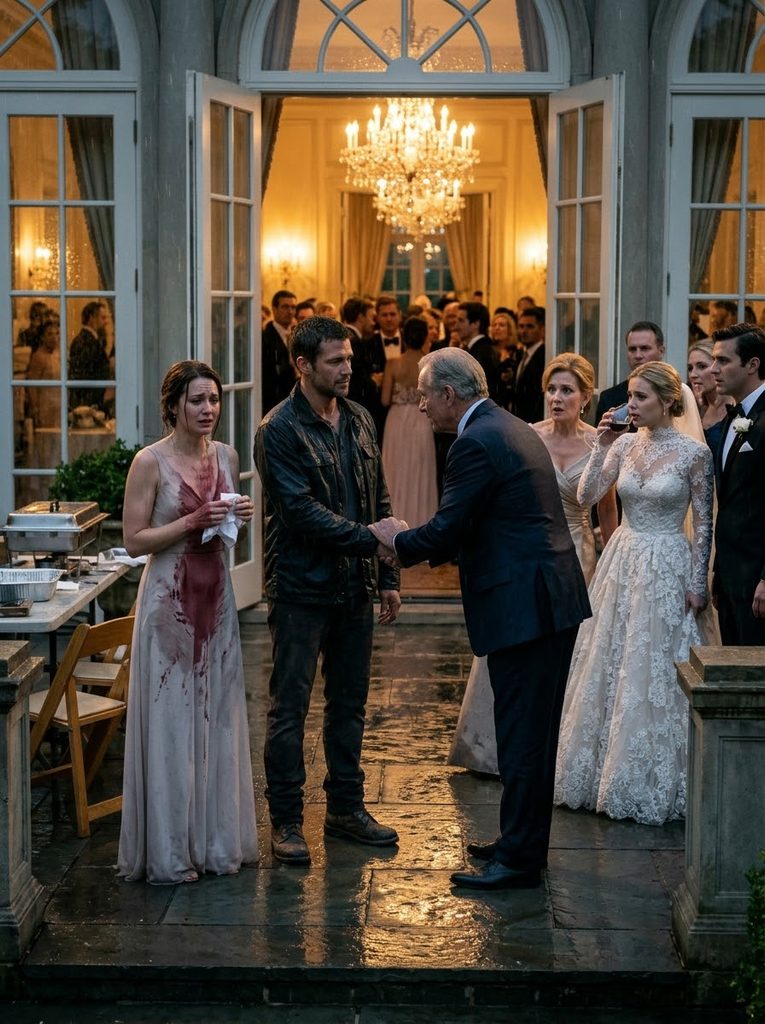
I never told my family that my “farmhand” husband was actually the billionaire investor they were desperate to impress.
At my sister Madison’s wedding, my mother seated me near the trash bins in the rain and told us, “We’ll bring you leftovers.”
My sister called me an embarrassment.
Then she poured a glass of red wine down the front of my dress while our mother stood nearby and watched.
They laughed.
I wanted to disappear.
But I stayed.
A few minutes later, my husband walked into the ballroom.
And in the space of a few seconds, every smile vanished.
The man my family had dismissed as a poor farmhand suddenly became the most important person in the room.
But the truth was, he hadn’t changed at all.
They had.
They had simply learned something about him that should never have mattered in the first place.
I had never told my family the full story about Daniel Brooks.
To them, he was simply the quiet man I married after leaving the city.
A man who worked with his hands.
A man who wore faded jeans and old work boots.
A man who drove a six-year-old pickup truck.
A man who kept bees, worked outdoors, and rarely talked about money.
They assumed that meant he didn’t have any.
Honestly, Daniel and I preferred it that way.
My family had always measured people by appearances.
My mother, Carolyn, believed success should be visible from across a room.
The right house.
The right clothes.
The right car.
The right neighborhood.
And most importantly, the right last name.
If someone walked into a room wearing a $2,000 suit, my mother wanted to know what they did.
If someone arrived in an old truck wearing work boots, she had already decided.
My younger sister Madison had learned that lesson perfectly.
She had spent years building a life that looked impressive from the outside.
And when she announced her wedding, it quickly became obvious that the celebration wasn’t only about marrying the man she loved.
It was about status.
Her fiancé came from a well-known business family, and the guest list was filled with executives, investors, developers, bankers, and people whose names my mother loved casually dropping into conversations.
But there was one particular guest everyone seemed especially interested in.
An extremely private billionaire investor whose firm had recently begun exploring several major development opportunities in the area.
Madison’s future father-in-law desperately wanted to meet him.
So did several of the businessmen invited to the wedding.
My mother couldn’t stop talking about him.
“If he comes,” she told me one evening, “this wedding could open doors for this family that you can’t even imagine.”
I almost smiled.
Because the man she was talking about was sitting beside me at our kitchen table in muddy work boots, repairing the handle on an old coffee mug.
Daniel Brooks.
My husband.
The billionaire investor they were all desperate to impress.
Very few people outside Daniel’s professional world recognized him in person.
That was exactly how he wanted it.
He had spent years building an investment fund that managed several billion dollars, but he had never cared much about being photographed beside expensive cars or walking into restaurants surrounded by assistants.
His professional world knew him.
His private life was different.
At home, he was simply Daniel.
He woke early.
Checked the fields.
Worked with the bees.
Fixed things himself.
He wore the same flannel shirts until the elbows began to thin.
He drove an old pickup because it worked.
He never felt the need to prove anything.
And because my family never asked meaningful questions about him, they never discovered anything beyond what I chose to tell them.
I told them Daniel owned a farm.
That he kept bees.
That he worked outdoors.
That we lived quietly in Vermont.
All of it was true.
I simply never told them about the investment fund.
I never told them about the billions under management.
I never told them about the executives who flew across the country to sit across a table from him.
And I certainly never told them how many of the people my mother desperately wanted to impress already knew his name.
I wanted one thing.
I wanted my family to judge Daniel as a person before they knew what his bank account could offer them.
That shouldn’t have been too much to ask.
I was wrong.
When the wedding weekend arrived, I hesitated about going.
Part of me already knew what would happen.
Daniel squeezed my hand.
“Let’s go,” he said calmly. “She’s your sister. I’ll follow your lead.”
So we drove to Connecticut in his old pickup.
Rain followed us for most of the journey.
By the time we reached the countryside venue, the grounds were wet and gray, and a steady drizzle was falling over the elegant property.
The ballroom itself looked like something from a magazine.
Tall windows.
Crystal chandeliers.
Long tables covered in white linen.
Massive floral arrangements.
A polished dance floor.
Everything was designed to communicate one thing:
This wedding mattered.
My mother was standing near the entrance when she saw us.
Her eyes traveled immediately to Daniel’s clothes.
He was clean and neatly dressed.
But his boots were worn.
That was apparently enough.
Her lips tightened.
“We didn’t plan a seat for… extra guests.”
I stared at her.
“Extra guests?”
I pointed toward Daniel.
“He’s my husband.”
Carolyn glanced toward the ballroom.
Then she pointed toward a small table outside near the catering entrance.
It was dangerously close to the trash bins.
Rain was falling steadily around it.
The grass was already turning to mud.
“You can sit there,” she said.
Then, as though she were doing us a favor, she added:
“We’ll bring you leftovers.”
I looked at Daniel.
I expected anger.
Instead, his expression remained calm.
He pulled out my chair.
“Your choice,” he said softly.
So we sat.
Outside.
In the rain.
Beside the service entrance.
While my parents and sister celebrated inside.
I should have left.
Every reasonable part of me knew that.
But some stubborn part of me refused to give my family the satisfaction of deciding that I wasn’t worthy of being there.
So Daniel and I stayed.
He didn’t complain.
He didn’t ask for special treatment.
He simply sat beside me while rain tapped against the tent covering the small table.
At one point, he looked at me.
“You okay?”
I nodded.
“I’m fine.”
He knew I wasn’t.
But he didn’t push.
That was Daniel.
He had always understood that sometimes the person you love doesn’t need a lecture.
They just need someone sitting beside them.
Inside, the ceremony continued.
Madison barely acknowledged me.
When the reception began, guests moved between the ballroom and the covered outdoor area.
I tried to stay out of the way.
I didn’t want to create a scene.
Then Madison came outside.
She was wearing a designer wedding gown and holding a glass of red wine.
She looked beautiful.
Until she opened her mouth.
“I can’t believe you actually showed up like this.”
I frowned.
“Like what?”
Her eyes moved toward Daniel.
“Do you know how embarrassing it is having to explain you two to my friends?”
Daniel remained silent.
I felt my face getting warm.
“We came because you’re my sister.”
Madison laughed.
“Exactly. You’re my sister. Which means people assume we’re alike.”
Her eyes dropped toward Daniel’s boots.
“And you’re married to a farmhand.”
Several people nearby laughed.
I looked toward my mother.
She was standing only a few feet away.
She had heard every word.
She didn’t stop Madison.
She smiled.
Then Madison lifted her wine glass.
At first, I thought she was taking a sip.
She wasn’t.
She tipped it.
Red wine poured straight down the front of my dress.
I gasped.
The laughter grew louder.
Someone actually covered their mouth while smiling.
I stood there frozen, staring at the wine spreading across the fabric.
Then I looked at my mother.
She did nothing.
Madison shrugged.
“Oops.”
My face burned.
Daniel immediately handed me a napkin.
“It’s okay,” he said quietly.
But when I looked into his eyes, I knew he wasn’t talking about the dress.
He was telling me he had seen enough.
He leaned closer.
“Do you want to leave?”
I looked toward the ballroom.
Then back at him.
“No.”
I swallowed.
“I don’t want them deciding how this night ends.”
Daniel nodded.
“Okay.”
He didn’t argue.
He simply stayed beside me.
Then he looked through the glass doors toward the ballroom.
His expression changed slightly.
“There’s someone inside who knows exactly who I am,” he said.
I followed his gaze.
“Who?”
“James Hartley.”
I knew the name.
James Hartley was a major figure in finance and one of the investors Daniel had been working with for months.
“He saw me through the glass,” Daniel continued.
I stared at him.
“Are you serious?”
Daniel nodded.
“Once I walk inside, their understanding of me is probably going to change.”
I almost laughed.
After everything that had happened, I couldn’t imagine anything changing.
But then the ballroom doors opened.
The music stopped.
A wave of excitement moved through the room.
The wedding planner hurried toward the entrance.
Several businessmen immediately stood.
Madison’s new father-in-law straightened his jacket.
Someone near the stage whispered:
“He came.”
Another voice answered:
“No way.”
Then someone gasped.
“That’s him.”
I watched as a group of sharply dressed executives entered the ballroom.
At first, I didn’t understand what was happening.
Then one of them looked across the room.
He saw Daniel.
And immediately walked toward him.
“Mr. Brooks,” he said, extending his hand. “We’ve been waiting for you.”
The room went silent.
My mother blinked.
Madison’s wine glass stopped halfway to her mouth.
Her new husband looked from the executive to Daniel.
Then back again.
“Mr… Brooks?”
Daniel shook the man’s hand.
“James.”
Hartley smiled.
“Good to finally see you in person outside a boardroom.”
And then something extraordinary happened.
Other people began approaching.
Bankers.
Developers.
Investors.
Business leaders.
People my mother had spent the entire evening trying to impress.
They knew Daniel.
Not vaguely.
Not because they had heard his name somewhere.
They knew him personally.
They wanted his attention.
They wanted to speak with him.
They wanted to shake his hand.
The same man my mother had placed beside the trash bins.
The same man Madison had just called a farmhand.
The same man they had assumed wasn’t important because he wore worn boots.
Conversations died mid-sentence.
Phones that had been discreetly raised for pictures froze in place.
The wedding planner stood several feet away, staring.
Madison looked at Daniel.
Then at me.
Then down at the red wine soaking my dress.
For the first time that evening, she looked frightened.
My mother went completely pale.
Because the billionaire investor everyone at that wedding had been desperate to impress was standing in front of them.
And he had heard everything.
He was still holding the napkin he had used to help clean the wine his new sister-in-law had poured over his wife’s dress.
My mother was the first to come outside.
She looked shaken.
“Why didn’t you tell me?”
I stared at her.
“Tell you what?”
“About Daniel.”
I almost laughed.
“What exactly should I have told you?”
“That he’s…”
She couldn’t finish the sentence.
“A billionaire?” I asked.
She nodded.
I looked back toward the ballroom.
“Would it have changed how you treated us?”
She didn’t answer.
That silence told me everything.
I reminded her that I had never lied.
Daniel really did own a farm.
He really did keep bees.
He really did work with his hands.
He really did live quietly with me in Vermont.
I had simply never told her how much money he had.
Because I wanted to know how my family would treat him when they believed he had nothing to offer them.
Now I knew.
My mother looked down.
“I didn’t realize.”
“Yes,” I said. “That’s the problem.”
She looked at me.
“I thought you had made a mistake.”
“Choosing Daniel?”
She nodded.
I shook my head.
“I chose a man who treats me well. A man who sits beside me in the rain. A man who doesn’t need everyone in a ballroom to know his name.”
My mother didn’t respond.
Because there was nothing left to say.
Madison eventually came outside.
Her confidence was gone.
The woman who had poured wine down my dress now stood in front of me looking embarrassed.
“I was showing off,” she admitted.
I said nothing.
She looked at Daniel.
“I’m sorry.”
Daniel nodded politely.
But he didn’t rescue her from the discomfort.
Neither did I.
Madison turned toward me.
“I thought you had failed,” she said quietly.
I looked at her.
“Because I chose a quieter life?”
She nodded.
“You seemed… less successful.”
I almost smiled.
“That’s because you were measuring success by what you could see.”
She wiped at her eyes.
“I shouldn’t have treated you like that.”
“No,” I said. “You shouldn’t have.”
It wasn’t the kind of apology that erased anything.
It couldn’t erase the rain.
It couldn’t erase the trash bins.
It couldn’t erase the laughter.
It couldn’t erase the wine soaking into my dress.
And it certainly couldn’t erase the fact that my family had only changed their attitude after discovering Daniel’s wealth.
But at least, for the first time, Madison seemed to understand what she had actually done.
My mother apologized too.
She admitted that she had spent years measuring people by status and appearances.
She admitted that she had judged Daniel before knowing him.
She admitted that she had treated my life as though it were somehow less valuable because it didn’t look impressive from the outside.
I accepted the apology.
But accepting an apology doesn’t mean pretending nothing happened.
Some things take time.
Some wounds don’t disappear simply because someone finally finds the right words.
Daniel and I stayed long enough for cake.
Not because we suddenly needed their approval.
Not because the ballroom had finally decided we were important.
We stayed because it was still my sister’s wedding.
Then, when the evening was over, we left.
No dramatic speech.
No final confrontation.
No announcement about Daniel’s fortune.
We simply got into the same six-year-old pickup truck and drove home to Vermont through the dark countryside.
The ballroom disappeared behind us.
So did the people who had spent the night judging us.
When we got home, the house was quiet.
Daniel changed into the same flannel shirt my family had once dismissed.
He went into the kitchen.
Made tea.
Then started joking about the wedding food.
“I think the potatoes were better outside,” he said.
I laughed.
For the first time all evening, I felt the tension leave my body.
I looked at him standing there in our kitchen.
No executives.
No bankers.
No billion-dollar deals.
No ballroom.
Just Daniel.
The same man who had sat beside me in the rain.
The same man who had handed me a napkin when my sister poured wine down my dress.
The same man who never once asked why my family didn’t recognize his worth.
And suddenly, the entire evening made sense.
Daniel hadn’t become more valuable when the ballroom learned about his money.
He had been exactly the same man before they knew.
Exactly the same man afterward.
His kindness hadn’t changed.
His intelligence hadn’t changed.
His character hadn’t changed.
His love for me hadn’t changed.
Only their perception had changed.
And that was the part that stayed with me.
My family had spent years believing that a person’s value could be measured by a house, a car, a suit, a last name, or a bank account.
But that night, they were given the clearest possible lesson.
The man they had treated like an embarrassment was the man they had been desperate to impress.
And the woman they had seated beside the trash was the person who had known his worth all along.
Daniel didn’t become important when they discovered he was a billionaire.
He was important when he sat beside me in the rain without complaining.
He was important when he handed me a napkin instead of starting a fight.
He was important when he asked if I wanted to leave and then respected my decision when I said no.
The ballroom hadn’t revealed who Daniel was.
It had revealed who my family was.
And that difference mattered more than any amount of money ever could.
The morning sun spilled over the Vermont mountains, painting the autumn canopy in brilliant shades of gold, amber, and crimson. There was a crispness in the air—the kind of sharp, clean morning that smelled of damp earth, woodsmoke, and pine.
Inside our small, unpretentious kitchen, the only sound was the low hum of the refrigerator and the gentle whistle of water heating on the stove.
Daniel stood by the window, wearing a faded flannel shirt with a frayed collar, holding a mug of black coffee. He looked entirely out of place compared to the image the ballroom had tried to project of him just hours ago—the mysterious billionaire tycoon, the elusive titan whose signature could shift global markets. Here, he was simply the man who knew how to fix a leaky porch rail and could name every bird species nesting in the valley.
“They’re going to call,” I said softly, wrapping my hands around my own mug.
Daniel didn’t turn around immediately. He took a slow sip of his coffee, watching the mist rise off the pasture behind our property. When he finally looked back at me, a faint, wry smile touched the corners of his mouth.
“They already have,” he said, nodding toward the kitchen counter.
My phone lay face down, silent, but the screen had lit up half a dozen times in the last twenty minutes. Missed calls and frantic text messages.
Mom: Sweetheart, please call us. There’s been an enormous misunderstanding. We want to clear the air.Victoria (my sister): Are you seriously ignoring us? After everything? Tell Daniel we didn’t mean to upset him. We were just teasing!Dad: Let’s have breakfast together. Name the place. Or better yet, we can fly a helicopter up to your place. Let’s talk business.
I stared at the screen, a strange mixture of numbness and liberation washing over me. For years, those texts would have sent my heart racing. They would have triggered a cascade of anxiety, a desperate urge to apologize for things I hadn’t done, to make myself smaller so they could feel taller.
Now? It just sounded like static noise.
“Are you going to answer them?” Daniel asked, his voice gentle, devoid of any malice or triumph. He wasn’t gloating. That was the most remarkable thing about him. Another man, possessing the kind of astronomical wealth he held, might have reveled in the poetic justice of humiliating people who had looked down on him. Daniel just found it… tiring.
“No,” I said, placing my mug on the wooden table. “Not today. Today belongs to us.”
He crossed the kitchen, pulled me into his arms, and rested his chin gently on the top of my head. “Good,” he murmured. “Because I have a pile of firewood waiting to be split, and I need my favorite assistant to help stack it.”
We spent the entire morning outside. The air was cool, but physical labor quickly warmed us up. As Daniel swung the axe with practiced, rhythmic precision, splitting heavy rounds of maple and oak, I stacked the logs neatly against the side of the shed.
For the first time in my life, I wasn’t thinking about what my family thought of me. I wasn’t measuring my worth by my clothes, my social standing, or the approval of people who measured human beings like livestock at an auction. I was just living. Breathing the crisp mountain air, listening to the solid thud of the axe, and watching the man I loved work with quiet, unassuming dignity.
By late afternoon, the illusion of peace was shattered by the unmistakable rumble of high-performance luxury engines echoing up our long, unpaved gravel driveway.
Daniel paused, resting his hands on the handle of the axe, and looked toward the road.
A sleek, obsidian-colored European SUV—the kind that cost more than my first two cars combined—navigated the potholes of our driveway with visible reluctance. It came to a halt right beside our weathered woodshed.
The door opened, and my father stepped out, followed closely by my mother and my sister, Victoria. They looked profoundly out of place. My mother’s designer heels sank uselessly into the gravel and loose dirt, and Victoria was holding the hem of her expensive trench coat away from the dust as if the Vermont countryside were a biohazard zone.
They had driven three hours north, fueled by panic, greed, and the frantic realization that they had just alienated the most powerful financial asset within a five-hundred-mile radius.
My father put on a tight, practiced smile, smoothing the lapels of his suit jacket as he walked toward us.
“Well,” my father said, pitching his voice to sound jovial and hearty, though his eyes darted nervously between Daniel and me. “You certainly aren’t easy to find, are you? We tried calling all morning.”
“We were busy,” Daniel said evenly. He didn’t drop the axe. He didn’t rush to stand at attention or wipe the sweat from his brow. He simply stood there, relaxed and grounded.
My mother forced a bright, trembling laugh, picking her way carefully across the gravel toward me. “Oh, darling! Look at you both, playing pioneer! How quaint. But really, why didn’t you tell us? You kept everything so terribly secret!”
“Secret?” I echoed, raising an eyebrow. “Mom, you spent the entire evening last night explaining to everyone within earshot that Daniel was a penniless nobody who didn’t belong in the same room as your guests.”
My mother’s face flushed a deep, uncomfortable crimson. She shot a desperate look at my father.
“Now, let’s not blow things out of proportion,” my father interjected, stepping forward with his hands outstretched in a gesture of conciliation. “People say things at high-profile events. Emotions run high. The press, the social pressure… it’s a goldfish bowl. Surely you understand, Daniel. In your position, you must deal with misunderstandings all the time.”
Daniel looked at my father for a long, silent moment. The silence stretched so long that my father’s hands slowly lowered back to his sides, the smile sliding off his face like melting wax.
“Mr. Kensington,” Daniel said quietly, using my father’s formal surname, which made my father flinch. “I don’t deal in misunderstandings. I deal in facts. And the fact is, last night, you didn’t just misunderstand who I was. You understood my bank account, and that was the only thing you cared about.”
Victoria stepped forward, her face contorted with a mixture of indignation and desperation. “Daniel, please! You can’t be serious. Are you really going to hold a grudge over a few careless words? We are family! Well… practically family. Dad has been looking for strategic partners for his commercial real estate expansion, and everyone knows your firm—”
“Stop,” Daniel said.
It wasn’t a shout. It wasn’t angry. It was just a single word spoken with absolute, unyielding authority.
Victoria stopped dead in her tracks. Even my mother held her breath.
The Vermont breeze rustled the autumn leaves overhead, the sound filling the heavy silence that had settled between us.
My father cleared his throat, trying desperately to regain control of the narrative. “Look, let’s be reasonable. No hard feelings, right? Let’s go inside, have a drink, and talk about how we can move forward. I’m sure there are plenty of ways our firms can collaborate. A joint venture, perhaps? A gesture of goodwill?”
I watched my father closely. Even now, standing in front of a rustic cabin in the middle of nowhere, surrounded by split firewood and dirt, his brain was operating like a ledger. He wasn’t here to apologize. He wasn’t here because he cared about me, or because he felt remorse for the humiliation they had inflicted upon us. He was here to secure an investment. He was here to hitch his wagon to a billionaire because his own empire was over-leveraged and sinking.
“There will be no joint ventures, Mr. Kensington,” Daniel said calmly.
My father’s jaw tightened. A flash of genuine anger broke through his diplomatic veneer. “Now see here! You might have billions in the bank, Daniel, but you don’t talk to me like that. I am—3
“You are the father of the woman I love,” Daniel interrupted, his voice cutting through my father’s protests like a blade. “And for that reason alone, I am speaking to you with respect. I am standing on my own property, on my own land, telling you the truth. You don’t want a family relationship. You want a transaction.”
“That’s completely unfair!” my mother gasped, clutching her pearls.
I finally stepped forward, moving to stand right beside Daniel. I looked at the three people who had raised me—people who had spent my entire life teaching me that human worth was measured in price tags, square footage, and pedigree.
“No, Mom,” I said, my voice steady and clear. “It’s the most fair thing anyone has ever said to you.”
I looked at Victoria, who had once poured wine down my dress just to ruin my evening and assert her dominance. “You spent my whole life making sure I knew I didn’t measure up. And last night, when you thought Daniel was poor, you treated him like garbage. Not because he did anything wrong, but because you assumed you were better than him.”
“We made a mistake!” Victoria cried, her voice cracking with panic. “People make mistakes!”
“No,” Daniel said softly, stepping closer to me and sliding his hand into mine. His fingers were warm, rough from the axe handle, and completely steady. “A mistake is forgetting your keys or missing a turn. Treating human beings as inferior because of their net worth isn’t a mistake. It’s a character flaw.”
My father’s face darkened with fury, the mask completely slipping away. “You think you’re untouchable now, don’t you? Just because you have money! You think you can lecture us?”
“I don’t need money to lecture you, Mr. Kensington,” Daniel replied quietly. “I have my self-respect. Something you lost a long time ago.”
For a second, my father looked as though he wanted to lunge forward, but the cold reality of the situation anchored him. He couldn’t bully a man who held more financial leverage in his pinky finger than my father’s entire corporation was worth.
Without another word, my father turned on his heel, his designer shoes crunching aggressively against the gravel, and yanked open the door of the SUV. My mother and Victoria cast one last desperate, pleading look at us before scrambling after him.
The doors slammed shut. The engine roared to life, kicking up a cloud of dust and gravel as the vehicle reversed violently down the driveway, speeding away into the Vermont afternoon until the sound of its engine faded entirely into the quiet whispers of the wind.
As the dust settled, the silence of the mountains returned, wrapping around us like a warm blanket.
I let out a long breath—a breath I felt like I had been holding for the last twenty-eight years of my life. The weight was gone. The invisible chains that had bound me to my family’s expectations, their judgments, and their endless, exhausting social ladder had finally snapped.
I turned and looked up at Daniel. He was watching the empty driveway, his expression neutral, but as he looked down at me, his eyes softened into that familiar, quiet warmth that had first made me fall in love with him.
“Are you okay?” he asked softly, brushing a stray lock of hair away from my face with his thumb.
“I’m better than okay,” I whispered, a genuine smile spreading across my face. “I think I’m finally free.”
He pulled me against his chest, holding me tightly against the steady, reassuring beat of his heart. We stood there for a long time, right beside the woodpile, just breathing in the scent of pine and woodsmoke.
Later that evening, as the sun dipped below the mountain ridge and painted the sky in streaks of violet and orange, we went back inside.
We didn’t talk about my family anymore. They belonged to a different world—a loud, superficial world of ballrooms, expensive suits, and hollow validations. Our world was right here.
Daniel made another pot of tea. We sat at the small wooden kitchen table, eating simple homemade soup and crusty bread. There were no executives, no bankers, no billion-dollar deals, and no glittering ballrooms.
Just the two of us.
And looking across the table at the man who had sat beside me in the rain, who had handed me a napkin when the world tried to make me feel small, I knew the ultimate truth of our story.
Money can buy ballrooms. It can buy luxury cars, designer dresses, and towering corporate empires. It can buy the superficial loyalty of people who only love what you can do for them.
But it couldn’t buy character. It couldn’t buy integrity, or kindness, or the quiet strength of a man who didn’t need to prove his worth to anyone.
Daniel hadn’t needed the ballroom to make him important. And the ballroom hadn’t changed who he was.
He was the same man who loved me when we had nothing, and he was the same man who loved me now. And in a world obsessed with a price tag, that was the only wealth that mattered.
THE END..!