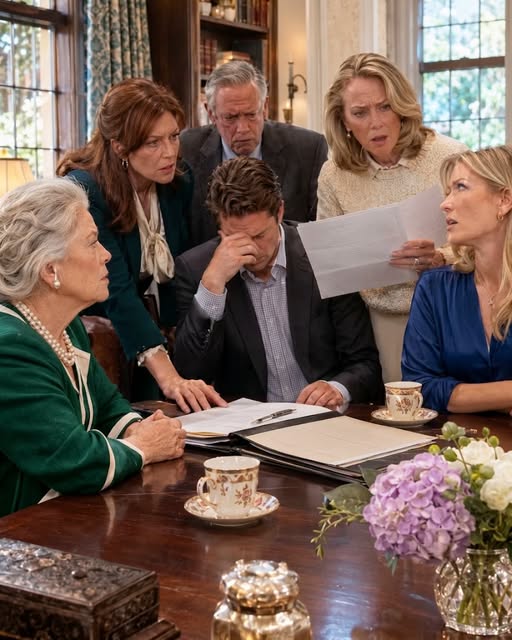
Amber,” Marjorie said, and she set the second sheet down very gently, the way you set down something that might still be hot. “Is this your signature?”
Nobody moved. The coffee I had poured sat steaming in six cups, untouched. Outside my dining room window, a neighbor’s sprinkler ticked across the wet Oregon grass.
Patrice kept her hands folded on the portfolio. She is sixty-one, silver-haired, a CPA who has done my books for twenty-two years and has never once raised her voice at anything, including the IRS.
“That’s a copy of the loan modification dated March 9th, three years ago,” she said. “Signed by Curtis and Amber. Notarized.”
Marjorie’s eyes went down the page, and I watched her lips move over one line. Then she looked at her daughter.
“This says you told Darlene we were co-signing.”
Amber opened her mouth. Nothing came out.
I should tell you how I got to my own dining room table on a Saturday morning, because the call on Thanksgiving was only the last stitch in something that had been coming apart for years.
My name is Darlene Kowalski. I’m sixty-four. I run a small bookkeeping and tax practice out of a converted back bedroom in Beaverton, Oregon, and I’ve done it since my husband, Frank, died eleven years ago. He was a long-haul electrician’s foreman, a big, easy man who hummed Patsy Cline while he cooked eggs. His heart stopped in our driveway on a Sunday in April, with the garage door half open. I found him when I came back from church.
Frank left me the house, a $150,000 life insurance policy through his union, and a pension that paid me $1,640 a month. I put the insurance money in a certificate of deposit at Willamette Credit Union and lived on the pension and what I earned preparing returns. I wasn’t rich. I was careful. A bookkeeper learns early that careful is its own kind of wealth.
I had two children. Pam, the elder, a dental hygienist in Spokane, practical like me, a phone-every-Sunday kind of daughter. And Curtis.
Curtis was the baby, the one who looked like Frank, with the same crooked grin and the same trick of making you forgive him before he’d finished apologizing. He was thirty-eight now, a regional sales manager for a flooring company. He had a good job and a better smile and a way of being just about to get on his feet.
I loved him more than was good for either of us. I’ll say that plainly.
He met Amber at a friend’s wedding in Portland. She was thirty-four, glossy and quick, in marketing for a real-estate firm. Her parents, Ted and Marjorie Whitlock, lived in Lake Oswego in a house with a circular drive and a view of the water. Ted had sold a commercial insurance agency and retired at fifty-eight. Marjorie chaired two charity boards and had a way of looking at your shoes before she looked at your face.
I liked Amber, at first. I want to be fair. She brought me flowers the first time we met and asked about Frank. When she and Curtis married, in a vineyard in the Willamette Valley, I paid $6,500 toward the catering, because Curtis had said, “Mom, we’re a little short, and I hate to ask.”
He never asked. That was the trick of it. He’d say, “I hate to ask,” and it would already be done.
Their first car died in the second year, a transmission, and Curtis called me from the shoulder of Highway 26. I wired $7,000 to the dealership that afternoon. Then came the house.
It was a four-bedroom colonial in Hillsboro, listed at $489,000. They’d fallen in love with it, and they were short on the down payment by $22,000. Curtis came to my kitchen table one evening in October, six years ago, with a folder and a face like a man at a graveside.
“Mom, I wouldn’t ask…”
“Then don’t.”
“We’d pay it back. I swear. It’s a loan, not a handout. I want to do it right.”
I looked at my son. I thought of Frank, who never borrowed a dollar he couldn’t see the end of. And I did the one thing in that whole sorry history that I’m proud of.
I called Patrice.
“If you’re going to lend it,” she said, over the phone, “put it in writing. Not because you don’t trust him. Because you do, and you’d like to keep it that way.”
So we drew it up. A promissory note for $22,000, at three percent simple interest, payable in full within five years, with a modest schedule. Patrice’s notary, a retired schoolteacher named Beverly Tran, stamped it at Patrice’s office on October 14th. Curtis and Amber both signed. I remember Amber’s pen, a thin silver one, and how lightly she held it, like a woman signing for a package.
I wired the money from the credit union on October 17th. I filed the note in a gray folder marked KOWALSKI–C, in the bottom drawer of my desk. And I forgot it, the way you forget a vaccination card.
I thought that was the end of the paper.
What came next wasn’t one request. It was a hundred small ones.
First, a monthly $400, “just until the baby’s daycare costs settle.” Their son, Owen, was born that winter. I set up an automatic transfer from my checking account at Willamette Credit Union. It was easier than writing a check.
Then $275 a month for Owen’s preschool enrichment program, which became his elementary “STEM academy.” Then $150 for Mari’s gymnastics, when Mari was born two years later. A $300 one-time for a ski trip. A $1,200 for an orthodontist. I stopped keeping track in my head. The transfers went out on the first of the month, quietly, like rain.
I never asked for thanks. I want you to understand that. I wanted my grandchildren to have things I couldn’t give my own kids at their age.
But the thing about money that moves in one direction is that it begins to carry a weight of its own. The phone calls got shorter. Curtis, who used to call on Sundays, started texting. Hey Mom, love you, crazy week. Thanksgiving, which had been mine for thirty-five years, moved to Lake Oswego in the second year. “Marjorie has the bigger dining room,” Curtis explained. “And Ted’s smoking a turkey. Come anyway!”
I came. I sat at the end of Marjorie’s long glass table, near the kitchen door. She served me a plate before everyone else, so I wouldn’t “feel rushed.”
Christmas visits shrank from a whole day to an afternoon, and then to a morning. Mari’s birthday, Owen’s piano recital, a school play. Invitations became afterthoughts. The photographs on Marjorie’s mantel showed her and Ted at Disney, at the lake, on a boat, with Owen and Mari on their knees. There was not one of me.
I told myself it was the way of things. A mother-in-law is always at the outside edge of a young family. I’d been one myself.
But I kept the transfers going. I’ll tell you why. I was afraid that if I stopped, I’d vanish.
Then came the Thanksgiving of the call.
I’d cooked anyway. I do it every year, out of stubbornness, a small turkey, a pan of Frank’s mother’s stuffing, cranberry sauce from fresh berries. It gives the day a shape. I’d made up my mind that Curtis and I would at least coordinate a time to drop off the grandchildren’s gifts, so I called at four in the afternoon, when I thought they’d be between courses.
He answered on the second ring.
“Hey, Mom. Happy Thanksgiving.”
“Happy Thanksgiving, honey. I wanted to see about bringing over the gifts for the kids. I’ve got a sweater for Mari and the science kit Owen asked for. Could I stop by tomorrow?”
A pause. Background noise, laughter, silverware, a child shrieking.
“Oh. Sorry, Mom. We’re celebrating at another house this year.”
“Another house?”
“Amber’s folks are hosting, you know. Her aunt’s in from Arizona, it’s a whole thing.” He cleared his throat. “Maybe next week.”
“Of course. I understand.”
I did. That was the awful part. I understood perfectly. I stood in my kitchen with the phone against my ear and the oven ticking and the potatoes steaming and a feeling like a coin dropping down a well.
“Okay, Mom. Love you.”
I waited for the click.
It didn’t come.
Instead I heard a rustle, as of a phone being set on a counter without being turned off, and Curtis’s voice, a little farther away, easy and amused.
“She thinks if she keeps sending money, she’s automatically included. Like those transfers earned her a spot at the table.”
And a woman’s laugh. Bright, throaty, familiar. And a second laugh under it, drier, older, a laugh like a spoon on crystal.
Amber. And Marjorie.
I stood very still.
I heard Curtis say, “I mean, I’m grateful, obviously. But it’s like, Mom, you can’t buy Thanksgiving.”
More laughter. A chair scraped. A child said, “Daddy, who are you talking to?”
“Nobody, bud. Eat your potatoes.”
I pressed the red button with my thumb. My hand, I noticed, was perfectly steady. I set the phone on the counter, next to the cranberry sauce, which had begun to scorch. I turned off the burner.
And I thought, in the clear cold voice of a woman who has balanced books for forty years: Well. That’s an entry.
I ate dinner alone at my kitchen table. I put the turkey on a good plate and I carved myself two slices and I ate every bite. It was dry. I didn’t mind.
At nine o’clock, I opened my laptop.
I logged into Willamette Credit Union, the same site I’d logged into every month for six years. I clicked on Scheduled Transfers. There were five, lined up in a neat column like a lineup of suspects.
Curtis & Amber Kowalski, household support, $400.00, monthly, 1st. Owen K., enrichment program, $275.00, monthly, 1st. Mari K., gymnastics, $150.00, monthly, 1st. Curtis K., “car fund,” $200.00, monthly, 15th. Curtis & Amber, savings contribution, $100.00, monthly, 1st.
Seven hundred and twenty-five dollars a month on the first, plus two hundred on the fifteenth. Nine hundred twenty-five dollars. I did the arithmetic out of habit. Eleven thousand one hundred a year. Over six years, with the one-time gifts, a little under seventy-three thousand dollars, not counting the $22,000.
I pressed Cancel five times. The machine asked, each time, Are you sure?
I was.
Then I opened my bottom desk drawer and took out the gray folder marked KOWALSKI–C.
I’ll tell you what was in it, because I’d nearly forgotten.
A single sheet, front and back. PROMISSORY NOTE. Principal: $22,000. Interest: 3% per annum, simple. Payable in sixty monthly installments of $395.31 beginning December 1st, or in full at maturity on October 14th, five years from execution. Late payments subject to a $50 fee. Signed: Curtis J. Kowalski. Amber R. Kowalski. Notarized: Beverly A. Tran, Oregon Notary Public, Commission No. 94417.
They had made eleven payments.
Eleven. Then the payments had slowed, then stopped. I’d noticed, in the way you notice a crack in a ceiling. I’d called Curtis once, gently. “Honey, I haven’t seen the payment this month.”
“Oh, Mom. Crazy month. I’ll catch up.”
I said it was fine. I said take your time. And then, three years ago, in a bad stretch when Curtis told me his company was cutting commissions, I’d done something kind, which in my experience is the most expensive thing a person can do. I’d signed a modification extending the deadline.
I found it in the folder, stapled behind the note. LOAN MODIFICATION AGREEMENT. Dated March 9th. New maturity date: eighteen months later, with payments deferred and interest continuing to accrue at three percent. A second notary stamp. Two new signatures.
The deadline had passed, a year and a half ago.
They had never paid a dollar more.
I sat in my kitchen with the folder open and my reading glasses on, and I did what I do best. I ran the numbers.
Principal: $22,000. Eleven payments of $395.31, minus the interest portion: roughly $3,900 in principal retired. Remaining principal: about $18,100. Interest accrued since the last payment, at three percent simple: another $2,400, give or take. Late fees under the original terms: a few hundred. Total owed: $21,300? No. I’d miscalculated. The late fees compounded. I did it again.
My phone buzzed against the table. Curtis.
I let it ring.
Patrice called back at 7:15 the next morning.
I’d left her a message at eleven the night before, nothing dramatic, just: It’s Darlene. I need you to pull the Kowalski loan file. And I may need you for a meeting.
“Darlene.” Her voice was brisk and warm. “I have it right here. Are you all right?”
“I’m fine.”
“You don’t sound fine.”
“I sound like a woman who’s reading a statement.”
A pause. “Tell me.”
I told her. The call, the laughter, the line about Thanksgiving. She didn’t interrupt. When I finished, she was quiet for several seconds, and I heard the faint scratch of a pen.
“Okay,” she said. “First. I’m so sorry.”
“Thank you.”
“Second. I’d like to pull the full loan file, including the modification. Do you have your copy?”
“In front of me.”
“Good. Don’t alter anything. Don’t annotate it. If you want, I’ll bring the original from my vault; Beverly’s notary journal is there, too.” Another scratch. “Third. Darlene, what do you want?”
I looked at the window. It was still dark, a thin gray line on the horizon, with a black fir against it.
“I don’t want to sue my son.”
“I didn’t say sue.”
“I want them to see it. The whole thing. Laid out on a table, in black and white, so nobody can say it wasn’t what it was.”
“All right.”
“And I want his wife’s mother in the room.”
Patrice laughed, a short, startled sound. “Why Marjorie?”
“Because Marjorie laughed.” I touched my reading glasses. “And because I think there’s a reason Amber never told her parents about this loan.”
A long silence.
“What makes you say that?”
“A feeling,” I said. “From the signing. Amber didn’t read the page. She just signed. A woman who isn’t worried about the terms usually isn’t worried about who’ll see them.”
“I’ll pull the whole file,” Patrice said slowly. “Every page.”
By eight that morning, my phone showed eighteen missed calls.
I sat on the edge of my bed and looked at the list, scrolling with my thumb. It was almost funny. Ten from Curtis. Five from Amber, the last at 7:48. Two from numbers I didn’t know, one with a Lake Oswego area code. And one, at 7:20, from Pam.
Pam, my daughter. My practical, steady Pam.
I called her back first.
“Mom!” She picked up in the middle of a ring. “Curtis called me at midnight. He’s, God, he’s beside himself. What did you do?”
“I canceled the transfers.”
“All of them?”
“All of them.”
A silence. I heard her breathing, and the clatter of a dish in her kitchen.
“Mom,” she said, carefully, “I’m not saying he was right. But is it possible this was a, a misunderstanding? He says he said something offhand. A joke. He feels terrible.”
“Pam. Did he tell you what the joke was?”
“He said it was, something about the money.”
“He said I thought sending money bought me a seat at the table. He said it to his wife and her mother, with the phone on, while I was listening.”
Another silence. A longer one.
“Oh,” Pam said, very quietly.
“Yes.”
“He didn’t tell me that part.”
“I imagine not.”
I heard her sit down. I heard a chair scrape, and then her voice, thicker. “Mom, I’m so sorry. I’ve been, I should’ve seen it. I thought he was just busy. I thought, he’s got two kids, and Amber’s parents, I didn’t realize you weren’t being, that they weren’t…”
“Pam, honey. It’s not your fault.”
“I should’ve called more.”
“You call every Sunday.”
“I should’ve asked.” Her voice cracked. “You never say anything. You never complain. I just assumed you were fine. That’s what you do, you’re always fine.”
“I’m good at it,” I said, and heard how strange it sounded.
“Mom.” She was crying now, quietly. “What can I do?”
I thought about that.
“Come on Saturday,” I said. “To the house. There’s going to be a meeting, and I’d like you there. Not to take sides. Just to be a witness.”
“A witness to what?”
“To what’s on paper.”
I didn’t answer Curtis for four days.
I’ll admit it wasn’t a noble silence. It was a kind of experiment. I wanted to see how he’d sound after the first panic wore off and the second set in. By the Thursday, he’d called thirty-one times. He’d sent texts. Mom please call. We need to talk. This isn’t funny. Then, on Wednesday night: We’ve been counting on that money. You can’t just do this without warning.
I finally picked up on Thursday evening, at six, when I was washing a pan.
“Mom.” His voice was ragged. “Thank God. I’ve been trying for days.”
“I know. I saw.”
“You’ve stopped the transfers.”
“I have.”
“We’ve been counting on that money!”
“I know you have.”
“You can’t just do that without warning!”
I dried my hands on a dish towel. I looked at the gray folder, open on the table, at the notary stamp, bright and purple, in the corner of the page.
“Curtis,” I said. “Where were you on Thanksgiving?”
A silence.
“At Amber’s parents’. I told you.”
“And what did you say about me, when you thought I’d hung up?”
His breath caught. I heard it, a faint, strangled intake, like a man touching a hot stove.
“Mom, I…”
“I heard it. All of it.”
“I didn’t, I didn’t mean it that way.”
“How did you mean it?”
“I was, they were all there, and Marjorie said something, and I just, it was a stupid joke, Mom. I’m sorry. I was trying to fit in.”
“By making fun of me.”
“I didn’t, it wasn’t making fun, it was…” He stopped. When he spoke again, his voice was small. “It was exactly making fun. I’m sorry.”
I closed my eyes. I thought of the boy with Frank’s grin, who’d once handed me a fistful of dandelions and said, These are for you because you’re the best.
“I’d like us to sit down,” I said. “All of us. Saturday morning, ten o’clock, at my house. You and Amber. Ted and Marjorie.”
“Her parents? Why?”
“Because they’ve been at the table longer than I have. I think it’s time they saw what’s on it.”
“Mom, that’s, that seems like a lot.”
“It’s a conversation, Curtis. About family. About what we owe one another.” I opened my eyes. “Patrice will be there.”
A long pause.
“Patrice? Your accountant?”
“Yes.”
“Why?”
“She keeps the books.”
I could hear him thinking. I could hear the gears of a man realizing, too late, that the world he’d built on a handful of good-natured assumptions was resting on a piece of paper.
“Okay,” he said, in a whisper. “Okay. We’ll be there.”
Saturday came with a low, silver sky and a smell of rain.
I’d been up since five. I’d baked an apple cake, because when in doubt, a Kowalski bakes. I’d put out my good cups, the Blue Willow ones Frank’s mother left me, and set a pot of coffee on the sideboard. I’d arranged six chairs around the oak dining table, then added two more. Patrice would sit at one end, with her portfolio. Pam at the other, hands folded.
At nine fifty, Pam arrived from Spokane, having driven through the night. She hugged me hard, and I smelled her shampoo and road dust.
“I couldn’t sleep,” she said.
“Neither could I.”
“Are you sure about this?”
“No,” I said. “But I’m ready.”
At ten, the doorbell rang.
They came in a little cluster, like people entering a dentist’s office. Curtis first, in a navy sweater, with shadows under his eyes. Amber behind him, in a cream coat, not meeting my gaze, her hair pulled back in a tight twist. Then Ted Whitlock, tall and gray, in a quarter-zip, with the carefully neutral expression of a man who has sat through many board meetings.
And Marjorie.
She swept in last, in a camel cashmere sweater and tailored slacks, trailing a scent of expensive roses. She nodded at me with a smile that stopped at her cheekbones.
“Darlene,” she said. “How sweet of you to have us.”
“Marjorie. Thank you for coming.”
“I’ll admit, I was curious.” She looked around my dining room, the oak table, the blue cups, the faded curtains. Her eyes lingered on the cake. “Such a cozy little house.”
“It’s paid for,” I said.
A flicker crossed her face.
I poured coffee. Nobody touched it.
I sat at the middle of the long side of the table, with Pam on my left, and Patrice at the head. Across from me sat Curtis and Amber, side by side, a careful two inches apart. Ted and Marjorie sat at their right.
The silence was thick as a quilt. Somewhere in the kitchen, the refrigerator hummed.
“Thank you all for coming,” I said. “I won’t take long. I wanted everyone to hear this together, so no one has to repeat it later.”
Curtis shifted. “Mom, if this is about the transfers…”
“It’s partly about the transfers.” I nodded to Patrice. “Patrice Hollis. Most of you know her. She’s been my accountant for twenty-two years. She’s here because she has the records.”
Patrice smiled politely and opened her leather portfolio.
“Six years ago,” Patrice began, “in October, Darlene advanced Curtis and Amber Kowalski the sum of twenty-two thousand dollars toward the down payment on their home in Hillsboro.”
She slid a single sheet across the table, a photocopy, with a purple notary stamp in the corner.
“This is the promissory note. Principal, twenty-two thousand. Interest, three percent simple. Payable in sixty monthly installments of three hundred ninety-five dollars and thirty-one cents. Both borrowers signed. The signatures were notarized on October 14th by Beverly Tran, Oregon notary public.”
Curtis stared at the page. I watched his face go from white to gray.
“Mom,” he said. “That was a gift.”
“No, honey.” I kept my voice level. “It was a loan. You said so. You said, ‘I want to do it right.’”
“I thought, I assumed…”
“You signed it.”
“I was stressed.” His voice cracked. “I didn’t think you’d actually…”
“Curtis.” Patrice’s tone was gentle, almost kind. “Eleven payments were made. The twelfth was missed. Over the following eighteen months, there were no payments at all. In March, three years ago, Darlene signed a modification extending the maturity date by eighteen months, with interest continuing to accrue.”
She slid a second sheet across the table.
“The extended deadline expired a year and a half ago. As of this morning, the outstanding balance, including accrued interest and late fees under the original terms, stands at twenty-four thousand, one hundred and sixty dollars.”
The room made a sound. I think it was Amber, a small, breathy gasp.
Marjorie, beside her, had not moved. But her eyes had sharpened. She was staring at the first page, at the signatures, at the stamp.
“Twenty-four thousand,” Ted repeated. His voice was dry, quiet. “That’s not nothing.”
“No,” said Patrice.
“Curtis.” Ted turned his head. “Did you know this was outstanding?”
“I, yes, I mean, I knew there was a loan, but, Mom said, she said take your time…”
“I did say that,” I said. “For a while. I didn’t want you struggling.”
“We were struggling!”
“I know.” I held his gaze. “And I helped. Every month. Nine hundred and twenty-five dollars, for six years. I never once asked for anything back.”
“We’re grateful, Mom.”
“Are you?”
He opened his mouth. Closed it.
“I think you’re sorry,” I said, gently. “I’m not sure the two are the same.”
Marjorie lifted the first page.
I watched her read. Her eyes moved down, with the practiced swiftness of a woman who has skimmed a thousand charity budgets. They reached the bottom. They moved to the second page, the modification. I saw her brow tighten, a faint vertical line between the eyes.
“Darlene,” she said slowly. “I believe I was told something different about this loan.”
“Mom,” Amber said, too quickly.
“I was told,” Marjorie continued, as if her daughter hadn’t spoken, “that the down payment on the Hillsboro house came from Ted’s and my gift. The twenty-two thousand dollars we gave for the closing.”
The room went very still.
I’d had a suspicion. I hadn’t known for certain.
Ted turned his head. “Marjorie, what are you saying?”
“That Amber told us the closing costs were covered. By us.” Marjorie’s voice had gone cool and thin. “That we’d gifted the money at the time. I remember it clearly. Six years ago, in November. She called to thank us.”
“We did gift her money,” Ted said. “Fifteen thousand. In November, after closing.”
“For what?”
“For furniture. She said.”
“There was no furniture,” Marjorie said quietly.
Amber had gone the color of chalk.
“Mom, please…”
“Patrice,” Marjorie said, without looking up, “may I see the closing statement? For the Hillsboro house?”
Patrice reached into her portfolio. She drew out a third sheet. I hadn’t known it was there. A photocopy of an HUD settlement statement, with a lender’s header and a line in bold.
Borrower’s funds to close: $22,000.00 — Source: Gift/Loan, D. Kowalski.
And below, in a second column, three words I’d never noticed.
Gift letter: NONE.
Marjorie read it. She went very still.
“Darlene,” she said, “this document shows your twenty-two thousand dollars as the source of the closing funds.”
“Yes.”
“And it shows no gift letter from Ted and me.”
“It doesn’t.”
“Then where,” Marjorie said, turning slowly toward her daughter, “did the fifteen thousand go?”
Patrice placed one more sheet beside the others. A single page, a bank statement from an account I’d never seen, in Amber’s name alone, at a bank in Portland. A deposit highlighted in yellow, dated November 18th, six years ago. Deposit: $15,000.00 — Check #4471, T. & M. Whitlock.
And beside it, a series of withdrawals.
Withdrawal — Cash, $4,000. Withdrawal — Transfer to Nordstrom Card, $2,600. Withdrawal — Wire, “Lakehouse Retreat Spa,” $3,200. Withdrawal — Cash, $5,200.
I looked at it and felt something shift in my chest.
I hadn’t asked Patrice to find this. I hadn’t thought to. She had pulled it, I learned later, after a call from the Whitlocks’ own accountant, a man who’d noticed a discrepancy while preparing their return, and who’d come to Patrice with a puzzled question. Small towns, in the business of numbers, are smaller than people think.
Marjorie stared at the statement.
“Amber,” she said, in a voice that could have cut glass. “What is this?”
“It’s, Mom, it’s not what it looks like.”
“It looks like fifteen thousand dollars of our money going to a spa.”
“I was going to pay it back! I, I had, there was a lot going on, I was stressed, and Curtis’s commissions were down, and I thought, I’ll just…”
“You told us it was for furniture.”
“I know.”
“You lied.”
“Mom, I…”
“You took our money. You took Darlene’s money. And you let your husband,” Marjorie’s voice rose, shook, “your husband stand at my table and say she thinks sending money buys her a seat!”
Amber put her face in her hands.
Curtis had turned slowly to look at his wife. He looked like a man who’d just seen a house he lived in from the outside.
“Amber,” he said. His voice was barely audible. “You said your parents gave us the closing money. You said it was a gift. You said my mother’s loan was, was just a top-up.”
“Curtis…”
“I’ve been feeling guilty for six years that we never thanked your parents enough. I wrote them a card. I sent them a fruit basket.”
Amber sobbed. “I didn’t know how to tell you.”
“Tell me what?”
“That we didn’t have it. That we never had it. That I’d…” She broke off. “I thought if I could just get through the first year, I’d fix it. And then it was too late. And then your mom kept giving us money and I thought, she doesn’t mind, she has plenty, and every month it got easier to just, not look.”
I sat very still.
I thought: she’s telling the truth. Not the whole truth, perhaps. But the part that had been rotting at the center of that house for six years.
I’d like to say I felt triumph. I didn’t. I felt tired, and a little sick, and unbearably sorry.
Because I looked across the table at the girl, and saw not a villain but a frightened woman who’d made a bad choice at twenty-eight and spent six years building a wall around it. And I recognized, with a small cold shock, something of myself. The part of me that had spent six years sending money rather than saying I need you. We’d both been hiding. We’d just done it in opposite directions.
Pam, at my left, put a hand on my arm. I didn’t look at her. I kept my eyes on Amber.
“Marjorie,” I said. “May I say something?”
She turned. Her face was mottled, her hands trembling on the table.
“Darlene. I owe you an apology. A terrible one.”
“You laughed.”
“Yes.”
“On Thanksgiving. At my expense.”
“I did.” She swallowed. “I’d like to tell you I didn’t think. That’s not true. I thought: what an easy thing to laugh at. I’ve been unkind to you for years. I looked at your coat and your car and your little house, and I decided you were less.” Her mouth trembled. “I was ashamed of my own daughter’s mother-in-law. Because you reminded me of my own mother, who cleaned offices in Gresham.”
I hadn’t known that.
“I spent forty years climbing out of that apartment,” Marjorie said. “And I’ve been so afraid of ever going back that I’ve been cruel to the one person who looked like where I came from.”
The silence settled. Ted, beside her, stared at the tablecloth. I saw his hand move, slowly, and close over hers.
“I’m so sorry,” Marjorie said.
I looked at her for a long moment. A hundred cutting replies rose and fell.
“I accept that,” I said. “I’m not sure I forgive it. But I accept it.”
She nodded, with tears on her cheeks.
“Now,” I said, to Curtis and Amber. “Here’s what I’d like to propose.”
They looked up.
“I’m not going to take your house. I’m not going to sue. I’m not going to ruin your credit, though I could, and Patrice tells me I’d be well within my rights.”
Curtis’s shoulders sagged.
“But I’m also not going to keep sending money into a hole.” I folded my hands. “The loan is real. It’s owed. I’d like it repaid. A fair schedule, in writing, with a witness, at the original interest rate, no penalties. Four hundred dollars a month, beginning in January. It’ll take five years and some change.”
“We can do that,” Curtis said quickly. “Mom, we can do that.”
“I’d like Amber to sign it herself.”
Amber lifted her head. Her face was swollen.
“I’ll sign,” she whispered.
“And,” I said, “I’d like you to repay your parents. Separately. On your own terms. That’s between you and them.”
Amber nodded, wiping her eyes.
“And there’s one more thing.” I looked at my son. “Curtis. Look at me.”
He did.
“I want you to understand something. The money was never the point. I wasn’t buying a seat. I was trying to say, I love you, I’m here, please don’t forget me. I did it badly. I did it in the only language I thought you’d hear.” My voice shook. “I should have said it plainly. And you should have noticed that I was the only one at that table who wasn’t asking for anything.”
His eyes filled.
“I’m sorry, Mom.”
“I know.”
“I’m so sorry.”
“I know, baby.”
He put his face in his hands. Beside him, Amber was weeping. Across the table, Marjorie dabbed her eyes with a linen handkerchief. Pam, at my side, was crying openly.
I sat there with my hands folded and my heart quietly breaking, and I thought, with a strange clarity: this is what it costs to be honest. Twenty-four thousand dollars, and an apple cake.
They signed the new agreement at eleven forty.
I won’t pretend it was a tidy moment. Curtis’s hand shook so badly that Patrice had to steady the paper. Amber signed last, with the same thin silver pen, but her hand wasn’t light this time. She pressed hard. When she finished, she looked at the signature as if she’d never seen her own name.
Beverly Tran, the notary, a small woman in a lilac cardigan, had come from her kitchen two blocks away at Patrice’s request. She stamped the page. “Done,” she said gently. “And I’d like to say, if I may, that I’m glad to see this settled in a family way.”
Marjorie, I noticed, had put her arm around her daughter. It was a stiff, unpracticed gesture. But she kept it there.
Ted cleared his throat.
“Darlene,” he said. “I’d like to say something, and I’d like you to let me finish.”
“Go ahead.”
“I’m a man who spent thirty years selling people insurance. I’ve sat across from a lot of folks on the worst days of their lives. I thought I understood what people owed each other.” He looked down at his hands. “I’ve been sitting at that Thanksgiving table for six years, eating a turkey while your name came up as a joke. I never said a word.”
“Ted.”
“I should have. That’s on me.” His voice cracked. “I’d like to make it right. Not with money. I’d like to host Thanksgiving. At your house.”
I blinked.
“At my house?”
“If you’ll have us. Next year. All of us.” He glanced at his wife. “I’d bring the turkey. Smoked. And I’d like to learn how to make that stuffing, if you’ll teach me.”
I looked at this tall, gray, dry man, and saw, for the first time, a person.
“It’s Frank’s mother’s recipe,” I said.
“Then I’d be honored.”
I laughed. It came out wet and shaky. “All right, Ted. It’s a deal.”
It’s been a year since that Saturday.
I’d like to tell you the hurt went away. It didn’t. It softened, the way a bruise softens, from purple to green to a faint, almost pleasant yellow. Some mornings I still wake with the memory of Curtis’s voice, the line about the seat at the table, and my chest tightens. But the memory is no longer sharp. It’s a small, smooth stone I carry in my pocket.
Curtis made every payment. Four hundred dollars, on the first of every month, deposited straight into my account at Willamette Credit Union. In March he sent two payments at once, with a note on the memo line. Bonus. Thank you for waiting. In August, he called me, out of nowhere, on a Tuesday afternoon, to tell me he’d gotten a promotion, and that the first person he wanted to tell was me.
“I’m calling because I want to, Mom. Not because I need anything.”
“I know, honey.”
“I just wanted you to hear it from me.”
I sat in my kitchen with the phone against my ear and a little bubble of joy rising in my chest.
“Tell me everything,” I said.
He did.
Amber paid back her parents on her own schedule, in small monthly sums, with a rigor that astonished everyone. She took a second job, doing graphic design on weekends. She’d begun, I heard, to see a therapist. In October, she came to my house alone, on a Sunday, with a small box of lemon bars and red-rimmed eyes.
“Darlene,” she said, on my porch. “I wanted to say it without anyone else in the room.”
“You don’t have to.”
“I do.” She held out the box. “I’m so sorry. For the lie, and the laugh, and, I don’t know, for six years of treating you like an ATM.”
“Amber.”
“I told myself you didn’t mind. It was easier than thinking about what I was doing.” Her voice shook. “I’d like to start over. If you’ll let me. I’d like to know you.”
I looked at her for a long time. At the glossy, frightened, brave young woman on my porch with a box of lemon bars.
“Come in,” I said. “I’ll put the kettle on.”
We sat at my kitchen table for three hours. We talked about Frank, and about her father, and about the awful, aching shame of being afraid of your own life. She cried twice. I did, once. When she left, she hugged me, a real hug, with both arms, and I felt her heart pounding against mine.
Thanksgiving came around again.
I’d cleaned the house for three days. I’d ironed Frank’s mother’s tablecloth. I’d put a leaf in the dining table and borrowed folding chairs from the church. I’d made twice as much stuffing as anyone could eat.
They arrived at noon. Curtis and Amber, with Owen and Mari, who ran straight into my arms. Ted and Marjorie, in matching wool coats, with a smoked turkey in a cooler, which Ted carried in like a newborn. Pam, who’d driven from Spokane the night before. Patrice, who I’d invited on a whim, and who’d arrived with a pie.
The house filled up. It was loud and warm and a little chaotic. Owen knocked over a glass. Mari asked if she could have two desserts. Marjorie, in my kitchen, in an apron, stood beside me stirring gravy with a look of deep concentration.
“Is it supposed to be this lumpy?”
“It’s supposed to be lumpy,” I said. “That’s how you know it’s real.”
She laughed. It was an actual laugh, warm and surprised.
We sat down at two. Ted carved the turkey. The stuffing was a little dry. Nobody mentioned it.
At the head of the table, in Frank’s old chair, I looked down the long length of oak, past the candles and the blue cups and the cranberry sauce. I saw my son laughing with his daughter on his lap. I saw Amber passing the potatoes to her mother. I saw Pam, quiet, content, her hand resting on my arm.
“Mom,” Curtis said, “would you like to say something?”
I looked at them. At the whole imperfect, scarred, hard-won circle.
“I’ll keep it short,” I said. “I once thought a seat at the table was something you earned. Or paid for.” I set down my fork. “I was wrong. It’s something you set. For each other. Over and over. And you keep setting it, even after somebody laughs.”
Nobody spoke.
“Thank you for coming,” I said. “There’s plenty.”
Ted raised his glass. “To the table.”
“To the table.”
We clinked. Owen, who was seven, asked loudly, “Can we eat now?”
And a great laugh went up around the oak, the kind that fills a house.
After dinner, when the dishes were done and the kids had fallen asleep on the living room carpet in a heap of limbs and blankets, I slipped out onto the back porch with a cup of coffee.
It was a cold, clear night. The sky was crowded with stars, and the big fir at the edge of the yard stood black against them. The kitchen light made a golden square on the grass.
I heard the screen door creak. Curtis came out beside me, in his socks, with his hands in his pockets.
“Mom.”
“Hello, honey.”
We stood side by side, looking at the stars.
“Dad would’ve loved today,” he said.
“He would.”
“He’d have eaten three plates of stuffing.”
“Four.”
He laughed. Then he was quiet.
“Mom,” he said. “I never said it right. What I should have said, on the phone, that day.”
“You don’t have to.”
“I do.” He turned to face me. His eyes were wet. “I should have said that I’m grateful. Not for the money. For you. For all of it. For being the person who’d keep a seat at the table for me even when I didn’t deserve one.”
I swallowed.
“I’m sorry I made you wonder.”
I reached up and touched his cheek, the way I had when he was small and feverish. His whiskers were rough under my fingers.
“There’s always a seat,” I said. “That’s all I ever wanted you to know.”
He covered my hand with his own. We stood there in the cold, with the stars wheeling overhead, a mother and a son on a porch, with a house full of sleeping children behind us.
Inside, the kitchen light burned warm and steady, and somewhere in the dining room, a clock began to chime.
Nobody had paid for the evening.
And every chair was full.
The Morning After
The house had a strange silence the day after Thanksgiving, the kind that settles into old wood and plaster after too much noise has been made.
It was six in the morning when I woke up. For fifty years, Frank and I had lived by the light, and even though Frank had been gone four winters now, my body hadn’t forgotten how to pull itself out of bed before the sun cleared the top of the Douglas firs. I put on my thick wool sweater, the gray one with the frayed cuffs that Curtis always told me to throw out, and walked down the hallway in my stocking feet.
The living room was still scattered with the remnants of the night before. Owen’s small plastic truck sat upside down near the couch, and Mari’s favorite stuffed rabbit—the one missing its left glass eye—was wedged between the cushions. In the kitchen, the air smelled faintly of sage, roasted poultry, and cold coffee.
I didn’t turn on the overhead light. I didn’t want to break the spell. Instead, I clicked on the small lamp above the sink and set the kettle on the stove.
Yesterday had felt like a miracle, but miracles, I’ve lived long enough to know, are heavy things. They take a toll on the bones. My knees ached from three days of standing over the counter, and my back was stiff from dragging the extra leaves out of the hall closet. But as I stood there waiting for the water to boil, I looked at the kitchen table.
It was bare now, stripped of Frank’s mother’s linen cloth, which was currently soaking in cold water in the laundry basin to get out a smudge of cranberry sauce from Mari’s spoon. The bare oak table looked clean, its smooth surface catching the gray first light of dawn.
A quiet knock came at the back door.
I froze, my hand hovering over the tin of tea leaves. It was barely six-thirty. I walked over and pulled back the curtain.
It was Ted.
He was standing on the back porch, wearing a brown canvas work jacket with the collar turned up against the frost. He had a small wooden crate in his hands, and his breath bloomed in white clouds around his head.
I unlocked the door and pulled it open. “Ted? What on earth are you doing up at this hour?”
“Morning, Darlene,” he said. His voice was lower than usual, muffled by the morning cold. He held out the crate. “I brought the rest of the roasting rack. I left it on your back counter last night by mistake when we were washing up. Didn’t want you to think I’d run off with your good iron.”
“Ted, you could have brought that by on Monday,” I said, but I stepped back to let him in. “Come in out of the frost before your toes fall off.”
He wiped his boots carefully on the mat—three long, deliberate scrapes—and stepped into the kitchen. He set the crate on the counter. Inside was my iron roasting rack, scrubbed so clean the metal shone like new silver, along with a small, neatly wrapped glass jar filled with yellow liquid.
“What’s that?” I asked.
“Turkey fat,” he said, looking slightly embarrassed. “For gravy next time. Or biscuits. Marjorie says her grandmother used to save it.”
“Ted,” I said, looking at him. “Sit down.”
He hesitated, holding his cap in his hands, then pulled out one of the heavy oak chairs and sat. He looked smaller in the dim kitchen light without his stiff winter coat, just a retired insurance man with thin gray hair and spots on the backs of his hands.
“I didn’t mean to intrude,” he said. “I just… I couldn’t sleep much last night.”
“Neither could I,” I admitted, pulling a second mug from the cupboard. “Tea?”
“If it’s no trouble.”
I poured the hot water over the tea leaves and set a mug down in front of him. For a few minutes, neither of us said anything. The steam rose between us, smelling of bergamot and damp morning air.
“Marjorie cried all the way home,” Ted said quietly, his eyes fixed on his cup. “In the car. She didn’t say two words until we hit the highway, and then she just started crying. Not angry crying. Just… quiet.”
“Marjorie worked hard yesterday,” I said. “She was determined to get that gravy right.”
“It wasn’t the gravy, Darlene.” Ted looked up, his gray eyes clear and tired. “It was the way you looked at her when she asked about it. Like she was just… a person in your kitchen. Not someone who’d spent six years looking the other way while her daughter acted like a fool.”
I took a slow sip of my tea. “We’ve all acted like fools at one time or another, Ted. Some of us just took longer to get caught.”
“Maybe,” he said. “But Marjorie… she’s got a hard shell. Her father was a strict man. School principal over in Linn County. Everything had to be neat, everything had to be accounted for. When Amber started messing up—the credit cards, the missed rent, the excuses—Marjorie didn’t know how to fix it except by pretending it wasn’t happening. If you don’t talk about a fire, maybe the house won’t burn down.”
“That’s a cold way to live,” I said softly.
“It is,” Ted agreed. “It ruined her stomach. Given her ulcers for ten years. But last night… when we got home, she went into the spare bedroom and brought out all those old boxes of Amber’s things. The high school yearbooks, the ribbons from the 4-H club. She sat on the floor until two in the morning going through them. She hasn’t done that since Amber was twenty.”
He took a drink of his tea, then set the mug down with a soft clink.
“I wanted to thank you,” he said. “For not making us crawl.”
“Nobody was ever going to make you crawl, Ted,” I said, my voice firmer now. “I didn’t take that check from Curtis last year because I wanted to punish anyone. I took it because if a man doesn’t pay his debts, he never really owns himself. Curtis needed to own himself. And Amber… Amber needed to realize that family isn’t a bank you rob when you’re short on rent.”
“She knows it now,” Ted said. “She’s been working those weekend hours at the print shop until her fingers bleed from paper cuts. She hasn’t bought a new dress in fourteen months. She brought those lemon bars to your porch on her own, Darlene. Nobody told her to do it.”
“I know,” I said. “That’s why I let her in.”
Ted nodded slowly. He reached into his coat pocket and pulled out a small, folded piece of paper. It wasn’t a check, just a lined sheet from a yellow legal pad. He pushed it across the table toward me.
“What’s this?” I asked.
“It’s a list,” Ted said. “Of all the things Frank helped me with when we moved into the neighborhood back in ninety-eight. He cleared the fallen fir off my driveway after the ice storm. He lent me his table saw for three weeks when I was building the deck. He never asked for a nickel. He just said, ‘You’ll catch the next guy.’”
I looked down at the tight, neat cursive on the yellow paper. Frank’s name was at the top, written in Ted’s precise agent hand.
“I didn’t catch the next guy,” Ted said, his voice dropping low. “I let my girl treat Frank’s wife like a line item on an expense account. I can’t fix ninety-eight, Darlene. But I put my name down on the church volunteer list for the snow-plowing rotation this winter. And I’m going to take care of your gutters next week.”
“Ted, my gutters are fine—”
“They’re full of fir needles, Darlene,” he said, with the first ghost of a smile touching his thin lips. “I saw ’em when I walked up. I’m doing the gutters. Don’t argue with an insurance man about roof drainage. It’s bad for my blood pressure.”
I looked at him for a moment, then let out a breath that was half a laugh. “All right, Ted. You can do the gutters.”
He stood up, zipping his canvas coat back up to his chin. “I’ll be out back around ten on Tuesday. Don’t make coffee. I’ll bring a thermos.”
He walked to the back door, paused with his hand on the brass knob, and looked back at me.
“Darlene?”
“Yes, Ted?”
“The stuffing wasn’t dry,” he said quietly. “It was just right.”
He pulled the door shut behind him before I could answer. Through the window, I watched him walk down the gravel path, his shoulders straight, his head held up against the crisp November air.
The Weight of Paper
By mid-December, the winter had settled into the Willamette Valley with a heavy, wet cold that stayed in the bones. The rain came down in long, gray sheets, turning the garden beds behind the house into dark mud and keeping me indoors for days at a time.
On a Tuesday afternoon, Patrice came by.
She didn’t knock; she just let herself in through the back kitchen door, carrying a wet umbrella and a thick brown accordion folder under her arm. Patrice was fifty-two, a paralegal who had worked in the same small firm downtown for twenty years, and she had the sharp, clear eyes of a woman who spent her life looking for missing commas in legal contracts. She was also the only person in town who had stood by my side when Curtis first asked for that twenty-thousand-dollar “investment” three years ago.
“You’re tracking water,” I told her, setting down my knitting.
“It’s Oregon in December, Darlene. Everything is water,” she said, setting her boots on the rubber mat and shaking out her coat. She walked over to the table and dropped the accordion folder onto the wood with a heavy thud.
“What’s that?” I asked, rising to put the kettle on.
“That,” Patrice said, sitting down and snapping open the elastic band on the folder, “is the final accounting. Or as close to one as we’re ever going to get.”
I paused with the teapot in my hand. “Patrice, the agreement was signed last month. Beverly stamped it. Curtis paid his four hundred on the first. It’s done.”
“The legal part is done,” Patrice corrected, pulling out a sheaf of papers covered in red ink notes and sticky tabs. “This is the personal part. The part you didn’t let me ask about when we were all sitting around like a happy family on Thanksgiving.”
She looked at me across the table, her dark eyes serious.
“Darlene, do you actually know where that twenty thousand went?”
I came back to the table and sat down. “He said it was for the business. The software venture.”
“It was,” Patrice said. “Partly. But I did some digging into the public court filings for Linn County last week. Just out of curiosity. Because something about Amber’s second job didn’t add up.”
My hand tightened on my apron. “What do you mean?”
Patrice pulled a single sheet from the file and slid it toward me. It was an itemized list of court costs and civil judgments from two years prior.
“Curtis didn’t spend twenty thousand dollars on software servers, Darlene,” Patrice said softly. “He spent eight thousand on the business. The rest—twelve thousand dollars—went to satisfy a civil judgment against Amber’s brother, Jason.”
I stared at the paper. The names were right there in dark black print: Linn County District Court. Judgment of Restitution. Defendant: Jason Miller.
“Jason?” I whispered. “Marjorie’s son?”
“Marjorie’s son,” Patrice confirmed. “He got caught up in a bad deal involving stolen construction equipment out near Albany. He was facing grand larceny charges. The contractor agreed to drop the criminal complaint if the damages were paid in full within forty-eight hours. Ted didn’t have the cash liquid—all his money was tied up in annuities he couldn’t touch without a thirty percent penalty.”
The kitchen seemed very quiet. Outside, the rain tapped against the glass like small, hurried fingers.
“Curtis took your money,” Patrice said, her voice gentle but unyielding, “not just because he was foolish about a business plan. He took it because Amber came to him crying that her brother was going to jail, and her mother was having a nervous breakdown in the hallway. Curtis thought he was being a hero. He thought he was saving her family.”
“And he didn’t tell me,” I said.
“He couldn’t tell you,” Patrice said. “If he told you, he’d have to admit that he was giving your hard-earned retirement money to a boy who’d stolen two skid-steers from a job site. He knew Frank would have gone straight to the sheriff. Frank was a deputy for twelve years, Darlene. He didn’t abide thieves.”
I leaned back in my chair, looking at the ceiling.
All those years. All those Thanksgiving dinners where Marjorie looked at me with that stiff, cold expression. It wasn’t hatred. It wasn’t arrogance.
It was shame.
She had sat at my table, eating my turkey, knowing that her son was walking free because my late husband’s life insurance had paid off his crimes. And Curtis… my Curtis had carried that lie on his back for three years, letting me think he was just a spoiled, irresponsible boy who had wasted his mother’s savings on a bad dream.
“Why didn’t Amber tell me?” I asked, my voice barely above a whisper. “When she came to my porch with those lemon bars…”
“Because Jason is her brother,” Patrice said. “And because Curtis made her promise. He told her that if you ever found out about Jason, you’d never look at any of them the same way again. He took the blame himself, Darlene. He let you be angry at him so you wouldn’t hate them.”
I reached out and touched the legal paper. The paper felt dry and cold under my fingers.
“He took four hundred dollars out of his paycheck every month,” I said slowly. “Not to pay back a bad investment. To buy his mother’s forgiveness for a debt that wasn’t even his.”
“Partly his,” Patrice reminded me. “He chose to lie to you. He chose to take money that didn’t belong to him without asking. Being a hero with someone else’s checkbook isn’t noble, Darlene. It’s just theft with good intentions.”
“I know,” I said. “I know it is.”
“So what are you going to do?” Patrice asked, leaning forward. “I can pull the court records. I can force a re-adjudication of the agreement. Ted has the funds now—he cashed out one of those policies last spring. We can make Ted and Marjorie pay you the remaining balance in full by the end of the month.”
I looked at Patrice. She was a good friend, a fierce friend, the kind of woman who would fight a bear with a butter knife if she thought it was protecting someone she loved.
“No,” I said.
Patrice frowned. “No? Darlene, they lied to you for six years.”
“Curtis lied to me,” I said. “And Curtis is paying me back. Every month. Four hundred dollars.”
“But—”
“If I take Ted’s money now,” I said, looking at the window where the rain was falling against the dark glass, “I make it a transaction again. I turn it back into a bill that can be settled with a stamp and a signature. That’s not what happened at Thanksgiving, Patrice. You were there. You saw Beverly stamp that paper.”
“Beverly stamped a lie,” Patrice said sharply.
“No,” I said. “Beverly stamped a promise. Curtis promised to pay me back. It doesn’t matter whose fault the debt was in the beginning. What matters is who is standing up to clean it up now.”
I picked up the court document, folded it carefully into thirds, and slid it back into Patrice’s accordion folder.
“Don’t tell Curtis I know,” I said.
Patrice stared at me for a long moment. “You’re too soft, Darlene. You always have been.”
“I’m not soft, Patrice,” I said, setting my cup down with a firm hand. “I’m eighty-two years old. I don’t have enough time left on this earth to spend it holding onto old mud. Curtis is coming by on Sunday to fix the back step. I’m going to make him a blackberry cobbler.”
Patrice let out a long, slow breath, shook her head, and snapped the elastic band back around the file folder.
“You’re an impossible woman,” she said, but her eyes were soft.
“I’m Frank Miller’s widow,” I said. “We don’t undo a settled contract just because the wind changes direction.”
The Winter Garden
January came in hard and white.
We don’t usually get much snow down in the valley—just a dusting that melts by noon—but this year a cold front came down from Canada and locked the town in ice for ten days. The power went out on a Thursday night, leaving the house dead quiet except for the ticking of the grandfather clock and the popping of the fir logs in the woodstove.
I was sitting by the stove wrapped in three blankets when I heard the scraping noise on the front drive.
I pulled back the curtain. Through the thick frost on the pane, I saw a shape moving in the dark, lit only by the yellow beam of a flashlight. It was Ted, wearing his heavy work coat and a bright orange knit cap, shoveling the thick ice off my front walkway.
I pulled my boots on, threw my coat over my shoulders, and stepped out onto the porch. The air hit my lungs like cold iron.
“Ted!” I called out. “It’s seven o’clock at night! You’re going to break a hip!”
He paused, resting his chin on the handle of the aluminum shovel. His breath rose in thick, rhythmic puffs.
“Driveway’s clear,” he shouted back. “Just finishing the walkway so the nurse can get up the steps tomorrow.”
“The visiting nurse isn’t coming until Friday!” I yelled. “Get in here before you freeze solid!”
He didn’t argue this time. He scraped the last chunk of ice off the bottom step, set the shovel against the railing, and stomped his boots on the porch boards. When he came inside, his eyebrows were white with frost.
I brought him into the living room, where the woodstove was throwing off a deep, red heat. He sat on the hearth hearth-rug, pulling off his heavy leather gloves and holding his gray hands out toward the iron stove.
“Marjorie sent some vegetable soup,” he said, nodding toward a thermal container he’d set by the door. “It’s hot. She put extra barley in it.”
“She didn’t need to do that,” I said, settling back into my armchair.
“Power’s out all over the county,” Ted said, his voice quiet in the room. “Curtis called us from his car an hour ago. He was trying to drive out here from the city, but the state patrol closed Highway 99 at the river bridge. Trees down across the power lines.”
“He shouldn’t be driving in this,” I said, feeling a cold knot in my stomach. “The roads are glass.”
“I told him that,” Ted said. “He was upset. Said he didn’t want you sitting in the dark alone.”
I looked at the small circle of orange light shining through the air vents of the woodstove.
“He’s a good boy,” I said softly. “He gets confused sometimes, but he’s a good boy.”
Ted didn’t answer right away. He stretched his thin fingers toward the fire, watching the small blue flames lick at the dry fir logs.
“He told me about the check, Darlene,” Ted said suddenly.
My hands went still in my lap. “What check?”
“The four hundred dollars month,” Ted said. “Last month… when he had that extra bonus in March. He didn’t get that from his company.”
I kept my eyes on the stove. “He said it was a bonus.”
“He sold his boat,” Ted said quietly. “That sixteen-foot aluminum fishing boat Frank gave him when he turned eighteen. The one he kept stored in my barn for five years.”
The room seemed to shrink. The only sound was the crackle of the wood snapping in the heat.
“He sold Frank’s boat?” I whispered.
“A guy from Eugene came up with a trailer back in February,” Ted said. “Curtis brought him out to the barn while I was cleaning the tractor. The guy offered eighteen hundred cash. Curtis took it, walked straight over to the bank, and put eight hundred in your account and used the rest to pay off the interest on his truck.”
I closed my eyes. The image of Frank and seven-year-old Curtis sitting on the aluminum bench of that little boat in the middle of Detroit Lake rose up in front of me so bright it made my eyes sting. Frank had spent three weekends sanding the hull and painting it green so Curtis could learn to row.
“Why didn’t he tell me?” I asked.
“Because he knew you’d tell him not to do it,” Ted said. “He knew you’d say the boat meant more than the money.”
Ted looked at me, his gray eyes steady in the firelight.
“He wanted to be square with you, Darlene. More than he wanted the boat. More than he wanted to go fishing.”
I leaned back against the cushions and looked at the shadows dancing on the living room wall. For six years, I had thought of Curtis as someone who took things—who took my comfort, took my trust, took the easy way out when things got hard. I had watched him walk away from every mess he made, leaving me or Frank or the bank to pick up the pieces.
But a man doesn’t sell his father’s boat just to pay off a line on a ledger unless something inside him has broken down and been built back up again out of stronger stuff.
“He’s thirty-four years old,” I said to the quiet room.
“He’s getting there,” Ted said softly. “Some of us take thirty years. Some of us take fifty. But he’s getting there.”
We sat in the warm dark for a long time without speaking. Outside, the ice rattled against the windowpanes like handfuls of small white stones.
Around nine o’clock, the lights flickered twice and hummed back to life. The refrigerator began its familiar, low thrum in the kitchen, and the digital clock on the microwave started blinking 12:00.
Ted stood up, creaking slightly at the joints, and brushed the wood dust off his trousers.
“Power’s back,” he said. “I’ll head on home before Marjorie starts sending out search parties.”
“Ted,” I said, standing up with him.
“Yeah?”
“Tell Curtis…” I paused, swallowing the lump that had settled in my throat. “Tell him he doesn’t need to sell anything else.”
Ted looked at me for a moment, then reached out and touched my shoulder—a brief, awkward, dry-handed gesture that lasted only a second before he pulled his glove back on.
“I’ll tell him,” Ted said. “Goodnight, Darlene.”
“Goodnight, Ted.”
After he left, I went into the kitchen and opened the thermal container Marjorie had sent. The soup was still steaming, thick with split peas, potatoes, and dark brown barley.
I sat down alone at the bare oak table, with the overhead light shining bright and cold above me, and ate every last bite.
The Unbroken Line
Spring came late that year, but when it finally arrived in April, it came all at once. The rain stopped, the sun broke through the clouds over the Cascades, and the old plum tree at the corner of the yard burst into a cloud of pale pink blossoms that scattered across the lawn like wet confetti.
On the first Saturday of May, Curtis arrived at eight in the morning with a flatbed trailer attached to his pickup truck.
I went out onto the porch with my morning tea to watch him pull up the gravel drive. He had his sleeves rolled up to his elbows, his boots dusted with red dirt, and he looked leaner than he had at Thanksgiving—not thin, but hard-worked, the way Frank used to look after three weeks of timber clearing in the spring.
“What’s all this?” I called out, gesturing toward the trailer.
He jumped out of the cab, slammed the door, and walked up the porch steps two at a time. He didn’t look like a boy carrying a burden anymore; he walked with his head up.
“Yard day,” he said, coming over to give me a quick, hard kiss on the temple. “Ted said your back bed needed turnin’ and the fence line was falling down behind the garage.”
“Ted has too much to say about my yard,” I said, but I smiled into my tea.
Behind his truck, a second car pulled into the driveway. It was Amber’s blue sedan. She got out, wearing old jeans and a faded gray sweatshirt, with her hair tied back in a messy knot. She waved to me across the lawn, pulled a pair of heavy leather garden gloves out of her trunk, and went straight to the flower beds near the porch without being asked.
“She’s been working hard,” Curtis said, watching her bend over the dark dirt to pull the winter weeds.
“I know,” I said. “She comes by on Thursdays now. We make jam.”
Curtis turned to look at me, a sudden, soft surprise in his eyes. “She didn’t tell me that.”
“She doesn’t tell you everything, Curtis,” I said mildly. “We’re women. We have our own business.”
He laughed—a clear, ringing sound that scattered a dozen sparrows from the lower branches of the plum tree.
He reached into his back pocket, pulled out a long white envelope, and held it out to me.
I looked at it. “It’s not the first of the month.”
“It’s May fourth,” he said. “It’s the last one.”
I stopped. The tea in my cup was still, reflecting the blue sky overhead.
“The last one?” I repeated.
“Four hundred a month for eighteen months,” Curtis said, his voice quiet now, steady and clear. “Plus the extra two in March. That’s twenty thousand dollars, Mom. Every cent.”
I didn’t take the envelope. I looked at his face—at the small scar near his right eyebrow from when he fell off his bicycle at nine years old, at the gray hairs starting to show at his temples, at the dark, clear eyes that looked straight into mine without blinking or looking away.
“Curtis,” I said. “You sold your father’s boat.”
He didn’t flinch. He didn’t look down.
“Ted told you,” he said.
“He did.”
Curtis took a slow breath, his hand still holding the envelope between us.
“Dad gave me that boat to teach me how to handle something that belonged to me,” Curtis said softly. “I didn’t handle it right for a long time. I let things rust. I let other people pay for my mistakes. Selling it… it was the only thing I had that was worth enough to make it right.”
“It was your father’s boat, Curtis,” I said, my voice shaking just a little. “It was supposed to stay in the family.”
“It did stay in the family, Mom,” he said. “It bought back my place at this table. That’s worth more than sixteen feet of aluminum.”
I looked at the envelope in his hand. The white paper was smooth, uncreased, stamped with the blue logo of the credit union downtown.
I reached out, took the envelope, and tucked it into the pocket of my cardigan.
“All right,” I said.
He stood there for a moment, as if he expected something more—a speech, a sermon, or a tearful weeping on the porch. But I just set my teacup down on the small wicker table beside my chair and looked out across the yard.
Down near the gate, Amber was working on her knees, shaking the wet dirt from the roots of a clump of dandelions. Ted’s truck was pulling into the drive now, carrying three bags of bark dust and a new cedar post for the fence. From the back door, I could hear the bell ringing on the oven—the batch of cinnamon rolls I’d set to bake an hour ago was finally ready.
“Curtis,” I said.
“Yeah, Mom?”
“Go tell your father-in-law to leave those heavy bags by the shed. He’s sixty-eight years old and his back is shot.”
Curtis looked at me, a slow, wide grin spreading across his face.
“Yes, ma’am,” he said.
He turned and walked down the steps, his heavy boots crunching on the gravel path. I watched him go—watched him meet Ted at the tailgate, watched them hoist the first bag of bark dust together, their shoulders working in rhythm under the bright May sun.
I stood on the porch for a long time, holding my cold tea, listening to the sound of their voices drifting back to me across the fresh-turned earth.
The agreement was finished. The debt was paid. The paper in my pocket was just paper now, nothing more than ink and cellulose that would rot in a drawer in ten years’ time.
What remained was the house.
What remained was the long oak table inside, with its scars and its lumpy gravy and its extra folding chairs brought in from the church hallway. What remained was the quiet, steady truth that people can break a thing to pieces, and if they are brave enough and patient enough, they can sit down in the dirt together and pick up the slivers one by one until the frame stands whole again.
Not new. Never new again.
But strong enough to hold the weight of another winter.
I turned around, opened the screen door, and stepped back inside the warm, scented kitchen to fetch the hot rolls before they burned.
THE END..!