At 6:18 in the evening, passing dinner rolls across a polished table, I learned what my silence had been costing me.
My son Daniel pushed back his chair, glanced at me the way you glance at a bill you’ve been meaning to deal with, and said, “Mom, when are you finally going to move out?”
He did not wait until the children had left the room.
I remember the rolls most clearly. Not his tone, though that stayed with me. Not Renee’s face, though I can still see the tight pull at the corner of her mouth. I remember the rolls because the basket was warm in my hands and the table beneath my wrists was polished so smooth it felt cold. Roast chicken cooling beside a bowl of mashed potatoes. Green beans smelling of garlic. The ice in Renee’s water glass cracked once, small and sharp, and for one second I thought of a bone breaking.
My name is Margaret Briggs. I was seventy-one years old when my son asked me to leave the house he had begged me to move into.
Two years before that dinner, my husband Harold died in Tucson. We had been married forty-seven years. Harold was not a loud man, but he had a way of making rooms feel safe. He made tea before sunrise. He checked the tire pressure before any long drive. He wrote grocery lists on the back of junk mail because he said good paper should never be wasted on onions. After he died, my house changed its sound. The hallway creaked the same way. The refrigerator hummed the same way. But every ordinary noise had an empty place under it.
Daniel noticed. At least I thought he did.
“Mom, you shouldn’t live alone,” he said after the funeral. Renee stood beside him in a cream dress, holding a casserole dish someone from church had brought over. “For a little while,” Daniel added. That phrase did a lot of work. It made the decision sound temporary. It made the sacrifice sound practical. It made my grief sound like something the family could manage if I would just cooperate.
So I sold the house Harold and I had owned for thirty-four years. I sold the yellow kitchen where he had measured coffee with the same bent spoon every morning. I sold the creaking hallway where our son had learned to walk. I sold the rosebushes Harold trimmed badly but proudly. I sold the porch where he drank tea at sunrise and waved at neighbors he never remembered by name but always greeted like cousins. I told myself this was what families did. They adjusted. They made room. They held each other up.
Daniel’s house in Scottsdale looked like a magazine nobody was allowed to touch. White cabinets. Black fixtures. A covered pool. Three garage doors. A refrigerator full of almond milk, string cheese, and routines that had no place for me. Renee called the spare bedroom the guest room. She corrected me the first week when I called it my room. “It just photographs better as a guest room,” she said, straightening a chair nobody ever sat in. That should have told me something. But loneliness makes people fluent in excuses.
I told myself Renee was particular. I told myself Daniel was busy. I told myself the children were growing and all teenagers drifted in and out of rooms like smoke.
And I made myself useful. I folded towels. I packed lunches. I signed permission slips when Daniel forgot. I drove my grandson to soccer and my granddaughter to piano. I learned which pan Renee liked for eggs. I learned which mug Daniel wanted left clean beside the coffee maker. I learned not to leave my crossword book on the counter. I learned that in their house, helpfulness was welcome until it looked like belonging. That was the trust I offered them. Access. Labor. Silence. The softest parts of myself. They used all of it.
At first, the slights were small enough to doubt. A brunch invitation that did not include me. A family photo where Renee said, “Let’s get one of just us first,” and then forgot the second one. A conversation that stopped when I entered the kitchen. Then one Sunday they left a note beside the coffee maker. Gone to brunch. Back later. No invitation. No apology. No asking whether I needed anything. Just a sticky note and an empty kitchen.
Another afternoon I walked past their bedroom and heard Renee’s voice behind the door. “She eats our food, uses our utilities, and contributes what exactly?” There are sentences you hear with your ears. There are others you hear with your whole body. I waited for Daniel to correct her. I waited for him to say, that’s my mother. I waited for the man I had raised to remember who had paid for his braces, sat through his fevers, packed his dorm room, and cried in the driveway the day he moved out.
He said nothing. Not once.
In February, I bought a lottery ticket at a gas station after a Medicare appointment. It was not a grand moment. There was no sign from heaven. The clerk smelled like cigarette smoke and cinnamon gum. The floor mat near the register was curled at one corner. A man in a baseball cap argued with the pump outside because his receipt would not print. I bought the ticket because Harold used to say luck sometimes wore dirty shoes.
The ticket stayed in my handbag for four days. On Monday morning at nine forty-two, while the house was empty and my coffee had gone lukewarm, I checked the numbers. I checked them once. Then again. Then I sat very still at the kitchen island while the refrigerator hummed behind me.
Eighty-nine million dollars.
It is strange what the body does when something impossible becomes real. I did not scream. I did not call Daniel. I did not run through the house laughing like people do on television. I folded that ticket and slid it into my Bible between Psalms and the church bulletin Harold had saved. Then I washed my coffee cup.
Money does not always make you louder. Sometimes it makes you careful. Sometimes it gives you the one thing nobody can take back. Options.
By March, the money had not changed how Daniel saw me. It had changed how I saw Daniel. I noticed every little performance. Renee’s sigh when I opened the pantry. Daniel’s silence when she complained about the water bill. The way they spoke about downsizing me without using the word. The way they treated my presence like a subscription they were tired of paying for.
And then came the dinner. The chicken. The garlic green beans. The cracking ice. My son’s chair scraping back.
“Mom, when are you finally going to move out?”
My grandson stopped scrolling. My granddaughter’s fork hovered above her potatoes. Renee stared at her plate, but her mouth tightened like she had helped rehearse the question. The table froze. Forks paused halfway to mouths. The candle on the sideboard kept burning like it had not noticed the room had gone cruel. A bead of condensation slid down Renee’s glass while both children stared at the table runner as if it might tell them what kind of people they were supposed to become.
For one ugly heartbeat, I wanted to tell them. I wanted to say, your mother has eighty-nine million dollars, Daniel. I wanted to watch Renee’s face rearrange itself. I wanted to see whether love would appear once money entered the room. But dignity is not the same as revenge. And I had spent too many years teaching Daniel that tantrums did not win arguments to throw one myself at seventy-one.
So I set the basket down. I folded my napkin once. Then again. “Excuse me,” I said.
Outside, the Phoenix evening smelled like chlorine, dry dirt, and somebody’s expensive candle burning through an open slider. The patio chair scratched the stone when I sat down. Behind me, nobody followed. I looked at the covered pool and thought about Harold’s old hands setting tea outside the bathroom door when I woke up sad. He never asked me to explain grief before he cared for it. That is how I knew what I was living in was not care.
At two in the morning, I opened the notepad in my nightstand and wrote five lines. Keep silent. Hire attorney. Claim privately. Separate assets. Find a home. Not a room. A home.
The next morning before dawn, I showered and put on my gray church blazer. It was the one Harold liked because he said it made me look like I could fire a banker. I sat at the same kitchen table where my son had erased me. By seven-thirty I had three estate attorneys booked under my maiden name. Renee came downstairs in heels. Her perfume arrived before her voice. She saw my laptop, my blazer, my steady hands on the keyboard. She had expected tears. She got typing.
My attorney was a woman named Patricia Holloway. Sharp-eyed, calm enough to make panic feel unnecessary. Her office had framed certificates on the wall and a receptionist who offered me coffee in a paper cup that said Good Morning in blue letters. Patricia asked one question before she touched any paperwork. “Have you told anyone?” “No.” “Good,” she said. “Keep it that way.”
Within days the trust existed. The private claim had been handled. The account authorizations were separated. Every paper Daniel thought he could someday touch had a wall around it. Patricia documented the claim process, reviewed the trust documents, and had me sign each page under my maiden name with the calm precision of a woman who had seen too many families confuse blood with ownership.
I kept living in Daniel’s house. I kept folding towels. I kept driving the kids when asked. But something inside me had stopped waiting for permission.
Then I saw the house.
Four bedrooms. East-facing sunroom. A real yard. A quiet street with shade trees. A porch wide enough for morning tea. It was exactly the kind of house Daniel and Renee had always described when they talked about their next chapter. More charm. Better neighborhood. More room for entertaining. I toured it alone at ten in the morning. The front hall smelled faintly of cedar and lemon oil. Sun warmed the old floorboards. A brass house key lay on the counter for the showing. I touched it with two fingers and remembered who I was before grief had taught me to ask permission.
The next morning, I made a full-price cash offer through the trust. Clean close. No Daniel. No Renee. No explanation.
When the offer was accepted, I sat in my car in the driveway of a grocery store and laughed so hard I had to press a napkin under my eyes. Not because I had beaten them. Because for the first time in two years, I could picture a morning that belonged to me.
By the end of that week, something had shifted in the house. Breakfast appeared before I asked. Renee smiled too warmly. Daniel asked if I needed anything from Target. My grandchildren were told to spend more time with Grandma. It was almost funny. Almost. Kindness that arrives too suddenly usually has paperwork behind it.
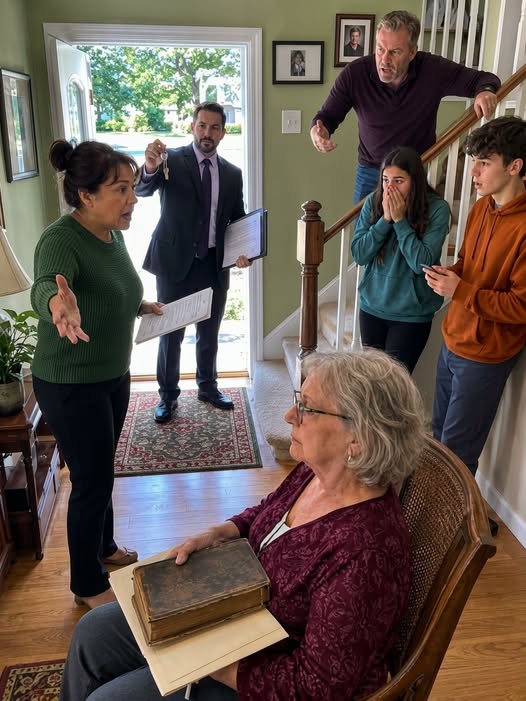
Saturday morning, Renee walked into my room without knocking. Her eyes dropped to the envelope on my dresser. The brass key was half visible beneath my Bible. “You bought a house?” she asked. I placed one hand over the key. Then the doorbell rang.
On the porch stood a man in a suit with a folder. Daniel came down the stairs barefoot, his hair still flat from sleep, and for the first time in years he looked less like the owner of the house and more like a boy caught opening something that didn’t belong to him. Renee reached for the folder. The man pulled it back just enough to leave her hand hanging in the air.
“Mrs. Briggs?” he asked.
Both of us answered with our eyes.
The First Dawn
The sunrise in Oakridge did not ask for permission. It spilled over the low hills in long, honey-colored ribbons, stretching across the wide oak floors of the sunroom until it brushed against my feet. In Daniel and Renee’s house, sunrise was an event announced by the clatter of garage doors, the whine of the espresso machine, and Renee’s heels clicking a rhythmic beat of organized impatience across the kitchen tiles. Here, the dawn came in absolute, unhurried stillness.
I sat on the newly installed porch swing with my morning tea. Beside me, Harold’s cup sat empty on the small iron table, catching the faint morning draft.
When you spend two years being treated like a piece of furniture that cost too much to store, your body forgets how to rest. Every muscle stays coiled, waiting for the subtle shift in a room’s atmosphere—the sharp sigh when you take too long at the counter, the quick glance between husband and wife that says, How long is she staying in here?
It takes time to unlearn that vigilance.
At nine in the morning, a black sedan pulled into the driveway. Patricia Holloway stepped out, carrying a slim leather briefcase and wearing the same crisp, unflinching blue suit she had worn when we signed the final trust documents. She walked up the front steps with the steady stride of a woman who dealt in facts, contracts, and ironclad legal realities.
“Good morning, Evelyn,” Patricia said, setting her briefcase on the porch table. “I brought the final deeds, the tax allocations, and the trust schedules.”
“Did they call you?” I asked, offering her a seat.
“Daniel called three times yesterday,” Patricia replied calmly, opening her file. “Renee left two voicemails. She wanted to know if the trust structure could be challenged on the grounds of undue influence or diminished capacity.”
A small, quiet coldness settled in my chest, but it did not break me. Two weeks earlier, it might have. Now, it was just information.
“What did you tell her?”
“I sent her the official affidavit from your independent psychiatric evaluation, the notarized capacity certificate, and a polite reminder that continuing to harass the trustee could result in a restraining order paid for directly out of any potential inheritance,” Patricia said, her voice entirely devoid of malice, offering only the flat certainty of an expert. “She hung up.”
I took a slow sip of my tea. “Thank you, Patricia.”
“You earned this quiet, Evelyn. Don’t let them make you feel guilty for building walls around your life when they were the ones who tore down your roof.”
After Patricia left, I walked through the house. Five bedrooms. A wide, bright kitchen with soapstone counters. A garden out back that had been allowed to run wild with ivy and overgrown hydrangeas. It was the exact house Renee had spent six months obsessing over in real estate listings, showing Daniel photos at dinner while I sat at the end of the table, passing the salt.
She had wanted it because of the address. She had wanted it because it proved they had arrived.
I had bought it because it had a room facing east, where the light came in first, and because it was big enough to hold my freedom without feeling crowded.
Around noon, my phone rang. The screen displayed Daniel’s name. I let it ring four times before answering.
“Mom?” his voice was hesitant, stripped of the clipped, efficient authority he usually reserved for family logistics. “Are you… are you busy?”
“I’m sitting on my porch, Daniel.”
“Can I come by? Just me. No Renee. Just… I want to bring you some things you left in the basement.”
“You can bring the boxes,” I said evenly. “Leave them on the driveway.”
“Mom, please. Let me come up.”
I looked out across the lawn, where the sun was burning off the morning dew. “You can come up for ten minutes, Daniel. Not a minute more.”
The Audit of Silence
He arrived thirty minutes later carrying three plastic totes containing forty-seven years of my life condensed into attic storage. Inside were Harold’s old ledger books, framed photos from our anniversary trips to Maine, and the ceramic nativity set my mother had given us when we bought our first house in 1978.
Daniel set the boxes down near the door. He looked older. The sharp posture he usually maintained—the posture of a successful mid-level executive managing a busy household—looked slightly caved in at the shoulders.
“Renee isn’t handling this well,” he began, standing near the top step, unsure if he was allowed to sit.
“I didn’t buy a house to manage Renee’s feelings,” I said quietly.
“She feels… humiliated, Mom. The neighbors knew we were looking at this place. She had told people we were putting in an offer once the quarter-end bonuses cleared.”
“Renee spent eighteen months telling the neighbors I was her live-in mother-in-law who needed watching,” I replied, looking him dead in the eye. “She told your friends at the summer barbecue that having me in the guest room was like having a third child, except less flexible. Do you remember that, Daniel?”
Daniel flinched. “She was stressed, Mom. The kids—”
“Do not use your children to hide your own cowardice,” I cut in. The words were not raised in anger; they fell like heavy stones into quiet water. “You stood by the grill. You held a beer. You laughed.”
He closed his eyes. The silence that followed was long, heavy, and unyielding.
“When your father died,” I continued, my voice steady, “I thought I was moving in with my son to share what remained of my life. I thought I was coming into a family. But within six months, I realized I was just an unbilled utility. I cooked the dinners you didn’t have time to make. I folded your laundry. I picked up Maya from volleyball practice when both of your schedules overflowed. And in return, I was given a room with no latch on the door and an unspoken rule that I should finish my dinner before eight so you two could have the main living room to yourselves.”
“Mom, I didn’t mean for it to be like that…”
“Intentions don’t heat a cold room, Daniel. Actions do.”
He sat down heavily on the top step, resting his elbows on his knees. “Where did the eighty-nine million come from? Dad… Dad was a high school principal. You were a librarian. How did you have an eighty-nine million dollar trust?”
I smiled—a small, tired smile that did not reach my eyes.
“Your father’s uncle had no children,” I said. “He owned four land parcels outside of Austin in the late nineteen-sixties. When he passed, he left the land in a silent holding trust managed by Patricia Holloway’s firm, with explicit instructions that it could not be liquidated or transferred until five years after Harold’s death, or upon my seventy-fifth birthday.”
Daniel looked up, bewildered. “Dad knew?”
“Harold knew,” I said. “And Harold chose never to live like a wealthy man, because he believed wealth bought people out of their integrity if they weren’t careful. He wanted to make sure you grew up learning how to work, how to earn, and how to treat people when you had nothing.”
Daniel looked at his hands. “I failed that test, didn’t I?”
“You didn’t fail it because you don’t have money, Daniel,” I said softly. “You failed it because the moment you thought I had nothing left to give, you let your wife treat me like an unwanted guest in your house. You let her talk about putting me in assisted living next fall so you could convert my bedroom into an home gym.”
His head snapped up. “She told you that?”
“She didn’t tell me,” I said. “She said it on speakerphone while I was standing in the pantry putting away the groceries I had paid for with my widow’s pension.”
Daniel sank his head into his hands. He didn’t speak for a long time.
The Ripple in the Glass
By the second week, the suburban rumor mill in our old neighborhood had fully churned.
Renee’s social circle was small, tight-knit, and ruthless. In high-end suburbs, news travels not by gossip, but by passive-aggressive sympathy. Friends began calling Renee to ask if it was true that her mother-in-law had outmaneuvered her on the Oakridge property. Others dropped off baked goods with loaded comments like, “It must be so nice for Evelyn to finally have her own space after feeling so cramped in your guest suite.”
The power structure had inverted, and Renee was suffocating under the weight of her own pride.
On Thursday afternoon, my granddaughter, Maya, showed up at my front door alone. She was fifteen, with Harold’s tall frame and dark, observing eyes. She carried her school backpack over one shoulder.
“Can I come in, Grandma?” she asked quietly.
“Always, sweetheart.”
She walked into the sunroom, looking around at the bright, open space, the light hardwood floors, and the wide view of the garden. She sat on the edge of the sofa and placed her bag on the floor.
“Mom and Dad are fighting,” she said flatly. “They’ve been fighting every night since you left.”
“I’m sorry you have to hear that, Maya.”
“Dad told Mom she blew it,” Maya said, looking down at her hands. “He said she drove you away because she couldn’t stop treating you like a nuisance. And Mom started crying and said Dad was a coward who never stood up to anyone, including her.”
I poured a cup of fresh apple cider and handed it to her. “Adults make their own choices, Maya. None of that is your responsibility.”
“Dad found out about the gym idea,” Maya added, looking up at me. “He didn’t know Mom had called the contractor to measure your room while you were at the dentist last month. When he found out, he threw the dinner plate into the sink and broke it.”
I leaned back in my chair, feeling a deep, slow sadness. It wasn’t triumph. It wasn’t satisfaction. It was just the painful validation of something I had suspected all along: Daniel hadn’t been actively cruel; he had simply been lazy. He had let his wife dictate the culture of his home because resisting her required effort he was too tired to give.
“Grandma?” Maya asked softly.
“Yes, Maya?”
“Are you ever coming back to our house?”
“No,” I said gently. “Never.”
“Can I come here after school sometimes? Just to do my homework? It’s… it’s really loud over there right now.”
I smiled, reaching over to touch her hand. “You have your own key arriving tomorrow, Maya. This house has five bedrooms. Pick whichever one you want for your study.”
Her eyes filled with tears, but she caught them quickly, wiping her cheeks with the sleeve of her sweater. “Thanks, Grandma.”
The Uninvited Guest
It was Saturday morning when Renee finally came.
She didn’t drive up the driveway with her usual authority. She parked on the street and walked up the front path slowly, wearing a neutral beige coat and carrying herself with a rigid, defensive posture.
I saw her from the sunroom. I did not hurry to the door. I let her knock twice before opening it.
“Evelyn,” she said, offering a tight, strained smile.
“Renee.”
“May I come in?”
“No,” I said simply. “We can talk here on the porch.”
Her jaw tightened slightly, but she controlled herself. She had spent years mastering the art of controlled suburban etiquette, and she was not going to break now, even if every instinct in her wanted to demand entry.
“I came to apologize,” she said, her voice careful and rehearsed. “Daniel and I… we’ve been under an immense amount of stress the last two years. Between his promotion cycle, the kids’ tuition, and managing a household… I realize I may have come across as blunt at times.”
“Blunt,” I repeated, letting the word hang in the crisp morning air.
“I didn’t mean to make you feel unwelcome,” she pressed on, stepping closer. “We were just trying to establish boundaries. Living with an in-law is difficult for any young family, Evelyn. You have to understand that.”
“Renee,” I said, my voice quiet and absolute. “You don’t need to perform for me anymore.”
She stopped. “What?”
“You don’t need to use words like ‘boundaries’ or ‘stress’ to disguise basic unkindness. You didn’t dislike me because I was old or inconvenient. You disliked me because I reminded you that you didn’t own everything in that house. I was a reminder of Daniel’s past—a past before you shaped him into the man who agrees with everything you say to keep the peace.”
Renee’s composure began to fray around the edges. Her nostrils flared slightly. “I built our family’s life. I managed our home. I tried to accommodate you—”
“You gave me the room above the garage that froze in November because the insulation was never finished,” I said calmly. “You gave me a single drawer in the refrigerator for my food. You told your daughter in front of me that ‘Grandma’s generation doesn’t understand modern boundary-setting.’ And when I offered to pay rent from my pension, you told Daniel it wasn’t enough to cover the rise in your utility bill.”
Renee swallowed hard. Her face was flushed now, the carefully applied makeup failing to hide the hot flare of anger and embarrassment beneath.
“You played the long game,” she spat out, her tone dropping the rehearsed sweetness entirely. “You sat in our house for two years, acting like a poor, pathetic widow, while sitting on tens of millions of dollars. You let us think you had nothing just so you could buy this house out from under us and humiliate me in front of our friends!”
“I didn’t play a game, Renee,” I said softly. “I survived your home. And when the trust matured, I used my own money to buy my own home. If you feel humiliated, it is not because of my money. It is because your actions have finally been exposed to the light.”
She stood there, her breath coming fast, realization settling over her: she had zero leverage. No guilt to manipulate, no financial pressure to apply, no authority to invoke. I was completely, permanently out of her reach.
“You’ve broken Daniel,” she whispered, attempting one final play. “He won’t even look at me at dinner.”
“Daniel broke himself the day he decided his mother was disposable,” I said. “He has to fix that himself. Now, please get off my porch.”
She stared at me for three long seconds, looking for a crack in my face—a sign of hesitation, a hint of old vulnerability she could exploit. She found none.
She turned and walked down the steps, her heels clicking fast and sharp against the concrete.
The Sunday Table
Three months passed.
Autumn gave way to the sharp, clear cold of early winter. The oak trees on the lawn dropped their leaves, leaving the branches silver and bare against the cold blue sky.
Every second Sunday, the table in my dining room was set for four.
My grandson, Lucas, came first, dropping his coat on the bench and heading straight for the kitchen to check what I was baking. He was seventeen now, quiet, with his father’s eyes but none of his father’s nervous need to please people.
“Grandma,” he said one afternoon, leaning against the counter while I stirred the gravy. “Dad asked me if I talk to you about him.”
“And what did you say?”
“I told him we talk about school, and football, and Harold,” Lucas said simply. “I told him if he wants to know how you are, he should call you himself.”
I looked at him, feeling a quiet surge of pride. “You’re a good boy, Lucas.”
“He’s trying, Grandma. He really is. He comes home from work early now. He doesn’t let Mom complain about you anymore. Last week she started saying something about the Oakridge house, and Dad just set his fork down and said, ‘That’s enough, Renee. We are not doing this again.’”
“Good,” I said. “A man should lead his own home.”
Daniel arrived at five o’clock sharp. He walked in carrying a bag of fresh firewood he had chopped himself from his back yard. He stacked it neatly by the fireplace in the living room without being asked, then washed his hands and came into the kitchen.
“Smells good, Mom,” he said.
“Roast chicken,” I said. “Your father’s recipe.”
He stood by the stove for a moment, watching the steam rise from the pot. “Renee went to visit her sister in Chicago for the weekend,” he said quietly.
“I know. Maya told me.”
“We’re going to counseling,” he added, his voice dropping. “Starting next Tuesday.”
I paused in my stirring and looked at him. “Do you want to go?”
“I have to, Mom,” he said, meeting my gaze. “If I don’t figure out why I let her treat you like that—why I let myself treat you like that—I’m going to lose my kids too. Maya barely speaks to her mother right now. Lucas spends all his time in the garage. My house feels… empty, even when everyone is in it.”
“An empty house is what happens when you build it on convenience instead of honor, Daniel,” I said gently. “I’m glad you’re going.”
We sat down to dinner ten minutes later. For two hours, the room filled with the sounds of a family slowly rebuilding itself from the foundation up. There were no phones on the table. There were no references to the eighty-nine million dollars, or the trust, or Patricia Holloway. We talked about Lucas’s college applications, Maya’s art project, and the cold winter that was coming.
When Daniel got up to leave, he stood in the hallway holding his coat.
“Mom?”
“Yes, Daniel?”
“Thank you for dinner.”
“You’re welcome.”
He hesitated, his fingers tracing the edge of his coat sleeve. “Do you think… do you think Dad would be disappointed in me?”
I looked at him for a long moment, seeing the boy who used to build treehouses with his father in the backyard of our old house, long before mortgage payments, status, and ambitious wives took over his heart.
“He would be disappointed by what you allowed,” I said honestly. “But he would tell you that a man isn’t defined by the mistakes he makes when he’s weak. He’s defined by whether he has the courage to stand up and fix them when he’s called out.”
Daniel swallowed hard and nodded. “Goodnight, Mom.”
“Goodnight, Daniel.”
The Ledger of Grace
By spring, the garden at Oakridge had begun to bloom.
The hydrangeas I had pruned back in November came back thick and green, pushing out tight white buds that promised full flowers by June. I hired a local gardener—not to do the work for me, but to help me turn the soil and plant the heritage roses Harold had loved so much.
My life had found its rhythm.
I did not spend the eighty-nine million on sports cars, trips around the world, or flashy renovations. Patricia Holloway established the Harold & Evelyn Vance Educational Foundation, which funded full scholarships for local kids from working-class families who wanted to go to trade school or college without starting life buried in debt.
Every month, Patricia sent me a simple, one-page summary of the applicants. I sat in my sunroom with my tea and read their letters. Some were nineteen and working two jobs. Some were single mothers trying to get a nursing degree. I signed each grant personally with Harold’s old fountain pen.
That was what money was for. Not to build walls to show off your wealth, but to build fences strong enough to protect your peace and open gates for people who needed a hand up.
One Tuesday in May, Renee sent a letter.
It was not a text, and it was not a rose delivery. It was a handwritten letter in a plain white envelope, delivered by standard mail. I sat on the porch swing and opened it.
Evelyn,
I am writing this because my counselor suggested it, but also because I need to say it without arguing.
I was wrong. I was bitter about how hard our life felt, and I took it out on you because you were vulnerable and close by. I convinced myself that treating you like a burden was just ‘being practical.’ It wasn’t. It was cruel.
I don’t expect you to invite me to your house or forgive me right away. But I want you to know that Daniel and I are trying to change how we live. I am trying to learn how to be a better mother and a better wife, and that starts with acknowledging the damage I did.
Thank you for being good to Maya and Lucas. They love you very much.
Renee.
I read the letter twice. Then I folded it neatly and placed it inside my Bible, right next to the note Maya had slipped into my purse on the day I left their house.
Forgiveness is not the same as access. I did not call Renee. I did not invite her for tea. But the knot of quiet resentment that had lived in my stomach for two years finally unraveled and vanished into the warm afternoon air.
She had owned her truth. That was enough.
The Brass Key
It is autumn again. One year since the morning I stood in Daniel’s kitchen with Patricia’s folder in my hands and the brass key resting in my palm.
The afternoon sun is setting low over the Oakridge hills, casting long, golden shadows across the porch. Maya is sitting at the small iron table, her laptop open, working on an essay for her AP History class. In the yard, Lucas and Daniel are tossing a football back and forth, their voices rising and falling in easy, unhurried laughter.
In the kitchen, the kettle begins to hum. It starts low, a soft vibration against the stove, before rising into that familiar, clear whistle—the sound I had kept in storage for two years because I couldn’t bear to let it go.
I step inside, pour the boiling water into Harold’s cup, and bring it out to the porch.
I set his cup across from mine.
Daniel catches the football, turns, and looks up at the porch. He smiles—a real smile, clear and unburdened by guilt or shame. He waves, then turns back to throw a long pass to his son.
I take my seat on the swing, feeling the slow, rhythmic sway beneath me.
People often ask what it feels like to suddenly come into wealth—to go from counting pennies in a guest room to holding millions in a private trust. They think the story is about the money. They think the victory is buying the house your daughter-in-law wanted, or standing up to the people who underestimated you.
But they are wrong.
The money was just a tool. The real victory was remembering who I was before I let other people’s coldness dictate my worth. The victory was learning that silence is only powerful when it is your choice, not your cage.
I reach into my cardigan pocket and feel the brass key. It is warm from my hand.
I don’t need to lock the doors to feel safe anymore. The key doesn’t just open a house; it marks the line between the life I survived and the life I chose to live.
I lift my tea cup, look out over the sunlit garden, and take a long, quiet sip.
The house is quiet. Not empty. Quiet.
And for the first time in a very long time, I am completely, beautifully at home.
THE END..!