I came home two days earlier than planned, a bottle of red wine and a box of pastries on the passenger seat, a small surprise I had been looking forward to since the conference ended Thursday morning instead of Saturday night.
After more than twenty years of marriage, I still loved the feeling of watching Sarah’s expression change when I walked through a door she thought would stay closed until Sunday. It was one of those private pleasures that belong only to long marriages, the specific joy of knowing someone’s face well enough to anticipate how it rearranges itself for you. I did not call her. I did not text our son. I changed my ticket, took the first flight out of Denver, and drove home from the airport in the kind of quiet contentment that felt, for those forty minutes, like everything I had ever wanted from a life.
I pulled into the driveway at five-eighteen on a Friday evening and saw Michael’s SUV parked at the curb.
That should have made me smile. The four of us sharing a dinner I hadn’t expected, Sarah’s good dishes out on a weeknight, Michael’s laugh filling the kitchen the way it always had. That should have been the best version of an already good day.
It didn’t make me smile.
There are things you register before your mind lets you understand them. The porch lights were on even though the sun hadn’t fully set. The front door was not latched. The house smelled of lemon floor cleaner and warm carpet and underneath both of those something else, something older and metallic that I recognized without wanting to.
Copper.
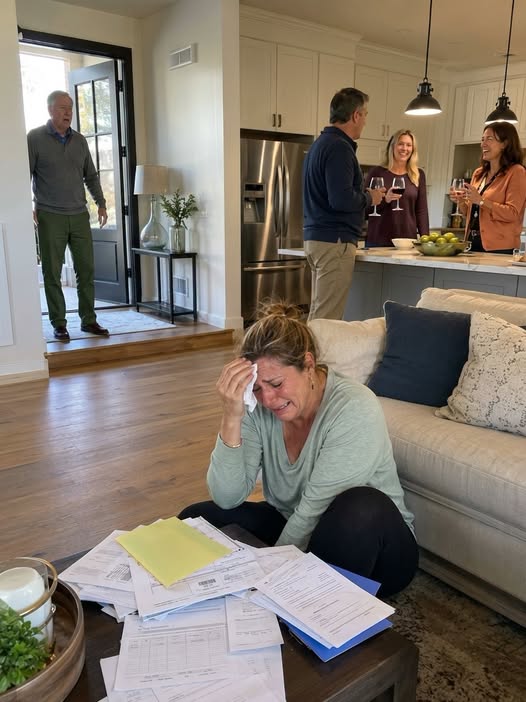
I pushed the door open with my shoulder, bottle in one hand and pastries in the other, and I saw my wife on the floor.
Sarah was sitting upright against the sofa with one hand pressed to her right eyebrow. Blood had trickled down her temple and soaked into the collar of her cream-colored shirt. It had dripped onto the anniversary rug, the one she bought for our twentieth, the one she always made me step around when my shoes were wet. Her knees were pressed together. Her shoulders were drawn forward. She looked like a woman trying to take up as little space as possible in the living room she had spent half her adult life making comfortable for everyone around her.
The wine bottle slipped from my hand onto the entryway table. The pastry box hit the floor.
Sarah looked up at me and her mouth opened, not to ask for help, not to cry out, but to explain. Before I could ask anything. Before I could even speak. She wanted to explain. That was the first thing that broke my heart, and it had nothing to do with blood.
I went to my knees beside her.
“Sarah. What happened?”
She tried to shake her head and grimaced.
From the kitchen came laughter. Michael’s laugh, the one I had heard at Little League games and graduation parties and every loud holiday for sixteen years, the one that used to fill the garage when he was a teenager pretending to know more about engines than I did. I heard Olivia’s quieter chuckle underneath it. Then David’s voice, deep and satisfied, the voice of a man who believed that confidence and correctness were the same thing. Then Jessica said something I couldn’t quite make out, and then there was another burst of noise from the table, silverware and voices and the ordinary sounds of people who were comfortable.
That sound was happening ten paces away from my wife’s blood on the rug.
A house can hold two truths at once. Sometimes that is the thing that makes it unbearable.
I touched Sarah’s wrist gently. “Who did this?”
She swallowed. Her eyes moved toward the kitchen.
That was enough, but she kept going. Her voice came out hoarse and too careful, the voice of someone who has been choosing their words for a long time. “I tried to get rid of them,” she said. “I told them I wouldn’t sign.”
I saw the documents then. On the coffee table, open beside a black pen. Not bills. Not family photos. Not any of the ordinary papers that live on family coffee tables. A county recorder cover sheet. A notary acknowledgment page. A deed transfer form. And beneath those, a second authorization page I couldn’t quite read from where I knelt.
The beach house.
Sarah’s mother had left it to her four years ago, a small place on the Oregon coast that smelled like salt and cedar and the particular kind of quiet that only older houses hold. It wasn’t grand. It wasn’t worth a fortune. But it was the last physical thing that connected Sarah to her mother, and that made it worth everything.
Michael had started asking about it three months ago. Politely at first. He said David’s restaurant just needed a little bridge money, a temporary thing, and the beach house was sitting half-empty most of the year anyway. He said Sarah was being emotional. He said the practical thing was obvious to everyone willing to look at it clearly.
I had said no. Sarah had said no. Michael acted as though our refusal were a personal wound inflicted on him, as if a parent maintaining a boundary were a form of aggression.
After that, the calls got shorter. The messages got colder. Olivia stopped sending Sarah pictures from Sunday dinners. David started calling the beach house an asset, which told me everything I needed to know about how he had been framing it to my son. Not an inheritance, not a memory, not a piece of a woman’s mother. An asset. A liquid resource waiting to be unlocked by people with better uses for it.
Sarah had given Michael more chances than he had earned because she was his mother and because she remembered who he had been. She remembered scraped knees and baseball practices and the summer he was twenty-two and slept on our living room floor for three weeks after his first serious heartbreak because he couldn’t stand to be alone in his apartment. She remembered every fever she had sat through, every school form she had signed, every meal she had packed in a brown bag with his name on it.
That was the trust he had counted on. A mother’s memory. He had walked into her house with papers and a pen because he understood, better than he should have, that she would rather sit quietly with whatever was happening to her than make him feel ashamed of himself.
“He grabbed my arm,” Sarah said. She sounded as though the words embarrassed her. “I pulled away. I hit the table.”
I saw the corner of the coffee table then. A small dark smear where her eyebrow must have caught it.
Behind me, the kitchen found another punchline.
For one ugly moment, I wanted to walk into that room and do something I could not take back. I wanted to become a different kind of man, the kind that solves things with his hands, the kind that makes a loud and immediate accounting of what had happened in my living room. The feeling was strong enough that I had to sit with it for a full breath before I could move past it.
I took out my phone instead.
Anger is easy. Anger is available to everyone. Evidence is harder and rarer and it outlasts everything.
I took three photographs. Sarah’s injury, the blood on the rug, the open folder with the county recorder form and the notary page visible in the frame. The phone recorded the time automatically. Five-twenty p.m. Then I called 911, keeping my voice low and steady. I gave our address. I said my wife had a head injury. I said there had been a confrontation over property documents. I said the parties involved were still on the premises.
The dispatcher told me to stay on the line. I said I would.
Sarah caught my sleeve as I started to stand. For a moment I thought she was trying to stop me, to ask me not to make it bigger than it was, to say what she had said a hundred times over the past three months about giving Michael one more chance to come around on his own.
Instead she whispered, “Don’t let them take it.”
Not don’t hurt him. Not don’t make a scene. Not give him a chance to explain.
Don’t let them take it.
I understood then how long this had been happening before I opened the door. How many days of phone calls and silences and pressure dressed up as concern. How many times someone had reminded her that she was being emotional, that she was being impractical, that love was a reason to let go of things.
I squeezed her hand once. “They won’t,” I said.
I stood and walked to the kitchen doorway.
The table was fully set. Glasses, plates, napkins. Olivia had her phone face-down beside her fork. Jessica was mid-sentence. David was in my chair. It was a small thing, that last detail, the kind of thing that shouldn’t matter as much as it does. But it sat under my skin the same way the laughter had.
Michael looked up at me with a grin still on his face. I watched it leave. Not all at once, the way a light goes out, but the way a tide pulls back, slowly enough that you can see the shape of what the water was hiding.
He knew I wasn’t supposed to be there. He knew his mother was supposed to have time. Time to clean herself up, time to compose a version of the afternoon that didn’t require explaining, time to absorb whatever had happened and present it to me as something that was already resolved and smaller than it was.
Olivia’s fork stopped halfway to her mouth. Jessica’s fingers tightened on her glass stem. David leaned back with the expression of a man deciding whether to be friendly or offended.
I set the phone face-up on the counter. The 911 call was still active on the screen.
“Nobody moves,” I said.
Nobody did.
David spoke first, because men like David have spent their lives using the first sentence of any confrontation to establish that they are in charge of its terms. “Now hold on,” he said. “This is family business.”
I looked at him steadily. “Sit down.”
He sat. His pride caught up with him a second later, but by then the moment had passed.
Michael rose halfway from his chair. “Dad, you’re overreacting. She fell, it was—”
The dispatcher’s voice came through the phone asking whether everyone in the house was safe.
“My wife is injured,” I said, not taking my eyes off my son. “The individuals who were pressuring her to sign property transfer documents are in front of me.”
Olivia began to cry. It was not the kind of crying that comes from remorse, from seeing someone hurt and feeling the weight of it. It was the crying of someone who has just understood that a plan has failed and the failure has witnesses. Panic looks for exits. Compassion looks toward the person who is bleeding.
Sarah’s voice came from the living room, still quiet, still careful. “Check the second page.”
The kitchen changed.
Michael’s eyes snapped to the folder on the coffee table. Olivia said his name under her breath.
I walked back to the documents and looked. Under the deed draft was a witness page with Olivia’s name typed beside a blank signature line. And behind that, a second authorization form directing the proceeds from any sale of the property into a business account that had not been mentioned to Sarah. Not once. Not in three months of pressure and politely reframed requests. Not ever.
The restaurant was not asking for a loan. The restaurant was asking to be funded by my wife’s dead mother without my wife’s full knowledge of what she would be signing.
I carried the pages into the kitchen. Olivia saw her name first. Her hand went to her mouth. “I didn’t know he brought that,” she said.
Michael turned on her so fast his chair scraped the floor. “Stop talking.”
That was when the siren turned onto our street.
It didn’t sound like justice. Justice is a word that belongs to later, after the adrenaline and the paperwork and the long quiet evenings of reckoning. What it sounded like in that moment was consequence. It sounded like the outside world arriving in a house where everyone had been counting on the inside remaining private.
The officers arrived first. The ambulance pulled in right behind. Our front porch looked too small for all of it, the uniforms and radios and medical bags, the neighbors who came out onto their lawns and then thought better of it but didn’t quite go back inside.
A small flag near the front door moved in the evening air as though nothing unusual were happening beneath it.
Inside, the officers separated everyone. That mattered more than almost anything else that happened in the next hour. It stopped Michael from performing the role of concerned son in front of me. It stopped David from turning the kitchen into a negotiation. It gave Sarah a room where she could speak without four people watching her mouth for the right words.
The EMT crouched beside her on the living room floor and asked questions in the flat calm voice of someone who has learned that stillness is its own form of kindness. Name. Date. Pain level. Whether she felt dizzy. Whether she had lost consciousness at any point. Sarah answered all of them clearly and steadily, but her eyes kept finding me across the room. I stayed where she could see me.
One officer took Michael into the dining room. I heard Michael’s voice through the wall describing the afternoon as a disagreement that had gotten out of hand, as an accident, as a family matter that had been blown far out of proportion by an unexpected arrival. His voice had the rehearsed quality of someone who had prepared for the possibility of explanation. He had not prepared for photographs with timestamps.
David told the officer in the kitchen that he had never touched Sarah. That was probably true. Men like David rarely need to use their hands when they have someone who loves them more than he deserves nearby to do the reaching for them. He said it three times, each repetition quieter than the last, as though the defense were fading even as he made it.
Olivia sat at the kitchen table with her hands in her lap looking at the witness page as though it had arrived from somewhere else and had nothing to do with her. Jessica cried into a paper napkin. The napkin was from our drawer, the good ones Sarah kept for company.
I gave the police the photographs from my phone. I showed them the timestamp. I handed over copies of the documents and let an officer photograph the originals in place on the coffee table before they were moved. I described the call order, what I had seen, what Sarah had told me, in the sequence it happened. The dispatcher confirmed the call record. The officer wrote everything down without comment, in the way that good officers do, reserving judgment for later and gathering fact now.
At the hospital, Sarah sat in a intake chair that was too plastic and too bright and gave her name to the nurse in a voice that was still smaller than her own. The cut needed closing. The swelling needed monitoring. Her pupils were checked twice. There was no life-threatening injury, which should have been a relief and was, though the relief sat alongside things that relief is not large enough to contain.
The police report listed the injury, the documents, the 911 call, the statements from all parties. A case number was printed in the upper right corner. Sarah looked at that number for a long time.
“What are you thinking?” I asked.
She said, “I’m thinking about how close I came to letting him make me feel rude for saying no.”
I didn’t say anything. There wasn’t a response that would have fit around what she had just said. She had not been weak. She had been trained, by love and by the particular logic of motherhood, to make herself smaller around a person who had learned to count on that. That is not weakness. That is what happens when someone you have known since before they could walk decides to weaponize the version of you that can’t stop caring about them.
Michael came to the hospital that evening. The officer at the desk would not let him back. I saw him through the glass doors in the waiting area, standing with his hands in his jacket pockets, looking in our direction. He looked younger than he had in the kitchen. That did not soften me. A man can look like someone’s child and still be responsible for what he did. The two things coexist without canceling each other out.
The following morning, Sarah and I sat in the dining room with the documents spread between us and coffee growing cold on both sides. She had said she did not want to sit in the kitchen yet. So we used the dining room, where the morning light came in at a different angle and the table carried different memories.
The transfer form was unsigned. The business account authorization was unsigned. The witness page was blank. The notary acknowledgment had never been completed. The beach house remained Sarah’s, exactly as it had been before any of this began, because she had held her position in a room where everyone had been counting on her to give it up.
By Monday we had called the county recorder’s office to confirm nothing had been filed anywhere without our knowledge. We called our attorney, not to begin a war but to understand precisely where we stood and what our options were. We changed the locks on every exterior door.
I took Michael’s garage key off the hook by the back door, the one he had kept since his second year of college and never returned, the one that had been there so long it felt like part of the house’s permanent inventory. I put it in the junk drawer in the kitchen.
Sarah watched me do it. She hadn’t cried when the nurse closed the cut. She cried when she saw the key go into the drawer.
“This is his house too,” she said. Her voice was not angry. It was simply true in the way that certain things are true before grief catches up with them.
“It’s a place where he’s always welcome,” I said. “That’s not the same thing as ownership.”
The weeks that followed were quiet in the way that aftermath is quiet, not peaceful but depleted. Michael sent messages in stages. First, explanations that were not quite apologies, accounts of how things had looked from his side of the room, reasons why what happened had not been what it appeared to be. Then anger, accusations that we were blowing everything out of proportion, that we were punishing him for a mistake instead of helping him through a crisis, that families found ways to move past things like this. Then, after a longer silence, a message that was different in tone, rawer, less rehearsed.
He said the restaurant was in worse trouble than he had admitted to anyone. He said Olivia was frightened. He said he had thought that once Sarah signed, everything could be sorted out before anyone got seriously hurt.
Before anyone got seriously hurt.
I read that line several times. I read it while remembering where I had been standing at five-eighteen on a Friday evening when I had walked into my own house.
I did not reply. Sarah did.
She wrote: You can’t call it desperation when the plan requires my silence.
That was the first sentence I heard from her that sounded like herself again.
The beach house stayed in her name. The restaurant closed three months later, not because of anything we had done but because the problems inside it had always been larger than any single asset could have addressed. David and Jessica moved to Portland. Olivia called Sarah once, in the early weeks, and cried for most of the call in a way that seemed genuine. Sarah listened and said she appreciated the call and then sat by the window for a long time afterward, not crying, just still.
The living room changed after that Friday. For several weeks Sarah avoided it at dusk, coming in to get things and then returning to other rooms before the light shifted. I moved the coffee table into the garage. We had the rug cleaned twice, but a shadow remained in the corner near the sofa. Sarah told me to leave it.
Not because she wanted to look at it. Not as punishment or reminder of pain. Because she wanted to remember that she had been on the floor and had not signed. She wanted to remember what it looked like when she had held the line.
Months passed. The case moved through its process. Michael’s path forward was his own to navigate, and whatever it would eventually contain between him and his mother was something I could not manage or predict or shortcut. Some repairs do not begin until the people who need to make them fully understand what they broke. That understanding, when it came, would come slowly.
One afternoon in late autumn I found Sarah standing on the porch in the low afternoon sun. She was looking down the street at nothing in particular, the way you look at a familiar view when you are actually looking at something inside yourself. I stood in the doorway behind her for a moment before she knew I was there.
She said, “I am not going to sign anything I don’t want to sign. Not now. Not for any reason. Not ever.”
She said it the way people say things that they have been quietly deciding for a long time, not with anger, not with relief, but with the flat certainty of something that has finally been said out loud and cannot be unsaid.
I didn’t answer. There was nothing to add. The afternoon was quiet around us, the street empty, the light falling across the porch boards in long warm strips.
The beach house was still hers. Her mother had left it to her and she had kept it, not because keeping it was easy but because she had understood, somewhere in all of it, that some things are not yours to give away simply because someone who loves you asks you to.
I had come home with wine and pastries to surprise my wife and found her on the floor of our living room with blood on the collar of her cream shirt, and I had taken photographs and called 911 and stayed where she could see me. That had been enough for that evening. Just enough.
What came after was slower and less dramatic and more important. Clean coffee cups in the morning. New locks on the doors. A police report in a file. A woman sitting upright at her own dining room table, going through pages in the morning light, understanding that she had not been wrong to hold her ground.
In a house you can find a wife bleeding in the living room and a kitchen laughing ten paces away. A house can hold both those things at once. But it can also hold what comes next. It can hold the morning after, and the slow work of deciding what survives and what doesn’t, and a woman on a porch in late autumn sun saying quietly that she will never again sign something she does not want to sign.
Nobody was laughing then.
And the flag by the front door moved in the wind, as it always had, as if none of this were unusual, as if families did not sometimes test each other past every limit and find, on the other side of it, whatever was true enough to remain.
The Audits of Memory
In the days after a house breaks open, time loses its steady rhythm and turns into something granular. Every room holds an interrogation that nobody speaks aloud.
By Wednesday, the formal notice from the prosecutor’s office arrived in a plain Manila envelope. It sat on the kitchen counter next to the mail stack like a weight pulling the surrounding paper toward it. Michael was facing initial charges of third-degree assault and attempted coercion—charges that sounded clinical, scrubbed clean of the blood on the rug, the smell of burnt pot roast in the kitchen, and the terrible sound of laughter coming through a hallway while Sarah lay on the floor.
Sarah didn’t open the letter right away. She made tea, moving through the kitchen with a deliberate, slow grace that felt fragile, as if sudden movements might cause her skin to split along the line of sutures above her brow.
“The district attorney’s office called while you were in the garden,” I said softly, coming up behind her and placing a hand gently between her shoulder blades. “They want to schedule a formal deposition next Tuesday. They’re bringing in a financial crimes investigator.”
She didn’t turn around. She watched the steam rise from the porcelain mug. “A financial crimes investigator. For Michael.”
“For the documents,” I clarified gently. “The authorization form behind the deed transfer wasn’t just a rush job, Sarah. Our lawyer looked at the banking numbers. That business account listed on the second page? It wasn’t just for the restaurant. It was tied to an LLC registered under David’s brother-in-law in Delaware. If you had signed, the equity from your mother’s beach house would have been liquidated within forty-eight hours through a private bridge loan.”
Sarah took a breath that shivered in her chest. “They didn’t just want a loan to save the bistro. They were liquidating it out from under us entirely.”
“Yes.”
She turned then. The swelling around her eye had turned a mottled yellow-green, the color of bruised fruit. “He looked me in the eye, Arthur. He sat right there—” she pointed toward the dining table, though we hadn’t eaten there since Friday—”and told me it was just a temporary line of credit. He told me that if I loved him, I’d trust him to fix his life.”
“I know.”
“What breaks a person like that?” she whispered. “Where did I fail him? Was it when we paid off his first credit card in college? Was it when we let him drop out of business school to start the catering venture? Did we teach him that there was always a net, no matter how far he jumped?”
It was the question every parent asks when the child they raised transforms into a stranger holding a weapon. But I refused to let her carry the blame.
“We gave him a net,” I said firmly, taking her hands in mine. “We did not give him the right to push you to the floor when you refused to be his collateral. That choice was entirely his.”
Later that afternoon, our attorney, Richard Vance, arrived at the house. He was a man of sixty with silver hair, wire-rimmed glasses, and a manner so precise it bordered on coldness—which was exactly what we needed. He sat at the dining room table, laying out yellow legal pads and copies of the police report.
“The physical assault is straight-forward,” Vance explained, adjusting his glasses. “We have the timestamped photos, the EMT report, and the police notes regarding the blood evidence. Michael’s defense attorney is already trying to float a narrative of an accidental bump during a heated argument. But the financial documents alter the charge entirely. Attempted grand larceny and elder financial exploitation carry mandatory minimums in this jurisdiction.”
Sarah winced at the phrase. Elder financial exploitation. She was fifty-eight. To hear herself categorized as a victim of elder abuse by her own twenty-six-year-old son was a second injury, quieter but deeper than the first.
“What about David and Jessica?” I asked. “They were in the kitchen eating our dinner while Sarah was injured on the floor.”
“David’s legal standing is complicated,” Vance said. “He claims he was merely acting as an informal advisor for Michael’s business turnaround. However, I ran a background check on his firm. David has two civil judgments against him in Oregon for predatory land acquisition practices. He operates in the grey zones of family desperation. He finds young entrepreneurs in debt, identifies family assets, and acts as the ‘muscle’ to convince reluctant relatives to sign over deeds.”
“A predator,” Sarah said, her voice flattening into cold realization.
“A predator who relies on family shame to cover his tracks,” Vance corrected. “Most parents don’t call the police when their children try to steal from them. They sign the papers to avoid the scandal, or they take the loss quietly. You broke the script, Sarah. By staying on that floor, by refusing to sign, and by letting Arthur make that 911 call, you broke a pattern that David has likely used half a dozen times before.”
After Vance left, I walked into the garage. The old oak coffee table sat near the lawnmower, draped in a dusty tarpaulin. I reached out and lifted the edge of the canvas. The sharp corner of the table—the corner that had caught Sarah’s temple when Michael pushed the folder into her lap—was stained with a dark, tiny smear of dried mahogany varnish and blood.
I didn’t burn it. I didn’t throw it out. I covered it back up. Some evidence belongs to the court, but some belongs to the house, a monument to the moment the illusion of absolute safety ended.
The Geometry of Silence
A house after a catastrophe becomes a maze of unsaid things.
In the second week, the silence from our extended family broken only by sporadic, uncomfortable text messages. My sister called twice, her voice dripping with careful neutrality, asking if we were “holding up” before delicately bringing up whether charges were “really necessary.”
“He’s your son, Arthur,” she said over the line, her tone carrying the unspoken weight of judgment. “Think of his future. A felony record will ruin him.”
“His choices ruined him,” I told her, and hung up before she could respond. It was astonishing how quickly people who hadn’t seen the blood on the rug turned into advocates for quiet forgiveness.
Sarah spent her mornings in the garden. Autumn was deepening, the leaves of the sugar maples turning a brilliant, violent crimson before dropping onto the lawn. She worked with an almost furious intensity, tearing up old tomato vines, turning the heavy soil, burying bulbs deep into the cold earth for a spring she seemed determined to reach on her own terms.
I watched her from the kitchen window. The cut above her eye had healed into a thin, pink line that crossed her left eyebrow like a strike-through on a draft of text.
On Thursday, Michael’s lawyer sent a formal request for a meeting—a “restorative dialogue,” he called it. He wanted Michael, Sarah, and me to sit down in a neutral conference room with a mediator.
Sarah read the letter at the kitchen counter. She set it down beside her garden gloves.
“Do you want to see him?” I asked.
“No,” she said instantly. Then she paused, looking out at the bare soil of the garden bed. “No, that’s not true. I want to see the boy I raised. But that boy isn’t going to be sitting in that room. The person sitting in that room will be a man trying to stay out of prison.”
“You don’t have to go.”
“I know,” she said. She looked at her hands. Her knuckles were rough from the dirt, the nails trimmed short. “I want to send him a letter instead. Not through the lawyers. Just from me.”
“What do you want to say?”
“I want to ask him a question.”
She sat down at the small desk in the corner of the living room—the desk where she kept the household ledgers and Christmas card lists—and pulled out a piece of cream stationery. She wrote for twenty minutes without stopping. She didn’t ask me to read it, but when she folded it into the envelope, she read the final lines out loud to me.
“‘You thought because I loved you, my answer would always eventually be yes. You mistook my patience for permission. I am not keeping the beach house out of malice, Michael. I am keeping it because it represents a line I should have drawn five years ago. You cannot buy your way out of your choices with my life.’”
She sealed the envelope. “Take it to Vance. Tell him to deliver it to his counsel.”
“Are you sure?”
“I am,” she said.
That evening, the doorbell rang at seven o’clock.
In the weeks since the incident, the sound of the chime sent a jolt of adrenaline straight to my throat. I walked to the front window and pulled the curtain back an inch.
It wasn’t Michael. It was Olivia.
She stood on the porch in a heavy wool coat, her hands shoved deep into her pockets, her hair pulled back into a messy bun. She looked smaller than she had on the night she sat at our kitchen table with her phone face-down.
I opened the door, but I didn’t step back to let her in. I stood squarely on the threshold.
“Arthur,” she said, her voice trembling in the chill evening air. “Please. I just… I need to talk to Sarah. Just for five minutes.”
Sarah came up behind me. She laid a hand on my shoulder, gently signalling me to step aside. “It’s alright, Arthur. Let her come into the entryway.”
Olivia stepped inside, her eyes darting nervously toward the living room rug, which had been thoroughly scrubbed but still bore the faint yellow halo of the cleaning solvent. She swallowed hard.
“I came to tell you,” Olivia began, her voice cracking, “that I didn’t know about the second form. I swear to God, Sarah, I didn’t know Michael had put my name down as a witness on the account transfer. He told me we were coming over for dinner to talk about a simple loan structure. He told me you had already agreed in principle.”
Sarah listened with an unreadable expression. Her pale eyes were steady, fixed on the young woman who had sat in our house dozens of times for Sunday dinners, who had helped wash dishes, who had talked about wedding dresses and future plans.
“You had your phone face-down by your fork, Olivia,” Sarah said quietly. “When I was on the floor, you didn’t reach for a towel. You didn’t call an ambulance. You looked at Michael to see what the story was going to be.”
Olivia flinched as if struck. “I was terrified—”
“Panic makes people run,” Sarah said smoothly. “Calculated silence makes people complicit. You were waiting to see if I would get up and sign the papers anyway to keep the peace.”
“I love him,” Olivia sobbed, pulling a crumpled tissue from her coat pocket. “He was drowning, Sarah. The investors were threatening to sue him for fraud over the restaurant accounts. He was desperate!”
“Fraud?” I caught the word immediately. “What fraud?”
Olivia closed her mouth instantly, realizing what she had blurted out. She looked at me with wide, terrified eyes.
“The restaurant didn’t just fail because of bad luck,” I said, stepping closer. “He mismanaged the funds, didn’t he? He took money from the payroll taxes or the vendors.”
Olivia didn’t answer, but her silence was an explicit confirmation. She backed toward the door, her hand reaching blind for the brass knob.
“I’m sorry,” she whispered. “I just… I wanted you to know I never wanted anyone to get hurt.”
“Wanting people not to get hurt isn’t enough, Olivia,” Sarah said, her voice ringing clear in the small entryway. “You have to refuse to participate in the hurting. Goodbye.”
Olivia opened the door and fled into the dark. We watched her car start up down the street, its taillights glowing red in the autumn fog before disappearing around the corner.
The Depositions of Truth
The legal process moves not with the speed of crisis, but with the glacial, crushing momentum of procedure.
By mid-November, the formal depositions were held at the District Attorney’s office downtown. The building was concrete and glass, gray rooms filled with fluorescent light that stripped every emotion down to its plainest factual frame.
Sarah sat at the end of a long mahogany table. On her right was Vance; across from her sat the Assistant District Attorney, a sharp-eyed woman named Ms. Chen, and a court reporter whose fingers hovered over her machine like a pianist waiting for the conductor’s baton.
Michael was not in the room. His defense attorney, a sleek man in a pinstriped suit named Sterling, sat across from us, taking notes with a silver pen.
“Mrs. Miller,” Ms. Chen began, her tone professional and respectful. “I want to walk through the events of October 14th once more, specifically regarding the moments leading up to the physical altercations.”
Sarah took a sip of water. She had dressed carefully today—a dark navy suit, a pearl necklace, her hair styled to cover the pale scar above her brow. She looked like a woman in complete command of herself.
“Michael arrived at four-fifteen,” Sarah stated clearly. “He brought David and Jessica. Olivia arrived fifteen minutes later. Michael laid the folder on the coffee table in the living room. He told me that his financial situation with the restaurant was critical, but that a simple equity draw on the beach house would resolve it.”
“And what did you say?”
“I told him no. I told him I had already consulted with my husband, and that we were not willing to encumber the property that my mother had left to me.”
“How did he react?”
“He became angry,” Sarah said. “He told me I was being selfish. He said my mother would have wanted him to succeed. Then David stepped in. David told me that as an older woman, I didn’t understand modern commercial finance, and that I was holding my son back out of ignorance.”
Attorney Sterling cleared his throat. “Objection as to characterization of Mr. David’s intent—”
“This is a deposition, Mr. Sterling, not a trial,” Ms. Chen said without looking at him. “Continue, Mrs. Miller.”
“I stood up to ask them to leave,” Sarah continued, her voice remaining firm and unhurried. “Michael grabbed the folder. He stepped into my path. He grabbed my forearm—hard enough to leave bruises, which were documented by the EMTs—and pushed the folder against my chest. He said, ‘You’re signing this today, Mom. We aren’t leaving until it’s done.’”
“And then?”
“I pulled back. I told him to let go of me. He yanked the folder, and when I lost my balance, he shoved me away. I fell backward. The back of my head struck the edge of the oak coffee table. I hit the floor, and for several seconds, everything went dark.”
The court reporter’s keys clicked rhythmically, an unnerving, mechanical background count to the story of a mother’s betrayal.
“Did your son render aid?” Ms. Chen asked.
“No,” Sarah said softly. “When I opened my eyes, he was standing over me looking at the blood on his shoe. Then he stepped over me, walked into the kitchen with David, and told Olivia to set the table so they could wait for Arthur to arrive and ‘handle him.’”
Sterling leaned forward. “Mrs. Miller, isn’t it true that your son was merely trying to steady you as you slipped on the rug?”
Sarah looked directly at Sterling. The look was so cold, so devoid of fear, that the lawyer actually hesitated.
“If he were trying to steady me,” Sarah said, “his hands would have been holding me up. He was holding the documents down. He wanted the signature, Mr. Sterling. He didn’t care if he got it from a mother who was conscious or a mother who was too terrified to say no.”
Ms. Chen turned to the financial documents attached to the case file as Exhibit C.
“Let’s talk about the second authorization page,” Ms. Chen said. “The defense claims that Michael was unaware of the secondary Delaware account clause inserted by David’s firm. Mrs. Miller, had you ever seen that clause prior to your husband finding it in the folder?”
“Never,” Sarah said. “Michael told me it was a standard mortgage application. He intentionally hid the secondary page under the deed draft.”
At that moment, the door to the deposition room opened quietly. A clerk stepped in and handed a sheet of paper to Ms. Chen. She read it, her eyebrows rising slightly, then handed it across to Sterling.
Sterling’s face lost its composure. He scanned the page quickly, his mouth hardening into a tight line.
“What is that?” Vance asked.
“It’s a forensic audit report from the state banking commissioner,” Ms. Chen said, leaning back in her leather chair. “It appears that yesterday morning, federal investigators executed a search warrant on Michael Miller’s restaurant business accounts. They found evidence of wire fraud, dummy invoices, and an illegal offshore transfer of sixty thousand dollars that occurred two days before the incident at your home.”
The room fell completely silent.
“He wasn’t trying to save the restaurant,” I said, the realization settling heavily in the room. “He had already looted it. He needed Sarah’s beach house equity to cover the missing money before the grand jury subpoenaed his books.”
Sterling slowly closed his briefcase. He looked at Sarah with a expression that was no longer combative, but almost sympathetic in a bleak, legal way.
“My client,” Sterling said quietly, “will likely be seeking a plea bargain.”
Sarah didn’t celebrate. She didn’t look relieved. She simply sat quietly in the bright room, her hands resting folded on the polished wood, watching the legal machinery strip away the last remaining pretenses of her son’s innocence.
The Inventory of Loss
By late December, winter had settled over the city like a heavy grey blanket. The trees were bare bone against a leaden sky, and snow fell in thick, silent flakes that dusted the porch and the front lawn.
The criminal trial for Michael never happened. Facing a mountain of federal wire fraud charges alongside the state charges of assault and attempted coercion, Michael took a plea deal.
Three years in a state correctional facility. Two years of probation. A permanent restraining order prohibiting him from contacting Sarah or coming within five hundred feet of our home.
David was indicted separately as a co-conspirator in the commercial fraud scheme; his firm was dissolved, his assets frozen. Olivia had returned to her home state, avoiding prosecution by testifying against David and Michael.
The legal fight was over, but the house remained.
Christmas came and went without a tree. We didn’t send cards. We didn’t hang lights on the eaves. For the first time in thirty years, our living room was dark on Christmas Eve.
We sat together by the fireplace, the crackle of burning birch logs filling the quiet space. Sarah held a mug of spiced cider, watching the flames flick across the hearth.
“I went through his old bedroom today,” she said softly.
I looked up from my book. “You didn’t have to do that alone, Sarah.”
“I wanted to,” she said. “I found his old Little League trophies. I found the drawing he made of the beach house when he was seven—the one with the yellow sun that took up half the sky and the purple seagulls.”
She paused, taking a long drink of her cider.
“I kept looking at that drawing,” she continued, her voice remarkably clear. “I kept trying to find the point where that boy turned into the man who stood over me while I was bleeding on the rug. But life doesn’t work like that, does it? There isn’t a single line where good turns into bad. It’s just a hundred tiny choices, made every day, when nobody is watching.”
“He chose greed over you,” I said gently. “That was his choice, Sarah. Not yours.”
“I know,” she said. “But the grief doesn’t care whose choice it was. It just sits in the room with you.”
She stood up and walked over to the closet near the front entry. She pulled out a large cardboard box filled with old photo albums—years of family vacations, birthdays, school plays, graduations.
She carried the box to the coffee table—the new one we had bought to replace the old oak table—and set it down.
“Are we getting rid of them?” I asked.
“No,” Sarah said firmly. “I’m not going to pretend he was never born. I’m not going to erase twenty-six years of my life as a mother just because the ending was terrible. That would be letting him steal the past, too.”
She opened the first album. It was a photo of Michael as a toddler, sitting on the porch of the beach house, covered in sand and laughing hysterically at a crab crawling across the deck boards.
She touched the picture gently with her thumb.
“I loved that boy,” she said, her voice dropping to a tender whisper. “I will always love that boy. But the man he became cannot come back into this house.”
It was the distinction that saved her. She did not poison her memories to survive her present. She allowed the good past to exist alongside the painful present, separated by a line as clean and absolute as the law could draw.
The Tides at the Beach House
In May, six months after the night of the sirens, we drove down to the coast.
The beach house had been built by Sarah’s grandfather in the late 1940s. It was a simple two-story weathered cedar structure perched on a bluff overlooking the Pacific, surrounded by wild beach grass and gnarled pine trees bent inward by decades of ocean wind.
It was the house Michael had tried to take. It was the house Sarah had bled for.
We arrived late in the afternoon. The air was cool and salt-heavy, filled with the deep, rhythmic roar of the tide crashing against the black rocks below.
We unlocked the front door. The house smelled of salt, cedar, and the dry silence of a place that had been closed up for the winter. Sunlight streamed through the floor-to-ceiling windows, illuminating the old braided rugs, the stone fireplace, and the mismatched furniture that had belonged to three generations of Sarah’s family.
Sarah walked to the center of the living room and turned slowly in a circle.
This was the asset. This was the target of the Delaware LLC, the private bridge loan, the predatory paper signed with an un-notarized signature line. Here, it was just wood and glass and memories.
“Help me open the windows,” she said.
We pushed open the heavy wooden sashes, letting the cold, clean ocean breeze sweep through the rooms, blowing away the stale air of winter.
We spent the weekend working on the house. We sanded the weathered deck railings, cleared the wind-blown sand from the gravel driveway, and repaired a broken shutter on the east bedroom window.
On Sunday morning, a contractor arrived. His name was Miller—no relation—a local builder who had known Sarah’s parents.
“You sure you want to go through with this, Sarah?” he asked, holding a clipboard and looking at the blueprint spread out on the kitchen counter. “It’s a big change to the old layout.”
“I’m sure,” Sarah said.
She was placing the property into an irrevocable land trust. The deed was being legally transferred away from individual ownership—ours or anyone else’s—and placed into a perpetual conservancy that would protect the bluff and the surrounding forest from any future commercial development or private sale after our deaths.
No one could borrow against it. No one could sell it. No one could leverage it for a business venture, a restaurant, or a debt settlement. It would remain exactly as it was, open to the public as a nature preserve once we were gone.
“Sign here,” the trust attorney said, placing a simple fountain pen beside the documents on the wooden table.
Sarah picked up the pen. Her hand didn’t shake. Her fingers were steady, her posture erect.
She signed her name in clear, elegant cursive across the line: Sarah Eleanor Miller.
When she laid the pen down, she looked out the window at the ocean. The waves were breaking white over the reef, endless and untamed.
“It’s done,” she said quietly.
“How does it feel?” I asked, putting my arm around her shoulders.
“It feels light,” she said, leaning her head against my chest. “For three months, people tried to tell me that property was love, that giving things away was proof of devotion. Now it belongs to the wind and the sea. Nobody can ever fight over it again.”
Letters from the Interior
In the autumn of the following year, a letter arrived from the state correctional facility in Salem.
It was the first direct communication from Michael since his sentencing. Up until then, any legal notifications had come through his state-appointed attorney.
The envelope was thin, stamped with the prison’s red administrative marking across the front.
I set it on the dining table next to Sarah’s coffee mug. I didn’t say anything. I simply sat down across from her.
She looked at the handwriting—the familiar, slanted script of her son—and didn’t touch it for a long time. The clock on the wall ticked steadily.
“Do you want me to read it first?” I asked.
“No,” she said softly. “I need to do it.”
She slid a butter knife under the flap and opened the letter. She read it silently, her eyes moving back and forth across the single sheet of lined notebook paper.
The letter was not an angry defense. It was not a plea for money or a demand for a lawyer to file an appeal. It was short, written in rough, unpolished prose:
Mom,
They put me in the woodshop program here last month. We build simple pine chairs for state offices. It’s the first time in my life I’ve had to finish something with my own hands from start to finish without asking someone else to fix my mistakes.
I’m not writing to ask you to visit. I know I don’t have the right to ask for that. I’m writing because I finally read the letter you sent through Mr. Vance last year.
You asked me why I didn’t look at you when you were on the floor. The truth is, I was terrified to look at you because if I looked at your face, I would have had to stop. And I was so far into the lie by then that I thought stopping meant dying.
I know now that I was already dead. I killed the person I was supposed to be a long time before I pushed you.
I don’t expect you to forgive me. I don’t even know if I know how to ask for that yet. But I want you to know that I am making the chairs. One at a time. Straight lines. No shortcuts.
Michael.
Sarah finished reading. She didn’t cry. She folded the letter carefully along its original creases and placed it back into the envelope.
“What do you think?” I asked softly.
“It’s a start,” she said. “Not a repair. Not a reconciliation. But a start.”
“Are you going to write back?”
“Not yet,” she said, looking out the dining room window at the afternoon sun filtering through the trees. “Words are too easy for Michael. He’s always been good with words. He needs to finish the chairs first. He needs to live in the quiet for a few years and see who he is when there’s nobody left to play.”
She took the envelope, walked over to the desk in the living room, and placed it inside the top drawer—unlocked, alongside the household bills and the garden schedule. It was no longer a secret or a threat. It was simply a fact, put away in its proper place.
What Remains
Two years after the night of five-twenty p.m., life had rebuilt itself around the empty spaces, the way wood grows around an old scar in a tree.
Our house was quiet, but it was no longer heavy. We had filled the rooms with light, with work, with the steady, uncomplicated comfort of a long marriage that had survived its darkest test.
It was a late Friday afternoon in October. The light was shifting into that amber dusk that always reminded me of the day I had walked through the front door with pastries and a bottle of wine.
I came down the stairs and found Sarah standing by the front entryway.
The small American flag hung from its brass bracket by the door, stirring gently in the autumn breeze. The porch was clean, swept free of fallen leaves.
She was holding a small wooden box—a simple, unpainted pine box with a fitted lid, finely sanded and joined with precise dovetail corners. It had arrived in the mail an hour ago from the prison woodshop, bearing no letter, no note, only a small return address label with Michael’s inmate registration number.
She held the box in both hands, feeling the smoothness of the pine, the clean craftsmanship of the joints.
“He made this,” she said quietly.
“He did,” I agreed, standing beside her.
She lifted the lid. The inside was empty, smelling cleanly of raw cedar and resin.
“What are you going to put in it?” I asked.
Sarah looked at the empty box for a moment, then walked to the junk drawer in the kitchen. She reached into the back, past the tape and the old batteries, and pulled out the old garage key—the key I had taken off the hook by the back door two years ago.
She carried the key back to the hall, set it gently inside the pine box, and closed the wooden lid with a soft click.
“Is that where it stays?” I asked.
“For now,” Sarah said. Her voice was calm, anchored in a deep, settled peace that nothing in this world could shake again. “It stays right here. Locked in the work he did with his own hands.”
She set the pine box on the entryway table beneath the mirror.
We stepped out onto the front porch together. The air was crisp and clear, carrying the scent of woodsmoke from neighbor chimneys down the block. Across the street, the houses were lit up with warm yellow light as families prepared for dinner.
A car drove past slowly, its headlights cutting twin beams through the gathering twilight. Children were laughing somewhere down the street, their voices carrying crisp through the evening air.
Sarah reached out and took my hand. Her grip was warm, strong, and completely steady.
We stood on our porch in the low autumn sun, looking out at the world outside our house—a world that had tried to break in, that had been met at the door by a low voice on a active phone line, by a camera timestamp, and by a woman who had refused to sign away her life.
The flag moved softly in the wind beside us.
We were still here. The line had held. And in the quiet morning that followed every storm, that was more than enough.
THE END..!