Chapter 1: The Echoes of Calder Street
The smell of machine oil and scorched cotton is permanently etched into the grooves of my fingerprints. For as long as I can remember, that scent has been synonymous with safety. My name is Kate Hollis. I am thirty-one years old, and I spend my days hunched over bolts of heavy velvet and slippery satin, sewing costumes for a regional theater company up in the freezing, wind-whipped expanse of Duluth, Minnesota. It is a quiet life, solitary by design, but it is one I built with my own two hands.
Those hands were trained by my grandmother, Edith Hollis. For forty-four years, she reigned supreme over Hollis Alterations, a cramped but beloved shop on Calder Street. She was a woman of measuring tape and tailor’s chalk, possessing an eye that could spot an asymmetrical hem from across a crowded room. She was the bedrock of our family, the silent matriarch who showed her love not through grand declarations, but by taking in the waists of our trousers and patching the knees of our winter overalls.
On March 3rd, the winter wind howling off Lake Superior claimed her. She was eighty-seven, her body finally surrendering to a heart that had beaten for others for far too long. My mother, Ruth, was Edith’s firstborn, but she had passed away nine years prior. That loss had effectively orphaned me within the wider Hollis clan, leaving me as a quiet satellite orbiting a family that barely tolerated my presence.
Eighteen days after we buried my grandmother into the frozen Minnesota earth, her bloodline convened in the suffocatingly mahogany-paneled office of her long-time attorney, Gerald Whitlock. We were arrayed in a semicircle of squeaky folding chairs that felt distinctly disrespectful for the occasion.
To my left sat the golden branches of the family tree. My cousin Brooke and her brother Tanner flanked their parents, my Aunt Pat and Uncle Dennis. Aunt Pat was a woman whose sharp, evaluating eyes always seemed to be appraising the net worth of everyone in the room. Across from them sat Lena and Wes, the offspring of my Uncle Gordon, who was mysteriously absent on a “business retreat.” I claimed a chair nearest the heavy oak door, isolated, sitting exactly where they expected the poor, orphaned seamstress to sit.
Whitlock, a man whose jowls shook when he cleared his throat, read the standard legal preamble for six agonizing minutes. The air in the room was thick with unspoken greed. You could practically hear my aunt counting the imaginary zeroes in her head. Then, Whitlock turned over a crisp sheet of paper, reaching the page that had brought them all out in a blizzard.
“To each of my four grandchildren,” Whitlock’s voice droned, “Brooke, Tanner, Lena, and Wes, I leave the sum of ninety thousand dollars.”
A collective exhale of relief swept through the room. Tanner grinned. Brooke adjusted her designer scarf.
Whitlock adjusted his bifocals, his eyes flickering toward me before looking back down. “And to my granddaughter, Kate… I leave my Singer sewing machine.”
Brooke’s laugh broke the silence first. It was a sharp, ugly sound, like glass shattering on tile. Tanner followed, a booming guffaw that he tried to stifle. Uncle Dennis pressed a thick, calloused hand over his mouth, his shoulders shaking as he laughed into his palm.
Aunt Pat leaned toward her husband. She didn’t even bother to whisper. Her voice, laced with venomous pity, carried clearly across the room. “Well, at least it’s an antique, Dennis.”
Lena, to her credit, stared intensely at her boots. Wes pulled out his iPhone, instantly disengaging.
I didn’t flush. I didn’t cry. I didn’t argue. I simply sat there, feeling the familiar, cold weight of my family’s disdain. I knew that heavy cast-iron Singer better than I knew most people. I had learned to navigate the world on its pedal, spending countless Sunday afternoons at the back table of Grandma’s shop, listening to the rhythmic clack-clack-clack while the snow fell outside. If they wanted their blood money, they could have it. I had the only piece of Edith Hollis that actually mattered.
Thirty minutes later, I was hauling the beast of a machine out to the icy parking lot. It weighed a solid forty pounds, bolted to a beautiful, custom-built wooden base. I wrestled it into the backseat of my rusted Subaru and was just buckling the seatbelt across its iron neck when the click of expensive heels sounded behind me.
“Kate, honey. Hold on a second.”
It was Aunt Pat. The mocking laughter had vanished from her face, replaced by a tight, practiced mask of maternal concern. She wrapped her wool coat tighter around her throat, shivering in the wind.
“That thing is a dinosaur, Kate,” she said, eyeing the machine through the open car door. “It weighs a ton, and you’re still renting that tiny one-bedroom over on 4th Street, aren’t you? It’s just going to take up space.”
“It fits perfectly on my table, Aunt Pat,” I replied, my voice neutral.
She stepped closer, blocking the door from closing. “Listen, I’m feeling sentimental. I’ll give you two thousand, five hundred dollars for it. Right now. I can write you a check, or go to the ATM for cash. That’ll help with your rent, won’t it?”
Her eyes were entirely too eager. The sum was absurd. A vintage Singer 15-91 in perfect condition might fetch a few hundred dollars on a good day. Two and a half grand was a bribe, but for what?
“It’s not for sale, Pat,” I said, dropping the ‘Aunt’ intentionally.
Her jaw tightened, the mask slipping just a fraction. “Don’t be stubborn, Kate. Think about it.”
She stepped back, her arms crossed, and she stood in the freezing wind, watching me unblinking until I put the car in drive and pulled out onto the icy road. As I glanced in the rearview mirror, a strange, cold dread began to coil in my stomach. Pat never offered money without expecting a massive return on her investment.
I looked at the bulky wooden base of the sewing machine strapped in the back. What are you so desperate to get your hands on, Pat? I thought.
Chapter 2: The Screwdriver and the Secret
Sal Benedetto is a man constructed entirely of patience and callouses. At sixty-eight years old, he had been the sole mechanic trusted to touch my grandmother’s machines since the Reagan administration. Every April, like the blooming of the first stubborn Minnesota crocus, Sal would drive his beat-up van to Calder Street, carrying a faded canvas tool roll and a heavy brass can of specialized oil.
On March 23rd, two days after the humiliating will reading, I called him. The handwheel on the Singer was seizing up, catching with a brutal metal-on-metal grind halfway through its rotation.
Sal arrived at my apartment just past six in the evening, smelling of stale coffee and industrial grease. He didn’t offer empty condolences; he just nodded, patted my shoulder with a heavy hand, and went straight to work on my kitchen table. He laid out a thick, stained towel, wrestled the heavy iron machine onto its side, and pulled a flathead screwdriver from his roll.
“Let’s see what’s biting her,” he muttered, his voice a gravelly rumble.
He started with the obvious. The bobbin case came out first. Clean. He unscrewed the needle plate, checking for impacted lint. Nothing. He checked the feed dogs, brushing away a minuscule amount of dust. Still nothing. Frowning, he grasped the heavy wooden base and flipped the entire unit onto its back, exposing the dark, oily underbelly of the motor mount and the internal gears.
For four minutes, the only sound in my apartment was the soft clink of Sal’s tools and the ragged sound of his breathing.
Then, the breathing stopped.
I looked up from the tea I was brewing. Sal was frozen. He was staring at the bottom of the wooden base, his screwdriver hovering in mid-air. Slowly, he reached out, his thick, oil-stained thumb tracing the bottom edge of the wood.
“This base,” Sal whispered, his voice sounding thin and hollow. “It isn’t original, Kate.”
“I know,” I said, walking over. “The factory cases were just cheap pine. Somebody custom-built this one out of oak.”
Sal looked up at me, his dark eyes wide beneath his bushy eyebrows. “Walter built this one. Your grandfather. He was a master cabinet maker, wasn’t he?”
“Yes,” I nodded. Walter Hollis had hand-carved the front counter of the alteration shop back in 1974. He passed away when I was little, in 1998, but his craftsmanship was legendary in our family.
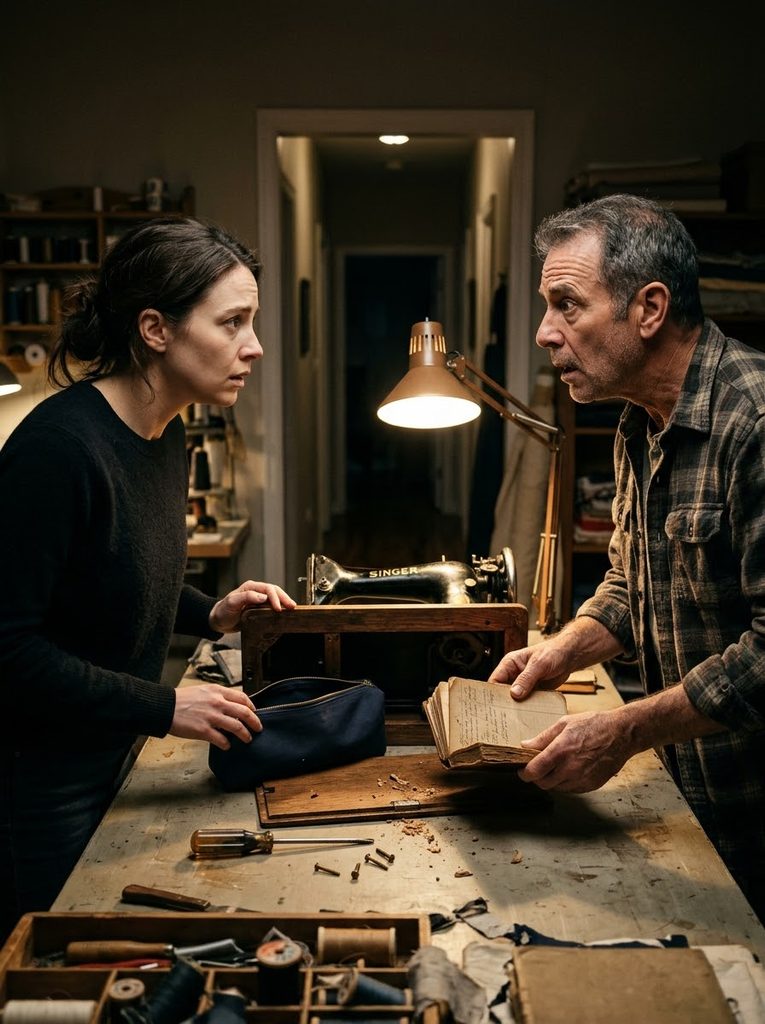
“Look here,” Sal said. He pointed the tip of his screwdriver at the underside of the base. There were eight screws holding a thick, secondary piece of wood to the bottom. Six of the screws were flat-head iron, rusted black with decades of age. But the remaining two, located at the far corners, were bright, unblemished brass. Phillips head. Much, much newer than anything else on the machine.
“Someone’s been in here recently,” Sal murmured.
He fit his screwdriver into the first brass screw. As he turned it, I noticed his hands. They were shaking. Sal Benedetto, a man whose hands possessed the microscopic precision required to calibrate tension springs, was trembling violently. He backed out the first screw, then the second. He set them gently on the towel.
With a soft, sickening slide, a thin panel of oak slipped sideways.
A hidden cavity opened underneath. It was a false bottom, exactly three inches deep and running the entire length of the heavy wooden case.
Sal stared into the dark recess. Slowly, he reached in and pulled out a thick, navy-blue zippered bank bag. He set it on the table between us. His breathing was heavy now. He unzipped the bag. Inside lay a green spiral-bound notebook, a thick stack of folded papers, and a sealed envelope.
Sal opened the notebook to the first page. His eyes scanned the ink. He swallowed hard, turned to the second page, and read again.
Suddenly, Sal slammed the notebook shut. He dropped it back into the bag, took one step back from my kitchen table, and set his screwdriver down with a sharp clack.
He looked me dead in the eye, his face pale beneath his olive complexion.
“Lock the front door,” he commanded.
I stared at him, my heart hammering against my ribs. “Sal, what—”
“Go lock the damn door, Kate.”
I moved mechanically, turning the deadbolt on my apartment door and sliding the chain into place. When I turned back, Sal was standing in the doorway leading to my tiny living room, keeping his distance from the table as if the bank bag were a live explosive.
“Kate,” he said, his voice trembling so badly it cracked. “Do not tell them. Do not tell your Aunt Pat. Do not tell your cousins. Do not breathe a word to a single living soul in that family.”
He stopped, pressing a hand to his chest, trying to catch his breath. The silence in the room was deafening. I waited for what felt like an eternity.
“There’s a ledger in there,” Sal finally whispered, pointing a shaking finger at the blue bag. “And your aunt’s name… her name is written on every single line of the last twelve pages.”
My blood ran cold. The memory of Pat in the icy parking lot, desperately offering me two and a half thousand dollars for a broken sewing machine, flashed through my mind. As I stepped toward the table and reached for the blue canvas zipper, the true weight of my inheritance finally settled upon me.
Chapter 3: The Anatomy of a Betrayal
I opened the blue bank bag. The air in my apartment felt heavy, suffocating. The bag contained five distinct items, stacked with the meticulous, OCD-like precision that defined my grandmother’s entire existence.
On top lay the green spiral notebook. The cover was worn at the edges. I flipped it open. The pages were filled with my grandmother’s unmistakable handwriting—a slanted, looping blue script, the exact same handwriting that graced thousands of alteration tickets over the decades.
The first entry on the new pages was dated December 4th, 2023. It was right around the time Grandma had fallen on the ice and shattered her hip.
“Pat says the checkbook is easier with her,” the entry read. Beneath it, in a slightly shakier hand: “$6,000 to Draper Building LLC. Not my signature.”
I felt the floor drop out from under me. Draper Building LLC was Uncle Dennis’s failing contracting company.
I flipped through the pages. The last entry was dated January 29th, just weeks before her death. Between that first date and the last sat thirty-one separate transfers. Grandma hadn’t just listed them; she had acted as her own forensic accountant. Each line contained a date, an exact dollar amount, and a ten-digit confirmation number she had painstakingly copied down.
At the bottom of the final page, she had drawn a neat, heavily inked box around the total sum of the stolen money.
$214,380.
My knees went weak. Two hundred and fourteen thousand dollars. It was nearly her entire life savings.
Underneath the ledger sat the proof. It was a thick stack of photocopied bank statements, ordered by month. Every single fraudulent transfer was circled in heavy graphite pencil.
My hands were shaking now, mirroring Sal’s. I moved the statements aside and pulled out the third item. It was a document bearing the heavy, raised seal of the county recorder’s office. A certified copy of a property deed.
The deed was recorded in late November 2023. It transferred the ownership of 41 Calder Street—the brick building that housed the tailor shop on the ground floor and Grandma’s apartment on the second—from Edith Hollis to Patricia Draper.
The sale price listed on the official document was $1.00.
Stuck to the center of the deed was a yellow Post-it note. The ink was pressed so hard into the paper it had nearly torn through.
“Signed by Pat under the Power of Attorney I gave her for my hip surgery. Pat did not ask me. She stole my home.”
Bile rose in my throat. The image of Pat, weeping beautifully at the funeral, accepting condolences from the community, made me physically sick. She had plundered the estate while Grandma was lying in a hospital bed, doped up on morphine.
Next was a two-page document, bound by a blue legal cover. It was a codicil—a legal addition to a will. Grandma had typed this one herself on her old Smith Corona. It was dated February 9th. It was fully signed, and crucially, stamped by a notary public at her local credit union, witnessed by two bank tellers.
The legal jargon was thick, but the intent was crystal clear. It explicitly stated that the deed transfer to Patricia Draper was executed without Edith’s knowledge, consent, or sound mind. Furthermore, it revoked any prior claims and left 41 Calder Street, in its entirety, to me.
At the very bottom of the bag lay a standard white envelope. My name, Kate, was written across the front.
I tore it open.
“Kate, my sweet girl. If you are reading this, the four of them got their $90,000. I wanted them to have it. Let them be bought off. But your Aunt Pat has been taking money from me since December. I could not prove it to myself until I sat down and counted, so I counted. I did not take this to Gerald Whitlock. Whitlock has handled Dennis’s sleazy business closings for fifteen years, and I knew the coward would bury this to protect them. I left you the machine because I knew you would keep it, and I knew Pat would sell it.
You are a Hollis, Kate. You have Walter’s spine and my hands. Take everything in this bag to a lawyer who has never met a single member of our family. And then, my girl, finish it.
Love, Grandma.”
I stood at my kitchen counter, tears finally spilling over my eyelashes, splashing onto the cold linoleum. Sal remained by the doorway, a silent sentinel, refusing to intrude on the sacred, devastating moment.
When I finally wiped my face, the grief was gone. In its place was something cold, hard, and terrifyingly sharp. A fault line had cracked open in my chest, and out poured a fury I never knew I possessed.
I set the letter down beside the toaster. I picked up the bank statements, and, line by line, I counted the transfers myself.
I got exactly thirty-one.
I looked up at Sal. His eyes held a mixture of fear and profound respect.
“Will you help me carry this down to my car tomorrow morning?” I asked, my voice devoid of any tremor.
“Where are we going?” Sal asked.
“To the bank. And then to war.”
Chapter 4: Forging the Arsenal
The morning of March 24th was a gray, biting Thursday. Sal met me outside my apartment at 8:00 AM sharp. We drove in silence to my credit union. We rented a safe deposit box, placing the original ledger, the deed, the codicil, and the bank statements into the cool, dark steel. I kept high-resolution photographs of every single page backed up on my phone and in the cloud.
When we walked back out to the parking lot, I tried to hand Sal a fifty-dollar bill for the emergency house call and his time this morning.
He pushed my hand away, his expression fierce. “Your grandmother paid me forty dollars a visit, every year, for thirty-nine years,” he growled. “She always offered me lunch, too. Keep your money, Kate. You’re going to need it to pay for the bloodhound.”
The ‘bloodhound’ Sal referred to was Priya Raman. She was a viciously smart, fiercely independent probate litigation attorney whom Sal’s niece had hired a few years back during a nasty dispute over her own father’s estate. Priya operated out of a sleek, minimalist office in a repurposed warehouse downtown.
On March 26th, I sat across from her glass desk. Priya was in her early forties, with piercing dark eyes and a demeanor that suggested she suffered exactly zero fools.
She read Grandma’s codicil twice. She didn’t blink. Then, she scrolled through the photographs of the ledger and the bank statements on the tablet I handed her. The silence stretched for ten minutes.
Finally, she set the tablet down and folded her hands.
“Your grandmother was a terrifyingly meticulous woman, Ms. Hollis,” Priya said, the corner of her mouth twitching upward in a predatory smile. “She essentially built a federal fraud case from a sewing table.”
“Is it enough?” I asked, my voice tight. “Pat’s attorney is Gerald Whitlock. He’s connected. He’s been doing this for forty years.”
Priya scoffed. “Whitlock is a dinosaur who survives on golf course handshakes. I eat dinosaurs for breakfast. But before we strike, I need to see the entire battlefield.”
Right there in front of me, she logged into the county recorder’s database and ordered the complete property file on 41 Calder Street.
“We wait,” Priya commanded. “Do not answer calls from your aunt. If she texts, you screenshot it and send it to me. Give them nothing.”
The county file arrived four agonizing days later. Priya called me into her office immediately. When I walked in, she didn’t look triumphant; she looked deeply disturbed. She had uncovered a layer of betrayal so deep, even my grandmother hadn’t known about it.
“Look at this,” Priya said, spinning her monitor toward me.
It was a mortgage document.
“Eleven days after your aunt fraudulently transferred the deed to herself,” Priya explained, her finger tapping the screen, “she used the building as collateral. She took out a one hundred and forty thousand dollar commercial mortgage against 41 Calder Street.”
“Where did the money go?” I whispered, feeling dizzy.
“I subpoenaed the wire routing,” Priya replied. “It went straight into the corporate accounts of Draper Building LLC. I did some digging into your Uncle Dennis. His company was drowning. They owed a major lumber supplier just over $188,000 since the fall of 2023. The supplier was preparing to sue them into bankruptcy.”
I did the math in my head, the numbers echoing like gunshots. Between the mortgage fraud and the thirty-one cash transfers, Pat and Dennis had siphoned $354,380 out of my grandmother’s life. They hadn’t just stolen her money; they had mortgaged her legacy to save their own incompetent skins.
On April 2nd, the trap finally sprang. My phone vibrated on my cutting table at the theater. The caller ID flashed Aunt Pat.
I let it ring three times before hitting accept. I hit the record button on a secondary app Priya had told me to install.
“Hello?”
“Kate, honey! It’s Pat.” Her voice was dripping with synthetic maple syrup. It started warm, casual, as if we were just catching up.
“Hi, Pat.”
“Listen, sweetheart, I know emotions were running high at the reading. Mom was sick for a long time, and she told me to handle things for her. I want you to know, everything I did was to protect her. Every dollar Dennis and I took was a loan. Just a short-term loan. Dennis was going to repay the estate the second his business turned around this spring.”
A loan. I bit the inside of my cheek until I tasted copper. I said absolutely nothing. Silence is the best interrogator.
My silence made her nervous. “Anyway,” Pat stammered, recovering her authoritative tone. “Dennis and I were talking, and we really feel terrible about you hauling that massive junker of a sewing machine around. I’ll offer you four thousand for it. Today.”
I let the silence hang for five seconds.
“Kate? Are you there?”
“I’m here,” I said flatly.
“Okay, look,” Pat sighed, her voice turning desperate. “Nine thousand, five hundred dollars. I can wire it to you in ten minutes.”
I waited another five seconds. I could hear her breathing raggedly into the receiver.
“Fifteen thousand!” she barked, losing her composure entirely. “Fifteen thousand dollars for the goddamn Singer, Kate! Just bring it to my house right now!”
I smiled, a cold, humorless expression. “Why are you so desperate for a piece of junk, Pat?”
She hesitated. And in that hesitation, she sealed her fate.
“Mom kept a green notebook,” Pat blurted out, her voice dropping to a frantic whisper. “I watched her put it inside the base of that sewing case back in January when she thought I was sleeping. If it’s in there, Kate, it is private family business. It belongs with the family, not with outsiders.”
Gotcha.
“If it’s family business, Pat,” I said smoothly, “you should probably discuss it with my lawyer.”
“Your what?”
“I’m texting you Priya Raman’s office number. Do not contact me again.”
I hung up the phone. My hands were shaking, but this time, it was from the sheer adrenaline of the strike. I forwarded the recording to Priya immediately.
Three minutes later, Priya texted back: “Checkmate in three moves. Sleep well, Kate.
Chapter 5: The Web of Deceit
The backlash was swift and legally violent. Five days after my phone call with Pat, a certified letter arrived at my apartment. It was printed on the heavy, embossed letterhead of Gerald Whitlock.
He was writing on behalf of Patricia Draper, “duly appointed Executor of the Estate of Edith Hollis.” The letter was a masterpiece of legal intimidation. It demanded that I immediately deliver the Singer sewing machine to Whitlock’s office so it could be “properly appraised and inventoried for estate tax purposes.” It threatened police involvement for theft of estate property if I failed to comply within forty-eight hours.
I took it straight to Priya. She barely glanced at it before dropping it into her shredder.
“Cute,” she remarked.
Priya’s response to Whitlock was drafted and sent within the hour. It consisted of a single, devastatingly brief paragraph:
“Dear Mr. Whitlock: The Singer sewing machine was a specific, named gift devised to my client under the terms of the Will you drafted. Title passed upon death. It is her property, it resides in her domicile, and it is staying exactly where it is. If your client wishes to inspect it, she may petition the court for a warrant she will never receive. Govern yourself accordingly.”
For a week, the silence from the family was total. I had been excommunicated. But the isolation was merely the calm before the storm.
On April 14th, Priya went on the offensive. She filed three simultaneous explosive requests with the St. Louis County Probate Court:
- A petition to void the quitclaim deed to 41 Calder Street due to fraud and elder abuse.
- A petition for the immediate removal of Patricia Draper as Executor of the Estate for breach of fiduciary duty.
- A petition to accept the February 9th Codicil into probate.
The court clerk scheduled the evidentiary hearing for June 10th. We had two months to prepare for war.
During those two months, I threw myself into my work at the theater, stitching bodices and hemming cloaks until my fingers bled, trying to drown out the anxiety. But the family drama refused to stay outside my door.
On the evening of June 2nd, the buzzer to my apartment rang. I looked through the peephole and froze. It was Lena, Uncle Gordon’s daughter. We hadn’t exchanged a single word since the suffocating silence of the will reading. Lena was twenty-six, quiet, and spent most of her life covered in animal hair from her job as a vet tech. She always seemed terrified of her own shadow.
I unchained the door cautiously. “Lena? What are you doing here?”
She looked over her shoulder, as if expecting Pat to jump out of the hallway shadows. “Can I come in, Kate? Please?”
I opened the door wider. She stepped inside, clutching her smartphone with both hands, her knuckles white. She sat awkwardly on the edge of my couch, refusing to take her coat off.
“I want you to know,” Lena started, staring at her knees, “I didn’t laugh at the reading. When Brooke and Tanner were acting like hyenas… I didn’t join in.”
“I know you didn’t, Lena. But you didn’t say anything to stop them, either.”
She nodded, tears welling in her eyes. “I know. I’ve always been a coward. Pat terrifies me. My dad is terrified of her. But… I’m saying something now.”
She looked up, her expression suddenly fierce, and handed me her phone. The screen was open to a group text message.
It was a chat thread titled “Hollis Grandkids.” The sender was Pat. The timestamp was March 21st, exactly twelve minutes past 4:00 PM. That was barely an hour after we had walked out of Whitlock’s office.
The text read:
“Listen to me, all of you. Whoever sees Kate first, find out if she has opened up the wooden base of that Singer. Mom kept her green notebook hidden in it. We need that book before Kate reads it. Do not mention a word of this to Gordon. Delete this text immediately.”
I stared at the glowing screen. It was the smoking gun. It proved premeditated knowledge, conspiracy, and intent to conceal.
“Lena,” I breathed, looking at my younger cousin. “Why are you giving this to me?”
“Because Grandma loved that shop more than she loved any of us,” Lena said, her voice shaking but resolute. “And because what Pat is doing is evil. I already sent a screenshot of this to that lawyer of yours this morning. She told me to come over here and make sure you were okay.”
I sat down next to her on the couch and pulled her into a hug. For the first time since my grandmother died, I didn’t feel entirely alone.
Chapter 6: The Scales of Justice
Wednesday, June 10th. The St. Louis County Courthouse smelled of floor wax and anxious sweat. The air conditioning was cranked to a glacial setting, but I was sweating through my blazer.
We were in Courtroom 4B, before Judge Annika Soderberg, a woman with iron-gray hair and a reputation for zero tolerance when it came to elder exploitation.
Aunt Pat sat at the respondent’s table, looking immaculate in a navy blue St. John knit suit. Uncle Dennis sat behind her in the gallery, gnawing on his fingernails.
Notably absent was Gerald Whitlock. Once Priya had filed the motions outlining the $140,000 mortgage that had miraculously saved Dennis’s business—a business Whitlock represented—Priya had sent him a polite email suggesting he withdraw due to a massive conflict of interest, lest she report him to the state ethics board. Whitlock had scurried away like a rat in the daylight.
In his place, Pat had hired a high-priced litigator from the Twin Cities named Calloway. He was slick, wore a suit that cost more than my car, and possessed the oily confidence of a man used to bullying his way to a settlement.
Calloway opened the proceedings aggressively. His entire strategy rested on character assassination. He painted my grandmother as a confused, rapidly declining woman who had spent her final year hallucinating betrayals.
“Your Honor,” Calloway boomed, gesturing dramatically. “Edith Hollis was eighty-seven. She was on heavy pain medication for a shattered hip. The ‘ledger’ the petitioner presents is nothing more than the paranoid scribblings of a woman losing her grip on reality. Patricia Draper stepped in as a dutiful daughter to save the properties from tax default and manage a complicated financial situation. She signed the deed to protect the asset, as allowed by her Power of Attorney.”
When it was Priya’s turn, she didn’t grandstand. She simply stood up, approached the bench, and handed Judge Soderberg the thick stack of photocopied bank statements.
“Your Honor, if the ledger is a hallucination,” Priya said calmly, “then the bank was hallucinating as well.”
Judge Soderberg put on her reading glasses. She laid the bank statements beside the original green notebook. For forty-five excruciating minutes, the courtroom was dead silent, save for the rustle of paper. The judge checked the entries, one at a time, moving her finger from the ledger to the official bank document.
“Counsel,” Judge Soderberg finally said, peering over her glasses at Calloway. “All thirty-one lines match the bank’s wire transfer figures. Down to the absolute cent. Furthermore, the confirmation numbers match.”
Calloway swallowed hard. “Be that as it may, Your Honor, my client had legal authority—”
Priya cut him off by entering her next exhibit. “Your Honor, I present a chart note from Dr. Amara Lindquist, Edith Hollis’s primary care physician. It is dated February 2nd. Just seven days before Edith typed and signed her codicil, and weeks after the alleged ‘confusion’ began. Dr. Lindquist administered a standard Montreal Cognitive Assessment. Edith Hollis scored a twenty-nine out of thirty. She possessed the cognitive function of a woman twenty years her junior.”
Calloway tried to object, but Soderberg waved him down. The trap was closing.
Then, Priya called Pat to the stand.
Pat walked up, her heels clicking loudly. She swore on the Bible, her chin held high, playing the victim perfectly.
Priya approached the podium. She was a sniper locking onto her target.
“Mrs. Draper, did your mother ever personally sign the deed transferring 41 Calder Street to you?”
“No,” Pat said, her voice steady. “I signed it under the Power of Attorney she gave me, to protect her.”
“Did your mother instruct you to do this?”
“Yes. She knew about the loan Dennis needed. She wanted to help.”
“I see,” Priya said, tapping a pen against her chin. “And where, exactly, did she write down this desire to gift you her home and two hundred thousand dollars in cash?”
Pat gripped the edges of the witness stand. “We discussed it privately. She didn’t write it down. Mom hated paperwork.”
Priya smiled. It was a terrifying sight. She turned and walked back to her table, picking up a printed sheet of paper. She walked back and handed it to Pat, and a copy to the judge.
It was Lena’s screenshot.
“Mrs. Draper,” Priya’s voice cracked like a whip. “On March 21st, exactly twelve minutes after your mother’s will was read, you sent this text message to four of your nieces and nephews, ordering them to find out if Kate had opened the sewing machine. You explicitly stated your mother had hidden a notebook there.”
Pat stared at the paper. The color drained from her face completely. She looked like a ghost.
“Mrs. Draper,” Priya leaned in, her voice dropping to a lethal purr. “If your mother ‘hated paperwork,’ and if these transfers were all consensual ‘loans,’ what exactly were you expecting to find inside that notebook?”
Pat’s mouth opened, but no sound came out. She looked out into the gallery, desperate. She looked at Dennis. He was staring at the floor, refusing to meet her eye. She looked at her hotshot lawyer, Calloway, who was suddenly very interested in his legal pad.
“I need an answer for the record, Mrs. Draper,” Priya demanded. “What did you know was in that book?”
It took Pat nine agonizing seconds to break. When she did, she deflated, her shoulders slumping, the veneer of the wealthy matriarch shattering into a million pieces.
“My mother’s notes,” Pat whispered, tears of profound humiliation finally spilling down her cheeks. “About the money.”
Chapter 7: The Final Judgment
Judge Soderberg did not deliberate long. On June 29th, a courier delivered her written order to Priya’s office. It ran nine pages long, and it was a total, unmitigated slaughter.
Reading the legal terminology was like drinking a glass of fine, cold champagne.
The judge voided the fraudulent deed to 41 Calder Street instantly, reverting ownership to the estate. She ordered Patricia Draper to repay the stolen $214,380 in full. Furthermore, she gave Pat a strict ninety-day deadline to personally pay off the $140,000 commercial mortgage she had illegally leveraged against the building.
Pat was formally stripped of her title as Executor, replaced by Uncle Gordon, who had spent the last month apologizing to me profusely via email. Finally, the judge accepted Grandma’s codicil, cementing my ownership of the building, and ordered Pat to pay $31,500 to cover my attorney fees.
The empire Aunt Pat had tried to steal collapsed under its own weight.
To meet the court’s ninety-day deadline and avoid criminal referral for embezzlement, Pat had to liquidate her life. In August, she fire-sold her beloved luxury lake cabin on Island Lake for $265,000. It wasn’t enough to cover the stolen cash, the mortgage payoff, and the legal fees, so she was forced to take out a massive second mortgage against her own primary residence.
On September 12th, Priya called to tell me the Calder Street mortgage had cleared. The building was officially free, clear, and solely in my name.
Later that same week, Uncle Dennis filed for bankruptcy and dissolved Draper Building LLC forever. The golden branch of the family tree had been pruned to the stump.
Brooke and Tanner, having successfully collected their $90,000 inheritances without lifting a finger to help their mother or me, took their money and vanished. Neither of them has spoken a word to me since the day of the hearing. I consider it the best purchase my grandmother ever made. She bought them out of my life for ninety grand apiece.
Lena and Wes, however, remained. The trauma of the trial had fractured the family, but it allowed a new foundation to be poured. On the first Sunday of every month, the three of us meet for lunch at a little diner downtown. We don’t talk about Pat. We talk about our jobs, our lives, and the memories of Grandma that aren’t tainted by greed.
Chapter 8: The Thread Continues
The crisp chill of October had just begun to bite the air when I walked up to the heavy oak door of 41 Calder Street. I slid the brass key into the lock and turned it. The mechanism clicked with a satisfying, heavy thud.
I pushed the door open.
The air inside still smelled faintly of wool and old steam. I had spent the last three weeks cleaning, painting, and restoring the space. On October 1st, I officially reopened the doors of Hollis Alterations. I wasn’t just a theater seamstress anymore; I was a proprietor.
Later that afternoon, Sal Benedetto stopped by. He didn’t bring his tool roll this time. He brought a ladder and a drill. Together, we rehung the antique brass bell over the front door—the same bell that had chimed for forty-four years whenever a customer walked in.
“Sounds good, kid,” Sal grunted, stepping down from the ladder and wiping his hands on his jeans.
“Thanks to you, Sal,” I said, handing him a cup of coffee.
I walked past the front counter—the beautifully carved oak counter my grandfather Walter had built—and headed to the back room.
There, sitting in the center of the massive cutting table, was the heavy, cast-iron Singer. It looked majestic.
I ran my hand over the cold metal of the handwheel, then traced the edge of the custom wooden base. The hidden compartment underneath it was empty now. The ledger, the deed, and the codicil were locked safely in my bank vault. Today, that secret cavity holds nothing more sinister than my spare bobbins and a pack of titanium needles.
I stood there for a long time, looking out the back window at the falling autumn leaves. My grandmother had spent twenty-five agonizing months in this room, her body failing her, writing down numbers in a spiral notebook while the family she raised decided she was too old, too blind, and too confused to notice them picking her bones clean. She had fought her final battle with a ballpoint pen and a sharp mind.
I carry that lesson with me now. On the first day of every single month, before I thread a needle or cut a yard of fabric, I sit at this table. I open my laptop, log into my accounts, and I check my bank statements. Line by excruciating line.
The brass bell over the door chimed, pulling me from my thoughts.
I walked out to the front counter. An older woman was standing there, holding a pair of heavy wool trousers over her arm.
“Hello,” she smiled warmly. “I’m Mrs. Anders. The sign in the window said you were open?”
“We are,” I smiled back, feeling a profound sense of peace settle over my shoulders. “How can I help you, Mrs. Anders?”
“Just a simple hem on these trousers,” she said, laying them on the oak counter.
I reached beneath the desk and pulled out a pad of alteration tickets. It was Grandma’s old pad. I smoothed out the top sheet, grabbed a pen, and began to write.
Mrs. Anders. One pair of trousers. Hemmed. $18.00.
I pressed hard on the pen. When I tore the top white ticket off to hand to her, I glanced at the yellow sheet beneath it.
The carbon copy still worked perfectly. Some things, if built right, are designed to last forever.