Chapter 1: The Edge of the Landing
Up until the crisp autumn afternoon my mother shoved my eight-year-old daughter down a flight of hardwood stairs, I genuinely believed I comprehended the boundary between a complicated family and a lethal one. My name is Claire Bennett. I am thirty-five years old, and for exactly thirty-five years, I had navigated the treacherous, invisible tripwires of my mother’s affection. But in a single, breathless fraction of a second, the illusion of safety shattered.
Lucy lay motionless at the bottom of the staircase, her cheek pressed flat against the polished oak floorboards. One of her bright yellow socks had twisted sickeningly around her heel. She wasn’t wailing. She was just staring up at me, her wide, terrified eyes entirely devoid of tears. That profound, unnatural silence frightened me more viscerally than any bloodcurdling scream ever could have.
“Mommy, my neck hurts,” she whispered, her voice barely a thread. “I can’t make my legs move.”
A cold dread coiled in my gut. My hands trembling, I yanked my phone from my back pocket. Before my thumb could even graze the screen to unlock it, my mother, Evelyn Mercer, clamped her manicured fingers around my wrist. Her grip was like a steel vise.
“Don’t you dare,” Evelyn hissed, her voice a low, venomous vibration. “You tell them she fell. She lost her balance.”
I stared at the white indentations her nails were pressing into my skin. Behind her, the upstairs landing gaped empty. Only heartbeats prior, I had been standing in the hallway. I had watched with my own two eyes as Evelyn planted both of her hands squarely against Lucy’s small shoulders and shoved.
“Let go of me,” I commanded, my voice dropping to an unfamiliar, guttural register.
“You’re being hysterical, Claire. You are going to ruin absolutely everything over an accident.”
From the bottom of the steps, Lucy emitted a tiny, whimpering sound. She was attempting to crane her neck to look up at us.
“Don’t move, baby!” I shouted down to her. “Keep your head perfectly still!” Through my administrative work at a local physical rehabilitation clinic, I had absorbed enough medical osmosis to know that potential cervical and spinal injuries required absolute immobility until the paramedics arrived. Knowing that clinical fact did absolutely nothing to quell the suffocating, terror-laced thought that my little girl might never walk again.
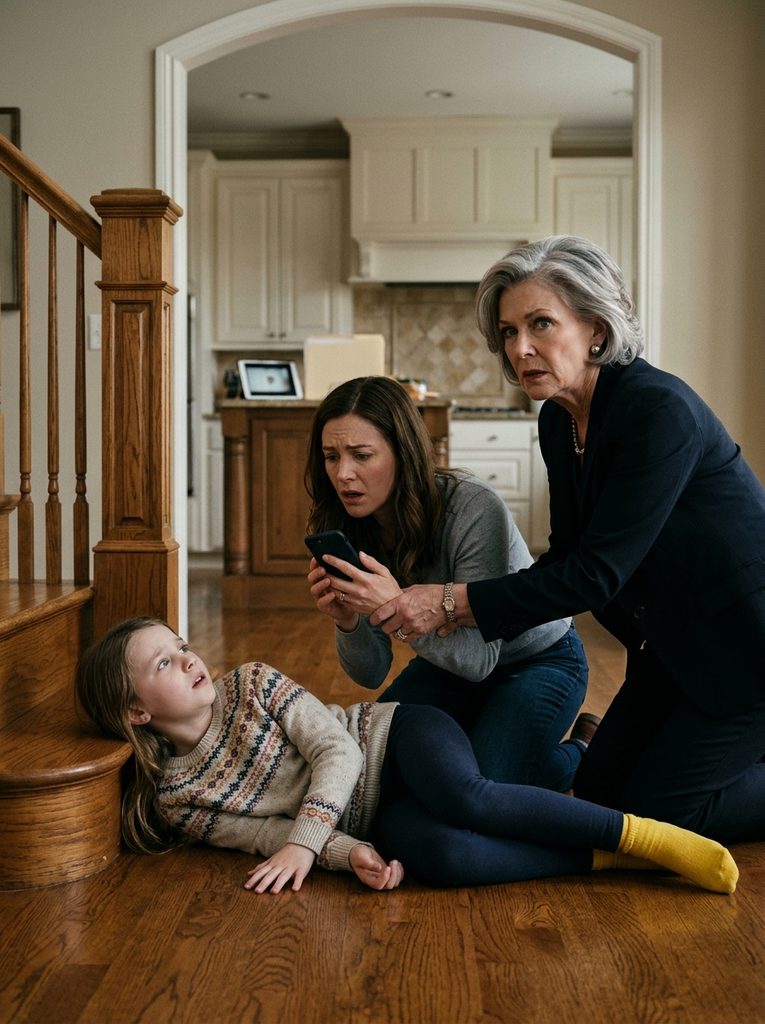
“Grandma,” Lucy whimpered, her voice echoing in the stifling quiet.
Evelyn peered down over the banister. In a display of psychological elasticity that made my stomach churn, her features instantly rearranged themselves into a mask of tender, grandmotherly concern. “Sweetheart, it was just a clumsy accident.”
“I recorded what you did,” Lucy said, her small voice piercing the heavy air. “Before you pushed me.”
The room seemed to violently inhale all its oxygen. Evelyn’s fingers tightened on my wrist, then went entirely slack. Her gaze flicked imperceptibly toward the kitchen, where Lucy’s battered tablet had been left resting on the countertop. It was a micro-expression, a twitch of the eye that a stranger would have dismissed. But I wasn’t a stranger. I was a daughter who had spent three and a half decades translating the tectonic shifts in her mother’s face to anticipate the next disaster.
That glance birthed a second, equally horrifying question beneath the first: Not only what had Evelyn just done to my child, but what on earth had my eight-year-old captured on film that terrified a sixty-year-old woman enough to commit violence?
To comprehend how we arrived at the precipice of that staircase, one must rewind to the morning prior. It was a Saturday in Bellweather, Pennsylvania—the sort of luminous October morning where the changing maples burned brighter than the suburban rooftops beneath them. Back then, the most severe conflict I anticipated having with Evelyn was debating whether Lucy required an extra cardigan.
Lucy had been sitting cross-legged on the linoleum of our rented duplex, painstakingly applying a sparkly sticker to the rubber casing of her tablet. She had recently decreed that the short videos she filmed required grand titles, akin to historical documentaries.
“Do you think Grandma will let me film her making the cookies?” Lucy had asked, peering up through her bangs.
“You’ll have to ask her first, bug. I always ask.”
“I know,” Lucy sighed, summoning the wounded dignity unique to third-graders. “You say it like I don’t.”
I had knelt beside her, smoothing the sticker’s peeling edge. “You’re right. I should have said Grandma prefers being asked before anyone does anything in her house.” I forced a laugh. It was a hollow sound because it was the absolute truth. Evelyn’s kitchen towels were mandated to hang with the seams facing inward. Footwear belonged in rigid, symmetrical rows. A question posed twice was deemed an act of defiance.
When Evelyn had called that morning to demand we arrive at precisely 1:00 PM for baking, she had added a sharp addendum: “Tell her not to bring that electronic nuisance to the table. I won’t have screens while we’re baking. Some things should remain private.”
I had merely translated my mother’s authoritarian edict into softer, palatable words for my daughter, calling it “keeping the peace.” It was a lifelong habit of cowardice.
The baking itself had commenced pleasantly enough in Evelyn’s immaculate, lemon-scented kitchen. Lucy filmed the flour cascading into the mixing bowl, then set the tablet aside, propped against a sugar tin, to measure out the granulated sugar. When the dough needed chilling, Evelyn contrived a chore for me, sending me upstairs to fetch an old box of linens. Halfway up, she yelled that she would get it herself later.
When I returned to the kitchen, I saw Evelyn hunched over the counter. Beside the worn, plastic-sleeved recipe card belonging to my late grandmother was a pale, Manila folder. Lucy’s tablet was still propped up, its camera lens pointing directly at the paper. Evelyn snapped the folder shut the instant my shadow fell across the room.
“Something wrong?” I asked.
“Nothing that concerns you,” she snapped. It was her signature phrase for end of discussion.
Lucy reached for her tablet. Evelyn snatched the folder further away.
“Can I see the old drawing of Grandpa’s house?” Lucy asked innocently. “The one on the paper?”
Evelyn went rigid. “That is grown-up business. Put that device away.”
“I’m saving the video,” Lucy said, pressing a button on the screen.
I turned my back to rinse the mixing bowl, the roar of the tap drowning out their ensuing whispers. By the time I shut the water off, Lucy was backing out of the kitchen, clutching the tablet to her chest like a shield. Evelyn was advancing on her.
“Give me that,” Evelyn demanded.
“You can’t make me delete it! It’s mine!” Lucy yelled, turning and fleeing toward the hallway stairs.
I wiped my hands on a towel, irritated but not panicked, assuming I was about to mediate a trivial squabble over a toy. But as I rounded the corner to the upper landing, I saw Evelyn cornering my daughter at the top step. I opened my mouth to shout a warning about the steep drop.
Evelyn lunged. She seized Lucy’s shoulder. Lucy shrieked, pivoting to keep the tablet out of reach. In a flash of raw, unfiltered desperation, Evelyn thrust both of her palms forward.
The sound of my daughter’s small body striking the wooden risers—a sickening, rhythmic thudding—would echo in my nightmares forever.
Now, kneeling beside Lucy in the agonizing present, I ripped my arm free from Evelyn’s grasp. “I’m calling 911.”
I dialed the numbers, my voice fracturing as I gave the dispatcher the address. “My daughter fell down a staircase. She can’t feel her legs. My mother pushed her. I saw it happen.”
The dispatcher’s voice remained a beacon of clinical calm, instructing me not to move her. As I sat on the floor, keeping my eyes locked on Lucy’s terrified face, I caught movement in my peripheral vision.
Evelyn was silently stalking toward the kitchen. Toward the tablet.
“Don’t you dare touch her things,” I snarled, my voice echoing off the foyer walls.
Evelyn froze. “You think I would destroy a child’s toy?”
“I don’t know what you’re capable of anymore.”
Sirens began to wail in the distance, growing louder as they pierced the quiet suburban street. As the heavy front door swung open and paramedics rushed in with their heavy equipment bags, a uniformed police officer stepped over the threshold right behind them.
Evelyn immediately smoothed her cardigan, her posture shifting from a panicked aggressor to the poised, respectable matriarch. But as the paramedics swarmed my daughter, I watched the police officer’s eyes scan the room. He didn’t look at Evelyn, and he didn’t look at me. His gaze bypassed us entirely, locking dead onto the kitchen counter where the little tablet sat blinking, the very device my mother was still secretly inching her way toward.
Chapter 2: The Architecture of Fear
The interior of the ambulance smelled of rubbing alcohol and sterile plastic. I sat rigidly on the vinyl jump seat, my eyes fixed on Lucy. A massive cervical collar engulfed her small neck, and she was strapped tightly to a backboard.
“Is the ceiling supposed to be moving, Mom?” she whispered, her eyes darting nervously around the brightly lit rig.
“We’re in the ambulance, baby. The truck is moving, not the ceiling.”
“Are my legs asleep? They feel fuzzy.”
I swallowed the massive lump of bile and terror in my throat. “The doctors are going to figure all of that out when we get to the hospital. I’m right here. I’m not going anywhere.”
“Even if Grandma gets mad?” she asked, her voice cracking.
“Especially then,” I promised, reaching out to graze her knuckles without disturbing the web of IV lines the paramedic had initiated.
The arrival at the emergency room was a blur of automatic doors, shouting nurses, and a barrage of rapid-fire questions. Any allergies? Did she lose consciousness? Can she wiggle her toes? I answered until the words bled together, my voice robotic. When a triage nurse gently touched my arm and asked if there was another parent to contact, my hands were vibrating so violently I dropped my phone. She had to dial the number for me.
Daniel, my ex-husband, answered on the third ring.
“Daniel,” I stammered, stepping into the sterile hallway. “Lucy is at the trauma center. She had a fall at my mother’s house. It’s her neck and her spine… she can’t move her legs.”
There was a hollow, agonizing silence on the line. “Is she conscious?”
“Yes.”
“I’m leaving work now.”
“Daniel, wait,” I choked out, leaning my forehead against the cool cinderblock wall. “My mother pushed her. She shoved her down the stairs.”
The silence that followed was longer this time, thick with a dark, impending storm. When Daniel finally spoke, his voice was chillingly constrained, vibrating with an immense effort to remain calm. “Tell the doctors absolutely everything. Do not cover for that woman. I am on my way.”
Our marriage had dissolved three years ago, a casualty of our inability to stop weaponizing our financial anxieties against one another. Daniel had always despised Evelyn. He used to say that my mother offered you a lifeline with one hand while holding a ledger of debts in the other. Back then, heavily dependent on Evelyn’s financial assistance for our deposit, I had aggressively accused him of being ungrateful. I hadn’t known how to hold two conflicting truths simultaneously: that my mother loved me, and that she was a tyrant.
I sat in a plastic chair outside the imaging rooms while the trauma team worked on Lucy. My phone buzzed in my pocket. The screen illuminated with three missed calls from Evelyn, followed by a text message: “Claire, we need to discuss what you said to those paramedics before this gets entirely out of hand. You are distraught and misremembering.”
I stared at the glowing letters. My child was currently inside a humming MRI machine, having her spinal cord evaluated for irreversible damage, and my mother was initiating a PR campaign to save her own reputation. For decades, I had treated Evelyn’s messages as royal decrees requiring immediate, groveling responses. This time, I powered the phone down and shoved it into my purse.
Twenty minutes later, the ER doors slid open and Daniel marched through. He was still wearing his navy blue municipal work jacket, a dark smudge of engine grease staining his left cuff. He looked terrified. He bypassed the nurses’ station and strode directly to me.
“Where is she?”
“Imaging,” I said, pointing down the corridor. “They haven’t given me the results yet.”
He dragged both of his calloused hands down his face, exhaling a ragged breath. He didn’t scream. He didn’t ask why the hell I had taken our daughter to Evelyn’s house. He just sank into the chair beside me, staring a hole into the linoleum floor.
“Tell me exactly what you saw,” he demanded softly.
I recounted the nightmare without softening the edges for his benefit, and without exaggerating it out of anger. I described the folder, the tablet, the raised voices, the landing, and the violent, intentional shove. I told him how Evelyn had physically restrained me from dialing 911.
Daniel stood up so fast his chair scraped violently against the floor. He paced to the water fountain, slammed his fist lightly against the wall, and paced back. “She actually tried to stop you from getting an ambulance?”
“She wanted me to say Lucy slipped.”
I could see the ghosts of our old arguments flickering in his eyes. The ‘I told you so’ was right there on his tongue. But he swallowed it. He looked at my tear-streaked face and seemed to realize that I was finally awake from the spell.
“Right now,” Daniel said, his voice dropping to a gravelly whisper, “we focus on what Lucy needs. We can deal with your mother later.”
The physician emerged shortly after, his face an unreadable mask of clinical professionalism. He explained that Lucy had sustained significant cervical trauma and severe nerve contusions, resulting in the temporary paralysis of her lower extremities. They were monitoring the swelling in her spinal column.
“Will she walk again?” Daniel asked, his voice cracking.
The doctor hesitated—a pause that shattered my heart into a thousand jagged pieces. “We are assessing her neurological responses hour by hour. It is too early to establish a definitive prognosis. Tell her that we are taking it seriously, and that you are here. Try not to make promises about her mobility that we can’t guarantee yet.”
When we were finally permitted to enter her recovery bay, Lucy looked impossibly fragile. The massive brace dwarfed her chin, and the rhythmic beeping of the cardiac monitor felt like a ticking clock.
“Daddy?” she rasped.
Daniel rushed to the bed, bending his knees so he was at her eye level without forcing her to move. “Hey, bug. I’m right here.”
“I didn’t mean to fall,” she whimpered, a single tear escaping her eye. “Grandma was so mad at me.”
Daniel’s jaw locked. He looked like he wanted to punch a hole through the hospital wall, but he forced a gentle smile. “You never have to apologize for getting hurt, Lucy. Ever.”
She blinked slowly, her gaze shifting to me. “Mom? Will Grandma be angry that I told the police she pushed me?”
I pulled a chair flush against the bed railing and took her tiny, uninjured hand. “Grandma’s feelings are not your job to manage anymore, Lucy. You tell the truth. Always.”
The words felt utterly alien in my mouth, like a foreign language I was speaking for the very first time. I only wished I had learned to speak it before it cost my daughter her legs.
As the nurses cycled in to check her vitals, a plainclothes detective appeared in the doorway, flashing a gold shield. It was the investigator assigned to the assault. He asked to speak to Daniel and me in the hallway. We stepped out, the heavy wooden door clicking shut behind us.
“Mr. and Mrs. Bennett,” the detective said, flipping open a small notepad. “We executed a preservation order on the scene. We secured the tablet your daughter was using.”
“Did you watch the video?” I asked, my heart hammering against my ribs. “Did it catch the push?”
The detective looked at me, a shadow of genuine pity crossing his hardened features. “We’re processing it now, ma’am. But there’s a complication. The file properties indicate that the video was tampered with before we arrived on the scene.”
Chapter 3: The Edited Truth
The word tampered echoed in the sterile corridor, a chilling reverberation that made my blood run cold.
“What do you mean, tampered with?” Daniel demanded, stepping in front of me as if to physically shield me from the detective’s words.
The investigator, a world-weary man named Mara Ellis—who I later learned was a specialist in domestic cases—sighed and adjusted her posture. “The digital timestamp on the video file indicates it was edited at 12:50 PM. That’s approximately ten minutes before the 911 call was placed. A portion of the footage has been trimmed out. Did you, or anyone else, alter that device after the incident?”
“No!” I said, my voice rising in panic. “I didn’t even touch it! I told the responding officer it was on the kitchen counter. Evelyn… my mother was moving toward it right before the ambulance arrived. I told her not to touch it.”
Mara scribbled something in her notebook. “We are sending the device to the cyber forensics lab to see if the missing data can be recovered. But as it stands, a defense attorney will argue that the footage has been manipulated to fit a narrative. We will need to rely heavily on your eyewitness testimony, Ms. Bennett, and the forensic analysis of your daughter’s injuries.”
I felt the floor tilt beneath me. Evelyn knew. She knew exactly how to weaponize doubt. I imagined a sleek, expensive lawyer holding up the tablet in a courtroom, painting me as a vindictive, unstable daughter who coached her child to frame her grandmother.
Later that afternoon, after Daniel had left to retrieve some pajamas and comfort items from our duplex, a hospital social worker named Naomi Price knocked softly on the doorframe. Naomi was a sharp-eyed, pragmatic woman who radiated an aura of unflappable competence. She didn’t begin with pity; she began with logistics.
“We need to discuss a safety protocol, Claire,” Naomi said as we sat in a cramped, windowless consultation room down the hall. “Given the nature of the allegations, your mother cannot have access to Lucy. But I need to ask—is there any avenue through which she might try to coerce you, or financially pressure you, into dropping these allegations?”
I looked down at my hands. The red crescent marks from Evelyn’s fingernails were still visible on my wrist. “She helped me secure the lease on my duplex,” I admitted, my voice thick with shame. “She paid the deposit after my divorce. She reminds me of it every time we disagree. It’s her ultimate trump card.”
Naomi nodded, her expression devoid of judgment. “Abusers frequently use financial entanglement as a leash. You need to prepare yourself, Claire. When the police inform her that she is under criminal investigation for child abuse, she will pull every string attached to you. You need to decide, right now, what your breaking point is.”
“I don’t have one,” I said. And to my utter shock, I realized I meant it.
Returning to Lucy’s bedside, I found her staring blankly at the ceiling. The heavy dose of pain medication made her eyes look glassy and unfocused.
“Mom?” she mumbled.
“I’m here, baby.”
“Did I do a bad thing by changing the movie?”
My heart stopped. I leaned in closer, brushing a stray lock of hair from her forehead. “What do you mean, Lucy? Did you change the video of Grandma?”
She blinked slowly. “I used the scissors button. To cut it. Grandma says you shouldn’t change the truth, but it was just so boring. Nothing was happening.”
The irony was so sharp it felt like a physical blade sliding between my ribs. My eight-year-old daughter hadn’t maliciously framed anyone. She had been exercising ordinary childhood creativity, trimming a video because she disliked a long, uneventful pause. In the context of a police investigation, her innocent editing looked like calculated tampering.
“You aren’t in trouble, Lucy,” I promised, fighting back tears. “You didn’t do anything wrong.”
That evening, Daniel returned bearing a duffel bag filled with clothes, Lucy’s favorite purple blanket, and a stack of mail he had retrieved from my porch. He looked exhausted, the adrenaline of the day wearing off to reveal the haggard reality beneath.
“We need to talk about the practicalities,” he said, pulling up a chair while Lucy drifted off to sleep. “Your mother isn’t just going to sit in her immaculate house and wait to be arrested. Do you have a lawyer? Someone to look at whatever it was she was trying to hide on that kitchen counter?”
I shook my head. “I can’t afford a lawyer, Daniel. You know my budget.”
Daniel reached into the stack of mail he had brought from my house. He slid a crisp, white envelope across the rolling hospital table. It bore the embossed return address of a prominent local law firm.
“I think your mother already has one,” he said grimly.
I picked up the envelope. It was addressed to me, dated three days ago, before the fall. I tore it open. It was a formal legal notice regarding the transfer of deed for the family property my late grandmother had left behind—a property I supposedly had a minor stake in. Attached to the dense legal jargon was a photocopy of a signature page.
I stared at the blue ink on the dotted line. It was my signature. But I had never signed this document.
“Daniel,” I whispered, the paper trembling in my hands. “She forged my name. This is what she was talking about on the tablet. She was trying to hide the financial documents she falsified.”
Before Daniel could respond, my phone buzzed on the table. The screen lit up. It was a text from my father, Thomas Mercer. My parents had been legally separated for years, but Thomas had always remained a passive, cowardly satellite orbiting Evelyn’s chaotic sun. He never intervened. He just weathered the storms.
I opened the text.
Claire. Your mother called me. She told me about the accident. She also said my name is on the lease to your duplex, not yours. She’s initiating eviction proceedings tomorrow morning unless you recant your statement to the police. Call me.
Chapter 4: The Ledger of Favors
The hospital room felt as though it had been plunged underwater, the sounds of the monitors muffled by the roaring in my ears. Eviction. My mother was actually going to throw her injured granddaughter out onto the street to save her own skin.
Daniel leaned over, reading the text over my shoulder. His jaw muscle feathered. “She’s bluffing. She has to be.”
“Evelyn doesn’t bluff,” I said, my voice eerily calm. The sheer audacity of the threat acted as a bizarre tranquilizer. The paralyzing fear I had harbored my entire life suddenly evaporated, replaced by a cold, crystalline fury. “She paid the deposit. She co-signed. I just didn’t realize she had put the primary lease in my father’s name.”
“I’ll pay for a hotel,” Daniel said immediately. “You and Lucy will come stay with me. We will figure it out. But you do not back down, Claire.”
The next morning, I left Daniel sitting by Lucy’s bedside and marched down to the hospital cafeteria to make a series of phone calls. The first was to the property management company that owned my duplex.
The landlord, a weary-sounding man named Mr. Henderson, seemed genuinely perplexed by my frantic questions. “Ms. Bennett? No, your father isn’t the primary leaseholder. He just acted as a guarantor for your initial background check three years ago. Your name is the only one on the actual lease. As long as you pay the rent, nobody can evict you.”
I sat in the plastic cafeteria booth, staring blindly at my reflection in the dark window. Evelyn had lied. She had orchestrated an elaborate, psychological illusion of absolute control, relying entirely on my lifelong habit of never daring to question her authority. She had governed my adulthood with phantom strings.
My second call was to Detective Mara Ellis.
“Detective,” I said, my voice steady. “I know why my daughter edited the video. She’s eight; she said the middle part was ‘boring.’ But I also know what the video captured before she cut it. My mother forged my signature on real estate transfer documents regarding my grandmother’s estate. I have the paperwork she mailed me.”
“Bring it to the precinct immediately,” Ellis said. “If we can establish financial motive, the defense’s argument that this was a simple accident crumbles. It shows a state of mind. It shows she had something highly illegal to protect.”
The third call was to my father.
Thomas Mercer met me at a dimly lit, generic coffee shop halfway between the hospital and his apartment. He was wearing the same faded brown corduroy jacket he wore to every family crisis, looking older and more hollowed out than I remembered. He clutched a thin, manila folder to his chest like a life preserver.
“How is Lucy?” he asked, not meeting my eyes.
“She has nerve damage, Dad. She’s starting physical therapy, but she can’t stand up. Evelyn shoved her.”
Thomas flinched as if I had struck him. He looked down at his lukewarm coffee. “Your mother told me you were confused. That you were letting Daniel manipulate you into destroying the family.”
“Stop it,” I snapped, slamming my hand onto the Formica table. Several patrons turned to look, but I didn’t care. “Stop protecting her. You’ve spent my entire life walking out of the room whenever she went on a rampage. You convinced yourself that staying quiet meant you weren’t taking a side. But your silence was a side, Dad. It left me completely alone with her.”
Thomas’s eyes watered. He swallowed hard, his Adam’s apple bobbing. “I didn’t know she would ever get physical, Claire. I swear to God.”
“I need to know about the lease. And I need to know about the property transfer.”
Slowly, agonizingly, Thomas slid the manila folder across the table. “I kept copies,” he whispered. “For years, my accounting background wouldn’t let me ignore the discrepancies. She’s been siphoning equity out of your grandmother’s estate. She needed your signature to finalize a massive sale to a commercial developer. When you wouldn’t sign right away, she panicked. She forged it.”
I opened the folder. Inside were bank statements, drafted deeds, and emails. It was a paper trail of meticulous, calculated fraud.
“Why didn’t you stop her?” I asked, the betrayal tasting like ash in my mouth.
“I was afraid of her,” he confessed, a tear finally spilling over his wrinkled cheek. “Just like you were.”
“I’m not afraid anymore,” I said, taking the folder and standing up. “I’m taking this to the police. If you want to finally be a grandfather to Lucy, you will come down to the station and authenticate these files. If you don’t, I will never speak to you again.”
I didn’t wait for his answer. I walked out into the brisk October air, feeling lighter than I had in a decade.
When I returned to the hospital, Daniel was waiting for me in the corridor outside Lucy’s room. His face was pale, his eyes wide.
“What’s wrong?” I asked, my heart leaping into my throat. “Did her vitals drop?”
“No,” Daniel said, shaking his head. He pointed to the heavy wooden door of Lucy’s room. “You need to see this.”
I pushed the door open. Sitting in the visitor’s chair, dressed in an immaculate charcoal pantsuit, her posture perfectly rigid, was Evelyn.
Chapter 5: The Stand
“What the hell are you doing in here?” I demanded, my voice a whip-crack that made Evelyn blink.
Evelyn didn’t raise her voice. She possessed the chilling ability to modulate her tone to sound like the most reasonable person in the room, making you feel entirely unhinged by comparison. “I came to bring Lucy her favorite stuffed rabbit. And to talk some sense into you, Claire. Before you do irreparable damage to this family’s reputation.”
Lucy was pressed as far back into the hospital pillows as her brace would allow, her eyes wide with sheer, unadulterated terror. She clutched Daniel’s hand with white knuckles.
“Get out,” I said, stepping between my mother and my daughter’s bed.
“Don’t be dramatic. I spoke with a very expensive attorney this morning,” Evelyn said smoothly, standing up and smoothing her slacks. “He has drafted an arrangement. If you retract your absurd statement to the police and attribute this to a tragic misstep on the stairs, I will establish a trust for Lucy’s medical bills. I will sign over the deed to your duplex entirely. You will never have to worry about money again.”
She was trying to buy a different reality. She was pricing my daughter’s spinal cord.
“I have the folder, Mom,” I said softly.
Evelyn froze. The mask of polished matriarch slipped, revealing the feral, desperate panic underneath. “What folder?”
“The one Thomas kept. The bank statements. The forged signatures on the estate transfer. I just handed it to Detective Ellis twenty minutes ago.” I took a step closer to her, invading her pristine personal space. “They aren’t just investigating an assault anymore. They’re investigating felony fraud. Your lawyer isn’t going to be able to draft an arrangement to fix that.”
Evelyn’s mouth opened, but no sound came out. For the first time in thirty-five years, I was looking at a woman who had run out of leverage.
“You ungrateful little bitch,” she hissed, her true face finally laid bare in the fluorescent hospital light. “I gave you everything. I put a roof over your head.”
“You built a cage,” I corrected her. “And I’m breaking the lock. If you ever come within fifty feet of my daughter again, I won’t just call the police. I will destroy you.”
I pressed the call button on the wall. “Security to room 412,” I said into the intercom. “We have a trespasser.”
Evelyn looked from me, to Daniel’s furious glare, and finally to Lucy, who was staring at her grandmother not with love, but with profound, heartbreaking fear. Evelyn snatched her designer purse off the chair and stormed out of the room before security could arrive.
The silence she left behind was deafening. I stood in the center of the room, my hands shaking so violently I had to press them against my thighs.
“Mom?” Lucy whispered.
I turned around, immediately softening my features. “I’m here, baby.”
“Is Grandma going to jail?”
I looked at Daniel. We had spent years fighting about how to handle my mother, but in this moment, we were perfectly aligned. We were finally just parents, protecting our cub.
“I don’t know what’s going to happen to her, Lucy,” I answered honestly. “But I promise you, she is never going to hurt you again.”
That afternoon, the legal machinery began to grind. Armed with Thomas’s documents and the context they provided, Detective Ellis obtained a warrant for Evelyn’s financial records. The “edited” video on Lucy’s tablet was no longer an isolated, questionable piece of evidence; it was the inciting incident of a violent cover-up.
The subsequent weeks were a grueling marathon of depositions, physical therapy appointments, and insurance battles. Evelyn was formally indicted for felony child endangerment and aggravated assault, alongside a slew of financial fraud charges. She attempted to negotiate a plea deal that would keep her out of prison, offering to return the stolen equity from the estate.
The prosecutor asked for my input on the plea. I sat in a sleek mahogany conference room, staring at the legal documents that represented the culmination of my mother’s tyranny.
“She wants probation,” the prosecutor explained gently. “And she wants to avoid a public trial that would humiliate her in the community.”
I thought about the yellow boots lined up perfectly by the door. I thought about the white crescent marks her nails left on my wrist. I thought about the sound of my daughter hitting the hardwood floor.
“No deals,” I said, sliding the paper back across the table. “She stands trial. I want it all on the public record.”
Chapter 6: The Yellow Boots
Lucy’s rehabilitation did not follow a miraculous, cinematic trajectory. There were days of encouraging breakthroughs, where she could wiggle a toe or sense the pressure of a therapist’s hand on her calf. And there were dark, agonizing days filled with tears of frustration, where her body simply refused to obey her brain’s commands.
We brought her home to the duplex just before Thanksgiving. Daniel had spent the weekend installing grab bars in the bathroom and rearranging the furniture to accommodate her wheelchair and walker. We were navigating a new, terrifying world, but we were doing it together, stripped of the old resentments that had poisoned our marriage.
My father started coming around, too. Thomas was a man attempting to rebuild a house he had allowed to burn down. He brought groceries, he sat quietly in the corner while Lucy did her exercises, and he never once mentioned Evelyn. Trust was not something I granted him freely; it was a brick-by-brick reconstruction, and he seemed to finally understand the grueling labor required.
When the trial finally concluded in early spring, the gavel fell with a heavy, satisfying finality. Evelyn Mercer was sentenced to thirty-six months in a state correctional facility, her pristine reputation in Bellweather publicly and permanently incinerated.
I didn’t attend the sentencing. I didn’t need to see her in handcuffs to know it was over. I was busy in my own kitchen, standing beside my daughter.
“Okay,” Lucy said, adjusting her posture in her wheelchair. She held her tablet up, the camera lens focused squarely on the mixing bowl. “Welcome back to Lucy’s Documentaries. Today, we are making the famous Bennett family chocolate chip cookies.”
I smiled, pulling the battered, plastic-sleeved recipe card from the drawer. It was my grandmother’s handwriting, slanted and elegant. In the margins, Evelyn had made aggressive, underlined notes: DO NOT OVERMIX.
“What happens if we overmix them?” Lucy asked, peering at the card.
“I guess they might come out a little different,” I said.
“Bad different?”
“Maybe just different. Want to try it your way?”
Lucy grinned, a spark of her old, mischievous self returning to her eyes. “Yes.”
We abandoned the strict rules. We added too much vanilla. We overmixed the dough until it was a sticky, chaotic mess. When they emerged from the oven, they were flat, sprawling puddles of chocolate and sugar, resembling delicious, deformed pancakes.
We ate them warm, sitting at the kitchen table. They were perfectly imperfect.
Later that afternoon, the spring sun broke through the clouds, warming the floorboards of the hallway. I was gathering the laundry when I saw Lucy sitting by the front door. She had pulled her bright yellow boots from the bottom of the closet. They were dusty, having sat untouched since that crisp October morning.
I held my breath, leaning against the doorframe, watching her. For months, I had viewed those boots as a gruesome artifact of trauma. But to Lucy, they were just her favorite footwear because they made puddles look deeper than they actually were.
Slowly, her face a mask of intense concentration, she reached down. Her hands shook slightly as she grasped the rubber handles. She didn’t have the full strength back in her legs yet, and she relied heavily on her leg braces, but she was determined.
“Do you need a hand, bug?” I asked softly, making sure not to rush her.
She paused, looking down at her feet, and then looked up at me. “Maybe in a minute. I want to try first.”
“Okay,” I said, staying exactly where I was. I didn’t hover. I didn’t panic. I let her struggle, safely, on her own terms.
I thought about the staircase. I thought about the thirty-five years I had spent trading my autonomy for a false sense of security. I had once believed that keeping the peace meant sacrificing the truth. But as Lucy finally jammed her foot into the yellow boot and let out a triumphant, exhausted sigh, I knew the real truth.
Love wasn’t about control, and it certainly wasn’t about obedience. It was about standing in the light, no matter how much it cost you, and letting your daughter know that she would never, ever fall without you there to catch her.
“Ready, Mom?” Lucy asked, grabbing her walker and turning toward the door.
“Whenever you are, kiddo,” I smiled.
And together, we stepped out into the bright, unwritten afternoon.