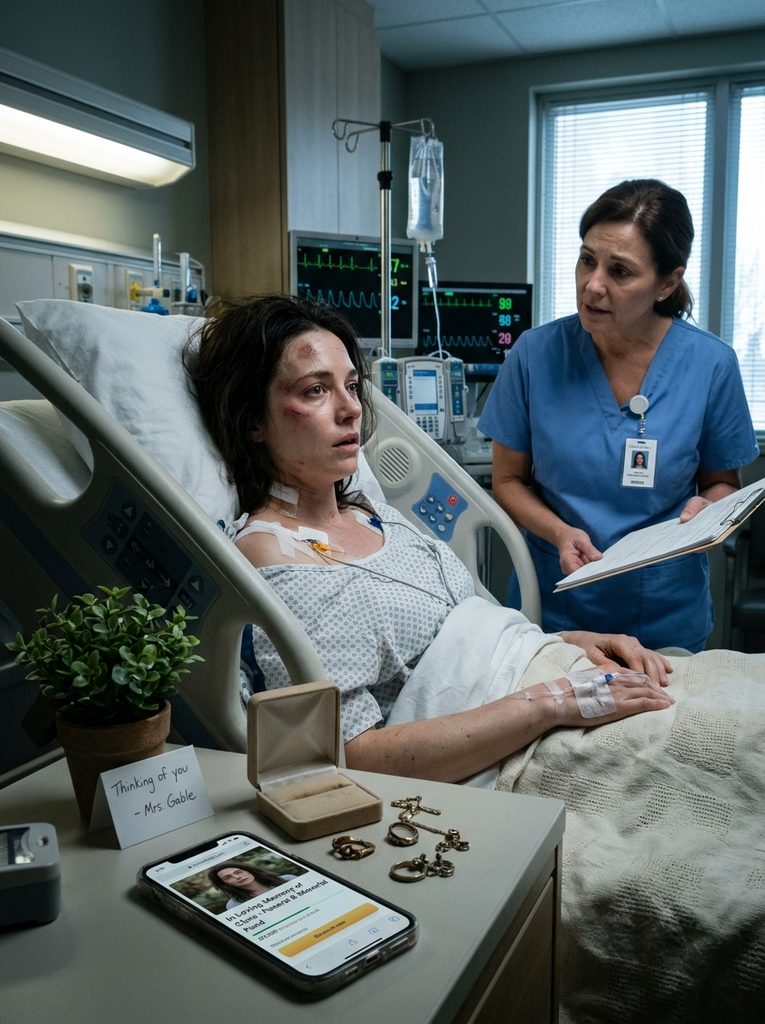
Chapter 1: The Taste of Concrete
The very first thing I registered was the taste of pulverized concrete.
It wasn’t the agonizing, white-hot pain of shattered bones. It wasn’t the panicked screams of the construction crew echoing across the lot. It wasn’t even the sickening, metallic shriek of the steel rigging shearing away beneath my steel-toed boots.
It was just the dry, choking grit of cement dust coating my tongue, and a flat, mechanical beeping that seemed to pulse directly from the center of my own skull. It was a cold, artificial rhythm, echoing through a vast, ink-black lake where my consciousness was actively drowning. I would learn much later that the persistent sound was a cardiac monitor, dutifully tracking a heart that the trauma surgeons had been forced to manually restart twice in the back of a speeding ambulance.
At the time, all I knew was that the darkness pressing down on my chest was impossibly heavy, and I desperately wanted the synthetic beeping to stop.
Then came the voices. They were horribly distorted, as if I were listening to them from the bottom of a murky swimming pool.
“Systolic pressure is bottoming out! Get another unit of O-negative on the rapid infuser, now!”
“Watch the cervical spinal alignment on the transfer. Stay with us, Ms. Vance. Come on, Clara, stay with us.”
Somewhere in that suffocating void, I tried to open my mouth. I wanted to tell them that my name was Clara Vance, that I was just the senior project manager executing a completely routine site inspection at the Riverfront Plaza development. I wanted to explain that I wasn’t even supposed to be standing under the third-tier scaffolding when the primary load-bearing supports failed. But my jaw was wired to nothing. I possessed no physical body, only horrific, disconnected fragments of memory: The deafening crack of tearing metal. The sudden, terrifying weightlessness of a three-story freefall. A rusted steel I-beam rushing upward to meet my ribcage.
Then, absolute, crushing blackness.
When I finally breached the surface of reality, it felt exactly like being dragged naked over a mile of broken glass. My eyelids were swollen, feeling as though they had been stitched shut with lead thread. My throat burned as if it had been vigorously scrubbed with steel wool. Every microscopic inhalation was a brutal negotiation with agony. It wasn’t just a sharp, localized ache; it was a profound, systemic devastation. I felt as though my entire skeletal architecture had been violently dismantled and hastily glued back together by a trembling, amateur hand.
Fluorescent light stabbed ruthlessly at my dilating retinas.
White acoustic ceiling tiles swam into view. A faint, sterile hum vibrated overhead. The unmistakable, nauseating scent of surgical iodine, industrial bleach, and old copper filled my nasal passages.
I managed to twitch the index finger of my right hand. The sheer physical effort required made my vision swim with gray spots.
A plastic chair groaned heavily beside my bed.
“Oh, thank the merciful Lord.”
A woman leaned into my limited field of view. She was perhaps in her late fifties, with warm, deep brown skin, kind but profoundly exhausted eyes, and crisp navy blue scrubs. Her laminated badge read Elena Rostova, RN.
“You’re finally back with us,” she murmured, her voice a soothing, maternal rumble. She gently adjusted a clear plastic line taped securely to the back of my bruised hand. “You gave the trauma unit a truly terrifying forty-eight hours, sweetheart.”
I tried to swallow, but my mouth was an arid desert. “How… long?”
“Two full days since the emergency spinal surgery. You’ve been drifting in and out of the anesthesia, but this is the first time your pupils are actually tracking my movements.”
Two days.
The concept felt completely alien. Forty-eight hours had simply been erased from the calendar. Two days where the earth kept rotating, traffic kept flowing, and coffee kept brewing, all while I was a ghost lingering on an operating table. I had been crushed beneath two tons of collapsed steel scaffolding. My ribs were splintered, my left lung had been punctured, and my spine had fractured in two separate places. The on-site paramedics, I would later discover, had engaged in a brief, grim debate about calling for a coroner’s van instead of a life flight.
I licked my severely cracked lips, tasting dried blood. “My… phone?”
Elena’s warm, professional expression faltered. It was a microscopic shift in the muscles around her mouth, but I was a veteran project manager; my entire corporate career was built upon reading the unspoken, shifting tension in a boardroom. Intensive care nurses are specifically trained to expertly smooth over bad news, but toxic family drama is a jagged, ugly edge they can rarely conceal.
“Let’s focus strictly on your vitals first,” Elena deflected, her tone gentle but firm. “Do you know your full name?”
“Clara. Clara Vance.” My voice was a gravelly, pathetic whisper.
“Excellent. Do you know where you currently are?”
“Hospital. Columbus, Ohio.”
She offered a tight, deeply sympathetic smile. “OhioHealth Riverside. You are in the surgical ICU.”
I rolled my head a fraction of an inch to the left, biting back a scream as a flare of liquid fire shot down my neck. I fully expected to see the familiar, stifling tableau of my family. I expected to see my mother, pacing the linoleum and loudly dramatizing the situation to anyone who would listen; my father, staring blankly and uselessly at his loafers; and my younger sister, Chloe, weeping photogenically for whichever handsome resident doctor might be watching.
The room was completely empty.
There was only Elena, the rhythmic hiss of a ventilator I was thankfully no longer attached to, and a small, vibrant potted peace lily sitting cheerfully on the sterile windowsill.
“Who’s here?” I rasped, my heart rate instantly ticking up, prompting a sharp beep from the monitor overhead.
Elena busied herself checking my IV drip flow, deliberately avoiding my eyes. “You had a visitor yesterday evening. Your neighbor from the floor below your condo. Arthur? He brought the plant. He asked me to tell you that he fed your cat, and that the animal is highly demanding.”
Arthur. The retired, deeply cynical homicide detective who lived in unit 3B. A gruff, solitary man built like a cinderblock who usually communicated exclusively in grunts and curt nods by the mailboxes.
Not my mother. Not my father. Not my own sister.
“Did… did the hospital call my family?”
Elena stopped fussing with the plastic tubing. She pulled a rolling examination stool closer to the bed and sat down, her posture shifting from medical professional to deeply reluctant messenger. “When the ambulance brought you in, Clara, it was a mass casualty code from the construction site. You were unconscious. We pulled your emergency contact from an old intake file. Your sister.”
The walls of the ICU room seemed to physically shrink. The recycled air grew dangerously thin.
“What did Chloe say?”
Elena took a slow, measured breath, placing a warm hand over my bruised fingers. “A clinical social worker, Miriam, was on the line with the intake coordinator when they made the call. She will come in to speak with you when you are a bit stronger, but… Clara, your sister was informed of the highly critical, life-threatening nature of the accident.”
“And?” I pressed, the dread pooling in my gut.
“And she told our staff, ‘She’s not our problem anymore. Don’t call back.’”
The words hung in the sterile, heavily filtered air, dense and lethally toxic.
Not our problem anymore.
I lay entirely still, waiting for the profound shock to hit. I waited for the emotional devastation to shatter my chest all over again. Instead, a cold, dark, and terrifying clarity settled over my mind. Of course. Of course Chloe—the golden, spoiled child who had spent her entire twenty-six years treating me like an endless line of credit and a convenient emotional dumping ground—would simply hang up the phone while I was bleeding out on a gurney.
“No one came,” I whispered, staring blankly at the acoustic ceiling tiles.
“Your neighbor came,” Elena corrected softly, giving my hand a gentle squeeze.
Before I could even begin to process the profound, echoing isolation of that truth, a sharp, urgent knock at the heavy glass door interrupted us. Standing on the other side was a woman in a beige cardigan, clutching a thick manila folder to her chest. It was Miriam, the clinical social worker. Her face was unusually pale, and she looked at me with an expression that made the cold dread in my stomach twist into an agonizingly hard knot.
She stepped inside, her eyes flicking nervously to Elena before settling on me. “Ms. Vance. I am so incredibly sorry to overwhelm you while you are in this condition, but there is an urgent matter regarding your residence. The Columbus police are on the phone.”
I tried to push myself up on my elbows, a blinding, white-hot spike of pain shooting directly down my fractured spine, forcing me back onto the mattress. “My residence? The condo? What happened?”
Miriam nodded grimly, her knuckles white against the folder. “Your neighbor, Arthur, caught someone breaking into your apartment late last night. Clara… it wasn’t strangers. It was your family.”
Chapter 2: Monetizing My Demise
To survive a catastrophic, near-fatal physical trauma only to wake up to the reality of a targeted home invasion is a highly specific, uniquely agonizing kind of psychological torture.
The physical pain of my shattered spine was somewhat manageable; the steady drip of intravenous morphine saw to that. But the betrayal was a jagged, rusted pill I was forced to swallow raw.
The following morning, after a team of grim-faced orthopedic surgeons had evaluated my spinal fractures and determined that I miraculously wouldn’t be permanently paralyzed—a minor medical anomaly—Arthur walked into my room. He was in his mid-sixties, built like a fire hydrant, possessing a permanent, deep-set scowl and the weary eyes of a man who had seen the absolute worst of human nature during his thirty years with the Columbus PD. He was holding a styrofoam cup of terrible hospital coffee.
“Kid,” he grunted, pulling up a plastic guest chair. He didn’t offer empty platitudes. He didn’t falsely tell me I looked good. He just sat heavily, the chair creaking dangerously in protest under his bulk.
“Arthur,” I rasped, my throat still raw from the intubation tube. “Thank you for the peace lily. And for keeping Mr. Whiskers alive.”
He waved a thick, calloused hand dismissively. “The cat is perfectly fine. Eats entirely too much premium salmon. Listen to me, Clara. I need to tell you exactly what happened at the building while you were under the knife.”
I braced myself, my uninjured hand gripping the thin cotton hospital blanket. “Miriam said my family broke in.”
“Not broke in. They waltzed right through the front door,” Arthur corrected, his voice a low, rumbling gravel. “I was coming up from the basement laundry room around eight o’clock. I saw your mother, your father, and Chloe stepping out of your unit into the hallway. They had the spare key from under your mat—the one you told me about two years ago in case of a plumbing emergency.”
My chest tightened, aggravating my broken ribs until I gasped. “What were they doing?”
“Carrying heavy cardboard boxes. Duffle bags. I stepped directly in front of the elevator doors to block them. I asked them what the hell they thought they were doing, considering you were currently lying in the ICU with a crushed spine. Your sister looked me dead in the eye, didn’t even blink, and said they were securing your valuables because the hospital had explicitly told them you weren’t going to make it.”
A nauseating, dizzying wave of vertigo washed over me. Weren’t going to make it.
“I called the precinct immediately,” Arthur continued, his jaw ticking violently with suppressed anger. “But by the time the patrol boys showed up, your mother turned on the waterworks. Claimed they had a verbal agreement with you to manage your affairs in the event of an accident. The cops said it was a civil matter. Familial access. It’s utter bullshit, if you ask me, but it delayed them from making an on-site arrest.”
“What did they take, Arthur?” I asked, dread pooling in my stomach.
He pulled a small, battered spiral notebook from his leather jacket pocket. “I went in after they scurried off. The place was completely tossed. Dresser drawers dumped on the carpet. The mattress physically shifted off the box spring. From what I could deduce without a full inventory? Your work laptop is gone. The fireproof document box from your home office is missing. Your jewelry case. And…” He hesitated, his hardened eyes softening just a fraction. “The wooden display box from your nightstand, Clara. The one with the vintage watch.”
My heart completely stopped. The monitor overhead let out a sharp, erratic blip.
Not the laptop. Not the sensitive financial documents. The watch.
It was a vintage, manual-wind Patek Philippe mechanical watch. It hadn’t belonged to a biological relative. It had belonged to Thomas, the senior architect at my firm who had mentored me, believed in my potential when I was just a terrified junior associate, and essentially acted as the loving father I had never been given. When Thomas passed away from aggressive pancreatic cancer three years ago, he specifically left the timepiece to me in his will. The elaborate engraving on the gold case back read: For Clara. Time is the only currency that actually matters. Spend it well.
My family knew exactly what that watch meant to me emotionally. They also knew, because Chloe had once secretly appraised a photo of it, that it was worth upwards of forty thousand dollars on the estate market.
“They took Thomas’s watch,” I breathed, the words tasting like ash in my mouth.
“I filed a formal burglary report anyway, leveraging some heavy old favors at the precinct to push it through,” Arthur said grimly, leaning forward. “But Clara, that is unfortunately not the worst of it.”
I looked at him, my vision blurring with angry, hot tears. “How could it possibly be worse than looting my mentor’s dying gift?”
Arthur reached inside his coat and pulled out an iPad. He unlocked the screen, his face a mask of absolute disgust, and handed it to me. “My niece showed me this last night. It’s been aggressively circulating on local social media for twenty-four hours.”
I took the tablet with a trembling, bruised hand.
It was a prominent crowdfunding page. The massive banner image was a high-resolution photo of me at Chloe’s college graduation, heavily cropped to remove her from the frame so I appeared alone and angelic. Below it, in bold, sickeningly tragic lettering: Memorial and Final Wishes Fund for Our Beloved Clara.
My eyes scanned the lengthy description, written in Chloe’s unmistakable, syrupy, manipulative prose.
Unimaginable tragedy has struck our family. My beautiful, fiercely hardworking sister Clara was involved in a horrific structural collapse at a construction site. The surgical doctors have told us to prepare for the absolute worst. As we wait by her bedside for her to take her final, agonizing breaths, we are facing insurmountable grief and the crushing financial burden of planning her funeral, bringing her ashes back to our hometown, and settling her remaining debts. Please, help us give Clara the beautiful goodbye she truly deserves.
The financial goal was set at $50,000.
The current amount raised from sympathetic friends, extended family, and gullible strangers was $28,400.
I stared at the glowing screen, my brain struggling to process the sheer, sociopathic audacity. They were publicly raising money to bury me while I was physically lying in a hospital bed, fighting through the blinding agony of a crushed spine just to take my next breath. They had literally monetized my anticipated death.
I scrolled down the page mechanically. There was a campaign update posted just hours after they had raided my apartment. It was a photo of my mother and Chloe, sitting in the plush, upscale leather booths of a high-end steakhouse. They were holding crystal glasses of expensive white wine, looking somber but elegantly put-together. The caption read: Finding strength in each other during these dark, impossible hours. Thank you for the incredible donations. It brings us immense peace knowing Clara’s final journey will be financially taken care of.
“They’re drinking Chardonnay,” I whispered, the grotesque absurdity of the image completely fracturing my sanity. “They just robbed my house, declared me legally dead to the internet, and went out for a prime rib dinner.”
Arthur took the tablet gently from my shaking hands. “I’ve already contacted the platform’s legal department to report it as fraud, stating the beneficiary is very much alive and non-consenting. But Clara, these people… they aren’t just vultures circling a corpse. They’re active predators.”
A cold, terrifying calm began to spread outward from the center of my chest, overriding the heavy dose of pain medication. For thirty years, I had been the sensible one. The family ATM. The reliable fixer. I had allowed them to drain my personal savings to bail out my father’s endless string of failed businesses. I had allowed them to aggressively gaslight me into believing my attempts at setting boundaries were “selfish” and “un-daughterly.”
The scaffolding collapse hadn’t killed me. But looking at that fraudulent crowdfunding page, I realized that the version of Clara who tolerated their abuse had just died on impact.
“Arthur,” I said, my voice eerily steady, stripped of all tears. “I need a lawyer. I need the meanest, most utterly ruthless civil litigator in the city of Columbus.”
Arthur’s scarred face split into a slow, terrifyingly wolfish grin. “Way ahead of you, kid. I called her this morning. She’ll be here in an hour.”
Before he could stand up to leave the room, the heavy glass doors to my ICU suite swung violently open.
Standing in the doorway, clutching an extravagant, massive bouquet of white lilies—the exact kind you explicitly purchase for a funeral arrangement—was my sister, Chloe, with my mother hovering anxiously right behind her.
Chapter 3: The Photo Op
The sheer, monumental audacity of their arrival was so profound it bordered on the cinematic.
Chloe stepped tentatively into the ICU room, her face carefully and expertly composed into a mask of tragic, overwhelming sorrow. She was wearing a tasteful, dark cashmere sweater, her expensive makeup expertly applied to look slightly tear-smudged, yet flawless. My mother followed close behind, clutching a designer leather handbag, her eyes darting nervously around the room, taking in the complex monitors, the IV bags, and finally, settling on me.
Neither of them looked like they had spent the last two days locked in the paralyzing agony of planning a funeral for a loved one. They looked precisely like they were arriving at a highly anticipated photo op.
“Oh, Clara,” Chloe gasped, pressing a manicured hand to her chest in a theatrical display of relief. She stepped forward, offering the funereal lilies like a tragic peace offering. “You’re awake. Thank God. The surgical team told us… they told us there was absolutely no hope.”
Arthur didn’t move an inch from his plastic chair. He just crossed his thick, muscular arms over his chest, physically blocking her path to the side of my bed like a gargoyle. “Funny,” Arthur growled, his voice vibrating with menace. “The doctors told you she was in critical condition. Nobody in this hospital said she was dead. But you sure moved awfully fast to cash in on the casket.”
My mother bristled instantly, her eyes flashing with indignant fury. “Excuse me? Who on earth are you to speak to us like that? We are her immediate family. We have been living an absolute waking nightmare!”
“The only nightmare in this room,” I said, my voice scraping like sandpaper against the heavy silence, “is that you couldn’t even wait for my heart monitor to flatline before you started picking the meat off my bones.”
Chloe’s faux-sorrow vanished in a millisecond, replaced by a defensive, petulant annoyance. “Clara, please don’t be dramatic right now. You don’t understand the immense stress we’ve been under. The hospital called us in the middle of the night! We panicked. We had to immediately prepare for the worst-case scenario.”
“By breaking into my home?” I demanded, fighting the desperate urge to scream as pain flared violently in my fractured ribs. “By stealing Thomas’s watch from my nightstand? By setting up a fraudulent GoFundMe to pay for my cremation while I was still breathing?”
My mother stepped aggressively forward, her jaw set in a stubborn line. “We were securing your vulnerable assets, Clara! You live entirely alone. If you passed away, the state would freeze everything in probate for months. We had to make sure the family was financially protected. And that fundraiser is to cover the massive, crippling medical bills you’re going to have. We were being proactive!”
“You used the donated money for a steak dinner,” Arthur stated flatly, not breaking eye contact with my mother. “I saw the geo-tag on the photo you posted. Hyde Park Prime Steakhouse. Proactive grieving, is it?”
Chloe flushed a deep, ugly, mottled red. “You have absolutely no idea how we cope with trauma! Clara, tell your creepy, stalking neighbor to leave right now.”
“He stays,” I said coldly, my eyes locking onto my sister’s. “You leave.”
My mother let out a sharp, incredulous laugh, shaking her head. “After everything we’ve done for you? After we rushed all the way down here to be by your side—”
“You didn’t rush down here,” I interrupted, my voice gaining volume and strength from pure, unadulterated adrenaline. “You told the clinical social worker that I wasn’t your problem. You looted my apartment like common thieves. You stole my mentor’s watch. You didn’t come here today to see if I was alive, Mother. You came here because the crowdfunding platform froze your payout account this morning due to fraud reports, and you desperately needed a photo of me in a hospital bed to prove you weren’t committing wire fraud.”
The silence that followed was completely deafening. Chloe’s eyes widened in genuine, undisguised panic. I had hit the nail squarely on the head. They hadn’t come for me. They had come for their alibi.
Before either of them could formulate a plausible lie, the door opened again.
A woman walked in. She was tall, dressed in an immaculate, razor-sharp charcoal power suit, carrying a sleek leather briefcase. She exuded an aura of absolute, terrifying competence. She looked at my mother and sister, then at Arthur, and finally at me, her eyes assessing the tactical situation in a split second.
“Clara Vance? I’m Beatrice Sterling,” she said, her voice crisp and commanding, slicing through the tension like a blade. “Arthur called me. I specialize in high-stakes civil litigation, hostile asset recovery, and making financial exploiters deeply regret their life choices.” She turned her piercing, predatory gaze directly onto my family. “I assume these are the defendants?”
Chloe took a physical step backward. “Defendants? Are you insane? We’re her family.”
Beatrice smoothly opened her briefcase, pulling out a sheaf of legal documents. “Under Ohio state law, familial status does not grant you immunity for burglary, conversion of property, or wire fraud. Now, you can leave this hospital room voluntarily, or I can have security physically escort you out and file an emergency restraining order before you reach the parking garage.”
My mother drew herself up to her full height, her face pale with narcissistic fury. “You’ll regret this, Clara. When you have absolutely nothing left, don’t come crawling back to us.”
“I’d rather crawl over broken glass,” I replied, my voice steady.
They turned and marched out, leaving the pungent, sickening smell of the funeral lilies behind. Arthur promptly stood up, picked up the crystal vase, and dropped the entire arrangement into the biological waste bin with a satisfying thud.
Beatrice pulled up a chair, her eyes gleaming with a terrifying, predatory focus. “Alright, Clara. Arthur briefed me on the stolen watch and the fake funeral fund. But while I was running a preliminary cyber-background check on your sister’s recent financial activities this morning, I found something much, much worse.”
I felt the remaining blood drain from my face, my heart hammering against my bruised ribs. “What did she do?”
Beatrice slid a printed document onto my lap. It looked like a server log. “Your sister didn’t just break into your apartment to steal physical, pawnable items. She accessed your home office computer. We know this because at 10:15 AM yesterday, an IP address explicitly registered to your condo’s router attempted to log into the employee portal of your construction firm.”
“Why?” I asked, my stomach violently churning.
“To access your corporate death benefits policy,” Beatrice said smoothly, tapping a line of code on the paper. “She attempted to change the primary beneficiary from your designated charity to herself. She failed because she didn’t have the two-factor authentication code sent to your destroyed cell phone. But Clara… she initiated the transfer request before she set up the funeral fund.”
Chapter 4: The Violation of Sanctuary
The grueling transition from the highly monitored safety of the ICU to my own condo three weeks later was a brutal exercise in sheer physical endurance. I was encased in a rigid, molded plastic back brace that dug painfully into my collarbones with every breath, and I was forced to walk with a heavy, four-pronged aluminum cane.
Arthur drove me home in his battered sedan. Beatrice met us in the lobby of the building, accompanied by a uniformed police officer she had specifically requested to properly document the crime scene.
Walking into Condo 4B was like stepping directly into a violent violation. It wasn’t completely trashed in a chaotic sense—my mother was far too fastidious and calculating for that—but it was profoundly, sickeningly disturbed. Every single drawer in my bedroom dresser was cracked open, its contents sifted through. My closet had been ruthlessly rifled through, my designer coats missing. The heavy steel lockbox in my home office had been pried open with what looked like a crowbar, leaving jagged, violent gouges in the metal.
And the polished wooden display case on my nightstand, where Thomas’s watch had rested on a velvet cushion for three years, was entirely gone. Just an empty, perfect square of dust remained on the mahogany wood.
I stood heavily in the doorway of my bedroom, leaning on my cane, and finally wept. I didn’t cry for the money. I didn’t cry for the betrayal. I cried for the complete erasure of my sanctuary. They had touched everything. They had sullied the only safe space I had ever built for myself in this world.
“Take high-resolution pictures of absolutely everything,” Beatrice instructed the officer, her voice entirely devoid of emotion, operating purely on tactical logic. She turned to me. “We have secured preservation orders on all your financial accounts. The crowdfunding platform has formally locked the $28,400 they raised, pending the conclusion of our fraud investigation. But we desperately need to locate the watch. It’s the physical anchor of the grand theft charge.”
My phone—a new replacement model Arthur had kindly bought and set up for me—vibrated aggressively in my pocket.
The caller ID read: Chloe.
I looked at Beatrice. She nodded sharply, pulling a digital audio recorder from her briefcase and placing it on the kitchen island. I answered and put the call on speakerphone.
“What do you want, Chloe?”
“Are you happy now, you psycho?!” Her voice was shrill, laced with absolute, unadulterated panic. “The police just showed up at Mom’s house to formally serve her with a civil suit! Are you actually suing your own family?!”
“You broke into my home and stole from me,” I said, my voice shockingly calm, tethered by the presence of my lawyer. “What exactly did you expect to happen?”
“We were trying to clean up your mess!” Chloe shrieked, her voice echoing through the speaker. “You were lying crushed under a ton of steel! We didn’t know if you had a will. We didn’t know if your affairs were in order. Somebody had to step up and handle the complicated logistics of your life falling apart!”
Beatrice pointed excitedly at the recorder. Logistics.
“So your personal definition of logistics is stealing a forty-thousand-dollar vintage watch and trying to hack my corporate death benefits?” I asked evenly.
A heavy, suffocating silence fell over the line.
“I didn’t hack anything,” Chloe muttered, her tone suddenly shifting from righteous anger to a defensive, cornered whine. “And that stupid, ugly watch… you never even wore it out of the house. It was just gathering dust on a table. I needed immediate capital for my new business venture. It’s called repurposing assets within the family, Clara. It’s not stealing.”
Beatrice’s eyes lit up like a supernova. She pumped a fist silently in the air and mouthed the words: Got her.
“Where is the watch, Chloe?” I demanded.
“It’s gone, Clara. Get over it. You’re alive, aren’t you? Stop being so incredibly greedy.”
She hung up, the dial tone buzzing in the violated apartment.
I looked at Arthur. He was gripping the wooden doorframe of the kitchen so hard his thick knuckles were completely white. “I’m gonna lock her up,” he growled, a promise vibrating in his chest. “I swear to God, Clara, I’m gonna personally put the steel cuffs on her.”
The massive break in the case came a mere two days later.
Arthur’s contacts at the police precinct had been running the watch’s unique serial number through pawn shop databases across the tri-state area. You don’t fence a pristine Patek Philippe at a corner pawn shop that deals in stolen power tools. You take it to a high-end estate buyer.
Beatrice called me at 8:00 AM on a Thursday.
“We found it,” she said, her voice thrumming with the electric thrill of absolute victory. “A luxury consignment broker located in Dublin, Ohio. Chloe sold it the exact same afternoon of the break-in. She was incredibly stupid, Clara. She used her own, valid driver’s license for the transaction because the broker strictly required official ID for any payout over ten grand.”
“Did she get the money?” I asked, feeling physically sick.
“She received twenty-five thousand dollars in a certified cashier’s check,” Beatrice replied, the typing of a keyboard audible in the background. “And Clara? We subpoenaed her bank records late last night. The check was deposited directly into her checking account. Two hours later, she transferred five thousand dollars to your mother, and then spent three thousand dollars on non-refundable first-class tickets for a ‘luxury grief and healing retreat’ in Sedona, Arizona.”
The sheer, sociopathic audacity of it was paralyzing. They had actively sold the absolute last physical piece of the man who had loved me like a father, specifically to fund a luxury desert vacation to mourn my hypothetical, monetized death.
“Can we get the watch back, Beatrice?”
“The police have officially seized it as stolen property,” Beatrice assured me. “It is currently sitting safely in an evidence locker at the precinct. Once the criminal and civil trials conclude, it will be returned to you. The trap is fully loaded, Clara.”
Chapter 5: The Oak-Paneled Guillotine
The courtroom was paneled in dark, imposing oak and smelled heavily of floor wax and old, dusty paper.
It was a brisk, gray Tuesday morning in November. I sat beside Beatrice at the plaintiff’s heavy mahogany table, my rigid back brace carefully hidden beneath a tailored, oversized blazer. Directly across the aisle sat my family.
My mother looked visibly, strikingly aged. The arrogant veneer of high-society elegance was violently cracking under the immense stress of impending criminal charges and public, humiliating exposure. My father stared exclusively at his hands, a pathetic, broken man who had simply allowed the toxic current of his wife’s malice to sweep him along for decades. Chloe, however, still looked furiously defiant. She wore a modest, pale blue dress, aggressively playing the part of the victimized, misunderstood younger sister.
The hearing was primarily for civil restitution and injunctive relief, though Beatrice had meticulously coordinated the evidence with the District Attorney, who was aggressively pursuing the criminal fraud and grand theft charges in a parallel docket.
Beatrice stood up. She didn’t yell. She didn’t dramatically pound the table. She simply laid out the timeline with the cold, surgical precision of an assassin.
A large, high-definition monitor illuminated in the center of the courtroom, displaying the digital evidence.
2:15 PM: Scaffolding collapses. Clara Vance critically injured.
8:30 PM: Hospital officially notifies family. Chloe Vance states to social worker: “She’s not our problem anymore.”
8:15 AM (Next Day): Family enters Condo 4B on security footage.
10:15 AM: Attempted cyber-intrusion into corporate death benefits portal originating from Clara’s IP address.
1:30 PM: Chloe Vance fences stolen Patek Philippe watch in Dublin, OH for $25,000.
4:00 PM: “Final Wishes” crowdfunding campaign launched, actively soliciting $50,000.
6:30 PM: Mother and daughter post celebratory selfie at luxury steakhouse.
Beatrice methodically walked the judge through the subpoenaed financial records, played the crystal-clear audio recording of Chloe blatantly admitting to “repurposing assets,” and submitted the pawn shop receipts bearing Chloe’s signature.
Then, it was my turn.
I walked slowly to the witness stand, leaning heavily on my aluminum cane, every step a calculated effort against the throbbing ache in my spine. The courtroom was dead, suffocatingly silent. I swore the oath and sat down, carefully adjusting my posture.
Beatrice approached the podium. “Ms. Vance, can you briefly describe your relationship with the defendants prior to the accident?”
“I was their human safety net,” I said clearly, my voice echoing in the cavernous room. “I funded my father’s debts. I paid for my sister’s endless mistakes. I truly believed that if I was just useful enough, if I bled enough for them, they would eventually love me.”
“And how did their specific actions following your catastrophic accident impact you?”
I looked directly at my mother. She flinched, unable to meet my gaze, staring instead at the defense table. I looked at Chloe, who was glaring at me with a raw, unmasked hatred.
“The physical pain of having my spine crushed by two tons of steel was horrific,” I said, my voice steady, stripped entirely of tears. “But the most devastating trauma was waking up and realizing that my own family viewed my impending death not as a tragedy, but as a highly profitable liquidation event. While complete strangers were digging me out of the rubble with their bare hands, my own flesh and blood were calculating my net worth and planning a vacation on my ashes.”
A heavy, oppressive silence blanketed the room. Even the seasoned court reporter had paused her typing, staring at me.
“They did not break into my home out of grief,” I continued, turning my head to address the judge directly. “They did it out of sheer, unadulterated greed. They stole the only physical memory I possessed of the man who actually acted like a father to me. They monetized my intense suffering for the internet. I am not here today just for the return of my stolen property, Your Honor. I am here to ensure that these people can never, ever exploit another human being again.”
The judge, a stern, formidable woman with severe silver hair, looked over her reading glasses at the defense table. The absolute disgust on her face was palpable, radiating from the bench.
The ruling was swift and utterly merciless.
Full, immediate restitution of the $25,000 from the watch sale. Complete forfeiture of the $28,400 raised in the fraudulent GoFundMe, to be strictly redistributed back to the deceived donors. Punitive damages for severe emotional distress and conversion of property that effectively bankrupted my parents’ remaining retirement savings. Permanent, legally binding restraining orders barring them from my home, my workplace, and any digital contact whatsoever.
Furthermore, the judge didn’t stop there.
“Given the profoundly macabre and predatory nature of these actions,” the judge announced, her voice ringing like a bell, “I am formally submitting my findings of fact directly to the District Attorney’s office. Let the record reflect that the evidence of grand theft and wire fraud presented here today is overwhelming, systemic, and morally repugnant.”
Chapter 6: The Architect of Time
As the judge’s heavy wooden gavel fell with a final, echoing crack, my mother buried her face in her hands and finally, genuinely, sobbed. She wept not for me, nor for the daughter she had lost, but for the absolute, inescapable ruin she had brought upon herself.
Chloe abruptly stood up, her chair scraping violently against the floor, pointing a trembling, accusing finger at me. “You destroyed this family! You’re a monster, Clara!”
Arthur, sitting in the front row of the gallery, simply smiled, tipping an imaginary hat to her.
I didn’t say a single word to them. I stood up, leaned heavily on my cane, and walked out of the courtroom, leaving the ghosts of my past permanently behind in the oak-paneled room.
Healing is not a cinematic montage set to uplifting music. It is a slow, grueling, agonizing war of inches.
It took eight brutal months of physical therapy before I could walk unassisted without the cane. It took a full year before I could sleep through the night without waking up gasping, tasting the phantom grit of concrete dust in my mouth.
The criminal trials concluded early in the spring. Faced with the mountain of civil evidence Beatrice had secured, Chloe cowardly accepted a plea deal to avoid hard prison time. It resulted in five years of strict felony probation, a thousand hours of community service, and a permanent, highly searchable criminal record for fraud that completely shattered her delusional dreams of being an online lifestyle entrepreneur. My parents were forced to downsize to a cramped, dingy apartment on the industrial outskirts of the city, drowning in legal debt and public shame.
I never spoke to them again. The silence, which had once been a source of immense anxiety and guilt in my life, slowly transformed into a profound and beautiful sanctuary.
With the massive punitive damages I was awarded, I didn’t buy a new luxury car or upgrade my condo. Instead, Beatrice helped me navigate the legal paperwork to set up the Thomas Architectural Foundation—a robust scholarship fund explicitly designed for young, low-income women entering the construction and structural engineering fields. It was a legacy of building things up, rather than tearing them down.
On a remarkably warm afternoon in late May, I sat comfortably on the balcony of my condo. The sun was shining brilliantly over the Columbus skyline, painting the glass high-rises in strokes of gold.
Arthur was sitting across from me, happily nursing a bottle of cheap domestic beer. He had become a permanent, welcomed fixture in my life—not a father figure, not a savior, but a steadfast, remarkably grumpy guardian angel who routinely checked my smoke detectors and loudly complained about the local sports teams.
I looked down at my left wrist.
The Patek Philippe watch rested there securely, its original leather band slightly worn, its gold casing catching the brilliant afternoon light. I lifted my wrist, holding the timepiece close to my ear. Over the distant, muffled hum of city traffic, I could clearly hear the intricate, mechanical heartbeat of the vintage gears.
Tick. Tick. Tick.
Time is the only currency that matters.
I looked at Arthur, I looked at the sprawling city I was helping to build, and I took a deep, entirely painless breath. My family had tried to bury me under the rubble of their greed. They hadn’t realized I was a seed.
And for the very first time in my life, my time belonged entirely to me.