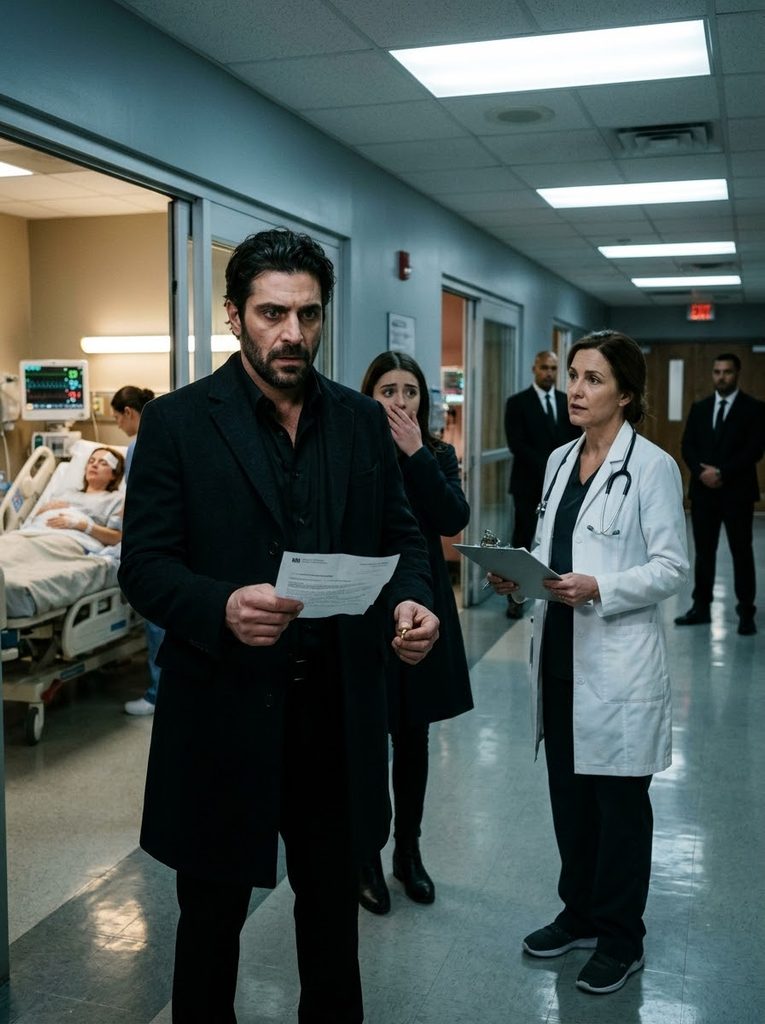
Chapter 1: The Shattered Glass
Power in Detroit is not measured in municipal ballots or corporate balance sheets. It is measured in silence. When eight hundred armed men answer to your breath, the city learns to whisper so it does not disturb you. For seven years, my name—Lucas Moretti—had been the boundary line between order and butcher’s work across the whole of Wayne County.
Yet at ten minutes past ten on a freezing Tuesday in mid-January, my entire empire was rendered hollow by a four-dollar plastic receiver pressed against my ear.
Outside the floor-to-ceiling glass of my downtown penthouse, the winter blizzard was turning Woodward Avenue into a blur of blinding white and smeared tail-lights. Across the expanse of my private office, two of my senior lieutenants were quietly arguing over a hijacked freight manifest out of Windsor, their voices muffled by thirty-foot ceilings and imported Persian rugs. On my desk of dark, hand-rubbed mahogany sat a cut-crystal tumbler of small-batch Kentucky bourbon.
The ice hadn’t even begun to melt when the private line lit up.
“Mr. Moretti, this is Nurse Amanda Foster from the emergency trauma intake at Wayne County General,” the voice said. It was professional, rapid, and pitched in the flat timbre of someone who saw people die between meal breaks. “You are currently registered in our municipal database as the primary emergency proxy for Hannah Campbell.”
My hand froze three inches above the desk. The rich scent of charred oak and aged corn liquor suddenly made me sick to my stomach.
“Hannah Moretti,” I said. The correction slipped through my teeth before my brain could stop it, cold and sharp.
“Sir, the Michigan driver’s license recovered from her coat identifies her as Hannah Campbell,” the nurse countered, refusing to bend. “She was admitted to our primary trauma bay approximately forty minutes ago in an unresponsive state following severe blunt-force trauma.”
The air evacuated my lungs as if I’d caught a shotgun blast to the breastbone. Across the room, my lieutenants stopped mid-sentence. They knew that tone. They had seen men executed with less venom in my voice.
“Is she breathing?” I demanded. My fingers clenched around the glass receiver until the polymer groaned.
“She is mechanically ventilated, but the trauma to the temporoparietal region of her cranium is extensive,” Nurse Foster replied. “Mr. Moretti, before the chief of trauma takes over her file, there is a secondary medical complication that requires immediate family verification.”
I shoved back the heavy leather chair, rising to my full height as I sliced my free hand through the air. My men scattered toward the outer corridor without waiting for an explanation. “Whatever she requires, you summon it. You pull the finest neurosurgical team in the Midwest into that operating theatre, and you route the invoices directly to my personal accounts. If she needs blood, you empty the blood bank. Am I making myself clear?”
“Mr. Moretti,” the nurse interrupted, her clinical voice dropping into something softer, heavier, and terrifyingly fragile. “We need to know if you were aware that Mrs. Campbell is sixteen weeks pregnant.”
The world lost its sound.
My fingers went numb. The heavy crystal tumbler slipped from my hand, tumbling through the empty air before smashing against the polished white oak floor. Amber liquor exploded outward, splashing across the hem of my trousers and soaking into the hand-knotted wool rug. Six bodyguards stationed along the perimeter stared at me in horrified disbelief. None of them, in all their years of blood and street warfare, had ever seen Lucas Moretti drop an object, let alone his composure.
Sixteen weeks.
The calendar in my head flickered through the months with vicious speed. Sixteen weeks took us past the bleak chill of autumn, straight into the quiet, rain-soaked weeks before the lawyers had summoned us.
It meant that three months ago, when I sat across from her in that mahogany-paneled conference room at the probate courthouse; when I looked her dead in the eyes and told her that our six years together had been a calculated convenience; when I watched her slender hand tremble so violently that her silver pen clattered across the table twice before she could sign the dissolution papers—she had already been carrying my child.
She had been carrying our flesh and blood beneath her ribs while I tore her heart out of her chest.
“Is the child alive?” The voice didn’t belong to me. It was a shredded, desperate rasp torn from a throat lined with gravel.
“The fetal heart monitor indicates a viable pulse at one hundred and forty-two beats per minute,” Foster said. “However, the extent of her maternal cranial injuries places both lives in critical jeopardy. The attending physician insists you report to the hospital immediately.”
“I’m on the road,” I choked out, and slammed the receiver onto its cradle.
I grabbed my heavy black cashmere overcoat from the mahogany stand. My hands were shaking so hard I could barely guide my arms through the silk-lined sleeves.
From near the limestone hearth, my younger sister, Paige Moretti, stepped forward to block my path. Her porcelain face was drained of color, her dark eyes wide with terror as she took in the shattered glass and the wild look in my eyes.
“Lucas, what was that?” she whispered, catching the lapel of my jacket. “Whose blood is on the street?”
“Hannah is in the trauma ward at County General,” I told her, my voice trembling as I yanked on my calfskin gloves. “She’s unconscious with a fractured skull. And Paige… she’s four months along. With my baby.”
Paige gasped, her hands flying to her mouth. In an instant, she arrived at the exact same devastating calculation that had just split my sternum in half. “Four months? Lucas, that means she was already pregnant when you made her sign those papers. Are you certain—are you entirely certain it’s yours?”
“Hannah never let another man breathe within an arm’s length of her for six years,” I snarled, catching my sister’s shoulders. “She gave me everything. Her youth, her art, her peace of mind. And I threw her into the gutter with a manufactured lie.”
I could still feel the warmth of our final morning in our suburban Bloomfield estate. I remembered her waking up with her forehead tucked against the hollow of my throat, her breathing soft and trusting. I had spent that whole night staring at the ceiling, swallowing my own soul because the Sicilian cartels out of Montreal had placed a half-million-dollar bounty on my household. I had convinced myself that stripping her of my name and driving her away with cruelty was the only armor thick enough to save her from the crossfire.
“You should have trusted her with the truth,” Paige wept, following me as I broke into a run toward the private elevator foyer. “You looked the only woman who ever loved you in the face and told her she was an obligation. You told her she meant nothing to you.”
“I know what I said!” I roared, the elevator doors sliding open to swallow us. “I know what I did! And every breath I’ve taken since that morning has tasted like burning kerosene! I thought if she hated me, she would stay far enough away to survive.”
The elevator plunged toward the subterranean garage. Within two minutes, four armored Suburbans tore through the concrete ramp, their studded tires biting into the fresh drifts of snow burying the city.
The convoy ran every red light along Michigan Avenue, sirens screaming into the howling gale. But when the vehicles skidded sideways into the red-tinted glow of the emergency bay at Wayne County General, I didn’t wait for the security perimeter. I kicked the door open before the tires stopped spinning and hurled myself through the automatic glass doors into the fluorescent blaze of the hospital.
“Mr. Moretti?” the intake clerk gasped, dropping her phone as four massive, overcoated men crowded through the entryway behind me.
“My wife,” I demanded, chest heaving, melted snow streaming down the collar of my coat. “Where is she?”
“Sir, the patient Hannah Campbell is currently in diagnostic imaging,” the clerk stammered, shrinking back against the plastic divider. “They’re finishing a high-resolution CT scan of the temporal bone.”
“Take me to her room now,” I said, planting both palms flat against the reception counter with a force that rattled the acrylic glass. “I don’t give a damn about your intake protocol. I don’t give a damn about visiting hours. Take me to my family.”
“Bellowing at the administrative staff will not heal a depressed skull fracture, Mr. Moretti.”
The voice was cool, measured, and entirely unimpressed by the presence of Detroit’s most dangerous men.
From behind the double doors of the trauma corridor walked a tall, severe-looking woman in surgical scrubs, her white lab coat stained with iodine and fresh streaks of dark arterial blood. She pulled a pair of wire-rimmed spectacles from her face, her sharp hazel eyes taking in my armed guards, settling briefly on Paige, and then locking onto me.
“I am Dr. Rachel Miller, Chief of Trauma Surgery,” she said, extending a hand wrapped in clean nitrile.
I gripped her fingers with enough force to turn her knuckles white. “Is she alive? Has the cranial bleeding crossed the midline?”
“She is hanging on by a thread, Mr. Moretti,” Dr. Miller said, pulling her hand free with calm authority. “We’ve stabilized the cervical spine, but the intracranial pressure is mounting rapidly. However, before I take you into that bay, there are several things about the circumstances of her intake that make no sense.”
Paige reached out, anchoring herself to my forearm. “What kind of things, Doctor? Was it a hit-and-run? Did someone run her car off the road?”
Dr. Miller looked down at the thick clinical clipboard in her hands, her expression hardening with an edge that sent ice through my veins. “Mrs. Campbell was not in an automobile accident. She was discovered half-buried in a snowdrift on a maintenance road behind the old rail yards off the Detroit River. And what our surgical technicians recovered from beneath her garments suggests she didn’t end up there by accident. Mr. Moretti, until I know what your former wife was involved in, I have a mandatory duty to notify the Organized Crime Division.”
My heart seized. The old rail yards off the river were the exclusive, iron-clad territory of the Russell Syndicate.
Before I could speak, Dr. Miller reached into her coat pocket and pulled out a heavy evidence bag. “This was taped to her bare flesh, directly over her uterus,” she whispered.
Through the clear plastic, I saw an envelope of thick vellum paper. It was sealed with heavy burgundy wax—stamped with the private crest of the Moretti family, an insignia that existed only on the signet ring resting in my office safe.
And across the face of the envelope, written in Hannah’s frantic, elegant script, was a message scrawled in her own blood: If Lucas finds my body, tell him they know about Windsor.
Chapter 2: Cold Tiles and Stolen Scars
The fluorescent tubes buzzing above the trauma corridor hummed like angry hornets. The sterile stench of the ward—a sickening mix of enzymatic detergent, rubbing alcohol, and old iron—clung to the roof of my mouth.
I stared through the clear poly-bag at that crimson-stained envelope. The room seemed to tilt beneath my boots.
“Where did she get this?” Paige asked, her voice cracking as she pressed her knuckles against her mouth. “Lucas, that’s your private stationary. You keep that locked in the vault behind the library panelling.”
“She didn’t steal it from the vault,” I said quietly, the realization settling into my gut like lead. “I wrote to her on that paper two years ago, for our paper anniversary. She kept the envelope.”
“The contents are not an anniversary poem, Mr. Moretti,” Dr. Miller countered coldly. She flipped the plastic bag over. “Inside are three pages torn from an international cargo manifest. They document seventy crate-loads of selective-fire military rifles routed through the Port of Montreal, scheduled to clear customs at the Ambassador Bridge before Friday. And folded between those ledgers was a handwritten note addressed to your sister.”
Paige let out a choked sound, taking a step back until her shoulders hit the beige wall. “Addressed to me? Why would Hannah write to me about machine guns?”
“Because Hannah was an artist, but she wasn’t an idiot,” I replied, my fists bunching inside the pockets of my wool coat until the seams strained. “She knew the geography of my business better than my caporegimes did. When I threw her out into the cold with that ridiculous story about falling out of love, she didn’t buy it. She knew the Montreal families were pushing south. She knew the Russell crew had set up distribution hubs on the river.”
I looked at Dr. Miller, stepping into her space until the physician was forced to tilt her chin up to hold my stare. “She went hunting for the leverage that was threatening us. She thought if she could steal their shipping ledgers, she could hand me the weapon to end the war, thinking I’d take her back.”
“Well, whoever caught her took that leverage out of her hide,” Dr. Miller said bluntly. She reached down, tapping the digital tablet hanging from her scrub pocket to bring up the radiological imaging. “Look at this screen, Mr. Moretti.”
The black-and-white scan of Hannah’s skull appeared on the monitor. A stark, jagged fracture ran along the left temporal plate like a lightning bolt, depressing inward toward the soft gray matter of her brain.
“Her wrists bear heavy, deep contusions—defensive ligature marks from someone pinning her down,” Dr. Miller explained, her voice steady but laced with grim disgust. “The fracture wasn’t caused by a car bumper. Someone took a blunt instrument—a steel pipe, or the butt of a heavy shotgun—and struck her with tremendous force. Then they threw her down a concrete embankment toward the river to let the blizzard bury her.”
A red haze settled over the edges of my vision. In my mind’s eye, I saw Hannah—delicate, gentle Hannah, who used to spend four hours mixing oil pigments just to capture the exact shade of morning sunlight through our kitchen curtains—cornered in some rusted, frozen warehouse, surrounded by Julian Russell’s sewer rats. I saw her clutching her belly, trying to protect the tiny life inside her while heavy boots kicked her into the frozen mud.
“Can you reduce the swelling?” I asked. The words came out so quietly they sounded like a prayer muttered before an execution.
“We’ve started her on an intravenous drip of high-potency mannitol to draw fluid off the brain tissue,” the surgeon replied. “We’ve also induced mild hypothermia to protect the cortical neurons. But her intracranial pressure reading just crossed twenty-four millimeters of mercury. If it hits thirty, the brainstem will herniate. If that happens, she dies. And the fetus dies with her.”
“Then open her skull,” I said without hesitation. “Relieve the pressure.”
“It is not that simple,” Dr. Miller snapped. “A full decompressive craniotomy requires deep general anesthesia and massive doses of synthetic paralytics. Her blood pressure will plummet. In a pregnancy at sixteen weeks, an extended drop in maternal mean arterial pressure reduces uterine perfusion by more than half. There is a forty-five percent chance that saving her brain will cause the child’s heart to arrest on the table.”
I stood paralyzed. All my life, I had operated on the principle that there was no problem in this city that could not be solved with sufficient leverage, money, or violence. If a supplier shorted a shipment, I burned his docks. If a politician got cold feet, I bought his mortgage.
Yet standing on these bleached hospital tiles, surrounded by eight armed men who would slaughter a precinct on my command, I was completely powerless. My money could not purchase a single millimeter of space inside her skull.
“I need to see her,” I whispered.
Dr. Miller hesitated, her gaze dropping to the heavy platinum band on my left ring finger—the ring I had taken out of my pocket and jammed back onto my knuckle the second I stepped into the elevator.
“Only immediate family,” she said softly.
“I am her husband,” I growled, looking the doctor in the eye. “The divorce was filed under coercion. The state might have stamped the paper, but God never saw it. Take me to my wife.”
Dr. Miller let out a slow breath, nodding once toward the double doors. “Ten minutes, Mr. Moretti. Room Four. You must scrub your hands and wear a sterile isolation gown. And prepare yourself. She does not look like the woman you remember.”
I left Paige in the waiting room flanked by my security chief, Silvio, and pushed through the doors. The hallway was quiet, save for the hum of ventilators and the occasional low chime of a vital monitor.
When I reached Room Four and pushed the privacy curtain aside, the breath left my chest in a strangled sob.
Hannah lay centered on an aluminum ICU bed, looking impossibly small beneath the rough hospital cotton. Her beautiful, honey-brown hair had been shaved clean along the left side of her head, exposing pale scalp marked by a constellation of black nylon sutures and an angry, purple swelling the size of a fist. Her face was bruised a terrible plum color along the jawline, and a clear plastic endotracheal tube was taped into the corner of her mouth, hissing rhythmically as a machine forced air into her bruised lungs.
IV poles crowded around her like gaunt, stainless-steel specters, feeding clear fluids and sedatives into the dark, collapsed veins of her hands.
I dragged a vinyl chair to the edge of the mattress and sank into it, my legs simply refusing to support me any longer. I reached out, my large, calloused hand trembling violently as I touched the tips of her cold fingers.
“Hannah,” I breathed, pressing her limp hand against my bearded cheek. Her skin smelled of cold snow and antiseptic, with just the faintest, ghostly trace of the lavender soap she had used since she was nineteen years old. “Hannah, please. It’s Lucas. I’m here.”
The monitors remained flat, their digital readouts ticking along in monotonous, indifferent loops. She didn’t stir. Her long, dark eyelashes lay motionless against the sunken hollows of her cheeks.
My gaze moved slowly downward.
There, beneath the coarse weave of the hospital gown, was a distinct, unmistakable curve rising from her lower abdomen. A small, perfect swell.
A silver ultrasound transducer was strapped across the mound with blue elastic bands, tethered to a bedside monitor. I reached down with my left hand, pulling off my leather glove, and gently laid my bare palm against the warm rise of her stomach.
The bedside speaker gave a sudden, sharp burst of static, and then the rhythm filled the room.
Thump-thump-thump-thump-thump.
It was fast, wild, and loud as an engine—the sound of an unborn child galloping against the dark, completely unaware that its mother was slipping away into eternity. It sounded like an iron hammer hitting an anvil.
“He’s fighting for you, baby,” I choked out, tears finally breaking past my eyelids and tracking hot down my face. “He’s in there fighting for every inch of breath. You have to fight, too. You hear me? You can’t leave me here alone. You can’t leave me to burn in this city by myself.”
I leaned down until my lips were inches from her ear, breathing against her bruised skin. “I lied to you in that courthouse, Hannah. I lied because I was a coward. I thought if I pushed you away, their guns wouldn’t find you. But I only handed you to them unarmed. Wake up, and I will burn Detroit to the bedrock. I will burn every dock, every ship, every dollar I own, and we will leave this place behind. Just open your eyes.”
A sudden, sharp metallic vibration startled me.
It wasn’t a medical monitor. It was coming from the pocket of Hannah’s winter jacket, which had been tossed into a plastic personal property bin beneath the sink.
I stood up, wiping my face with the sleeve of my shirt, and crossed the small room. I reached into the bag and pulled out her torn, blood-encrusted coat. In the inner lining, hidden inside an unauthorized slit cut through the down feathers, was a small, military-grade GPS transponder, its green diagnostic light pulsing rhythmically in the dim light.
Someone hadn’t just beaten her and dumped her in the snow.
They had let her live long enough to be found.
They had used her as bait, and the tracking unit had just led the wolves straight to the doors of Wayne County General.
Chapter 3: The Gallop of an Unborn Heart
My blood ran colder than the Detroit sleet rattling the glass.
I pinched the small, black plastic tracker between two fingers. It was an Israeli-made transponder—the kind favored by high-tier mercenary outfits and the maritime smuggling units operated by the Russell Syndicate. It was hardwired to transmit an active ping every forty-five seconds over a cellular mesh network.
They had planted it on her. They had broken her skull, left her just close enough to a public access road to ensure an ambulance would retrieve her, and then tracked the emergency response.
They weren’t after the cargo ledgers. They had used Hannah as an involuntary homing beacon to find me.
I slipped the device into my pocket, spun on my heel, and burst through the swinging doors of Room Four into the trauma hallway.
“Silvio!” I barked.
My security captain, a broad-shouldered Sicilian who had served my father before me, moved toward me instantly, his hand tucked beneath his unbuttoned overcoat where an automatic pistol rested in a custom leather holster.
“Boss?”
“Lock down the floor,” I ordered, keeping my voice low, flat, and lethal. “The Russells tagged Hannah’s coat. They know she’s here, and they know my convoy is parked in the ambulance bay. Clear the civilian staff from this wing immediately. Post three men on the stairwell fire exits, two on the main elevators, and put Dante on the roof access.”
Dr. Miller had just emerged from the nurses’ station holding a syringe tray. She stopped, her eyes narrowing as she caught the tail end of my commands. “Mr. Moretti, this is a public hospital, not a fortified compound. You cannot clear out my medical personnel when we have four unstable trauma admissions on this floor.”
“Doctor, in about five minutes, this floor is going to become a slaughterhouse unless my men control the access corridors,” I said, stepping into her path. “Julian Russell’s soldiers are within four blocks of this building. They don’t leave witnesses, and they don’t care about your Hippocratic oath. If you want to keep Hannah and that baby alive, you prep your surgical suite for that craniotomy right now, and you let my men do their work.”
Before Dr. Miller could fire back a response, the fluorescent light strips overhead flickered twice with a dull, buzzing drone.
Then, every light in the hallway went black.
The sudden darkness was absolute, broken only by the piercing, high-pitched whine of life-support equipment switching over to internal batteries. Across the ward, alarms began to chime in staggered, chaotic tempos.
Two seconds later, the low, mechanical rumble of the hospital’s basement diesel generators kicked in, and the corridor was bathed in the sickly, blood-red glow of the emergency auxiliary lamps.
“Main grid power has been severed,” Silvio whispered, drawing a sound-suppressed semi-automatic from beneath his coat with a practiced, fluid motion. “They cut the transformer down the street. It wasn’t the blizzard.”
“Lucas!” Paige cried out from the waiting area, running toward me with her phone illuminated. “The phone lines just died. My cellular reception just dropped to zero—they’re running a broadband frequency jammer!”
“Stay behind me,” I commanded, pulling Paige behind my back as I reached under my cashmere coat and pulled my custom 1911 from its holster, racking the slide with a sharp, heavy clack.
I turned to Dr. Miller, who was standing frozen against the wall, her clinical arrogance finally cracking under the realization of what was unfolding.
“Where is the secure surgical suite?” I demanded.
“Sub-level one,” she whispered, her hands shaking as she set down the tray. “The neurological operative theaters have dedicated backup power lines that run through an independent concrete conduit. If the main power fails, those rooms stay sterile and lighted for twelve hours.”
“Move Hannah now,” I said. “Take two of your nurses, load her onto the mobile transport gurney, and take the private service freight elevator. Silvio, give the doctor two men with shotguns. If anything with two legs approaches that elevator door that isn’t wearing a Moretti signet, shoot it through the teeth.”
“What about you, Lucas?” Paige sobbed, gripping my sleeve.
“Julian Russell came here because he thinks I’m sitting by a bedside, weeping like a broken widower,” I said, the fury that had been building inside me for three months finally snapping into a crystal-clear, icy resolve. “He thinks he’s hunting an injured dog. I am going to remind him why my family has ruled this city for fifty years.”
From the far end of the corridor, beyond the heavy magnetic fire doors that separated the trauma wing from the public lobby, came the muffled, distinct sound of three rapid gunshots—the dry, snapping bark of small-caliber rounds fitted with cheap suppressors.
A woman screamed. Then silence fell again, thick and suffocating.
“Move!” I roared at Dr. Miller.
The doctor sprang into motion with terrifying efficiency, lunging into Room Four with two male orderlies. Within fifteen seconds, Hannah’s bed was unlatched from the wall monitors, the portable oxygen rig whistling as they wheeled the gurney into the crimson-lit hallway, heading for the service lift at a dead sprint.
I watched the back of Hannah’s shaved head disappear around the corner, her small, pale hand dangling off the edge of the mattress, swaying with the momentum.
Fight, I told her silently. Just keep breathing, and I’ll take care of the rest.
I adjusted my stance, planting my boots on the slick linoleum floor, and raised my weapon toward the double fire doors at the end of the hall.
The magnetic locks clicked open.
The heavy steel doors swung outward slowly, their hinges screaming in the silence. Through the gap stepped three men dressed in dark utility parkas, tactical vests, and black ski masks, holding short-barreled automatic submachine guns.
They didn’t check the corners. They were confident. They believed the cut power and the jammed radios had left the trauma floor defenseless.
The first man didn’t even have time to bring his weapon to his shoulder.
I pulled the trigger twice.
The heavy .45-caliber rounds tore through the center of his chest before the brass casings hit the floor, dropping him instantly onto the tiles. Silvio fired simultaneously from my right, his suppressed weapon spitting three muffled coughs that took the second man through the throat, sending him crashing into a row of stainless-steel medicine carts.
The third intruder scrambled backward, spraying a desperate, wild burst of nine-millimeter rounds into the ceiling. Acoustic tiles shattered in an explosion of white gypsum dust and sparks.
I charged through the smoke, clearing the distance in three strides, kicking his weapon from his grip with the steel toe of my boot. Before he could reach for the sidearm on his vest, I drove my gun hand forward, smashing the heavy steel slide across his jawbone.
Bone crunched sickeningly beneath the impact. The man slammed against the wall, sliding down into a heap of plaster dust, groaning as blood poured from his shattered mouth.
I stepped over the bodies, grabbed the collar of his tactical vest, and hauled him up until his eyes were level with mine. I jammed the hot muzzle of my pistol directly beneath his eye socket.
“You have five seconds to tell me if Julian Russell is in this building,” I whispered, my voice as calm as a frozen pond. “Or I will paint this corridor with whatever is left inside your skull.”
The man choked on his own blood, his fingers clawing at my wrists. “He’s… he’s not here,” he gasped through his ruined teeth. “Julian… Julian is down at the rail yards. At the cold storage terminal. He sent us… he sent us to finish the girl and bring back the ledgers.”
“Who gave you the clearance codes for the hospital power grid?” I pressed the barrel harder, until the skin split against his cheekbone. “No street crew cuts city lines without an administrative key. Who sold her out?”
The man’s eyes shifted, flickering with a sudden, terrified awareness. “The city councilman… Campbell. Her uncle. He took fifty grand to wipe her new address from the state registry and ping her phone.”
Hannah’s own blood. Her uncle, the corrupt municipal parasite I had personally kept out of federal prison three years ago, had sold his own niece to Julian Russell for the price of a luxury sedan.
“Thank you,” I said softly.
I pulled the trigger, letting the man drop like an empty coat onto the floorboards.
I turned back to Silvio, wiping a streak of black powder from my forehead with the back of my hand. “Get Paige into the surgical bunker with Hannah. Tell Dr. Miller she has my authorization to take off half her skull if that’s what it takes to save her life.”
“Where are you going, Lucas?” Silvio asked, his eyes wide.
“Julian Russell wants to conduct business in the snow,” I said, racking a fresh magazine into my weapon. “I’m going to go collect our debt.”
Chapter 4: Shadows in the Blizzard
The blizzard over the Detroit River had transformed the industrial rail yards into a frozen graveyard of rusted iron, derelict boxcars, and howling wind.
The temperature had dropped to twelve degrees below zero. Ice crusted the windshield of my black Suburban as we crawled through the broken chain-link gates of the Russell Cold Storage Terminal with the headlights extinguished. Snow banked against the rusted corrugated metal of the warehouse walls, muffling the low, guttural idle of my engine.
I had four vehicles behind me—sixteen seasoned men armed with short-barreled carbines, tactical body armor, and thirty years of accumulated bloodlust.
Inside my overcoat, the secure satellite radio on my belt crackled with static, bypassing the terrestrial cell towers.
“Lucas?” It was Paige’s voice. She was speaking from inside the reinforced concrete bunker of the sub-level operative suite at Wayne County General. Her voice sounded small, frayed, and drowning in technological beeps.
“I’m here, Paige,” I said into the microphone, my eyes scanning the shipping docks ahead through night-vision optics. “Is she on the table?”
“Dr. Miller just began the incision,” Paige said, her breath shuddering over the line. “They had to shave the rest of her hair, Lucas. She looks so young. But the brain swelling… when they pulled the flap back, the doctor said the pressure was so violent the tissue was blanching. And the fetal monitor…”
Paige choked back a sob.
“Tell me,” I commanded, gripping the steering wheel until the leather cracked.
“The baby’s heart rate dropped to ninety-five beats per minute when the anesthesia hit her system,” she wept. “Dr. Miller is administering atropine to try and stimulate the placenta, but she told me to prepare myself. If Hannah goes into cardiac arrest during the craniotomy, they cannot perform a caesarean section at sixteen weeks. The baby cannot survive outside her.”
My knuckles burned white against the wheel. My teeth ground together so hard that a shooting pain lanced up into my jaw.
Sixteen weeks. A human life no larger than the palm of my hand, floating in the dark, suspended between the surgeon’s scalpel and the grave.
“She will not die,” I said, and the certainty in my voice was so cold it startled my own sister into silence. “Stay beside her, Paige. Sing to her if you have to. Remind her of the summer house in Traverse City. I am ending this right now.”
I cut the transmission and shoved the radio into my pocket.
I looked at Silvio, who was sitting in the passenger seat, quietly chambering a round into a customized twelve-gauge shotgun. “Nobody leaves this yard breathing,” I told him. “If they drop their weapons, shoot them where they kneel. Julian Russell does not get a trial, and he does not get a casket.”
“Understood, boss.”
I slammed my foot on the accelerator.
The heavy, four-ton armored Suburban surged forward, its steel brush guard smashing through the rusted aluminum roll-up doors of the primary loading terminal in an explosion of splintering metal, shattering glass, and blinding dust.
The interior of the cold storage facility was massive, lit by high-intensity sodium vapor lamps that cast long, sickly orange shadows across stacks of wooden shipping pallets, industrial refrigeration units, and dozens of black wooden crates stenciled with Russian military insignias.
A dozen men in heavy winter parkas were gathered around an oil drum fire near the center of the bay, checking packing lists. When my vehicle crashed through the bay doors, they scattered like roaches, reaching for automatic weapons slung over their shoulders.
Before their rifles could clear their hips, my convoy poured through the breached entrance.
The deafening roar of automatic fire filled the enclosed concrete space like rolling thunder. The air turned instantly foul with the stench of burning cordite, pulverized drywall, and the hot, metallic spray of ruptured cooling pipes emitting plumes of white freon gas.
I kicked my door open, using the armored frame as a shield as I squeezed the trigger of my rifle in controlled, rhythmic bursts.
Two men near the loading dock dropped into the gravel, their weapons clattering across the frozen floor. Silvio advanced behind me like a mechanical reaper, the rhythmic, booming cadence of his shotgun obliterating wooden crates and sending men tumbling backward into the shadows.
We moved through that warehouse like an execution squad. These were not soldiers defending a homeland; they were mercenaries and dockside thugs who fought for hourly envelopes. The moment they realized the full fury of the Moretti family had cornered them inside an enclosed kill-zone, their discipline disintegrated.
Within four minutes, the shooting died down to sporadic, wet coughs as my men swept the perimeter, finishing the wounded.
At the far end of the terminal, elevated behind a bulletproof glass observation booth overlooking the docks, a lone figure stood silhouetted against the amber light.
Julian Russell.
He was wearing an expensive camel-hair coat, his graying hair slicked back against his skull, clutching a leather briefcase to his chest like a life preserver. He was frantically typing a code into a reinforced emergency exit door that led out toward the riverfront piers.
I climbed the iron stairs two at a time, my boots ringing against the steel grating.
Julian heard the footsteps. He spun around, pulling a small silver revolver from his coat pocket with a trembling hand.
I didn’t duck. I didn’t slow down.
When he raised the barrel, I closed the distance, caught his wrist with my left hand, and twisted it downward until the radius bone snapped with a sickening, wet pop. The revolver clattered harmlessly onto the metal landing.
Julian screamed, dropping to his knees, clutching his mangled arm against his ribs.
I grabbed him by the throat, lifting his six-foot frame off the ground until his boots dangled two inches above the grating, and slammed him hard against the bulletproof glass of the observation window.
“Lucas,” he wheezed, his face turning an ugly shade of purple as his hands clawed weakly at my leather gloves. “Wait… listen to me! It was business! The Montreal families… they forced my hand! They were going to wipe out my docks if I didn’t secure the Windsor pipeline!”
“You struck my wife,” I said. My voice wasn’t loud. It was a terrifying, hollow monotone that came from a place beyond human rage. “You broke her skull with an iron bar. You dumped her in the snow like garbage while she was carrying my son.”
Julian’s eyes bulged with genuine, horrifying realization. “A baby? Lucas, I swear… I swear on my mother’s soul, I didn’t know she was pregnant! She came sniffing around my containers… she stole the ledgers… my boys just thought she was an operative!”
“She was an artist,” I whispered, leaning in until he could smell the gun oil and winter sleet radiating from my skin. “She painted landscapes. She planted hydrangeas in our garden. And you hunted her with dogs.”
“I have money,” Julian sobbed, tears cutting lines through the grime on his face. “I have twelve million in bearer bonds in that safe! Take it! Take the docks! Take the whole riverfront! Just let me get on a boat to Canada!”
I reached down and calmly retrieved the heavy cargo manifest from his fallen briefcase—the ledgers that had cost Hannah her life. I shoved the papers into my breast pocket, right next to the anniversary envelope stained with her blood.
“There are no boats to Canada tonight, Julian,” I told him.
I released his throat, stepped back, and before he could scramble toward the stairs, I caught him by the lapels of his camel-hair coat and swung his body over the guardrail.
He screamed the entire three-story drop down to the concrete floor of the loading bay.
The impact sounded like a sack of wet mortar hitting stone. Then, the vast, echoing warehouse returned to absolute silence, save for the hiss of leaking freon and the howling of the blizzard outside.
My radio hissed to life in my pocket.
I snatched it out, pressing the receiver to my ear, my chest heaving with exhaustion. “Paige?”
There was a long, terrible silence on the other end of the line—a silence so thick that I could hear the distant, frantic chime of a cardiac flatline alarm echoing through the speakers.
“Lucas,” Paige whispered, her voice completely broken, dissolving into uncontrolled weeping. “Come back to the hospital. Oh God, Lucas… she’s coding. Her heart just stopped.”
Chapter 5: The Blood Debt of Detroit
I have no memory of the drive back to Wayne County General.
Silvio took the wheel, driving the Suburban like a guided missile through the blinded streets of downtown Detroit, blowing through intersections at ninety miles an hour while the snow lashed against the reinforced glass.
I sat in the passenger seat with my weapon resting dead across my knees, my mind entirely vacant, suspended in a state of shock so profound that even grief could not reach me.
Her heart just stopped.
The phrase repeated in my skull with the mechanical precision of a firing pin.
If Hannah died, the world was over. There would be no empire to rule. There would be no fortune to spend. There would only be an endless, hollow winter, walking through empty rooms in an empty house, haunted by the ghost of a girl who had loved an executioner and paid for it with her life.
When the vehicle screeched to a halt in the ambulance bay, I didn’t wait for the doors to open fully. I rolled out onto the asphalt, hit the ground running, and burst through the shattered emergency intake, ignoring the stunned police officers who had finally arrived to secure the crime scene.
I took the service stairs three at a time, plunging down into the damp, concrete subterranean corridor of sub-level one.
The air down here was cold, smelling of stale hydraulic fluid and ozone. Outside Operative Suite B, the heavy double doors were sealed behind frosted safety glass, where a red warning light spun silently on its axis: SURGERY IN PROGRESS – CRITICAL INTERVENTION.
Paige was sitting on the cold floor with her knees pulled to her chest, her face buried in her hands, her whole body shaking with violent, rhythmic sobs.
When she heard my boots echoing against the concrete, she looked up, her dark eyes red-rimmed and hollow.
“Lucas,” she cried, scrambling to her feet and throwing her arms around my neck.
I caught her shoulders, holding her back with an iron grip. “Is she gone?” I demanded, and my voice cracked in the middle of the words, raw and bleeding. “Paige! Look at me! Is she dead?”
“They had to shock her twice,” Paige wept, wiping her cheeks with trembling hands. “When they cut through the dura mater to remove the bone flap, her blood pressure cratered. Her heart slipped into ventricular fibrillation. They had the paddles on her chest right there on the table, Lucas. I saw the monitors through the observation window. The baby… the baby’s heart rate was down in the sixties.”
I staggered backward against the concrete wall, sliding down two inches before my spine caught the rough surface. I dropped my head into my hands, the smell of cordite and dried blood from the rail yards clinging to my skin like a curse.
For the first time since my father was murdered twenty years ago, I fell to my knees on the cold floor and wept.
I didn’t pray to the God of the church; I had broken every commandment He had ever written before I turned twenty-five. I prayed to Hannah. I spoke to her spirit across whatever veil was separating our souls.
Take my life, I bargained into the darkness of my hands. If a debt must be paid for the blood I’ve spilled in this city, take mine. Strip me of everything. Take my sight, take my breath, break every bone in my body, but let that girl wake up. Let that child see the sun.
A mechanical latch clicked.
The heavy steel doors of the surgical suite swung outward.
Dr. Rachel Miller stepped out into the corridor. She looked completely decimated. Her surgical cap was soaked through with sweat, her hazel eyes bloodshot behind her spectacles, and her blue scrubs were stained with a horrific mixture of amniotic fluid, iodine, and dark, venous blood. She pulled down her paper mask with a trembling hand, letting out a long, shuddering breath that sounded like a dry leaf scraping across pavement.
I stood up slowly, clutching the rough wall for support, terrified to hear the sentence that would end my life.
“Doctor?” Paige whispered.
Dr. Miller looked at me for a long, unblinking moment. Then, slowly, she reached out and rested a hand against my arm. Her fingers were shaking.
“The cranial decompression was successful,” she said, her voice rough and cracked with exhaustion. “We removed a three-inch section of the temporal bone to allow the swelling to expand outward. The intracranial pressure dropped from thirty-two millimeters down to fourteen the moment the bone was lifted.”
“Her heart?” I managed to choke out.
“We achieved return of spontaneous circulation on the second discharge,” Dr. Miller said, swallowing hard. “Her rhythm has converted back to a stable sinus tachycardia. She is breathing with mechanical assistance, but her neurological reflexes are intact. Her pupils are reactive to light.”
I closed my eyes, a silent, ragged sob ripping through my throat.
“And the baby?” Paige asked, clutching the doctor’s sleeve. “Doctor, please… the baby?”
A tiny, exhausted smile finally cracked the severe lines of Dr. Miller’s face.
“That child is as stubborn as its father,” she whispered. “The fetal heart rate stabilized at one hundred and thirty-eight beats per minute ten minutes after we closed the scalp. The placenta remained adhered to the uterine wall throughout the entire cardiac arrest. It is a statistical impossibility, Mr. Moretti. By every medical metric I was taught in medical school, you should have lost them both tonight.”
I couldn’t speak. I dropped my forehead against the cool concrete of the wall, my shoulders heaving as months of poison, fear, and self-hatred finally washed out of my body in a flood of silent tears.
“Can I see her?” I asked after a long time.
“She is being transferred to the surgical intensive care unit under strict isolation,” Dr. Miller replied, tapping my shoulder gently. “She will be in a medically induced coma for at least seventy-two hours to allow the cerebral edema to subside. But yes, Mr. Moretti. You can sit with your wife.”
Chapter 6: The Architecture of Resurrection
Seventy-two hours in an intensive care unit is a lifetime measured in milliliters and digital waveforms.
I never left the room.
I had Silvio bring clean clothes from the penthouse, but I refused to step outside the hospital doors. I had a cot dragged into the corner of Room Seven, but I spent ninety percent of the night sitting in the same vinyl chair, holding Hannah’s right hand in both of mine, watching the steady, green line of her heartbeat march across the central monitor.
The criminal empire of the Moretti family was dismantled in those seventy-two hours.
I didn’t care about the territory. I didn’t care about the docks. Sitting by that bed, watching the gentle rise and fall of her chest, the hundreds of millions of dollars I had accumulated felt like nothing more than dirty paper used to start a fire.
Through my lawyers, I surrendered the shipping ledgers recovered from Julian Russell directly to the United States Attorney’s office, effectively decapitating the Montreal syndicate’s Midwest operations in a single stroke.
As for her uncle, Councilman Campbell—the man who had sold his own flesh and blood for pocket money—I didn’t send a hitman. Violence was too clean for him. I handed his offshore bank records and real estate fraud files to the Federal Bureau of Investigation. He was arrested on live television at his country club forty-eight hours later, facing forty years without the possibility of parole.
I signed over my shares in the downtown commercial holdings to Paige, establishing an independent trust that would ensure the families of my legitimate workers were supported for three generations.
Lucas Moretti, the underworld boss who ruled Detroit, was systematically erased from the ledger.
On the fourth morning, the winter sun broke through the gray clouds over Detroit for the first time in two weeks, casting long, warm rectangles of golden light across the white tiles of the recovery room.
The heavy sedatives had been suspended eighteen hours earlier. The breathing tube had been safely removed the previous evening, replaced by a simple nasal cannula delivering a whisper of humidified oxygen.
I was sitting with my head resting against the edge of the mattress, my eyes heavy with exhaustion, when I felt a microscopic twitch against my thumb.
I froze.
I lifted my head slowly, terrified that my sleep-deprived brain was manufacturing miracles out of wishful thinking.
Hannah’s hand moved again. Her slender, delicate fingers curled weakly around my palm, squeezing with the strength of a newborn sparrow.
I rose from the chair, my heart pounding against my ribs like a war drum. “Hannah?”
Her long, dark eyelashes fluttered against her cheeks. She groaned softly—a dry, tiny sound that was the most beautiful music I had ever heard in my thirty-nine years on this earth.
Slowly, painfully, her eyelids opened.
Her hazel eyes were hazy with the remnants of anesthesia, clouded with confusion, but as the golden sunlight caught her pupils, they narrowed, darting around the unfamiliar ceiling tiles before slowly drifting down to find my face.
She stared at me for a long, quiet minute.
I held my breath, terrified that the brain injury had taken her memories, terrified that the woman looking back at me would see only a stranger.
Her cracked, dry lips parted. “Lucas?” she whispered, the voice barely a thread of sound.
“I’m here, sweetheart,” I choked out, leaning down to press my forehead against hers, taking immense care to avoid the sterile white bandages wrapping the left side of her shaved head. “I’m right here. You’re safe. You’re in the hospital.”
Tears welled in the corners of her eyes, spilling over her bruised cheekbones. “The papers…” she whispered, her fingers trying to find purchase on my wrist. “Lucas… the rail yards… they took the ledgers… I couldn’t stop them…”
“Hush,” I commanded softly, kissing the tears from her skin. “The ledgers are gone. The Russells are gone. There is no one left to hurt us, Hannah. It’s over. The war is over.”
Her hand drifted downward, trembling as it reached toward the gentle curve of her stomach beneath the cotton sheet. Her eyes widened with sudden, suffocating panic, her breath hitching in her throat.
“Our baby…” she gasped, looking up at me with terror in her gaze. “Lucas, I fell… I hit the concrete… is our baby—”
Before she could finish the sentence, I took her small hand and guided it firmly against the rounded swell of her abdomen.
I reached over to the bedside fetal Doppler unit, which had been tracking the child continuously, and clicked the volume knob to the right.
The room was instantly filled with that glorious, rapid, galloping thunder.
Thump-thump-thump-thump-thump.
Hannah’s breath caught in her throat. She stared down at her stomach, her chest heaving as a flood of fresh, cleansing tears washed the terror from her features. She looked at me, her face glowing with an emotion so pure, so absolute, that it brought me down to my knees beside her bed.
“Sixteen weeks,” I whispered, looking up at her with my heart exposed on my sleeve. “Sixteen weeks, and he has your stubborn heart.”
She looked down at my hand resting over hers—at the heavy platinum band shining brightly on my left ring finger.
“You’re wearing your ring,” she murmured, her thumb tracing the cool metal. “In that courtroom… you said you never loved me. You told me it was all a lie.”
“The only lie I ever told you was that I could live without you,” I confessed, pressing her knuckles against my lips while my tears soaked into her hospital gown. “I thought I was saving your life by breaking your heart. But I almost killed everything that mattered in this world because I was too proud to admit that you were my only real strength.”
I reached into my pocket and pulled out the small velvet box I had retrieved from my penthouse safe two days ago. Inside was her matching platinum wedding band, nestled in black silk.
I lifted the ring, holding it between my fingers before her eyes.
“I am done with the blood, Hannah,” I swore, looking deep into the eyes of the only woman I would ever worship. “I have stepped down. The docks are gone. The crews are disbanded. I bought a farm out in Leelanau County, four hundred acres of cherry orchards and open sky where nobody knows the name Moretti. If you will have me… if you can ever find it in your heart to forgive the monster who pushed you away… I want to spend the rest of my days learning how to be the husband you deserved from the very first day.”
Hannah looked at the ring, then looked up at my scarred, exhausted face.
She didn’t hesitate. She extended her left hand, her long, slender fingers opening to receive the metal.
“Put it back on, Lucas,” she whispered, her voice gaining strength, her fingers curling around mine. “And don’t you ever take it off again.”
I slid the heavy platinum band onto her fourth finger, watching it settle into the faint, pale indentation where it had rested for six years. It fit perfectly, as if it had never been removed.
Six months later, on a warm, brilliant Sunday in late June, the orchards of Leelanau County were heavy with sweet, dark cherries.
The breeze coming off Lake Michigan smelled of clean water, wild cedar, and damp earth—a world away from the soot and iron of the Detroit riverfront.
I sat on the wide, white-painted cedar porch of our farmhouse, watching the sunlight dance through the branches of the apple trees. Inside the house, I could hear the faint, comforting melody of a Chopin nocturne playing from the record player in Hannah’s newly constructed art studio.
In my arms, wrapped in a blanket of soft yellow wool, slept our son, Leo Moretti.
He had his mother’s golden-brown hair, but when his dark blue eyes opened to look up at the clouds drifting through the northern sky, they carried the fierce, unyielding spirit of a fighter who had survived an execution before he was even born.
Hannah stepped through the screen door onto the porch, carrying two glasses of iced tea. She was wearing a loose linen dress, her honey-colored hair grown back into a short, stylish bob that playfully hid the faint, silver scar curving across her left temple.
She set the glasses on the small wicker table, walked over to my chair, and leaned down, wrapping her arms around my neck from behind, resting her chin on the crown of my head as we both looked down at our sleeping boy.
“What are you thinking about?” she asked softly, her breath warm against my ear.
I reached up, covering her hands with mine, feeling the cool metal of her wedding ring resting against my knuckles.
“I was thinking about the currency we spend,” I said, looking out over the endless green rows of fruit trees stretching toward the blue horizon. “For twenty years, I thought blood was the only thing that bought peace in this life. But it turns out, the only thing that keeps the dark away… is the love you’re willing to die for.”
Hannah smiled, pressing a soft kiss against my cheek.
Below us, in the quiet shade of the orchard, Leo shifted in his sleep, sighing softly against my chest as the summer wind swept through the leaves, carrying the past away into the great, untroubled blue.