I stayed quiet and called the police. Hours later, a mysterious message revealed the name of the girl’s missing father—and changed everything…
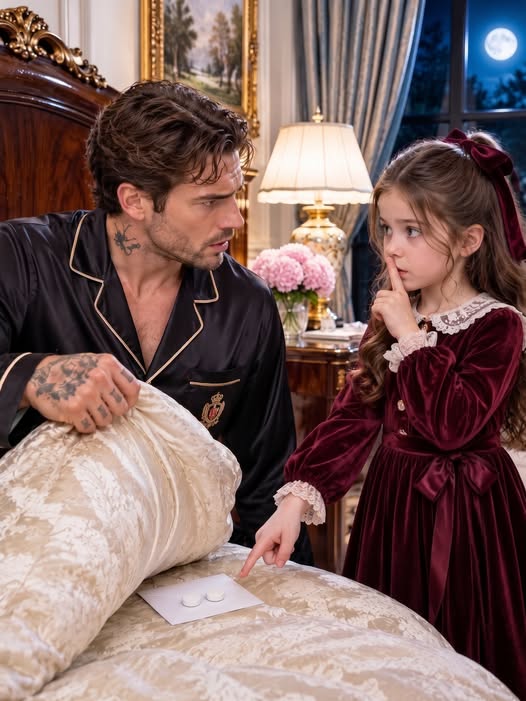
At 3:12 in the morning, a seven-year-old girl walked barefoot into the bedroom of the most feared man on the Georgia coast and whispered in his ear:
“Mr. Kincaid, somebody switches your pills while you sleep.”
Jasper Kincaid opened his eyes.
For eighteen years, warehouse owners, truckers, and businessmen around the Port of Brunswick had learned not to say his name too lightly.
Jasper ran a network of maritime businesses inherited from his father, some of them entirely legal and others wrapped in silences nobody wanted to break.
But the forty-six-year-old man who had intimidated half the coastline could no longer get out of bed without help.
For four months he had been losing weight and hair, his legs barely obeyed him, and he suffered spells of confusion.
The specialists in Atlanta spoke of a strange combination of exhaustion, neurological problems, and an old heart condition.
Jasper had even begun putting his estate in order.
But Hattie Ames, the seven-year-old daughter of his night nurse, had noticed something every adult had missed.
Her mother, Renee, had taken the job at the Kincaid estate because she needed the money.
She had been a widow for five years.
Her husband, Eddie Ames, had died on a night run out to sea while working for one of Jasper’s companies.
Ever since, Renee had distrusted that family.
Hattie, however, understood nothing of last names or old grudges.
She understood numbers.
She counted the thirty-nine steps in the house, the sixty-four floor tiles in the hallway, the gulls that landed on the dock, and even the number of times a loose board creaked outside Jasper’s bedroom.
That was how she discovered that on certain nights, just after three o’clock, someone walked down that hallway.
The person wore checkered slippers.
Came in with a key.
Stayed less than two minutes.
And then disappeared.
Hattie had also noticed that Jasper’s white pills sometimes looked slightly yellowish in the morning, with a different edge.
For five nights she did something no one would have expected from a little girl: she waited for the figure to leave, slipped in quietly, and took away the suspicious pills before Jasper could swallow them.
On the sixth night, she no longer wanted to keep the secret.
“The bad ones are under your pillow,” she said.
Jasper slid a trembling hand under the cloth and found a small packet.
He opened it.
Inside were eighteen tablets.
He looked at Hattie.
“Does your mother know about this?”
The girl shook her head.
“Mama says kids imagine things when they can’t sleep.”
Jasper lay still.
Only five people had a key to that room: his brother Travis, his doctor, the housekeeper, Renee, and Lyle Hargrove, the man who had worked beside his father for more than thirty years.
Any one of them could be waiting for Jasper to disappear.
But there was something worse.
Whoever had been switching those pills didn’t yet know that a seven-year-old had caught on.
Jasper gently took Hattie’s wrist.
“From now on, don’t walk around this house alone at night.”
“Why not?”
Jasper looked at the tablets on the blanket.
Because he understood something that made even him afraid.
If that person found out who had been taking them away, Jasper would stop being their main problem.
Hattie would be next.
The next morning, Jasper used an old phone he kept in a safe and called Dr. Lorraine Whitfield, a toxicologist in Atlanta who had owed him a favor for years.
Lorraine arrived pretending to be a rehabilitation specialist.
She quietly analyzed the tablets and took samples from Jasper.
Forty-eight hours later, she called.
“You’re being given a toxic substance, repeatedly. The tablets you gave me contain a much higher concentration than the earlier ones.”
Jasper was silent.
“How long do I have?”
“If the girl hadn’t pulled several doses, you probably wouldn’t have made it to Monday.”
Monday.
That was the day Jasper was supposed to sign a new will.
Only five people knew.
He decided to pretend he was still getting worse while Lorraine began treating him discreetly.
But he needed Renee.
When he told her what had happened, she stood staring out the window.
“My husband left from one of your docks one night and never came back,” she said. “I took this job swearing my daughter would never have anything to do with your world. And now it turns out she’s spent five nights watching your bedroom because none of your men knows how to protect you.”
“I’m not asking you to do it for me.”
“Good thing.”
Renee wanted to leave immediately with Hattie.
Jasper stopped her.
“If you leave today, whoever is doing this will figure out we know something. Then they’ll ask who found out.”
Renee looked down the hall where her daughter was playing, lining up seashells.
She agreed to stay three days.
The tension exploded the next day.
Travis burst into the bedroom with two guards.
“We found her!”
He was holding a jar with powder inside.
“It was hidden in Renee’s purse.”
The guards held the woman in the hallway while Hattie cried, clinging to her skirt.
Travis pointed at Renee.
“She’s trying to kill you!”
Then Jasper noticed something on the table: an anonymous note telling exactly where to search.
It was too perfect.
He sat up.
After weeks of being unable to walk alone, he put both feet on the floor.
Everyone fell silent.
“Let her go.”
“Jasper…”
“I said let her go.”
Travis went pale.
Jasper ordered that from that night on Renee and Hattie would sleep inside his own room.
Hours later, with the lights off, Hattie said:
“Mr. Kincaid, I forgot to tell you something.”
“What?”
“The man in the slippers smells like peppermint candy.”
Jasper felt his body go cold.
He knew only one person who always carried a round tin of peppermints.
Lyle Hargrove.
The man who had been like a second father to him.
Jasper didn’t sleep that night.
Lyle Hargrove had entered his life when Jasper was eleven.
He had been partner to Walter Kincaid, Jasper’s father, for decades.
After Walter died in a maritime accident, Lyle was the one who held the businesses together, calmed the workers, and taught a young Jasper to run an empire he wasn’t ready for.
When others tried to take advantage of the twenty-year-old who had just lost his father, Lyle stood beside him.
When Jasper made mistakes, he corrected him.
When he won, he never claimed the credit.
He had even sat by Jasper’s bed almost every night since the strange illness began.
That was why Jasper needed to be sure before accusing him.
The next morning he called Lorraine.
The doctor listened to the peppermint clue and answered:
“Don’t build a sentence around a smell. Your doctor uses a menthol rub for his back, too. And half the country buys peppermint candy.”
She was right.
Jasper set a trap.
That afternoon he summoned Travis, Lyle, Dr. Howard Tillman, and the housekeeper, Odessa, separately.
He told every one of them the same thing.
His condition had worsened.
The attorney would arrive at ten the next morning.
It would probably be his last night.
Travis left in tears.
Odessa crossed herself and went to make broth.
Lyle stayed sitting beside Jasper for several minutes.
“I’ve always loved you like a son,” he said.
Then he set a very old bottle of bourbon on the nightstand, one that had belonged to Walter Kincaid.
“We’ll open it when you walk again.”
Dr. Tillman examined Jasper and left a new box of medication.
“Try to rest.”
By midnight, the house was quiet.
Renee and Hattie hid in the walk-in closet with a phone recording.
Jasper pretended to sleep.
One o’clock passed.
Then two.
At 3:07, the board in the hallway creaked.
The door opened.
Checkered slippers appeared on the rug.
A figure moved to the nightstand.
Jasper kept his eyes barely open.
A hand opened the box.
Then he caught a medicinal smell.
Not peppermint.
When the figure turned toward the lamp, Jasper recognized the face of Dr. Howard Tillman.
He opened his eyes and seized the doctor’s wrist.
The doctor dropped the packet he was carrying.
Renee came out of the closet, recording everything.
Howard didn’t even try to run.
He sat down.
And began to cry.
For years he had piled up enormous debts from failed ventures and gambling.
Months earlier, someone had bought all of those debts.
Then photographs started arriving of his daughter, a college student in Boston.
The young woman entering her apartment.
Leaving class.
Having coffee.
Alongside them came instructions.
Switch certain pills.
Don’t ask.
Don’t talk.
“I don’t know who it is,” Howard kept saying. “I’ve never seen his face.”
Jasper watched him without blinking.
The confession seemed to close the circle.
Until Hattie came out of the closet.
She stared at the doctor’s slippers for several seconds.
Then she slowly shook her head.
“It’s not him.”
Renee turned.
“Hattie…”
“The other man drags his left foot a little.”
The girl walked across the room, imitating the sound.
“And he comes more nights. This man only came some of them.”
Howard raised his head.
He confessed that his instructions had him enter only on certain Tuesdays.
But someone else had been replacing the pills too.
There were two people.
One forced into it.
And another who wanted to make sure personally that Jasper didn’t live to sign the will.
Howard’s phone buzzed.
Hidden number.
The message read:
“Why is he still alive? Tomorrow I’ll finish the job. The girl is in the way too.”
For the first time, Jasper felt real panic.
Not for himself.
For Hattie.
The next morning, he went down the thirty-nine steps leaning on the banister while Hattie walked beside him, counting them out loud.
Odessa nearly dropped a tray when she saw him.
The guards thought Jasper could barely sit up, and yet he was standing.
The attorney was sent back.
Howard was held until the sheriff’s deputies arrived.
Then Jasper called in Travis.
His brother walked into the study with shaking hands.
Jasper laid the anonymous note used to accuse Renee on the desk.
“Who paid off your debts?”
Travis denied it.
Jasper repeated the question.
Finally his brother broke down.
A year earlier he had lost an enormous sum gambling.
He hadn’t dared tell Jasper.
Lyle had shown up one day and paid everything.
He asked for nothing.
He only said:
“Someday this house will be yours. Then you’ll remember who stood by you.”
Travis began to cry.
He also confessed that Lyle had planted his suspicions against Renee.
He had reminded him that Eddie Ames disappeared working for the Kincaids and that his widow might hold a grudge.
Jasper rose slowly.
Suddenly he remembered the bottle Lyle had left beside his bed.
He asked Odessa to bring it.
The housekeeper came back without it.
“It’s gone.”
“Where’s Lyle?”
Odessa looked confused.
“He left an hour ago.”
Then she added:
“He took Hattie to school.”
The silence that followed was unbearable.
Renee appeared in the doorway.
“What did you say?”
Odessa explained that Lyle had found the girl eating breakfast.
He told her Renee was busy and that he could drop her at school.
Hattie trusted him.
He always handed out candy to the workers.
Renee dropped the keys she was holding.
Jasper ran to get the old phone from the safe.
There was a message.
“Old pier at Dover Bluff. Come alone. If I see one of your men, the girl will meet the same end as her father.”
Renee read those words.
Her face changed.
“Bring her back to me.”
Nothing more.
Jasper then called the sheriff’s office.
For years his family had lived by avoiding any cooperation with them.
That morning, he told them exactly where he was going.
Then he drove alone to an old abandoned pier beside the marshes.
He found a small wooden boat.
Lyle was inside.
Hattie sat beside the helm, wrapped in a blanket.
She wasn’t crying.
She was counting the pilings of the dock under her breath.
Lyle looked tired.
He didn’t look like a monster.
That was precisely the worst part.
“Get in,” he ordered.
Jasper obeyed.
“Why?”
Lyle gave a sad smile.
“Because you want to destroy everything your father and I built.”
The new will didn’t hand the businesses to Travis.
Jasper had decided to sell most of his maritime companies, shut down the shady operations inherited from decades past, and create a fund for the families of workers who had lost their lives at sea.
Lyle considered that a betrayal.
For years he had been negotiating behind Jasper’s back with foreign groups that wanted to use his shipping routes again.
With Jasper gone and Travis in debt, he would control everything.
“Your brother would have signed any document I put in front of him.”
Jasper looked at Hattie.
“Let her go.”
Lyle shook his head.
“She already knows too much.”
Then he mentioned Eddie.
Renee had always believed her husband’s death was the result of a storm.
It wasn’t true.
Five years earlier, Eddie had stumbled on a secret meeting between Lyle and some middlemen Jasper had banned from his ports.
Eddie threatened to tell.
Days later there was a storm warning.
Lyle tampered with the orders so that Eddie would fill in for the captain of a boat with unresolved mechanical problems.
The boat went out.
It never came back.
Jasper felt the air leave him.
He had trusted Lyle more than anyone.
“Eddie wanted to tell me the truth.”
“Eddie was afraid of you,” Lyle answered. “That was always your problem, Jasper. Everyone obeyed you, but nobody dared talk to you.”
Those words hurt more than any betrayal.
Lyle started the engine.
He meant to head out into open water and make it look as if Jasper, weakened by his illness, had suffered another accident.
But Hattie was staring at a small red cord beside the controls.
Two nights earlier, Jasper had explained to her how the basic safety systems on boats worked.
He had told her that certain engines had an emergency kill switch.
Hattie waited.
Lyle turned toward Jasper.
The girl pulled.
The engine died.
Lyle lost his balance for an instant.
Jasper used that second to lunge at him.
They both crashed onto the wooden deck.
Jasper was weak.
Lyle was older but still strong.
They struggled until Jasper managed to drag him away from Hattie.
Then engines sounded.
Three boats from the sheriff’s marine unit appeared from behind one of the marsh channels.
Lyle understood it was over.
He didn’t resist.
When the deputies boarded the boat, Hattie ran to the first vessel.
Renee was there.
Mother and daughter embraced.
Hattie held out for only a few seconds before she began to cry like the seven-year-old girl who should never have had to be so brave.
Jasper watched them.
Then everything went dark.
He woke twenty-six hours later in a hospital in Savannah.
The first voice he heard was Hattie’s:
“You slept a whole lot.”
The girl was sitting beside the bed, arranging seashells on the sheet.
Lorraine explained that Jasper was recovering well, though he would need months to heal.
Then a sheriff’s captain came in.
Lyle had confessed.
He had also provided documentation about what happened to Eddie, the threats against Dr. Tillman, and numerous activities of the Kincaid companies.
“We’ll have questions for you as well,” the captain warned.
Jasper looked at Renee.
For the first time he understood that changing meant no longer demanding silence.
“I’ll answer all of them.”
And he did.
The following months transformed his life completely.
He sold several companies.
He brought the ones that continued into legal compliance.
He cooperated with the investigation even though it meant admitting to decisions he wasn’t proud of.
Travis voluntarily entered a treatment center for his gambling problem.
Howard lost his license and had to face the consequences of what he had done, though his cooperation made it possible to clear up much of the case.
Lyle never set foot on the Kincaid estate again.
The fund for families of maritime workers began operating in the spring.
The first case file bore the name Eddie Ames.
When Renee received the documents, she went to the house and set them down in front of Jasper.
“I don’t want your money.”
“It isn’t mine.”
She looked at him.
“Then whose is it?”
“Eddie’s. He paid a price for trying to tell the truth. His daughter should receive something better from this family name than an absence.”
Renee was quiet.
Finally she agreed that part of it would be set aside for Hattie’s education.
Months later, Jasper was walking with a cane.
One June afternoon he went down to the river with Renee and Hattie.
The sun was setting over the marshes, and the lights on the boats were starting to come on.
Hattie carried a box full of shells.
She took out a small one, white and pink.
“It was my dad’s.”
Jasper shook his head right away.
“Then you have to keep it.”
“I have a hundred eighty-seven.”
“That’s exactly why.”
Hattie thought for a few seconds.
Then she placed the shell in Jasper’s palm.
“Dad probably would have wanted the person who found out what happened to him to have one.”
Jasper couldn’t answer.
For almost twenty years he had gathered money, boats, property, and people willing to obey his orders.
None of it had protected him.
A seven-year-old girl had.
Renee came over and rested a hand briefly on his shoulder.
Hattie crouched by the water and began counting the little waves rolling up to the shore.
At seventy-three she lost count.
She laughed.
And started again from one.
Jasper closed his hand around the shell.
Then he understood what the real poison in that house had been.
It wasn’t only in a handful of pills.
For years it had been in the fear that kept everyone quiet.
Eddie had known a truth and hadn’t dared tell it.
Travis had hidden his problems.
Howard had obeyed threats.
Renee had lived for five years believing a false version of her husband’s death.
And Lyle had been able to betray him while still sitting by his bed every night.
The only person who broke that silence was the one nobody considered important.
A little girl who counted stairs.
A little girl who noticed pills because they were slightly different.
A little girl who heard a board creak while everyone else slept.
From that day on, Jasper never again teased Hattie when she checked his medication box.
Every Sunday she opened the compartment, counted the tablets, and looked at him with total seriousness.
“All correct.”
And Jasper always answered the same way:
“Then I can sleep easy.”
Because the man the coast had feared for years finally learned the most important lesson of his life from a seven-year-old girl:
Power gets many people to obey you.
But only trust gets someone to dare tell you the truth.
The Shadows of the Port
The rain in Savannah did not fall; it drifted, settling over the salt grass like a gray shroud. On the third day after the rescue on the river, Jasper sat in a high-backed leather chair that felt too large for his shrunken frame. His knuckles, once thick and capable of crushing a ledger binding, were translucent.
Lorraine stood by the sideboard, her fingers hovering over a porcelain teacup. “The sheriff’s office called again, Jasper. They want to know if you’ll sign the deposition today or wait until Friday.”
“Friday,” Jasper said. His voice was no longer the dry bark that had once cleared a boardroom in twenty seconds. It sounded like parchment being crumpled in an empty room. “Let Lyle stew in the county jail a few more days. It will do his joints good.”
“He was your partner for thirty years,” Lorraine murmured, her eyes fixed on the rain-streaked window.
“He was my shadow,” Jasper corrected. “And shadows don’t have blood. They just copy the shape of whatever stands in the light.”
Outside, the heavy dray trucks of Kincaid Shipping rumbled down Bay Street, their diesel engines vibrating through the floorboards of the old office. For decades, those trucks had carried timber, cotton, and things whose manifests were written in pencil rather than ink. Jasper had believed that by keeping the machine running, he was preserving a dynasty. Now, looking at the ledger open on his knee—a ledger where Travis’s debts were itemized alongside port bribes dating back to the Carter administration—he saw that he had only built a very expensive cage.
A soft knock interrupted his thoughts. The door swung open six inches, and a small pink sneaker appeared, followed by a blue denim cuff. Hattie slipped into the room, her hair tied back with a piece of orange twine she’d found in the tack room.
“Are you doing the math again?” she asked, walking straight to his chair and leaning her elbows on his knee.
Jasper closed the ledger with a soft thud that sent a puff of dust into the damp air. “Not math today, Hattie. Just history.”
“History is boring,” she declared, her eyes bright. “Miss Gibson says history is just a bunch of people who forgot to turn off the lights before they went to bed.”
A dry cough that sounded suspiciously like a chuckle escaped Jasper’s throat. “Miss Gibson is a remarkably sensible woman. Remind me to double the school district’s endowment next month.”
“You already did that yesterday,” Hattie said, tilting her head. “I heard you talking to Mr. Vance through the screen door. You said ‘make it fifty thousand and keep my name off the plaque.’”
Jasper stared at her. “You have ears like an otter, child.”
“My dad said you have to listen to the water before it hits the pilings,” she replied, as if that explained everything about human nature, maritime law, and estate administration. Then she reached into her pocket and pulled out a small, jagged piece of yellow quartz. “I found this in the garden. It looks like a tooth.”
“Put it in the box with the others,” Jasper said, nodding toward the mahogany cigar box on the mantelpiece—the one now reserved exclusively for beach stones and bits of sea glass rather than medical prescriptions.
Hattie scampered over, deposited the quartz, and then paused, her hand resting on the carved lid. “Is Uncle Travis coming home today?”
Jasper’s expression tightened, the old lines around his mouth hardening before softening again like wet clay. “Travis is staying at the farm in Aiken for a while. He’s learning how to fix tractors.”
“Do tractors break a lot?”
“If you don’t treat them right, they break into a thousand pieces,” Jasper said quietly. “Just like everything else.”
The Ledger of the Dead
The hearing in the federal district court was remarkably brief. Lyle Kincaid did not look at Jasper when he was led into the wood-paneled room in handcuffs. His gray hair, usually meticulously combed, was tufted on one side as if he had slept in his clothes. He wore the standard-issue orange jumpsuit of the federal holding facility, though he still carried himself with the stiff-backed dignity of a man who believed he owned every square foot of mud between Savannah and Tybee Island.
The prosecutor, a young woman from Atlanta with wire-rimmed glasses and an expression of permanent exhaustion, laid out the charges: wire fraud, obstruction of justice, interstate smuggling, and the falsification of maritime safety records leading to the death of Edward Ames.
When Eddie’s name was spoken, Renee—sitting in the third row with her hands folded tightly in her lap—did not flinch. She had spent five years believing her husband was a careless sailor who had ignored a squall line. Now she knew that the squall had been manufactured in an air-conditioned office on the third floor of the Kincaid terminal, paid for with insurance premiums and signed off in triplicate.
Jasper sat two rows behind her. He had refused the wheelchair, though his cane clicked rhythmically against the terrazzo floor every time he shifted his weight.
When the judge asked Lyle if he had any statement before the court remanded him for sentencing, Lyle stood. He adjusted his shoulders, looked past the bench toward the tall arched windows where the Savannah River was just visible beneath a bridge pylon, and spoke with the flat clarity of an accountant reading an inventory report.
“I kept the doors open,” Lyle said. “When Jasper was building his monuments and Travis was losing the payroll at the card tables in Brunswick, someone had to keep the salt off the books. If the boats stopped moving, the town died. Everyone knew where the grain came from. Nobody asked because they didn’t want the bread to cost twice as much.”
He turned his head slightly, his pale blue eyes locking onto Jasper’s. “You taught me how to look at the bottom line, Jasper. You just didn’t have the stomach to read the last page.”
The judge banged his gavel—not with anger, but with the weary finality of a clerk closing a shop at sunset. Twenty-five years without the possibility of parole. For a man of Lyle’s age, it was an administrative way of saying he would die in a room with a concrete floor.
As the bailiffs led him away, Lyle didn’t look back.
Renee stayed in her seat long after the gallery had emptied. The heavy oak doors swung shut with a muffled thud, leaving only the hum of the overhead ventilation system and the distant sound of traffic on Montgomery Street.
Jasper walked down the row, his cane making a dry tap-tap against the wood. He stopped three feet from her back.
“The federal marshals released Eddie’s personal effects yesterday,” Jasper said, his voice low. “They found them in a locker in Brunswick that Lyle had been paying for under an assumed name.”
Renee turned her head slowly. Her eyes were dry, but there was a hard, brilliant clarity in them that Jasper had never seen during the years she had worked as the estate’s housekeeper—years when she had kept her head down and her voice trained to a polite, submissive whisper.
“What was in it?” she asked.
“A silver pocket watch his grandfather gave him,” Jasper said. “A notebook with seventeen pages of calculations on hull stress—he was trying to prove the company boats were carrying twenty percent more weight than the safety margins allowed. And a letter addressed to me.”
Renee stood up, her skirt rustling slightly in the quiet room. “Did you read it?”
“It was never delivered,” Jasper said. He reached into his coat pocket and drew out a folded, yellowed envelope, the paper thin and brittle at the creases. He held it out by the corner, as if it were an artifact too fragile for human hands. “Lyle must have intercepted it from the mail room the morning after Eddie… the morning of the accident.”
Renee took the envelope. She didn’t open it immediately. She ran her thumb over the cursive writing—firm, precise, entirely unlike the hurried scrawl Travis used when he was asking for an advance on his allowance.
“He told me once that you were the only man in Georgia who understood how a tide table worked,” Renee whispered. “He thought if he told you, you’d fix it. He didn’t know you were the one who signed the insurance riders.”
“I didn’t know about the weight limits, Renee,” Jasper said, and for the first time, a note of raw, defensive fatigue crept into his tone. “The manifests came across my desk in code. I looked at the totals. I didn’t check every bolt on every spar.”
“That was your job, Mr. Kincaid,” she said, using the old title not out of respect, but as a fence between them. She tucked the envelope into her handbag, zipped it shut with a sharp zip, and walked toward the exit without looking back.
The House on the Bluff
The Kincaid estate looked different in the autumn. Stripped of the heavy Spanish moss that Lyle had neglected to trim—fearing it would cost too much to hire the crew—the white pillars of the front portico stood out stark and severe against the pale sky.
Travis had not returned from Aiken. A series of letters, written on lined legal paper in a hand that was slowly recovering its steadiness, arrived every Tuesday. Dear Uncle Jasper, one read, the soil here is different. It doesn’t hold the water the way the marsh does. You have to dig twice as deep to find anything that stays wet.
Jasper spent his afternoons in the glass-enclosed sunroom, watching the egrets pick their way through the mud flats where the river curved toward the sound. His legs refused to carry him down the long wooden dock anymore, so he had ordered a low stone bench built halfway down the slope, where the smell of salt was strong enough to sting his nostrils.
Hattie came every afternoon at four o’clock, carrying her schoolbag and a small tin box of ginger biscuits Lorraine baked for her.
“Miss Gibson says I’m the best in my class at long division,” she announced, dropping her bag onto the rattan settee with a heavy thump.
“Long division is an aggressive pursuit,” Jasper murmured, not turning from the window. “It assumes that everything can be divided evenly, which is usually a lie.”
“Everything can be divided if you have a big enough knife,” Hattie said reasonably. She sat down beside him on the wicker chair, her small legs swinging three inches off the floor. She pulled out a small black ledger—a miniature version of the ones Jasper had kept for sixty years—and opened it to a page covered in jagged pencil marks. “I made a list of all the boats that belong to us now.”
Jasper turned his head slowly. “Us?”
“Well, you and the court,” she corrected. “The man with the briefcase said the judge put them in a trust for the people who work here. But you’re still the one who has to sign the checks.”
Jasper looked down at the child. Her fingers were smudged with graphite, the same gray smudge that had marked Eddie’s hands every evening when he came home from the slip.
“What are you planning to do with the Cormorant?” Jasper asked, naming the forty-foot tug that had once been Lyle’s personal launch.
“We’re going to paint it yellow,” she said without hesitation. “And we’re going to use it to carry the school children across to Barnwell Island when the bridge is down for repairs.”
“Yellow,” Jasper repeated, a dry sound rattling in his chest. “That’s a very loud color for a boat that’s spent forty years carrying contraband whiskey and uninspected timber.”
“It’ll make it easier to see if it starts to sink,” she said, as if discussing the most obvious law of physics in the universe.
The front doorbell chimed—a heavy, brass-weighted ring that hadn’t sounded for a stranger in twenty years. Lorraine appeared in the doorway two minutes later, her face set in lines of cautious disapproval.
“There’s a man from the Savannah Morning News in the foyer,” she said, her voice dropping an octave. “He wants an interview about the reorganization of the shipping lines. Says the state legislature is asking questions about the tax abatements from 1994.”
Jasper closed his eyes. For fifty years, the Kincaids had handled reporters the way they handled stray dogs—by setting the gatekeepers on them until they went back across the county line.
“Tell him the Kincaid offices are permanently closed to anyone who doesn’t carry a bill of lading,” Jasper said.
“I already told him that,” Renee’s voice came from behind Lorraine. She had entered quietly through the garden door, her boots caked in gray marsh mud. She held a gardening trowel in one hand and Eddie’s pocket watch in the other, the silver chain dangling like a dead vine. “He’s not leaving, Jasper. He’s sitting on the horse mounting block with a notebook.”
Jasper looked from Lorraine to Renee. The house, which had once been a fortress built on silence and absolute obedience, was suddenly full of people who refused to lower their voices.
“Bring him in,” Jasper said after a long silence.
“Into the study?” Lorraine asked, horrified.
“No,” Jasper said, rising with the slow, deliberate care of a man lifting a heavy anchor. He picked up his cane. “Into the front yard. If he wants to write about the Kincaids, he can do it standing in the mud where the rest of us live.”
The Weight of the Tide
The article appeared on a Thursday, tucked away on page four of the state section under a dry, bureaucratic headline: Kincaid Shipping Disbands Legacy Fleet; Trust Established for Maritime Families.
It didn’t mention the pistol in the mahogany desk. It didn’t mention the green pills or the way Lyle had looked when the federal marshals clicked the cuffs around his wrists. It spoke only of restructuring, of legal compliance, of an aging patriarch who had decided that an empire built on closed mouths was no longer worth the cost of the paper it was printed on.
By November, the salt air had turned sharp, smelling of dead spartina grass and woodsmoke from the oyster shacks down the creek.
Travis came back for three days. He didn’t stay at the big house; he slept in the old net-loft above the boat slip, where the smell of Stockholm tar and rotting hemp had lingered since the 1920s. He looked heavier—not with the bloated softness of his drinking days, but with the solid, square-shouldered bulk of a man who had spent six weeks swinging a pickax in the Georgia clay.
On his last morning, he walked up to the sunroom while Jasper was eating his porridge. He didn’t knock; he simply pushed the French doors open, letting in a gust of cold river air that made the curtains billow.
“I’m staying in Brunswick,” Travis said without preamble. He didn’t look at his uncle; he looked out at the gray water where the tide was beginning to turn against the pilings.
Jasper set his spoon down. The silver made a sharp ting against the china. “The yard on the south slip is yours if you want to run it legally. There are four tugs left that haven’t been condemned by the coast guard.”
“I don’t want the tugs,” Travis said. His voice was flat, devoid of the old whining cadence that used to make Jasper’s fingers twitch toward his cane. “I’m working for the dredge commission. Operating the crane on the mud scow.”
Jasper stared at him. “You’re an officer of Kincaid & Sons. You have a degree from Emory in corporate finance.”
“And I spent ten years signing my name to papers I never read while people died in the marsh,” Travis said, turning his pale, ruined eyes toward his uncle. “The crane’s simpler, Jasper. If you drop the bucket, the mud goes where you put it. You don’t have to lie to an auditor to explain why the hole is empty.”
He laid a set of brass keys on the edge of the table—the keys to the brick warehouse by the city market, the ones where the smuggled tobacco and the unregistered ledger books had been kept during the federal embargoes of the nineties.
“What about the house?” Jasper asked, though he already knew the answer.
“Keep it,” Travis said. “Or give it to Hattie. She’s the only one who ever counted the stairs right anyway.”
He turned and walked out, his boots heavy on the gravel path. Jasper didn’t call after him. He watched through the thick glass as Travis climbed into a battered Ford truck with prime-colored fenders, shifted into first with a grinding of gears, and drove down the shell drive without looking back once at the white columns.
The Winter Ledger
The winter of 2026 was the coldest the low country had seen in a decade. A skim of white ice formed over the shallow salt pans behind Barnwell Island, and the wild ducks sat huddled in the gray reeds, too stiff to rise when the oyster boats put out at dawn.
Jasper spent most of his time in the small library on the ground floor, where the fireplace could be kept small enough to manage without choking his lungs.
Renee brought his broth at noon. She didn’t leave immediately, as she used to do when she was merely the housekeeper executing an order. She stood by the mantelpiece, her fingers touching the edge of the cigar box where Hattie kept her stones.
“The county commissioners voted on the dock repairs,” she said.
“And?” Jasper asked, not looking up from a volume of admiralty law from 1912.
“They approved the grant for the public landing. But they want to know if you’re going to contest the property line where the old cooperage used to stand.”
Jasper closed the book. The leather was dry and flaked off on his thumb like dried tobacco. “Tell them the property line goes wherever the high-water mark was before the hurricane of ’84. If the state wants the mud, they can have it. There’s nothing in it anymore.”
Renee looked at him for a long moment. The lines around her mouth had softened over the past six months, but her eyes retained that terrible, bright clarity—the look of a woman who had spent five years walking through a fog and had finally reached the dry dirt on the other side.
“Eddie’s watch,” she said softly. “I had it cleaned. The jeweler in Savannah said the mainspring was broken, but he managed to fix it.”
“Did it keep time?” Jasper asked.
“It’s twenty minutes fast,” she said. “Always was. Eddie liked to think he was arriving before he got there.”
A faint, dry sound came from Jasper’s chest—not a laugh, but the acknowledgment of one. “He was a good mechanic. Better than the men we were hiring out of Charleston.”
“He was an honest man, Jasper,” she corrected, her voice dropping an octave so that it seemed to vibrate against the brick of the fireplace. “That was his real mistake. He thought an engine would run right just because you told it the truth about its pistons.”
She set the tray down—the bowl of broth had a skin forming over the top—and walked toward the door. Just before she reached the threshold, she stopped.
“Hattie found another one,” she said.
“Another what?”
“Another stone. A round one this time, dark as a crow’s wing. She says it’s a weather stone.”
“What does a weather stone do?” Jasper asked.
“It tells you when to stay inside,” Renee said, and for the first time in her life, she closed the door without waiting for his permission.
The Spring Tides
The marsh turned green almost overnight in April, the sharp spikes of new cordgrass punching through the dead thatch of the previous year like green needles through a quilt.
The foundation for the Eddie Ames Memorial Clinic—funded by the liquidation of Lyle’s private accounts and three parcels of timberland Jasper had deeded over without consulting his lawyers—was poured on a Wednesday morning behind the county wharf.
Jasper didn’t attend the ground-breaking. He sat on the porch with a woolen blanket over his knees, watching the tugs move upriver against the current through a pair of brass marine binoculars that had belonged to his grandfather.
Hattie sat on the top step, her bare feet tucked under her skirt, sorting through a fresh handful of river shells she had collected during the morning recess.
“The man with the shovel said my dad’s name is going to be on the copper plate by the door,” she said, her voice small and steady against the background noise of the mockingbirds in the live oaks.
“It is,” Jasper said.
“Will people read it when they go to get their teeth fixed?”
“They’ll read it every time they walk into the building,” Jasper answered. “And if they have any sense, they’ll remember why it’s there.”
Hattie picked up a flat, gray oyster shell, turned it over twice in her palm, and tossed it onto the gravel path. It landed with a dry click. “My mom says we’re going to move into the little house by the creek next month. The one with the green shutters.”
Jasper’s hands tightened on the leather wrapping of the binoculars. “The brick cottage? That’s drafty in the winter. The roof needs new cedar shingles.”
“Mom says we can fix the roof ourselves,” Hattie said simply. “Uncle Travis brought over a box of copper nails and a hammer with a rubber head so it doesn’t make too much noise.”
Jasper stared out across the marsh toward the gray line where the river met the sound. For seventy-three years, he had believed that nothing in the low country could happen without his permission, his signature, or his money. He had owned the boats, the docks, the ledger books, and the silence of the men who worked them.
Now the house was full of drafts, the roof leaked when the northeast gales blew in from the sea, and the little girl on the steps was planning to shingle her own kitchen with a rubber hammer.
“Tell your mother,” Jasper said, his voice rough with the sudden dryness in his throat, “that if she uses cedar from the north ridge, it won’t rot when the summer damp sets in.”
Hattie looked up, her eyes wide and clear. “You have cedar?”
“In the old timber shed behind the net-loft,” Jasper said. “The stuff Lyle bought in ’98 and forgot to use because he was too busy counting what it cost.”
The child grinned—a quick, sharp flash of white teeth in a brown face—and stood up, brushing the dirt from her skirt with both palms. “I’ll tell her. But we’re going to haul it ourselves in the red wagon.”
“The red wagon has a broken axle,” Jasper noted.
“Uncle Travis fixed that yesterday,” she said, already turning toward the path that led down to the creek. “You don’t know everything, Mr. Kincaid.”
Jasper watched her small, skinny figure skip down the shell drive, her blue dress fluttering against the dark green of the privet hedges. He didn’t answer. He laid the binoculars down on the wicker table, reached into his coat pocket, and pulled out the small pink shell she had given him six months before.
It was smooth now, worn round by the friction of his thumb during the long, sleepless nights when the wind came off the marsh and rattled the windowpanes.
He closed his hand around it, feeling the hard, cool edge press into his palm.
The tide was coming in. Down at the landing, the water was rising against the green pilings, covering the old mud, the oil slicks, and the dark stains that had lingered since the summer Eddie went out on the boat with the bad steering gear. It covered everything, washing it clean in the salt and the gray silt, leaving only the water, the sky, and the long, flat line of the horizon where the sun was beginning to go down behind the pines.
THE END..!