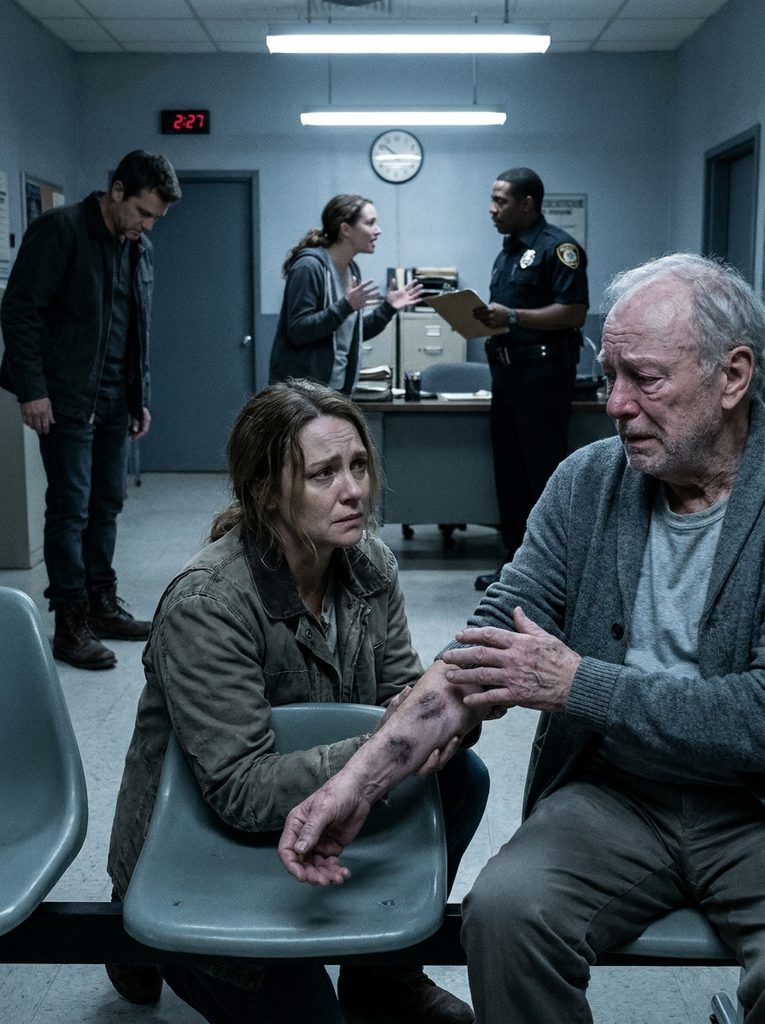
I demanded to know how he could betray the man who raised us. But then Dad reached for my hand, his sleeve slipped down, and what I saw made my blood run cold…
At 2:27 a.m., my eighty-year-old father called me from a police station in Little Rock, Arkansas. His voice was so unsteady that I could barely understand him.
“Sweetheart, Tanya hurt me. Now she’s telling the police I’m losing my mind.”
Then he said something that frightened me even more.
“Garrett was right there. He saw everything, and he won’t tell them the truth.”
My brother had always been Dad’s favorite fishing partner, the son he’d helped through a failed business and more than one financial crisis. I couldn’t imagine him standing by while our father was accused of something he hadn’t done. But when I asked Dad whether he was hurt, he whispered, “Please just come get me,” and the call ended.
I pulled on jeans and a sweater, grabbed my keys, and drove through the nearly empty streets. I’d worked in federal law enforcement for seventeen years, long enough to know that a frightened caller rarely tells the whole story over the telephone. But this wasn’t a witness or a stranger asking for help. It was the man who’d taught me to ride a bicycle, checked the oil in my first car, and sat beside my hospital bed when I had pneumonia at twenty-three.
At the station, I found Dad sitting alone in a molded plastic chair near the wall. His gray cardigan hung loosely from his shoulders, and his hands were clasped tightly in his lap. Across the waiting area, my sister-in-law, Tanya, was speaking to an officer while Garrett stood beside her, staring at his boots.
“He’s been confused for months,” Tanya insisted. “Tonight he got aggressive. We can’t keep pretending he’s capable of living alone.”
Dad lifted his head when he heard my voice.
“I’m here,” I told him, kneeling beside his chair. “You’re coming with me as soon as we know you’re all right.”
His eyes filled with tears. “I didn’t do what she’s saying.”
“I believe you deserve to be heard, Dad. First, tell me where you’re hurting.”
He tried to stand, perhaps to prove he was fine, but his knees gave way almost immediately. I caught his elbow and helped him settle back into the chair. His cardigan sleeve slipped toward his elbow, revealing several dark marks around his wrist.
I had seen enough injured people in my career to know that marks like those required medical attention, not speculation from a daughter who happened to carry a badge.
“Dad, did someone grab your arm?”
He pulled the sleeve down.
“It’s nothing. I don’t want any more trouble.”
I looked toward Garrett. He had watched his father nearly collapse without taking a single step forward.
That was the moment I stopped thinking of this as an ugly family argument.
I approached the desk and asked for the officer handling the incident. Officer Dunning introduced himself and explained that deputies had responded to a disturbance at Dad’s house after Tanya called 911.
“My father is having trouble standing, and he has visible injuries,” I said. “Has anyone requested medical assistance?”
“He declined treatment at the scene, ma’am.”
“I’d like someone to ask him again, away from the people involved in the complaint.”
Dunning glanced toward Tanya. “We’re still sorting out conflicting statements.”
“I understand. I’m his daughter, and I also work in law enforcement. I’m not here in an official capacity, and I won’t interfere with your investigation. But he’s eighty, he’s injured, and he needs to be examined.”
I never imagined I’d have to say those words about my own father. This was the man who held my hand through every childhood fear, who worked himself tired making sure Garrett and I never went without. Now he sat trembling in a police station, afraid of causing trouble, while his own son looked away. Folks, how could my brother abandon the very man who’d never once abandoned us?
A supervising officer came out a few minutes later. I explained what I’d observed, then returned to Dad while they arranged an ambulance. I also asked that his account be taken privately, without Garrett or Tanya listening.
Tanya approached before the paramedics arrived.
“You always do this,” she said, folding her arms. “You show up after months away and act like you know what’s going on.”
“I’m trying to get Dad medical care.”
“He needs psychiatric care. He accused me of stealing from him tonight. Then he started yelling and waving his arms around.”
Garrett finally looked at me.
“Sis, things have been getting bad. He’s forgetting stuff.”
“Then why didn’t you call me?”
He hesitated. “We didn’t want to worry you.”
“You let him get taken to a police station in the middle of the night, but you didn’t want to worry me?”
Tanya stepped closer. “Don’t make this about Garrett. We’ve been the ones looking after your father.”
I looked directly at my brother.
“Did you see what happened tonight?”
His mouth tightened. “It was a mess. Everybody was upset.”
“That’s not what I asked.”
“I don’t want to get into it here.”
Before I could answer, the paramedics arrived. Dad agreed to be examined after I assured him that going to the hospital didn’t mean he was being committed to a psychiatric facility.
As they helped him onto the stretcher, he caught my hand.
“Your brother’s going to be angry.”
I leaned close enough that only he could hear me.
“You don’t have to make decisions based on whether Garrett gets angry. Not tonight.”
At the emergency department, Dr. Whitmore examined Dad and ordered imaging of his legs and lower back. The bruising was extensive, and his left wrist was swollen. Dad kept insisting he’d be fine after a little rest, but the doctor explained that injuries in an older adult could be more serious than they initially appeared.
While we waited for the imaging results, I sat beside his bed and asked what had happened.
Dad stared at the blanket.
“Garrett and Tanya came over after supper. They brought papers.”
“What kind of papers?”
“Something about putting the houses into a trust they could manage. They wanted me to sign over control of the accounts too.”
“Did you sign?”
“No.” He said it with a trace of the old stubbornness. “I told them I’d have Harold Pruitt look at it first. He’s done my legal work for thirty years.”
“And what did they say?”
“Tanya said Harold was too old to be trusted. Then she said I was too old to be trusted.” He swallowed. “I stood up to go to the kitchen. She grabbed my wrist and told me to sit down and sign. When I pulled away, she shoved me. I hit the edge of the table and went down.”
I kept my voice level. It was the voice I use in interviews, because anything else would have made him stop.
“Where was Garrett?”
“In the doorway. He said, ‘Tanya, that’s enough.’ But he didn’t come in. He just watched.” Dad’s chin trembled. “When I tried to get up, I couldn’t. She picked up the phone and called 911. By the time the deputies came, she had it all worked out. She told them I’d thrown a lamp and accused her of stealing. There wasn’t any lamp, honey. I haven’t thrown anything since Eisenhower.”
I almost laughed, and then I almost cried.
“Dad, there’s something I want to look at. May I see your arm?”
He hesitated, then pushed the cardigan sleeve up past his elbow.
I had expected the grip marks on his wrist. I had not expected what was above them.
There were more bruises along his forearm and upper arm. Some were yellow-green, fading. Some were purple. A few were nearly gone, pale shadows with edges I could still make out. They were different ages. Fingers, in some, and in others a flat, wide shape, as if his arm had been struck against something hard.
I looked at them for a long time. My hands, flat on the blanket, had gone cold.
“Dad,” I said carefully. “How long has this been going on?”
He pulled the sleeve down again, and the shame in the gesture broke something in me.
“Since March,” he said. “After Garrett’s business went under again. They moved in to ‘help.’ She says I bruise easily.”
It was November.
I did what I’d been trained to do. I did not go looking for my brother, and I did not raise my voice. I took out my phone and photographed the injuries with Dr. Whitmore’s permission and a nurse present as witness, noting dates, times, and angles. I asked the doctor to document everything in the chart, including Dad’s own account, in his own words.
Then I called Adult Protective Services.
The after-hours caseworker, a woman named Renata Cho, took my report with the calm of someone who had taken a hundred like it. She asked about Dad’s living situation, finances, and mental state. Then she said something I would remember.
“Ma’am, the single most important thing right now is that he doesn’t go back to that house tonight. Can you take him?”
“Yes.”
“Then I’ll open the case and send someone first thing in the morning. And I’d advise you, if it’s safe to do so, not to discuss any of this with your brother or his wife until we’ve spoken.”
I looked through the glass of the room. Down the hall, I could see Garrett on a plastic chair, elbows on his knees, head in his hands. Tanya had gone to the cafeteria. For a moment, I almost walked down to him. I wanted to shake him. I wanted to ask whether he could look at himself in the mirror.
I didn’t.
At six in the morning, Dr. Whitmore came in. Dad’s wrist was fractured, a hairline break. His lower back was badly bruised, and one of his ribs had a crack. Nothing that would not heal, the doctor said, but it would have been far worse if I hadn’t brought him in.
“One more thing,” she said quietly. “I did a basic cognitive screening, with his consent. He scored in the normal range for his age. Whatever his daughter-in-law told the deputies, I see no evidence that he’s confused.”
“Could you put that in writing?”
“I already have.”
APS opened the case that morning. Caseworker Cho arrived at my house by nine, where I’d put Dad in the spare room with his slippers and a stack of the westerns he loved. She interviewed him alone for an hour. When she came out, her face was tight.
“He’s very clear,” she said. “Consistent on every detail.”
“What happens now?”
“We’ll refer it to the prosecutor and the sheriff’s elder-abuse unit. But I’ll be honest. Cases like this often come down to one person’s word against another’s, especially when family members are the accusers.” She paused. “Is there anything that might corroborate his account?”
I thought about it.
Then I remembered something Dad had said two months earlier on the phone, offhand, the way he mentioned everything. The neighbor kid put a camera on my porch. Says it’ll scare off the porch pirates.
“Mr. Fenner’s grandson,” I said slowly. “He installed a doorbell camera on Dad’s front porch.”
Cho’s eyebrows rose. “Does it record to the cloud?”
“I don’t know. I’d have to ask.”
It took me two hours to get Dad’s phone password from his memory, and another to get into the account. The camera didn’t cover the living room, but it covered the front door. It covered every arrival and departure for the past eight months.
And it had an audio feed.
I sat at my kitchen table with my laptop and Caseworker Cho beside me, and I opened the file from the previous night at 10:41 p.m.
We didn’t need the living room. Through the front door, muffled but clear, we could hear everything.
“Sign it, Walter.” Tanya’s voice, sharp. “Sign it or I swear.”
“I want Harold to look at it.”
“Harold is a dinosaur. You’re a dinosaur.”
A crash. A cry of pain, short and high.
“Tanya, that’s enough.” That was Garrett, from the doorway, his voice weak and nasal, like a boy who had been caught.
“Don’t you dare ‘enough’ me. You owe forty thousand dollars to people who don’t send reminders. He’s got a house paid off and three hundred thousand in the bank, and he’s going to die with it rotting there.”
A silence. Then, quietly, Garrett: “I know.”
Cho looked at me. I looked at her.
Neither of us spoke for a long time.
Garrett found me at my house two days later.
I let him in, because I wanted to see his face. He looked like he hadn’t slept. His shirt was wrinkled, and his hands hung at his sides.
“I got a call from a detective,” he said. “She says there’s a recording.”
“There is.”
He sat down hard on the edge of the couch.
“I didn’t know she’d gone that far,” he said. “I swear to God, Abby, I didn’t. She said the papers were just to protect him. She said it was the safest thing.”
“You stood in the doorway while she pushed him.”
“I froze.” His voice cracked. “I’ve never been able to stand up to her. When she gets like that…”
“Garrett.” I kept my voice low. “I’ve interviewed hundreds of people who say they froze. Some of them mean it. Some of them use it as a shield. I’m not sure which you are.”
He put his face in his hands.
“I know what I did,” he said. “And what I didn’t do. And the bruises. She said he’d bruise easily. I wanted to believe that.”
“How many months did you want to believe it?”
He didn’t answer.
“There’s something else,” he said finally. “I owe a lot of money. More than Tanya told you. I took out loans in Dad’s name last year. I forged his signature.”
I felt the room go quiet around me.
“You what?”
“Two loans. Eighty thousand dollars total. I was going to pay them back before he ever found out.” He looked up. His eyes were red. “That’s why the trust. If everything was under Tanya’s control, nobody would have to look at those loans.”
I thought of Dad at eighty, in a plastic chair at a police station in the middle of the night, with a cracked rib and a broken wrist.
“I can’t promise you anything,” I said. “But I can tell you what I’d do in your position. I’d walk into the prosecutor’s office this afternoon, with a lawyer, and tell the truth. Everything. Not just the loans. The bruises, the months, the doorway.”
“They’ll put me in prison.”
“Maybe,” I said. “But if you do it first, maybe they won’t. And Dad would know you tried.”
He stared at me for a long time.
“Does he hate me?”
“No,” I said. “That’s the worst part. He doesn’t.”
Garrett went to the prosecutor that afternoon.
He gave a full statement, with an attorney beside him, about the loans, the forged signatures, Tanya’s threats, and the months of bruises he had seen and pretended not to. He turned over text messages, bank records, and a notebook in which Tanya had planned the timeline of the trust.
“We want him to testify,” the prosecutor told me. “His cooperation is the difference between a strong case and an airtight one.”
Tanya was arrested the following Monday. She was charged with felony elder abuse, financial exploitation of an elderly person, false reporting, and conspiracy to commit fraud. She screamed in the parking lot of the sheriff’s office that she had been framed, and the arresting deputy, I’m told, did not look up from his clipboard.
The trial took seven months.
Dad testified on the second day. He walked into the courtroom slowly, with a cane and a pressed blue suit he had worn to my own graduation. I had asked him whether he wanted me to sit with him. He said no, he’d do it himself.
He told the jury everything in the same steady voice I had known all my life. He didn’t exaggerate. He didn’t embroider. When Tanya’s lawyer tried to suggest that his memory was unreliable, Dad looked at him and said, “Son, I remember what I had for breakfast on every Tuesday for the past fifty years. I remember what happened to me in my own living room.”
A juror in the front row, a heavyset man in a plaid shirt, put his hand over his mouth.
The doorbell recording was played in court. It lasted four minutes and eleven seconds. When it ended, nobody moved.
Tanya was convicted on all counts. The judge sentenced her to twelve years.
Garrett pleaded guilty to forgery and the lesser charge of failing to report abuse. In exchange for his cooperation, he received five years’ probation, full restitution of the stolen eighty thousand dollars, and two thousand hours of community service. The judge said, in open court, that cooperation was the only reason he wasn’t going to prison.
“Mr. Hollis,” she said, “you were given a chance your father never had. I suggest you use it.”
Dad didn’t go back to the house that fall. He stayed with me for two months while the cracked rib healed and the wrist knit. I took leave from work, which my supervisor granted without a single question. We ate dinner at the kitchen table every night, and he told me stories I’d never heard, about the Korean War cooks he’d bunked with, and the winter our family car froze in a ditch outside Hot Springs, and the day I was born.
Harold Pruitt came by with a folder and a thermos of coffee, and the two of them sat at my table, working for three afternoons. By the end, Dad had a new will, a durable power of attorney naming me and an independent professional fiduciary, a medical directive, and a plan to keep him in his home as long as he wanted.
“I’m not going to a facility,” Dad said firmly on the third afternoon.
“No one is making you.”
“I’d like Mrs. Alvarez from church to come three days a week,” he said. “She’s a nurse. She makes good tamales.”
“Done.”
“And I want Garrett to come to the house on Sundays.”
I set down my pen.
“Dad.”
“I’m not saying he gets a key or a check or a say in any of it.” His voice was gentle. “But he’s my son. He made a terrible mistake, and then he did the one thing that took courage. I’d like to see him, and I want you to be there.”
I thought about it for a long time.
“Okay,” I said. “Sundays. With me there.”
The first Sunday was excruciating.
Garrett arrived at noon, early, carrying a pie from the bakery near his apartment. He stood on the porch for nearly a minute before he rang the bell. Dad opened the door himself.
“Hello, son.”
Garrett burst into tears.
Dad pulled him into a hug, an old man in a cardigan holding a grown man who was shaking against his shoulder. I stood in the hallway with my arms crossed, pretending to examine the wallpaper.
Over the following months, they built something small. Garrett was never trusted with money again, and he never asked to be. He mowed the lawn. He fixed the porch step. He sat with Dad in the evenings, watching Razorbacks games, and learned how to be quiet in a way that wasn’t cowardice. He attended counseling. He attended a gambling support group. When the restitution payments came due, they were on time.
I did not forgive him all at once. Forgiveness, I’ve learned, is less a door than a staircase, and some of its steps are very steep. But about a year after the verdict, on a Sunday in the middle of October, Garrett and I were washing dishes after lunch, and he said, without looking up, “Thanks for not letting me off the hook.”
“You didn’t ask me to.”
“No.” He rinsed a plate. “But I needed someone to.”
I took the plate from him and dried it.
“I wasn’t sure what you’d do,” I said. “That night at the station. I didn’t know whether you’d back her or him.”
“I didn’t either,” he said. “Until you walked in.”
I think about that sometimes. It wasn’t a badge or a federal career that made the difference, though I used both. It was a daughter who came when her father called at 2:27 a.m., and who believed him before she had any proof.
Dad is eighty-two now. His wrist has healed, though it aches when it rains. He still fishes every second Saturday at the lake, with Garrett paddling the boat and me packing sandwiches. Last week, I noticed him watching the two of us from the dock, a thermos in his hands and a crooked smile on his weathered face.
“What?” I asked.
“Nothing,” he said. “Just thinking about the night you were born.”
“What about it?”
“The nurse put you in my arms,” he said, “and I thought, well, here’s somebody who’s going to look after me someday.” He sipped his coffee. “I was right.”
I sat down beside him on the dock, and for a long while, neither of us said anything. The sun was coming up over the water, pink and gold, and somewhere across the lake a heron lifted off the shallows.
Some families break in ways that can’t be repaired. Ours broke, and then, slowly and unevenly, with a great deal of effort and no guarantee, it was pieced back together. Not the way it was before. Better, in a way. Honest.
And on Sundays, there was pie.
The Aftermath of Accountability
The glow of the courthouse lights had barely faded when the real work began. A criminal conviction of twelve years for Tanya was a legal milestone, but for our family, it was merely the clearance of debris. The house on Elm Street remained ours, though its walls seemed to exhale a long-held breath of relief. For weeks, the scent of fresh paint and bleach replaced the lingering odors of fear and neglect.
Garrett’s probation officer, a formidable woman named Agent Vance with steel-gray hair and an unerring BS detector, met with Garrett every Tuesday morning at 8:00 sharp. I attended the first three sessions at Garrett’s nervous request.
“Mr. Hollis,” Agent Vance had said, sliding her glasses down her nose, “your sister tells me you’ve been entirely cooperative. The court sees your contrition. But probation isn’t a reward; it’s a microscope. Every receipt, every community service hour at the county food bank, every minute of your Gamblers Anonymous meetings will be logged and verified. Do we understand each other?”
“Yes, ma’am,” Garrett had replied, his voice barely above a whisper.
“Good. Because your father’s grace is your business, but your compliance is mine.”
That first month, Garrett lived on a strict budget consisting of instant ramen, black coffee, and whatever groceries I dropped off on my way home from work. He had sold his car—a sporty sedan he’d bought with questionable funds—and bought a beat-up bicycle with a squeaky chain. When it rained, he walked the two miles to his job at a local hardware store where he worked the lumber counter, lifting heavy beams and measuring timber until his hands blistered and calloused.
Dad watched him from the porch on those Friday afternoons when Garrett stopped by to check the gutters or mow the lawn. He didn’t offer praise immediately. Dad knew, better than anyone, that true remorse isn’t bought with a few weeks of good behavior; it has to be proven across the changing of seasons.
The Reconstruction of Trust
Rebuilding trust with a sibling who has watched you fail is harder than building it with a stranger, because the stranger doesn’t remember what you looked like when you were ten years old and stealing pennies from the change jar.
One evening in November, about six months after the trial, Garrett came over while Dad was napping. We sat on the back patio with two mugs of lukewarm tea. The autumn wind was stripping the last red leaves from the maples, swirling them across the grass.
“She called me,” Garrett said suddenly. His hands were clasped tightly around his mug.
I froze. “Tanya?”
“From the correctional facility down in Tucker. It was a three-minute prepaid call. Automated voice said it was an incoming call from an inmate. I didn’t pick up the first time. But she called back.”
“Did you talk to her?”
“For about twenty seconds,” Garrett said, staring into the dark amber liquid of his tea. “She didn’t ask how Dad was. She didn’t ask how I was doing. She wanted to know if I still had access to the safety deposit box under the stairs, and whether I’d talked to the appellate lawyer about getting her asset freeze lifted.”
A cold spike of anger hit my chest, but looking at Garrett, I saw something else—clarity. The fog of manipulation that had enveloped him for years had finally burned away.
“What did you tell her?” I asked quietly.
“I told her I didn’t have access to anything, that I was working forty hours a week at the lumber yard, and that if she ever called me again, I’d block the number.” He looked up at me, his eyes dead steady. “And then I hung up. I called Agent Vance right after and reported the contact.”
I reached across the small metal table and laid my hand over his scarred knuckles. “Good.”
“It felt heavy,” Garrett admitted, his voice cracking slightly. “For a long time, I thought pleasing her was the same thing as being safe. Now I realize it was just a slow way of dying.”
That night, the invisible wall that had separated us since childhood didn’t entirely vanish, but a door opened in it. We began to talk—really talk—about the pressures of growing up in a home where perfection was expected and failure was met with cold silence. We talked about Mom, who had passed away years before, and how her quiet endurance had shaped our different flaws: Garrett’s desperate need for approval, and my fierce, protective hyper-independence.
The Legal and Financial Blueprint
While Garrett mended his life on the physical plane, Harold Pruitt and I worked tirelessly to ensure that Dad’s remaining years would never again be vulnerable to predators.
The new estate plan was a fortress of legal safeguards. The property deed was placed into an irrevocable family trust managed jointly by myself and a fiduciary corporation in Little Rock—meaning no single individual, not even me, could sell the house or alter the beneficiaries without dual authorization and court oversight.
Harold Pruitt, now well past the age when most attorneys retire, sat in my living room one rainy afternoon sipping bourbon and reviewing the final documents.
“You know, Clara,” Harold said, tapping his fountain pen against the leather-bound folder, “in forty-eight years of practicing law, I’ve seen families torn apart over much less than eighty thousand dollars and a fraudulent deed. Most people want vengeance. They want blood in the courtroom.”
“I wanted justice,” I corrected gently.
“You got justice,” Harold agreed. “And more importantly, you got your father back whole. That’s rare. People like Tanya—they rely on our desire for politeness. They count on us being too embarrassed to make a scene, too afraid of family scandal to call the cops. Your father was lucky you didn’t care about politeness.”
“I learned it from him,” I said. “He spent his whole life being decent to people who didn’t deserve it. It was time someone returned the favor.”
Dad walked into the room just then, wearing his old green cardigan and carrying a plate of sliced apples. He set them on the table between us.
“Is Harold talking shop again?” Dad asked, raising an eyebrow. “I can smell the legal jargon from the kitchen.”
“Just admiring your defense team, Dad,” I smiled.
Dad sat down heavily in his favorite armchair, wincing slightly as his ribcage adjusted. “Defense team? We aren’t fighting a war anymore, Clara. We’re just living. And frankly, the living part is much more pleasant without auditors and emergency room visits.”
Sundays on Elm Street
The Sunday dinners became an institution. What started as an excruciating exercise in forced reconciliation gradually transformed into the anchor of our week.
Mrs. Alvarez, the retired nurse and culinary artist from Dad’s church, ensured that our Sundays were blessed with food that could cure almost any spiritual ailment. Her tamales became legendary in our small circle—steaming corn husks filled with slow-cooked pork, red chilies, and spices that filled the old house with warmth every Sunday morning.
Garrett arrived punctually at 11:30 AM every week. He no longer stood on the porch hesitating; he walked right in, hung his jacket on the peg by the door, and immediately asked Dad what needed fixing.
Over the next two years, the house on Elm Street underwent a quiet renaissance. Garrett repaired the rotting floorboards on the back porch, painted the peeling trim around the bay windows, and built a custom wooden ramp from the back door to the garden so Dad wouldn’t have to navigate the concrete steps with his cane.
One Sunday in late spring, as Garrett and I sat on the back steps shelling peas while Dad napped in his recliner, Garrett looked out over the tomato plants he had helped stake.
“You know,” Garrett said, his fingers deftly snapping a green pod, “I ran into Marcus last week at the hardware store.”
Marcus was Garrett’s old college roommate—the one who had introduced him to the online poker circuits and high-interest private lenders that had triggered the downward spiral of debt years ago.
“How was that?” I asked, keeping my voice neutral.
“Strange,” Garrett said. “He looked older. Still wearing designer clothes, still talking about some ‘guaranteed crypto play’ that was going to make him a millionaire by winter. He tried to buy me a coffee and catch up.”
“And?”
“And I told him I was late for my shift,” Garrett smiled faintly. “Walked right past him. Ten minutes later, I didn’t even feel the urge to check my phone for scores or odds. It’s funny—when you stop trying to fake a life, you realize how exhausting the performance was.”
“It takes courage to be boring, Garrett,” I said.
He laughed—a genuine, deep sound that I hadn’t heard since we were kids. “Boring never felt so good.”
The Weight of Memory and Healing
Time has a way of softening jagged edges, but it doesn’t erase them entirely. Dad’s wrist still throbbed when an Arkansas thunderstorm rolled in from the west, bringing heavy humidity and flickering lights to Elm Street. On those nights, we didn’t turn on the television. We sat in the living room with battery-powered lanterns—just in case the power failed—and talked.
Those nights were when Dad revealed the deepest chambers of his history. He spoke of the Great Depression, when his own father had walked out the front door and never returned, leaving a mother and four children with a sack of flour and a half-ton of debt.
“People talk about survival like it’s a grand adventure,” Dad said softly one stormy night, watching the lightning flash across the lace curtains. “It’s not. Survival is mostly just waking up on Tuesday morning when you’re tired, making oatmeal you don’t want to eat, and deciding not to hate the world for being hard.”
Garrett, sitting cross-legged on the rug by Dad’s chair, looked up. “Did you ever want to walk out, Dad? Like Grandpa did?”
The room went completely silent save for the rumble of distant thunder. Dad looked down at his son, his weathered face softened by the warm glow of the lantern.
“Every single day for three years after your mother died,” Dad said without hesitation. “The house was too quiet. The bills were too high. I looked at you and your sister and thought, ‘I don’t know how to do this alone.’” He paused, reaching down to place a warm, calloused hand on Garrett’s shoulder. “Then I looked at your mother’s photograph on the mantelpiece, and I remembered that love isn’t a feeling you fall into. It’s a promise you keep when you want to run away.”
I sat across from them in the wingback chair, feeling a heavy, beautiful lump rise in my throat. We were no longer the broken fragments of a family hiding behind locked doors and forged documents. We were something sturdier—forged in fire, tested by courts, and bound by truth.
New Horizons
By his eighty-third birthday, Dad’s health had stabilized to a remarkable degree. His doctor, a young sports-medicine specialist who marveled at Dad’s bone density and stubborn constitution, gave him a clean bill of health with only one warning: “Mr. Hollis, keep fishing, keep eating Mrs. Alvarez’s tamales, but stop trying to carry the upright piano by yourself.”
“Piano was out of tune anyway,” Dad muttered to me on the drive home.
My own life, which had been put on hold during the crisis, began to expand again. My supervisor at the federal agency in Washington, recognizing the extraordinary circumstances I had navigated, offered me a promotion that would allow me to open a regional liaison office right here in Little Rock. I wouldn’t have to choose between my career and my family anymore.
When I told Dad over Sunday dinner, he didn’t cheer or clap. He simply reached across the table, poured another cup of coffee, and said, “Took them long enough to realize who was doing the actual work around here.”
Garrett, meanwhile, had been promoted to assistant manager at the hardware store. He had enrolled in night classes at the community college, working toward a degree in accounting—not to play high-stakes finance, but to help small local businesses manage their books honestly. When he passed his midterm exams with an A-minus, he didn’t call me first; he drove straight to Dad’s house and laid the paper on the kitchen table like a boy showing his father a winning home run.
The Lake and the Ledger
The second Saturday of October dawned crisp and clear. The sky was an impossible shade of cobalt blue, and the maple trees around the lake were ablaze with amber and crimson.
We drove out in my car—Garrett in the passenger seat handling the radio, Dad in the back with his tackle box and a wool blanket over his knees. The boat rental dock was quiet, owned by an old friend of Dad’s named Eli who didn’t charge us for the aluminum skiff anymore, though Dad insisted on slipping a twenty-dollar bill into Eli’s jar every single time.
Garrett rowed us out toward the northern cove where the largemouth bass gathered near the submerged timber. The water was glass-smooth, reflecting the brilliant autumn sky like a polished mirror.
Dad sat in the stern with his cane resting across his knees, holding his favorite fiberglass rod with the scarred cork handle. For an hour, nobody spoke. There was only the rhythmic thump-splash of Garrett’s oars, the gentle ripple of water against the aluminum hull, and the distant call of a hawk circling the ridge.
“Clara,” Dad said quietly, breaking the silence.
“Yeah, Dad?”
“You remember that ledger Harold Pruitt brought over?”
“The one with the new trust documents?”
“No,” Dad said, a faint smile touching the corners of his mouth. “The old one. The black leather one from my desk where I used to keep track of mortgage payments and truck repairs back in the seventies.”
“I remember it.”
“I burned it last night,” Dad said simply.
Garrett paused mid-stroke, his oars hovering an inch above the water. “Burned it, Dad?”
“Every page of it,” Dad said, turning his gaze toward the wooded shoreline. “It had names of people who owed me money thirty years ago. People who cheated me, people who forgot me, people who walked away. I realized I was carrying around a library of grudges heavier than my tackle box.” He looked at Garrett, then at me. “We don’t need the old ledger anymore. We’ve got a new one. And the pages are clean.”
I felt a tear slip down my cheek, catching the autumn sunlight before it hit my collar. I reached over and squeezed Garrett’s arm as he dipped the oars back into the water.
The Trial’s Final Ripple
Though Tanya’s conviction was final and her appeals were systematically denied by the state appellate court, the legal system continued to reshape itself around cases like ours. The Arkansas legislature, prompted in part by the evidence and testimony from Dad’s case, introduced a bipartisan bill known as the Elder Financial Protection and Coercion Act.
A state senator, who had followed newspaper coverage of the trial, invited me to speak at a committee hearing in the state capitol. I didn’t want to go at first—I am an investigator, not a public speaker, and the thought of standing before television cameras made my stomach tighten.
It was Garrett who persuaded me.
“You told me to walk into the prosecutor’s office when I was too scared to move,” Garrett said, tying his work boots on the porch. “You stood in that courtroom when everyone else looked away. You have to tell them what happened, Clara. Not just for Dad. For every old man sitting in a plastic chair wondering why his family forgot him.”
So I went.
I wore my best charcoal suit—the same one I wore to the federal bureau every day. I spoke for seven minutes. I didn’t use flowery language or legal jargon. I told them about Dad at eighty-two in a police station at 2:27 a.m., with a cracked rib and a broken wrist, holding a plastic cup of water because he was too proud to ask for more. I told them about the doorbell recording that played four minutes and eleven seconds of silence broken only by fear.
When I finished, the committee room was entirely silent. Two weeks later, the bill passed unanimously in the state senate.
When I brought the newspaper clipping home to Elm Street, Dad pinned it to the bulletin board inside the pantry, right beside a photograph of Garrett and me holding our fishing licenses at the lake.
Sunday Dinner, Forever
We are back at the kitchen table on Elm Street.
The sun is dipping below the horizon, painting the sky in deep shades of violet and burnt orange. Inside, the radio is playing an old Johnny Cash tune low in the background. The smell of Mrs. Alvarez’s apple cinnamon pie fills every corner of the house, warm and sweet and entirely real.
Garrett is at the sink washing the last of the heavy ceramic plates, his sleeves rolled up to his elbows, a smudge of flour on his forehead from helping fold the crust. Dad is sitting at the head of the table, his reading glasses perched on the tip of his nose as he finishes the Sunday crossword puzzle.
“Clara,” Dad calls out without looking up from his paper.
“Yes, Dad?”
“Four-letter word for ‘steadfast.’ Starts with H.”
I smile, looking across the bright, clean kitchen at my brother, who catches my eye and gives a slow, knowing nod.
“Hold,” I say.
Dad writes it down, pen scratching against the newsprint with a steady, certain sound.
“Good word,” Dad says. “Fits just right.”
THE END..!