Just three days after my husband’s death, my daughter-in-law resigned from work. “Why should I keep working? Your mom’s inheritance is enough for all of us,” she told my son. She even promised her parents a beach house, assuming she could spend my money. I said nothing, allowing her to continue planning without revealing the truth…
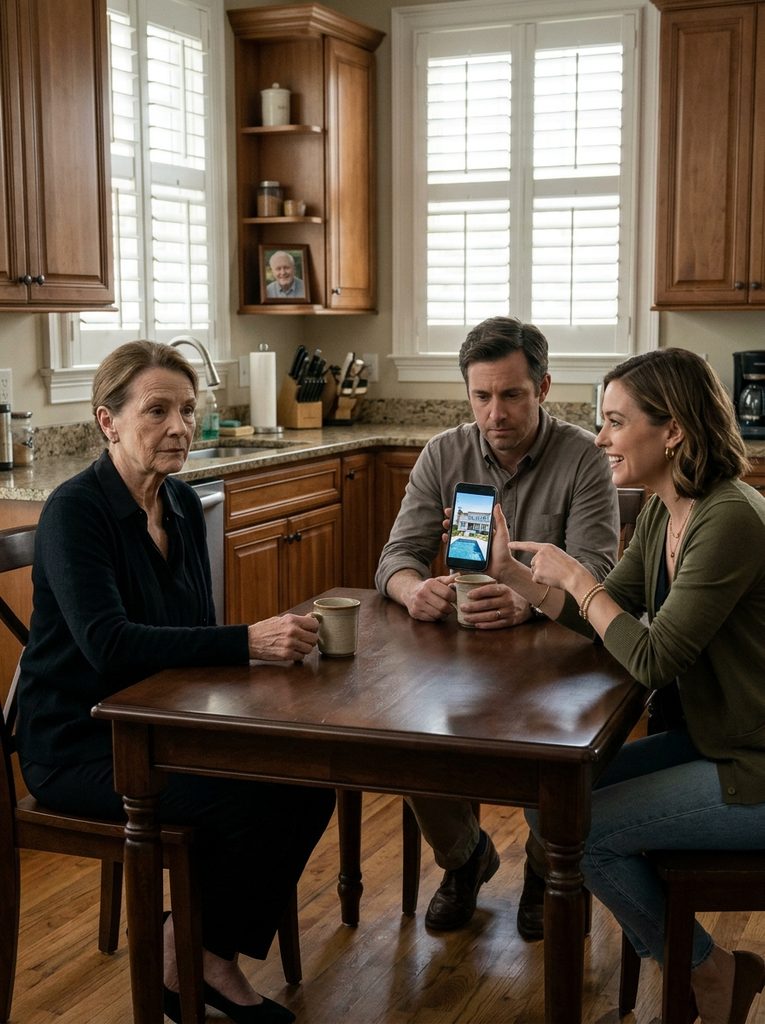
Three days after losing my husband, my daughter-in-law entered my kitchen and announced her resignation.
I was still dressed in black from Robert’s funeral.
“Why should I keep working?” Madison said cheerfully. “Your mom’s inheritance is enough for all of us.”
She addressed my son Andrew as though I weren’t sitting six feet away.
Then she showed him her phone.
“Look at this beach house! Mom and Dad have always dreamed of living by the ocean. We can buy it for them!”
I stared in disbelief.
My husband of forty-one years had been buried only seventy-two hours earlier, yet Madison was already choosing oceanfront properties with money she assumed belonged to her.
I’m Evelyn Harper, sixty-six years old. Until then, I’d thought grief was the greatest suffering imaginable.
I was mistaken.
Robert had died suddenly from a heart attack. A retired high school teacher, he enjoyed fishing, classic films, and repairing things around our Charleston, South Carolina, home.
Madison had barely acknowledged me during his funeral.
Now she eagerly examined pictures of luxurious kitchens and private pools.
“This one is only $1.2 million,” she announced.
Andrew appeared uneasy.
“Madison, maybe this isn’t the right time.”
She rolled her eyes.
“Your father would’ve wanted us to enjoy life. Why pretend otherwise?”
I set down my coffee.
“Have you discussed any of this with me?”
Madison smiled.
“Of course we’ll include you, Evelyn. You can visit the beach house whenever you want.”
Visit.
She planned to purchase that property using what she believed was my inheritance.
I could practically imagine Robert laughing at the absurdity.
Madison had always viewed us as ordinary retirees. She never questioned our finances, which suited Robert perfectly.
She didn’t know I’d sold my architectural design business six years before.
Most of our fortune came from that sale, and the assets already belonged to me.
Robert had separate savings and a carefully arranged estate plan.
Neither entitled Madison to my money.
I didn’t explain any of this.
Instead, I quietly listened while she discussed retiring permanently, purchasing her parents’ beach house, and buying Andrew another car.
By Friday, she’d booked a viewing.
Saturday brought a celebration with her parents.
Sunday evening, she texted me.
“Evelyn, the realtor needs to know when you can provide the money.”
Before I could respond, another message arrived.
“Please don’t make this awkward. I’ve already promised everyone.”
I finally typed:
“Bring Andrew to the attorney’s office tomorrow.”
Her response was a smiling emoji.
She expected a check.
What awaited her was the truth about Robert’s estate.
Madison entered my attorney’s office in an expensive cream suit, carrying beach-house photographs.
Andrew followed reluctantly.
“Good morning, Evelyn!” Madison said brightly. “I hope this won’t take long. The realtor needs confirmation of the funds by Wednesday.”
My attorney, Catherine Blake, glanced toward me.
I’d already permitted her to discuss the relevant estate arrangements with them.
I nodded, and Catherine opened Robert’s documents.
“Mr. Harper’s will leaves certain personal belongings to Andrew, provides a charitable gift in support of local education, and leaves the remainder of his estate to Evelyn. His life insurance also names Evelyn as its beneficiary.”
Madison’s expression changed.
“What about the other money?”
Catherine folded her hands.
“What other money?”
“The money from their investments. The business sale. The house. Everything.”
“Those assets belong to Evelyn. They’re not funds available for you to distribute.”
Madison blinked.
“But Andrew is their only child!”
“That doesn’t make him the owner of his mother’s property.”
Silence settled over the room.
Madison faced me.
“You’re joking, right?”
“No, Madison.”
Her cheeks flushed.
“Then why did you let me quit my job? Why did you let me promise my parents a beach house?”
I calmly met her gaze.
“Because you never asked for my permission. You made those decisions yourself.”
Andrew covered his face.
Madison jumped up.
“You’ve got millions sitting around, and you’re going to let my parents suffer?”
Catherine reminded her that attendance was voluntary and we could finish whenever necessary.
I stayed seated.
“Your parents have a comfortable home, Madison. And you had a good job until last week.”
She snatched her folder.
“This is unbelievable! Robert would be ashamed of you!”
For the first time since his funeral, I felt genuine anger.
“Don’t use my husband’s name to demand money from me.”
My quiet tone stopped her.
“Robert worked forty years teaching children to become responsible adults. He would never have approved of someone treating his death as a winning lottery ticket.”
Madison stormed outside.
Andrew remained, staring at the floor.
“Mom, I’m sorry.”
I waited.
“I told her we shouldn’t make plans. But she kept saying you would want to help, and I didn’t want another argument.”
“Andrew, your father died eleven days ago. I needed my son. Instead, I watched you sit silently while your wife planned to spend my money.”
His eyes filled.
“I know.”
I reached toward him.
“I love you. But loving you doesn’t mean funding every decision you make.”
That evening, Madison called seventeen times.
I ignored every call.
Then Diane, her mother, contacted me.
“Evelyn, what’s going on? Madison says you’re refusing to honor a promise about our beach house.”
“What promise?”
“The one she said you made.”
I closed my eyes.
“Diane, I never promised anyone a beach house.”
A long pause followed.
“But we’ve already listed our home for sale.”
My stomach tightened.
“Why would you do that without speaking to me?”
“Madison said everything was arranged. She told us you were giving the family a million dollars from Robert’s inheritance.”
I glanced toward Robert’s photograph on the mantel.
Only then did I understand how widely Madison had spread her assumptions.
Another confrontation was inevitable.
Two days afterward, Madison’s parents visited me.
Diane looked embarrassed, while her husband Paul carried photographs of the coastal property.
We sat at the same kitchen table where Madison had announced her retirement eleven days earlier.
“Evelyn,” Diane began, “we owe you an apology. We genuinely believed you had offered to help us.”
I believed her sincerity. Diane had always treated me kindly.
“Your daughter never discussed a beach house with me,” I explained. “And I never agreed to buy one.”
Paul shook his head.
“She told us the money was guaranteed.”
I glanced at my wedding ring.
“My husband hasn’t even been gone two weeks. I haven’t had time to understand what my life looks like without him.”
Diane squeezed my hand.
“I’m so sorry. We’ve been thinking about a house when we should’ve been asking how you’re doing.”
That afternoon, they withdrew their listing.
Thankfully, no offer had been accepted, and they hadn’t committed to another purchase.
Madison remained furious.
She repeatedly messaged Andrew, accusing me of manipulating everyone and intentionally embarrassing her.
When he refused to demand money from me, she threatened to return to her parents.
Andrew called that evening.
“Mom, I think my marriage is falling apart.”
He explained that Madison had abandoned a well-paid marketing job without discussing their finances and promised money neither possessed.
“I kept trying to make her happy,” he admitted. “But I let her make decisions that affected everyone.”
“Then it’s time you make some decisions of your own,” I told him.
This time, he agreed.
Andrew informed Madison they’d have to live within their actual income, establish a budget, and stop relying on my finances.
She stayed with her parents for three weeks.
Meanwhile, I finally began organizing Robert’s possessions.
Among his fishing equipment, favorite cardigan, and gardening books, I discovered a handwritten reminder.
It wasn’t a goodbye letter, merely a note from years earlier.
“Plant the roses before the first frost. Evelyn likes the yellow ones.”
Sitting on our bedroom floor, I cried harder than I had during his funeral.
Robert had never valued luxurious homes or lavish holidays.
He made ordinary moments meaningful.
I wanted to remember his kindness, not his wealth.
A month later, Madison came to my door wearing jeans and a simple sweater.
Her expensive handbag and confident expression were absent.
“Evelyn, can I speak with you?”
I invited her inside.
She sat nervously, twisting her fingers.
“I’ve been angry because I embarrassed myself. I quit my job, made promises I couldn’t keep, and blamed you when everything fell apart.”
I studied her.
“Why did you think my money belonged to you?”
She lowered her eyes.
“Because I assumed you’d eventually give everything to Andrew. I started treating that possibility like money we already had.”
“And Robert’s death?”
She began crying.
“I didn’t think about what you were going through. I only thought about what his death might mean financially.”
Her admission was painful but truthful.
She apologized and explained she’d resumed applying for jobs.
Andrew had agreed to marriage counseling, provided she stopped making major financial decisions without consulting him.
I accepted her apology, though forgiveness would take longer.
Several months passed before our relationship became comfortable.
Madison eventually secured another marketing position, and she and Andrew worked together to restore their finances.
I never purchased the beach house.
Instead, I created a scholarship honoring Robert, supporting students whose families couldn’t afford college.
He’d always believed education could transform lives. I wanted that belief to endure.
On the first anniversary of his death, Andrew and Madison accompanied me to the cemetery.
We brought yellow roses.
Standing beside Robert’s grave, Andrew whispered:
“Dad would’ve loved the scholarship.”
“I think so too,” I answered.
That evening, I returned home and prepared tea.
I remembered sitting in my kitchen a year earlier while Madison enthusiastically planned to spend a fortune she didn’t own.
Three days after Robert’s death, she’d resigned, promised her parents an expensive property, and imagined a future funded by my assets.
I could have confronted her immediately.
Instead, I’d remained silent until she actually requested the money.
Madison needed to learn that Robert’s death wasn’t an opportunity for personal enrichment.
My inheritance wasn’t a spending account for relatives.
And loving Andrew didn’t mean financing every decision he made.
Robert left me treasured memories, forty-one years of devotion, and sufficient financial security to determine my future.
I intended to respect all three.
Throughout our marriage, he’d made me feel valued without measuring my worth in money.
Now I was learning to offer myself that same respect.
Nobody in my family would ever take it from me.
Shadows of the Estate
The quiet that settled over the house after Andrew and Madison left following their anniversary visit was complete, but it was no longer heavy with grief—it was heavy with history. Sitting at the mahogany desk in Robert’s study, I looked out over the back garden where the yellow roses he had planted before his death were just beginning to lose their late-summer bloom. A year had passed since the storm over the non-existent beach house, but grief, like water, always finds the hidden cracks in a life.
On the desk lay three thick binder folders bound in dark leather, stamped with the crest of Vance & Sterling, Attorneys at Law. They were the administrative legacy of forty-one years of marriage: land titles, corporate ledgers, tax returns, and private correspondence. While Madison’s early attempt to appropriate my inheritance had been coarse and direct, the actual management of Robert’s legacy was a subtle, intricate maze that required my full attention.
My husband had been a man of quiet enterprise. Behind his simple love for gardening books, worn cardigans, and Saturday morning fishing trips lay a lifetime of disciplined investment and prudent asset management. He had built a substantial real estate holding company, Vance Properties LLC, alongside a portfolio of mid-century commercial buildings across the county. He had never boasted about it. To Robert, wealth was not a badge of status; it was a wall built against the uncertainties of the world, designed to keep his family safe.
A soft knock at the front door interrupted my inventory. When I answered, I found Arthur Vance—Robert’s elder brother and senior partner at Vance & Sterling—standing on the porch, briefcase in hand and a tired expression on his weathered face.
“Evelyn,” Arthur said, taking off his hat. “I hope I’m not disturbing you. We have some matters to review regarding the estate’s tax filings before the quarter ends.”
“Of course, Arthur. Come in,” I replied, stepping aside. “I’ll put the kettle on.”
We sat in the living room, the autumn sun casting long patterns across the hardwood floor. Arthur opened his leather satchel and extracted a stack of blue-bound legal documents. While he had always been supportive during the immediate aftermath of Robert’s death, I noticed a subtle shift in his demeanor over the past few months. He was protective—not just of me, but of the family business structure that he and Robert had spent decades building.
“The scholarship fund is fully registered now,” Arthur began, spreading a document across the coffee table. “The first round of grants for the local high school graduates will be disbursed next spring, just as you requested. It’s a fine tribute to Robert, Evelyn. Truly fine.”
“Thank you, Arthur. It gives purpose to the capital,” I said, reviewing the signatures.
Arthur adjusted his spectacles and cleared his throat. “There is, however, another matter we need to discuss regarding Vance Properties. Now that the primary probate period has closed, the structure of the board of directors needs to be formalized. As it stands, you hold the controlling seventy percent interest, with my remaining thirty percent.”
I looked up from the paper. “And what needs to be formalized?”
“Well,” Arthur hesitated slightly, choosing his words carefully. “Historically, Robert managed the operational decisions entirely. Given the complexity of the commercial leases and the upcoming maintenance schedules for the industrial park in Westford, I thought it might be prudent to transfer the voting proxy for your shares to me. It would spare you the administrative burden, Evelyn. You’ve been through a trying year.”
The offer was delivered with warmth and familial concern, yet something in his posture caused me to pause. It was the same tone people often used with widows—an implicit assumption that grief rendered a woman incapable of understanding balance sheets or property rights.
“I appreciate the thought, Arthur,” I said quietly, leaning back against the sofa. “But I intend to retain my voting rights and attend the board meetings myself.”
Arthur’s eyebrows flickered in surprise. “Evelyn, with respect, the tenant negotiations for the commercial properties are demanding. There are environmental audits, municipal zoning reviews, and contractor bids. Robert handled those aspects quietly, without burdening you with the details.”
“Robert didn’t burden me because he was alive and doing the work,” I replied firmly, meeting his gaze. “Now he is not. If I am to honor his memory, I must understand the work he did. I won’t sign away my voice in his company.”
Arthur looked at me for a long moment, then smiled faintly, though his eyes remained serious. “You sound more like him every day. Very well. But if you’re going to take an active role, we must begin with the Westford development. There is a dispute regarding the boundary lines on the parcel bordering the old railway line, and the city council is pressing for a resolution.”
“Send the files over tomorrow morning,” I said. “I will review them.”
After Arthur left, I returned to the study and sat down at Robert’s desk again. I opened the top drawer, reaching for a pen, and felt my fingers touch something jammed far in the back behind the divider. Pulling it out, I discovered a small, velvet-lined box containing an old gold pocket watch, along with a sealed envelope bearing my name in Robert’s neat, deliberate handwriting.
My heart gave a sudden, sharp thud. The envelope was undated, but the ink was crisp.
I broke the seal with trembling fingers and unfolded the single sheet of cream paper inside.
My Dearest Evelyn,
If you are reading this, it means I have left you to navigate the world alone for a little while. I know you will be sad, but I also know how strong you are—far stronger than you have ever given yourself credit for.
Money has a way of testing the people around us. It reveals what is already inside them: greed in the foolish, ambition in the restless, and devotion in the loyal. Be careful with what I leave behind, not because the dollars themselves matter, but because the independence they afford you is sacred. Do not let anyone—be it family, friend, or advisor—convince you that you need their permission to manage your own life.
Look after Andrew. Help him learn that true standing is built, not given. And remember to tend to the roses.
All my love,Robert
Tears blurred my vision as I read his words again. He had anticipated the very pressures I was currently facing. He knew that the moment his steady hand was gone from the helm, others would attempt to take the wheel—some out of greed, like Madison’s initial impulse, and others out of well-meaning condescension, like Arthur.
I folded the letter carefully, placed it inside my lockbox alongside the gold watch, and closed the lid. The period of mourning was not over, but the period of passive observation was.
The next morning, I arrived at the offices of Vance Properties at eight o’clock sharp. The small office suite on the third floor of the downtown bank building had remained virtually untouched since Robert’s passing. His long-time administrative assistant, Clara, a sharp-eyed woman in her late sixties who had worked for the firm for twenty-five years, looked up in surprise as I walked through the door carrying a leather briefcase.
“Mrs. Vance,” Clara said, rising from her desk. “We weren’t expecting you.”
“Good morning, Clara,” I said with a warm smile. “Please, call me Evelyn. I am taking over Robert’s desk today. We have the Westford development files to review, and I’ll need the complete financial audits for the last three fiscal years.”
Clara stared at me for a second, then a slow, approving smile spread across her face. “Right away, Evelyn. I’ll bring the ledger boxes into the inner office.”
For the rest of the day, I immersed myself in the mechanics of my husband’s business. I read through commercial leases, analyzed property maintenance costs, and examined tenant ledgers. What I discovered was both impressive and daunting: Robert had run a remarkably clean operation, but in his final years, as his health declined, several major property updates had been deferred. The Westford commercial park, in particular, required immediate capital investment to retain its primary anchor tenants.
At noon, my phone rang. It was Andrew.
“Mom? Clara said you were at the office today working through Dad’s files,” he said, his voice carrying a mix of confusion and concern.
“I am, Andrew,” I replied, holding the receiver between my shoulder and ear as I scanned a lease agreement. “There is work to be done here, and I am the majority shareholder.”
“Is everything okay? Are there financial problems?”
“No, Andrew. Everything is fine. In fact, it is better than fine. But I am learning how your father spent his days, and I am taking responsibility for what he built.”
There was a silence on the line, followed by the sound of Andrew taking a deep breath. “Madison and I were talking last night,” he said softly. “She’s started her new job at the agency downtown. It’s a lower position than her last one, but… she’s working hard, Mom. We both are. We’re sticking to the budget.”
“I’m glad to hear that, son,” I said genuinely. “How is she adjusting?”
“It’s been humbling for her,” Andrew admitted. “And for me. I realized how much I enabled her expectations because I was afraid of disappointing her. Standing up to her about the beach house was the hardest thing I’ve ever done, but it saved our marriage.”
“Character isn’t built when things are easy, Andrew,” I reminded him. “It’s built when we have to face our mistakes.”
“I know. Look… could we come over for dinner this Sunday? Madison asked if she could bring dessert. She wants to make that lemon tart you like.”
“I would like that very much,” I said.
Hanging up the phone, I felt a sense of quiet accomplishment. The boundary lines were being redrawn—not just on the commercial property in Westford, but within my own family. The path forward was becoming clear, grounded in clarity, strength, and self-respect.
The Boardroom Table
The board meeting of Vance Properties LLC took place on a crisp Thursday morning in late October. The firm’s conference room—a paneled space featuring a long walnut table and framed architectural renderings of past developments—had been Robert’s domain for over three decades. Today, it was the battleground where my right to govern my own inheritance would be tested.
When I entered the room at nine o’clock, Arthur was already seated at the head of the table, flanked by Richard Hayes, the company’s long-standing corporate attorney, and Marcus Thorne, a senior commercial real estate broker whom Arthur had invited without consulting me.
“Evelyn,” Arthur said, standing up and motioning toward a chair near the middle of the table. “Good morning. We’ve set up everything for you. Marcus has joined us to present a proposal regarding the Westford Industrial Park.”
I walked to the head of the table—the seat Robert had always occupied—and sat down, laying my leather folder flat on the polished wood.
“Good morning, gentlemen,” I said calmly. “Arthur, please take the seat to my left. Marcus, we will certainly hear your proposal, but first, we need to approve the minutes from the previous quarterly meeting and establish the agenda.”
Arthur blinked, caught off guard by my choice of seating and tone. He hesitated for a brief second before pulling out the chair to my left and sitting down.
“Of course,” Arthur cleared his throat. “Well, let us begin with the Westford parcel. Marcus has brought us a purchase inquiry from Apex Logistics. They are offering four million dollars for the entire twenty-acre tract, including the existing flex-space warehouses.”
I opened my folder to the financial tab marked Westford Industrial Park.
“Apex’s offer works out to roughly two hundred thousand dollars per acre,” I noted, looking directly at Marcus. “However, the recent municipal rezoning along the eastern corridor has elevated light-industrial land values in that sector to at least two hundred and eighty thousand per acre. Furthermore, the existing leases in those warehouses generate two hundred and twenty thousand dollars in net annual cash flow.”
Marcus leaned forward, adjusting his tie. “Mrs. Vance, while that is true on paper, the capital expenditure required to update the roofing and HVAC systems across those three buildings over the next two years will cost upward of six hundred thousand dollars. Selling now allows the company to liquidate a depreciating asset without absorbing those capital calls.”
“Or,” I replied, turning the page, “we utilize three hundred thousand dollars from our current cash reserves to complete the roof replacements ourselves, which allows us to raise tenant rents by twelve percent upon lease renewal next spring. That increases our annualized yield to over two hundred and fifty thousand dollars while retaining an asset that will appreciate significantly once the new interstate ramp opens in eighteen months.”
Silence descended upon the room. Richard Hayes looked up from his notes, an approving glint in his eyes, while Arthur stared at me with an expression that mixed disbelief with sudden caution.
“Evelyn,” Arthur began, lowering his voice into a patronizing register. “Robert always preferred low-risk cash positions. Taking on major construction management at this stage—”
“Robert was a prudent manager, Arthur, not a timid one,” I interrupted softly. “He bought the Westford parcel precisely because he anticipated the infrastructure growth along the eastern bypass. Liquidating it below market value to avoid routine maintenance is not prudence; it is capitulation. We will decline Apex’s current offer and solicit competitive bids for the roof maintenance.”
Arthur pressed his lips into a thin line. “As a thirty-percent equity partner, I must voice my strong reservation.”
“Your reservation is duly noted for the minutes, Arthur,” I said, calling the vote. “As seventy-percent majority shareholder, I vote to retain the property and proceed with the capital improvements. Motion carried.”
When the meeting adjourned an hour later, Marcus hurriedly gathered his papers and exited. Arthur remained behind, packing his leather briefcase with deliberate, heavy movements.
“You played your hand very assertively today, Evelyn,” he said without looking up.
“I didn’t play a hand, Arthur. I managed my assets,” I replied, gathering my papers. “I know you built this business alongside Robert, and I respect your thirty percent. But Robert left his controlling share to me because he trusted my judgment. I intend to honor that trust.”
Arthur looked at me for a long moment, his defensive posture softening slightly. He let out a long sigh and nodded once. “He did trust you. More than anyone. I suppose I forgot that for a moment.”
On Sunday evening, Andrew and Madison arrived for dinner. It was the first time Madison had set foot in my house since our confrontation months earlier, and the tension in her posture was palpable as she crossed the threshold.
She wore a simple dark blue dress, her dark hair pulled back neatly. In her hands, she carried a glass baking dish containing a freshly baked lemon tart.
“Good evening, Evelyn,” she said, her voice quiet and respectful. “Thank you for having us.”
“Welcome, Madison,” I said, taking the dish from her. “The tart smells wonderful. Come inside.”
Dinner was a comfortable affair. We spoke about Andrew’s recent promotion at his engineering firm and Madison’s work at her new marketing agency. The grandiosity that had once characterized Madison’s conversation—the constant references to high-end brands, prospective luxury purchases, and social events—had vanished, replaced by a practical focus on her daily responsibilities.
After we finished our main course, Andrew stepped into the kitchen to brew coffee, leaving Madison and me alone at the dining table.
Madison adjusted her napkin, looking down at her hands before raising her eyes to mine. “Evelyn… I wanted to say something while Andrew is out of the room.”
“Go ahead, Madison.”
“When my parents bought their current house years ago, it was always a point of pride for my mother,” she began softly. “Growing up, there was always this implicit pressure that success was measured by what you could display to others—the neighborhood, the car, the vacation home. When Robert passed away and I saw the magnitude of his estate, I didn’t see a tragedy; I saw a shortcut to proving my own worth.”
She took a deep breath, her hands steady despite the emotional weight of her words.
“I ruined my relationship with my parents for months, and I nearly destroyed my marriage because I couldn’t separate my ego from reality. I am deeply sorry for the pain I caused you while you were mourning.”
I looked at her, seeing for the first time not an entitled young woman seeking an easy fortune, but a flawed person working to rebuild her integrity from the ground up.
“Forgiveness isn’t granted overnight, Madison,” I said gently. “It is earned through consistent action over time. But seeing how hard you and Andrew have worked these past few months—and hearing you take ownership of your actions tonight—means a great deal to me.”
Andrew re-entered the room carrying three cups of coffee on a tray, sensing the quiet shift in the air. He set the tray down and smiled at his wife, then at me.
“Everything okay in here?” he asked.
“Everything is fine, Andrew,” I replied, slicing into the lemon tart. “In fact, things are right where they ought to be.”
The Construction of Trust
By early spring, the crisp chill of winter gave way to clear, bright mornings. The roof renovation project at the Westford Industrial Park was under way—a $300,000 undertaking that represented my first major operational decision as head of Vance Properties.
Every Tuesday morning, I drove out to the site in my sedan, swapping my office low heels for sturdy work boots and a yellow hard hat. Arthur had initially offered to handle the site inspections himself, hinting gently that a construction zone was “hardly an environment for a woman of leisure.” I politely declined. If I was risking the firm’s cash reserves, I intended to see where every dollar was being spent.
The general contractor, a blunt, broad-shouldered man named Tom Callahan, had initially treated my visits with polite condescension. But after I pointed out a discrepancy between the architectural flashing specifications and the materials delivered to Bay 4—saving the project twelve thousand dollars in potential water-damage repairs—his attitude shifted completely.
“You’ve got an eye for detail, Mrs. Vance,” Callahan admitted one morning as we reviewed the crew schedules inside the temporary site trailer. “Most owners just wait for the invoice.”
“My husband taught me that details are where profits or losses hide, Mr. Callahan,” I replied, tracing the structural diagram with my finger. “We stick to the timeline, and we stick to the specs.”
While the Westford project demanded my mornings, my afternoons were devoted to establishing the Robert Vance Memorial Scholarship. Working alongside the guidance counselors at the local high school, we drafted criteria focused not merely on high test scores, but on resilience, work ethic, and financial need.
One afternoon in April, Andrew stopped by my house unannounced after work. He looked tired, but there was a grounded composure in his expression that had been missing for years.
“Mom, do you have a minute?” he asked, stepping into the kitchen and setting a stack of paper folders on the table.
“Of course, Andrew. Tea?”
“Please.” He sat down at the very table where, months ago, his wife had mapped out a lifestyle funded by an inheritance that wasn’t hers. “Madison got a promotion today,” he said softly.
I paused with the teapot in hand. “A promotion? That was quick.”
“She brought in a local medical equipment supplier as a permanent client for her firm,” he explained, a note of genuine pride in his voice. “It comes with a modest salary bump, but more importantly, her manager praised her for taking ownership of account logistics instead of just delegating.”
“That is wonderful news, Andrew.”
“The reason I’m telling you,” he continued, looking me in the eye, “is that she wanted to put the entire raise toward paying off her remaining credit card debt from last year. No luxury upgrades, no celebrating with a weekend trip. She did the math herself.”
I set his cup in front of him and sat down. “And how does that make you feel?”
“Relieved,” he confessed, leaning back. “For a long time, I thought my job as a husband was to give her everything she wanted so she wouldn’t leave. But watching her earn her own way… it’s like we’re finally partners instead of a bank and a customer.”
“Partnership requires equal weight on both ends of the beam, Andrew,” I said gently. “I’m proud of both of you for doing the hard work.”
Later that evening, after Andrew left, the phone rang. It was Diane, Madison’s mother.
“Evelyn,” Diane said, her voice hesitant. “I hope I’m not intruding.”
“Not at all, Diane. How are you and Paul?”
“We’re well. We… we actually wanted to invite you over for dinner this weekend. Paul and I have been thinking a lot about the future. After the whole beach house ordeal, we realized we had never properly audited our own retirement readiness. We’ve been meeting with a financial advisor, and… well, we wanted to thank you.”
“Thank me?” I asked, surprised.
“If you hadn’t put your foot down,” Diane said earnestly, “we would have stretched ourselves to the absolute limit buying a coastal home we couldn’t afford, relying on promises that had no foundation. You stopping Madison forced all of us to look at reality. It was painful, but it saved our family from financial ruin.”
Sitting in the quiet living room, holding the receiver, I realized how far the ripples of that initial refusal had spread. Silence, boundaries, and truth had not broken my family—they had anchored it.
The First Harvest
May brought the official ribbon-cutting for the renovated Westford Industrial Park, along with the announcement of the inaugural Robert Vance Scholarship recipients.
The three flex-space warehouses stood immaculately refurbished under high-grade, energy-efficient roofing systems. As I had projected, two new regional distributors signed multi-year leases at the higher rental rates, increasing the company’s net operating income by fourteen percent. Arthur stood beside me at the ribbon-cutting ceremony, raising a glass of sparkling cider in my direction.
“I stand corrected, Evelyn,” he said quietly as the attendees mingled. “Robert would have been proud of how you handled this.”
“Robert would have checked the invoices twice, Arthur,” I smiled back. “Which I’ve already done.”
Two weeks later, the high school auditorium was filled for the annual awards evening. I sat in the front row alongside Andrew and Madison. When the principal called my name to present the Robert Vance Memorial Scholarship, I walked up to the stage with a steady step.
Looking out at the audience, I saw three young students standing nervously near the podium: a young man who worked night shifts at a grocery store to support his mother, and two young women who were the first in their families to apply to university.
“My husband, Robert,” I spoke into the microphone, my voice clear and unhesitating, “believed that true wealth was not measured by what one accumulated, but by what one rendered possible for others. This scholarship is not a gift; it is an investment in your character and your future.”
As I handed each student their award certificate, I glanced toward the third row. Madison was watching, tears glistening in her eyes, clapping softly alongside Andrew.
After the ceremony, we walked out into the warm spring evening. Madison walked beside me, her arm lightly touching mine.
“Evelyn,” she said softly as Andrew went to fetch the car. “Thank you for letting us be part of tonight.”
“You belong here, Madison,” I replied quietly.
She looked out toward the parking lot, quiet for a moment. “I started a small savings account last week. Just fifty dollars a paycheck. It’s not much, but it’s mine. Built from my own work.”
“Fifty dollars earned by your own labor is worth more than fifty thousand given to indulge a whim,” I told her, placing a hand over hers. “Remember that.”
That night, returning home to the quiet house, I didn’t feel lonely.
I walked out to the back garden with a small watering can. The yellow roses Robert had planted were in full, glorious bloom, their petals glowing soft golden in the moonlight. I bent down, smelling the delicate sweetness of the blossoms, touching the leaves that he had tended with his own hands.
I had kept his memory intact. I had protected the estate he labored to build. I had taught my son and daughter-in-law the quiet discipline of self-reliance, and I had claimed my own standing as an independent woman.
Sitting at the kitchen table with a hot cup of tea, looking out into the serene darkness of the garden, I felt a deep, unshakeable peace. Robert had left me forty-one years of devotion, cherished memories, and financial security. But the strength to stand tall in my own life—that was something I had discovered within myself.
THE END..!