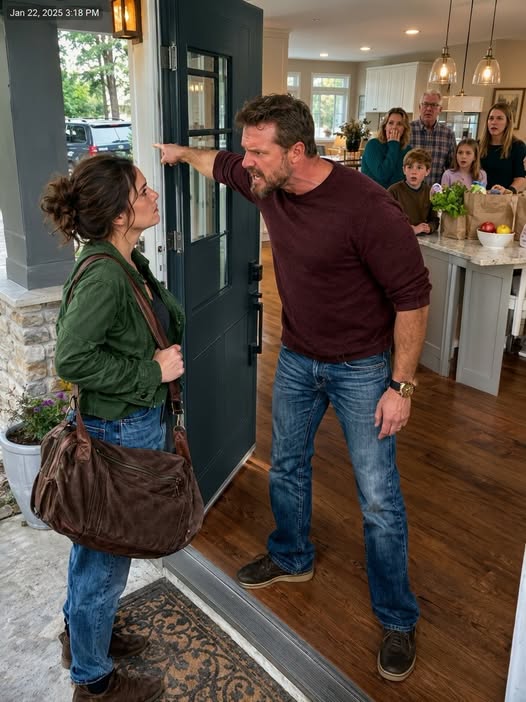
“What is this freeloader doing here? Get out right now.”
Ryan said it loud enough for the whole room to hear. He said it standing in the doorway of my living room, with my favorite coffee mug in his hand, while twenty people I barely knew turned around to watch.
I smiled. I didn’t argue. I turned around and walked out.
Because Ryan had absolutely no idea whose home he had just claimed, or who he had just ordered to leave.
My name is Emily Carter. I’m thirty-four years old. And that afternoon changed the way my family looked at me forever.
As far as most of them knew, I was a government employee who disappeared for months at a time because of “training.” That’s what I told them. That’s what they repeated to each other at Thanksgiving when my chair sat empty. “Emily’s off at training again.” Like I was taking a seminar on spreadsheets in a hotel conference room in Ohio.
It wasn’t exactly a lie. But it was nowhere near the whole truth.
I had spent eleven years in the United States Army. Three months earlier, I had been promoted to colonel. I commanded one of the Army’s specialized operational units, and the security rules around my work meant I couldn’t talk about it. Not with friends. Not with neighbors. Not even with my own sister.
So I kept my answers short. “Work’s fine. Busy. Can’t really get into it.” After a while, people stop asking. They fill in the blanks themselves.
My family knew I worked hard. They knew my schedule could change in a single phone call. They knew I missed birthdays and school plays and Christmas mornings and Sunday dinners at my mother’s house.
What they didn’t know was how much I carried with me when I walked out the door.
And they didn’t know how much I needed the one place where none of it followed me.
That place was my lake house.
I bought it four years ago, on the north shore of Lake Holloway in North Carolina, about two hours from the base. I paid for it with my Army salary, my deployment pay, and the kind of saving that doesn’t feel like saving while you’re doing it. It just feels like saying no.
No to the new car. I drove the same gray Toyota 4Runner for nine years. No to the beach vacations my friends posted pictures of. No to the expensive apartment in town. Every month, I moved money into a savings account at Pinnacle Federal Credit Union and pretended it didn’t exist.
When I had $68,000 saved, I put it down on a two-bedroom cottage with a wraparound deck and a mortgage of $1,740 a month. The closing documents were signed on April 9th, four years ago, at a title company in Raleigh. My name is the only name on the deed. I remember holding the pen and thinking it was the first thing I’d ever owned that wasn’t issued to me.
The house is not big. It’s not fancy. That’s exactly why I love it.
It sits so close to the water that when the windows are open, you can hear the lake moving against the rocks at night. The deck faces west, so the sunsets come straight in through the glass doors and turn the whole living room orange. There’s a worn leather chair by the front window where I read. There’s a kitchen with open shelves, and on those shelves there’s a crooked line of mismatched coffee mugs I collected one at a time over eleven years.
A blue one from a diner in Kentucky. A white one with a chipped handle from a gas station in El Paso. A green one my father gave me the day I graduated from officer training, two years before he died. That green one is my favorite. I don’t let anybody else drink out of it.
Every window, every chair, every mug, every floorboard in that house belongs to me.
When I’m away, a property management company called Lakeside Property Services checks on the house once a week. They handle the lawn, the gutters, the furnace filter, anything that breaks. The manager there is a woman named Deborah Pruitt who has been doing this for twenty years and doesn’t miss anything.
My older sister, Jessica, also has a spare key. Just for emergencies. A burst pipe. A storm. Something Deborah couldn’t get to fast enough.
I trusted her with it because she was my sister. Because when we were kids, she braided my hair before school and let me sleep in her bed during thunderstorms. Because family is supposed to be the one thing you don’t have to guard.
I never imagined she’d use that key to hand my home over to her husband’s entire family.
Two days before my leave started, I called her from my office on base.
“I finally got seventy-two hours,” I told her. “Friday afternoon to Monday afternoon. I’m going straight to the lake house. I need somewhere quiet enough to remember what silence sounds like.”
She laughed. “You deserve it, Em. Seriously. Turn your phone off.”
“I can’t turn my phone off.”
“Then at least don’t answer it.”
We talked for ten more minutes. About our mother’s knee surgery. About her son Tyler’s soccer team. About nothing.
Not once did she mention Ryan’s family reunion.
Not once did she tell me she’d given anyone permission to stay at my house.
I drove up on Friday afternoon with a duffel bag in the passenger seat and a gas-station coffee going cold in the cup holder. I’d changed out of uniform before I left. Jeans. A gray T-shirt. A light jacket. Running shoes.
No rank. No name tape. Nothing that said who I was or what I did.
That was on purpose.
For seventy-two hours, I didn’t want to be Colonel Carter. I didn’t want to be the person who signs off on things that keep other people awake at night. I wanted to be Emily. Just Emily. The woman who drinks coffee out of a green mug on her own deck and watches the water and doesn’t make a single decision more complicated than whether to have eggs or toast.
The first sign something was wrong showed up before I even got to the house.
There were cars lined up along the road near my driveway. Lots of them.
At first, I figured the Hendersons next door were having a party. They have six grandchildren and a pontoon boat, and summer weekends at their place sound like a county fair.
Then I came around the last curve and saw my own driveway.
Pickup trucks. Three of them. Two minivans. A big black SUV parked on my grass with one tire sunk into the flower bed I’d planted last spring. One truck was pulled up so close to the porch that its bumper was nearly touching the steps.
I slowed down to a crawl.
Music was blasting from the backyard. Country music, loud enough to rattle the windows. Kids were shrieking somewhere near the water. Somebody had left a big red cooler sitting right in the middle of the front walkway.
For one strange second, I honestly wondered if I’d taken a wrong turn. Two hours on the road, three months without a full night’s sleep. Maybe I’d driven to some stranger’s cottage.
Then I saw the gouge in the porch railing.
Last summer, I’d dragged a heavy Adirondack chair up the steps by myself and scraped a long white scar into the wood. I’d been meaning to sand it and paint over it. I never did.
There it was. My scar. My railing.
My house.
I parked at the very edge of the driveway, the only space left. I took my duffel bag out of the passenger seat. I walked up the path, stepping around the cooler.
The closer I got, the more I saw.
Sneakers and flip-flops kicked off everywhere across the porch. Grocery bags lined up against the wall. My outdoor table, the one I always keep under the overhang, had been dragged out into the sun. Through the front window, I watched a little boy go running past holding a fluffy white towel.
I knew that towel. It came from the upstairs bathroom closet. I’d bought a set of four at a store in Raleigh the week I closed on the house.
The front door was standing wide open.
I stopped in the doorway with my duffel bag on my shoulder and just looked.
There were nearly twenty people inside my house.
Kids were tearing through the living room, dodging around the furniture, screaming over the music. A teenage girl was sprawled on my couch with her muddy sneakers up on the cushions, scrolling through her phone. Two men I’d never seen before were standing in my kitchen opening and closing my cabinets, looking for something.
At my dining table, Ryan’s parents sat drinking coffee.
Ryan’s mother had my blue mug from Kentucky. Ryan’s father had the white one with the chipped handle.
My kitchen island was covered with paper grocery bags, foil trays of food, hot dog buns, a bag of charcoal, a bottle of ketchup lying on its side. Somebody had opened the cabinet above the refrigerator, the one where I keep my father’s old Army photographs in a shoebox, and left it hanging open.
Out through the glass doors, I could see that somebody had dragged all six of my deck chairs down the grass to the edge of the water.
And across the arm of my leather reading chair by the window, somebody had thrown a soaking wet beach towel. Water was dripping off the end of it onto the hardwood floor.
I stood there trying to understand how a family reunion for twenty people had been planned inside my home, food bought, cars packed, kids loaded up, and not one person had thought I deserved a phone call.
Then Ryan saw me.
Ryan Holt has been married to my sister for twelve years. He sells commercial roofing for a company outside Charlotte. He’s loud. He’s always been loud. He’s the kind of man who tells a joke at your expense at Christmas dinner and then says you’re too sensitive when you don’t laugh.
He likes an audience. And that day, he had one.
He came across the living room toward me with his arms crossed over his chest, walking like a man who’d been interrupted in his own house.
He didn’t say hello. He didn’t ask why I was there.
He looked me up and down. My jeans. My running shoes. My duffel bag. Then he looked past me through the doorway at my nine-year-old Toyota parked crooked at the end of the drive.
And he barked it, loud enough that the music almost seemed to stop.
“What is this freeloader doing here? Get out right now.”
A few conversations in the room died. The two men in the kitchen stopped opening cabinets. The teenager on the couch looked up from her phone.
I shifted the strap of my duffel bag and looked straight at him.
“Excuse me?”
“You heard me.” He smirked. “We’re having a family reunion. You weren’t invited.”
Somebody at the table laughed.
I looked past Ryan toward the kitchen.
Jessica was standing by the island.
She had one hand resting on a grocery bag, like she’d been about to unpack it. But she wasn’t unpacking anything. She was just standing there. Frozen. Staring very hard at a jar of pickles.
She wouldn’t look at me.
“Ryan,” I said carefully, “this is my house.”
He laughed. Actually laughed.
“Jessica said we could use it.”
He said it like that settled everything. Like Jessica’s word was a document with a notary stamp.
“There are almost twenty of us,” he went on, spreading his arms wide to include the whole room. “And you’re one person. One. Don’t ruin everybody’s weekend just because you showed up. Drive back to base.”
Drive back to base. He said it like it was an insult. Like I was a kid being sent back to summer camp.
One of his cousins, a heavyset man in a fishing shirt, snorted into his beer. A woman near the window shook her head at me, like I was the one being rude by standing in my own doorway.
I kept my eyes on Ryan.
“Jessica gave you permission to bring all these people here?”
“She’s your sister,” Ryan said. “Why would she need permission?”
That answer told me more than he realized.
To Ryan, my house wasn’t something I had earned. It wasn’t eleven years of deployments and skipped vacations and a $1,740 mortgage payment drafted out of my checking account on the first of every month. It was just an empty building. A family resource sitting around unused. And because I was gone so often, he’d decided it belonged to whoever happened to be standing in it.
I looked at my sister again.
“Jess. Can we talk?”
She let out a long, heavy sigh. Like I’d driven two hours just to make her life difficult.
“I honestly didn’t think you’d make it,” she said. “You’re always deployed somewhere.”
“I called you on Wednesday. I told you I was coming.”
“The house sits empty most of the year, Emily.” Her voice was quieter than Ryan’s, but it was saying the same thing. “Ryan’s family needed somewhere to stay. His aunt’s place in Myrtle Beach fell through. What was I supposed to do?”
“You could have asked me.”
Ryan stepped between us before she could answer. He planted himself right in front of her like a wall.
“She didn’t need to ask. We’re already here.”
Behind him, a little boy in swim trunks crashed into the side of my coffee table. A stack of magazines slid off and scattered across the floor. One of them slid all the way under my reading chair, into the puddle from the wet towel.
A woman across the room called out, “Brayden! Careful!”
Nobody picked up the magazines.
I watched that magazine soak up the water under my chair. And I’ll be honest with you. That small thing hit me almost as hard as Ryan’s shouting.
These people weren’t acting like guests. Guests pick up the magazines. Guests ask where the towels are. Guests don’t drink out of your father’s coffee mugs without asking.
These people were acting like my home had no owner worth respecting.
I need you to understand something about my sister and me.
For years, I helped Jessica every single time she called.
When Ryan’s commissions dried up during the slow winter three years ago and they fell two months behind on their mortgage, I wired her $6,500 from my savings so the bank wouldn’t send a default notice. When her car’s transmission died, I covered the $3,200 repair. When Tyler needed braces and their dental insurance wouldn’t pay for them, I sent $4,800 directly to the orthodontist’s office in Charlotte.
When her babysitter quit and she had a work conference she couldn’t miss, I spent four days of my own precious leave watching her kids. When our mother needed someone to drive her to Duke for her knee surgery in the middle of an ice storm, I was the one who drove.
I never asked for the money back. I never kept a running list.
Well. That’s not quite true. My attorney made me keep a list two years ago, after I told her about the mortgage payment. “Not because you’re going to collect,” she said. “Just so you know.” It was in a folder in my desk at home. The last time I added it up, it came to $23,400.
I never once mentioned that number to Jessica. I believed that’s what family did. You show up. You pay the bill. You don’t make a scene.
And now that same sister was standing in my kitchen, letting her husband throw me out of a house I’d paid for with my own blood and sweat.
Here’s what hurt the most.
It wasn’t Ryan. Ryan is Ryan. I’ve known for twelve years exactly who he is. If anything, I would have been surprised if he’d behaved any other way.
What hurt was Jessica.
She knew the truth. She knew this was my house. She’d been at the closing. She’d hugged me in the parking lot of the title company and cried and said, “Dad would be so proud of you.” She knew how long I’d saved. She knew I had exactly seventy-two hours before I had to go back. She knew I’d been counting down the days to this weekend for months.
And she still wouldn’t look at me.
Something inside me went perfectly still.
I’ve felt that stillness before. In places I can’t tell you about. It comes when anger stops being useful. When the insult that started everything matters a lot less than the next decision you’re about to make.
“All right,” I said. “I’ll leave.”
Ryan’s grin stretched all the way across his face.
“Finally,” he said, turning to his relatives. “Somebody with some common sense.”
A couple of his cousins chuckled. Someone turned the music back up.
I shifted my duffel higher on my shoulder and walked back out across the porch. Behind me, the room loosened up almost instantly. Laughter. Conversation. The clatter of somebody opening my silverware drawer. They all thought the show was over. They thought I’d accepted Ryan’s authority, and the weekend could go on exactly the way they’d planned it.
At the bottom of the porch steps, I stopped.
I turned around, just enough to face him.
“Just so we’re clear, Ryan,” I said. My voice was calm and loud enough to carry. “You’re ordering me off my own property?”
Ryan leaned against my doorframe with his arms crossed.
“Exactly.”
He said it nice and loud. Loud enough for his parents at the table to hear. Loud enough for his cousins in the kitchen. Loud enough for the teenager on my couch.
Good.
I looked past him at my sister.
“And you agree with him, Jessica?”
For one second, I thought she might finally do it.
She lifted her eyes from the jar of pickles. Her lips parted. She took half a step forward.
Then Ryan glanced back over his shoulder at her. Just a glance.
And she turned her face away.
“It’s just one weekend, Emily,” she said to the floor.
That was the answer that settled it.
It wasn’t a misunderstanding. It wasn’t a mix-up about dates. It wasn’t a phone call that got lost.
She had made a choice.
I nodded once.
“Enjoy your vacation.”
Then I walked to my Toyota, tossed my duffel in the back seat, and drove away.
In the rearview mirror, I could see Ryan still standing in my doorway with my coffee mug in his hand. He was smiling. He looked like a man who’d just won something.
He probably thought he had. I hadn’t raised my voice. I hadn’t made a scene. He probably figured my silence meant I was embarrassed. Intimidated. Too weak to stand up to him in front of his whole family.
People mistake restraint for surrender all the time.
They usually only figure out the difference after the consequences start arriving.
I drove about a mile down the road to a little public boat launch with a gravel parking lot under a row of old oak trees. I could see a slice of the lake through the branches. Gray-blue and quiet. I didn’t let myself look at it for long.
I turned off the engine. I set my phone on the center console.
And I did what I’ve been trained to do. I laid out the facts.
Fact one. My sister had given access to my house to nearly twenty people without asking me.
Fact two. Ryan had ordered me off my own property, out loud, in front of more than a dozen witnesses.
Fact three. After I told him clearly that I was the owner, he confirmed he intended to stay.
I didn’t need to go back and argue. Arguing wouldn’t fix anything. Arguing would just give Ryan another audience.
I needed to handle it correctly.
First, I called my attorney.
Dana Whitmore has handled my personal affairs for six years. My will. My power of attorney paperwork before every deployment. The closing on the lake house. She’s sixty-one, sharp as a tack, and she answers her cell phone on Friday afternoons for clients who are deployed, because she was an Army JAG officer for twenty-two years before she went into private practice in Raleigh.
“Emily,” she said. “I thought you were on leave.”
“I am. I’m sitting in a parking lot a mile from my lake house because my brother-in-law just threw me out of it.”
There was a long pause.
“Start from the beginning,” she said. “Slowly.”
I told her everything. The cars. The twenty people. Ryan’s exact words. Jessica’s spare key. Jessica’s refusal to stand up for me. The fact that I’d asked Ryan, in front of witnesses, whether he was ordering me off my own property, and he’d said “Exactly.”
Dana didn’t interrupt once. I could hear her pen scratching on a legal pad.
When I was done, she was quiet for a moment.
“Did anyone besides Jessica have permission to be there?”
“No.”
“Did you give Jessica permission to let anyone stay there? Ever? In writing or out loud?”
“No. The key was for emergencies. Burst pipes. Storms.”
“And Lakeside Property Services manages the house when you’re away?”
“Yes.”
“Call them next,” Dana said. “Right now. I want to know if they knew anything about this. And Emily?”
“Yes, ma’am.”
“Don’t go back there alone. Whatever happens. Let me make some calls.”
The second call was to Deborah Pruitt at Lakeside Property Services.
Deborah picked up on the second ring. When I told her what was happening, she went silent for so long that I thought the call had dropped.
“Emily,” she finally said. “I need to tell you something, and I need you to sit down if you’re not already sitting.”
“I’m sitting.”
“Two weeks ago, we got a call at the office. A woman from Greensboro. She said she’d rented your lake house for the Fourth of July weekend through an online vacation rental site, and she wanted to confirm the check-in instructions. I told her she must have the wrong property, because we don’t manage your house as a rental. You’ve never authorized that. She sent me a screenshot of the listing.”
My stomach dropped.
“What listing?”
“Lakefront Cottage, North Shore, Lake Holloway. Sleeps eight. Two hundred and seventy-five dollars a night. The photos are your deck, Emily. Your living room. Your kitchen with the coffee mugs. The host’s name on the listing is R. Holt.”
I closed my eyes.
“I tried to call you,” Deborah said. “Your phone went straight to voicemail for three days. I left two messages.”
I’d been in the field. No phones. No signal.
“How many bookings?” I asked.
“I don’t know how many. The woman from Greensboro paid a deposit of eight hundred and twenty-five dollars. She said the calendar for July and August was almost completely booked. I reported the listing to the site as unauthorized, but it’s still up. I’ve got the screenshots saved. I was going to call the sheriff’s office on Monday if I couldn’t reach you.”
“Send everything to my attorney,” I said. “Dana Whitmore in Raleigh. I’ll text you her email.”
“Emily. I’m so sorry.”
“You did exactly the right thing, Deborah. Thank you.”
I hung up and sat there for a long time, staring at the oak leaves moving against the windshield.
Ryan hadn’t just borrowed my house for a weekend.
He’d been renting it out. To strangers. Under his own name. Collecting money for a property he didn’t own.
And Jessica had given him the key.
My phone rang nine minutes later. Lieutenant Colonel Webb.
“Colonel Carter, I’m sorry. Your leave is being cut short. You’re being recalled. Effective immediately.”
I closed my eyes. I didn’t ask why. I knew better than to ask why on an open line.
“Understood. How long do I have?”
“Transport is already en route. We sent it to your residence address on file, because that’s where your leave paperwork said you’d be. I’ve got the driver on the radio. I’ll tell him to swing by the boat launch instead.”
I looked through the windshield toward the road. And I thought about something.
“No,” I said slowly. “Let him go to the house. I’ll meet him there.”
“Colonel, you said there was a situation at the residence.”
“There is. But I have to go back for my gear anyway. My go-bag is in the hall closet. I’ll need it.” I paused. “And Marcus? My attorney is sending a deputy from the county sheriff’s office out there. It might be a little crowded.”
He was quiet for a second. “You want me to tell the driver to wait at the road?”
“Tell him to come right up to the front door,” I said. “And tell him to ask for me by name.”
I hung up. Then I called Dana back.
“I’ve been recalled,” I told her. “I have to leave in about forty minutes. I need to get my gear out of that house, and I need this handled before I go, because I don’t know when I’ll be back.”
“I already called the Holloway County Sheriff’s Office,” Dana said. “Deputy named Carla Brooks is on her way. I’ve emailed her a copy of your deed and Deborah’s screenshots of that rental listing. Deborah’s driving over too, with a locksmith. Emily, do you want to press charges?”
I thought about it. Really thought about it.
“Not today,” I said. “Today I want them out. I want my key back. I want my locks changed. And I want every single person who paid Ryan money for my house to get it back.”
“Then that’s what we’ll do,” Dana said. “Go get your bag, Colonel.”
I started the engine.
As I pulled out of the gravel lot, a dark green government sedan with official plates passed me going the other way. Slow. Careful. Driven by a young man in uniform with his eyes on the house numbers.
It turned onto my road.
I followed it.
Back at the house, Ryan’s relatives were still crowded into my living room and kitchen. My deck chairs were still down by the water. The grocery bags were still spread across my island, and my mugs were still in other people’s hands.
Ryan believed the matter was finished.
Jessica believed I’d calm down, come back after the reunion, and let the whole thing get swept under the rug the way I always did.
Neither of them knew what had just turned into my driveway.
I pulled in behind the government sedan and parked on the grass.
I didn’t get out right away. I watched.
The driver was a sergeant, maybe twenty-six, in his service uniform, every crease sharp enough to cut paper. He stepped out of the sedan, put on his cover, and walked up my front path. He stepped around the red cooler without breaking stride. He climbed the porch steps and knocked on my open front door.
The music inside stopped.
Through the windshield, I watched Ryan appear in the doorway. He looked at the uniform. He looked at the government plates on the sedan. His whole posture changed. Shoulders back. Big friendly salesman smile.
I rolled my window down so I could hear.
“Afternoon, Sergeant! Can I help you?”
“Good afternoon, sir. I’m Sergeant Daniel Ortiz. I’m here to pick up Colonel Carter.”
Ryan blinked. “Who?”
“Colonel Emily Carter, sir. This is the residence listed on her leave paperwork. I’m her transport.”
Behind Ryan, the whole room had gone silent. I could see faces crowding in the front window. Ryan’s mother, still holding my blue mug. The cousin in the fishing shirt. The teenager from the couch.
Ryan laughed, a little too loud. “I think you’ve got the wrong house, buddy. There’s no colonel here. The only Emily around here is my wife’s sister, and she’s not a colonel. She does paperwork for the government or something. She was just here. I sent her home.”
Sergeant Ortiz didn’t change expression at all.
“Sir, the Colonel is this property’s owner of record. I was told she’d be here.”
“Owner?” Ryan’s laugh faltered. “No, see, she’s—”
That’s when I opened my car door.
I walked up the path. Past the black SUV parked in my flower bed. Past the red cooler. Jeans. T-shirt. Running shoes. Same as twenty minutes ago.
Sergeant Ortiz turned around when he heard my footsteps on the porch steps. He snapped to attention so fast the boards creaked under his boots.
He saluted.
“Colonel Carter. Sergeant Ortiz, ma’am. I’m here to take you back.”
I returned the salute. Out of uniform, it wasn’t required. But I wanted Ryan to see it.
“Thank you, Sergeant. Give me fifteen minutes to get my gear. And please wait right here.”
“Yes, ma’am.”
I turned to the doorway.
Ryan was standing exactly where he’d stood when he called me a freeloader. Except now his arms weren’t crossed. They were hanging at his sides. His face had gone a strange gray color, like old dishwater. His mouth was open, but nothing was coming out.
Behind him, every single person in that room was staring at me.
“Excuse me, Ryan,” I said quietly. “I need to get into my hall closet.”
He stepped aside without a word.
I walked through my living room. Nobody said anything. The kids had stopped running. The teenager had taken her muddy sneakers off my couch. Somebody had finally turned off the country music, and the only sound was the lake moving against the rocks outside.
I passed my dining table. Ryan’s father was sitting there, a thick-shouldered man in his late sixties named Gerald Holt. He had my white mug with the chipped handle in front of him.
He stood up when I walked by.
I didn’t expect that. I glanced at him. He was staring at me with an expression I couldn’t read. Then I noticed the faded tattoo on his forearm. An anchor and a rope. Navy.
He set my mug down very carefully on the table, like it was made of glass.
I opened the hall closet. My go-bag was right where I’d left it, on the top shelf, packed and ready, the way it always is. I pulled it down.
When I turned around, Jessica was standing at the end of the hallway.
Her face was white. Her hands were shaking.
“Emily,” she whispered. “A colonel? Since when?”
“Since March.”
“You never told me.”
“You never asked, Jess. Not once. Not in eleven years. You asked if I was still doing my government thing. You asked when I’d be back. You asked if I could lend you money. But you never once asked me what I actually do.”
She flinched like I’d slapped her.
I heard tires on gravel outside. A car door. Then another.
Through the front window, I saw a Holloway County Sheriff’s patrol car parked behind the government sedan. A deputy in a tan uniform was walking up the path, a woman about forty with her hair pulled back tight. Behind her, Deborah Pruitt climbed out of a white SUV with the Lakeside Property Services logo on the side. Behind Deborah, a man in a work shirt was carrying a toolbox.
Ryan saw them too. I watched what was left of the color drain out of his face.
The deputy stepped onto the porch, nodded at Sergeant Ortiz, and looked into the room.
“I’m Deputy Carla Brooks with the Holloway County Sheriff’s Office. I’m looking for Emily Carter.”
“That’s me,” I said, stepping forward.
“Ma’am, your attorney, Ms. Whitmore, called our office. I’ve got a copy of your deed here.” She held up a folder. “Recorded with the Holloway County Register of Deeds, April 9th, four years ago. Sole owner. Is that correct?”
“That’s correct.”
“And did you authorize any of these people to stay at this property?”
“No, I didn’t.”
Deputy Brooks turned to the room. Her voice was calm, polite, and absolutely unbending.
“Folks, the owner of this property is present, and she’s telling me she has not given you permission to be here. I’m going to need everybody to gather their things and leave the premises.”
For a second, nobody moved.
Then Ryan found his voice. “Hold on. Hold on just a second. My wife has a key. Her sister gave her a key. That’s permission.”
Deputy Brooks looked at him. “Sir, are you the property owner?”
“No, but—”
“Is your name on the deed?”
“No.”
“Then the owner gets to decide who stays. And she’s decided.” Brooks turned to me. “Ma’am, do you want to give them a reasonable amount of time to pack up? There are a lot of kids here.”
I looked around the room. At the little boy in swim trunks. At the teenager. At the grandmother holding my Kentucky mug.
They hadn’t done this. Most of them had probably been told it was all fine. Ryan’s sister-in-law’s empty house. She’s never there. She won’t mind.
“Two hours,” I said. “That’s enough time to pack up and get the kids fed. Deborah will stay until everyone’s gone. Then the locksmith will change the locks.”
“Fair enough.” Deputy Brooks nodded. “Two hours, folks.”
People started moving. Slowly at first. Then faster. Someone began folding up the foil trays. Someone went out to the water to get the kids. Ryan’s mother stood up and carried both of my mugs over to the sink and began to wash them. Carefully. By hand.
But Deborah Pruitt wasn’t finished.
She stepped forward with her phone in her hand.
“Deputy, there’s one more thing you should see.”
She turned the screen around. The vacation rental listing. Lakefront Cottage, North Shore, Lake Holloway. Sleeps eight. $275 a night. My deck. My living room. My mugs on the shelf.
Host: R. Holt.
“This listing has been active for at least five weeks,” Deborah said. “The owner never authorized it. I’ve spoken to one renter who paid an $825 deposit. According to the calendar, there are bookings almost every weekend in July and August.”
Deputy Brooks studied the screen for a long time. Then she looked up at Ryan.
“Sir. Is this your listing?”
Ryan opened his mouth. Closed it.
“Sir, I’m asking you a direct question. Did you list this property for rent online?”
“It was just sitting here,” Ryan said. His voice had gone small and thin. “Empty. Nobody was using it. I figured I’d make a little money off it. Jessica and I are behind on some stuff. I was going to tell Emily eventually.”
Across the room, Jessica made a sound like she’d been punched in the stomach.
“Ryan,” she said. “You told me those were your cousins. The people coming in July. You said they were your cousins.”
Ryan didn’t answer her.
Gerald Holt crossed the room.
He moved slow because of his knees, but he moved with purpose. He stopped right in front of his son. He was a couple of inches shorter than Ryan, but somehow he seemed bigger.
“How much money, Ryan?”
“Dad, come on, this isn’t—”
“I asked you a question. How much money did you take from strangers for a house that doesn’t belong to you?”
Ryan stared at the floor.
“Around six thousand,” he muttered. “Deposits. Maybe a little more.”
The room went dead quiet. Even the kids, who had been gathering up their towels by the glass doors, stopped and stared.
Gerald Holt turned around and faced me. He stood up straight. Shoulders back. Chin up. The posture comes back to you, no matter how old you get.
“Colonel,” he said. “I served twenty years in the United States Navy. Chief Petty Officer, retired. I raised my son better than this. Or I thought I did.” His voice shook. “I didn’t know any of this. When Jessica said we could use the house, I thought it was her family’s place. I didn’t know whose it was. I’m ashamed. And I apologize, ma’am. To you, and to your house.”
I looked at him for a long moment.
“Thank you, Chief,” I said. “I believe you.”
Then I turned to Deputy Brooks.
“Deputy, I don’t want to press charges against anyone in this room today. But I want a report made. On the record. Everything. The unauthorized occupancy and the rental listing.”
“I’ll write it up,” Brooks said. “Those renters are going to need to know they’ve been scammed. And the person who took their money is going to have to answer for it, one way or another. That’s up to the district attorney’s office and those victims. Not you.”
I nodded. “I understand.”
Then I turned to Ryan.
“Every person who paid you a deposit gets refunded. Every dollar. Within ten business days. My attorney will be checking with each one of them. And you’ll take that listing down before you leave my driveway.”
Ryan’s jaw worked. “I already spent some of it.”
“Then you’ll find it,” his father said, in a voice like a closing door.
Ryan pulled out his phone. His hands were shaking. He tapped the screen a few times, and then he held it up so Deputy Brooks could see.
Listing deactivated.
I had six minutes left before I had to get in the sedan.
I walked into the kitchen. Jessica was standing by the sink where Ryan’s mother had just finished washing my mugs. She was crying now. Quiet tears that ran down her face and dripped off her chin.
“Can I have my key back, Jess?”
She dug it out of her purse. It was on a ring with a little plastic charm shaped like a sailboat. I’d given it to her that way, four years ago, at the closing.
She put it in my palm.
“Emily, I swear I didn’t know about the rental. I swear on Tyler’s life. He told me it was cousins.”
“I believe you didn’t know about the rental,” I said. “But you knew about today. You knew I was coming. I called you on Wednesday and told you. And you let him stand in my doorway and call me a freeloader in front of all these people. And when I asked you if you agreed with him, you looked at the floor.”
“I was scared,” she whispered. “He’s been so angry about money. We’re behind on the mortgage again, Em. Three months. The bank sent us a notice of default in May. I didn’t want to tell you because you’ve already given us so much. And I thought if his family had a nice weekend, maybe he’d calm down.”
I closed my eyes for a second.
Three months behind on the mortgage. A notice of default. And she’d been too ashamed to tell me. But not too ashamed to hand my house to the man who’d driven them there.
“Jessica,” I said. “I’ve given you twenty-three thousand four hundred dollars over the last four years.”
Her head snapped up. She’d never heard the number before.
“I’m not saying that to hurt you. I’m saying it because I never said it at all, and I should have. I never asked for a single dollar back. I’d have helped you this time too, if you’d called me. But you didn’t call me. You gave away my home instead.”
She covered her face with both hands.
“I’m not going to bail you out of this one,” I said gently. “Not with money. Dana Whitmore is going to send you the name of a housing counselor who works with families behind on their mortgages. It’s free. Go see her. Take Ryan. And if you want to talk to me again, really talk, without Ryan standing in front of you, you call me. I’ll answer when I can.”
Outside, Sergeant Ortiz cleared his throat.
“Colonel. We need to move, ma’am.”
I picked up my go-bag. On my way through the kitchen, I stopped at the shelf.
My green mug was sitting in the dish rack, still wet. Somebody had been drinking out of it.
I picked it up, dried it carefully with a dish towel, and tucked it into the side pocket of my go-bag.
Then I walked out the front door and got into the back of the government sedan.
I was gone for seven weeks.
I can’t tell you where. I can’t tell you why. I can only tell you that I drank coffee every morning out of a green mug my father gave me, and it helped.
While I was gone, Dana Whitmore handled everything.
She sent certified letters to every renter who had booked through Ryan’s listing. Eleven families. They had paid a total of $6,325 in deposits. Ryan refunded every one of them within the ten days. Dana told me later that he’d had to sell his bass boat to cover the last $2,400. Gerald Holt drove the boat to the buyer himself.
Two of the renters filed reports with the sheriff’s office anyway. That was their right. The Holloway County District Attorney’s office agreed to a deal. Ryan paid a fine and completed a diversion program for first-time offenders. It went on his record. I didn’t ask for that. I didn’t ask them not to do it either. It wasn’t my decision to make.
Deborah Pruitt sent me pictures every week. New locks on every door. The couch cushions professionally cleaned. The flower bed replanted where the SUV had crushed it. The magazine that had soaked up the puddle under my reading chair, thrown away. The scratch on the porch railing, finally sanded and painted, because Deborah said she was tired of looking at it.
“No charge for the railing,” she wrote. “Consider it a thank-you for your service.”
I also got an email from Jessica. Just one. It came three weeks after I left.
It said she’d gone to the housing counselor Dana recommended. The counselor had helped them call the bank and apply for a loan modification. The bank had agreed to add the missed payments to the end of their loan and lower their monthly payment by $310. The foreclosure was off the table.
It also said she’d gone with Ryan. And that halfway through the meeting, when the counselor asked them to list all their debts, Ryan had admitted to a credit card she didn’t know about. Eleven thousand dollars. Opened two years ago.
She said she’d asked him to move out for a while. He was staying with his parents in Fayetteville. Gerald had insisted on it.
The last line of the email said: I don’t expect you to forgive me. I just wanted you to know I’m trying to be someone you’d want to call back.
I read that email nine times.
I didn’t answer it right away. I didn’t know what to say yet.
When I finally came home, it was the first week of September.
I drove up to the lake house on a Friday afternoon. Same Toyota. Same jeans. Same duffel bag. I came around the last curve, and my stomach knotted up, the way it does when you go back to a place where something bad happened.
The driveway was empty.
Completely empty. Just gravel and my freshly planted flower bed with yellow mums blooming in it. The porch was swept. The front door was closed and locked with a brand-new deadbolt.
I let myself in with my new key.
The house was quiet. It smelled like lemon cleaner and lake air. My leather chair was by the window, dry. My magazines were stacked neatly on the coffee table. My mugs were lined up on the shelf, every one of them clean.
I set the green mug back in its spot at the end of the row.
Then I stood in the middle of my living room and listened.
The lake was moving against the rocks. That was it. That was the only sound in the world.
I’d driven two hours just to hear it.
On the kitchen island, there was a small cardboard box I hadn’t put there. Deborah’s handwriting on a sticky note on top: Dropped off by a Mr. Gerald Holt. Said you’d understand.
I opened it.
Inside was a brand-new coffee mug. Navy blue. Plain except for a small gold anchor on one side. And a folded piece of paper in shaky handwriting.
Colonel Carter,
Every sailor I ever served with had a favorite mug. You should never have to share yours. This one’s for the next guest who actually gets invited.
Respectfully,
CPO Gerald Holt, USN (Ret.)
I laughed out loud in my empty kitchen. Then I cried a little. Then I put the anchor mug on the shelf, right next to my father’s green one.
On Saturday morning, I made coffee and sat on my deck in my pajamas and watched the sun come up over the water. I didn’t answer my phone. I didn’t make a single decision more complicated than eggs or toast.
Eggs. Definitely eggs.
Around ten o’clock, I heard a car on the gravel.
I got up and walked around to the front porch.
It was Jessica’s old Honda. She parked carefully at the edge of the driveway. Not on the grass. Not near the flower bed. She sat behind the wheel for a long time without getting out.
When she finally did, she walked up the path alone. No Ryan. No kids. Just my sister in a sweatshirt with her hair pulled back, holding a paper bag from the bakery in town.
She stopped at the bottom of the porch steps. She didn’t come up.
“I didn’t use a key,” she said. “I don’t have one anymore.”
“I know.”
“I brought cinnamon rolls. From Miller’s. The ones you like.” She held up the bag. Her hand was shaking. “I’m not here to ask for anything. I swear. I just wanted to say I’m sorry. To your face. Without anybody standing in front of me.”
I looked at her for a long time. My older sister. The girl who braided my hair before school. The woman who’d looked at the floor.
“I also brought this,” she said.
She pulled an envelope out of her sweatshirt pocket and set it on the bottom step. She didn’t hand it to me. She just set it down.
I came down the steps and picked it up.
Inside was a check for $400. And a sheet of paper, handwritten, with a list of dates. The first of every month. For the next fifty-nine months.
At the bottom, it said: $23,400. Paid back. Every dollar. Even if it takes five years.
“Jess,” I said. “You don’t have to—”
“Yes, I do,” she said. Her voice broke. “I do, Emily. For once in my life, I have to be the one who shows up.”
I stood there holding that check in my hand.
Then I went up the steps, opened my front door, and held it wide.
“Come in,” I said. “I’ll make the coffee. And you’re drinking out of the mug with the anchor on it.”
She came up the steps. She paused in the doorway, right where Ryan had stood. She looked at my living room like she was seeing it for the first time.
“It’s beautiful, Em,” she said quietly. “It’s really, really yours.”
“Yeah,” I said. “It is.”
We sat on my deck all morning, two sisters and a bag of cinnamon rolls, watching the water.
Nobody called me a freeloader. Nobody ordered me to leave. Nobody drank out of my father’s mug.
And for the first time in a very long time, I didn’t have to be Colonel Carter.
I was just Emily. At home.
THE EN…!