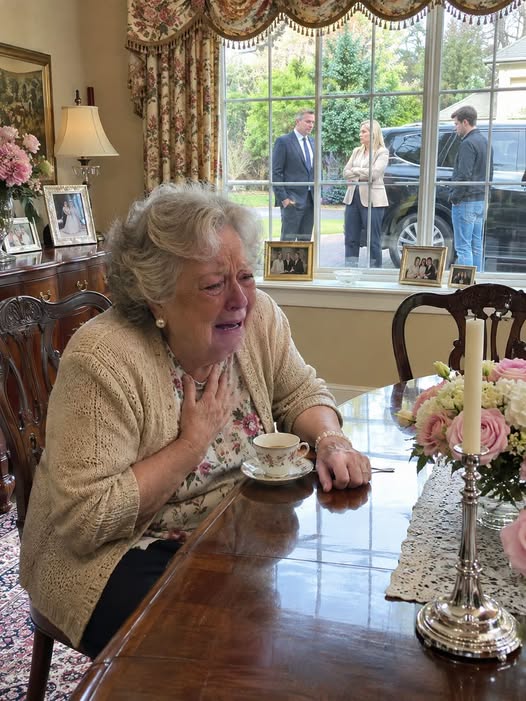
The woman standing behind my son was carrying a folder with my late husband’s name on the front.
For one terrible moment, I thought I was seeing things.
I was standing at my kitchen window with a cup of Earl Grey going cold in my hand. I’d been standing there since six o’clock that morning. I hadn’t slept. I’d watched the sun come up over the Hendersons’ roof across the street and the newspaper boy throw the paper into the hedge again.
Then Benjamin’s gray SUV pulled into my driveway.
Three people got out.
My son. His wife, Genevieve. And a third woman, older, in a camel coat, holding a manila folder against her chest with both arms.
On the front of the folder, in black capital letters, under the dark green logo of Harrington, Pryce & Kelley, it said:
THOMAS R. KELLEY — ESTATE MATTERS.
Thomas had been dead for six years.
And the woman holding that folder was somebody I’d trusted for more than twenty years.
Patricia Monroe.
Patricia had been Thomas’s legal assistant at the firm for twenty-two years. She knew his handwriting better than I did. She knew how he took his coffee, which clients made him crazy, and which judges he played golf with on Thursdays.
She’d sat in the second row at his funeral. She’d brought homemade chicken soup to my house every day for a week afterward. She’d held my hands in my kitchen and told me Thomas Kelley was one of the kindest men she’d ever known.
I hadn’t seen her in nearly three years. Not since she retired from the firm.
Now she was standing in my driveway beside Benjamin and Genevieve, looking like she’d rather be anywhere else on earth.
I set my teacup down on the counter.
I walked toward the front door.
The bell rang before I got there.
I looked through the glass.
Genevieve stood on the porch with her arms folded. Benjamin was staring at the welcome mat. Patricia was holding the folder like a shield.
I opened the front door. But I left the glass storm door closed between us.
“Good morning,” I said.
Genevieve stepped forward immediately.
“Margaret,” she said. “What have you done?”
I looked at her.
“Good morning to you too, Genevieve.”
She ignored that.
“Our cards are being declined.”
I nodded.
“I imagine they are,” I said.
Benjamin finally raised his eyes.
“Mom,” he said. “Please. Can we come inside?”
I looked at my son.
He was forty-eight years old. His face was pale. His hair was a mess. His shirt was buttoned wrong. He looked like he hadn’t slept any more than I had.
For a moment, the old instinct came back. Strong as a wave.
I wanted to open the door. Make coffee. Sit him down at the kitchen table and ask what was wrong and tell him everything would be all right. The way I’d done since he was four years old and fell off his tricycle in this very driveway.
Then I remembered his message.
You weren’t invited. My wife doesn’t want you there.
My name is Margaret Elaine Kelley. I’m seventy-seven years old.
I was married to Thomas Kelley for fifty years. He was an estate attorney. A partner at Harrington, Pryce & Kelley for thirty-one years. He spent his whole career helping families plan for what happens when somebody dies, so the people left behind wouldn’t have to fight.
He used to say, Maggie, I’ve seen more families torn apart by money than by anything else in the world. Infidelity, illness, distance, none of it comes close.
I used to think he was exaggerating.
Two days before Benjamin showed up at my door with Patricia, it was my birthday.
Seventy-seven.
Benjamin had called me the week before. “Mom, we’re doing a family dinner Saturday night. At the club. For your birthday. Seven o’clock.”
I’d been so happy. I’d marked it on the calendar on my refrigerator in red ink. I’d gotten my hair done on Friday. I’d bought a new navy dress at Nordstrom, which I never do.
On Saturday, at five-thirty, I got dressed. I put on the navy dress. And the pearl earrings Thomas gave me for our fiftieth anniversary. I don’t wear them often. They felt too special.
At six-fifteen, I was standing in my front hall with my coat over my arm and my purse in my hand, waiting for the taxi.
My phone buzzed.
A text. From Benjamin.
Mom, sorry, change of plans. It’s just going to be us tonight. You weren’t invited. My wife doesn’t want you there.
I read it three times.
Then I sat down on the bench in the front hall in my new navy dress and my anniversary pearls and my coat still over my arm.
I called the taxi and canceled it.
I sat there until it was dark. I didn’t turn on the lights.
At nine-thirty, Genevieve posted pictures online. My granddaughter sent them to me, because she didn’t know any better. Ava’s eight. She thought I’d want to see.
The four of them at the country club. Benjamin and Genevieve and Ava and little Theo, who’s four. A candlelit table. A big chocolate cake with sparklers.
The caption said: Family night. Just us. Exactly how it should be.
I didn’t cry that night.
I want to tell you that I did, but I didn’t. Something in me went very cold and very quiet.
I took off the pearls. I put them back in their velvet box. I hung up the navy dress.
Then I sat down at my mother’s old wooden desk in the study and opened my checkbook register. And my bank statements. And the little blue notebook where I keep track of what I send Benjamin.
I hadn’t added it up in a long time.
I added it up that night.
Over the last twelve months, I’d given Benjamin and Genevieve ninety-three thousand, six hundred dollars.
The mortgage assistance on their townhouse. Theo’s preschool. Their health insurance premiums. A new furnace. Groceries, twice a month, when Genevieve said money was tight. The car insurance. The club membership, because Genevieve said Benjamin needed it for networking. Ava’s ballet. Their water bill. Their electric bill. A trip to Florida in March “so the kids could see the ocean.”
Ninety-three thousand, six hundred dollars.
That was almost a third of what Thomas and I had saved. In one year.
And on my seventy-seventh birthday, I wasn’t invited to dinner.
The next morning, Sunday, I called Clara Whitfield at First Federal.
Clara has been my banker for nineteen years. She’s fifty-two, with short red hair and reading glasses she pushes up on her head. She came to Thomas’s funeral too. She calls me every year on my birthday.
She’d called the day before. I’d been too happy to really talk.
“Margaret,” she said when she picked up. “It’s Sunday. Is everything all right?”
“Clara,” I said. “I need to know every single recurring payment going out of my accounts. Every automatic transfer. Every bill I’m paying that isn’t mine. Can you do that?”
She was quiet for a second.
“Come in at nine tomorrow,” she said. “I’ll open early.”
On Monday morning, Clara printed out a list.
It was eleven pages long.
One hundred and seventy-four recurring payment instructions. Transfers. Scheduled contributions. Linked authorizations. Some of them were mine. My utilities. My insurance. My church tithe.
Most of them weren’t.
The townhouse. The preschool. The club. The insurance. Benjamin’s car. Genevieve’s car. Three streaming services I’d never heard of. A gym membership. A meal-kit delivery service.
And one more I’d never heard of at all. A monthly transfer to an account at another bank. Labeled only KRH OPERATING.
“What’s KRH?” I asked.
Clara shook her head. “I don’t know, Margaret. It’s not one of ours.”
I looked at that list for a long time.
Then I picked up her pen.
“Cancel them,” I said. “Everything that isn’t mine. Today.”
“All of them?”
“All of them.”
She looked at me over her reading glasses.
“Margaret, some of these have notice periods. Some of them are tied to contracts. A few you may have actually guaranteed. We can’t stop everything at once.”
“Then stop everything you can,” I said. “And show me the rest.”
That was Monday.
By Monday night, Benjamin’s cards were bouncing.
By Tuesday morning, he was standing on my porch with his wife and my husband’s legal assistant.
I took a slow breath. I looked at my son through the storm door.
“Benjamin,” I said. “Why is Patricia here?”
He glanced over at her.
Genevieve answered for him.
“We need to discuss some documents,” she said.
I kept my eyes on Patricia.
“Patricia?”
She swallowed.
“Margaret,” she said quietly. “I think you should hear what they have to say.”
Something about her voice frightened me.
Not the words. The way she said them.
She sounded ashamed.
I opened the storm door.
“Come in,” I said.
Genevieve walked right past me without saying thank you. She didn’t wipe her feet. She never does.
Benjamin followed her, with his head down.
Patricia came in last. She stopped in the front hall for a second and touched my arm.
I closed the door behind them.
I led them into the living room.
Thomas’s photograph stands on the mantel over the fireplace.
It’s from our forty-fifth anniversary. He’s wearing the brown corduroy jacket I always loved, the one with the leather patches on the elbows. He’s smiling. That crooked, slightly embarrassed smile he always had in pictures, like he wasn’t sure he deserved to be photographed.
Patricia looked at it when she came in.
Her whole face changed. For a moment, she looked close to tears.
I noticed.
But I didn’t say anything.
We sat down.
Genevieve sat on the couch and set her designer handbag on the floor beside her feet.
Benjamin didn’t sit. He stood by the window with his arms crossed. Like he might need to leave in a hurry.
Patricia sat in Thomas’s old leather armchair. She held the folder on her lap with both hands.
I sat across from them in my reading chair.
I looked at all three of them.
“Well?” I said.
Genevieve went first.
“You canceled our payments,” she said. “Without warning.”
“Yes,” I said.
She stared at me.
“Do you have any idea what that caused?”
I looked at her calmly.
“Several bills are now your responsibility.”
Her cheeks went pink.
“Theo’s preschool payment was declined. Yesterday. In front of the director.”
“Then you’ll need to arrange payment.”
“The club membership too. They sent a letter.”
“That sounds correct.”
“And the account connected to Benjamin’s business,” Genevieve said.
I turned toward my son.
“Which business?” I said.
Silence.
Genevieve’s face changed. Like she’d just realized she’d said something she shouldn’t have.
Benjamin closed his eyes.
I leaned forward in my chair.
“Benjamin,” I said. “Which business?”
He swallowed.
“Mom,” he said. “That’s what we came here to explain.”
I looked over at Patricia.
She was staring down at the folder in her lap.
“Then perhaps,” I said, “somebody should start.”
Genevieve crossed her arms.
“Margaret, you’re making this unnecessarily hostile.”
I turned and looked at her.
“Two nights ago,” I said, “you decided I wasn’t welcome at my own birthday dinner.”
She looked away.
“My son informed me of that decision by text,” I said. “While I was standing in my front hall with my coat on.”
Benjamin flinched by the window.
“And this morning,” I said, “you arrived on my doorstep because the money stopped.”
Nobody said anything.
I folded my hands in my lap.
“So I think it’s fair,” I said, “to ask why my husband’s former legal assistant is sitting in my husband’s chair, holding documents with his name on them.”
Patricia looked up.
“Margaret,” she said. “May I speak?”
“Please.”
She took a breath.
“As you know, I no longer work for the firm.”
“I know.”
“I retired three years ago.”
“Yes.”
She glanced over at Benjamin. Then back at me.
“About four months ago,” she said, “Benjamin contacted me.”
I looked at my son.
He was staring at the carpet.
Patricia went on.
“He said he was trying to organize some family financial matters,” she said. “He said you’d asked him to help.”
My stomach tightened.
“What financial matters?”
She hesitated.
“Your property,” she said. “Your estate planning documents. And certain accounts that had belonged to Thomas.”
I went very still.
I looked at Benjamin.
“You contacted Patricia about my estate?”
He swallowed.
“Yes.”
“Without telling me?”
He looked down at the floor.
“Yes.”
I turned back to Patricia.
“What did he ask you to do?”
She opened the folder. Her hands were shaking.
“He asked whether I still had copies of your old estate planning documents. From when Thomas was alive. From the firm.”
I stared at her.
“Did you?”
She shook her head quickly.
“No. I told him I couldn’t provide confidential client records. Not ever. Not even to family. I told him he needed to speak directly with you. Or with your current attorney.”
I felt a small wave of relief.
Then she said:
“But then he showed me something.”
She took a single sheet of paper out of the folder.
She put it on the coffee table.
She turned it so it faced me.
I looked down.
At the top of the page was my name.
MARGARET ELAINE KELLEY
Below it, a title.
PROPOSED FAMILY ASSET MANAGEMENT AUTHORIZATION
I stared at it.
Then I looked at the bottom of the page.
At the signature line.
And there was my signature.
Or something that looked remarkably like it.
My blood went cold.
I picked up the paper. My hands started trembling so badly that it rattled.
“Where did this come from?” I said.
Nobody answered.
“Benjamin?”
He whispered, “Mom, please don’t panic.”
I stared at him.
“Why,” I said, “is my signature on this?”
Genevieve leaned forward on the couch.
“It was only a preliminary document,” she said.
I turned toward her.
“That wasn’t my question.”
She pressed her lips together.
I looked down at the page again. I made myself read it.
It said that I authorized Benjamin Thomas Kelley to “participate in the management of certain financial affairs.” It mentioned my home. My accounts. My retirement assets. And something about “the possibility of transferring responsibilities in the event the undersigned becomes unable to manage them.”
I read the first paragraph twice.
Then I looked up at Patricia.
“Is this valid?”
She shook her head immediately.
“Not as presented,” she said. “It looks like an unsigned draft that somebody has added an image of a signature to. Copied and pasted. I told Benjamin I couldn’t verify it. I told him it should not be used. For anything.”
I looked at the signature again.
It looked exactly like mine. The loop on the M. The way the K leans forward. The little tail on the y.
But I had never signed that document.
I had never seen it before in my life.
I had never asked anybody to prepare it.
I looked at my son.
“Where,” I said, “did you get my signature?”
He closed his eyes.
Genevieve spoke up.
“Margaret, you’re overreacting.”
I turned toward her.
For seventy-seven years, I’d been told to be patient. Understanding. Reasonable. Not emotional. Not difficult. By my mother. By my teachers. By the women at church. Sometimes even by Thomas, God rest him, when I got too upset at a dinner party about something somebody said.
I’d heard those words so many times they’d become almost automatic. Like breathing.
But this time, something inside me went perfectly calm.
“Genevieve,” I said. “I am asking my son a question.”
She stared at me.
I turned back to Benjamin.
“Where did you get my signature?”
His voice broke.
“From one of the forms you signed,” he said. “For the townhouse.”
The floor seemed to shift under my chair.
I remembered those forms.
Three years earlier, Benjamin had come over with a stack of papers. He said the lender needed documentation about the money I was giving them for the down payment. A gift letter, he called it. Proof that it was a gift and not a loan.
I’d read them. I’d signed them. Right here. At my kitchen table.
I’d trusted him.
I’d trusted that those papers would be used only for what he told me they were for.
Now I was holding a copy of my signature, lifted off one of those forms, pasted onto a document that gave my son control over my whole life.
“Benjamin,” I whispered.
He started to cry.
“Mom,” he said. “I didn’t think it would go this far.”
I looked at him.
“How far?”
He put his hands over his face.
Genevieve stood up abruptly.
“This is ridiculous,” she said. “We haven’t done anything.”
Patricia looked up at her.
“Genevieve,” she said. Very clearly. “I need to be very clear about this. I told you both not to use that document.”
Genevieve turned on her.
“You said it wasn’t legally effective.”
“I said I could not verify it,” Patricia said. “And I said it should not be presented to anyone as Margaret’s authorization.”
The room went silent.
I looked at Patricia.
“Presented,” I said, “to whom?”
She hesitated.
Then she looked at Benjamin.
He started crying harder.
My heart started pounding.
“Benjamin. Who saw this document?”
He lowered his hands from his face.
“A financial adviser,” he said.
I felt sick.
“Whose financial adviser?”
He whispered, “Ours.”
I closed my eyes.
For a moment, I couldn’t hear anything except the clock ticking on the mantel. Thomas’s grandfather’s clock. Tick. Tick. Tick.
Then I asked, “What were you trying to do?”
Benjamin stared at me.
Finally, he whispered:
“We wanted to see whether we could borrow against the house.”
I opened my eyes.
My house.
The house Thomas and I bought after thirty-eight years of marriage, when Benjamin was grown and gone. A small brick colonial on a quiet street, with a sunroom and a rose garden Thomas planted himself. The house where we planned to grow old together.
The house we’d paid off eleven years ago. We’d had a little party. Just the two of us. Thomas burned the mortgage papers in the fireplace and we drank champagne on the floor in front of it.
“You wanted to borrow against my house?”
He nodded. Miserably.
“Without asking me?”
He started crying again.
“We were going to explain.”
“When?”
He didn’t answer.
I looked at Genevieve.
She was standing next to the couch. Her face was red.
“How much?” I said.
She looked away.
I said it again.
“How much money were you trying to borrow?”
Benjamin answered. In a whisper.
“Two hundred and forty thousand dollars.”
For a moment, I couldn’t breathe.
Two hundred and forty thousand dollars.
Against my house. My retirement. My whole future.
I gripped the arms of my chair.
Patricia leaned forward.
“Margaret,” she said quickly. “I want you to understand. I haven’t seen any evidence that a loan was actually completed. None.”
I nodded slowly.
“I came today,” she said, “because I was worried about what I’d been shown.”
I looked at her.
“Why didn’t you call me? Four months ago?”
Her eyes filled with tears.
“I should have,” she said.
She looked down at her lap.
“Benjamin told me he was going to talk to you. Immediately. That same week. He promised me. And then yesterday he called me in a panic about the cards, and I realized he never had. So I insisted on coming. I told him I’d come with him or I’d come alone.”
I swallowed.
I was grateful she’d come. I truly was.
But knowing that other people had been sitting in offices for months, discussing my home without me, made me feel exposed. Like the walls of my living room had suddenly turned to glass.
I turned to Benjamin.
“Why?”
He looked up. His face was wet.
“Mom,” he said. “We’re in trouble.”
“What kind of trouble?”
“The business.”
I thought about Clara’s list. The eleven pages.
KRH OPERATING.
I leaned forward.
“Tell me about the business.”
Genevieve answered fast.
“Benjamin started a consulting company.”
“What kind of consulting company?”
She hesitated.
“Property management. And investment services.”
I turned to my son.
“Benjamin?”
He nodded.
“It’s called Kelley Residential Holdings,” he said.
KRH.
“When did you start it?”
“Eighteen months ago.”
Eighteen months.
For eighteen months, I’d been paying their insurance. Their mortgage. Theo’s preschool. Their furnace. Their groceries. Their electric bill.
I’d believed my son was struggling to support his family.
And all that time, he’d been running a business.
A business he’d never once mentioned.
“Why didn’t you tell me?”
He stared at the floor.
“Because it wasn’t doing well.”
“And you were afraid I’d stop helping.”
He started crying.
“Yes.”
I didn’t say anything for a long time.
I looked up at Thomas’s photograph. At the brown jacket and the crooked smile.
Thomas spent his whole life teaching Benjamin about honesty. At the dinner table. In the car. At Little League. He used to say, Ben, mistakes can be repaired. Debts can be paid back. Businesses fail every day. But trust is different. Once you break it, it takes a long, long time to put back together.
I looked at my son.
“Benjamin,” I said. “Did you use my money for the business?”
He hesitated.
Then he nodded.
My heart sank.
“How much?”
He whispered, “I don’t know exactly.”
“Then I suggest,” I said, “that you find out.”
Genevieve stepped forward.
“Margaret, we’ve told you we’re struggling.”
I turned to her.
“And I’ve given you ninety-three thousand, six hundred dollars in twelve months,” I said.
She looked away.
“I paid for things you told me you couldn’t afford.”
Benjamin wiped his eyes. “I know.”
“And now I find out that some of that money went into a business I didn’t even know existed.”
Nobody answered.
I looked at Genevieve.
“Did you know about this?”
She folded her arms.
“Of course.”
“Then why did you keep asking me to pay your household expenses?”
She looked irritated. Like the answer was obvious.
“Because the business needed time.”
I stared at her.
“And my retirement didn’t?”
She blinked.
“Did you ever once think about what would happen if I needed that money?” I said. “If I got sick?”
She opened her mouth.
I held up one hand.
“If my roof needed replacing? If I needed a hip replacement? If I needed care? A nursing home? A nurse at home?”
She pressed her lips together.
“Or did you simply assume,” I said, “that I would keep paying because I always had?”
Benjamin started crying again.
Genevieve looked out the window.
I stood up.
My knees felt weak. But my voice was steady.
“I want everyone to leave,” I said.
Benjamin looked up.
“Mom, please.”
“Not another word, Benjamin.”
He stood up from the window.
“Mom, I’m sorry.”
“Benjamin,” I said. “I need time to understand what you’ve done. And I need to protect myself.”
Genevieve picked up her handbag.
“So that’s it?” she said. “You’re abandoning your family?”
“No,” I said.
She stared at me.
“I’m refusing to let my family use my money and my property without my informed consent.”
She scoffed.
“That’s a very dramatic way to describe helping your son.”
I felt a flash of anger. Hot and sharp. But I kept my voice calm.
“Helping my son,” I said, “would have been something I chose. After being told the truth.”
I pointed at the folder on Patricia’s lap.
“This was something you tried to arrange without telling me.”
She looked away.
I turned to Patricia.
“Please leave that copy with me.”
“Of course.”
“And I’d appreciate a written statement. Of what you know.”
She nodded. “I can give you a factual account of my own involvement. Everything I saw and everything I said. Dated and signed.”
“Thank you.”
Benjamin was standing in the doorway to the front hall.
He looked older than forty-eight. He looked about sixty.
For a moment, I saw the little boy who used to run into my arms after school with paint on his hands. The boy who cried in the car for an hour when his team lost the Little League championship. The teenager who stood at Thomas’s hospital bed and promised his father he would always look after me.
I wanted to hold him.
I couldn’t.
Not yet.
He whispered, “Mom. Do you hate me?”
My heart broke.
“No, Benjamin,” I said.
His eyes filled.
“I love you,” I said.
He took a step toward me.
I raised my hand. Gently.
“But love doesn’t make what happened acceptable,” I said. “And it doesn’t mean I can trust you right now.”
He stopped.
He lowered his head.
Then he walked out.
Genevieve followed him.
Patricia stopped at the front door.
“Margaret,” she said. “I’m truly sorry. I should have called you four months ago. I’ve been sick about it.”
“Thank you for coming, Patricia.”
She looked past me, down the hall, toward the living room. Toward the mantel.
“He’d have been so angry,” she said quietly. “Thomas. Not at you. At what they did. He used to tell every single client, Never let anybody else sign for you. Not even your children. Especially not your children.”
She shook her head.
“He wrote that in the margin of every estate plan he ever drafted. In red pen.”
Then she left.
I closed the door.
I locked it.
I stood in the front hall, right where I’d sat on the bench in my navy dress three nights before.
I couldn’t move for a long time.
Then I walked back into the living room. I picked up the document off the coffee table.
My signature. On a paper I’d never seen.
I looked up at Thomas.
And I started to cry.
Not quietly. Not gracefully. I cried the way people cry when something they believed was solid gives way under their feet.
I cried for my husband. For the son we’d raised. For all the years I’d spent trying to keep Benjamin’s family comfortable.
And for the terrible understanding that my generosity hadn’t protected my relationship with my son.
It had let something dangerous grow.
When I was done crying, I washed my face. I made a fresh cup of tea.
Then I picked up the phone and called Clara.
“Margaret?”
“Clara,” I said. “I need your help.”
Her voice changed immediately.
“What happened?”
“I think somebody’s been trying to use my financial information without my permission.”
She was quiet.
“Tell me everything,” she said.
I did. The folder. The copied signature. The authorization. Kelley Residential Holdings. Two hundred and forty thousand dollars.
When I finished, Clara took a long breath.
“Margaret, we need to review every account and every access permission. Today. We need to separate the payments you knowingly authorized from anything you didn’t.”
“Can we do that?”
“We can start. Anything at another bank, you’ll have to take up with them directly.”
“Thank you.”
“Margaret?”
“Yes?”
“Call your attorney. Today.”
“I will.”
“And Margaret,” Clara said gently. “Don’t sign anything Benjamin or Genevieve brings you. Not a birthday card. Not until you’ve had independent advice.”
After we hung up, I sat down at my mother’s old wooden desk in the study.
It’s a walnut writing desk with a green leather top. My mother paid her bills at that desk for forty years. Then I paid mine.
I opened a fresh spiral notebook.
On the first page, in big letters, I wrote:
MY LIFE. MY DECISIONS.
I looked at those words for a long time.
Then I started making a list.
Accounts. Automatic payments. Access permissions. Insurance policies. Estate documents. Property records. Credit reports.
Every financial arrangement I could remember.
Thomas and I were never rich.
People assume we were, because he was a lawyer. But he was a small-town estate lawyer, not a Wall Street one. We were careful. Disciplined. We saved. We paid our bills on time. We drove our cars until they died. We never had credit card debt. Not one month in fifty years.
We made sacrifices so we could have a comfortable retirement without ever having to depend on our son.
After Thomas died, I kept those habits.
Or I thought I did.
But somewhere along the way, I’d let Benjamin’s needs become the center of my whole financial life.
Every emergency. Every unexpected bill. Every Mom, we hate to ask.
I paid because I loved him.
And because saying no made me feel like I was failing as a mother.
Now I understood I’d been failing somebody else entirely.
Myself.
The next Monday, I met with Clara and my attorney, Rebecca Lawson.
Rebecca is in her early sixties. Calm. Gray-haired. She was a junior associate at Thomas’s firm thirty years ago, before she opened her own practice. She’d handled my estate planning since Thomas died.
She listened to everything.
Then she picked up the document Patricia had left. She studied the signature with a magnifying glass. The wording. The dates. The information in it.
Finally she looked up at me.
“Margaret, did you authorize anyone to prepare this?”
“No.”
“Did you sign it?”
“No.”
“Did you give Benjamin permission to use your signature from any other document?”
“Absolutely not.”
Rebecca nodded.
“Then we preserve this copy. And we find out whether it was ever submitted anywhere.”
I swallowed.
“Could somebody have taken my house?”
She looked at me very carefully.
“Not simply because this piece of paper exists,” she said. “Transferring a house or borrowing against it requires specific legal steps. Notarized documents. Lender verification. Recording with the county. We’ll check every one of them. But the document is concerning, Margaret, and we’re going to treat it seriously.”
She explained it all. We’d pull the county property records. Confirm my title. Check for any recorded liens. Freeze my credit. Put fraud alerts on my accounts.
Then she said, “And I’d like you to think about your estate plan.”
I looked down at my hands.
“Thomas and I always meant to leave the house to Benjamin.”
“That may still be your wish.”
“I’m not sure anymore,” I said.
Rebecca leaned forward.
“Margaret, you don’t have to decide that today. Your estate plan should reflect your own wishes. Made freely. With a clear understanding of your circumstances.”
My eyes filled.
“Let’s start by making sure your present is secure,” Rebecca said. “Then we’ll talk about the future.”
Your present.
Those words stayed with me for days.
For years, I’d been so focused on protecting Benjamin’s future that I’d almost forgotten I still had a present of my own.
A life. A home. Savings. Friends. Plans.
Years that deserved to be lived without lying awake at night wondering who was going to need money next.
Over the next few weeks, I worked carefully.
Clara and I went through every account at First Federal, line by line. I called other banks and companies directly. I changed every password. I updated my security questions. I removed every access permission I hadn’t knowingly given. I reviewed every automatic payment.
Not everything could just be stopped. Some contracts needed notice. Some had cancellation fees. Two accounts, I’d actually co-signed myself, years ago, for Benjamin’s car loans. Those needed Rebecca’s help.
But going through it all, I understood something I hadn’t before.
It wasn’t one big request.
It was dozens and dozens of little ones. Each easy to say yes to. Each presented as temporary. Each followed by another.
And over time, all those little yeses had built a whole financial system. A system that depended on me.
I didn’t mean to build it.
But I’d helped keep it running.
That was painful to admit. Because it meant taking responsibility for my own part.
Benjamin and Genevieve had misled me. They’d taken advantage of my generosity.
But I’d also ignored warning signs because I was afraid of conflict. I’d accepted vague answers. I’d paid without asking questions. I’d let guilt make decisions that should have been made with my head.
I couldn’t change the past.
But I could change what happened next.
One afternoon, at Clara’s desk, she pointed to a column of transfers.
“Margaret, do you recognize these?”
Monthly payments. Each one labeled household assistance. Each one going to Benjamin.
Except they weren’t going to Benjamin’s personal account.
They were going to Kelley Residential Holdings.
“How long?” I said.
“About fourteen months, from what we can see.”
Fifteen hundred dollars. Two thousand. Three thousand. A few bigger.
“Did I authorize these?”
Clara pointed to the setup records. “They were created using your online banking login. Through the transfer feature. We need to look at exactly how.”
I remembered. Two years ago. Benjamin sitting at my kitchen table with my laptop. Here, Mom, let me set up automatic transfers so you don’t have to write checks every month. It’s easier.
I’d given him my password.
That night, I sat at my mother’s desk until almost midnight.
I compared dates. Amounts. Bank statements. Receipts. Text messages from Benjamin.
Then I noticed something.
Four thousand dollars. Transferred two days after Benjamin texted me that the townhouse needed emergency roof repairs.
I scrolled back through my phone. I found the message.
Mom, we hate to ask, but the roof repairs are going to cost way more than we thought. Could you help?
I looked at the bank statement.
Four thousand dollars. Not to Benjamin. To Kelley Residential Holdings.
Another payment, three weeks later, after a text about insurance.
Another, after Genevieve said they were behind on Theo’s preschool.
All to the business.
I sat back in my mother’s chair.
“Benjamin,” I whispered. “What have you done?”
The next morning, I called him.
He answered on the first ring.
“Mom?”
His voice sounded so hopeful it hurt.
“I need to ask you something,” I said.
“Anything.”
“Why did the money I sent you for the roof go into Kelley Residential Holdings?”
Silence.
“Benjamin?”
“The accounts were connected,” he said.
“What does that mean?”
“We were using the business account to manage some expenses.”
“Did you tell me that?”
“No.”
“Did you ask my permission?”
He was quiet.
Then he whispered, “Not specifically.”
I closed my eyes.
“I need complete records, Benjamin. Every transaction in that business that involved my money.”
“Mom, it’s complicated.”
“Then you’ll have to explain it carefully.”
He started to cry.
“I don’t want to lose you,” he said.
My throat closed up.
I loved my son. Despite everything. Despite the lies, the humiliation, the document with my signature on it.
But I’d finally learned that loving someone doesn’t mean protecting them from every consequence of what they’ve done.
“Benjamin,” I said. “The way to start repairing this is to tell me the truth.”
He was quiet for a long time.
“Okay,” he said. “I’ll get the records.”
Three days later, Benjamin came to my house alone.
No Genevieve. No Patricia. No demands.
Just my son. Standing on my porch in the cold, holding a cardboard box.
“Mom,” he said. “Can we talk?”
“What’s in the box?”
“The records,” he said. “All of them.”
I stepped aside.
“Come in.”
We sat at the kitchen table.
The same table where Thomas helped him with his math homework every night for twelve years. The same table where we had birthday cakes and Thanksgiving turkeys and the night Benjamin told us he was going to marry Genevieve.
He opened the box.
Folders. Bank statements. Invoices. Receipts. A spreadsheet he’d printed out. And some pages of handwritten notes.
He laid it all out on the table.
Then he looked at me.
“Mom,” he said. “I need to tell you everything.”
“Then start at the beginning.”
He stared at his hands.
“Kelley Residential Holdings was supposed to be a small property management business,” he said. “I’d manage rental houses for people who didn’t want to deal with tenants. Collect rent. Handle repairs. Take a percentage.”
“Go on.”
“I hired a company to build a website. Paid for software. Insurance. Advertising. Then I leased office space.”
“Office space?”
He nodded. “Genevieve said it would make us look more professional. Downtown. On Market Street.”
My heart sank.
“We had a few clients at first. Three. Then two. Then one.” He looked down. “It wasn’t enough to pay for the office. So we started using our savings. And when the savings were gone…”
His voice broke.
“We started using the money you sent.”
There it was.
Not every detail. But the truth I’d needed to hear.
“Benjamin,” I said. “Did you tell me you needed money for household expenses when you meant to use it for the business?”
He started crying.
“Yes.”
“How many times?”
He shook his head. “I don’t know. Sometimes the money really did go to household bills. The preschool. The groceries. That was real. But sometimes it went to the business. And I didn’t tell you.”
“Why?”
He looked at me. His eyes were red.
“Because I was ashamed,” he said. “I kept thinking I could make it work. And then I’d pay you back, all of it, and you’d never have to know. But every month got worse.”
He wiped his face.
“Genevieve was so angry. We were spending all this money and getting nowhere. She wanted to borrow against the townhouse. But we didn’t have enough equity. We’d barely paid anything down.”
My stomach tightened. I already knew what came next.
“So you started looking at my house,” I said.
“Yes.”
“Whose idea was it?”
He hesitated.
“Benjamin, I’m not asking so I can blame someone else instead of you. I’m asking because I want the truth.”
He nodded.
“It was mine,” he said.
I stared at him.
“Genevieve wanted us to just ask you,” he said, crying harder. “Straight out. For a loan. She said, Your mother has money, just ask her. I said I couldn’t. I couldn’t ask you for that much. I couldn’t look you in the face and tell you what we’d done with the rest. So I said maybe we didn’t have to ask. Maybe we could just… borrow against it. And pay it back. And you’d never know.”
My heart broke.
For days, I’d imagined Genevieve pushing my son. Manipulating him. Making him choose between us.
But this was worse.
My son hadn’t just gone along.
He’d made the plan.
“Did Genevieve know about the signature?”
“Yes.”
“And you both knew I hadn’t agreed.”
He whispered, “Yes.”
I sat back in my chair.
Neither of us said anything for a long time.
Then I asked the question that had been sitting inside me since Saturday night.
“Benjamin. Why did you tell me I wasn’t welcome at dinner?”
His face changed.
“Mom…”
“Please don’t tell me it was because Genevieve didn’t want me there.”
He covered his face.
Then he whispered, “Because I couldn’t face you.”
I went very still.
“We’d been fighting about money all day,” he said. “Genevieve said we couldn’t keep pretending everything was fine. That we had to tell you. Before Christmas. And I knew… I knew you’d been paying for things we should have paid for ourselves. I knew about the transfers. I knew about the document.”
He looked at me.
“I didn’t want to sit across from you at your birthday dinner,” he said, “and pretend I hadn’t done anything wrong.”
For a moment, I couldn’t breathe.
I’d believed Genevieve shut me out because she found me inconvenient.
Maybe that was part of it.
But Benjamin had wanted to avoid looking me in the eye. He’d been ashamed. Scared. Unwilling to face it.
So he’d sent me a cruel text message.
And let his wife take the blame.
“Benjamin,” I said. “Do you understand what that message did to me?”
“I know.”
“No,” I said. “I don’t think you do.”
He looked up.
“I was dressed for dinner,” I said. My voice was trembling now. “I was wearing the pearls your father gave me. For our fiftieth anniversary. I’ve worn them maybe five times. I’d gotten my hair done. I’d bought a new dress.”
Benjamin put his hand over his mouth.
“I spent the whole afternoon looking forward to seeing you,” I said. “Seeing Ava and Theo. And then I was standing in the front hall with my coat on my arm, and you told me I wasn’t invited.”
He started sobbing.
“I sat alone in this house while you ate chocolate cake with sparklers at the club,” I said. “Ava sent me the pictures. She thought I’d like to see them.”
“Mom, I’m so sorry.”
“And then I found out that the money I’d been sending you had been going to a business you never told me about. And then I found out you’d put my signature on a document I’d never seen. To borrow against the house your father and I paid for.”
I wiped my eyes.
“Benjamin, do you understand how frightened that made me?”
He nodded. “I do now.”
“I spent six years learning how to live without your father,” I said. My voice broke. “I thought I could always trust you. You promised him. At the hospital. You held his hand and promised him.”
He cried and cried.
I looked away. Out the window. For a moment I couldn’t bear to look at him.
Snow had started to fall. Big, soft flakes, drifting down over Thomas’s roses.
I thought about Thomas. About the boy we’d raised. About the values we’d tried so hard to teach him.
About the difference between making a mistake and hiding one.
“Benjamin,” I said finally. “Forgiveness isn’t something I’m ready to talk about today.”
“I understand.”
“But accountability is.”
He raised his eyes.
“You’ll give me complete records,” I said. “You’ll cooperate with any proper review of what happened. With Rebecca. With Clara. With anyone they need you to talk to. And you’ll stop treating my money as something you can reach for every time you make a bad decision.”
“I will.”
“Benjamin, I won’t take your word for that anymore. I need to see it.”
He nodded.
“I know,” he said.
Then he reached into his jacket and took out an envelope. He put it on the table between us.
“What’s this?”
“A repayment plan,” he said. “I know I can’t pay it all back right away. But I want to start.”
I opened it.
A list of amounts. A suggested monthly payment. Small, but real.
And a note at the bottom, in his handwriting:
Mom, I know money can’t fix what I did. But I want to stop pretending your sacrifices were gifts I was entitled to.
I stared at those words for a long time. My eyes filled.
“This needs to be reviewed properly,” I said.
“I know.”
“I won’t agree to anything today.”
“Okay.”
I looked at the note again.
“But I’m glad you’re starting to understand,” I said.
He started crying again. I handed him a tissue.
And for the first time since Saturday night, I felt a small, small flicker of hope.
Not because the money was coming back.
But because my son had finally stopped pretending the truth could be avoided forever.
Over the next few months, Benjamin cooperated with everything.
It was hard. Some of the transactions were simple. Some needed more paperwork. Some of the business expenses were legitimate. Others had been sloppily recorded. A few transfers didn’t match anything I’d been told.
Rebecca helped me understand the difference. Money I’d knowingly given as a gift. Payments I’d authorized for a specific purpose. And transactions that raised real questions about consent.
We didn’t assume every painful discovery was automatically a crime.
But we didn’t pretend it was nothing, either.
The copied signature was the most serious part. Rebecca walked me through every step to preserve the evidence and protect my identity. She contacted the financial adviser’s firm directly. They confirmed in writing that the document had been reviewed, flagged as unverified, and rejected. No loan application had ever been filed. Nothing had ever reached a lender.
And then, one Thursday afternoon, Rebecca called me with the county records.
“Margaret,” she said. “Your house is in your name. Free and clear. No liens. Nothing recorded against it. Nothing.”
I sat down on the bench in the front hall and cried with relief.
I updated my estate plan that spring.
Not out of anger. Not to punish Benjamin.
But because I needed arrangements that matched my life as it actually was. That protected my independence.
Rebecca asked me to think carefully about who should make decisions for me if I ever couldn’t make them myself. I thought about it for weeks. Then I made my choices based on reliability and judgment and my own wishes.
I told Benjamin I’d reviewed my plans.
He listened. Then he asked, very quietly, “Mom, did you take me out of everything?”
“Benjamin,” I said, “my estate plan is about protecting my wishes. It’s not a reward for good behavior. And it’s not a punishment for bad behavior.”
He looked down.
“But I won’t discuss the details with you,” I said, “as though my death were a financial event you’re waiting for.”
His face crumpled.
“Mom, I never thought of it like that.”
“Then I’m glad we’re talking about it now.”
He nodded.
For once, he didn’t argue.
Genevieve took longer.
She called me over and over at first. Sometimes angry. Sometimes crying. Sometimes saying I was destroying their family.
I listened when she spoke to me with respect. I hung up when she started blaming me for problems I didn’t create.
One afternoon in May, she called while I was out in the garden, cutting back Thomas’s roses.
“Margaret,” she said. “Do you understand we might have to sell the townhouse?”
I looked at the roses.
“Yes,” I said.
“And you’re comfortable with that?”
“Genevieve,” I said. “I’m not comfortable knowing you’re struggling. But I’m comfortable refusing to risk my home to keep you from making decisions you need to make.”
She went quiet.
“The townhouse belongs to you and Benjamin,” I said. “The decisions about it are yours.”
“You could help us,” she whispered.
“I already have,” I said.
She started crying.
I felt sorry for her. I truly did.
But being sorry for someone doesn’t mean you have to surrender to them.
“I hope you and Benjamin find a solution you can live with,” I said.
“And if we don’t?”
“Then you’ll get good advice,” I said. “And make the hard choices that follow.”
She was quiet for a long time.
Then she said, “You sound so different, Margaret.”
“I suppose I am,” I said.
I stood in the garden for a long time after she hung up.
The sun was warm on my shoulders. A breeze moved through the roses.
And I thought about how strange it felt. To say no without apologizing.
For years, I’d believed saying no made me selfish.
Now I understood there’s a difference between generosity and letting someone else control your future.
I could love Benjamin. Worry about Ava and Theo. Feel sorry for Genevieve.
And still protect myself.
Those things weren’t opposites.
They were part of learning how to love someone without disappearing.
Benjamin and Genevieve sold the townhouse in August.
It was painful for them. That townhouse was success to them. The kind of house you want other people to see.
They moved into a smaller rental on the other side of town. Three bedrooms. A narrow kitchen. A little backyard with a swing set the last tenants left behind.
Benjamin closed Kelley Residential Holdings in September. He broke the office lease. He paid off what he could. He got a job as an operations manager for a property company. Somebody else’s company. Less money. Less glamour. But steady. Honest. Paid every two weeks.
Genevieve went back to work part-time at a dental office.
They canceled the club. Sold the second car. Sold a lot of things.
They started living within their means.
The first time Benjamin invited me over to the new house, I hesitated.
I remembered the text. The navy dress. The pearls.
But I also remembered the cardboard box. The repayment plan. The note.
I want to stop pretending your sacrifices were gifts I was entitled to.
I went.
Benjamin opened the door himself.
“Mom,” he said. He smiled. Nervously.
“Hello, sweetheart.”
He hugged me.
The house smelled like fresh paint. Theo was building a tower out of blocks in the living room. Genevieve stood by the kitchen doorway.
“Hello, Margaret,” she said. Carefully.
“Hello, Genevieve.”
Then Ava came flying down the hall.
“Grandma!”
I bent down. She threw her arms around my neck.
I held her tight.
For a moment, all the hurt of those months seemed to disappear. Not because it was forgotten. But because what I felt for that little girl had never changed. Not for a single day.
“Grandma, come see my room!”
She took my hand and pulled me down the hallway. She showed me her pink curtains, her stuffed animals lined up on her bed, her little white bookshelf.
“It’s beautiful,” I said.
She looked up at me.
“Grandma, are you staying for dinner?”
My throat tightened.
“Yes, sweetheart.”
“Good,” Ava said. “Daddy said we’re waiting for you.”
Waiting for you.
Such a simple thing to say.
After everything, it meant more than she could possibly understand.
We went back to the dining room.
The table was set. The food was still in the kitchen. Nobody had started eating.
There was an empty chair next to Benjamin.
He pulled it out.
“Mom,” he said. “Sit here.”
I looked at the chair. Then at my son.
He seemed to understand what I was thinking. His eyes filled.
“We wanted you to be part of dinner,” he said.
We ate together.
Roast chicken. Mashed potatoes. Green beans. A homemade chocolate cake Ava had helped frost, with more frosting on her face than on the cake.
No country club. No candlelit table. No sparklers.
Just a family around a table. Talking. Laughing. Ava telling me about her teacher. Theo telling me a very long story about a dinosaur that I didn’t understand at all.
For the first time in a very long while, I felt like my being there mattered more than my checkbook.
At the end of the meal, Benjamin cleared the plates. Genevieve brought coffee.
“Mom,” Benjamin said. “You’re welcome here whenever you want to visit.”
“Thank you, sweetheart.”
He smiled. A little sadly.
“And you don’t have to pay for anything,” he said.
For a moment, I couldn’t say a word.
Then I laughed.
Not because the past was funny. But because that sentence was so simple. So obvious.
And so long overdue.
I reached across the table and took his hand.
“I know, sweetheart,” I said.
He squeezed my fingers.
And for the first time, I believed he understood.
That winter, Benjamin started making payments under the plan Rebecca reviewed.
The amounts were modest. Some months were easier than others. But he never missed one.
I didn’t measure his love by those payments. And I didn’t pretend paying me back could fix the trust on its own.
But the effort mattered.
Because it showed me something I’d rarely seen from him before.
That my sacrifices had been real. That my money had value. That my future mattered.
And that loving his mother meant respecting her independence.
Meanwhile, I started making changes of my own.
For years, my whole life had revolved around Benjamin. His bills. His children. His emergencies.
Now, for the first time since Thomas died, I sat down at my mother’s desk and asked myself a different question.
What do I want?
Not what Benjamin needed. Not what Genevieve expected. Not what would make everybody else comfortable.
What do I want?
The question felt almost foreign.
I made a list.
Travel. Books. My garden. More time with friends. A new reading chair for the sunroom.
And a trip.
Thomas and I had planned a trip once. To the Blue Ridge Mountains in October. A little inn with a stone fireplace. Towns full of old bookstores. Breakfast by a window looking out at the trees.
We booked it for our fiftieth anniversary. October, six years ago.
He gave me the pearls at our anniversary dinner that June. And in July, he got sick.
We never went.
After he died, I couldn’t bring myself to go alone. It felt wrong. Like enjoying something without him would mean leaving him behind.
Now, at seventy-eight, I started to wonder if it was the other way around.
Maybe living fully was one way to honor the years we had.
I called my friend Eleanor.
She’s seventy-nine. Widowed. Sharp as a tack. And not the least bit interested in spending her last years waiting for other people to make plans for her.
When I told her about the trip, she laughed.
“Margaret, why are we still talking about it?”
“What do you mean?”
“Book the hotel.”
“Eleanor…”
“No excuses. We’ve spent enough of our lives taking care of everybody else. Let’s go look at some mountains.”
I smiled.
“All right,” I said.
She whooped on the phone.
And for the first time in months, I felt something that had nothing to do with fear or disappointment.
I felt excited.
We went in October.
The mountains were covered in gold and red. The air smelled like pine and woodsmoke. We stayed at a little inn in a town called Blowing Rock, with a stone fireplace and a long porch overlooking the valley.
Every morning, we drank coffee on that porch while the mist rose out of the trees.
We visited four bookstores. Ate warm apple pie. Walked through little towns. Laughed until our sides hurt.
One evening, we sat on a bench overlooking the valley. The sun was going down. The whole sky turned orange.
“Thomas would have loved this,” I whispered.
Eleanor smiled.
“I know.”
My eyes filled with tears. For a moment, I missed him so much I could barely breathe.
Then Eleanor took my hand.
“Margaret, he’d have wanted you to come,” she said. “And he’d have been delighted you brought me.”
I laughed through my tears.
“Yes,” I said. “He would.”
We sat there a long time.
And something shifted in me.
For years, I’d believed my life was getting smaller. Thomas was gone. Benjamin had his own family. My body was getting older. My whole world seemed to revolve around the people who still needed something from me.
But sitting on that bench, with the mountains turning gold and orange in front of me, I understood something.
My life wasn’t finished.
There were still places to see. Books to read. Friends to laugh with. Mornings I could wake up and decide for myself how to spend the day.
I’d spent ninety-three thousand, six hundred dollars in one year trying to make my son’s life easier.
Now I was learning I was allowed to spend my own time and my own money making my own life mean something.
It felt like freedom.
When I got home, Benjamin came over.
He brought flowers. Not because it was my birthday. Not because he needed anything.
Just to welcome me home.
“Mom,” he said, at the door. “How was the trip? I want to hear everything.”
We sat in the living room. I showed him my photographs. The inn. The porch. The bookstores. Eleanor eating her third slice of apple pie.
He laughed at my stories. He asked questions. He listened.
Really listened.
At one point, he looked up at Thomas’s photograph on the mantel. Then back at me.
“Mom,” he said. “I used to think that since you were retired, you didn’t really need much.”
I looked at him.
“I thought your house was paid off and your bills were small,” he said, “so helping us wasn’t a big deal. I thought you were just sitting here with money you didn’t need.”
He swallowed.
“I never thought about what you were giving up. Trips. Peace of mind. This.” He held up a photo of the mountains. “I was wrong.”
My eyes filled.
“Benjamin,” I said. “I spent my whole life saving for the years I hoped to share with your father. When he died, those savings became the only security I had left.”
He nodded.
“I wanted to help you,” I said. “I really did. But I also wanted to live.”
He started crying.
I reached over and took his hand.
“And I’m still here, sweetheart,” I said. “So I intend to enjoy the time I have.”
He squeezed my hand.
“You should,” he said.
And I believed him.
Christmas came quietly that year.
I decorated the tree. Hung Thomas’s stocking, the way I do every year. Baked his favorite cookies, the ones with the cherries in the middle. Put my mountain photographs on the mantel beside his picture.
Benjamin invited me to Christmas dinner.
This time, he called. Not a text. A real phone call.
“Mom, we’d love for you to come for Christmas dinner.”
“What time?”
“Six-thirty.”
I laughed softly. “Are you sure?”
He was quiet for a moment.
“Mom,” he said. “I know. I promise you’re invited.”
“Thank you.”
“And dinner won’t start until you get here,” he said.
My eyes filled.
Such a small promise.
But after everything, it meant more than any gift.
I arrived at six twenty-five. Five minutes early.
Benjamin opened the door before I could knock.
“Mom!”
He hugged me. Genevieve stood behind him in the hallway.
“Merry Christmas, Margaret,” she said. And she smiled. A real smile. The first one I’d seen from her in a long time.
“Merry Christmas, Genevieve.”
The children ran to me. Ava wrapped her arms around my waist. Theo grabbed my leg and wouldn’t let go.
The house was warm. It smelled like ham and cinnamon. The table was set. The food was still in the kitchen.
And there was an empty chair waiting next to Benjamin.
He smiled.
“That’s your seat,” he said.
We ate together. Talked. Laughed. Opened presents. Theo got a toy fire truck and drove it into every piece of furniture in the house.
Later, Ava climbed into my lap. She reached up and touched my ear.
“Grandma,” she said. “Why do you always wear these pearls?”
I touched them.
Thomas’s gift. The same pearls I’d worn the night Benjamin told me I wasn’t welcome.
I’d thought about leaving them in their velvet box that night. I’d thought about never wearing them again.
Then I’d decided they were mine. And so was the memory of the man who gave them to me. Nobody got to take that away.
“Your grandfather gave them to me,” I said.
“Really?”
“For our fiftieth wedding anniversary.”
Her eyes got very big.
“That’s a long time.”
I laughed. “Yes, sweetheart. It is.”
She touched one pearl very gently with her fingertip.
“Did he love you a lot?”
I looked across the table at Benjamin.
He was watching us. His eyes were wet.
“Yes,” I said. “He loved me very much.”
Ava smiled.
“Then you should always wear them,” she said. “So you remember.”
I kissed the top of her head.
Across the table, Benjamin wiped his eyes with his napkin.
After dinner, Benjamin walked me out to my car.
The snow was coming down again. Soft and slow.
“Mom?”
“Yes, sweetheart?”
He hesitated.
“I know I can’t undo what happened,” he said. “But I promise I’ll never make you feel unwanted again.”
I looked at him for a long moment.
“Benjamin,” I said. “I don’t need expensive gifts. I don’t need big promises. I need honesty. I need respect. And I need to know that you love me even when I have nothing to give you.”
He nodded.
“I understand,” he said.
I hugged him.
“Then we’ll keep trying,” I said.
On the drive home, I thought about those one hundred and seventy-four payments I’d canceled at Clara’s desk.
At first, I thought canceling them meant I was losing my family.
Now I understood I’d just stopped paying for a place in their lives.
My house was still mine. My savings were protected. My future belonged to me again.
The folder Patricia carried up my front walk that morning had brought me a frightening secret. But that secret had forced me to face a truth I’d been avoiding for years.
I could be a loving mother without sacrificing my security. Or my dignity. Or my happiness.
When I walked into my quiet house, I stopped in the living room.
I looked up at Thomas on the mantel. The brown corduroy jacket. The crooked smile.
“We’re going to be all right, sweetheart,” I said.
Then I turned off the lights and went upstairs.
On the nightstand, next to the velvet pearl box, there was a new brochure. Eleanor had left it the week before.
Spring on the Maine Coast. Lighthouses. Lobster. Ten days.
For the first time in years, I wasn’t lying awake wondering who would need money tomorrow.
I was thinking about where I wanted to go next.
And that, I realized, was the greatest gift I could give myself.