The White Envelope
Part One: 2:17 A.M.
The maternity suite smelled of disinfectant, baby formula, and the cold coffee my husband had left on the windowsill six hours earlier. It was a little after nine in the morning on a gray Tuesday in March, and sleet was ticking against the window of Room 412 at St. Mary’s Hospital in Madison, Wisconsin.
My name is Chloe. I’d just been through twenty hours of labor.
Our daughter was born at 2:17 that morning. Seven pounds, three ounces. A full head of dark hair, a tiny pursed mouth, and a cry so loud the delivery nurse laughed and said, “Oh, she’s going to have opinions.” Now she was asleep on my chest, wrapped in a pink-and-white striped blanket, one fist curled up against her cheek.
My hair was still damp with sweat. Every part of my body ached. I had stitches I didn’t want to think about, and when I shifted in the bed, the pain made my eyes water. But when I looked down at her face, everything else seemed very far away.
I’d imagined this moment for nine months. Longer, really. Since I was a little girl playing with dolls on my parents’ porch in Middleton. I always pictured my husband sitting on the edge of the hospital bed, holding our daughter’s tiny fingers, crying, maybe, the way my father cried when I was born. Celebrating the start of our new life together.
Instead, my husband was sitting across the room in the visitor’s chair by the window, completely absorbed in his phone.
Part Two: The Phone
Mark’s thumbs moved fast across the screen, tapping and swiping. He had his earbuds in. Every few seconds, his jaw tightened, or he muttered something under his breath. Once, he said, “Come on,” loud enough that our daughter stirred against my chest.
He hadn’t held her once.
Not when the nurse first carried her over to the warmer after she was born. Not when they put her on my chest and I looked across the room and whispered, “Mark. Mark, she’s finally here.” Not even an hour ago, when she opened her dark, unfocused eyes and seemed to look right toward the sound of his voice.
I kept telling myself he was overwhelmed. Becoming a father was probably more frightening than he’d expected. Some men need time. Some men don’t know how to hold a newborn and are afraid of dropping them. Everything would change once we went home. He’d hold her at three in the morning and fall in love the way everybody says you do.
I desperately wanted to believe that.
I’d been wanting to believe things about Mark for a long time.
He’s thirty-four. Two years older than me. We met six years ago at a friend’s birthday party at a brewery on the east side of Madison. He was funny and charming and handsome in a rumpled way, with dark hair that never stayed combed and a big easy laugh. He worked in IT support for a health insurance company downtown. I was a speech-language pathologist at an elementary school in Fitchburg.
He made me laugh the first night we met. He made me laugh every day for the first two years.
The phone came later.
Part Three: The Room
Earlier that morning, around seven, after they’d moved me from labor and delivery to the postpartum floor, I’d paid for a private recovery suite. Using my own savings, with my own debit card, at the nurses’ station, while Mark was downstairs getting coffee.
It wasn’t anything extravagant. A real bed instead of a curtain divider. A small couch where a partner could sleep. A chair for visitors. A private bathroom with a shower. And a door that closed, so I could rest without listening to a stranger’s newborn crying three feet away, and learn how to nurse my daughter without an audience.
It cost two hundred and eighty dollars a night beyond what our insurance covered. Two nights. Five hundred and sixty dollars.
My pregnancy had been hard. I’d had hyperemesis in the first trimester, vomiting fifteen times a day, losing eleven pounds by week twelve. Then gestational diabetes. Then, at thirty-six weeks, my blood pressure spiked and I spent a week on modified bed rest. I wanted one small comfort at the end of it all. One room with a door.
Mark had complained about medical expenses for months. Every copay. Every ultrasound. His mother, Beatrice, had even asked me at Christmas whether all those appointments were really necessary, or whether I was being a little dramatic.
So I didn’t ask Mark. I paid for it myself, from my own account, hoping there wouldn’t be another argument.
I was wrong.
Part Four: Beatrice
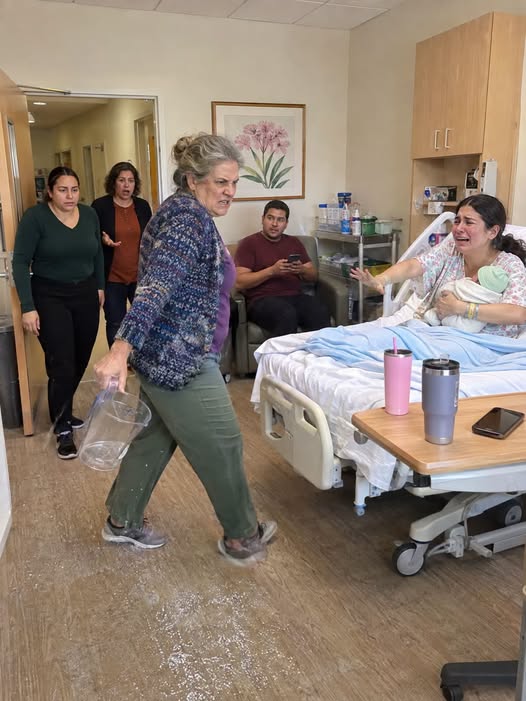
Beatrice pushed the door open without knocking at a quarter past nine.
She’s sixty-two. Small and wiry, with short frosted hair and reading glasses on a beaded chain and a quilted purple coat she wears from October to May. She worked thirty years as a bank teller at a credit union in Sun Prairie and retired with a pension and a lot of opinions about other people’s money.
She didn’t greet her granddaughter. She didn’t look at the baby on my chest. She didn’t ask how I was feeling or how the labor went or whether I needed anything.
She stood in the doorway and looked around the room. At the bed. The couch. The private bathroom. The window with the view of Lake Monona through the sleet.
Her face darkened.
“So this,” Beatrice said, “is where my son’s money has been going.”
I looked at her. I was so tired I wasn’t sure I’d heard her right.
“What do you mean?” I asked.
She swept her hand around the room. “A private suite? Really, Chloe? Women have babies in regular hospital rooms every single day. I had Mark in a ward with five other women in 1991, and we were grateful.” She shook her head. “Why do you need all this special treatment?”
I adjusted the blanket around my daughter. She was still sleeping, her little mouth working.
“Beatrice,” I said quietly, “I paid for this myself.”
She frowned. “Excuse me?”
“I used my own savings,” I said. “From my own account. Mark didn’t pay anything toward this room.”
Part Five: The Pitcher
For a moment, she just stared at me.
Then something boiled over.
She stepped toward the bed. She jabbed her finger at me, close enough that I flinched and pulled my daughter tighter against my chest. Her voice went loud and shrill.
“Your own savings?” she said. “There’s no such thing as your own savings in a marriage! Everything you have is Mark’s too! And you’re wasting it on a hotel room while my son works himself to the bone!”
My daughter startled awake. She opened her mouth and started to wail, a thin, desperate newborn cry that cut right through me.
I pulled her closer. I tried to shush her. My hands were shaking.
But Beatrice wasn’t finished.
She grabbed the plastic water pitcher from my bedside table, the one the nurse had filled for me an hour ago, and slammed it back down so hard the lid popped off. Water sloshed out across the table and splashed onto the floor, pooling right beside the clear plastic bassinet where my daughter was supposed to sleep.
My daughter screamed louder.
I stared at the water on the floor. At my mother-in-law’s red face. At my newborn daughter, five hours old, screaming in my arms.
Then I looked across the room at my husband.
Surely, now, he’d do something. Surely he’d finally put down his phone. Surely he’d stand up and tell his mother to stop, to calm down, that his wife had just given birth and his daughter was crying.
Mark sighed.
“Mom,” he muttered, without looking up from his screen. “Can you please keep it down?”
His thumbs kept moving.
“I’m in the middle of an important match,” he said.
Part Six: The Upgrade
I couldn’t believe what I was hearing.
Our newborn daughter was crying in my arms. His mother was shouting at me and had just thrown water across a hospital room. And my husband was worried about a mobile game.
Then Mark finally looked up from his phone. For one brief second, his eyes met mine across the room. I hoped, so hard it hurt, that he finally understood how wrong everything had become.
Instead, he said, “Honestly, Chloe, Mom kind of has a point.”
I stared at him.
“Just switch to a regular room,” he said, with a little shrug. “It’s not a big deal.” He looked back down at his phone. “We could save the difference. I could put it toward the premium battle pass. The season upgrade comes out Friday. It’s a hundred and fifty bucks.”
For several seconds, I couldn’t speak.
I’d carried our daughter for nine months. I’d thrown up fifteen times a day for three months. I’d had my blood pressure checked twice a week since January. I’d pushed for three hours and forty minutes. I’d paid for my own recovery room with money I’d saved from my own paychecks.
And my husband wanted me to give up the one small comfort I’d arranged so he could buy a battle pass in a video game.
I looked down at my daughter. She’d stopped screaming. She was making small hiccuping sounds against my chest, her face red and wet. Her tiny fingers had found the edge of my hospital gown and curled around it, holding on.
Suddenly, something became painfully clear to me.
The man I’d married wasn’t going to give us the care we deserved. Not today. Not when we went home. Not at three in the morning. Not ever, unless something changed.
Part Seven: “Stop Being Difficult”
Beatrice took a step closer to the bed. She’d calmed down a little, the way she always did after an outburst, as if nothing had happened.
“Stop being so difficult, Chloe,” she said. “Just call the nurse and tell her you want a regular room. It’s the sensible thing to do.”
I didn’t say anything.
For months, I’d convinced myself that Mark’s behavior would improve. That the gaming was a phase. That his mother’s constant criticism was something I just had to tolerate to keep the peace. That avoiding arguments was easier than defending my own choices.
But now I was a mother.
And I wanted my daughter to grow up knowing that love is supposed to come with kindness. With patience. With respect. Not with your husband playing a video game while his mother throws water across the room and you sit there, silent, holding your breath.
That’s when I noticed two figures standing just outside the open doorway.
My parents.
Part Eight: My Parents
My mother, Susan, was standing with one hand pressed against her mouth. She’s sixty, a retired kindergarten teacher, small and soft, with gray-blond hair she wears in a braid. She was holding a big gift bag with a pink tissue-paper bow, and a bouquet of pink tulips wrapped in paper.
My father, Martin, stood completely still beside her. He’s sixty-three, a retired union electrician, tall and broad-shouldered, in his good gray wool coat and the Green Bay Packers stocking cap he wears all winter. He was looking at the spilled water on the floor beside the bassinet. Then at Beatrice. Then at Mark in the chair, with his phone. Then at me.
They’d driven in from Middleton to meet their granddaughter.
Judging by their faces, they’d been standing there long enough to hear everything.
For a moment, I felt embarrassed. I’d never wanted my parents to see how unhappy things had become. I’d spent two years making excuses. Mark’s busy. Mark’s tired. Mark didn’t come to Thanksgiving because he had a migraine. Mark’s mother is just old-fashioned.
But my father stepped quietly into the room.
He looked at my daughter. Then at me. Then, finally, his gaze settled on the phone in Mark’s hand.
My father is a calm, quiet man. In thirty-two years, I’ve heard him raise his voice exactly three times. Once when I ran into the street after a ball when I was four. Once at a referee during a Packers game in 1997. And once, the day I left for college, when he stood in the driveway and shouted I love you so loud the neighbors came out on their porches.
But there was something different in his face that morning. Something I’d never seen before.
“Mark,” he said.
Part Nine: “Put That Away”
My husband finally looked up. “What?”
My father pointed at his phone.
“Put that away for a minute,” he said.
Mark frowned. “Why?”
“Because,” my father said, “we need to have a serious conversation.”
For the first time that whole morning, Mark looked uncertain. He looked at my father. At my mother in the doorway with the flowers. At the water on the floor.
Slowly, he pulled out his earbuds. He lowered his phone into his lap. The game was still running on the screen. I could hear the tinny sound of explosions.
My father turned to me.
“Chloe,” he said gently. “Sweetheart. Are you okay?”
I tried to answer him. I opened my mouth.
But hearing someone ask that, really ask it, with his whole face, for the first time all morning, after twenty hours of labor and five hours of being alone in a room with my husband and his phone, broke something open in me.
I started to cry.
My mother came across the room in three quick steps. She set down the tulips and the gift bag and put her hand on my shoulder, very gently, the way she used to when I was little and had a fever.
“You’ve been through so much, honey,” she whispered. “You should be resting. Not this.”
Part Ten: Beatrice and Dad
Beatrice folded her arms across her purple coat.
“This is between our family,” she said. “Mark’s and mine. There’s no need for anybody else to interfere.”
My father looked at her calmly.
“Chloe is our daughter, Beatrice,” he said. “Her well-being matters to us. That’s not interference. That’s what parents do.”
Then he turned back to my husband.
“Mark,” he said. “Your wife gave birth to your child seven hours ago. She was in labor for twenty hours. She had complications all through the pregnancy.” He nodded at the room. “Right now, she deserves support. Not criticism about a room she paid for herself.”
He paused.
“And not a lecture about a battle pass,” he said quietly.
Mark looked away. Out the window, at the sleet coming down over Lake Monona.
Nobody said anything for several seconds. The only sounds were the hiss of the radiator and my daughter’s little hiccups against my chest, slowly settling down.
For the first time that morning, I wasn’t explaining myself. I wasn’t justifying my choices or apologizing for my body or my room or my savings. Somebody else had finally seen what I’d been living through and said it out loud.
Part Eleven: The Envelope
Then my mother reached into the big gift bag with the pink tissue-paper bow.
She took out a white envelope. Sealed. Thick. Letter-sized.
I recognized it.
Two weeks earlier, at Sunday dinner at my parents’ house, while Mark was home with a “migraine,” my father had mentioned something over pot roast. He said he’d been preparing some paperwork for me. He said it was nothing to worry about. Just a way to make sure I had options, if I ever needed them.
At the time, I’d been thirty-eight weeks pregnant, exhausted, swollen, and terrified of the birth. I hadn’t asked many questions.
Now my father took the envelope from my mother. He set it gently on my bedside table, on the dry side, away from the spilled water.
Mark stared at it.
“What’s that?” he asked.
My father looked at me.
“Something I hoped you’d never need, Chloe,” he said.
My heart began to beat faster. I looked at the envelope. Then at my parents.
And suddenly I understood that they’d noticed much more about my marriage than I’d ever realized. The missed Thanksgivings. The migraines. The way Mark never put down his phone at birthday dinners. The way I always paid for everything when we went out. The way I’d stopped laughing.
They’d seen it all. And they’d quietly been getting ready.
Part Twelve: What Was Inside
I didn’t open it right away. I asked my mother to hold the baby first.
She took her granddaughter in her arms for the very first time. My father stood beside her looking down at that little red face with the full head of dark hair, and his eyes filled up. “Oh, look at her,” he said. “Oh, Susie. Look at her.”
Then I picked up the envelope and opened it.
Inside were three things.
The first was a letter from an attorney. A family law firm in downtown Madison, on the Capitol Square. Bergstrom & Lee. It confirmed that a retainer had been paid on my behalf in February, in full, by Martin and Susan Hartman, and that attorney Rebecca Lee was available to meet with me at any time, for any reason, with complete confidentiality. There was a business card paper-clipped to the top.
The second was a copy of a deed.
Our house. The little three-bedroom ranch on a quiet street in Fitchburg that Mark and I moved into three years ago. My parents had given us the down payment as a wedding present. Forty thousand dollars. I’d always thought of it as our house. Mark’s and mine.
But the deed was in my name only.
And stapled to it was a document I’d forgotten I’d ever seen. A gift letter, required by the mortgage lender, stating that the forty thousand dollars was a gift from Martin and Susan Hartman to their daughter, Chloe Hartman, and was not a loan. And a second page, a marital property agreement under Wisconsin law, which Mark and I had both signed at the closing table three years earlier, without either of us really reading it. It classified the down payment, and the equity it created, as my individual property.
Mark had signed it in blue ink, right under my name. I remembered him signing it without looking up from his phone.
The third thing in the envelope was a letter in my father’s handwriting. Blocky capital letters, the same handwriting he used on electrical diagrams for forty years.
CHLOE —
YOUR MOTHER AND I DON’T KNOW WHAT GOES ON IN YOUR MARRIAGE. IT’S NOT OUR BUSINESS UNLESS YOU MAKE IT OUR BUSINESS.
BUT WE’VE WATCHED YOU GET QUIETER FOR TWO YEARS. WE’VE WATCHED YOU PAY FOR DINNER EVERY TIME. WE’VE WATCHED YOU MAKE EXCUSES.
WE’RE NOT TELLING YOU WHAT TO DO. YOU’RE A GROWN WOMAN AND A GOOD ONE. THIS ISN’T A PLAN. IT’S A FLASHLIGHT. SO WHATEVER YOU DECIDE, YOU DECIDE IT BECAUSE YOU CHOSE TO, NOT BECAUSE YOU’RE SCARED THERE’S NOWHERE ELSE TO GO.
THE HOUSE IS YOURS. THE LAWYER’S PAID FOR. YOUR OLD ROOM IS MADE UP. THE CRIB’S IN THE BASEMENT. YOUR MOTHER BOUGHT DIAPERS.
WE LOVE YOU. WE ALWAYS WILL. — DAD
Part Thirteen: Mark Reads It
I read it twice. Then I folded it and held it against my chest and cried, very quietly, with my mother rocking my daughter beside the bed and my father standing at the foot of it with his hands in the pockets of his good gray coat.
Mark had gotten up from his chair. He came over to the bedside table and picked up the deed. He read it. I watched his face change.
“This says the house is yours,” he said slowly.
“It does,” I said.
“Since when?”
“Since the day we closed,” I said. “You signed the agreement. Right there.” I pointed. “Under my name. In blue ink.”
He stared at his own signature.
“I didn’t read it,” he said.
“I know,” I said. “You were playing a game.”
Beatrice snatched the paper out of his hands. She read it. Her face went from red to white.
“This is outrageous,” she said. “You tricked him. Your father tricked him. My son has been paying the mortgage on that house for three years.”
My father didn’t say anything. He just looked at me.
Part Fourteen: Who Paid
I hadn’t planned to say it. Not that day, five hours after giving birth. But Beatrice was standing in my hospital room, with water still pooled on the floor beside my daughter’s bassinet, telling me her son had been paying our mortgage.
“Beatrice,” I said. “Mark hasn’t paid the mortgage in fourteen months.”
The room went silent.
Mark turned around. “Chloe,” he said. “Don’t.”
“I’ve been paying it,” I said. “Every month. From my paycheck. Fourteen hundred and twenty dollars.” I looked at my husband. “Since January of last year. When you told me your paycheck was short because of a payroll error at work.”
Beatrice turned to her son. “Mark?”
Mark didn’t answer.
“There was no payroll error,” I said quietly. “I called your HR department in April. When you said it happened again.” I swallowed. “They said your paychecks had been deposited in full every two weeks. Into a separate account. One I didn’t know about.”
Mark had gone completely pale. He was staring at the floor, at the puddle of water spreading toward the bassinet.
“I didn’t say anything,” I said. “I was pregnant. I was sick. I was scared. I told myself it was a phase. That you’d stop. That it would all be different when the baby came.”
I looked at Beatrice.
“Ask your son,” I said, “where his paychecks have been going for fourteen months.”
Part Fifteen: The Game
Mark didn’t answer for a long time. His mother stood beside him with the deed in her hand, looking at his face.
Finally, he said it. Very quietly. To the floor.
“The game.”
It came out in pieces after that. He couldn’t look at any of us while he said it.
It was a mobile game. A fantasy battle game with characters you could buy and upgrade and collect. He’d started playing it three years ago, the winter we bought the house, during the long gray Wisconsin months when it got dark at four-thirty. At first, it was free. Then he bought a few small things. Five dollars. Ten. A battle pass for twenty.
Then the characters started costing more. Limited editions. Seasonal events. Loot boxes that might give you a legendary hero, or might give you nothing at all. Ninety-nine dollars for a chance. And then you had to try again.
“I just wanted to finish the collection,” Mark said quietly. “I was so close. Every season, I was so close.”
“How much?” Beatrice asked. Her voice was barely a whisper.
Mark didn’t answer.
“Mark,” his mother said. “How much?”
He finally looked up at her.
“Forty-one thousand,” he said. “Give or take. In three years.”
Beatrice sat down hard in the visitor’s chair by the window, the one Mark had been sitting in all morning.
“And the nursery fund,” I said quietly.
Mark closed his eyes.
“I’d been saving for the nursery since I found out I was pregnant,” I said. “In our joint savings account. Fifty dollars a paycheck. For the crib and the dresser and the changing table.” I looked at my husband. “In January, I went to buy the crib. The account had eleven dollars in it.”
My mother made a small sound beside me, holding her granddaughter.
“My parents bought the crib,” I said. “It’s in their basement.”
Part Sixteen: The Nurse
That was when the nurse came in.
Her name was Paulette. She was in her fifties, with short gray hair and purple scrubs and a laminated badge that said RN — Postpartum. She’d been my nurse since seven that morning. She’d helped me get from the wheelchair into the bed. She’d shown me how to get the baby to latch. She was kind and brisk and called me “Mama.”
She stopped in the doorway. She looked at the water spreading across the floor beside the bassinet. At my mother holding the baby. At Beatrice slumped in the chair. At my father standing at the foot of the bed. At my husband, standing in the middle of the room, pale as paper.
At me, crying in the bed.
“Everything all right in here, Mama?” Paulette asked quietly.
I looked at her. Then at my parents. Then at the envelope on my bedside table.
“No,” I said. “It’s not.”
Paulette nodded once. She’d been a postpartum nurse for twenty-seven years. She told me later she’d seen this room a hundred times before. She knew exactly what she was looking at.
She stepped inside. She looked at Beatrice. Then at Mark.
“Visiting hours for this room are now limited to the people the patient wants here,” she said pleasantly. “That’s hospital policy. Mama, who would you like to stay?”
I looked at my husband. At the man I’d married six years ago because he made me laugh. At the phone still glowing in his hand.
“My parents,” I said.
Paulette turned to Beatrice and Mark.
“I’m going to have to ask you both to step out,” she said. Her voice was still pleasant. It was also not a request.
Part Seventeen: Mark Leaves
Beatrice stood up. She opened her mouth to argue. Then she looked at Paulette’s face and closed it again.
She walked to the door. She stopped there and looked back at me.
I thought she’d say something cruel. She’d been saying cruel things to me for six years.
Instead, she just looked at her granddaughter, asleep in my mother’s arms. For the first time that whole morning, she really looked at her. At the dark hair. The tiny pursed mouth. The fist curled against her cheek.
Something passed over Beatrice’s face. I couldn’t name it.
Then she walked out.
Mark stood in the middle of the room for a long moment. He looked at the baby. At me. At the deed and the letter on the bedside table.
“Chloe,” he said. “I’m sorry. I didn’t… I don’t know how it got this bad.”
“I know,” I said.
“Can I come back?” he asked. “Later? To see her?”
I thought about it.
“Mark,” I said. “You haven’t held her yet. Not once. She’s seven hours old, and you haven’t held her.”
He looked at the floor.
“When you’re ready to hold her,” I said, “without your phone in your other hand, you can come back.”
He nodded slowly. He put his phone in his pocket. He walked to the door.
He didn’t look back. But I saw, as he stepped out into the hallway, that his shoulders were shaking.
Part Eighteen: My Old Room
Paulette mopped up the water herself. She wouldn’t let my father do it. She brought me a fresh pitcher of ice water and a warm blanket from the warmer and a little paper cup of ibuprofen, and then she stood beside my bed for a moment with her hand on my arm.
“You did good, Mama,” she said quietly. “Today, and last night. Both.”
Then she left us alone.
My father pulled the visitor’s chair over beside my bed. My mother sat on the couch, still holding the baby. For a long time, none of us said anything.
“I’m sorry, Dad,” I said finally. “I’m sorry you had to see all that.”
My father looked at me.
“Don’t you ever apologize to me for that,” he said. “Not ever.” He took my hand. “You were carrying all of that by yourself. For two years. I’m sorry we didn’t say something sooner.”
“You couldn’t have,” I said. “I wouldn’t have listened.”
He nodded. “That’s why I made the envelope,” he said. “So when you were ready to listen, it’d be right there.”
I went home with my parents two days later. Not to the house in Fitchburg. To my old bedroom in Middleton, with the faded wallpaper of tiny blue flowers and my high school swimming trophies still on the shelf. My father had set up the crib in the corner, under the window, the white one my parents bought when the nursery fund was empty.
My mother had bought diapers. A lot of diapers. Stacked to the ceiling of my old closet.
Part Nineteen: Evie
We named her Evelyn. Evie, for short. After my grandmother, my father’s mother, who raised five children on a dairy farm in Mount Horeb and never once let anybody tell her she was being dramatic.
The first two weeks were a blur. Feeding every two hours. Changing diapers at three in the morning. Learning her cries, the hungry one and the tired one and the one that meant she wanted to be held upright against your shoulder so she could look around.
My mother took the four a.m. feedings with a bottle of pumped milk so I could sleep. My father walked Evie up and down the upstairs hallway at midnight, singing old Johnny Cash songs in a low rumble until she fell asleep against his chest.
I’d never once seen Mark do that. Not once in nine months had I pictured him doing it. I’d only pictured my father.
I met with Rebecca Lee, the attorney, on the third Monday. My mother drove me. We brought Evie in her car seat. Rebecca’s office was on the fourth floor of an old building on the Capitol Square, with a view of the dome through the window, and she had a box of tissues on the coffee table and a stuffed bear on the shelf for clients’ kids.
She was forty-five, calm and direct, with gray streaks in her dark hair. She listened to everything without interrupting. Then she laid out my options very simply, the way my father had in his letter.
A flashlight. Not a plan.
“You don’t have to decide anything today, Chloe,” she said. “Or this month. You can file for separation. You can file for divorce. You can do nothing at all and just see what he does.” She paused. “Gambling disorder is a real diagnosis, and these mobile games are designed to trigger it. Some people get treatment and get better. Some people don’t.” She looked at me over her glasses. “What matters is that you protect yourself and your daughter while you find out which kind he is.”
Part Twenty: What Mark Did
Mark didn’t call for nine days.
I thought, honestly, that he might not call at all. That he’d go back to the house in Fitchburg and play his game and let the whole thing slide away, the way he’d let everything slide away for three years.
On the tenth day, my father’s phone rang. Not mine. My father’s.
My father took it out onto the back porch. He was out there for forty-five minutes. When he came back inside, his face was very serious.
“That was Mark,” he said. “He wants to know if he can come see you. And Evie.”
He sat down at the kitchen table.
“He’s been going to meetings,” my father said. “Gamblers Anonymous. In a church basement on the east side. Every day for nine days. He found a counselor at UW Health who specializes in gaming addiction.” He paused. “He deleted the game. He sold the gaming PC on Craigslist. He gave his credit cards to his mother.”
“His mother?” I said.
“Beatrice,” my father said. “He said she drove over to the house the day after Evie was born. She sat him down at the kitchen table. And she made him show her everything. Every bank statement. Every charge.” He shook his head. “He said she cried for three hours. Then she drove him to his first meeting herself.”
Part Twenty-One: Holding Her
Mark came to my parents’ house on a Saturday morning, sixteen days after Evie was born.
He rang the doorbell. My father answered it. They stood there on the front porch for a moment, two men in winter coats, not saying anything.
Then my father stepped aside and let him in.
Mark came into the living room. He looked thinner. He hadn’t shaved. He had dark circles under his eyes. He was wearing the gray UW sweatshirt he wore the night we met at the brewery.
His hands were empty. No phone.
He stood in the doorway of the living room and looked at me on the couch, with Evie asleep against my chest.
“Hi,” he said.
“Hi,” I said.
“I left my phone in the car,” he said. “Your dad said that was the rule.”
“It was my rule,” I said.
He nodded. “I know.”
He stood there for a long time. Then he said, very quietly, “Chloe, can I hold her?”
I looked at my husband. At his empty hands, which were shaking.
I stood up slowly. I walked across the living room. I showed him how to hold his arms, one under her head, one under her body. Then I placed our daughter in them.
Mark looked down at her. At her dark hair, his dark hair. At her tiny pursed mouth. At her fist, curled against her cheek.
Evie opened her eyes. She looked up at him, unfocused, the way she had in the hospital at nine in the morning when he didn’t look back.
This time, he looked back.
He didn’t say anything. He just stood there in the middle of my parents’ living room, holding his sixteen-day-old daughter for the very first time, and cried. Big, silent tears running down his face and dripping onto her pink-and-white blanket.
“I missed it,” he whispered. “The first two weeks. I missed all of it. For a game.”
“You did,” I said.
“I’m so sorry,” he said. “I’m so sorry, Evie.”
She closed her eyes and went back to sleep against his chest.
Part Twenty-Two: Beatrice
Beatrice came a week later.
She called first. She asked my mother if it would be all right. She came on a Tuesday afternoon, in her quilted purple coat, carrying a casserole dish wrapped in a dish towel.
She stood in my parents’ front hall for a long moment, holding the casserole, looking at me on the couch with Evie.
“It’s tuna noodle,” she said. “Mark said you like it.”
“I do,” I said. “Thank you.”
She set it down on the coffee table. Then she sat on the very edge of the armchair across from me, like she wasn’t sure she was allowed to sit all the way back.
“Chloe,” she said. “I owe you an apology. For the hospital. For the water.” She swallowed. “For saying there’s no such thing as your own savings in a marriage.”
I didn’t say anything.
“My husband left when Mark was seven,” Beatrice said. “Did Mark ever tell you that? Rick. He walked out on a Tuesday. Took the car and the savings account and everything in it. Eleven thousand dollars. I found out when I tried to buy groceries and my card was declined at the Piggly Wiggly.” She looked down at her hands. “I raised Mark alone on a bank teller’s salary. And I swore he’d never be a man who took from his family.”
She laughed, a terrible little sound.
“And I made him into one anyway,” she said. “I gave him everything. I never told him no. I told myself it was because his father left. Really, I was just scared he’d leave too.”
“I came into that hospital room,” Beatrice said, “and saw a private suite, and all I could think was, She’s spending his money. She’s going to drain him the way Rick drained me.” She shook her head. “I never once thought it might be the other way around. That my son was the one draining his wife.”
She looked at me with wet eyes.
“I was a bank teller for thirty years,” she said. “I should have seen it. The way he never had money. The payroll errors. I should have asked.”
Part Twenty-Three: The Accounting
It took a long time. I want to be honest about that. Things don’t fix themselves in a weekend, or a month, or even a year.
Mark went to Gamblers Anonymous every single day for ninety days. Then four times a week. He saw his counselor at UW Health every Thursday. He put a gambling block on his phone and gave his mother the password. He set up his paycheck to deposit into an account that required a second signature to withdraw from. Beatrice’s.
He moved out of the house in Fitchburg. He rented a small studio apartment on the east side, near the church where his meetings were. He said I should have the house, with Evie. He said it was mine anyway. It always had been.
And he started paying it back.
Every two weeks, on payday, a check arrived in my mailbox at the house in Fitchburg. Five hundred dollars. With a sticky note on it in his handwriting.
Nursery fund. Payment 1.
Nursery fund. Payment 2.
Mortgage. Payment 1 of 28.
Sometimes there was a drawing on the sticky note. A badly drawn crib. A stick figure baby. A cartoon cow, because Evie had a stuffed cow she wouldn’t sleep without.
Part Twenty-Four: Separate
We stayed separated for a year.
Rebecca Lee drew up a separation agreement. Custody schedules. Child support. Visitation. Mark saw Evie every Saturday and every Wednesday evening, at first at my parents’ house with my father in the next room, then at the house in Fitchburg, then, after six months, at his little studio on the east side.
He learned how to change a diaper. Badly at first. He put the first one on backward, and Evie peed through it onto his favorite sweatshirt.
He learned how to warm a bottle. He learned her cries: the hungry one and the tired one and the one that meant she wanted to be held upright against your shoulder so she could look around.
He learned Johnny Cash songs from my father, so he could sing them to her at bedtime.
At three months, Evie smiled at him for the first time. He was making a ridiculous face, puffing out his cheeks, and she broke into a huge gummy grin. He called me afterward from his car in the parking lot of his apartment building, crying so hard he could barely talk.
“She smiled at me, Chloe,” he said. “She smiled at me.”
“I know,” I said. “She does that.”
“I almost missed that,” he said quietly. “I almost missed all of it.”
Part Twenty-Five: The First Birthday
Evie turned one in March. Exactly one year after the gray morning in Room 412, with the sleet against the window.
We had a party at my parents’ house in Middleton. My mother made a cake shaped like a cow. My father strung pink and white balloons across the living room ceiling. Fifteen people came. My aunts and uncles. My best friend, Jenna, from college. Paulette, the nurse from St. Mary’s, whom I’d stayed in touch with and who brought a stuffed bear in purple scrubs.
And Beatrice. In her quilted purple coat, with a casserole dish of tuna noodle and a hand-knitted pink blanket she’d made herself, stitch by stitch, for eleven months.
Mark came at two o’clock.
He’d been in recovery for a year. Three hundred and sixty-five days without a single in-game purchase. He had a coin from his group to prove it, bronze, with a 1 on it. He showed it to me in the front hallway, a little shyly, before he came into the party.
“I wanted you to see it first,” he said.
I looked at the coin in his palm. Then at him.
“I’m proud of you, Mark,” I said.
He closed his hand around the coin. He looked like he was going to cry. He didn’t. He just nodded.
He’d brought Evie a present. It was wrapped in brown paper with twine. He knelt down on the living room floor beside her where she sat in a pile of tissue paper, and helped her tear it open.
It was a little wooden toy box. Handmade. Pine, sanded smooth, painted white with pink trim. On the lid, in careful hand-painted letters, it said EVIE.
“I made it,” Mark said. “Your dad showed me how. In his garage. We’ve been working on it on Sundays since October.”
I looked across the room at my father. He was standing by the fireplace with his arms folded, pretending he wasn’t watching.
He winked at me.
Mark opened the lid of the toy box. Inside, at the bottom, was a white envelope.
He handed it to me.
Part Twenty-Six: Another Envelope
I opened it.
Inside was a check. From Mark’s account, the one with his mother’s second signature on it, made out to me.
Eleven thousand, four hundred and twenty dollars.
And a note, on a sticky note, in his handwriting.
Nursery fund: paid in full, plus interest.
Mortgage: 14 of 14 months, paid in full.
Private room at St. Mary’s, 2 nights: $560. That one’s on me. You should never have had to pay for it.
Battle pass: $0.
I looked up at him. I couldn’t talk.
“I’m not asking you for anything, Chloe,” Mark said quietly. He was still kneeling on the floor beside Evie. “I know I don’t get to ask. I just wanted you to know I paid it back. All of it. Every dollar I took.” He looked down at our daughter, who was trying to climb into the toy box. “And I wanted her to have something I made with my hands. Instead of something I bought with yours.”
Behind me, Beatrice made a small sound. I turned around. She was standing by the kitchen doorway with her hand over her mouth, crying, watching her son kneel on the floor beside his daughter.
My father walked across the room. He stood beside her. After a moment, he put his big hand on her shoulder.
“He did good, Bea,” my father said quietly. “He did real good.”
Part Twenty-Seven: The Flashlight
I kept my father’s letter. The one from the white envelope.
It’s in a frame now, on the wall of Evie’s nursery at the house in Fitchburg. Right above the white crib my parents bought, next to the wooden toy box Mark made.
THIS ISN’T A PLAN. IT’S A FLASHLIGHT.
People ask me sometimes what happened. Whether Mark and I got back together. Whether I forgave him. Whether I filed for divorce. Friends from work, other moms at Evie’s daycare, the women in my book club.
I tell them the truth. We’re still figuring it out.
Mark comes to dinner on Sundays now. At the house in Fitchburg. Sometimes he stays and gives Evie her bath and sings her Johnny Cash and puts her to bed. Sometimes, after she’s asleep, we sit on the back steps and talk, the way we used to when we first met at the brewery. He makes me laugh again. Not every day. But some days.
He’s never once, in all those Sunday dinners, taken out his phone at the table.
What I tell them, the women who ask, is this.
For two years, I stayed quiet because I was scared. Scared there was nowhere else to go. Scared I’d be alone with a baby. Scared that if I said anything, the whole thing would fall apart.
And then my father put an envelope on my hospital bedside table. A lawyer who was already paid. A house that was already mine. A room with a crib and a closet full of diapers.
It didn’t tell me what to do. It just made sure that whatever I chose, I chose it with the lights on.
Last week, Evie found the framed letter on her nursery wall. She’s fourteen months old now, walking, pointing at everything. She stood on her tiptoes in front of it and pointed and said, “Papa!”
She knows his handwriting already. She’s seen it on every birthday card and every sticky note on the refrigerator.
“That’s right, baby,” I said, picking her up. “Papa wrote that.”
She looked at the letter. Then at me. Then she put her small hand flat against the glass, right on the words WE LOVE YOU, and held it there.
I stood in my daughter’s nursery, in my own house, holding her up to her grandfather’s letter, and I thought about that gray morning in Room 412. The water on the floor beside the bassinet. My husband’s phone. The sleet against the window.
And my father in the doorway, in his good gray coat and his Packers stocking cap, saying the words nobody else had said to me all morning.
Chloe, sweetheart. Are you okay?
I am now, Dad. I really am.