I was doing the Tuesday crossword at my own kitchen table when the phone rang, coffee gone lukewarm beside me, and I already knew, somehow, before I even looked at the screen, that whatever came out of that call was going to sit with me for longer than a Tuesday.
Nolan’s name lit up the display. I set the pencil down.
“Mom,” he said, before I’d even finished saying hello. “About Sunday. At the club.”
“I’m listening,” I told him, and I meant it, the way I’d meant it for eleven years every time my son called me with that particular tightness in his voice, the one that meant he wanted something from me but hadn’t yet worked out how to ask for it plainly.
My house in Glenn Arbor is small brick, one story, with a maple tree out front older than my son. I’ve lived in bigger places and smaller ones over the years, and this one fits me the way a good coat fits, without needing to think about it. I still keep an office downtown three mornings a week, above a shuttered dry cleaner, second floor, a sign so small you’d miss it walking past. Nothing dramatic. Paperwork mostly, and phone calls I could probably take from this very kitchen table if I were the type to stop showing up places simply because I’d earned the right to stop.
On my left wrist I wear a plain steel watch. I bought it with my very first real paycheck, forty-three years ago, and it has never once stopped keeping good time. My daughter-in-law calls it vintage. I call it reliable, which isn’t always the same compliment, though she’s never seemed to notice the difference.
I should explain about Walter, because none of what follows makes much sense without him, and I promise I won’t dwell on it longer than it deserves. He died in a rail yard accident when Nolan was eleven months old. I was twenty-eight. There was no pension worth mentioning, no life insurance large enough to matter, and a baby who needed new shoes every few months whether the world had a plan for me or not. I don’t tell that part of my life like a tragedy anymore. It happened a long time ago, and I got through it the way most people get through things — one Tuesday at a time, and then the Tuesday after that.
For a few years I took whatever work paid that week. I’m not going to pretend that was noble. It was simply Tuesday, over and over, until Tuesday started paying a little better. I’ve never been ashamed of a single year of it. Somewhere along the way I just stopped explaining it to people, mostly because the people who actually mattered to me never once needed the explanation in the first place.
I didn’t understand yet, that morning with Nolan on the phone, that the people who hadn’t earned an explanation were about to get one anyway. Just not from me.
Let me back up to a dinner at Nolan and Vivian’s house a few weeks earlier, because it tells you most of what you need to know about how these things usually went between us. I’d brought a gift for Josie’s upcoming birthday wrapped in plain brown paper, because I like the way it looks — simple, honest, no fuss. Vivian took one glance at it and said, “Oh, we’re doing a color scheme for the party this year,” already reaching to take it out of my hands. “I’ll just rewrap it before Saturday.”
I let her. At the table that same evening, I mentioned I might come early to help set up chairs. Vivian gave me the smile she reserves for things she’s already decided without me. “We’ve got it handled, Harriet. Don’t worry about a thing.” I have been not worrying about things in that house for eleven years.
Josie, who was eight then and is nine now, climbed straight into my lap before dessert and stayed there through the rest of the conversation, sticky hands and all, telling me at length about a frog she’d found by the mailbox. Nobody had to coach her into that. She simply liked being near me, which is a different thing entirely from being told to be near me, and I have always trusted that particular difference more than almost anything else in that family.
Near the end of the night, Vivian topped off my coffee, almost offhand, and said, “I finally got you an invitation to see the club, by the way. Sunday. Everyone’s been asking about you.”
She said it like a gift. It landed like a summons.
“I said I’d be there,” I told her. “I always said I’d be there.”
Nolan followed me into the kitchen later that same evening while Vivian was upstairs putting Josie to bed. He leaned against the counter the way he has since he was fourteen, arms crossed, working up to something.
“Mom, about Sunday.”
“I’m listening,” I said, rinsing a coffee cup that didn’t need rinsing.
“Just keep it low-key about work, is all I’m saying. Vivian’s friends ask forty questions about everything. It gets exhausting explaining. You know how it is.”
I did not, in fact, know how it was, but I’d learned a long time ago that pressing my son rarely got me anything but a longer, more careful version of the same original sentence.
“Low-key,” I repeated. “I can manage that.”
“It’s not that I’m—” he started, and didn’t finish that one either.
“Nolan.” I dried my hands on the towel by the sink and looked at him properly. “I’ve kept plenty low-key for you over the years. I can manage one more Sunday.”
He laughed, relieved in the particular way people laugh when they think they’ve dodged something. He kissed my cheek on his way out of the kitchen and didn’t ask what I’d meant by plenty. I didn’t explain that one either. I just stood there a minute, listening to him climb the stairs two at a time, off to be a good husband to a woman who apparently needed forty fewer questions asked about me than about anyone else in that house.
It didn’t sting, exactly. It just made a note of itself somewhere, the way things do.
I wasn’t in the room for this next part, obviously. Vivian told enough of it to Nolan later, in the wreckage of everything, that I can put the shape of it together honestly enough. That same week, she apparently stood in front of her bathroom mirror more than once, practicing a sentence. This is my mother-in-law, Harriet. Just that, over and over, like a woman rehearsing for a part she was afraid she’d fumble. She wasn’t rehearsing kindness. She was rehearsing damage control for a category of person she’d decided I belonged to long before she’d ever bothered asking me a single real question about my own life.
If I’m fair to her, some of that had nothing to do with me at all. Vivian grew up in a town where everyone knew exactly who her family used to be, and then, for a few very public years, exactly who they no longer were. She’s never told me that story directly. I only know the outline of it the way you know the outline of a house that burned down before you moved onto that street, from the scorch mark still left in the ground.
Her father’s company had been called Ashgrove Furniture, three generations of it, a name stitched into the tags of half the dining sets in that county. Vivian was sixteen when a single overseas contract, cheaper by half, pulled out from under them with one signature on someone else’s desk somewhere far away. The factory closed within the year. Sixty people lost their jobs. Her family lost the house eight months after that. The last time people in her hometown looked at her family the way she was apparently afraid Pauline’s friends might look at me, she’d told Nolan once, they never really stopped looking that way again.
That fear didn’t excuse anything that came later. But it explained more of it than I understood at the time, sitting quietly in my own kitchen wondering what exactly I’d done to earn a rehearsed introduction.
Pauline Whitfield called Vivian two days after that dinner, and this part, too, I only heard about secondhand, mostly from Pauline herself, who told it later like a woman confessing to a parking ticket rather than what it actually was.
“So,” Pauline said, in the voice she uses for things she already finds funny, “is the famous mother-in-law finally coming to the club, or are we still pretending she doesn’t exist?”
Vivian, by every account, laughed too quickly. “Sunday. I finally caved.”
“Is she going to embarrass you, Viv? I need to know if I should brace the group.”
Pauline had run the social calendar for the younger set at Kestrel Hollow for six years by then, mostly by being first to notice anything anyone would rather she hadn’t. She collected small humiliations the way other people collect recipes — swapped them, refined them, served them up at exactly the right moment for maximum effect.
“Bring her for the full tour,” Pauline said. “Not the quick coffee version. People should meet her properly.”
It sounded generous. It wasn’t. Pauline didn’t want Vivian’s mother-in-law to feel welcome. She wanted a show, something fresh to discuss over Bloody Marys for the next three Sundays, and she knew exactly how to dress that appetite up as hospitality.
“Kestrel Hollow people notice everything,” Pauline added, almost as a warning.
Vivian knew that already. It was the entire reason she’d been avoiding this particular introduction for eleven years, dressing it up as scheduling conflicts and busy seasons when the real reason had never once been about the calendar. She said yes to Pauline anyway. She always said yes to Pauline.
That Thursday, three days before Sunday, I drove downtown to my own office the way I do most weeks. It isn’t much to look at from the street. Inside, it’s a different story, though not the kind of story I go around telling. A courier dropped off a folder around ten that morning, cream-colored, unremarkable, the kind of thing that ends up filed within the hour. The label read simply Fair Haven Quarterly. I set it on the corner of my desk to read properly with my afternoon coffee, the way I do every quarter.
One of the younger staffers, a sharp young woman named Renata who’d only been with us eight months, poked her head in about a scheduling conflict. “Chairwoman Clifton, do you have two minutes?”
I did. I always do for that kind of thing.
I’ve never minded the title in that building. It’s simply accurate there, a description rather than a costume. It only becomes strange when I picture it following me out the door and into a kitchen where my own son had asked me, three days earlier, to keep things low-key.
I didn’t think about that irony too hard that Thursday. I had invoices to review and a quarterly folder waiting, and Sunday still felt like something that belonged to a smaller part of my week. I know better now. It was never really the smaller part. I’d just been the one deciding, for years, to treat it that way.
Vivian called Friday night to confirm Sunday, a phrase that always makes me picture a woman checking a delivery window rather than inviting family to see where she spends her afternoons.
“Everyone’s just dying to finally meet you,” she said. “It’s going to be so fun.”
I said that sounded lovely. I have gotten very good, over eleven years, at saying that sounded lovely.
Josie grabbed the phone before I could hang up, breathless in the way only a nine-year-old can be about a swimming pool. “Grandma, there’s a diving board and a snack bar with the good popsicles, the orange ones.” A quick, delighted breath. “I already told everyone you’re coming.”
That’s the part that decided it for me, if I’m honest. Not Vivian’s performance. Not Pauline’s reputation for noticing everything. Not even my own stubborn refusal to be managed. Josie had already told everyone. A nine-year-old had already spent her own small currency of pride on the fact that her grandmother was coming. I wasn’t going to make a liar out of her for anyone’s comfort.
“I’ll be there, sweet pea,” I told her. “Save me a popsicle.”
I noticed something in Vivian’s voice that Friday night, underneath the brightness — a rehearsed quality, like a woman reading lines she’d practiced enough times that they’d started to sound natural even to her. I almost called Nolan back and asked him outright what was going on. I got as far as picking up the phone. Then I set it back down, because I already half knew the shape of the answer and I wasn’t sure I was ready to make him say it to my face.
That’s the part of this I’m least proud of, if I’m being honest with you. Not going to the club. Not wearing the wrong watch. The part where, for eleven years, I let my son’s comfort decide how much of myself I brought into rooms with his wife in them. I told myself it was patience. Some of it was just avoidance wearing patience’s clothes.
I didn’t understand yet why Sunday felt different from the hundred other Sundays I’d quietly shrunk myself down for. I only knew that some old, tired part of me had decided it was done rehearsing apologies for a life I’d never once been ashamed of. So I picked out the blazer, dusty rose with a cream camisole underneath, nothing showy, nothing that needed an explanation. I was going to that club exactly as myself, whatever that turned out to cost me.
Saturday afternoon, Vivian called again, ostensibly to confirm the time. Actually, I understood within thirty seconds, to manage my wardrobe.
“So, for tomorrow,” she said, “maybe something a little more put together. Nothing dressy, just presentable. You know how the club crowd can be.”
“I own exactly one country club wardrobe,” I told her, “and you’re welcome to it.”
She didn’t laugh. “And is that the same watch you always wear?” she asked, in the tone of someone identifying a stain. “It’s very vintage.”
I looked down at my wrist out of habit, though I already knew exactly what was there. Steel band, plain face, the second hand ticking along without a single skipped beat in forty-three years.
“It’s kept perfect time since I was twenty-eight years old, Vivian,” I said. “I’ve never once needed a second opinion on it.”
There was a pause on the line, the kind people leave when they’re deciding whether to push further or let something go.
She let it go. “Okay, we’ll see you at eleven,” she said, and hung up before I could say anything else.
I stood in my kitchen a moment, turning the watch over on my wrist, thinking about the jeweler near my very first workplace who’d let me pay it off in four installments because she liked how hard I worked. Vivian would have called that woman’s whole shop vintage too, I suspect, and missed the point of it entirely.
Nolan stopped by alone Saturday evening, after Vivian had gone to bed early with a headache I suspected had more to do with nerves than migraines. He sat at my kitchen table the way he used to as a teenager, elbows planted, turning a coaster in slow circles.
“Mom, there’s something about the way Vivian talks about—” he started, then stopped, the way he’d stopped a dozen half-sentences that week already.
I waited. I’ve gotten good at waiting for my son. It’s one of the few skills that particular relationship has actually sharpened in me.
“Never mind,” he said. “It’s nothing. Tomorrow will be fine.”
I could have pushed. I’ve thought about that moment more than almost any other one in this whole story, turning it over the way you’d turn a stone to see what’s underneath. I could have said, Nolan, finish that sentence right now. I didn’t. I poured him a glass of iced tea instead and asked about his patients, and he told me a funny story about a seven-year-old who’d bitten his hygienist, and we let the real conversation go the way we’d let a hundred real conversations go before.
He hugged me a little longer than usual on his way out. “Love you, Mom. See you tomorrow.”
“Love you too,” I said, and meant it completely. Some part of me already understood, though, that loving someone and defending them out loud aren’t always the same gift. I was about to learn exactly how far apart they could stand.
That same Saturday night, in a kitchen eleven minutes from mine, Vivian called Pauline to finalize the plan for the next day. This part, too, I only pieced together afterward, mostly from Pauline herself, who told it later like a woman confessing to a parking ticket.
“So what’s the story on her, exactly?” Pauline asked. “For tomorrow. I want to have the right face on.”
Vivian was quiet a second. Then she found the sentence she’d apparently been circling for days without quite landing on it. “Honestly, she used to clean for the family,” she said. “It’s — it’s a whole thing. I’ll explain more tomorrow.”
Pauline made a small, delighted sound on the other end. The sound of a woman who’s just been handed a very good party favor. “Oh, that explains so much.”
“Right,” Vivian said, already relieved to have the sentence out of her mouth and approved.
Neither of them asked what exactly it explained. Neither of them asked whose family, or which years, or what any of it was even supposed to mean once said out loud to a room full of strangers. It was just a shape that fit neatly into the space where a real answer should have gone. Vivian hung up feeling lighter than she had all week, the way you feel lighter after finally saying the thing you’d been dreading, never once noticing that the thing she’d said had nothing true left in it by the time it left her mouth.
She went to sleep without a second thought. I went to sleep not knowing a single word of it had been spoken.
Sunday morning, I drove the forty minutes out to Kestrel Hollow with the radio off, which is how I do most of my thinking. The last stretch of road curves up through old oak trees before the stone gate appears, two pillars with the club’s name carved into them, moss softening the letters at the base the way moss will do to anything left alone long enough.
I recognized the gate before I’d even made the turn. I recognized the particular slope of the front lawn too, and the exact spot where the drive splits toward the service entrance around back — a detail no first-time guest has any business knowing. Vivian, watching for my reaction in her rearview mirror as I parked behind her, clearly assumed I was simply admiring the view like anyone would.
I rolled my window down for a second before getting out. The air smelled like clipped grass and chlorine, and underneath that, something I couldn’t name until I was most of the way across the parking lot — the specific mineral smell of stone kept in shade. The smell of a building’s north side. It caught me harder than I expected, that smell. I didn’t explain that to anyone either.
Nearly forty years ago, before Fair Haven was anything more than an idea I hadn’t said out loud yet, I scrubbed floors and polished silver inside that very clubhouse. Banquets. Housekeeping. Whatever shift needed covering that week. Nolan grew from diapers to a backpack in the back hallway of that building, on the days I couldn’t afford a sitter. I knew every hallway there long before I ever owned a share of the company that runs it now.
Vivian was already waving from the entrance, bright and performative, one arm looped through Pauline’s like they were about to walk a stage together. “There she is,” Vivian called out, loud enough for the valet to hear, loud enough for the two women near the door to turn and look.
I smoothed my blazer, checked my watch out of old habit, and walked toward my daughter-in-law’s smile. I had no idea yet how many people I already knew inside that building.
Let me tell you something I’d already been holding for three weeks before that Sunday ever arrived, because none of what comes next will make sense unless you’re holding it too. It came in that cream-colored folder my Thursday courier had dropped off, the one labeled simply Fair Haven Quarterly. I’d opened it with my afternoon coffee, same as always, and turned to the one line I always read twice out of habit more than necessity, because by then I already knew most of these numbers by heart. Kestrel Hollow Country Club, Glenn Arbor, Kentucky. General Manager: Julian Ferris. Management agreement, year fourteen of contract, renewal pending Q1.
I sat with that page a long moment that Thursday, three weeks before Vivian ever said the word club to me at all.
Fair Haven Club Services is the company I founded twenty-eight years ago. In the plainest terms I know, it’s a private club management company. We place general managers. We run food and beverage, staffing, front of house, back of house — the entire working machine most members never think about, because a well-run club is supposed to feel effortless, the same way a well-raised child is supposed to feel like he simply turned out that way on his own.
Kestrel Hollow has been one of our properties for fourteen years. I am its chairwoman, on paper and in fact, and I had known for three weeks, quietly, unremarkably, the way I know most things about my own company, that it was also, as of that Sunday, my granddaughter’s country club. I hadn’t mentioned it to Nolan or Vivian. Nobody had asked. It never once seemed worth volunteering into a room that had already decided, a long time ago, exactly who I was.
Inside, Kestrel Hollow was exactly the kind of beautiful that costs a great deal of money to look effortless. High ceilings, a wall of windows facing the eighteenth green, the low hum of a room full of people who’d never once had to think hard about a light bill. Nolan peeled off almost immediately, waving at a college buddy near the pro shop. “I’ll catch up with you two on the terrace,” he said, already half turned away.
Vivian’s whole posture changed the second the door closed behind him. “Diane, you look incredible,” she called to a woman in white linen, air-kissing both cheeks. “Reggie, did you get the invite for the gala?” A hand on a man’s forearm, a laugh pitched half an octave higher than the one she used at her own dinner table. Then she turned to me and her whole face recalibrated, warmer than a stranger, cooler than a mother-in-law — some careful third setting she must have practiced in that same bathroom mirror.
“Come on, Harriet, let me show you around properly,” she said, her hand landing on my elbow the way you’d guide an elderly stranger across the street.
I let her guide me. I’ve let a lot of things happen to me over the years that I could have stopped, mostly because stopping them always seemed to cost more than it saved. I noticed the switch in her voice, though. Filed it away the way I file most things without comment.
Josie found me within thirty seconds, orange popsicle already in hand, and pressed a second, half-melted one into my palm without a word, like she’d been planning that handoff for days. That, at least, was exactly as advertised.
Vivian narrated the tour the way a real estate agent narrates a house she doesn’t own. “Initiation’s sixty-eight thousand now, if you can believe it,” she said, “plus monthly dues. But honestly, worth every cent.” I nodded along. I happened to know the initiation figure had gone up eleven thousand dollars over three years, because I’d approved the fee schedule recommendation myself the previous autumn, but that seemed an unhelpful thing to mention over popsicles.
We passed the linen room on the way to the pool deck, door propped open for a delivery, and I noticed, the way you notice a crooked picture frame in someone else’s house, that the Tuesday linen truck had clearly come on a Thursday that week. We passed a chipped baseboard near the men’s grill flagged with blue tape and evidently not yet fixed. In the formal dining room, someone had pushed the tables together against the fire code layout I’d personally signed off on two years earlier — the kind of small thing that becomes a real problem during a fire marshal’s walkthrough, and exactly the kind of note I’d be leaving for Julian before the day was over.
We passed a young server named Deshawn. I only knew his name because I’d approved his promotion to lead banquet server four months earlier, and I nearly said hello before catching the word right at the edge of my teeth.
“You’re very quiet,” Vivian said, not unkindly, just observing. “Big place, huh? It’s a lot to take in.”
I agreed, which was true, in a way she didn’t understand yet.
I checked my watch without thinking, an old habit from decades of shift changes and vendor windows, and Vivian caught the motion. “Still wearing that thing,” she said, half a laugh, already turning to wave at someone else across the room. “It’s very you, Harriet.”
I let that one go too. I was getting good at letting things go that day. I didn’t yet know how limited a supply I actually had left.
We found Franklin Doss near the pro shop, reviewing something on a clipboard with the kind of concentration only a volunteer club president brings to laminated tournament brackets. “Franklin,” Vivian said, already reaching for a hug. “I want you to finally meet Nolan’s mother. Harriet, this is our club president.”
Franklin shook my hand, warm and a little distracted — the handshake of a man who’s shaken four hundred hands that morning already. Then he paused mid-pleasantry and looked at me a second time. “Have we — forgive me,” he said, tilting his head slightly, “you look like someone I ought to know.”
Something in my chest went very still, hearing that half-familiar note in a stranger’s voice inside a building I hadn’t set foot in for fifteen years.
“Maybe so,” I said, which was true, and told him nothing at all, which was also true.
Vivian, sensing an opening to keep the tour moving before Franklin’s small talk turned into actual talk, looped her arm through mine again. “We should let you get back to your bracket, Franklin. We’ve got a whole terrace of people dying to say hello.”
Franklin nodded, already refocusing on his clipboard, the moment sliding past him the way most moments slide past a busy man on a Sunday morning. I glanced back at him once as Vivian pulled me toward the terrace doors. Fourteen years of quarterly calls, board meetings, contract renewals — and not once in all that time had Franklin Doss ever needed to know my face. Only my signature. That was about to change faster than either of us expected.
The terrace doors opened onto a view I remembered with my whole body before my mind caught up to it. The eighteenth green sloping down toward a tree line. White umbrellas over round tables. The specific gold color the afternoon light turns everything by eleven-thirty in late summer.
I was still taking that in when I saw him. A man in his early forties, dark blazer, a tray of iced tea glasses balanced on one palm, moving between tables with the unhurried efficiency of someone who’s done this exact job for twenty years. He glanced up the way staff do, cataloging the new arrivals on the terrace. Then he stopped walking entirely.
He set the tray down carefully on the corner of an empty table and crossed the terrace in maybe six long strides, a smile breaking across his face like something that had been waiting a long time for permission.
“Mrs. Clifton,” he said. “It’s really you.”
“Julian,” I said, and felt my own face do something it hadn’t done all morning — an actual unguarded smile. “Look at you.”
Vivian, a step behind me, registered this as nothing more than attentive staff being attentive. “Oh, that’s so nice,” she said, already scanning the terrace for Pauline’s table. “Everyone here is just so sweet.”
Julian’s eyes flicked to her, then back to me. Something careful passed behind them for just a second. He understood, I think, in that instant, that I hadn’t told her anything.
“How’s your mother doing these days?” I asked him, keeping my voice easy, giving him the exit if he needed one.
“Good days and bad days,” he said. “She’d love to see you sometime.”
“I’d like that.”
Vivian was already tugging my elbow toward Pauline’s table, oblivious to the fact that she’d just watched her mother-in-law be recognized warmly and by name by the man who ran the entire building. Julian recovered the tray a moment later and fell into step beside us for a few paces, the way staff do when they’re covering ground toward a service station anyway.
“Feels like Brier Run all over again,” he said quietly, just to me. “Except now I’m the one carrying the tray, and you’re the one who gets to sit down for once.”
I laughed, actually laughed, for the first time all morning. “Don’t get used to it. I still don’t sit well.”
Vivian glanced back, half interested. “Brier Run. Is that a course you two used to play?”
“Something like that,” Julian said, easy, unbothered, giving her nothing false and nothing complete either. She didn’t ask a second question. I’d learn later that not asking a second question was something of a specialty of hers.
Pauline intercepted us before Julian could say anything more, sweeping in with the particular energy of a woman who’s been waiting for her scene and doesn’t intend to let a server steal it. “Vivian, there you are. And this must be the famous Harriet.”
Julian gave me one last look, steady and unmistakably watchful, before he turned back toward the kitchen with his tray. I didn’t know it yet, but he’d be back.
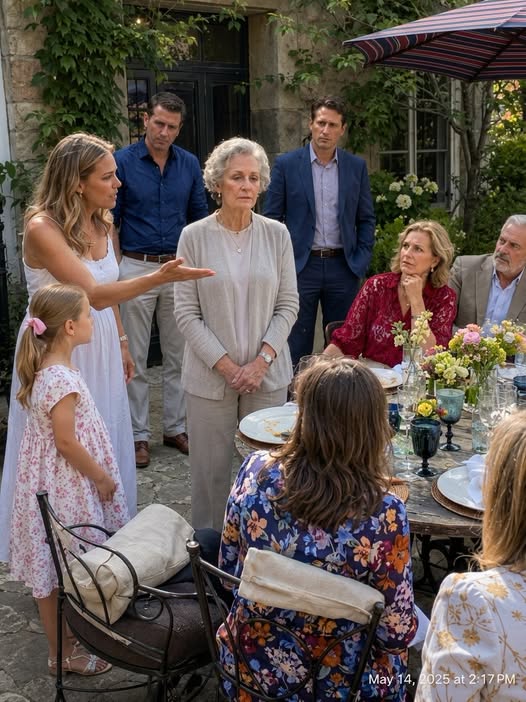
Pauline’s table sat five women deep, sunglasses pushed up into expensive haircuts, a picture of something pale pink sweating in the center. They all turned to look at me with the specific, synchronized interest of a group that had clearly been briefed in advance. Nolan reappeared around then, drifting back from the pro shop with a fresh drink, and slid into the empty chair beside Vivian without quite joining the conversation, the way he’d learned over eleven years to be present at these tables without ever being fully in them.
“So,” Pauline said once introductions had made their way halfway around the group, “how exactly are you two related? I always get confused with the in-law math.”
“She’s Nolan’s mother,” Vivian said, a beat too quickly.
“Right, but—” Pauline let the sentence hang, eyes flicking deliberately over my blazer, my watch, the popsicle stain drying on my wrist. “I just mean you two seem so different. It’s interesting.”
A woman named Diane laughed, not unkindly, more out of nerves than malice. Another woman at the table, a redhead named Audrey, tilted her head and studied me the way you’d study a piece of furniture you were deciding whether to reupholster or simply replace.
I stood there with my hands folded, watching my daughter-in-law’s face do the same careful math it had been doing all week. Nobody at that table asked me a single direct question. I noticed that too. Eleven years of family gatherings, and I had become, in the space of one Sunday morning, a subject to be discussed rather than a person to be addressed.
I could have spoken up. I had a full sentence ready — something true and simple I could have offered that table myself. I didn’t offer it. Some part of me, old and stubborn and maybe not entirely wise, wanted to see what my daughter-in-law would do with the silence I was handing her.
She filled it exactly the way I was afraid she would.
I watched Vivian hesitate for maybe four full seconds. Nothing to the table, everything to her. She had a true sentence available to her too, in that pause — a modest woman who raised a good son by herself and never once made him feel poor. It would have cost her nothing that actually mattered. But Pauline’s table was watching, and somewhere underneath eleven years of careful reinvention, Vivian still believed, the way you believe things burned into you before you were old enough to argue with them, that the distance between used to be poor and still secretly is could close in an instant the moment anyone looked closely enough.
She opened her mouth.
“Everyone,” Vivian said, bright, easy, a hostess’s voice pitched to carry exactly as far as it needed to. “This is Harriet. She used to clean for the family. It’s a whole story I’ll tell you all later.”
She laughed a little as she said it. A small practice laugh, meant to signal that the story was charming rather than what it actually was.
For a second, nobody at that table moved. Then Diane laughed too, too quick and a little too loud, the laugh of someone following a cue she didn’t fully understand. Another woman’s smile went thin and fixed, the particular way smiles go when a person is deciding in real time whether something is funny or something is terrible.
I stood very still. I did not correct her. I did not flinch, and I did not smile the tight, hurt smile I could feel waiting somewhere behind my face if I let it. I have been called worse things by better people over the course of seventy-one years, and none of it ever needed my permission to be untrue. I decided, standing there with a popsicle stain drying on my wrist, to let the table believe her for exactly as long as it took someone else in that building to stop it.
I didn’t know yet how short that would be.
Vivian reached for her iced tea, satisfied, already moving on to whatever she’d planned to say next, completely unaware that six feet behind her, a tray of glasses had just gone very still in a pair of hands that knew exactly who I was.
Julian had been three steps from the table, delivering a fresh pitcher to the group beside us, close enough to catch every word. I watched it land on him in real time. Not confusion, the way it had landed on Diane, but something closer to recognition curdling fast into anger.
He didn’t say anything right away. He finished setting the pitcher down on the neighboring table with careful, deliberate hands — the kind of control you learn from twenty years of not being allowed to show a guest exactly what you’re feeling. Then he picked up his own tray, the one with the last two iced teas still balanced on it, and set it down on the nearest empty table with a sound sharp enough that two glasses rattled against each other.
Even the quartet near the clubhouse doors seemed to catch the change in the air, their tuning trailing off half a bar early, though I doubt any of them could have said exactly why.
Pauline’s table quieted, first the way a room quiets when it senses, before it understands, that something has shifted in the air pressure around it. Vivian was still mid-sentence about the pool renovation when she noticed the shift too, and turned to see what everyone else was already looking at.
Julian Ferris, general manager of Kestrel Hollow Country Club, was walking straight toward her. And he was not smiling.
I set my own popsicle down on a napkin and waited to see what my son’s wife had actually built her whole morning on top of.
He stopped a respectful distance from the table, close enough to be heard clearly, far enough to still be a professional man addressing a member rather than a stranger picking a fight. “Ma’am,” he said to Vivian, calm and even, the voice of a man who has de-escalated a hundred country club disputes over cold soup and slow tea times and never once needed to raise it to be taken seriously. “I think there’s been a misunderstanding.”
Vivian blinked at him, still half-smiling, the automatic smile of someone who hasn’t yet realized the ground has already shifted under her.
“About Mrs. Clifton,” Julian said. And he glanced at me for exactly half a second — not for permission, I understood later, but because some things are easier to say to a room once you’ve looked the person you’re defending in the eye first.
Pauline’s table had gone fully silent now. Five sets of sunglasses pushed up, five faces turned toward a scene none of them had actually expected when they’d asked their careful, pointed questions twenty minutes earlier.
“I don’t think you have the full story,” Julian said to Vivian.
“I think I know my own mother-in-law,” Vivian said, a laugh creeping back into her voice, brittle now, reaching for the easy dismissal that had worked in every other room she’d ever stood in.
Julian didn’t laugh back. “With respect, ma’am,” he said, “I don’t think you do.”
The terrace had gone quiet enough by then that I could hear the quartet tuning near the clubhouse doors, and underneath that, my own heartbeat, steady the way it had stayed steady through worse rooms than this one.
Vivian’s smile held for one more second. Then Julian told her exactly who I was.
“Mrs. Clifton doesn’t clean for anyone, ma’am,” he said. “Not anymore, and not the way you mean it, either.” He let that sit for exactly one beat before he finished it. “She owns the company that runs this club. Every one of us works for her, including me.”
I have replayed that sentence more times than I can count since that Sunday, and I still don’t think there’s a way to fully describe what it did to that terrace. It wasn’t loud. Julian never once raised his voice. It simply moved through that group of women like weather, each face catching it a half second after the one beside it.
Diane’s mouth actually fell open. Another woman set her glass down so fast that iced tea slopped over the rim onto the white tablecloth, and nobody moved to blot it. A man at the next table, a stranger to all of it, set his fork down slowly, the universal signal of someone who senses he’s about to become a witness to something he’ll be repeating at dinner for weeks.
Vivian’s smile — the bright, performative one she’d worn since the parking lot, the one built specifically for this crowd — simply stopped being there. Not dramatically. Not all at once. It just wasn’t on her face anymore, the way a light isn’t on anymore the instant after you flip the switch.
She looked at Julian. She looked at me. Her mouth opened slightly, and nothing came out of it at all.
Pauline, to her credit or discredit, recovered first, the way people like Pauline always do. “I’m sorry. She owns Kestrel Hollow?”
“She owns the company that manages it,” Julian said. “Fourteen years. I’d have thought someone here might have mentioned that by now.” He wasn’t looking at Pauline when he said it. He was looking at Vivian.
Nobody at that table said anything for a second. So Julian kept going, and I let him, because some truths land harder coming from someone who has nothing to gain from telling them.
“Twenty-two years ago, I was nineteen,” he said. “I’d just aged out of foster care with nowhere to go.” His voice stayed level the whole time, the voice of a man who has told himself this story a thousand times in the quiet and only rarely out loud. “I got a job at a restaurant, lost it inside a month. I was sleeping in my car, and it showed. My manager fired me in front of the whole morning shift.”
He glanced at me once, then back to the table. “Mrs. Clifton found me two days later, behind Brier Run Golf Club. I was crying behind a dumpster. I didn’t have anywhere else to be that wasn’t my car. She hired me on the spot. Let me stay in the room over her garage for eight months. That’s how long it took me to get back on my feet.”
He paused, and something in his jaw tightened. “She paid for my food safety certification herself. A few years later, my club management certification too. Three thousand, one hundred dollars all in. She never once brought it up again after she wrote that check.”
He looked around the table, slowly, meeting eyes that had all gone very still. “I don’t know what you were all told about her this morning. I know what she actually did for me, and I’d bet good money I’m not the only person on this staff who could tell you a version of that same story.”
Vivian’s face had gone a color I’d never seen on her before, somewhere between white and something worse.
Nobody at that table laughed this time.
Franklin Doss must have heard some of the commotion from the pro shop, because he came through the terrace doors at a near jog, clipboard still tucked under one arm, and pulled up short at the edge of the group. “What’s happened? Julian, is everything—” He stopped mid-sentence, his eyes landing on me, and I watched the exact moment the pieces he’d been missing an hour earlier finally clicked into place.
“Oh my goodness,” he said quietly, almost to himself. “Mrs. Clifton.”
“Hello, Franklin,” I said. It was the first thing I’d said to anyone at that table since Vivian’s introduction, and my voice came out steadier than I expected it to.
He looked for a moment like a man trying to recalculate an entire morning in real time. “I am so sorry. I had no idea.” He shook his head. “I should have known. We’ve spoken for years. I just never—”
“You never had a reason to picture my face,” I said. “That’s not a failure on your part, Franklin. That was rather the point.”
He turned to the table, and something in his posture straightened, the club president reasserting himself over the mortified acquaintance. “For anyone who doesn’t know,” he said, his voice pitched to carry the way a man’s voice carries when he wants a fact on the record, “Mrs. Clifton is chairwoman of Fair Haven Club Services. They’ve held our management contract for fourteen years.” He paused. “I’ve sat across a boardroom table from her company more times than I can count. I owe her considerably better than what I just watched happen on this terrace.” He looked directly at Vivian when he said the next part. “I’d say this club owes her more respect than it showed her this morning.”
Vivian said nothing at all.
I want to tell you Vivian apologized right there on the spot, because that’s usually how these stories are supposed to go, and because some small, tired part of me was still hoping for it even after everything. She didn’t.
“Well, nobody tells me anything in this family,” she said instead, color rising in her face, her voice climbing toward something defensive and brittle. “How was I supposed to know? Nolan’s never once explained any of this to me.” She turned toward her husband as she said it, already reaching to hand the moment off to someone else, the way she’d been handing off uncomfortable moments for years.
Pauline, meanwhile, had gone very quiet, and I watched her do something I recognized instantly from thirty years of reading rooms for a living. She took one small physical step back from Vivian’s side of the table — not dramatic, not even probably conscious, just the reflexive retreat of a woman recalculating in real time exactly how much social capital she had left to spend on being associated with whatever had just happened.
“I should check on the kitchen,” Pauline said to no one in particular, and didn’t move to check on any kitchen at all. She simply stood a few feet further from Vivian than she had ninety seconds earlier, watching the rest of it unfold from a safer distance.
Nobody at that table offered Vivian a defense. Not one of the five women who’d been so eager twenty minutes earlier to hear the story of the woman who used to clean for the family. They’d gotten their story, after all. It just wasn’t the one any of them had been expecting.
Nolan hadn’t said a word this entire time. He’d been standing a few feet behind Vivian’s chair since he’d wandered back from the pro shop, drink still in hand, and I watched the color drain out of his face in stages as Julian spoke, then as Franklin spoke, then as his wife failed twice to say anything resembling an apology. For a moment I thought he was going to do exactly what he’d done for eleven years — nothing, quietly, and let the silence close back over all of it like water over a stone.
Vivian glanced at him, startled, like he’d switched languages mid-sentence. This was not a version of her husband she’d met before, the one who let silence do all of his arguing for him.
Then he set his glass down and stepped forward. His voice, when it came, wasn’t smooth. It cracked a little on the second sentence. “She’s my mother,” he said to the table, to Pauline mostly, I think, though really to himself. “She raised me by herself. She worked jobs most of you have never had to think about.” He swallowed. “She never once, not one single day, made me feel poor or ashamed or like I was missing something other kids had.” He looked at Vivian. “I let you believe less about her than the truth. Because admitting the truth meant admitting some things about myself I wasn’t ready to say out loud.” His voice caught again. “That’s on me. Not on Mom.”
It wasn’t a smooth speech. It wasn’t perfectly timed either. It came about ninety seconds too late to spare me anything at that table. But it was the first time in eleven years I’d heard my son defend me in a room instead of quietly managing the room around me. And something in my chest loosened that I hadn’t fully realized was clenched.
I didn’t say much in the end. I want you to understand that clearly, because I think it matters. I didn’t correct anyone else’s math about who I was. I didn’t list numbers or explain Fair Haven or tell that table one more word about a foster kid behind a dumpster, or a factory floor gone quiet in some other woman’s hometown. Julian and Franklin had already said what needed saying, and I’ve never seen much use in repeating a true thing just to hear myself say it twice.
I looked at Julian first. “Thank you,” I told him, quiet, just for him. “You didn’t have to do that.”
“Yes, I did,” he said. And I let him have that, because he was right.
Then I turned to the table, to Vivian, to Pauline and Diane and the others whose names I’d already half forgotten. “I think I’d like to find my granddaughter and head home,” I said. “It’s been a full morning.”
Nobody argued.
I found Josie by the pool, orange popsicle number three already melting down her wrist, and took her small, sticky hand in mine. I checked my watch on the way to the car, old habit, the second hand ticking along exactly as steady as it had forty-three years ago. Exactly as steady as it had been the whole time that terrace spent deciding who I was.
I never once told anyone in that building who I was that morning. I didn’t need to. Truth doesn’t require an audience. It only ever needed one honest man standing close enough to hear it.
Nolan came by my kitchen three days later, alone, on a Wednesday morning before his first patient. He didn’t try to explain himself this time or soften anything. He just sat down across from me at the same table where he’d once said keep it low-key, and said, “I’m sorry, Mom. Not sorry it happened in front of people. Sorry it took people for me to finally say anything at all.”
I let that sit a moment before I answered him. “Three years ago, when you and Vivian first looked at Kestrel Hollow, the wait list was four years long. You remember that?”
He nodded slowly, already sensing where this was going.
“I called Franklin myself. Asked him, as a personal favor, to move your application forward. I never told you why it happened so fast, and you never asked hard enough to find out.”
“Mom—”
“I’m not sorry I made that call,” I said, before he could apologize for it. “You’re my son, and Josie deserved a good pool and better popsicles than my garden hose could offer. But I won’t be making another one. Not that call, and not any of the quiet ones I’ve made for this family over the years without ever mentioning them.”
He absorbed that the way you absorb something you already half knew was coming.
Josie wandered in from the living room right then, still in socks, and climbed straight into my lap the way she always does, no calculation in it at all.
“Grandma,” she said, matter-of-fact, like she was asking about the weather, “you own the whole place. The pool and everything.”
“The company that runs it, sweet pea,” I said. “Not quite the same thing.”
“That’s so cool,” she said, already losing interest, already reaching for the crossword pencil on my table instead.
Nolan watched the two of us with an expression I hadn’t seen on him in years. Something like relief and something like grief arriving at exactly the same time.
A few concrete things happened after that Sunday, and I think concrete things matter more than feelings do in the end, so let me give them to you plainly. The Kestrel Hollow board approved Julian’s staff wage increase that same quarter, something he’d been requesting for two years, quietly, through every proper channel, and gotten nowhere with until a Sunday morning made it impossible to keep ignoring. It worked out to just under nine percent for full-time staff, backdated to the first of the month. Not quite what he’d originally asked the board for, but close enough that he stopped asking for a while. I hadn’t asked for any of it. Franklin brought it to the board entirely on his own.
Vivian never did apologize to me directly. Not that week, not the month after. What I got instead, weeks later, was a slightly stiffer version of the same politeness she’d always shown me, minus the performance, which was, in its own way, an improvement. Pauline, I’m told, found other company to keep at the club for a while. Vivian mentioned it once, carefully, like a bruise she was still checking for tenderness.
The club’s next membership newsletter ran a short paragraph thanking Fair Haven Club Services for fourteen years of partnership — the first time in fourteen years anyone had bothered to print my company’s name where the members could actually read it.
Josie still comes by most Saturdays. Still climbs into my lap without checking first whether it’s socially advisable. That relationship, at least, needed no repair, because nothing about it had ever been built on the wrong foundation to begin with.
She used to clean for the family. Five words tossed off lightly enough to fit inside one breath. It took Julian about the same number of words to answer them, and he never once had to raise his voice to make them stick. I think about that trade sometimes — how little cruelty actually costs the person spending it, and how much truth is worth when the right person happens to be standing close enough to spend it back.
If there’s one thing I’ve learned from all of this, it’s that the people who work hardest to make you feel small are usually the ones most frightened of how much room you actually take up in the world. And the only thing you ever really owe them is the truth, delivered in its own good time, by whoever happens to be standing close enough to hear it.
The autumn after that Sunday at Kestrel Hollow settled into the valley with an unusual, crisp stillness, the kind of weather that makes people linger longer on porches and talk slower over coffee. For eleven years, my life had been divided into two cleanly separated compartments: the quiet, unassuming grandmother who lived in a modest brick ranch on Elmwood Avenue, and Harriet Clifton, Chairwoman of Fair Haven Club Services, a regional hospitality and private-club management firm overseeing nineteen properties across four states.
For eleven years, I had kept the door between those two rooms locked at my son’s unspoken request. Now, the hinges were off, and the draft was moving through both sides.
It started small, the way real shifts always do. Two weeks after the newsletter went out, I was at the grocery store on Fourth Street, picking through bruised Gala apples, when a woman in a camel-hair coat paused beside the scale. I recognized her from the terrace—not Pauline, and not Diane, whose laughter had been too loud and too brittle, but the woman who had sat at the far end of the table, the one whose smile had gone thin while she weighed whether Vivian’s joke was funny or cruel.
“Mrs. Clifton,” she said, her voice careful, stripped of the performative warmth people use at charity luncheons. “I’m Claire Vance. We sat at the same table a few weeks ago. At Kestrel Hollow.”
I weighed the apples, dropped them into a plastic bag, and tied a loose knot. “I remember, Claire. How are you?”
“Honestly? Embarrassed,” she said, and there was no theater in it. She looked tired around the eyes, the look of a woman who spends her days managing an actual business rather than curating an image. “I’ve owned a logistics firm in the industrial park for eighteen years. I know what it takes to build something from nothing, and I know what it looks like when someone lets a room diminish them out of grace. I just wanted to say I’m sorry I didn’t speak up that morning.”
“You didn’t know me,” I told her, setting the apples in my basket. “And you didn’t owe a stranger a rescue.”
“Maybe not,” she said. “Though I’d like to buy you a cup of coffee sometime, if you’re ever free. Not at the club. Somewhere the coffee actually tastes like coffee.”
We went to Miller’s Diner on Tuesday morning. Claire didn’t ask about Vivian, and she didn’t fish for gossip about Nolan. Instead, she asked about the early days—how a woman who used to scrub industrial kitchen floors at two in the morning ended up bidding on municipal golf course concessions in the late nineties. For the first time in over a decade, I talked about margins, labor retention, and supply-chain headaches in my own hometown without lowering my voice or changing the subject when someone walked past the booth.
Meanwhile, the quiet reorganization inside my own family was moving at a much slower, heavier pace.
Nolan started coming by on Wednesday mornings before his clinic opened. At first, I thought it was guilt—a temporary penance he’d assigned himself to balance the ledger after eleven years of letting his wife rewrite our history. Doctors are trained to diagnose, treat, and close the chart, and I half-expected him to treat our estrangement the same way.
He didn’t. On the third Wednesday, he brought a bag of warm sourdough rolls from the bakery on Pine Street and sat at my kitchen table while I worked through the morning crossword.
“Vivian and I are seeing someone,” he said, staring down into his black coffee. “A counselor. Over in Ashton, so we don’t run into anyone from the club.”
I didn’t look up from the grid. “Seven-letter word for a coastal inlet. Starts with E.”
“Estuary,” Nolan said automatically. He rubbed the bridge of his nose, looking suddenly forty-two instead of the polished, effortless surgeon people saw at hospital galas. “She’s angry, Mom. Not at you. Well—at first at you, because it’s easier to be angry at the person who saw you fall than the person who built the ledge. Mostly she’s angry at me.”
“She has a right to be,” I said, penciling in the letters. “You let her build a whole house on sand, Nolan, and you held the ladder while she painted the shutters.”
He winced, because he knew it was true. “Growing up, when we didn’t have much, I used to watch the way people looked at us in line at the pharmacy when you counted out change. I swore when I went to medical school that nobody would ever look at me like I was asking for something I couldn’t afford. When I met Vivian, she had that—that armor. She knew which fork to use, which neighborhoods mattered, how to walk into a room like she owned the deed. I thought if I tucked our past away neatly enough, neither of us would ever have to feel small again.”
“And look how small it made both of you,” I said gently.
He let out a long, ragged breath. “Yeah. It really did.”
Vivian herself stayed away for nearly two months. When she finally appeared on my front porch, it was a chilly November afternoon, and she was carrying a cardboard box of Josie’s outgrown winter coats to donate to the church drive I helped run. She didn’t have her sunglasses on, and her hair was pulled back in a plain clip instead of the salon blowout she usually wore even to run errands.
She stood on the welcome mat like she wasn’t sure she had the clearance to cross the threshold.
“Hello, Vivian,” I said, opening the storm door. “Come in before you let all the heat out.”
She stepped into the foyer, set the box down carefully, and kept her hands tucked into the pockets of her trench coat. There was no bright hostess smile, no practiced cadence. She looked slightly pale, stripped of all the usual scaffolding.
“Nolan told me you’re stepping back from day-to-day operations at Fair Haven,” she said, her voice quiet, testing the ground.
“I’m seventy-one,” I said, leading the way into the kitchen and putting the kettle on. “I’ve spent forty years making sure other people’s dining rooms run on time. It’s past due I let my vice presidents earn their salaries.”
Vivian leaned against the edge of the counter, watching me measure loose tea into the pot. For a long moment, the only sound in the kitchen was the low hum of the refrigerator and the beginning whistle of the kettle.
“I grew up in a trailer outside of Mercer,” Vivian said suddenly. The words came out flat, entirely devoid of self-pity, like she was reading an inventory list. “My father worked third shift at the tire plant until his back gave out, and my mother bought our school clothes at the church rummage sale two towns over so nobody in my class would recognize the tags.”
I stood still with the tea tin in my hand. I hadn’t known. Nolan hadn’t known either, or if he had, he had guarded her secret just as fiercely as he had guarded mine.
“When I met Nolan at the hospital,” she continued, staring at the linoleum floor, “I thought I’d finally crossed the river. I thought if I was careful enough—if I dressed right, spoke right, never let a seam show—nobody would ever guess where I started. When Pauline asked about you at that table, I panicked. I saw her looking at your watch and your cardigan, and all I could hear was my mother telling me not to let the town girls see where we parked our car.”
She looked up then, and for the first time in eleven years, I didn’t see the sharp, polished stranger my son had married. I saw a frightened girl who had spent twenty years holding her breath underwater.
“That doesn’t excuse what I said,” Vivian added quickly, her chin coming up just a fraction. “It was cruel, and it was stupid, and you didn’t deserve a second of it. I don’t expect you to forget it, Harriet. I just couldn’t stand pretending I didn’t remember how to speak in my own voice anymore.”
I poured the hot water over the tea leaves and set two mugs on the table.
“Sit down, Vivian,” I said. “The tea takes four minutes to steep, and neither of us is in a rush.”
By the time winter settled over the valley in earnest, the ripple effects of that September morning had reached corners of Kestrel Hollow that had nothing to do with my family.
In private clubs, power rarely announces itself with a gavel; it shifts in the locker rooms, on the back nine, and in the quiet spaces between board meetings. For fourteen years, Fair Haven Club Services had operated under a standard management contract—we handled staffing, culinary operations, turf maintenance, and member events, while the club’s board of directors, led by Franklin Doss, controlled capital improvements, membership dues, and long-term property leases.
What almost none of the members knew—and what Franklin himself had forgotten until he checked the corporate filings in October—was that back in 2012, when Kestrel Hollow had nearly gone under during the tail end of the recession, Fair Haven hadn’t just taken over management. Through a holding subsidiary, my company had quietly bought out the club’s defaulted secondary mortgage note to keep the bank from liquidating the back nine to a commercial housing developer.
I had never exercised a single governance right on that note. As long as the club paid its quarterly interest and kept the staff employed, I stayed out of the boardroom.
Until February, when Franklin Doss called my office line on a Tuesday afternoon, sounding like a man who had just swallowed a piece of glass.
“Harriet,” he said without preamble. “Do you have twenty minutes? I’m at my office downtown, or I can drive out to Elmwood.”
“Come to the Fair Haven office on Commerce Street,” I told him. “I’m reviewing the spring turf budgets anyway.”
He arrived twenty minutes later, shaking snow off his overcoat, carrying a thick leather binder that he set on my conference table like an unexploded shell. He looked across at me, rubbing a hand over his jaw.
“We have a problem with the spring capital proposal,” Franklin said. “Specifically, Pauline Mercer and three other members of the finance committee.”
I raised an eyebrow. “Pauline is on the finance committee now?”
“Her husband bought two commercial strips near the highway last year, and she campaigned hard for the seat in November,” Franklin said grimly. “She’s pushing a motion at Thursday’s board meeting to terminate Fair Haven’s management contract at the end of the fiscal year and bring in an outside luxury hospitality group out of Atlanta. She’s calling it a ‘brand elevation initiative.’”
I leaned back in my chair, folding my hands over my blotter. “Let me guess. She told the committee that Fair Haven is ‘too regional’ for the direction Kestrel Hollow is heading.”
“Almost word for word,” Franklin muttered. “And she’s been whispering to the newer members that the club’s management has a ‘conflict of interest’ because of personal family ties. She’s made it personal, Harriet. She’s still furious about looking foolish on the terrace in front of her friends, and she’s using the club’s budget to settle the score.”
I looked out the window at the gray sleet slanting against the glass. I had spent forty years watching people try to use institutional levers to scratch personal itches. Usually, they burned down half the barn just to catch one mouse.
“What do the numbers look like on her Atlanta firm?” I asked.
Franklin opened the binder and slid a spreadsheet across the mahogany table. “Their management fee is twenty-two percent higher than Fair Haven’s. To cover it without raising initiation fees, Pauline’s proposal cuts seasonal turf crew hours by fifteen percent, eliminates the full-time medical benefit tier for kitchen and clubhouse staff—the exact increase Julian just got approved—and outsources the banquet service to a temp agency.”
I studied the columns of figures. They were neat, ruthless, and entirely shortsighted—the work of people who only ever look at a club from the dining room side of the swinging doors.
“Does Julian know?” I asked.
“I haven’t told him yet,” Franklin said. “If he finds out his staff’s healthcare is on the chopping block because Pauline Mercer has a bruised ego, he’ll walk out before Thursday, and half the kitchen will follow him.”
I tapped my pen once against the edge of the spreadsheet. “And what do you want from me, Franklin?”
“I don’t have the votes on the finance committee to block her proposal from reaching the full board,” Franklin admitted, his shoulders dropping an inch. “Three of the members owe Pauline’s husband favors. If it goes to a general membership vote, she’ll dress it up in brochures about ‘five-star dining’ and ‘resort-level amenities,’ and half the membership will vote for it without reading the fine print.”
I stood up, walked over to the credenza, and pulled a thin manila folder from the bottom drawer—the one labeled KH-2012 Note. I laid it gently on top of Pauline’s glossy Atlanta proposal.
“Have you read clause nine of the subordinated debt restructuring agreement from October 2012, Franklin?” I asked quietly.
Franklin frowned, reaching for his reading glasses. “I wasn’t president in 2012. Artie Pendelton signed that.”
“Artie was a good man, and he was desperate to keep the doors open,” I said. “Clause nine states that while the principal balance remains unpaid, any material change to primary vendor management or structural alteration to full-time staff benefit tiers requires written consent from the note holder. Otherwise, the remaining four point two million dollars becomes immediately due and payable within ninety days.”
Franklin stared at the document for ten full seconds. Slowly, he took off his glasses and set them down on the table.
“You’ve held a four-million-dollar call option on Kestrel Hollow for fourteen years,” he said softly, “and you never once mentioned it in a single contract negotiation.”
“I didn’t buy the note to run the club, Franklin,” I said, sitting back down. “I bought it so thirty-eight people wouldn’t lose their livelihoods before Thanksgiving in 2012. And I have no intention of calling it now unless someone forces me to.”
Franklin looked at the folder, then up at me, a slow, quiet understanding settling into his face. “Thursday night,” he said. “Seven o’clock. The boardroom.”
“I’ll bring my own tea,” I told him.
Thursday evening arrived with a clear, biting frost that turned the Kestrel Hollow fairways silver under the floodlights. I didn’t wear my plain gray cardigan this time, nor did I dress to imitate the women on Pauline’s committee. I wore a tailored charcoal wool suit I’d had for ten years, sensible low-heeled leather shoes, and my husband’s old Bulova watch.
When I walked into the oak-paneled boardroom at five minutes to seven, Julian was already there, standing near the sideboard where a junior server was setting out water pitchers. Julian didn’t look surprised to see me; Franklin had briefed him that afternoon. When our eyes met across the room, he gave me a single, almost imperceptible nod—the steady, grounded look of a man who had spent twenty-two years learning how to hold his ground without making a sound.
Pauline Mercer arrived at seven on the dot, flanked by two men in bespoke blazers and Diane, who had somehow secured a spot as a non-voting observer. Pauline was mid-laugh as she pushed through the heavy doors, carrying a stack of bound presentation folders.
Then she saw me sitting at the far end of the table, directly across from Franklin.
The laugh didn’t die dramatically; it simply snagged, like a wool thread catching on a nail. Pauline stopped beside her chair, her eyes flicking from me to Franklin, then to the thin manila folder resting beside my water glass.
“Franklin,” Pauline said, her voice tightly controlled, smoothing her skirt as she sat down. “I didn’t realize the finance committee meeting was open to outside vendors.”
“It isn’t,” Franklin replied evenly, tapping his gavel once to call the session to order. “Mrs. Clifton isn’t here as a vendor tonight, Pauline. She’s here as a secured creditor.”
Diane blinked, leaning slightly toward Pauline, while the two men in blazers exchanged a quick, puzzled glance.
“I’m sorry?” Pauline said, a sharp edge creeping into her cadence. “A creditor?”
“Before we review your management transition proposal,” Franklin said, passing copies of the 2012 restructuring agreement down both sides of the table, “our legal counsel advised that the committee review the terms of the club’s secondary mortgage note. Specifically, page fourteen.”
I watched Pauline turn the pages. I watched the man beside her—a corporate real estate attorney named Vance Sterling—run a manicured finger down clause nine. Unlike Pauline, Vance didn’t need anyone to translate legal language for him. His jaw tightened before he even reached the end of the paragraph.
“This is still active?” Vance asked Franklin, his voice dropping an octave. “I assumed this note was retired during the 2018 membership drive.”
“The 2018 drive paid for the indoor tennis facility,” Franklin said calmly. “The note holder agreed to defer principal amortization so the club could build the courts without assessing the members. They’ve been collecting three percent simple interest for fourteen years—roughly half of market rate.”
Vance closed the document slowly and looked down the length of the mahogany table at me. There was no condescension in his gaze now—only the sudden, sharp recalculation of a man realizing he had been playing chess without noticing the queen sitting two squares away.
“And you’re the managing member of the holding LLC,” Vance said to me.
“I am,” I replied. “Fair Haven was never interested in owning golf courses, Mr. Sterling. We manage them. When Kestrel Hollow needed a bridge in 2012, we stepped in because good clubs are built by the people who show up at five in the morning to cut the greens and prep the kitchens, and those people deserved a chance to keep their jobs.”
I turned my gaze directly to Pauline. She had her hands folded tightly over her glossy Atlanta folders, her knuckles white against the dark wood.
“I read your proposal, Pauline,” I said, keeping my voice as even as Julian’s had been on that September terrace. “The Atlanta group runs fine resorts. They’ll charge you two hundred and forty thousand dollars more a year, they’ll strip medical coverage from nineteen full-time employees, and within eighteen months, half the kitchen staff who know your members’ allergies and anniversaries will be gone.”
“This club needs to evolve,” Pauline said, her chin lifting, though a faint patch of red had appeared just above her collar. “We can’t run Kestrel Hollow like a charity or a—a personal patronage network for people who owe you favors.”
“Nobody in this building owes me a favor,” I said quietly. “Every person on Julian’s staff earns their paycheck twice over before noon. What they do have is a contract. And as long as this club carries my note, that contract includes full health benefits and a living wage.”
I slid a single sheet of paper across the table toward Vance Sterling.
“If the committee wishes to terminate Fair Haven’s management agreement and bring in Atlanta,” I continued, “you are entirely within your rights to do so. That document is a formal payoff demand for the four point two million dollar principal balance, due in ninety days. You can refinance it at current commercial rates—which, as Mr. Sterling will tell you, will add roughly three hundred thousand dollars a year to your debt service—or you can assess each equity member twelve thousand dollars by May first.”
Silence settled over the boardroom, thick and absolute. You could hear the faint tick of the wall clock above the fireplace.
Vance Sterling didn’t even look at Pauline. He picked up his pen, drew a neat line through the agenda item labeled Management Transition, and looked at Franklin.
“I move we table the Atlanta proposal indefinitely and renew Fair Haven’s management contract for a standard five-year term,” Vance said briskly. “Second?”
“Second,” said the man beside him before the echo had even died.
Pauline sat motionless, staring straight ahead at the framed watercolor of the eighteenth hole on the opposite wall. She didn’t argue. She didn’t make a speech. When Franklin called for the vote, she kept her hands flat on the table while the ayes carried unanimously.
As the committee adjourned and filed out into the corridor in muted, brisk clusters, Pauline lingered for half a second by the door, gathering her untouched folders. Diane was already halfway down the hall, suddenly engrossed in her phone.
I stood by the sideboard, pouring myself a small cup of decaf coffee, when Pauline paused beside me. Up close, without an audience around her, she looked smaller than she had on the terrace—just a middle-aged woman who had spent too many years mistaking exclusivity for worth.
“You enjoy this, don’t you?” Pauline murmured, keeping her voice low enough that Julian, standing by the door, wouldn’t hear. “Letting people walk right into a wall before you tell them it’s brick.”
I set the carafe down and looked at her steadily.
“Pauline,” I said, “I spent thirty years invisible in rooms you wouldn’t step inside without gloves on. If I’ve learned anything, it’s that I don’t need to build walls for people like you. You build them yourselves, brick by brick, every time you decide someone in the room doesn’t count. I just stopped knocking them down for you.”
She opened her mouth, closed it again, and walked out into the hall without another word.
Spring came early that year, bringing dogwood blossoms along Elmwood Avenue and a steady rhythm of Saturday mornings that felt entirely different from the ones before.
The first Saturday in April, Josie turned eight. Instead of the elaborate, catered country-club lawn party Vivian had originally sketched out back in January—complete with a hired balloon architect and a printed seating chart—they held it in my backyard.
It was a warm, breezy afternoon. Nolan manned the charcoal grill in a faded college sweatshirt, flipping burgers with the focused intensity of a man who had spent all week holding a scalpel and was grateful for something that couldn’t sue him if it burned. Vivian sat at the weathered picnic table beside Claire Vance—whom Vivian had awkwardly, bravely invited after running into her at the florist—helping Josie glue sequins onto cardboard crowns for six noisy second-graders.
I watched Vivian from the back porch steps, a glass of lemonade resting on my knee. She was laughing at something Josie had just said, a real laugh that crinkled the corners of her eyes and didn’t stop halfway down her throat to check who was listening. When she caught me looking, she didn’t stiffen or reach for the bright hostess mask. She just raised her eyebrows in mock despair at the glitter spreading across my patio table and mouthed, I’m vacuuming before we leave.
“You’d better,” I called back, and she grinned.
Later, after the kids had gone home sticky with birthday cake and Nolan was packing Tupperware into the trunk of their SUV, Julian stopped by. He wasn’t in his club blazer; he was wearing jeans and a flannel shirt, carrying a small wrapped box tied with twine.
“Hope I’m not interrupting,” he said, stepping around the side gate. “Wanted to drop off Josie’s birthday present before I headed up to the lake.”
“You’re never interrupting, Julian,” I said, waving him onto the porch. “Have a piece of cake before Nolan takes the rest of it hostage.”
He sat down on the top step beside me, stretching his long legs out toward the grass. For a minute, neither of us said anything, watching Josie chase a stray dandelion puff across the yard while Vivian leaned against the hood of the car, talking quietly with Nolan.
“Board approved the summer apprentice program yesterday,” Julian said, looking out over the yard. “Six high school kids from the east side. Paid internships in culinary, turf management, and hospitality. Franklin actually championed it himself.”
“Good,” I said. “Franklin’s learning.”
Julian turned his head to look at me, a faint smile touching the corner of his mouth. “You know, twenty-two years ago, when you found me behind that dumpster at Brier Run, I thought you were just taking pity on a kid who couldn’t keep a dishwashing job.”
“I don’t do pity, Julian,” I told him. “Pity doesn’t pay for food safety certifications. I saw a young man who was embarrassed to be seen crying, which meant you still had pride, and you were scrubbing your own shoes with a wet paper towel before your next interview, which meant you still had grit. That’s a decent return on three thousand dollars.”
Julian laughed softly, shaking his head. “Well. Whatever you called it, it’s still paying dividends.”
Six months later, on a crisp Sunday morning in October, I drove out to Kestrel Hollow one last time as Chairwoman of Fair Haven Club Services.
I had formally signed over the executive leadership to my longtime chief operating officer, Elena Ruiz, the Friday before. I was keeping a seat on the advisory board and retaining the holding company notes, mostly because Elena had threatened to resign if I didn’t stay on call for budget season, but the daily weight of nineteen properties was finally off my shoulders.
The terrace looked much the same as it had a year earlier—white linen tablecloths snapping lightly in the autumn breeze, silver iced-tea pitchers sweating in the sun, the string quartet tuning near the clubhouse doors.
Except this time, when I walked out onto the flagstones, nobody looked past me.
A young server I didn’t recognize—one of Julian’s summer apprentices who had stayed on for weekends—stepped forward immediately with a warm smile. “Good morning, Mrs. Clifton. Your usual table by the hedge is ready, and Julian said to tell you he’ll be right out with the good tea.”
“Thank you, sweetheart,” I said. “Tell him not to rush.”
Nolan, Vivian, and Josie joined me ten minutes later, fresh from Josie’s morning soccer match, Josie still wearing her shin guards under her socks. Vivian pulled out my chair before Nolan could reach it, set a small pastry box from the Pine Street bakery beside my plate, and sat down across from me without once glancing over her shoulder to see who was watching from the neighboring tables.
Across the terrace, Pauline Mercer was hosting her usual Sunday brunch. She caught my eye over the rim of her water glass. There was no warmth there—we were never going to be friends, and neither of us saw any point in pretending otherwise—but she gave a slow, measured nod of acknowledgment before turning back to her guests. Respect, I’ve found, doesn’t require affection. Sometimes it just requires two people finally agreeing on the facts.
Josie climbed halfway onto my lap to inspect the pastry box, her chin resting on my shoulder.
“Grandma,” she whispered, loud enough for the next two tables to hear, “now that you’re retired, are you going to come to all my soccer games?”
“Every single one,” I said, wrapping an arm around her narrow shoulders. “Rain or shine.”
I glanced down at my wrist. The old Bulova watch was ticking away, steady and unhurried, just as it had for forty-four years. Around us, the terrace hummed with the easy, ordinary noise of a Sunday morning—ice clinking in glasses, chairs scraping against stone, a quartet finding its pitch.
For the first time in eleven years, I didn’t feel like a guest in my own life, and nobody at my table was trying to explain me away. We were simply there, whole and unedited, taking up the exact amount of space we had earned.
THE END..!