The match struck on a Tuesday afternoon.
I know it was a Tuesday because I had driven four hours from California to Oklahoma specifically to hand-deliver the invitations to my parents. I had wanted them to feel it in their hands before it arrived in the mail — the weight of the paper, the pressed flower inside, the care that had gone into every detail.
I was thirty-three years old and I had spent my entire adult life being the invisible daughter. The reliable one. The one who paid the emergency bills and absorbed the insults and kept quiet so the family structure didn’t crack under the weight of its own dysfunction.
That afternoon, I was going to ask my parents to come watch me get married.
I thought it was a reasonable thing to ask.
My mother Valerie held the cream-colored card stock over the flame without saying a word. The paper caught quickly — heavy stock burns faster than you’d expect — and the edges curled from cream to brown to black. The pressed flower I had placed inside turned to ash and dropped onto the linoleum.
My father Clifford was sitting at the kitchen table with his reading glasses pushed down his nose, absorbed in the sports section. He didn’t look up. He didn’t flinch at the smell of burning paper.
He just turned a page.
My sister Morgan stood behind my mother, and she was smiling. Not a huge, theatrical smile — something smaller and more satisfied. The smile of a person watching the world arrange itself exactly the way she had demanded it to.
Valerie dropped the last burning corner into the kitchen sink and ran the faucet. A short sizzle. She wiped her hands on a dish towel and looked at me with the blank expression of someone who had just finished unloading a dishwasher.
Then Clifford spoke without lifting his eyes from the baseball scores.
“We can only afford one daughter’s wedding.”
Seven words.
That was all it took to sever thirty-three years of trying to be enough.
I am a structural engineer. I calculate load paths for a living. I assess foundational cracks and I know, with mathematical precision, exactly how much pressure a support beam can absorb before it splinters and brings the whole structure down. Eleven years of that work, and nothing in any of it had prepared me for the sound of a match striking a kitchen counter or the smell of my own name burning.
I walked to the sink. I reached into the basin and picked up the single burnt corner where my name was still partially visible. I closed my fist around it.
I didn’t look at any of them.
I turned around and walked out the front door.
I made it to my car before my hands started shaking. Not a sad tremble — a violent, full-body vibration, like a bridge hitting its exact resonance frequency right before catastrophic collapse. I gripped the steering wheel and stared at the quiet suburban street.
They had made their choice.
They had burned my handmade paper invitation to prove that Morgan was the only one worth investing in.
But as I sat there forcing oxygen back into my lungs, an engineer’s thought cut through everything else.
When you burn something down, you leave an empty space.
And in empty space, you can build whatever you want.
I put the car in drive.
I didn’t know it yet, but twenty-one days later, my parents were going to see exactly what I built — in their living room, projected ten feet tall onto the wall, in front of forty people they’d invited to watch.
To understand what happened in that kitchen, you have to understand the foundation everything was built on.
There were two daughters in the Ingram family. Morgan was the radiant one, the one who walked into a room and expected a standing ovation simply for arriving. I was the reliable one.
In our house, reliable was just another word for invisible.
If Morgan got a B-minus on a test, there was a celebratory dinner because she tried so hard. If I won a state mathematics competition, it was filed away as expected behavior, unworthy of comment. Over the years I learned to shrink myself. Asking for attention was a tax my parents were unwilling to pay, so I stopped asking.
I poured everything into mathematics, physics, and eventually structural engineering because numbers never lied to me. Concrete and steel made sense. They held up exactly the amount of weight they were designed to carry. They did not play favorites.
Three days before the kitchen incident, I had received the biggest promotion of my career. My firm had named me lead structural engineer on the restoration of the Whitmore Estate — a 98-year-old Mediterranean revival mansion perched on the cliffs of Malibu, overlooking the Pacific Ocean. Forty-two rooms. Limestone colonnade. Salt air and three major earthquakes had left the building weeks from total collapse. It was a career-defining project, the kind engineers spend entire lifetimes working toward.
I called home that night to share the news.
Valerie answered, listened to me speak for forty-five seconds, and then interrupted to tell me Morgan was having a crisis because the florist she wanted for her wedding was already booked.
I hung up feeling hollow.
But there was something else. Something my aunt Sylvia told me when she called the morning after the kitchen.
“They’re in deep trouble, Sloan,” Sylvia whispered. “Morgan’s wedding has spiraled completely out of control. Destination bachelorette party, custom designer gown, a venue that costs more than my car. Your parents couldn’t say no to her. They never can. So your father took out a second mortgage.”
“How much?” I asked, keeping my voice flat.
“Forty-two thousand dollars,” Sylvia said. “And they’re not making the payments. I saw the mail on the counter — legal notices, warnings about default proceedings. They’re risking the roof over their heads for ice sculptures and a string quartet.”
Forty-two thousand dollars. They were facing foreclosure. They had burned my handmade invitation because they claimed they couldn’t afford a single stamp for an RSVP.
Sylvia waited for me to offer a solution.
“Maybe you could call them,” she said. “Help them figure out a payment plan. Like you always do.”
Like I always do.
I looked at the charred corner of paper I’d placed in a clear plastic sleeve on my desk. It looked like something you’d put in an evidence bag.
“No, Sylvia,” I said. “I’m not calling them. I’m not fixing this.”
“But Sloan, they could lose the house.”
“Then they’ll have to ask Morgan if she has a spare bedroom behind one of her ice sculptures,” I replied. “I’m done. Don’t ask me to send money. Don’t ask me to mediate. Their financial collapse is not my engineering problem anymore.”
I hung up, opened my banking portal, found the recurring automatic transfer I’d been sending for years to help with their utility bills, and clicked cancel.
A small green check mark appeared on the screen.
The financial pipeline was severed.
I sat with that for a while, watching the cursor blink.
The Ingrams had made a catastrophic miscalculation. They assumed the load-bearing column they had spent years chipping away at would always be there when the weight got heavy.
They were about to learn a very hard lesson in physics.
When you remove the support, gravity always wins.
I pushed the thought of Oklahoma out of my mind. I had a mansion to save.
For fourteen months I had been crawling through the dusty crawl spaces of the Whitmore Estate, reinforcing failing floor joists with carbon fiber, designing custom steel moment frames to carry the building through the next major seismic event. It was grueling, unglamorous work. The kind where you go home with concrete dust in your hair and calluses you stop noticing.
Because of the historical significance of the restoration, a major national television network had been documenting the entire project. The show was called Rebuild America, and it averaged over four million viewers an episode. Cameras had followed my team for months — filming me arguing with contractors, pointing at blueprints, covered in dust and completely in my element.
Two days after I cancelled the utility payments, I was checking tension on a newly installed steel bracket in the grand ballroom when the executive producer, a sharp woman named Elena, walked in with a clipboard and a serious expression.
“The network wants something massive for the season finale,” she said. “The restoration finishes by early June. They want to host the first event in the restored estate and broadcast it live.”
“A charity gala?” I offered. “A historical society dinner?”
Elena looked at me directly. “A wedding. Your wedding.”
I stared at her.
“Sloan, listen. The narrative is perfect. The engineer who spent two years saving this romantic, historic landmark gets to be the first person to walk down its aisle. The network will cover everything — catering, flowers, lighting, the band. A world-class event venue, fully funded. All you do is let us point cameras at you while you say your vows on live television. We’re estimating over five million viewers for the live broadcast.”
I stood very still with the words settling around me.
A fully funded luxury wedding at a forty-million-dollar estate on the Malibu cliffs. The exact kind of event Morgan was currently destroying my parents’ finances to afford — being offered to me on a silver platter, simply because I was good at my job.
“Can I have a few days to think about it?” I asked.
“Forty-eight hours,” Elena said, tapping her clipboard. “Talk to your fiancé.”
I walked out to the limestone colonnade and stood looking down at the Pacific crashing against the rocks below. The terror of it was real — I was an engineer, not a television personality. I wore steel-toed boots and calculated wind resistance.
But underneath the terror, something cold and clear was beginning to glow.
My parents had told me they could only afford one daughter’s wedding. They had burned my handmade paper and decided I wasn’t worth the cost.
And now the universe was handing me a microphone and a spotlight bright enough to blind anyone looking in my direction.
That night, Garrett sat across from me at our kitchen table while I stared at the fifty-page broadcast contract.
Garrett manages construction projects for a living. We met on a job site four years ago. He is a man of very few words, broad shoulders, and an irritatingly steady calm. He has watched me try to earn my family’s love for years, and he has always delivered his warnings gently, like someone handing you an umbrella when you refuse to admit it’s raining.
“I can’t do this,” I whispered, rubbing my temples. “It’s too flashy. Morgan is the one who does cameras and pageants. I’m the one who calculates wind resistance. If I do this, everyone’s going to think I’m showing off.”
Garrett turned off the stove, walked to the table, and sat down directly across from me.
“Sloan,” he said. “You spent two years saving that building from falling into the ocean. You worked eighty-hour weeks. You solved engineering problems that a dozen men before you couldn’t crack. If they want to put you on television to celebrate that, it is not showing off. It is acknowledging reality.”
He tapped the stack of paper.
“The only reason you think you don’t deserve this is because you let your parents write your performance review for thirty-three years. They gave you a failing grade because they were too cheap to pay attention. Fire them. You’re the lead engineer now. Approve your own project.”
I looked at him for a long moment.
Then I pulled a pen from my bag, flipped to the last page of the contract, and signed my name.
Garrett grinned — a wide, genuine grin that reached his eyes.
“We’re going to need a really nice suit,” he said.
I laughed. A real, physical laugh that felt unfamiliar in my chest.
“There’s one condition,” I said, the cold logic returning.
“Name it.”
“We don’t tell them. We don’t tell Valerie, Clifford, or Morgan. No announcement. No social media. No warning. We operate under total silence.”
Garrett raised an eyebrow. “You don’t want to rub it in their faces?”
“If I tell them, it becomes a negotiation. Valerie will try to take credit. Morgan will make herself the victim. I’d be back in the same cycle — managing their emotions, softening the truth to protect people who burned my name in their kitchen sink.” I met his eyes. “I’m done managing them. We tell your family, we tell my firm, and we keep our mouths shut until the cameras roll.”
Garrett nodded. “Silence. Clean.”
It was more than clean. It was armor.
By choosing silence, I was removing the only weapon the Ingram family had left — the ability to react, manipulate, and rewrite the narrative before it could reach anyone else.
I was going to let reality speak for itself.
Three weeks before the wedding, my phone buzzed with Morgan’s name on the screen.
I hadn’t spoken to any of them since I walked out of the kitchen.
The engineer in me needed data. I tapped the screen.
“Listen,” Morgan said brightly, completely devoid of guilt, “I’m finalizing the seating chart for my reception and Mom wanted me to ask if you’re bringing a plus one because we’re tight on numbers and the caterer needs a headcount by Friday.”
She was calling about her own seating chart. While standing in the background when my mother burned my invitation. The sheer architectural scale of her self-absorption was almost impressive.
“I haven’t sent an RSVP, Morgan,” I replied, keeping my voice flat.
“Right, well can you just tell me now?” She sighed, as if I were complicating a logistics problem. “If you’re not bringing that construction guy you’re dating, I can give your seat to someone else.”
“Morgan,” I said. “You do know I’m getting married, right?”
A pause. Then a short, dismissive laugh. “I mean, sure. Mom said you were doing some little courthouse thing. I hope that goes well for you, but my wedding is a massive catered event. It’s a real wedding, Sloan. So I just need to know about the seat.”
She said it the way people state obvious facts. The sun rises in the east. My wedding is a real wedding. Whatever Sloan does is a temporary administrative footnote.
In the past, this was the exact moment I would have argued. I would have raised my voice, presented evidence, thrown myself against the brick wall of her certainty until I was bruised and exhausted.
I didn’t feel the need anymore.
Arguing is just auditioning. It’s begging someone to see your worth.
I was done auditioning.
“Enjoy your real wedding, Morgan,” I said softly. “I’ll be busy. I won’t be attending. You can have my seat.”
I ended the call before she could respond.
I sat in the quiet for a moment, waiting for the usual wave of guilt to arrive. The old reflex that told me I needed to call back and apologize for setting a boundary.
It never came.
I picked up my pen and went back to the blueprints.
Two weeks before the wedding, the network dropped the promotional trailer online.
Within three minutes of it going live, I had fourteen text messages, five missed calls, and an inbox that had essentially caught fire.
I watched the clip standing on scaffolding outside the estate.
The drone swept over the cliffs at sunset. The Pacific glittered. A booming voiceover described the restoration. The screen cut to a quick three-second shot of me — hard hat, rolled blueprints, giving instructions to a crew, covered in dust.
The final frame showed the grand aisle being prepared. White chairs flanking a seventy-two-foot stretch of reclaimed Italian stone, leading to an altar with the full Pacific behind it.
Then large white text: The Season Finale Event. June 14th. Live.
By the time the clip ended, it had two hundred thousand views. My firm’s website crashed from the traffic surge within ten minutes.
That night, my aunt Sylvia called, breathing hard.
“Sloan,” she said. “Your mother saw the video.”
I stopped pouring my water.
“The network promoted it in their area. Valerie was scrolling on her tablet when it autoplayed. She saw the estate. She saw the date. She saw your face for those three seconds.” Sylvia paused. “She called Morgan immediately.”
“What did Morgan say?”
“She told your mother the network must have taken a photo of you from the internet and photoshopped it for drama. She said television networks fake things all the time and there was no way you were the lead engineer on a forty-million-dollar estate.” Sylvia let out a long, tragic breath. “And Sloan — your mother believed her.”
I actually laughed. A dry, humorless sound.
Valerie was staring at a high-definition video broadcast by a major national network, and she chose to believe a frantic lie told by her twenty-nine-year-old daughter.
“Your mother wants to believe her,” Sylvia said. “If she admits that video is real, she has to admit she burned the invitation to a nationally televised wedding while driving her own family into foreclosure for a party at a golf club. She’s clinging to Morgan’s lie because the truth would destroy her.”
I took a sip of water. “Thank you for telling me, Sylvia. But it’s not my problem anymore.”
One week before the wedding, Sylvia called again. This time she didn’t sound like a gossip. She sounded like someone delivering a terminal diagnosis.
“I just received the digital invitation to Morgan’s bridal shower,” she said. “Valerie is hosting it at their house. Forty women invited. And Sloan — the date is June 14th.”
I set down my pen.
June 14th.
The exact day of the live broadcast.
“There’s more,” Sylvia continued, her voice tightening. “Morgan has been obsessed with Rebuild America for months. So Valerie decided to make the shower a viewing party. She rented a digital projector. At eight o’clock Central, forty women are going to sit in your parents’ living room to watch the season finale.”
I put the phone down on the counter and stood very still.
My parents had leveraged their house to the brink of foreclosure for Morgan. They had burned my invitation to ashes. And now they were gathering forty people in their living room, projecting a massive image onto the wall, completely unaware that they were about to watch me walk down an aisle on live television.
“Sloan, you have to warn them,” Sylvia pleaded. “One text. If that show comes on and your face is on that giant screen, your mother is going to have a breakdown in front of half the town.”
The old programming flared in my chest. The deeply ingrained reflex to absorb the impact before it could reach them. One text message. Four seconds of effort.
I reached into my pocket and closed my hand around my grandfather’s brass spirit level.
I had inherited it from him when I was twelve. He was a bricklayer who had died before he had much money, and my mother had always considered him a little beneath their suburban standard. But before he passed, he called me into his room and pressed the small, warm, scratched piece of metal into my hand.
“Slo,” he had said, “before you build anything in this life, you have to check if the ground is true. If the ground is fake, it doesn’t matter how pretty the house is. It will fall.”
I held the level in my fist now, in a television production trailer in Malibu, five days before my wedding.
I thought about the smell of sulfur in the kitchen.
I thought about the baseball scores and the turned page.
I thought about seven words delivered in a tone that held no doubt, no apology, no room for negotiation.
We can only afford one daughter’s wedding.
I put the phone back against my ear.
“Sylvia,” I said quietly. “I’m not sending a text.”
“But Sloan — it will be a disaster.”
“It’s a disaster they built themselves,” I said. “They poured the foundation. They framed the walls. They rented the projector. I’m just letting the building stand on its own. I’m not going to protect them from the reality of their own choices ever again.”
I hung up.
I didn’t feel vindictive. I didn’t feel a rush of anything sharp or gleeful.
I felt the quiet, absolute weight of inevitability.
The laws of physics are not interested in your feelings. Every action has an equal and opposite reaction. The Ingram family had been pushing against the truth for thirty-three years.
The truth was about to push back.
The night before the wedding, I couldn’t sleep.
I got up at three in the morning, careful not to wake Garrett, drove the winding coastal highway up to the Whitmore Estate, and let myself in through the side entrance with my key.
I needed to see it once more in the quiet, before the cameras and the crowd arrived.
The security guard waved me through without a word.
Under a full moon, the limestone walls glowed softly and the restored arches stood clean and proud against the dark sky. The sound of the Pacific was a low, constant rhythm somewhere below the cliffs.
I walked slowly through the east wing, running my hand along the load-bearing walls I had spent months calculating and reinforcing. The thousands of micro-fractures we had repaired. The tons of steel hidden behind the plaster to give the building the strength to survive the next time the earth moved.
A building doesn’t know it’s beautiful. It only knows if it’s strong.
I sat down on a limestone bench near where the altar would be set in the morning and pulled the clear plastic sleeve from my coat pocket.
The charred gray ash. The burnt corner of my original invitation, my name still partially visible through the plastic.
I had carried it for a month. It had been the fuel — the cold, precise anger that had carried me through thirty days of silence while my parents threw a watch party and decided my wedding was a Photoshopped lie.
Part of me wanted to tuck it inside my dress tomorrow. To carry the pain as armor.
But sitting in that beautifully restored room in the silver moonlight, the engineer in me recognized something.
You don’t build a structurally sound house and then deliberately carry a rotted piece of wood inside and hide it in the walls.
You leave the rot outside.
If I walked down that aisle tomorrow with that burnt paper against my chest, I’d be dragging Valerie and Clifford and Morgan straight into the center of my marriage. I’d be proving that they could still burn me from a thousand miles away.
I stood up from the limestone bench.
I walked to a heavy trash can the construction crew had left near the side exit. I didn’t hold a ceremony. I didn’t make a speech.
I dropped the plastic sleeve into the can, turned my back on it, and walked out.
I drove home, got into bed, and fell into the deepest sleep I’d had in a month.
June 14th. 6:30 in the evening, Pacific time.
The air in Malibu was perfectly still. The scent of salt water and blooming gardenias. The evening sun hung low on the horizon, casting a golden lateral light across the colonnade exactly as I had calculated it would during my sight planning six months earlier.
I stood behind the massive wooden double doors of the grand entrance in a simple white silk dress, my hands perfectly steady.
Tucked into a hidden pocket sewn inside the lining of my dress, right against my ribs, was my grandfather’s brass spirit level.
Through the thick wood I could hear the hum of the production crew and the quiet murmur of guests settling into their chairs.
The network had filled every seat with people who actually showed up for me. Brenda, Garrett’s mother, who had put a plate of pot roast in front of me without asking any questions. Donovan, who had pushed a glass of water toward me and gone back to his toaster. My colleagues from the firm. The foundation board. People who had driven and flown and rearranged their lives to be in that room.
There was no Ingram section. No empty chairs waiting for people who felt obligated to be there.
Every seat held someone who wanted to be there.
The stage manager counted me down.
Three.
Two.
One.
The doors opened.
Golden light. The orchestra swelling through the hidden speakers. Camera operators gliding smoothly on their tracking rails.
I stepped onto the seventy-two-foot aisle of reclaimed Italian stone.
I didn’t look at the cameras. I didn’t think about the six million viewers watching from their living rooms. I looked straight ahead to the end of the aisle where Garrett was waiting — dark charcoal suit, broad shoulders squared, jaw tight, eyes wide and shining with the tears he was clearly doing his best not to shed.
I walked past Brenda, who was crying openly and making no effort to hide it.
I walked past my managing director, who gave me a nod that meant more than a standing ovation.
I walked through a building I had saved from ruin, on a foundation I had personally calculated, toward the man who had offered me a safe place to land when my own family threw me off a cliff.
When I reached the altar, Garrett took both my hands. His grip was warm and completely solid, and I felt the knot in my chest finally, fully release.
We said the vows we had written ourselves at the wobbly kitchen table in his mother’s house. When the officiant smiled and said you may kiss the bride, Garrett didn’t hesitate. He pulled me in, and the entire room erupted.
I pressed my hand against the side of my dress and felt the outline of the brass spirit level through the silk.
The bubble was dead center.
The ground was true.
In Norman, Oklahoma, it was 8:30 in the evening, Central time.
Aunt Sylvia described the scene to me weeks later with the precision of someone who had watched a slow-motion car accident from the curb.
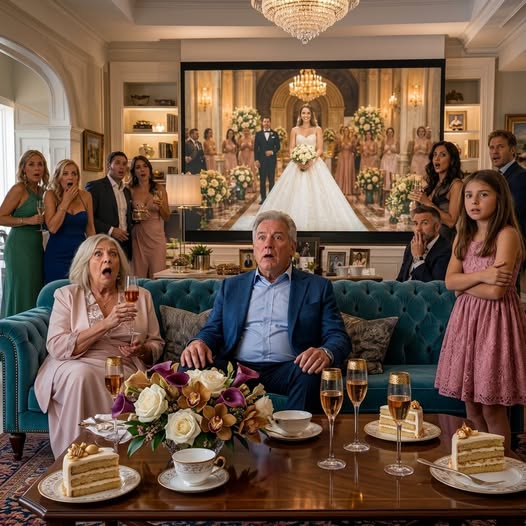
Valerie’s living room held forty women. Cheap champagne, vanilla cake, the smell of perfume and hairspray. Morgan was sitting at the center in her white bride-to-be sash, surrounded by gifts purchased on credit cards approaching their limits. Clifford had set up the rented projector, casting a ten-foot image onto the wall where Morgan’s high school portrait usually hung.
The room quieted as the Rebuild America network logo appeared.
The broadcast opened with thirty minutes of restoration retrospective — drone footage soaring over the cliffs, the history of the estate, the engineering challenges. And then it cut to a sit-down interview with the lead engineer.
My face, ten feet tall, filled the Oklahoma living room.
My voice, calm and completely steady: “This building survived because someone ninety-eight years ago refused to cut corners on the foundation. When you build on the truth, it holds.”
Forty women stopped breathing.
Valerie dropped a plate of appetizers onto the carpet.
Morgan’s smug expression went blank.
Clifford lowered his drink and said nothing.
Then the retrospective ended and the broadcast cut to live feed.
The front doors of the Whitmore Estate opened.
And forty of Morgan’s closest friends and family members sat in stunned silence and watched me walk down the aisle of a forty-million-dollar estate, broadcast to over six million people, marrying Garrett in a ceremony of complete and absolute reality.
Nobody looked at Morgan.
For the first time in her life, she was invisible in her own home.
Far away on the terrace of the Whitmore Estate, I slipped away from the dance floor to catch my breath in the cool ocean air.
I pulled my phone from Garrett’s jacket pocket.
Forty-seven missed calls.
Dozens of messages forcing their way back through the group chat I had deleted.
Sloan, please answer the phone. — Valerie.
Sloan, we are so proud of you, honey. Why didn’t you tell us? — Clifford.
Why do you always have to make everything about you? — Morgan, followed by a string of angry emojis.
No apologies for the burnt invitation. No apologies for the forty-two thousand dollars. Just the frantic scrambling of people trying to reconstruct a bridge they had gleefully demolished, because they had just realized the daughter they discarded was the only one the world was actually watching.
I stood in the dark listening to the waves below.
I opened the text box.
I typed two words.
Too late.
I hit send, powered the phone off, slipped it back into the jacket pocket, and walked inside to dance with my husband.
A year has passed.
I am now a principal partner at my firm. Garrett and I bought a house with a solid foundation. The brass spirit level sits on my new desk.
The Ingrams eventually had to sell their home to cover the debt from Morgan’s wedding. We don’t speak.
I learned the most important lesson of my career the hard way, and it had nothing to do with load calculations or seismic retrofitting.
The strongest building is not the one with the most expensive decorations or the loudest crowd watching it go up.
The strongest building is the one that holds its ground when the people who were supposed to support it walk away.
When you finally build your life on the truth, you realize you never needed their approval to stand.
You just needed ground that was real.
The fallout in Norman, Oklahoma, didn’t begin with a scream. According to Aunt Sylvia, who sat near the kitchen archway nursing a glass of flat prosecco, it began with the low, mechanical hum of the rented Epson projector cooling down—the only sound in a living room packed with forty women who had just watched the final credits of Rebuild America roll over a sweeping drone shot of the Pacific Ocean.
On the drywall, where Morgan’s laminated senior portrait usually hung, the network logo faded to black.
Valerie Ingram was standing three feet from the sofa. At her feet, a paper plate of puff-pastry brie bites lay upside down on the beige Berber carpet, a smear of melted cheese soaking into the synthetic fibers. Nobody moved to pick it up.
“Turn it off,” Morgan whispered.
Her white satin Bride-to-Be sash had slipped off one shoulder, pooling around her elbow like a deflated bandage. Her face, meticulously contoured for Instagram stories that hadn’t been posted yet, looked blotchy under the blue glow of the idle projector screen.
“Clifford,” Valerie said. Her voice didn’t have its usual sharp, country-club cadence. It sounded thin, like stretched wire. “Turn the projector off.”
Clifford didn’t reach for the remote. He was staring at the blank rectangle on the wall, his glass of bourbon halfway to his mouth, frozen like a man trying to calculate a column of numbers that refused to add up. Forty-two thousand dollars. That was the exact figure he had pulled from their home equity line of credit three weeks ago to pay the deposit on Morgan’s venue in Oklahoma City, the floral arches, and the string quartet. He had signed the paperwork on a Tuesday afternoon, right after telling his eldest daughter over speakerphone that there simply wasn’t room in the budget for two weddings.
“That was the Whitmore Estate,” one of Valerie’s bridge club friends murmured from the loveseat, breaking the silence. “The one in Malibu. My nephew works in commercial real estate out there—that property was listed at forty-two million before the foundation bought it.”
“And she was the lead structural engineer,” another woman added, squinting at her phone as she scrolled through the Rebuild America Twitter feed. “Look at this. They’re calling her the prodigy who saved the coastal bluff. Six million live viewers.”
Valerie turned slowly toward the room. For thirty-three years, Valerie Ingram had curated the narrative of her family with the precision of a museum director. In her version of reality, Morgan was the dazzling centerpiece—the effortless beauty, the social butterfly, the daughter who deserved the grand stage—while Sloan was the quiet, plain workhorse who played with dirt and measuring tapes and didn’t require much fuss. When Sloan had mailed a heavy cream-colored wedding invitation to Norman a month earlier, Valerie had laughed at the Malibu return address, held a lighter to the corner over the kitchen sink, and told Clifford that Sloan was clearly trying to stage a fake destination wedding to upstage Morgan’s engagement party.
She had believed her own lie so completely that she had rented a projector to watch a home-renovation special, expecting to mock a twenty-second background cameo of Sloan wearing a hard hat.
Instead, she had watched her eldest daughter walk down seventy-two feet of reclaimed Italian limestone in white silk, surrounded by Hollywood executives, architectural historians, and a groom who looked at her as if she had hung the moon.
“It was a publicity stunt,” Valerie said aloud, though her eyes darted frantically toward the hallway where her purse sat on the console table. “The network paid for it. It’s television. It’s not even legal.”
“The officiant was a Superior Court judge from Los Angeles County, Val,” Aunt Sylvia said calmly from the archway, taking a slow sip of her prosecco. “I recognized him from the news. And the marriage license was signed on camera right after the vows. That wasn’t television, Valerie. That was a wedding. The one you burned the invitation to.”
A collective intake of breath rippled through the forty guests. Heads turned toward the kitchen, then back to Valerie, then down to the crushed brie on the carpet. The math was suddenly visible to everyone in the room. The burned invitation. The forty-two thousand dollars borrowed against a house already carrying a second mortgage. The watch party designed to humiliate a daughter who had just been broadcast across the country as a triumph.
Morgan stood up so fast her folding chair clattered backward against the coffee table. Tears of pure, unvarnished rage spilled over her lower lashes, cutting tracks through her foundation.
“She did this on purpose!” Morgan shrieked, pointing a manicured finger at the blank wall. “She knew! She knew I was having my shower tonight and she scheduled a live broadcast just to ruin it! Look at everyone—nobody is even looking at my gifts!”
“Morgan, honey, lower your voice—” Valerie started, reaching out, but Morgan slapped her hand away.
“You told me she was lying!” Morgan yelled, her voice cracking as the women from her sorority began quietly gathering their clutches and keys, suddenly desperate to be anywhere else. “You told me she couldn’t afford a backyard barbecue in Bakersfield! Now half of Norman thinks we’re trash who couldn’t even get invited to our own family’s wedding!”
Within twelve minutes, the living room was empty. Forty women filed out the front door with tight, polite smiles and mumbled excuses about babysitters and early church services, leaving behind thirty-eight untouched slices of vanilla sheet cake and a mountain of pastel-wrapped boxes from Williams Sonoma.
Clifford finally set his bourbon down on the end table. He picked up his phone, his thumb trembling slightly as he opened the text thread he hadn’t bothered to read in four weeks.
Too late.
Two words. Six letters. No punctuation, no explanation, no lifeline.
Clifford stared at the screen until it dimmed and went black, realizing for the first time in his life that a bridge doesn’t collapse all at once. Sometimes, the supports rot quietly in the dark for years, and by the time you hear the crack, you’re already standing on empty air.
Part 3
Sixteen hundred miles west, the Pacific Ocean was dark and steady against the base of the Malibu cliffs.
I didn’t turn my phone back on until Tuesday morning—three full days after the broadcast. Garrett and I spent Sunday and Monday in a small cedar-shingled cottage north of Santa Barbara, walking along empty stretches of beach where the fog rolled in thick and cool until noon, eating sourdough toast at a diner with vinyl booths, and talking about everything except Oklahoma.
When I finally powered the device on while sitting at the kitchen island with a mug of black coffee, the screen vibrated continuously for nearly ninety seconds.
One hundred and twelve missed calls. Sixty-four text messages. Nineteen voicemails.
Garrett leaned against the counter across from me, wearing a faded gray sweatshirt, his hair still damp from the shower. He watched my face carefully, his hand resting near mine on the butcher block. “You don’t have to listen to them,” he said softly. “We can get you a new number this afternoon. Transfer the firm contacts, wipe the slate.”
“I will,” I said, scrolling through the log without opening a single audio file. “I just want to read the transcripts first. In engineering, you always inspect the debris after a failure. You don’t do it to feel bad about the building—you do it so you understand the stress points.”
The transcripts read like a textbook case of structural panic.
Saturday night, 9:14 PM — Valerie: Sloan, pick up right now. Your sister is hysterical. People are calling the house asking why we weren’t there. You need to issue a statement saying there was a scheduling conflict with the network.
Saturday night, 10:42 PM — Valerie: If you don’t answer this phone in five minutes, don’t bother coming home for Thanksgiving.
Sunday morning, 7:15 AM — Clifford: Sloan, it’s Dad. Your mother hasn’t slept. We had no idea the project was this big. Call me when you get a minute so we can clear the air. Congratulations, sweetheart.
Sunday afternoon, 3:30 PM — Morgan: Hope the blood money from that trashy TV show keeps you warm at night. Everyone here knows you’re a narcissist who abandoned her family.
Monday evening, 6:08 PM — Valerie: Sloan, please. The bank called your father today about the second equity draw because someone from the board saw the broadcast and started asking questions about our debt ratio. We’re family. You don’t let family drown when you’re standing on a yacht.
I set the phone down on the counter. The coffee in my mug had gone lukewarm.
“A yacht,” I repeated quietly, almost amused by the sheer distance between Valerie’s imagination and reality. “I didn’t get paid a dime for the broadcast, Garrett. The network covered the catering and the flowers in exchange for exclusive filming rights to the restoration finale. My salary didn’t change by a dollar.”
“She doesn’t care about the ledger,” Garrett said, wrapping his fingers around mine. “She cares about the optics. For thirty years, she thought she owned the narrative. Now the narrative has six million witnesses, and she’s trying to write herself back into the script before the bank forecloses on the set.”
He was right. My mother hadn’t suddenly discovered remorse. She had discovered consequences. For three decades, whenever Valerie overextended herself—financially, socially, emotionally—she had quietly expected me to absorb the shock. When Clifford lost his bonus in 2016, I had paid Morgan’s sophomore tuition at OU without a word of thanks. When Valerie’s roof leaked in 2019, I had flown home for a weekend, hired the contractors, and covered the seven-thousand-dollar invoice while Morgan complained that the hammering ruined her afternoon naps.
I had been the invisible retaining wall holding up their hillside. And when I finally stepped aside, they were shocked to discover that gravity still worked.
“Let’s go get that new number,” I said, picking up my coffee mug and dumping the cold liquid into the sink. “And then I need to stop by the firm. Marcus left a message on my work line about the San Francisco waterfront bid.”
By August, the life Garrett and I had built in Los Angeles felt less like a refuge and more like bedrock.
The Rebuild America special had done something neither of us anticipated. Within three weeks of the broadcast, my structural engineering firm—Vance & Mercer—received fourteen inquiries from historic preservation trusts, municipal boards, and private coastal foundations across California and the Pacific Northwest. Clients weren’t just hiring the firm anymore; they were specifically requesting me as lead principal.
On a warm Thursday afternoon in late August, Arthur Vance, the senior founding partner, called me into his corner office overlooking the Wilshire corridor. Two leather-bound partnership agreements sat on his mahogany desk next to a bottle of single-malt scotch and three heavy crystal tumblers.
“Fourteen new retainers in sixty days, Sloan,” Arthur said, leaning back in his chair with a wry smile. “And three of them are multi-year seismic retrofitting contracts that will keep our structural division funded through 2029. Mercer and I voted this morning. We’re offering you equity partnership, effective October first. Twenty-two percent stake, seat on the executive board, full sign-off authority on all historic and coastal projects.”
I looked at the thick vellum pages on the desk. Seven years ago, I had started at Vance & Mercer as a junior field inspector making fifty-four thousand dollars a year, driving a rusted Civic with a broken air conditioner up and down the coast to measure concrete core samples. My mother had told everyone at her church that I “worked in construction paperwork.”
“I accept,” I said, my voice steady as I picked up the pen.
That weekend, Garrett and I made an offer on a 1928 Spanish Revival house tucked into the hills of South Pasadena. It wasn’t a forty-million-dollar Malibu cliffside estate. It had three bedrooms, original terracotta roof tiles, a slightly overgrown lemon tree in the backyard, and a crawlspace I personally spent two hours inspecting with a flashlight and a moisture meter before we signed the escrow papers. The foundation was poured concrete, twelve inches thick, anchored into solid decomposed granite with zero lateral cracking.
On the day we got the keys, I carried a single cardboard box into the small room off the hallway that would become my home office. I unpacked my reference manuals, my architectural scale rulers, and finally, wrapped in a soft flannel cloth, my grandfather’s brass spirit level.
I set it down on the oak desk by the window, right where the afternoon sun caught the worn edges of the brass casing. The tiny glass vial was filled with pale yellow mineral oil, and the single air bubble sat dead center between the two black hairlines.
My phone—the new number, known only to Garrett, Brenda, Donovan, my colleagues, and Aunt Sylvia—buzzed on the desk.
It was Sylvia.
“Tell me you’re sitting down in that new house of yours,” Sylvia said without preamble when I answered.
“I’m sitting at my desk,” I said, leaning back in my chair and looking out at the lemon tree. “What’s happening in Norman?”
“Clifford listed the house this morning,” Sylvia said. “Private broker, trying to keep the sign off the front lawn so the neighbors don’t talk, though everyone on the street already saw the appraiser’s truck on Tuesday. They owe ninety-two thousand on the second equity line, plus the wedding vendors in Oklahoma City are threatening to sue for the remaining balance on the catering and floral contracts.”
I felt a brief, dull ache behind my ribs—not grief, exactly, just the quiet recognition of waste. “What about Morgan’s wedding? It’s supposed to be next month.”
“Canceled,” Sylvia said flatly. “Yesterday afternoon. Garrett—excuse me, Tyler, whatever that boy’s name is—his parents found out Clifford couldn’t cover the rehearsal dinner or the honeymoon deposit they’d promised. Tyler told Morgan he wanted to ‘postpone until things stabilized,’ and she threw her engagement ring into his swimming pool. His father had to fish it out with a leaf skimmer.”
I closed my eyes for a second. “Where are they going to go when the house sells?”
“Two-bedroom apartment off Highway 9,” Sylvia replied. “Near the university. Clifford took a consulting gig auditing municipal water bills to pay off the credit cards. Valerie hasn’t been to bridge club in six weeks.” Sylvia paused, the sound of her iced tea glass clinking faintly through the receiver. “Valerie asked me for your new number yesterday, Sloan. She cornered me in the parking lot at Crest Foods. Looked ten years older. Said she just wanted to send you a birthday card next month.”
“Did you give it to her?”
“I told her I didn’t have my phone on me and walked to my Buick,” Sylvia said crisply. “You spent thirty-three years giving that woman spare keys to your life, Sloan. If she wants to talk to you, she can write a letter with a stamp on it and wait to see if you open the mailbox.”
The letter arrived in November, three days after Thanksgiving.
Garrett and I had hosted our first holiday dinner in South Pasadena. Brenda had flown down from Sacramento with two homemade pecan pies, and Donovan had spent six hours obsessively basting a heritage turkey while debating structural bridge tolerances with my managing director. The house had smelled of rosemary, roasted garlic, and woodsmoke from the living room fireplace. It was loud, slightly chaotic, and entirely devoid of the suffocating tension that had defined every holiday of my childhood.
On Monday morning, I walked down the front steps to retrieve the mail from the cast-iron box by the curb. Tucked beneath a utility bill and an engineering journal was a heavy cream envelope, addressed in Valerie’s unmistakable looping cursive. There was no return address, just a postmark from Norman, Oklahoma.
I stood on the sunlit porch for a long moment, turning the envelope over in my hands. For a fraction of a second, I remembered the smell of sulfur in my parents’ kitchen—the sharp flare of a match as my mother dropped my wedding invitation into the stainless-steel sink, watching the edges curl black while telling me I was embarrassing myself.
I didn’t burn her letter. I didn’t tear it up. I walked inside, sat down at the kitchen table, and slit the flap open with a butter knife.
Inside was a single sheet of stationery.
Sloan,
I don’t expect you to call, and I suppose I understand why you changed your number. Things here have been very difficult since the summer. We sold the house on Elmwood in October. Your father’s health isn’t what it used to be, and Morgan has moved to Dallas to stay with a friend while she looks for work.
I saw your name in Architectural Digest last month. A friend from church brought the magazine over. I didn’t realize the scope of the work you were doing out there. We are very proud of you.
Your father and I are driving through Arizona in January to visit his cousin in Scottsdale. It’s only five hours from Pasadena. We would love to take you and Garrett to lunch, no strings attached, just to see your face and start fresh. Let me know what day works.
Love,Mom
I read the letter twice.
Look at what was there, and look at what wasn’t.
There was a mention of the house sale. A mention of Clifford’s health. A mention of Architectural Digest—the glossy validation Valerie had always craved. There was an invitation to lunch, framed as a generous offer to “start fresh.”
Nowhere on the page did the words I’m sorry appear.
Nowhere did she acknowledge burning my invitation. Nowhere did she mention telling me I wasn’t worth a dime of the family budget while mortgaging their home for her favorite daughter. To Valerie, the past wasn’t something to repair; it was simply an inconvenient hallway she wanted to walk past without turning on the lights.
I folded the stationery neatly along its original creases and slid it back into the envelope.
If you pour new concrete over cracked, shifting soil without excavating the rot underneath, the new slab will fracture along the exact same fault lines within a year. Every first-year engineering student learns that in week two. You don’t build on an unacknowledged failure.
I walked into my office, opened the bottom drawer of my desk, and placed the envelope inside—not as a trophy, and not as a grudge, just as a record. I didn’t write back. Silence wasn’t cruelty; it was simply the absence of a bridge I refused to rebuild alone.
Three years after the broadcast at the Whitmore Estate, in the spring of 2029, I stood on a scaffolding platform sixty feet above the rocky shoreline of Big Sur, inspecting the concrete piers of the historic Bixby Creek maintenance depot.
A cool Pacific wind whipped off the water, carrying salt spray up the canyon walls. Below me, two junior engineers from my firm were logging laser-scan measurements onto a ruggedized tablet, calling out coordinates over the roar of the surf.
“South pier shows zero lateral displacement since the winter storms, Sloan!” my project lead shouted up through the wind. “The bedrock anchors held completely!”
“Good!” I called back, making a final notation on my clipboard before descending the steel ladder to the ridge trail. “Pack up the transit gear before the fog rolls in at four!”
My phone buzzed inside my canvas field jacket as I unclipped my safety harness near the truck. It was a text from Garrett, accompanied by a photo.
In the picture, our two-year-old son, Leo, was sitting cross-legged on the hardwood floor of my home office in South Pasadena, wearing an oversized yellow plastic hard hat and holding my grandfather’s brass spirit level with both chubby hands, staring intently at the tiny yellow bubble as if he were trying to decode the secrets of the universe.
Future structural principal, Garrett’s text read. Brenda just arrived with groceries. Pick up sourdough on your way back from the airport?
I smiled, my chest warming against the chill of the coastal wind, and typed back: Two loaves. Landing at Burbank at 6:15.
As I climbed into the cab of the rental truck and started the engine, I glanced out the windshield at the massive stone arches of the bridge spanning the canyon ahead. The structure had stood there since 1932, battered by ninety-seven years of Pacific gales, earthquakes, and salt erosion. It hadn’t survived because people stood on the cliffs cheering for it. It hadn’t survived because someone painted over the cracks to make it look pretty for the neighbors.
It survived because the people who built it dug down through the loose sand and gravel until they hit solid granite—and refused to pour a single ounce of concrete until the ground was true.
I put the truck in gear and drove south toward home.
(Note: Continuing the chronological narrative forward from Part 6 as requested in your sequence)
The phone call that finally bridged the four-year silence didn’t come from Valerie, and it didn’t come from Morgan. It came from a nurse at Norman Regional Hospital on a rainy Tuesday evening in October 2029.
I was standing at the stove in South Pasadena, stirring a pot of marinara sauce while Leo sat at the kitchen counter coloring on a brown paper grocery bag, when my office landline—the public business number listed on Vance & Mercer’s website—rang in the hallway.
“Mrs. Vance-Miller?” a brisk, tired voice asked when I picked up. “This is Nurse Dawson calling from the cardiac telemetry unit in Norman, Oklahoma. Your father, Clifford Ingram, was admitted this afternoon after a mild myocardial infarction. He’s stable, resting comfortably, and his cardiologist expects a full recovery with stents and medication, but he asked me to look up your firm’s number and let you know. He said he didn’t want you finding out from someone else.”
I stood in the quiet hallway, the wooden spoon still in my hand, listening to the steady rain tapping against the front porch windows.
“Thank you for calling,” I said evenly. “Is my mother there with him?”
“She stepped down to the cafeteria a few minutes ago,” the nurse said. “Would you like me to put a note in his chart for him to call you tomorrow?”
“Please tell him I’m glad he’s stable,” I said. “And give him this direct cell number if he wants to talk.”
Clifford called at nine o’clock the next morning, while I was sitting in my parked car outside Leo’s preschool in Pasadena. His voice sounded gravelly, stripped of the booming, country-club heartiness he had worn like a suit for forty years.
“Sloan,” he said, and paused so long I could hear the faint, rhythmic beep of a heart monitor in the background. “Thanks for taking the call. I didn’t expect you to.”
“How are you feeling, Dad?”
“Like I got kicked in the chest by a mule,” he admitted with a dry, wheezing breath. “Doc says I got lucky. Blocked artery, caught it before it did permanent damage.” Another long pause followed, filled with the rustle of hospital sheets. “Lying in this bed all night gives a man a lot of time to look at the ceiling, Sloan. And the truth is, I’ve been looking at that ceiling for three years, ever since we sold the house.”
I rested my forehead lightly against the steering wheel, watching raindrops trace lines down the windshield. “You don’t have to do this right now. Just focus on resting.”
“No, I do,” Clifford said firmly. “Because I’m sixty-six years old, and I’m tired of carrying around a lie I was too cowardly to stop. When your mother burned that invitation in the kitchen, I stood there reading the sports section and let her do it. When we borrowed that money for Morgan, I knew it was wrong, and I told myself you were strong enough to take the hit so I wouldn’t have to deal with your mother’s tantrums. I used your strength as an excuse to treat you like dirt, Sloan. And I am deeply, profoundly sorry.”
There it was. After four years, after thousands of miles and a television broadcast and a foreclosed house, the words finally landed in the air between us—plain, unvarnished, and completely real.
My throat tightened, a sudden sting burning behind my eyes. “Thank you for saying that, Dad.”
“I’m not asking you to fly out here,” Clifford said quickly. “And I’m not making excuses for your mother or your sister. Valerie’s still angry at the world, and Morgan’s down in Dallas blaming everybody else for why her life didn’t turn out like a magazine spread. You don’t owe them a thing. I just needed you to hear me say it before I leave this hospital: you were the best thing your grandfather and I ever had in that family, and I’m proud of the woman you built yourself into.”
We talked for fifteen minutes—about Leo, about the weather in California, about the old brick church down the street from my grandfather’s house that had finally been restored. When we hung up, the heavy, calcified weight I hadn’t even realized I was still carrying in my chest had dissolved. Not because everything was fixed, and not because we were going to pretend the past hadn’t happened, but because the truth had finally been spoken out loud by the one person who owed it.
In the spring of 2030, Vance & Mercer was commissioned to design and oversee the structural restoration of the historic Santa Barbara Courthouse clock tower—a landmark project that drew architectural historians from across the country.
On the morning of the ribbon-cutting ceremony, the courtyard was filled with sunlight, blooming jacaranda trees, and local reporters. Garrett stood near the front row with Leo perched on his shoulders, grinning up at me as I stood at the podium beside the city’s historic preservation director.
When the speeches ended and the crowd dispersed toward the reception tables, I walked over to Garrett and lifted Leo down, smoothing his collar as he immediately darted toward a plate of strawberries.
“You were brilliant up there,” Garrett said, sliding an arm around my waist and kissing my temple. “Though I think Leo was mostly impressed by the size of the brass bell.”
“He’s got good instincts,” I laughed.
A quiet voice spoke from a few feet away, near the shaded colonnade. “Excuse me. Sloan?”
I turned.
Standing beside one of the sandstone pillars was Morgan.
For a second, I almost didn’t recognize her. The glossy, high-maintenance armor she had worn throughout her twenties was gone. She was wearing a simple navy cardigan, dark jeans, and flat leather shoes, her hair pulled back into a loose, unpretentious ponytail. She looked thinner, older, and noticeably nervous, her hands twisted together in front of her.
Garrett stiffened slightly beside me, stepping half a pace forward, his eyes scanning the courtyard to see if Valerie was lurking nearby.
“It’s just me,” Morgan said quickly, raising one hand slightly as if to show she wasn’t carrying anything. “I’m in Los Angeles for a trade show—I work as an event coordinator for a hospitality group in Dallas now. I saw the announcement about the courthouse ceremony in the local paper this morning, and I… I drove up.”
I looked at her carefully, waiting. In the old days, every interaction with Morgan had been a trap—a setup designed to extract money, attention, or an emotional reaction she could weaponize later.
“Dad told me you two have been talking on the phone,” Morgan said, her gaze dropping briefly to the stone flagstones before meeting mine again. “He told me what he said to you in the hospital. And it made me realize how pathetic I’ve been for the last five years.”
She took a breath, her voice trembling slightly, though she didn’t cry.
“I spent years telling myself you stole my spotlight, Sloan. Every time things went wrong for me—when Tyler left, when we lost the house, when I couldn’t pay my rent in Dallas—it was easier to blame you than to admit I had spent my whole life expecting everyone else to pay my way. Watching you on that screen in Mom’s living room was the worst night of my life, not because you ruined my shower, but because for the first time, I couldn’t pretend I was better than you.”
She glanced briefly toward the reception table where Leo was happily eating a strawberry under Garrett’s watchful eye, then looked back at me.
“I don’t expect us to be best friends,” Morgan said quietly. “I know I burned that down a long time ago. I just wanted to say I’m sorry—for the texts, for the shower, for all of it. And… congratulations on the tower. It looks incredible.”
She didn’t ask for my phone number. She didn’t ask for lunch, or money, or a seat at the reception. She gave a small, awkward nod, turned toward the courtyard archway, and began walking back toward the street.
I watched her go for three steps before speaking.
“Morgan.”
She stopped and looked back over her shoulder.
“There’s a coffee shop two blocks down on Anacapa Street,” I said calmly, feeling Garrett’s steady hand squeeze mine in quiet support. “I have forty-five minutes before our train back to Pasadena. If you want to grab a cup before you drive back to LA, I’d like to hear about your job in Dallas.”
Morgan blinked, surprise flashing across her face before softening into something genuine—something unscripted and entirely new. “Yeah,” she said softly. “I’d really like that.”
By 2032, the rhythm of our lives had settled into something deep, unhurried, and remarkably solid.
My relationship with Clifford and Morgan didn’t miraculously transform into a Hallmark movie—real repairs never do. You don’t erase thirty years of conditioning overnight. Instead, we built something modest and honest, brick by careful brick. Clifford flew out to California twice a year to visit Leo, staying in a small hotel near Old Town Pasadena, bringing bags of pecan brittle from Oklahoma and spending hours in my backyard teaching his grandson how to mix mortar and lay garden pavers. Morgan and I texted every few weeks—short, grounded updates about work, books, and life, completely free of the old competition or theatrical drama.
Valerie remained in Norman, living in the small apartment off Highway 9. Once a year, around Christmas, she would send a store-bought greeting card signed simply Love, Mom. She never mentioned the past, never apologized, and never asked to visit. And I realized, with complete peace, that I no longer needed her to. Some structures are simply beyond retrofitting; the kindest thing you can do is rope off the perimeter, wish them well from a safe distance, and refuse to step inside.
On a crisp Saturday morning in June—eight years to the day after I had walked down the aisle at the Whitmore Estate—Garrett and I took Leo up the coastal highway for a weekend trip to Santa Barbara.
As we rounded the familiar bend above Malibu, the limestone walls and terracotta roofs of the Whitmore Estate came into view, perched proudly above the sparkling blue expanse of the Pacific. The foundation that had purchased the property now operated it as a public architectural museum and coastal preservation center, open to visitors on weekends.
“Want to stop for ten minutes?” Garrett asked, glancing over at me with a knowing smile as he signaled for the turnoff.
“Let’s do it,” I said.
We parked near the lower gate and walked up the winding garden path past blooming white gardenias, the warm salt air filling our lungs. Inside the grand colonnade, sunlight slanted across the seventy-two-foot aisle of reclaimed Italian stone, illuminating the soaring restored arches and the reinforced limestone walls I had spent months calculating nearly a decade earlier.
A small brass plaque mounted beside the main entrance listed the history of the 1926 estate and the 2024 seismic restoration, with my name engraved quietly beneath the structural engineering credit.
Leo ran ahead down the stone aisle, his sneakers tapping cheerfully against the limestone, before stopping near the sunlit terrace overlooking the ocean. “Mommy, look!” he called out, pointing toward the horizon where a pod of dolphins was cresting through the silver-blue swells below the cliffs. “The water is sparkling!”
I walked over and knelt beside him, wrapping an arm around his shoulders as Garrett stepped up behind us, resting his hands warmly on mine.
Standing there in the golden coastal light, I thought briefly of a twelve-year-old girl sitting beside her grandfather’s bed, closing her small fingers around a scratched piece of brass.
Before you build anything in this life, you have to check if the ground is true.
I looked at my husband, at my son, and out across the vast, steady ocean. Every stone beneath our feet was solid. Every wall was plumb. We had built a life that didn’t require applause, didn’t fear the truth, and would never, ever fall.
(Note: Concluding the ten-part arc and closing the overall narrative)
Later that evening, after Leo had fallen asleep in the backseat on the drive back to South Pasadena, I carried him upstairs and tucked him into bed, pulling the quilt up to his chin.
Before heading downstairs to join Garrett on the back porch, I stepped briefly into my office. The house was quiet, save for the faint hum of crickets outside the open window and the soft clink of two wine glasses on the patio below.
I walked over to my oak desk and picked up the brass spirit level.
The metal was warm from the afternoon sun that had streamed through the west window. Over the years, the brass had darkened to a rich, deep patina, worn smooth along the edges where my grandfather’s calloused thumbs had held it on a hundred bricklaying jobs, and where my own fingers had gripped it in a television trailer in Malibu eight years ago.
I held it horizontally in the palm of my hand and looked down at the tiny glass vial.
The pale yellow oil settled instantly. The single air bubble floated effortlessly to the center, resting squarely between the two black hairlines—unmoved, unbothered, completely true.
I set the level back down on the desk beside the blueprints for our next project, turned off the lamp, and walked downstairs into the warm evening light where my husband was waiting.
THE END..!