My name is Warren. I’m seventy years old. I’m a retired mail carrier, and I live alone on a few acres outside Lancaster, Pennsylvania.
My wife passed four years ago. Since then, it’s just been me and the quiet. I have a bad heart. Two stents. A bottle of nitroglycerin pills in my pocket at all times.
My neighbor is Burt. He raises pigs for a meat company. Two hundred of them, in long metal barns that smell for a mile.
In September, a truck from Burt’s farm was driving down our road to the processing plant. It hit a pothole. The back gate rattled open.
One pig jumped out.
She was small for a pig. Pink with black spots. One ear flopped over. She ran straight into the cornfield behind my house and disappeared.
The truck never stopped.
That night, I heard something rooting around by my garbage cans.
I went out with a flashlight.
There she was. Shaking. Scared. A cut on her leg from the jump.
She looked up at me with these small, smart eyes.
I don’t know why I did it. I’d eaten bacon my whole life.
But I opened the door to my empty barn and put down a bucket of water and some apples.
She walked right in.
I named her Dolly.
Every morning after that, I fed her. Apples. Corn. Leftover bread. I cleaned the cut on her leg. I sat on an overturned bucket and talked to her about my wife, about the weather, about nothing.
She followed me around like a dog. She learned her name in three days. She learned to sit for an apple in a week. When I came into the barn every morning, she’d squeal and spin in a circle.
She was the best company I’d had in four years.
On the fortieth day, Burt showed up at my door.
He’s a big man in his fifties. Red face. Always angry.
“Warren,” he said, “one of my drivers says he saw a spotted pig in your yard. I’m missing one from the September load.”
I didn’t lie to him.
“She jumped off your truck. She was hurt. I took care of her.”
“That’s my pig. I’m taking her.”
“Burt, I’ll buy her from you. What’s she worth?”
He laughed.
“She’s not for sale. She’s property. And you’ve been hiding stolen property for over a month.” He pointed his finger at my chest. “I’m coming back Sunday with my trailer. That pig goes to the plant. Bacon by Sunday. And if you give me any trouble, I’ll call the sheriff and have you charged with theft.
You’ll pay me for every day you hid her.”
Then he walked off my porch.
That night, I sat in the barn with Dolly for a long time. She put her head in my lap.
I didn’t sleep. I didn’t argue anymore. I just said to her, very quietly, “Okay. We’ll figure it out.”
The next morning was day forty-one.
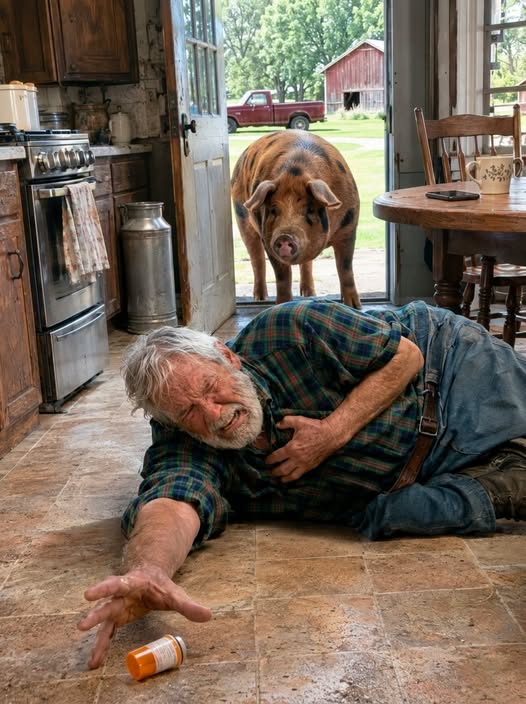
I was standing in my kitchen, making coffee, when a pain hit my chest like a hammer.
I couldn’t breathe. My left arm went numb. The coffee pot fell out of my hand and shattered on the floor.
I reached for my pill bottle in my pocket. My fingers wouldn’t work. It fell and rolled under the stove.
I fell down next to it.
My phone was on the kitchen table. Six feet away. It might as well have been six miles.
I tried to crawl.
I couldn’t.
I don’t know how long I lay there. Ten minutes. Maybe more.
Then I heard a loud squeal at the back door.
Dolly.
She’d pushed open the barn door. She was standing outside the kitchen, looking at me through the screen.
She squealed again. Then she pushed the screen door open with her nose and trotted over to me. She sniffed my face. She nudged my cheek.
“Good girl,” I whispered. “Go. Get help.”
I don’t know if she understood.
But she turned around and ran out the door.
Straight down my driveway.
And out onto the road.
The last thing I saw, before everything went dark, was a little spotted pig running toward the highway, where the cars go sixty miles an hour.
I pieced together what happened next from the people who were there.
A young nurse named Brianna Kowalski was driving to her morning shift at Lancaster General.
At 7:20, she came around the bend on Route 30, still half-asleep, her coffee going cold in the cup holder.
A spotted pig was lying in the middle of her lane.
Not running. Not wandering. Lying flat on the asphalt, right in the path of anything that came around that curve.
Brianna stood on the brakes. Her tires shrieked, and her car stopped about ten feet short.
She honked. The pig didn’t move.
She got out, heart pounding, and waved her arms. “Hey, piggy. You’ve got to get out of the road.”
The pig stood up. She trotted a few steps toward a gravel driveway. Then she stopped and looked back over her shoulder.
She squealed.
Brianna didn’t move. The pig trotted a few more steps and looked back again. Squealed again, louder, like she was losing patience.
“I know how this sounds,” Brianna told the newspaper later.
“But she was asking me to follow her. Like those dogs in old movies. I honestly thought I’d lost my mind.”
She followed anyway. Up my driveway, past the barn with its door swung wide open, to my back door, which stood ajar.
And there I was, gray-faced on the kitchen floor in a puddle of cold coffee.
Brianna worked cardiac care. Eleven years of it. She dropped to her knees, found no pulse worth the name, and shouted for 911 on speaker while her hands were already moving. She dug my pill bottle out from under the stove. She started compressions.
My heart stopped twice before the ambulance reached the house. Twice she brought me back, on the linoleum, with a pig standing three feet away, watching.
“She never left,” Brianna said. “She stood right there the entire time. When the paramedics came through the door, she backed up to the wall to give them room.
Like she knew.”
I woke up in the hospital two days later, with tubes in both arms and a new stent in my chest. A woman I didn’t recognize stood at the foot of my bed in scrubs.
“Mr. Warren? I’m Brianna. I’m the one who found you.” She smiled. “Well. Your pig found me.”
I started laughing. It hurt like fire. I didn’t care.
“Where is she? Where’s Dolly?”
The smile slipped.
“Your neighbor came by the house while the paramedics were loading you up. He had a trailer.”
My stomach turned over.
“What day is it?”
“Sunday.”
I closed my eyes. Forty-one days of apples and bad jokes and a spinning pig in a barn doorway, and I’d lost her anyway, because my heart couldn’t wait until Monday.
I lay there a long time.
Brianna sat down beside me and didn’t say anything, which was the kindest thing she could have done.
Around four that afternoon, someone knocked on the door frame.
Burt stood there with his cap crushed in both hands. He looked ten years older than he had on my porch. His face was less red and more gray, and his eyes were swollen.
“Warren.”
I couldn’t think of one thing to say.
He came in slowly and lowered himself into the visitor’s chair like it might break under him.
“That nurse found me in the parking lot this morning,” he said. “She told me everything. About Route 30. About the pig lying down in the road.” He rubbed his jaw. “I’ve been raising hogs thirty-one years. I’ve loaded about forty thousand of them onto trucks. I never once thought of them as….”
He stopped.
“I stood in your barn at six o’clock this morning with a rope in my hand,” he said.
“And she looked at me. She wasn’t scared, Warren. That’s what got me. She looked at me like she was waiting to see what kind of man I was going to be.”
My throat tightened.
“I didn’t load her,” he said. “I couldn’t.”
He reached into his jacket and pulled out a folded sheet of paper. His hands weren’t steady.
“Bill of sale. One spotted sow, sold to Warren Hadley for one dollar.” He set it on my blanket. “I already put the dollar in the till myself. She’s yours. She’s been yours since the day she jumped off my truck, I just didn’t have the sense to see it.”
I picked up the paper. The ink blurred.
“And I’m sorry,” Burt said quietly. “For what I said on your porch. About the sheriff, and the days, and the bacon. You didn’t deserve that. You were a better neighbor to that animal than I’ve been to anybody in a long time.”
“Where is she now?”
“Back in your barn. I fed her this morning. Gave her some of those apples out of your cellar.” He cleared his throat. “She wouldn’t eat until I told her you were alive.”
I laughed and cried at the same time, and I didn’t feel one bit ashamed of either.
They let me go home eight days later.
Brianna drove me. She’d offered, and I’d stopped arguing with her by the second day, because I could tell it was a waste of breath.
She carried my bag up the steps and made me sit in the kitchen while she checked my blood pressure, my pills, my pulse, and the refrigerator.
“Mr. Warren, there’s nothing in here but pickles and half a stick of butter.”
“I live alone.”
“Not anymore,” she said, and she nodded toward the window.
Out in the yard stood Dolly, at the barn door, ears pricked, staring at the house. The second my face appeared in the glass, she let out a squeal that rattled the panes and began to spin in circles so fast she nearly fell over.
I made it out to the barn without my cane. Dr. Patel would have had my hide. I didn’t care.
Dolly shoved her whole warm snout into my stomach and leaned there, grunting, and I stood in the straw with my hands in her bristly shoulders and cried like a child.
“Okay, girl,” I said. “Okay. I’m here. I’m here.”
The newspaper ran the story that Thursday. A reporter named Gladys Finch drove out with a photographer and spent three hours at my kitchen table. The headline said PIG SAVES RETIRED MAILMAN, and the photo showed Dolly sitting at my feet, ears flopped, looking dignified.
By Saturday, cars were lining my road.
People came from Ohio and Maryland and one family all the way from Vermont. They stood at my fence and took pictures. Kids fed her apples through the boards. A woman in a church dress held a toddler up to scratch behind that crooked ear, and Dolly allowed it, with the patience of a queen.
I put out a coffee can with a sign.
Apples for Dolly. By the end of the month it was a barrel.
One morning in November, Burt’s pickup crawled to a stop at my fence.
I’d seen him a few times since the hospital. A nod at the mailbox. A wave over the hedge. We hadn’t really talked.
He climbed out with a bucket of cracked corn and set it on the ground like he wasn’t sure he was allowed to come any closer.
“For the hero,” he muttered.
“She’ll eat every kernel,” I said.
He stood there with his hands in his pockets. The cold made his breath puff white.
“Warren, I did something.”
“What’s that?”
“I called the company yesterday.” He stared at the ground. “I told them I’m cutting my herd. Not all at once. I can’t, I’ve got a mortgage and a son at Penn State.
But I’m converting half the barns. Going to try pasture-raised. Smaller. Slower.” He shrugged, awkward. “It won’t pay as well.”
“Why?”
He looked at Dolly for a long moment. She’d wandered over and was leaning her whole weight against the fence post, eyes half-closed.
“Because I stood in that barn,” he said, “and I couldn’t do it. And if I couldn’t do it to one, I don’t know how I’ve been doing it to two hundred.”
I didn’t say anything. There wasn’t a thing to say that he hadn’t already said better himself.
He opened the gate, slow, and stepped into my yard. He crouched, grunting, and held out one hand toward Dolly.
She sniffed it. Then she pushed her head under his palm.
He scratched behind that floppy ear for twenty minutes.
I watched from the porch, sipping coffee, and pretended I wasn’t looking.
He never knew I saw it, the way his rough old face went soft and wet and almost young.
It’s been two years now.
Dolly weighs three hundred pounds. She has her own heated corner in the barn, with a quilt my wife knitted forty years ago and a mound of fresh hay that Burt’s son delivers every other Saturday, free, over my protests.
Brianna still comes every Sunday. She says it’s to check my blood pressure, but she stays for supper, and sometimes she brings her fiancé, a quiet carpenter who built Dolly a covered porch for the rainy days. My heart’s held steady. Dr. Patel says I’m the most boring patient he has, and he means it as a compliment.
Every morning, I take my coffee out to the barn.
And every morning, before I’ve even reached the latch, I hear it.
That squeal. Then the sound of hooves scrambling in the straw.
I open the door, and Dolly spins in a circle.
I sit down on my overturned bucket. She rests her enormous head in my lap. And I tell her about the weather, about nothing, about my wife, who I think would have liked her.
The quiet in this house doesn’t feel like quiet anymore.
It feels like company.
The First Frost and the New Fence
December came in hard that third year, with a wind off the ridge that sounded like a freight train rattling the storm windows and turning every puddle in the barnyard into black iron.
I’d laid out extra straw in Dolly’s heated corner before the sun went down, tucking the edges of my late wife Clara’s knitted quilt under the floorboards so Dolly couldn’t root it into a ball and sleep on the bare wood.
She’s a tidy pig in her own stubborn way, though she likes to rearrange her bedding twice a night just to prove she’s in charge of the geometry.
Around eight o’clock, while I was rinsing my supper plate at the sink, headlights swept across the kitchen wall.
It was Burt’s truck—not the old dented Ford he’d driven when we fought over the fence line three winters back, but a newer silver Chevy with a heavy-duty utility bed. He stepped out wearing a canvas barn coat stiff with grease and salt, carrying a roll of heavy-gauge woven wire on one shoulder and a post-hole digger in his other hand.
I threw on my wool jacket, grabbed my flashlight, and walked out to the porch.
“You’re out late, Burt,” I called over the wind. “Ground’s half-frozen.”
“Top four inches is,” he shouted back, setting the digger down with a dull clack.
“Below that it’s still soft enough to work if we move before midnight. The visitors from Sunday left three posts leaning like drunken sailors when they leaned over the rail to take selfies with Dolly.”
“I told folks to stay back from the top board.”
“Folks don’t read signs, Warren. They read lenses.” He walked up the porch steps, stamping snow off his boots, and pulled a thermos from his coat pocket. “Brought coffee. Figured you hadn’t brewed a fresh pot since noon.”
We sat on the top step with the wind humming through the porch lattice. Burt poured two metal cups of dark, bitter brew that tasted faintly of chicory and long drives.
“How’s the conversion going?” I asked.
He blew across his cup, his weathered face crinkling in the beam of the porch light. “Slow. Expensive.
My accountant nearly had a seizure when I showed him the projections for the north forty. Half the barns are stripped down to the studs and airing out. We’re seeding clover and orchard grass come spring, if the frost doesn’t heave the soil too bad.”
“And your son?”
“Leo’s home for the weekend. Helped me haul cedar posts out of the south woods this afternoon.” Burt tilted his head toward the barn. Through the cracks in the siding, a warm amber glow leaked out from Dolly’s heat lamp. “He told me yesterday that half his ag-science classmates want to see what we’re doing. Says nobody in their textbooks talks about what happens when a man looks at a single animal and realizes he’s forgotten her name.”
I took a sip of the hot coffee.
It burned all the way down, right where the scar tissue from my heart attack still pulled tight whenever the barometric pressure dropped. “Most folks don’t want to know names. Names make things harder to tally on a ledger.”
“Yeah,” Burt said quietly. “That’s the trick of it, isn’t it?”
We sat there until the coffee was gone, listening to the wind and the occasional low huff from the barn as Dolly shifted her three hundred pounds in the straw. Eventually Burt stood up, stretched his bad back with a groan that sounded remarkably like mine, and hoisted the wire roll.
“Come on, mailman. Hold the flashlight. If we get the corner brace set tonight, we can stretch fifty yards before breakfast.”
I set my empty cup down, clicked the flashlight on, and followed him into the cold.
For the first time in years, a winter night didn’t feel like something to endure until April. It felt like work worth doing.
Brianna’s Carpenter
By February, the snow had piled waist-deep along the stone wall, and the county plow only came through twice a week, leaving a ridge of frozen slush across the end of my lane that shook my fillings loose every time I drove to town for groceries.
Brianna didn’t care about the slush. She drove a beat-up Subaru with studded tires and an attitude that could melt black ice.
On a gray Sunday afternoon, she arrived forty minutes early, not with her medical bag first, but with a tall, quiet man whose flannel shirt was dusted with sawdust and whose hands looked like they’d been carved out of white oak.
“Mr. Warren,” Brianna said, kicking the snow off her boots in the mudroom.
“This is Caleb. Caleb, this is Mr. Warren. Don’t try to lift anything—Caleb’s doing the heavy lifting today.”
Caleb offered a firm, calloused handshake and a nod that didn’t waste a single syllable. “Afternoon, sir. Brianna says Dolly’s porch needs a steeper pitch on the roof so wet snow slides off instead of caving the rafters.”
“She’s right,” I said, leading them through the kitchen. “Last wet snow we had, that awning groaned like a dying cow.”
Brianna immediately took over the kitchen table, laying out her blood pressure cuff next to a bowl of clementines she’d brought. “Sit. Arm flat. Don’t talk while the cuff’s inflating—you always talk and skew the reading.”
I sat. The cuff squeezed. The little digital display blinked and settled on 124 over 78.
“See?” I said once she unstrapped it. “Boring as ever.
Tell Dr. Patel he’s wasting good paper writing my charts.”
“He likes boring,” Brianna said, peeling a clementine and handing me half. “Boring means you’re taking your pills and not shoveling three-hundred-pound drifts by yourself. Now tell me what you’ve been eating all week.”
“Oatmeal. Roast chicken. Baked apples.”
“And vegetables?”
“Collards on Thursday. Frozen peas Friday.”
She narrowed her eyes, searching for a lie, then sighed and popped a segment into her mouth. “Okay. Acceptable. Caleb and I are staying for supper if you’ve got enough.”
“I put a pork loin in the slow cooker at ten this morning,” I said—and then paused, catching myself, and looked over at the window toward the barn. “Wait. Beef chuck. Beef chuck. Not pork. Lord, my tongue’s getting careless.”
Brianna grinned, a bright, warm flash that lit up the whole room. “Good save, Mr. Warren.
Dolly would never forgive you if she found out.”
Out in the yard, Caleb was already walking toward the barn with a tape measure clipped to his belt and a roll of blueprints tucked under his arm. Through the frosted glass, I watched him crouch beside Dolly’s covered run. Dolly trotted over, sniffed his boots, and let him scratch behind her ears while he squinted up at the eaves.
“He doesn’t talk much,” I noted quietly as Brianna packed up her cuff.
“He doesn’t have to,” Brianna said softly, leaning against the counter. “When we first started dating, I thought he was shy. Then I watched him spend three weeks restoring an antique cradle for my sister’s baby without saying a word until he handed over the keys. He just listens until he knows what needs building.”
“That’s a rare kind of man,” I said.
“Hold onto him.”
“I plan to.” She looked out at Caleb and Dolly again, her expression softening in a way I’d only seen a few times since the hospital. “He told me on the drive over that he’s thinking about opening a small woodworking shop down by the river this summer. Custom furniture, timber framing, barn repairs. Nothing mass-produced.”
“Good soil for that around here,” I said. “Plenty of old timber and plenty of folks who’d rather fix what’s broken than haul it to the dump.”
By dusk, Caleb had measured every board, sketched a new truss design on a piece of pine scrap, and come back inside with red cheeks and cold hands. We sat around the kitchen table eating beef chuck stew with crusty bread while outside the wind rattled the panes.
Caleb spoke maybe twenty words during the entire meal, mostly answering questions about timber joinery, yet when he laughed at one of my old mail-route stories, it was a deep, steady sound that made the whole table feel anchored.
The Reporter’s Return
April brought mud—thick, sucking, boot-stealing mud that turned the lane into a ribbon of brown chocolate and made the frogs in the lower pond start up their evening chorus before sundown.
Gladys Finch, the reporter who’d written the original story two years back, called on a Tuesday morning.
“Warren,” she said without bothering with a hello—Gladys had the cadence of a woman who’d spent thirty years beating deadlines on rotary phones and laptops. “I’m doing a follow-up piece on rural shifts. Small farms, aging communities, unusual partnerships. Got twenty minutes Thursday afternoon?”
“Gladys, you know well enough I don’t do twenty minutes.
If you drive all the way out from the valley, you’re staying for coffee and pie.”
“Apple?”
“Dried apple stack cake. My neighbor Mrs. Miller dropped one off yesterday.”
“Sold. See you at two.”
She arrived at 2:05 in a dented sedan with a camera bag on the passenger seat and a notebook already half-filled. We sat out on the back porch where the air smelled of wet earth, skunk cabbage, and woodsmoke from the neighbor’s brush pile.
Dolly had wandered out into the paddock, rooting through the new spring grass with her snout turning up rich black clods. She’d grown wide across the shoulders and heavy in the flank—three hundred and twenty pounds of muscle, bristle, and quiet authority.
“Look at her,” Gladys said, adjusting her glasses as she jotted a note. “She’s bigger than the last time I saw her.”
“She eats well,” I said.
“And she’s got room to move now. Burt helped me knock down that old wire partition and open up another half-acre of clover.”
Gladys tapped her pen against her chin. “Speaking of Burt. I drove past his place on the way in. Saw fifty or sixty hogs out on open pasture instead of crammed into those long metal confinement sheds. Half the sheds looked empty.”
“They are,” I said. “He’s letting the old ones rest and air out while he builds shelters on skids. It’s been a rough winter on his wallet, though. Feed costs didn’t drop just because he changed his mind.”
“Does he regret it?”
I watched Dolly lift her head, chew a mouthful of clover, and look toward the porch as if she knew we were talking about her.
“Burt’s too stubborn to regret something he chose with his eyes open,” I said.
“He told me last month that his profit margin’s thinner, sure, but he hasn’t had a Sunday night knot in his stomach in six months. Says when you walk out to check stock at dawn and the animals come running instead of piling in a corner away from you, it changes the math.”
Gladys wrote that down carefully. When she looked back up, her sharp journalist’s gaze softened. “And you, Warren? Two years ago you told me you felt like a ghost in your own house after Evelyn passed. How’s the house feel now?”
I thought about the morning quiet—the way sunlight hit the kitchen floor at 6:15, the sound of Dolly’s squeal before I even unlatched the barn door, the stack of mail and cards that still arrived occasionally from strangers who’d read her story and wanted to send a word of encouragement.
“A house doesn’t stop missing the person who made it a home,” I told her honestly. “I still catch myself reaching for Evelyn’s tea cup or starting to tell her something funny that happened at the post office. That part doesn’t vanish.”
“Then what changed?”
“The silence stopped being heavy,” I said. “Before Dolly, quiet meant being left behind. Now quiet just means everyone’s settled in for the afternoon.”
Gladys took three photos—one of me sitting on the porch steps with my coffee, one of Dolly grazing in the clover with the ridge blue in the distance, and one wide shot that caught the white farmhouse, the red barn, and the crooked fence line where two old men had finally stopped fighting over inches.
“I’m going to call it The Weight of Company,” she said, packing her camera away. “Too corny?”
“Not if it’s true,” I said. “Cut me a slice of that cake before you go, or I’ll have to eat the whole thing myself.”
A Stranger at the Gate
May came in green and loud, with orioles nesting in the maples and dandelions turning the front yard into a yellow carpet that I didn’t have the heart to mow until the bees were done with it.
On a warm Saturday morning, a dusty maroon sedan pulled onto the shoulder by my fence. A man in his late fifties stepped out—wearing khaki trousers, a faded plaid shirt, and wire-rimmed glasses. He didn’t open his trunk or pull out a camera. He just stood by the gate for a long minute, looking at the barn, the clover field, and finally at me where I was sitting on the porch shelling early peas into a bowl.
“Morning,” I called out.
He walked slowly up to the gate, resting his forearms on the top rail. “Excuse me. Are you Mr. Warren?”
“I am.”
“My name’s Arthur Pendelton.
I read a piece in the regional paper a couple of weeks ago—about you and your pig.” He gave a small, hesitant smile. “I drove up from Lancaster. About three hours.”
“Well, you picked a nice day for the drive,” I said, setting the pea bowl on the porch table and walking down the steps. “Come on in. Don’t mind the mud by the trough.”
Arthur unlatched the gate carefully and stepped inside. He looked around the yard with a quiet, searching intensity that reminded me of how I’d looked at empty rooms during the first year after Evelyn died.
“My wife passed away fourteen months ago,” Arthur said, his voice steady though his fingers tightened around the gatepost. “Thirty-four years. We didn’t have children. Just the two of us and a terrier that went last autumn.”
“I’m sorry,” I said. Simple words.
The only ones that don’t sound hollow when someone’s carrying that weight.
“The house is so quiet,” Arthur said, looking out toward Dolly, who had trotted over to inspect him with twitching ears and a wet nose. “Everyone tells me to travel, or volunteer at the library, or join a grief group. And I’ve tried some of that. It helps for an hour or two. Then I turn the key in the lock at six o’clock and the quiet hits me all over again.”
Dolly nudged Arthur’s knee with her snout, grunting softly—her standard greeting for anyone who smells like he might have an apple in his pocket, even if he doesn’t.
Arthur looked down at her, startled, then reached out slowly and scratched the top of her head.
Dolly leaned into his hand, letting out a long, contented sigh that vibrated right through her chest.
“I didn’t come here expecting to get a pig,” Arthur said, a faint laugh escaping him. “My apartment in town doesn’t allow much more than a goldfish. I just… I wanted to see what you meant when you said the quiet felt like company.”
“Sit down on that bench by the lilac bush,” I told him, pointing toward the shade. “I’ll get us a couple glasses of cold water.”
When I came back out, Arthur was sitting with his elbows on his knees, watching Dolly root happily in the clover while a pair of robins argued over a worm near the fence.
“It’s not a cure,” I told him, handing him a glass. “Nothing brings back the person you lost. You still grieve.
Some days hit you out of nowhere over a song on the radio or a smell in the kitchen.”
“I know,” Arthur said.
“What changes is having something that needs you right now,” I said. “Something that doesn’t care about your bank account or your job title or whether you’re having a bad memory day. It just wants to know if you’re going to open the door in the morning and say hello.”
Arthur took a slow sip of water and looked out across the green pasture. “When I left this morning, I didn’t turn on the radio until I hit the turnpike. For the first time in a year, the quiet in the car didn’t feel like an empty room.”
“Good,” I said. “Hold onto that feeling. You don’t have to figure out the next ten years today.
Just figure out what you’re doing tomorrow morning.”
He stayed for an hour, talking about nothing much—old cars, vegetable gardens, the way small towns change—and when he finally got back in his sedan, he waved through the window with a lighter step than he’d had when he arrived.
The County Fair and the Pasture Walk
By late July, the heat hung heavy over the valley like a wool blanket, and the corn along the ridge was already waist-high and rustling whenever a breeze stirred the leaves.
Burt had organized what he called a “Pasture Walk” on a Sunday afternoon—nothing formal, just a dozen neighbors, a couple of local veterinarians, Caleb, and a few folks from the county extension office walking his rotated paddocks to see how the clover and native grasses were holding up under rotational grazing.
I rode over in Burt’s truck with Dolly riding in the back—not loose, of course, but in a wide, padded livestock stall Caleb had built with shade slats and non-slip rubber mats.
Dolly loved the ride almost as much as she loved the treats waiting at the end of it.
At Burt’s place, the old confinement barns stood quiet with their big side doors propped open to let the breeze blow through. Out in the pastures, pigs of every size—sows with broad backs, piglets chasing each other in tight circles, shoats rooting under the shade of white oaks—moved freely across green ground that smelled of sweet clover and damp earth rather than ammonia.
“Look at the hooves on those gilts,” one of the extension agents said, crouching near the fence line. “Solid, clean, good angle. You don’t see that kind of foot health on concrete slats.”
“Took a lot of fencing and a lot of sore muscles,” Burt said, wiping sweat from his forehead with a red bandanna.
“First month I thought I’d lost my mind dragging water lines out to the back forty in the rain. Now I wouldn’t trade it for a gold mine.”
Burt’s son Leo was there too, home from college for the weekend, taking soil core samples and comparing organic matter readings from last year to this year. He looked older than the boy I remembered seeing in the school yard years ago—broad-shouldered, earnest, talking shop with the older farmers like he belonged right there in the dirt with them.
“Dad says Mr. Warren’s pig is the reason we’re standing in grass instead of concrete,” Leo said with a grin, tossing a slice of watermelon rind over the fence to Dolly.
“Don’t pin all my mistakes on Warren,” Burt shot back, though there was warmth in his voice. “I had my own eyes.
I just needed somebody to remind me what I was looking at.”
Later, while the others gathered under the walnut trees for iced tea and lemonade, I stood near the fence with Burt watching Dolly crunch watermelon.
“You know,” Burt said quietly, “when we had that row over your fence three years ago, if somebody had told me I’d be hosting neighbors to look at clover and thanking a three-hundred-pound pig for saving my soul, I’d have had them tested.”
“Same here,” I said. “If somebody had told me my heart would give out and the best thing to come out of it would be learning how to let people help me.”
“Yeah,” Burt said, looking out toward his herd. “Funny how the things that knock you down sometimes clear out enough brush so you can see the path.”
Late Summer Storm
August brought a line of black thunderstorms rolling off the mountains on a Tuesday evening, turning the sky the color of a bruise and dropping the temperature fifteen degrees in twenty minutes.
I was sitting in my armchair with a book when the first crack of thunder shook the floorboards and the power flickered twice before going out completely.
The house went dark except for the pale gray light coming through the windows. My phone buzzed once on the side table—a weather alert—and then went quiet.
Out in the yard, the wind lashed the maple branches against the roof. I stood up slowly, my knees clicking, and walked over to the window looking toward the barn.
Caleb’s new roof on Dolly’s covered porch held firm against the gusts, water sheeting off the metal edge in silver curtains. Inside the barn, it would be dark without the heat lamp, though August nights were warm enough she didn’t need it.
Still, pigs can get spooked by loud thunder if they’re startled, and Dolly had a habit of pacing back and forth until she heard my voice.
I pulled on my rubber boots and slicker, grabbed a heavy D-cell flashlight from the pantry, and stepped out onto the porch.
Rain pelted my slicker hood as I crossed the yard. The mud squelched under my boots. When I slid the barn door open and swept the flashlight beam across the straw, Dolly was standing right near the gate, ears flicking forward at every rumble of thunder, her tail giving a slow, uncertain twitch.
“Hey, girl,” I said over the drumming rain on the tin roof. “Just noise. Sky’s clearing its throat.”
She let out a low woof—the sound she makes when she’s alert but not afraid—and trotted over as soon as she recognized my voice.
I sat down on my overturned five-gallon bucket right inside the dry doorway, shining the flashlight low so it didn’t blind her.
Within ten seconds, she pushed her broad head into my lap, letting out a heavy breath that smelled of hay, rain, and warm skin.
“Good girl,” I murmured, resting one hand on the ridge of her back while thunder rolled across the valley. “Good girl.”
A flash of lightning lit up the open barn door for a split second, outlining the wet grass, the fence posts, and the dark line of trees along the creek. Then darkness settled back in, punctuated by the steady rhythm of rain on metal and Dolly’s slow, even breathing against my knees.
Twenty minutes later, headlights cut through the rain along the lane.
It was Brianna’s Subaru—she’d probably seen the storm warning and driven out just to make sure I wasn’t sitting in the dark alone with a bad ticker.
I walked to the barn door, waved the flashlight twice so she’d know I was fine, and waited while she hurried up under the eaves, shaking water from her umbrella.
“Mr. Warren! You’re out here in the storm?”
“Just keeping Dolly company,” I said, smiling in the dim light. “Come on inside before you get soaked. I’ve got two flashlights and a pot of instant coffee that doesn’t need electricity if we heat water on the camp stove.”
She laughed, shaking her head, and followed me back toward the house, her footsteps splashing in the puddles. Even in the dark, with the wind blowing and the lights out, the house didn’t feel cold or empty.
It felt lived-in.
The Quilt and the Years
September turned the maples along the lane to burnt orange and deep crimson, dropping leaves so thick on the porch steps I had to sweep them twice a day just to keep from slipping.
One crisp Saturday morning, I pulled my late wife Evelyn’s knitted quilt out of Dolly’s corner to shake out the hay and wash it in the big laundry tub before winter set in properly.
Evelyn had knitted that quilt over two winters in the early eighties, sitting in her rocker by the living room radiator with a basket of leftover wool yarn in a dozen shades—ochre, forest green, rust, cream, navy. She’d made it for us to throw over our legs while watching television, never imagining it would end up in a barn keeping a pig warm forty years later.
At first, when Dolly was still small and I’d put her in the barn after the hospital, I’d wondered if putting Evelyn’s blanket out there was disrespectful—like letting something old and precious get dirty.
Now, holding it in the morning sunlight with bits of timothy hay clinging to the wool stitches, I didn’t feel that way at all. Evelyn had loved animals almost as much as she loved people. She’d once brought home a three-legged stray cat in a shoebox during a blizzard and named him Sergeant because he marched around the kitchen demanding liver treats.
She would have looked at Dolly—three hundred and twenty pounds of gentle grit with a crooked ear and a big heart—and laughed until her eyes watered. Then she would have marched into the kitchen, pulled a bag of apples from the cellar, and told me to stop worrying so much about my blood pressure.
I shook the quilt out over the porch rail, watched a dozen bits of golden hay drift down onto the grass, and carried it inside to soak.
Later that afternoon, I sat out on the back steps with my coffee while Dolly napped flat on her side in a patch of sun near the barn door, rising and falling with slow, rhythmic breaths.
A monarch butterfly drifted lazily past my shoulder, landing for a second on a late-blooming aster before lifting off toward the woods.
I thought back over the last three years—the ambulance ride, the hospital bed, the fear that had sat in my chest heavier than the heart attack itself, the long days when the quiet in the house felt like a verdict rather than a peace.
None of the hard things had been erased. My chest still ached on damp mornings. The years had taken plenty of friends and neighbors, and they’d take more.
But the story hadn’t ended in the quiet. It had opened up into it.
A Neighbor’s Promise
October came in crisp and clear, with bluebird skies that made the whole ridge look like it had been painted with watercolor.
On a Thursday afternoon, Burt stopped by—not with tools or feed this time, but with a small wooden box tied with twine.
“What’s in the box, Burt?” I asked, sitting on the porch with a mug of cider.
“A plaque,” he said, looking slightly embarrassed as he set it on the table. “Leo helped me burn the letters into a piece of white oak in the shop. Figured Dolly ought to have something official over her stall.”
I untied the twine and lifted the lid. Carve-burned into the smooth oak grain, in clean, steady letters, were four words:
DOLLY — GUARDIAN OF GRACE
I traced the letters with my thumb. The wood still smelled faintly of scorched oak and linseed oil.
“That’s fine work,” I said softly. “Leo’s got steady hands.”
“He gets it from his mother’s side,” Burt said, leaning against the porch post. He looked out toward the pasture, where Dolly had just woken up and was trotting toward the fence with her ears perked, hoping for a handout.
“You know, Warren, I’ve been thinking about next spring. If I’m going to expand the pasture herd another thirty percent, I’m going to need more hay ground.”
“I’ve got six acres of bottomland behind the creek that’s mostly sitting idle since I stopped cutting it myself,” I said. “Too steep for big combine equipment, maybe, but good for small square bales or grazing.”
Burt turned his head, squinting at me. “You’re offering me bottomland?”
“I’m offering to lease it to you for a dollar a year,” I said, “on two conditions.”
“Name ’em.”
“First, you keep that crooked-eared pig supplied with apples and cracked corn whenever my cellar runs low. Second, you stop acting like you’re doing me a favor every time you fix a fence post around here. We’re neighbors. Act like it.”
Burt stood quiet for a second, then let out a short, rough laugh that sounded younger than his years.
“Deal. Though I might throw in a few bushels of sweet corn come July just to keep the ledger honest.”
“Fair enough,” I said.
Morning Company
It’s been three years since that night in the barn, and the mornings still start the same way.
Before the sun clears the eastern ridge, while the frost still feathers the edges of the windowpanes and the coffee’s just finishing its drip into the carafe, I pull on my coat, pick up my mug, and step out onto the back porch.
The air is sharp and clean, carrying the scent of damp earth, cured hay, and woodsmoke from somewhere down the hollow.
And before my hand even touches the barn latch, I hear it.
That unmistakable squeal—bright, eager, full of life.
Then the scrabbling sound of hooves in the straw as three hundred and twenty pounds of pig turns around twice in excitement because the day has officially begun.
I slide the door open, step inside out of the chill, and sit down on my overturned bucket.
Dolly comes right over, pushes her warm, bristly head into my lap, and lets out a long, contented grunt that tells me everything is right with her world.
I set my coffee on the ledge beside me, rest one hand behind her crooked ear, and start talking—about the frost on the grass, about the card Brianna sent from her trip, about Burt’s clover fields, about Evelyn, who loved autumn mornings more than any season of the year.
The house behind me is still quiet, waiting for me when I go back inside.
It just doesn’t feel empty anymore. It feels like company.
THE END..!