My name is Riley. I’m thirty-two years old, and I work in contract administration for a commercial construction company. My job, in plain language, is turning other people’s vague promises into binding language they cannot wiggle out of later. I know exactly how words work. I know which ones protect you. I know which ones quietly ruin your life three years down the road when nobody sees it coming.
That matters, because everything that happened at the cabin came down to exactly that. Words. Whose name was on what. What an irrevocable trust actually means. And why I had been careful enough to make sure those words were in place long before my sister’s husband pulled an unfamiliar truck into my parents’ driveway with the hatch open wide.
My father was diagnosed with early-onset Parkinson’s when I was nineteen. He was fifty-one years old.
His hands had started trembling at work, small shakes he explained away as fatigue, as too much coffee, as nothing worth mentioning. By the time he saw a neurologist, the diagnosis was already clear enough that there was no softening it.
My mother became his caregiver almost overnight. She reorganized her entire life around his medications, his specialist appointments, his bad days, and his pride, which was considerable and which she protected without ever making him feel managed. For thirteen years she carried that without complaint. She learned every dosage change, every new symptom, every early warning sign that something had shifted. She laughed at his jokes even on the mornings when his hands shook so badly he could barely hold a coffee mug. She made his condition feel like something they were navigating together rather than something happening to him.
The one thing my parents never did was ask for help.
Not once. Not from me, not from extended family, not from anyone. They were of the generation and the temperament that believed asking meant burden, and burden meant failure, and so they simply didn’t ask. They absorbed everything quietly and kept moving.
So I decided I would do something anyway.
I started saving from my first paycheck. Nothing dramatic, nothing that required sacrifice that hurt. Just steady and quiet and intentional, the way you save when you’re building toward something that matters more than anything else. I didn’t have a plan yet. I just knew I was going to need money for something important, and I wanted to be ready when I figured out what it was.
Two years ago, I found the property.
A little over an acre on a still, dark lake about ninety minutes outside the city.
The listing described it as a small structure with potential, which in real estate language means start over from the ground up. But the land itself was exactly right. Hemlocks around the perimeter. Water so calm it reflected the sky like a mirror. Total silence except for wind moving through the trees.
I stood there on a gray November morning with mud on my boots, and I thought one clear thought: my father could sit here for hours and finally feel peace.
So I bought it.
Then I did what I am best at. I wrote the scope of work myself. I hired a contractor I had worked with and trusted for six years. I pulled every permit personally. I oversaw every stage of the build. I designed the entire place not for the way a cabin looks in a magazine, but for the way my parents actually lived.
Single story.
Fully accessible. Wide doorways. Grab bars built into the design in a way that looked intentional rather than institutional, because my father’s dignity was not a secondary consideration. Kitchen counters at the right height for his harder days. A wraparound porch so he could always find sunlight without navigating a single stair. A bedroom on the main level that would still work for them ten years from now, fifteen years from now, however far into the future this disease took them.
I thought of everything I could think of.
What I did not do was tell my sister.
Vanessa is four years older than me. She is not cruel in any simple or obvious way. She is something quieter and more draining than that. She has a way of entering other people’s important moments and gradually repositioning herself closer to the center of them, not through aggression but through a kind of persistent emotional gravity.
By the time you notice it happening, she is already there, and it feels churlish to point it out.
When my father first got sick, Vanessa was present and genuinely helpful for about six weeks. She made casseroles. She cried with my mother in the kitchen. She managed the family group chat like it was a communications operation. She was there in the way that made everyone feel like she was going to be there for the long haul.
Then she got a new job. Then she met Craig. Then her life took a hard turn toward itself and never really curved back.
Craig is a specific kind of person. He walks into any room and immediately begins calculating what value he can extract from it. He has the energy of a spreadsheet that has learned to smile. Hyper-observant, always scanning, always measuring, always clocking what other people have before deciding how useful they might be to him.
In six years of watching him at family events, I have never once seen him do something generous that did not eventually circle back to benefit Craig.
I did not want those two anywhere near this project while it was happening. I did not want Vanessa crying over the finished cabin as though she had been part of building it. I did not want Craig walking the floor plan before the gift was given, running numbers in his head. I did not want any version of the moment that allowed either of them to retroactively insert themselves into the story and casually claim a share of the credit over time.
So I built it in silence.
Weekend after weekend. Loan payment by loan payment. Every decision made alone and with full intention.
Total cost: three hundred and ten thousand dollars. The land. The construction. The furniture, chosen for accessibility and comfort rather than style.
The dock, where my father could sit in a chair and watch the water for as long as he wanted. I prepaid the property taxes for fifteen years. I stocked the pantry and set up both bedrooms and had the porch furniture arranged before I brought them out for the first time.
Then I transferred the deed into an irrevocable trust with my parents as the only lifetime beneficiaries.
That part was deliberate. That part was my contract-administration brain overriding my sentimental one, because I knew that a gift of this size, in a family with a Craig in it, needed language around it that could not be undone by pressure or persuasion or a weekend when my parents felt guilty and wanted to help someone they loved. An irrevocable trust means the grantor cannot take it back. It also means no one else can take it forward without the beneficiaries’ full legal consent.
I put those words in place because I knew the day might come when I would need them to hold.
For their fortieth anniversary, I told my parents I was taking them to dinner.
Instead I drove them ninety minutes out of the city under an October sunset, down a gravel road they had never seen, through a break in the hemlock trees, and up to a porch light that came into view like something out of a dream neither of them had let themselves have.
My father did not speak. He sat in the passenger seat for nearly a full minute after I stopped the car, just looking at it through the windshield. My mother covered her mouth with both hands and whispered, the way you say something when you are afraid saying it too loudly will make it disappear: is this real?
I looked at them both and said, yeah, it’s yours.
My father cried. My mother swayed where she stood like the weight of it hit her all at once in her legs. It was the most complete and uncomplicated joy I have ever felt in my life.
I thought it was the most important moment the cabin would ever hold.
I was wrong about that.
Five months later, my phone buzzed at eleven in the morning on a Tuesday. A text from my father’s number, three words: please come now.
My father does not text like that. He is a man of context and full sentences and the careful preamble of someone who grew up writing letters. Three words with no explanation meant something had happened that he could not put into a longer message.
I was on the highway within four minutes.
The drive felt longer than ninety minutes.
I ran through possibilities the way you do when your brain is trying to prepare for something it doesn’t have enough information to prepare for. Medical emergency. A fall. Something with the house. I called my mother twice. No answer either time, which told me she was occupied with something that had both hands.
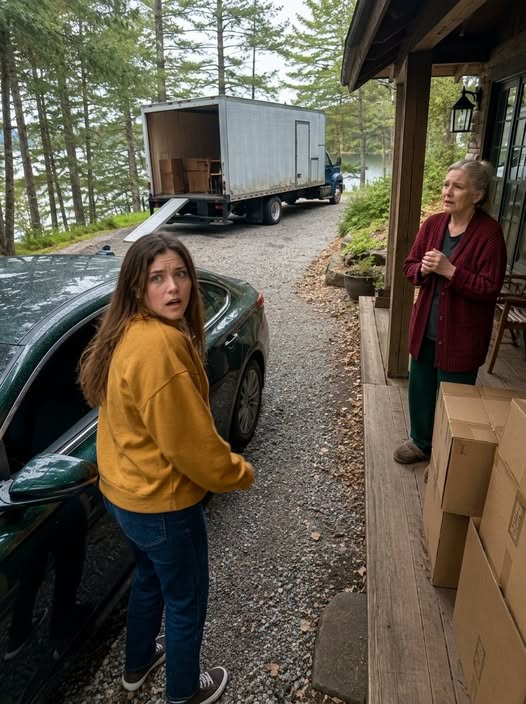
When I turned onto the gravel road and came through the trees, I saw my sister’s car in the driveway. I saw my mother standing on the porch in her bathrobe at two in the afternoon. And I saw a truck I didn’t recognize parked near the side door with the rear hatch open wide, the kind of open that means either loading or unloading, and in that moment I was not sure which was worse.
My mother’s face when she saw me come up the porch steps told me everything about how the last several hours had gone.
Not panic. Not anger. The specific expression of a woman who has been managing a difficult situation alone for longer than she should have had to, and who is deeply relieved that someone else has finally arrived to help her carry it.
She didn’t say anything. She just touched my arm and gestured me inside.
The cabin felt different. The air had the quality of a room where an argument has recently happened or is still happening at a lower volume. My father was in his chair by the window, the one we had positioned to catch the morning light over the water. He looked tired in the particular way that means emotional exhaustion rather than physical, the weariness that comes from having to hold a position you should not have been required to hold.
Vanessa was standing near the kitchen island.
She had the look she gets when she knows she has done something she cannot fully defend, which is a specific expression, chin slightly forward, eyes searching for the version of the situation that allows her to present herself as having meant well. Craig was not in the room, which was its own kind of information. The open truck hatch was his work. His absence meant he had either gone out to it or positioned himself somewhere he could monitor without being directly in the frame.
“Riley,” Vanessa said, and her voice had the particular mixture of relief and defensiveness that means she was glad I had arrived while also having already prepared her case.
“Tell me what’s happening,” I said.
She looked at my father.
He gave her a small nod that I read correctly: go ahead and tell her, because I am not going to tell it for you.
Craig’s company had collapsed. She laid it out in the careful language of someone presenting a business case rather than an admission. The business had been struggling for over a year. The formal closure had come four months ago. They had been managing on savings and on Vanessa’s income but the savings were mostly gone and her income was not enough to cover their mortgage and their expenses both. They had not told anyone because Craig didn’t want it known and Vanessa went along with that.
“And so Craig decided,” she said, not quite finishing the sentence.
“That they could move in here,” I said.
The words sat in the room for a moment.
“Just for a while,” she said.
“Just until we stabilize. The cabin is sitting empty most of the week. Mom and Dad aren’t here full-time. It seemed practical.”
I looked at my mother, still in her bathrobe. I looked at my father, whose hands were resting in his lap with the careful stillness he adopted when he was working hard at appearing calm. I thought about the truck hatch and what had been planned for it. I thought about the word practical and what it meant coming from Craig’s mouth through my sister’s.
“Where is he?” I said.
“Outside,” Vanessa said.
“Did anyone ask Mom and Dad before this plan was made?”
Silence.
My mother spoke then, quietly and with the diplomacy she has practiced for decades. “We didn’t want to trouble you, Riley. We know how much you’ve already done. And Vanessa is family.
We were trying to figure out how to—”
“Mom,” I said gently. “Did anyone ask you what you wanted? Yes or no.”
She looked at her hands. “Craig called Thursday and said they needed somewhere temporary. He said it made sense. He said you’d understand.”
He had not called me.
He had called my parents, who are in their sixties, one of whom has a progressive neurological disease, and he had framed the situation as practical and reasonable and temporary, knowing they would not say no because they do not say no to their children, and knowing that by the time I found out the truck would already be in the driveway and boxes would already be inside.
Craig came in from the side door carrying a duffel bag and a box of kitchen items. He set them down when he saw my face.
“Riley,” he said.
The smile he attempted did not connect with the rest of his expression. “I was hoping to talk to you about this.”
“You should have called me before you called them,” I said.
“We’re family,” he said. “This is a family situation. There’s plenty of room here—”
“Craig.” I kept my voice even. “I need you to stop moving things into this house.”
He looked at Vanessa. Vanessa looked at the floor.
“This is your parents’ place,” he said. “Not yours. They can decide who stays here.”
That was the moment I had built the trust for.
I went to my bag and took out my phone and pulled up the trust documents I had saved as a PDF eighteen months ago on the day the paperwork was finalized.
I had them because I am who I am, because I live in a world of binding language, because I had stood in a notary’s office and understood that the day might come when I would need to show someone exactly what the words said.
I placed the phone on the kitchen island where both Vanessa and Craig could see it.
“This is the property trust,” I said. “The cabin is held in an irrevocable trust. My parents are the sole lifetime beneficiaries. That means they have the right to live here, to use it, and to enjoy it for the rest of their lives. It does not mean they can grant residency to other parties without triggering a formal legal review of the trust terms.
It also means I cannot take it back, and it means no one can pressure them into arrangements that compromise their use and enjoyment of the property.”
Craig’s expression did the thing I had watched it do at family dinners when a situation stopped going his way. A brief stillness, like a recalculation happening somewhere behind his eyes. Then a reassembly into something smoother.
“We’re not trying to compromise anything,” he said. “We just need a few months—”
“You need a few months,” I said. “My parents need their home to remain their home. Those are different needs.”
“Vanessa and I are going through a hard time.”
“I understand that. And I’m sorry for it.
But the way to address that is not to move into a space my parents depend on without asking me, without asking an attorney, and without giving my father and mother any actual choice in the matter.”
“They said yes,” Craig said.
I looked at my parents. My mother’s eyes were careful. My father’s hands had stilled in his lap.
“Mom,” I said. “Did you want them here? Not what seemed kind, not what felt like the right thing to do for Vanessa. What did you actually want?”
The quiet that followed was long enough to be an answer by itself.
“I wanted to help,” my mother said finally. “But I was also scared about what it would mean for your father. The routine here matters. The quiet matters.” She paused. “I didn’t know how to say no.”
Vanessa made a sound, something between a breath and the beginning of a sentence she didn’t complete.
“She didn’t know how to say no,” I said to Craig, “because you didn’t give her a real opportunity to. You presented a plan as settled and called it a conversation.”
Craig started to respond and I held up one hand. Not unkindly, but with enough firmness that he stopped.
“Here is what’s going to happen,” I said. “You’re going to take everything you brought inside back out to the truck. You’re not going to leave any of your belongings here today. And then we’re going to have a real conversation, the four of us, not six, about what actual help looks like for you and Vanessa, and what my parents actually need from their family right now.”
Craig looked at Vanessa.
Vanessa looked at the floor and then at me and then at something past my left shoulder.
“This is cruel,” she said.
“We’re in a crisis.”
“I know,” I said. “I’m not dismissing that. But your crisis doesn’t get solved by creating one for them.”
She started crying. It was the kind of crying I have seen from her before, real in its origins but also strategic in its deployment, the tears arriving at the moment when argument is no longer working. I felt for her. I did. Whatever Craig had done or failed to do with his business, whatever decisions had led them here, Vanessa was genuinely frightened and genuinely lost, and she was my sister, and none of that was simple.
But I also looked at my father in his chair, hands folded too carefully, and my mother in her bathrobe at two in the afternoon, and I understood what quiet damage looks like when it is already in progress.
Craig took his things back to the truck.
He did it without further argument, which told me the document on my phone had done what I needed it to do. Binding language. Words that could not be walked back. He was still calculating, I could see it in the set of his shoulders, but the calculation had changed. There was nothing here to extract.
Vanessa sat at the kitchen table while he carried things out. She and I did not talk much. I made coffee because my hands needed something to do, and I set a cup in front of her without asking, and she held it with both hands the way people do when they are cold even when they are not cold.
After Craig had finished and was waiting outside, I sat down across from her.
“I’m not trying to hurt you,” I said.
“I know,” she said, though she didn’t sound entirely sure.
“Craig put you in a position where you had to go along with something that wasn’t right, and then he let you be the one to explain it.”
She looked at the coffee cup. Something shifted in her face.
“He said it was just practical,” she said quietly. “He kept saying they weren’t using it most of the week. He said Riley will understand, it’s temporary, family helps family. He made it sound like the normal thing to do.”
“He made it sound like that because he needed it to sound like that.”
She was quiet.
“Do you have somewhere you can go? Not here, but somewhere real?”
She nodded slowly. Her college friend in the city had an extra room. She had been avoiding asking because it felt like more admission of failure, but the room was there.
“That’s a better option than this,” I said.
“Not because I don’t care about you, but because this place needs to be what it was built to be. And because you living here under Craig’s terms would put you sideways with Mom and Dad in ways you don’t want to live with later.”
She looked up.
“He said you’d try to control everything,” she said. “He said you built the cabin to have leverage over the family.”
I let that sit for a moment.
“Does that sound like me?” I said. “Or does it sound like him?”
She pressed her lips together. Didn’t answer. But she heard it.
Before she left, she hugged my mother for a long time on the porch. My mother held her like mothers hold their children when they are frightened, regardless of age, regardless of fault, regardless of what has happened in the hours before. That part was not complicated.
That part was just love.
Craig did not say goodbye to me. He got in the truck and started the engine while Vanessa was still on the porch. When she came down the steps and got in the passenger seat, he pulled out without looking back.
I watched them until the truck disappeared through the trees.
My mother came to stand beside me on the porch. My father had moved to his chair near the window where the afternoon light came across the water. From where I stood I could see his profile, the slight stillness of his hands, the way he was looking at the lake with the particular attention he brought to things he found genuinely beautiful.
“I’m sorry,” my mother said. “We should have called you immediately.”
“You called me,” I said. “That’s what matters.”
“Your father sent that text about thirty seconds after Vanessa told us Craig wanted to move furniture in.
Before any of us had said another word.”
I looked at my father’s silhouette in the window.
“He trusts you,” my mother said.
“I know,” I said. “I’m trying to deserve it.”
She took my hand and held it the way she has held my hand since I was small enough for it to disappear inside hers. The lake was flat and still in the late afternoon. The hemlock trees were dark at the edges of the property. A bird moved across the water far from shore.
We stood there for a while without talking, which is its own kind of conversation.
Eventually my father called from inside that he was thinking about making tea, and my mother went in to help him, and I followed, and we spent the rest of the evening the way the cabin was built to be spent: the three of us at the kitchen table with the light on over the water and nowhere else to be.
I stayed the night in the second bedroom. I lay awake for a while listening to the hemlocks and the quiet that had settled back into the house now that the truck was gone. I thought about Craig’s face when he saw the trust documents. I thought about the word practical and all the things it is used to justify. I thought about my father’s three-word text and the thirty seconds it took him to send it.
Before I fell asleep, I thought about the morning I had stood on this land for the first time in November with mud on my boots, and the thought I had then. My father could sit here for hours and finally feel peace.
He had been sitting by that window looking at the water when I walked out to the porch with my mother.
His hands were resting in his lap and his shoulders were settled and his face was quiet in the way I had hoped for when I signed the purchase agreement.
The cabin was doing what I built it to do.
And the trust was doing what I wrote it to do.
Sometimes the most important thing you can put into the world is binding language. Words that say what you mean and mean what you say and hold their shape when people push against them.
I had known that for a long time. I just hadn’t known yet how much it would matter here, in this particular family, on this particular afternoon.
Now I knew.
The Aftermath on the Porch
Morning at the lake arrives in layers. First comes the gray mist lifting off the water where the hemlocks crowd the shoreline, then the faint tap of wind against the cedar siding, and finally the warmth of low sun working its way across the floorboards of the wraparound porch.
I was awake before my alarm, listening to the house breathe. For five months, this cabin had existed in my mind as a finished artifact—a completed contract, a signed-off punch list, a gift delivered with a bow and a long exhale. Yesterday had reminded me that real life does not sign off on anything permanently. Clauses get tested. Assumptions get pushed. People who treat boundaries like suggestions will eventually walk up to the gate and rattle the latch.
When I walked into the kitchen at seven, my father was already sitting at the table with a mug of tea beside his left hand.
His right hand—the one that had once framed doorway headers with a plumb bob and a pencil behind his ear—rested flat on the wood, steady enough for the moment, though his jaw was set with the quiet concentration of someone pacing himself through the first hour of the day.
“Morning, Dad,” I said, filling the kettle.
“Morning, Riley,” he replied. His voice had a slight rasp from the dry air, warm and unhurried. “You slept.”
“Some.”
“Good. Yesterday was loud, even when nobody was shouting.”
He was right. The worst part of the afternoon hadn’t been Craig’s rehearsed reasonableness or Vanessa’s tears. It had been the air in the room before I arrived—the slow erosion of my parents’ certainty that this place belonged to them without strings attached.
When someone frames a demand as an emergency and calls it family, gentle people start negotiating against their own peace before they even realize they’ve been pulled to the table.
My mother came down the hall in a light cardigan, her hair tied back loosely. She looked at the table, saw the three of us gathered in the quiet light, and let out a breath that sounded like a weight finally setting down on solid ground.
“I called the trustee’s office in my head ten times last night,” she admitted, pouring herself coffee. “Even though I know you’re the one who set it all up.”
“It’s still worth talking through,” I told her. “Not because Craig gets a vote, and not because I don’t trust the language I wrote.
Just so you and Dad never feel like you’re carrying a legal puzzle by yourselves.”
My father looked across the table at me, his eyes sharp behind his glasses. “Craig doesn’t like closed doors.”
“No,” I said. “He likes open ledgers where he gets to write the final column.”
“He’s going to call Vanessa’s mother’s side, or your aunt, or whoever will listen to his version,” my mother said softly. “He’s very good at sounding reasonable to people who weren’t in the room.”
“Let him,” I said. “Reasonable-sounding stories fall apart the second someone asks to see the text.”
What the Trust Actually Said
By ten o’clock that morning, I was back at my desk in the city, staring at two monitors while commercial construction schedules blinked quietly in the background.
In my line of work, people routinely confuse what they want a contract to mean with what the ink actually says. A subcontractor will swear up and down that “substantial completion” meant Friday at noon, even though the executed rider defines it by municipal sign-off and lien waivers. Emotion makes people terrible readers of fine print.
I pulled up the full digital binder of the hemlock-lake trust—not just the summary page I’d shown on my phone the day before, but the recitals, the definitions, the trustee powers, and the occupancy provisions I’d spent weeks reviewing with estate counsel before signing.
I had structured it carefully for three reasons:
- Lifetime occupancy and quiet enjoyment: My parents were named as sole lifetime beneficiaries with explicit rights to exclusive use, occupancy, and quiet enjoyment of the property during their lives.
- No unauthorized encumbrance or sub-tenancy: Neither the grantor nor any third party could convert the cabin into a secondary residence, boarding arrangement, or commercial/quasi-commercial asset without formal trustee review aligned strictly with the beneficiaries’ welfare.
- Protection against undue pressure: Any modification or accommodation affecting daily living conditions required documented beneficiary intent free of coercion, paired with trustee oversight to ensure the property remained a sanctuary rather than a liability.
Craig had called my parents on Thursday and treated their politeness like a signature on a lease. To a man like Craig, “we’ll figure it out” sounds like yes, and “we don’t want any trouble” sounds like move in on Tuesday. He didn’t care about the legal mechanics of a trust; he cared about leverage and convenience. If he could get his foot across the threshold—literally a duffel bag and a box of kitchenware—he could turn temporary into permanent by attrition.
Around noon, my phone buzzed with a text from Vanessa.
Can we talk? Not with Craig. Just you and me.
I stared at the screen for thirty seconds. Vanessa rarely asked for one-on-one conversations when things were going smoothly; she usually preferred group momentum or casual side-comments.
Asking to talk without Craig meant the script had cracked, at least a little.
I texted back: Five-thirty at the coffee shop on Fourth. Just us.
The Coffee Shop on Fourth
Vanessa was already sitting at a corner table when I walked in, nursing a paper cup she hadn’t touched. She looked thinner than she had at Thanksgiving, with faint shadows under her eyes that hadn’t come from a bad night’s sleep alone. Four months of hiding a collapsed business, draining savings, and keeping up appearances had caught up to her.
I sat down and set my bag beside the chair. “How’s your friend’s place?”
“Quiet,” she said, looking down at her cup. “She asked if I needed anything. I told her I was fine.”
“Are you?”
Vanessa let out a short, humorless laugh. “Riley, I haven’t been ‘fine’ since August.
Craig told me not to tell anyone because ‘people talk’ and ‘reputation is half the runway.’ He said if we kept it tight for ninety days, he’d restructure and bring in a partner and nobody would ever know the company went under.”
“And ninety days turned into a hundred and twenty.”
“And now we’re two mortgage payments behind and the truck’s got eighty thousand miles on it.” She looked up, her chin lifting in that familiar defensive angle—though this time there was real exhaustion behind it. “You made me look like a villain out there yesterday. In front of Mom and Dad.”
“I didn’t make you look like anything,” I said evenly. “You and Craig showed up unannounced with a truck to move into a house built for Dad’s Parkinson’s without asking either of them if they wanted roommates.”
“It wasn’t roommates!
It was helping out for a couple months while we got back on our feet. The cabin sits empty half the week!”
“It sits empty when Mom and Dad aren’t there because they’re managing medical appointments and rest,” I said. “And even if it sat empty every single day of the year, it’s theirs to decide how it’s used—not Craig’s.”
She bit her lip, staring at the grain of the table. “He told me you’d pull some legal card. He said you always act like the smart one who holds all the strings.”
“I don’t hold strings, Vanessa. I wrote rules so nobody could pull Mom and Dad’s strings.” I leaned forward slightly. “Look at what happened yesterday. Craig called your parents. He put words in their mouth. He put a truck in the driveway.
And when I pushed back on the plan, who was standing on the porch taking the heat while Craig was out by the side door?”
Silence stretched between us over the hiss of the espresso machine.
“He said you were being rigid,” Vanessa muttered, though her heart wasn’t in it. “He said a real brother would just let us stay until spring.”
“A real brother protects his parents when someone tries to use their kindness as a shortcut,” I said. “If you need help finding resources, talking through budget options, or figuring out next steps for you, I’m here. Not to bankroll Craig’s next pitch, and not to hand over Mom and Dad’s peace.”
She looked at me for a long moment, searching my face the way she used to when we were kids and I knew something she didn’t want to hear.
“Mom cried after you left yesterday. Not at you. At the whole thing.”
“I know,” I said. “She hates seeing her kids at odds.”
“We’re not at odds,” Vanessa said quietly. “At least, I don’t want to be. Craig’s just… he’s terrified, Riley. Underneath all the spreadsheets and the big talk, he’s terrified of looking like a failure.”
“So he tried to make Mom and Dad his safety net without asking.”
She didn’t argue with that. She just wrapped both hands around the warm cup and stared out the window at the evening traffic.
The Spreadsheet Mindset
Two days later, I got a call from my mother at work. She didn’t sound panicked, just crisp and slightly irritated—the tone she used when a telemarketer wouldn’t take no for an answer.
“Craig called,” she said.
“What did he want?”
“He wanted to know if there was a ‘work-around’ in the trust.
Those were his exact words. A work-around.”
I closed my eyes for a second and felt that familiar contract-administrator tightness behind my temples. Whenever someone asks for a “work-around” in a binding agreement, what they really mean is: How do I get the benefit without accepting the limitation?
“What did you tell him?” I asked.
“I told him we weren’t looking for a work-around. Your father told him the house isn’t a rental or a temporary shelter, and that if he needed help with Vanessa, he could talk to you directly instead of calling us.”
“Good for Dad.”
“Craig got very polite after that,” my mother added dryly. “The kind of polite where you can hear the calculator clicking in the background. He said he understood completely, that family is complicated, and that he and Vanessa were just going to ‘reassess.’”
“Reassess” was Craig’s word for pivoting.
When a deal stalls, he doesn’t walk away angry in the moment; he steps back, scans the room for another angle, and waits for a softer opening. I had seen him do it at family gatherings for six years. If a relative mentioned a spare room, a boat slip, a discount at a shop, or a connection at a firm, Craig logged it like inventory.
That evening, I sat down and reviewed every detail of the property setup:
- Security & access: Smart lock codes reset, spare keys accounted for, and exterior lighting/cameras verified so my parents never felt exposed when alone.
- Routine & care: Confirmed with my mother that Dad’s physical therapy schedule and quiet lake days remained untouched.
- Clear boundary line: Kept communication with Craig strictly through plain, factual boundaries—no side deals, no informal promises, no ambiguity.
In construction, when a party tries to bypass the contract and go straight to the site superintendent with a verbal change order, you shut it down immediately. Because once verbal change orders become normal, the project goes off the rails before anyone notices the budget is gone.
A Different Kind of Tuesday
The next Tuesday didn’t bring a three-word text. It brought a photo.
Around two in the afternoon, my phone chimed with a picture from my father’s number. It showed the wooden dock stretching out into the still lake, two folding chairs set side by side near the edge, and a pair of coffee mugs resting on a small side table with the hemlocks dark and sharp along the far bank. Beneath it was a single line:
No rush today.
I sat back in my chair and smiled. Five months earlier, when I’d handed over the keys on their fortieth anniversary, I had pictured grand moments—holidays, family dinners, big celebrations. I hadn’t pictured the quiet Tuesdays. Yet the quiet Tuesdays were the whole point.
Parkinson’s doesn’t announce itself with fanfare; it narrows a person’s world one small friction at a time—buttoning a shirt, turning in bed, carrying a tray across a room, feeling self-conscious in front of crowds. A place where there is no rush, no stairs, and no need to perform strength is worth more than a dozen grand gestures.
My mother called ten minutes later while walking down to the dock. “Your father wants to know if you’re coming up this weekend.”
“I can be there Friday evening,” I said.
“Bring that smoked trout from the market on the way if you pass it. And don’t bring any folders.”
“No folders,” I promised. “Just groceries.”
We hung up, and for the rest of the afternoon I worked with a lighter chest than I’d had all week.
Knowing the structure was sound—both the physical beams under the porch roof and the legal clauses holding the title—let me focus on what mattered next.
The Pressure Shifts
Peace rarely lasts unchallenged when someone in the orbit feels cornered.
By the end of the month, Vanessa reached out again. This time she didn’t ask for coffee. She sent a long message explaining that Craig had found a short-term consulting gig two hours away, that he’d moved some of his gear into a storage unit, and that she was staying at her friend’s apartment while looking for a smaller place of her own.
I’m starting to see why you were so firm at the cabin, she wrote.
When things got tight, Craig wanted to solve it by moving into other people’s lives. It feels different when you’re the one sitting in the middle of it.
Reading that, I felt a mixture of relief and caution. Relief because Vanessa was finally looking at the situation with her own eyes instead of through Craig’s lens. Caution because realizations like that don’t always stick on the first pass—especially when money is tight and old habits pull hard.
“Good,” I replied. “Take it one step at a time. You don’t have to fix everything in a week.”
She didn’t reply right away, which was fine. Growth doesn’t happen on a schedule; it happens when someone stops blaming the weather and starts looking at the map.
Meanwhile, Craig’s silence was its own tell. Whenever Craig went quiet, I knew he was running scenarios.
Would he try to enlist an older relative to guilt-trip my parents into lending money? Would he pitch some “investment opportunity” to Mom and Dad’s retirement account under the guise of helping them earn higher yield?
I brought the idea up gently with my mother over dinner that Friday night while the trout baked in the oven.
“If Craig ever brings up investments, loans, or business ideas,” I said, keeping my voice light so it wouldn’t sound like an accusation, “you don’t even have to say no yourself. Just tell him, ‘Riley handles all our financial and property paperwork, talk to her.’”
My father looked up from his crossword puzzle. “That’s a clean line.”
“It’s the cleanest one there is,” I said. “It takes the emotional weight off you.”
My mother nodded slowly, buttering a slice of warm bread. “I like that.
It makes it simple.”
Simple is underrated. When people try to manipulate a situation, they almost always make it complicated—adding urgency, secrecy, guilt, and shifting definitions. Plain, boring boundaries strip all that away until only the facts remain.
What Holding the Line Looks Like
Autumn turned crisp and clear. Leaves dropped onto the gravel road in gold-and-russet drifts, and the lake water turned the color of slate under high October clouds.
One Saturday morning, my father and I walked slowly down the path to the dock. He used a walking stick now on uneven ground, moving with deliberate care, placing each step before shifting his weight. He didn’t rush, and I didn’t crowd him.
I walked a half-pace behind and to his left, close enough to steady him if a root caught his toe, far enough back that he still felt like he was leading the walk.
When we reached the bench near the water, he sat down and exhaled long and slow.
“You know,” he said, looking out across the ripples, “when I first got diagnosed, I thought my job was just to hold on until the bad parts caught up.”
“And now?”
“Now I think my job is to enjoy the days that are still good, and let the people who love me help without feeling like I’m stealing air from them.” He turned his head slightly toward me. “You built a good house, Riley.”
“You helped make it a home, Dad.”
He smiled—that quiet, real smile that had grown rarer over the years and had come back more often since the cabin became part of their life.
“Your sister’s going to have a hard road for a while.”
“Yeah. She is.”
“Don’t close the door on her completely,” he said softly. “Just keep the lock on the inside.”
I thought about that line all the way back up the path. Keep the lock on the inside. In contract terms, it meant maintaining clear terms, protecting the core asset, and refusing to surrender control to someone else’s crisis—while still leaving room for genuine human decency when boundaries are respected.
One Year Later
A full year after the afternoon of the open truck hatch, the cabin looked even more settled into the land. Moss had softened the edges of the stone path. The porch chairs sat permanently angled toward the morning sun.
On the kitchen counter, a ceramic jar held spare keys, a flashlight, and a small notebook where my mother jotted down bird sightings and weather notes.
Vanessa had moved into a modest studio apartment thirty minutes from the city. She and Craig were separated—not with fireworks, just the slow, undeniable realization that his way of living didn’t match the life she actually wanted to build. She had started part-time bookkeeping work and was paying off her debts slowly, one month at a time. When she visited the cabin now, she called two days ahead, brought groceries she’d picked out herself, and left when she said she would. No truck idling in the driveway. No unannounced boxes on the porch.
Craig still sent occasional messages—usually upbeat check-ins that always seemed to graze near a favor or an angle—and I answered them politely, briefly, and without opening any doors.
Some people never change their operating system; you just stop giving them root access.
My father’s tremors were more noticeable than they’d been the year before, and his mornings took longer. Yet his posture at the kitchen table had a kind of quiet authority that had nothing to do with physical strength. He was at peace in his own space. My mother slept better on the nights they spent by the water. And I no longer felt the low-grade dread of waiting for someone else’s emergency to swallow theirs whole.
The Clause That Holds
People ask me sometimes what contract administration teaches you about human nature.
It teaches you that good intentions are wonderful, and love is essential, and neither one is a substitute for clear terms. When things are calm, everyone agrees on what’s fair.
When pressure hits—money runs out, fear sets in, someone gets desperate—people start bending definitions to suit their needs. Temporary stretches. Practical turns into entitled. Family gets used like a master key.
Building the cabin was an act of love. Putting it in an irrevocable trust with clear beneficiary protections was an act of foresight. Standing at the kitchen island a year ago with those pages pulled up on my screen wasn’t about winning an argument with Craig or punishing my sister. It was about keeping a promise I had made on a gray November morning with mud on my boots: that my father would have a quiet place to sit by the water, and nobody would take that peace away from him.
The hemlocks still stand tall around the lake. The water still holds the sky like glass at dusk. And whenever I drive down that gravel road and see the porch light glowing through the trees, I know the most important words I ever put on paper are doing their quiet, steady work—holding fast so the people I love can simply rest.
THE END..!