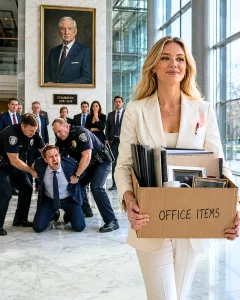
No calendar invitation.
No private heads-up from a sympathetic colleague.
No quiet “thank you” for nearly two decades of giving my body, my mind, and my life to the company.
Just a cheap brown cardboard box shoved across my mahogany desk, and a man in a tailored charcoal suit smiling at me with eyes that looked polished, empty, and hungry.
“We’re updating leadership, Rachel. You understand,” Brandon said, using that smooth, rehearsed tone executives use when they want cruelty to sound like strategy.
I looked down at the box.
It smelled like dry cardboard and stale office air. Someone from HR—someone too ashamed to face me—had already packed my life into it. My chipped ceramic coffee mug. My old calculator that had survived three accounting systems. A few framed photographs of factory workers at summer cookouts.
And on top of everything lay a heavy engraved silver fountain pen.
My throat tightened.
That pen had been given to me by the founder—my grandfather—the year our company survived the 2008 recession without laying off a single plant worker. To anyone else, it was an antique. To me, it was a promise.
For nineteen years, I had been the quiet backbone of Whitaker Industries. I was the person people called when the numbers didn’t balance. I caught supplier fraud before software noticed it. I corrected payroll mistakes at midnight so workers could make their mortgage payments. I rebuilt our shipping routes after a hurricane destroyed half the East Coast supply chain. I answered urgent emails from hospital waiting rooms while my mother was sick, and once drove through a brutal Pennsylvania snowstorm to hand-deliver compliance files because a nervous lender was threatening to freeze our credit line.
But to Brandon Pierce, the CEO’s shiny new son-in-law, I was just old furniture taking up valuable space.
He had married the CEO’s daughter—my cousin—only six months earlier. Then he arrived at headquarters with consultant language, expensive shoes, and a mission to “refresh outdated talent” and “optimize overhead.” He had no idea how this company actually functioned. He didn’t know which vendors could be trusted with a handshake, which clients always paid late but always paid, or which old agreements kept our southern factories alive when cash was tight.
He understood PowerPoint.
And he understood how to smile while removing anyone who remembered too much.
“You’re taking this better than expected,” Brandon said, adjusting his silk tie. “Most people in your age group become a little… emotional.”
I looked up slowly.
My age group.
He meant loyal.
He meant inconvenient.
He meant disposable.
Before I could answer, Brandon reached into my box. His manicured fingers ignored the photographs and lifted the silver fountain pen. He spun it between his fingers, smirking.
“Heavy,” he said. “Very old-fashioned.”
He studied the engraving, then looked back at me.
“It’s a nice little piece of history, Rachel. Perfect for writing retirement notes, maybe. But not exactly suited for signing the digital contracts of the future.”
Then, still holding my eyes, he tossed the pen over the edge of my desk.
It struck the rim of the trash can with a sharp clack and fell inside, landing among crumpled sticky notes and an empty paper coffee cup.
Heat flashed up the back of my neck. My hands curled into fists beneath the desk.
Through the glass walls of my office, the executive floor had gone silent. Employees stared from behind monitors, afraid to breathe too loudly. My assistant, Dana, stood near the copier with both hands over her mouth, tears shining in her eyes. Down the hall, Cole, the massive warehouse supervisor who had come upstairs for inventory reports, clutched his clipboard so tightly I thought it might snap. He looked ready to drag Brandon through the glass wall by his collar.
I took one slow breath.
My grandfather had taught me two rules about business.
Never sign anything in anger.
And never show the full size of your power until it can end the war.
So I stood.
I didn’t cry. I didn’t shout.
I walked around my desk, knelt beside the trash can in my navy skirt, and reached inside. My fingers brushed damp paper before closing around the cold silver pen. I pulled it out, wiped it carefully with a tissue, and slipped it into the inside pocket of my blazer.
Then I lifted the cardboard box.
“Have a pleasant morning, Brandon,” I said calmly.
His smirk twitched.
He had expected pleading. Maybe rage. Maybe humiliation. Something that would let him feel like the conqueror.
Instead, he got silence wrapped in ice.
That annoyed him more than tears ever could have.
“Security will walk you out,” he snapped.
Two large security guards met me at the elevators. I knew them both. I knew their children’s names. I had quietly approved hardship grants when one of their families had medical bills. Neither man could look me in the eye as they escorted me down.
When the brass elevator doors opened into the lobby, I stepped out beneath the giant oil portrait of the founder: Henry Whitaker, standing outside the original brick factory in 1978, sleeves rolled up, work boots dusty, face proud.
My grandfather.
Brandon had been so focused on my current job title that he had never bothered to ask my maiden name.
I walked out through the revolving glass doors and sat on the cold stone bench near the street. At exactly 10:03 a.m., my phone vibrated violently.
It was Dana.
Her voice came through in a frantic whisper.
“Rachel, are you still in the building?”
“I’m outside. Breathe. What’s happening?”
“He’s in the main boardroom,” she whispered, footsteps echoing behind her. “Legal opened your employment file to process severance. Mr. Caldwell is there. Brandon is losing his mind. He just yelled, ‘Rachel Moore—who the hell is she?’”
I looked down at the cardboard box on my lap and touched the inside of my blazer, where the silver pen rested against my chest.
“Tell him,” I said softly, “I’m the woman he needed permission to fire.”
Dana’s voice dropped lower. “Rachel… that’s not all. I saw the deck on his laptop. He isn’t bringing in consultants. He’s selling the manufacturing division. The vote is in twenty minutes.”
Everything around me blurred.
Selling the manufacturing division.
My grip tightened around the phone. “Dana, what company is on the deck?”
There was a rustle of paper. “I wrote it down. Blackstone Consolidated.”
My blood went cold.
Blackstone Consolidated wasn’t just a competitor. It was the predator that had tried to crush my grandfather’s business in the 1990s with price wars, supplier sabotage, and lawsuits. They didn’t buy companies to run them. They bought them to dismantle them, sell the assets, and eliminate competition.
If Brandon sold our manufacturing division to Blackstone, four thousand workers across three states would be unemployed by Christmas. The factories would close. Pensions would vanish. A fifty-year legacy would become a tax benefit.
I hung up, stood from the bench, and left the cardboard box exactly where it was.
Then I walked back into the building.
The security guards at the front desk stiffened when they saw me.
“Rachel,” the older one, Frank, said softly, stepping in front of me. “You know I can’t let you upstairs. I’ll lose my job.”
“I know, Frank.”
I stopped beneath my grandfather’s portrait.
Brandon had walked past it every day, complaining about the gold frame and how it didn’t match his minimalist vision for the lobby. But he had never bothered to read the small brass plaque beneath it.
It read:
“To the true heir, R.W. — Protect the house.”
He had never wondered who R.W. was.
He assumed my aunt, Patricia, the CEO, held every card. He assumed the quiet woman in the corner office was just an accountant.
I pulled out my phone and dialed a number I had not called in three years.
“Caldwell, Price & Reed. How may I direct your call?”
“Put Grant Caldwell on immediately,” I said. “Priority authorization code: Whitaker-Delta-Nine.”
Ten seconds later, my grandfather’s longtime attorney came on the line, his voice rough and low.
“Rachel? I’m sitting in the boardroom watching an expensive suit have a breakdown over your name. Tell me you’re still in the building.”
“I’m in the lobby.”
“Good. Don’t leave. They’re trying to force an expedited merger vote at 10:30. Brandon calls it restructuring, but Blackstone’s fingerprints are all over it.”
“I know,” I said. “He’s been draining our cash reserves to lower the valuation. That’s what the fake vendor contracts were for. He made us look weak so Blackstone could buy us cheap.”
“Can you prove it?”
“With my laptop, yes.”
“He locked your employee credentials the second you were escorted out.”
“He locked my employee credentials,” I corrected. “He doesn’t know about the root access IT gave me during the 2018 server migration.”
“We have twelve minutes,” Grant said. “If they vote yes, stopping this will take years. We have to kill it in the room.”
“Trigger the protocol,” I said. “All of it.”
There was a pause.
That protocol would expose nineteen years of corporate secrecy. It would likely split my family in half.
“Are you certain?”
“They threw my grandfather’s pen in the trash, Grant. Open the gates.”
“Understood. I’ll buy time. Bring witnesses.”
The call ended.
I turned to Frank.
“In about three minutes, your console will show a catastrophic executive protocol breach,” I said. “It will tell you to lock the elevators.”
Frank swallowed. “Rachel, please don’t make me choose.”
“I’m not making you choose,” I said gently. “But remember who got HR to approve your wife’s medical support when insurance denied her treatment.”
His jaw tightened.
“I’m going to the loading dock,” I said. “You’re going to find something very interesting on the ceiling for four minutes.”
Frank turned his back, lifted his coffee cup, and stared at the ceiling tiles.
I didn’t take the public elevators. I moved quickly toward the rear of the building, through the heavy double doors, and into the manufacturing floor.
Machine oil, hot metal, and ozone hit me like home.
Forklifts beeped. Conveyor belts hummed. Workers in safety vests moved through the factory with practiced rhythm.
“Cole!” I shouted.
The warehouse supervisor turned. His eyes widened when he saw me.
“Rachel? What are you doing here? I thought they walked you out.”
“They tried.” I moved toward him as workers began gathering. “Brandon Pierce is upstairs right now trying to sell this division to Blackstone Consolidated.”
The name landed like a live grenade.
Cole’s face went blank, then furious. Every worker with more than five years in the company knew what Blackstone meant. Locked gates. Empty pensions. Families destroyed.
“He’s selling us out?” Cole growled.
“The vote is in seven minutes,” I said. “I’m going upstairs to stop it. But I need witnesses. I need the board to see exactly who they’re selling.”
Cole didn’t hesitate.
He reached up and pulled the emergency air horn chain.
A deafening mechanical roar tore through the factory.
Machines stopped.
The floor went quiet.
“First shift!” Cole shouted. “Drop your tools. We’re going to the executive floor.”
A low angry murmur spread through the workers, growing into momentum.
I walked toward the freight elevator. Cole stepped beside me, arms crossed. Behind him came thirty senior workers, shift managers, and union representatives, their faces hard as stone.
The freight elevator doors closed.
As we rose, I pulled the silver pen from my blazer pocket.
The metal was finally warm in my hand.
The elevator opened on the 40th floor, not into the polished reception area, but the rear corridor behind the executive suites.
I led the way.
My heels struck the carpet in a steady rhythm. Behind me, the boots of thirty factory workers sounded like an approaching army.
We rounded the corner. The receptionist dropped her phone.
Through the frosted glass of the boardroom, I saw twelve board members around the long table. Brandon stood at the front, laser pointer aimed at a graph with a steep downward line.
I didn’t knock.
I pushed the double oak doors open with both hands.
They hit the stoppers like a gunshot.
The room jumped.
“What is this?” Brandon shouted, the laser pointer jerking across the wall. “Security! How did you get back in here?”
I stepped inside, silent.
Then I moved aside.
Cole entered behind me, in work boots and a safety vest, scowling like a storm. Behind him came the warehouse managers, union reps, the HR director, and several trusted regional vendors who happened to be in the building.
The sterile boardroom filled with the real company.
Machine oil. Sweat. Steel. Labor.
They lined the walls, blocking the exits without saying a word.
The board members looked terrified.
“Rachel,” Patricia, the CEO and my aunt, said sharply. Her face was pale beneath perfect makeup. “You were dismissed this morning. You are trespassing.”
I walked to the center of the room. “I was dismissed by a man who did not have authority to fire me, Patricia.”
Brandon laughed. “I am Chief Operating Officer. I have authority over departmental restructuring. Someone call the police.”
Grant Caldwell slowly stood at the far end of the table.
“Mr. Pierce,” he said calmly, “I suggest you sit down before you create even greater liability for this board.”
Brandon glared at him. “Who are you?”
“I am the chief executor of the Henry Whitaker Family Stewardship Trust.”
Grant pulled a thick red-bound document from his briefcase and dropped it on the table.
Brandon pointed toward HR. “Why wasn’t her status in her employee profile?”
“It was,” Grant replied. “You failed to read the governance appendix. Page forty-two, subsection C.”
“Nobody reads appendices,” Brandon snapped.
The board chairman, William, stared at him coldly. “People firing protected corporate officers do.”
Protected officer.
The phrase settled over the room.
After my grandfather retired, he created the Whitaker Family Stewardship Trust. He knew the second generation, especially Patricia, cared more about margins and society events than the people who built the business. So he placed thirty-eight percent of Whitaker Industries into an irrevocable trust. Not enough for daily control, but enough to block destruction.
The trust required one Whitaker family representative to remain inside the company as an independent steward over finance, labor relations, and vendor ethics.
For nineteen years, that person had been me.
Grant opened the red document.
“The unauthorized termination of the Executive Steward,” he read, “without unanimous approval from the trust board, triggers a Level One governance breach. Such a breach immediately suspends all executive restructuring, freezes pending mergers, and mandates forensic review of actions taken by the terminating officer.”
Brandon’s color drained. “Executive Steward?”
“Moore is my married name,” I said. “My maiden name is Whitaker.”
Every head turned.
Patricia whispered, “Rachel… why didn’t you tell him?”
“He never asked who he was firing,” I said. “He was too busy throwing my grandfather’s legacy into the trash.”
Grant placed another folder on the table. “Fortunately, Mr. Pierce’s restructuring proposal appears deeply connected to replacing loyal vendors with private consulting entities tied to him.”
William leaned forward. “Connected how?”
I pulled out my phone and activated the root access IT had forgotten I still held.
“Shared addresses,” I said. “Shared directors behind Delaware LLCs. Inflated bids designed to bleed cash.”
The screen behind Brandon changed.
His graph vanished.
An email appeared.
From Brandon to a senior Blackstone executive.
I read the highlighted sentence aloud.
“The cash bleed is accelerating as planned. Valuation is dropping. We can force the board to accept by Q3. Just make sure you get Rachel out first. She’s been here too long; she’ll recognize the dummy vendor names.”
The silence became lethal.
Brandon stared at his own destruction on the wall.
Then I looked at Patricia.
I expected horror. Shock. Betrayal.
Instead, I saw calculation.
Part 3 of 3
Her hands weren’t trembling. They were clenched.
She wasn’t surprised.
“You knew,” I whispered.
Patricia stiffened. “Rachel, don’t be ridiculous.”
“Don’t lie to me.” My voice cracked like a whip. “You sign every contract above fifty thousand dollars. Brandon could not have drained reserves like this without your signature.”
The board turned toward her.
Brandon saw the opening and panicked. “Patricia approved the realignments. She agreed we needed to cut dead weight.”
“Shut up, Brandon,” William growled. Then he looked at Patricia. “Is it true? Did you know about Blackstone?”
Patricia looked around the room. At the board. At the workers. At me.
Then the polished CEO mask cracked.
“Yes,” she said.
A gasp went through the workers.
“How could you?” I asked. “This was your father’s company. These are your people. Blackstone will strip the factories and fire everyone.”
“Oh, grow up, Rachel,” Patricia snapped. “This company is a dinosaur. Overseas manufacturing is crushing us. Automation is coming. Your grandfather built something beautiful, but it is bleeding us dry. Blackstone offered an exit that would make every shareholder rich.”
“You walk away rich,” I said. “They walk away with nothing.”
I pointed toward the workers.
“No pensions. No severance. No jobs. Did you even negotiate protections?”
She looked away.
That was answer enough.
“It’s business,” Brandon said weakly. “Not personal.”
“It is personal,” I said. “You created fake vendor contracts to manufacture a crisis. You panicked the board into considering a lowball offer, and you expected a payout for delivering the kill shot.”
The board erupted.
Fraud.
Fiduciary breach.
Regulators.
Patricia stammered. “I didn’t know about kickbacks.”
“It doesn’t matter,” Brandon shouted, losing control. He pointed at me. “The trust holds thirty-eight percent. It’s still a minority. Patricia is CEO. Together, we control the board.”
He looked wildly around the table.
“We vote now. Before any injunction. Push the sale through and let lawyers argue tomorrow.”
Patricia hesitated, then nodded.
“I second the motion.”
The room froze.
If they forced the vote and panicked the board, the company could die.
I reached into my pocket and closed my fingers around the silver pen.
“You really should have read the whole appendix, Brandon,” I said.
I looked at Grant.
He stepped forward.
“As stated,” Grant said, “termination of the Executive Steward triggers a Level One breach. However, subsection D covers breaches paired with evidence of fiduciary fraud or self-dealing.”
He turned to the final page.
“In that circumstance, the Steward’s minority share converts.”
Brandon went still. “Converts to what?”
“A supermajority proxy,” Grant said. “A fail-safe designed by Henry Whitaker to prevent internal sabotage.”
Patricia gasped. “My father wouldn’t—”
“He knew exactly who you were,” I said quietly. “He gave you the CEO title to protect your pride. He gave me the loaded gun to protect the house.”
I turned to Brandon.
“The protocol doesn’t just freeze the vote. It suspends the CEO and COO immediately, pending forensic audit and regulatory review.”
The room exploded again, but now the board members were scrambling to survive.
“I withdraw support for the merger,” one shouted.
“The motion is dead,” William said, furious. He pointed at Patricia and Brandon. “Security, escort them out. Do not let them near their computers.”
Brandon tried to laugh. It came out broken.
“This is a misunderstanding,” he said. “I was streamlining operations.”
“No,” I said. “You were eliminating witnesses. You just didn’t realize you were trying to eliminate the landlord.”
By noon, IT had suspended his access. By two, his keycard no longer opened the executive floor or parking garage.
By three, he was begging.
He was being escorted through the lobby with his own cardboard box when he saw me beneath my grandfather’s portrait.
He broke away and hurried toward me.
“Rachel, please. We can fix this quietly. I didn’t know who you were. If I had known—”
I raised my hand.
“That is the problem,” I said. “You didn’t care who I was. You didn’t care who the workers were. You only respect power when it wears a title you recognize.”
His face tightened. “You’re going to destroy my career over one mistake?”
I looked at the box in his arms.
“One mistake did not pack my desk before speaking to me. One mistake did not create fake vendor contracts. One mistake did not try to erase nineteen years of my life before breakfast.”
I turned to security.
“Show Mr. Pierce to the street.”
He left through the revolving doors, disappearing into the city as just another man in an expensive suit.
Six weeks later, the dust began to settle.
The board removed Brandon from every role and filed suit to recover stolen funds. Patricia stepped down as CEO and signed a humiliating public admission that she had allowed family influence to override governance. The fake vendor contracts were canceled, restoring millions to operating reserves.
And I came back.
Not to my corner office.
To the boardroom.
The trust, with unanimous board approval, appointed me Acting CEO and Executive Steward of Whitaker Industries. My mandate was simple: rebuild governance, protect the workforce, and repair vendor ethics from the foundation up.
My first executive action was to end the ambush-firing policy Brandon had used like a weapon. No employee would ever again be walked out without transparent review, human dignity, and a witness not controlled by HR.
On my first official day back in the executive suite, I entered the main boardroom to sign the documents terminating the Blackstone merger.
Dana, now promoted to Chief of Staff, was waiting.
She pointed to the center of the mahogany table.
Resting on the contract was my heavy silver fountain pen.
“Your grandfather would have loved this,” she whispered.
I picked it up and ran my thumb over the engraving.
Henry Whitaker once told me a company is not inherited by whoever wears the finest suit or shouts loudest in meetings. It belongs to the people willing to bleed for the foundation beneath it.
I removed the cap.
The metal felt cool and steady in my grip.
I pressed the nib to the signature line that would end Brandon’s corporate life and bury the Blackstone deal for good.
“Antiques,” I murmured to the quiet room, “are sometimes the only tools sharp enough to cut out modern rot.”
Then I signed my name.
Later that week, someone in IT found the deleted screenshot of Brandon’s email to Blackstone. They printed the sentence and taped it inside the main factory break room.
Get Rachel out first.
Under it, Cole had written a permanent addition in thick black marker for every future executive who walked in thinking power came from a title.
Next time, check her maiden name.