The date on the file was six weeks before I ever said the word divorce out loud.
isp.decodo.com
I picked it up with hands that had gone completely numb, and the diagnosis printed across the top wasn’t anything I’d ever heard either of us discuss during those final, quiet months of our marriage. Peripartum cardiomyopathy. A weakening of the heart muscle, the notes explained, triggered by pregnancy, capable of developing even after a loss, sometimes worsening for months before symptoms became severe enough to notice.
“Sophie,” I said, my voice barely functioning, “you knew about this before I asked for the divorce?”
She didn’t answer right away, lowering herself carefully back into the chair, the doctor hovering nearby with the particular patient concern of someone who’d clearly cared for her through considerably more than a single hallway conversation.
“I found out three weeks after the second miscarriage,” she said finally. “I started having trouble breathing during ordinary things. Walking up the stairs. Carrying groceries. I told myself it was just exhaustion, grief, all the obvious explanations, until it got bad enough that I finally saw a cardiologist on my own.”
“Why didn’t you tell me?”
She looked up at me then, and I understood, watching her face, that this question had been waiting for me considerably longer than the two months since our divorce had finalized.
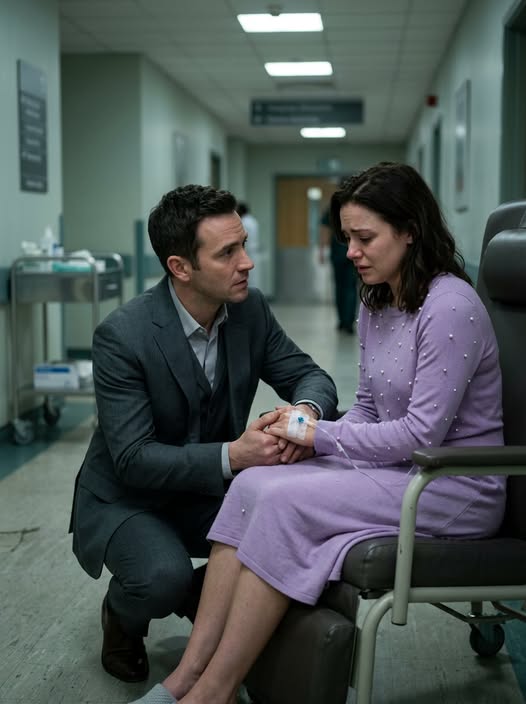
“Because I heard you on the phone with your brother,” she said quietly. “About a month before you said it out loud. You told him you didn’t know how much longer you could do this, watching me disappear into grief you didn’t know how to reach. I understood, hearing that, exactly where we were heading. I didn’t want you to stay because you felt obligated to care for a sick wife, Ethan. I wanted you to leave believing it was simply grief that broke us, not guilt over abandoning someone who was actually dying.”
The word landed in that hallway with a weight I wasn’t prepared for. “Dying,” I repeated. “Sophie, is that—how serious is this?”
The doctor, who’d introduced himself quietly as Dr. Whitfield, stepped forward. “Sophie’s condition has progressed to the point where we’re actively evaluating her for a heart transplant. Her ejection fraction has declined significantly over the past several months, faster than we initially hoped to see given her age and overall health otherwise.”
I felt the hallway tilt slightly around me. “A transplant. Sophie, why didn’t anyone call me? I’m still listed as your emergency contact on some of these old—”
“I changed it,” she said softly. “After the divorce finalized. I changed it to my sister. I didn’t want you finding out this way, Ethan. I wanted you to keep believing the version of our ending that let you move forward without this hanging over you.”
I sat with Sophie in that hallway for nearly two hours that afternoon, missing my visit with my best friend entirely, absorbing details about a condition she’d apparently been managing almost entirely alone for the better part of a year.
She explained the timeline slowly, patiently, despite her own visible exhaustion — the initial diagnosis three weeks after our second pregnancy loss, the months of medication adjustments that had initially seemed to stabilize things, the gradual decline that had started accelerating around the same time our marriage had been quietly disintegrating in the space of our shared apartment.
“I kept thinking I’d tell you once I understood more,” she said. “Once I had a clearer picture from the doctors. But every appointment brought worse news instead of better, and every week that passed made the secret feel harder to finally break, not easier.”
“You went to appointments alone,” I said. “For months. While I was sitting at home assuming you were simply grieving quietly, the way you always processed things.”
“I was grieving,” she said. “Both things were true simultaneously. I just chose which truth to let you see.”
Her sister, Marissa, arrived partway through our conversation, her expression shifting from surprise to something more complicated once she understood I’d learned everything in a single unplanned hallway encounter rather than through any deliberate conversation Sophie had been planning.
“I told her she needed to tell you,” Marissa said, once Sophie had been convinced to return to her room for rest. “Months ago, actually, before the divorce was even finalized. She said you deserved to leave without guilt, that adding this diagnosis to an already broken marriage would only trap both of you in something neither of you actually wanted anymore.”
“I never stopped wanting her,” I said, the words arriving with a clarity I hadn’t allowed myself during the entire two months since our divorce. “I stopped knowing how to reach her, through the grief. That’s different from not wanting the marriage at all.”
Marissa studied me for a long moment. “She needs a transplant, Ethan. The waiting list, the recovery, all of it — she’s going to need people around her who are actually staying, not people who show up once out of guilt and disappear again once the crisis passes. If you’re not certain you can be that person, it’s kinder to be honest about that now, before she lets herself hope again.”
I didn’t leave the hospital that evening, despite Marissa’s warning, despite my own uncertainty about exactly what role I was supposed to occupy in Sophie’s life now that I understood the full truth she’d been carrying alone.
I sat in the hallway outside her room until visiting hours technically ended, then found a chair in the waiting area and stayed considerably longer than that, working through the particular vertigo of understanding that the marriage I’d walked away from had never actually been the marriage I thought I was leaving.
I returned the next morning, and the morning after that, slowly rebuilding a presence in Sophie’s life that had nothing to do with our legal status and everything to do with a decision I made somewhere in that hallway, watching her explain a diagnosis she’d carried alone specifically to protect me from a burden she’d decided, unilaterally, I shouldn’t have to share.
“I’m not asking you to remarry me,” Sophie told me, during one of those early visits, her voice still weak but considerably steadier than that first devastating afternoon. “I’m not even asking you to stay, if this feels like too much. I need you to understand that showing up now doesn’t erase months of me managing this completely alone, believing that was actually the kinder choice.”
“It wasn’t kinder,” I said. “It was lonely, for both of us, in ways neither of us needed to be. I understand why you made that choice, Sophie. I don’t agree it was the right one.”
I attended her cardiology appointments after that, learning the language of ejection fractions and transplant waiting lists alongside Marissa, slowly becoming part of a medical team’s understanding of Sophie’s support system in a way I’d never once been included in during the months she’d carried this secret alone.
The transplant evaluation process took considerably longer than either of us anticipated, months of tests and waiting and the particular exhausting uncertainty of not knowing when, or whether, a matching heart might become available in time.
I didn’t ask Sophie to remarry me during those months, understanding, the way Marissa had warned me, that rebuilding trust required considerably more patience than a single dramatic hallway reunion could provide. I simply showed up, consistently, for appointments and difficult nights and the ordinary, unglamorous work of actually being present for someone rather than retreating into work and television the way I had during our marriage’s final year.
Sophie received her transplant eight months after that afternoon in the hospital hallway, a call that came at two in the morning, both of us rushing to St. Vincent together in a version of partnership I hadn’t managed to offer her during our actual marriage.
The surgery succeeded. Her recovery, while difficult, progressed steadily over the following months, her color returning, her breath no longer catching on ordinary tasks like climbing stairs or carrying groceries, small, ordinary miracles that felt considerably larger given everything we’d both survived to witness them.
We didn’t remarry immediately. I want to be honest about that, because I think stories like ours sometimes rush toward a tidy, romantic conclusion that doesn’t actually reflect how long real trust takes to rebuild after it’s been fractured by both grief and secrecy in equal measure.
We dated again, slowly, almost shyly, two people who already knew each other’s worst fears and deepest griefs working to rebuild something considerably more honest than what we’d allowed our marriage to become during those final silent months.
We married again eighteen months after her transplant, in a small ceremony that included exactly the people who’d shown up during the hardest parts — Marissa, Dr. Whitfield, my best friend whose hospital visit had accidentally led me back to Sophie in the first place.
I think about that hallway often, the file slipping from Sophie’s trembling hands, the date that told me everything I hadn’t known to ask about during our marriage’s final collapse. I understand now that grief and illness had been quietly intertwined the entire time, each one making the other harder to name honestly, until secrecy became easier than the vulnerability actual honesty would have required from both of us.
Sophie’s heart, the new one, beats steadily now, three years into a recovery neither of us takes for granted. I’ve learned to ask harder questions since that hallway, to notice the difference between someone quietly grieving and someone quietly disappearing, understanding, finally, that the two can look nearly identical from the outside if you’re not paying close enough attention.
I almost lost her twice — once to the silence I let grow between us, and once to a condition I never knew she was fighting entirely alone. I don’t intend to lose her to either kind of silence again.