Chapter 1: The Blueprint of Betrayal
The air inside the Blackwood Estate always tasted like cold money and stale secrets. As I stepped into the suffocating, hyper-air-conditioned foyer of my childhood home in Dallas, Texas, the sheer gravity of the silence almost brought me to my knees. My eyes were raw, bloodshot from the brutal, red-eye flight from New York, my mind a fractured mosaic of grief.
My twin sister, Harper, was dead.
The words still didn’t compute. A house fire at her secluded cabin in the Hill Country. A tragic accident, the authorities had allegedly said. We were twenty-eight years old. We were supposed to grow old together, supposedly insulated from the world by the massive tech fortune our grandfather had bypassed our financially parasitic parents to leave entirely to us.
I stood in the entryway, my duffel bag hanging limply from my shoulder, waiting for the embrace of a grieving mother. Instead, I was met with the sharp, sterile click of designer heels on imported Italian marble.
My mother, Margaret Blackwood, descended the grand staircase. She was wrapped in impeccable, custom-tailored black crepe, a string of heavy South Sea pearls resting against her collarbone. Not a single hair was out of place. More horrifyingly, not a single tear marred her flawless, surgically maintained face.
She didn’t reach out to hold me. She didn’t offer a word of comfort. Instead, she crossed the floor and immediately pressed a thick, heavily bound stack of legal documents against my chest.
“The fire at Harper’s cabin was utterly devastating, darling,” Margaret sighed, her voice a practiced, breathy whisper that held all the emotional weight of ordering a martini. She casually adjusted her pearls. “The funeral costs, the media management, and the estate transfer taxes are going to be astronomical. We need you to sign over your half of the trust as collateral by tonight, just to keep the family afloat until probate clears.”
I stared at her, the air turning to jagged glass in my lungs. My sister’s bones were barely cool, and my mother was handing me a pen.
Across the room, standing by the antique mahogany wet bar, was my father, Richard. He was pouring a generous measure of twenty-year-old scotch into a crystal tumbler. He didn’t look at my face. His pale, icy blue eyes were fixed entirely on the Montblanc pen in Margaret’s hand, watching it with a hungry, reptilian glint.
“Sign the papers, Harrison,” Richard commanded, the ice clinking loudly in his glass. “It’s a mere formality. Your grandfather’s archaic stipulations require both your signatures for major liquidations. With Harper gone… well, the burden falls to you. Be a good son.”
I was an architect. My entire life was built on understanding structural integrity, recognizing load-bearing walls, and identifying when a foundation was built on sand. For twenty-eight years, I had known my parents were vain, shallow, and relentlessly greedy. But standing here, blinded by the agonizing loss of my other half, a new, deeply unsettling instinct flickered to life in my gut.
The math didn’t add up. The structure of their grief was entirely hollow.
I looked down at the documents. They weren’t just collateral agreements. Even through my exhaustion, I could see the headers: Irrevocable Power of Attorney. Total Asset Transfer.
I slowly pushed the papers back toward Margaret’s chest. “No.”
Richard’s hand momentarily tightened around his scotch glass until his knuckles turned a violent, bloodless white. The silence in the room stretched until it felt like a piano wire pulled taut against my throat.
“I’m not signing anything until I see her,” I said, my voice cracking, yet laced with a stubbornness I didn’t know I possessed. “I need to go to the morgue. I need to see my sister.”
Margaret’s plastic smile faltered for a fraction of a second. She shared a dark, fleeting, terrifyingly communicative glance with Richard over my shoulder. It was a look that screamed a single, unified thought: We need to accelerate the timeline.
“Of course, Harrison,” Richard said smoothly, setting his drink down with a sharp clack. He pulled his phone from his vest pocket, his thumb hovering over the screen. “I’ll arrange a private viewing. But let’s make it quick. You look dead on your feet, son. And we have so much to prepare for tomorrow.”
Chapter 2: The Truth in the Ashes
The smell of the Dallas County Morgue was a violent assault on the senses. It was a heavy, suffocating blanket of industrial bleach, ozone, and the faint, metallic sweetness of decay. It was a world entirely divorced from the opulent, fake warmth of the Blackwood mansion. Here, under the buzzing, jaundiced fluorescent lights, there was only cold, hard reality.
I stood shivering in the subterranean chill, my arms wrapped around myself. My parents had refused to come down into the viewing room, citing their “delicate nerves.” They were waiting out in the idling Mercedes, probably calculating exchange rates for offshore accounts.
Dr. Thorne, the county medical examiner, stood on the other side of the stainless-steel table. He was a small, balding man who looked as though he hadn’t slept in a decade. His hands, clad in thick blue nitrile gloves, trembled slightly as they gripped the heavy zipper of the black canvas body bag.
“Mr. Blackwood,” Thorne mumbled, not meeting my eyes. “I must warn you. The thermal damage… it’s catastrophic. The structural integrity of the remains…”
“Just open it,” I choked out, bracing myself against the edge of the table.
The zipper parted with a loud, tearing sound that echoed off the tiled walls.
I looked down. My knees buckled instantly, a wave of profound nausea washing over me. The shape on the table barely resembled a human being, let alone the vibrant, brilliant woman who had shared my womb. It was just charred mass, brittle and silent. A sob tore its way up my throat, rough and desperate. I leaned heavily over the table, burying my face in my hands.
Dr. Thorne stepped around the table, moving uncomfortably close to my side.
“Here,” Thorne murmured, pulling a tissue from a box and pressing it into my hand.
But it wasn’t just a tissue.
Beneath the thin paper, my fingers brushed against a crumpled, slightly damp piece of notebook paper. I froze. The architectural part of my brain—the part that analyzed spatial relationships and subtle anomalies—snapped to attention.
I looked up at Thorne. The man was sweating profusely, his eyes darting frantically toward the black dome of the security camera mounted in the corner of the ceiling.
“Wipe your eyes, son,” Thorne whispered, his voice so low it barely registered over the hum of the refrigeration units. “And listen to me very carefully. Do not react.”
I kept the tissue pressed to my face, my heart beginning to hammer a frantic, erratic rhythm against my ribs.
“The dental records don’t match,” Thorne breathed, pretending to inspect a clipboard. “Not even close. The femur length is off by two inches. That is a Jane Doe.”
What? The word screamed in my mind, but I kept my body perfectly still, mimicking the posture of a broken man.
“Your sister is sitting on a beach in Tampa,” Thorne continued, his words slicing through my grief like a scalpel. “She’s alive. I intercepted your father’s encrypted texts to a local fixer down here. They paid a small fortune to have this body planted in the wreckage.”
The grief evaporated. In a single, violently sudden heartbeat, the profound sorrow that had been drowning me was completely incinerated, replaced by a cold, calculated, terrifying rage.
“Why?” I whispered behind the tissue.
“Because they needed a dry run,” Thorne replied, his hands shaking violently now. “They’re planning to drug you tonight. The funeral is tomorrow, Harrison. And they’re planning to put you in that casket instead of this girl.”
I stared at the burned corpse. It wasn’t Harper. It was a prop in a masterclass of sociopathic greed. My own parents were going to murder me in my sleep, burn my body, and forge my signature on the trust transfer to steal everything.
I didn’t scream. I didn’t collapse. Instead, a terrifying, icy calm settled over my features. The architect was back online, and I suddenly saw the entire structural blueprint of their murderous trap.
I slipped the note with Harper’s Florida address into my pocket. I wiped my dry eyes, thanked Dr. Thorne loudly for his time, and walked out of the double doors.
My mother was waiting in the hallway, looking expectant, her fake-sympathetic face arranged in a mask of maternal concern.
I looked directly into her eyes. I smiled a slow, dead-eyed smile that made her flinch.
“Let’s go home, Mother,” I said smoothly. “I have a sudden urge to plan the most unforgettable funeral this city has ever seen.”
Margaret nodded, her smile returning, entirely oblivious to the monster she had just created. But as we walked out into the blinding Texas heat toward the waiting car, I saw my father standing by the open trunk. He was tossing a heavy, rolled-up black canvas body bag into the back. He slammed the trunk shut and looked at me with a sickeningly warm smile.
“Ready for bed, son?” Richard asked.
Chapter 3: The Dead Man’s Switch
The guest bathroom of the Blackwood estate felt like a marble tomb. I had locked the heavy oak door and turned the shower on full blast, the scalding water hitting the tile to generate enough white noise to muffle my voice.
I sat on the edge of the porcelain bathtub, staring at the crumpled piece of paper Dr. Thorne had given me. It had an address in Tampa and a burner phone number. I memorized it, then shredded the paper and flushed it down the toilet.
I pulled out my phone and dialed the only man ruthless enough to handle this. Arthur Caldwell, my senior corporate attorney in New York. Caldwell was a shark in a tailored suit, a man who viewed the law not as a moral code, but as a weapon of mass destruction.
“Harrison,” Caldwell answered on the first ring, his voice clipped and sharp. “I heard about Harper. I’m sorry.”
“She’s not dead, Arthur,” I said, my voice eerily steady. “But I will be by tomorrow morning if we don’t act right now.”
There was a two-second pause. Caldwell didn’t ask for clarification; he asked for parameters. “Give me the tactical situation.”
I laid it out in rapid, precise detail. The fake body, the forced signatures, the impending assassination attempt tonight. I could practically hear Caldwell’s mind grinding the gears of legal warfare on the other end of the line.
“Alright,” Caldwell said, his tone dropping into a deadly register. “I am initiating a ‘Dead Man’s Switch’ protocol on the entire Blackwood Trust. As of midnight tonight, every single asset, bank account, stock portfolio, and real estate deed associated with your parents will be locked under a federal freeze pending an FBI investigation for conspiracy and fraud. They won’t be able to buy a cup of coffee by morning.”
“Good,” I replied. “But I need to be in that casket tomorrow. I need them to think they won. I’m booking the most extravagant, five-star catering service in Dallas for the memorial. Open bar, caviar, wagyu. Put it on the estate tab before the freeze hits.”
Caldwell chuckled, a dry, rasping sound. “Theatrical, Harrison. I like it. But how do you survive tonight?”
“I play dead,” I said. “Send a private security extraction team to intercept the transport van before it reaches the crematorium. I’ll make sure I’m the one in the bag.”
“Done. They’ll be waiting at the estate gates in an unmarked utility truck. Do not resist, Harrison. Go limp. Let them take you. We will catch you when you fall.”
I hung up. I splashed cold water on my face, practiced my expression of exhausted grief in the mirror, and unlocked the door.
The waiting game began.
At exactly 11:00 PM, a gentle, rhythmic knock sounded at my bedroom door. Margaret pushed it open, carrying a polished silver tray. Resting on it was a steaming mug of chamomile tea.
“For your nerves, sweet boy,” she coos, her voice dripping with maternal poison. “You look so, so tired. Drink this. It will help you sleep.”
Her eyes lingered on the rim of the cup. With my architect’s eye for detail, I noticed it immediately: a fine, white powdery residue meticulously dissolved into the amber liquid, barely catching the light of the bedside lamp.
I took the mug with trembling hands, playing the broken, naive son to absolute perfection. “Thank you, Mom. You’re… you’re always taking care of me.”
She stroked my hair, a gesture that made my skin crawl with physical revulsion. “Always, darling. Sweet dreams.”
She closed the door. I waited exactly thirty seconds, listening to her footsteps fade down the hall. Then, I walked over to the massive potted Boston fern by the window and poured the laced tea directly into the soil. Within hours, I knew those green leaves would begin to turn brown and wither.
I set the empty mug on the nightstand. I lay down on top of the covers, fully dressed in a bespoke black suit, and began the hardest physical task of my life. I slowed my breathing. I relaxed every muscle in my body until I was dead weight. I slowed my heart rate using deep meditation techniques I had learned years ago to combat architectural exam stress.
I waited in the dark.
At 2:00 AM, the heavy brass handle of the bedroom door clicked open.
Through the sliver of my eyelashes, I saw two silhouettes step into the room. Richard, and a burly, unknown man smelling of cheap cigarettes and stale sweat. The man was holding the heavy canvas body bag I had seen earlier.
“He drank it all,” Richard whispered, picking up the empty mug. He looked down at my face. There was no hesitation, no remorse. “Lift him.”
Rough, calloused hands grabbed my shoulders and ankles. I remained completely limp, fighting every primal instinct in my body that screamed to fight back. They dumped me unceremoniously into the canvas bag.
The heavy, metallic zipper closed over my face, plunging me into absolute, suffocating darkness. The smell of the synthetic canvas was overwhelming. I was trapped inside my own makeshift coffin, held by the men who wanted to burn me.
Through the thick fabric, I heard my father chuckle softly.
“Take him to the crematorium’s back entrance,” Richard whispered to the hired muscle, his voice thick with pure, unadulterated greed. “Margaret and I have a fortune to count.”
I was hoisted over a massive shoulder. I bounced against the man’s back as he carried me down the back stairs and out into the humid Texas night. I heard the trunk of the Mercedes open, and I was thrown violently onto the hard carpeting. The trunk slammed shut.
The car engine roared to life. We began to move.
I lay in the pitch-black trunk, the air growing hot and thin, counting the seconds, praying Caldwell’s men were as good as he promised. Ten minutes passed. Then fifteen. The panic began to claw at the edges of my mind. What if Caldwell was too late? What if I was about to be rolled alive into a two-thousand-degree furnace?
Suddenly, the Mercedes slammed on its brakes, the tires squealing violently against the asphalt. I was thrown hard against the side of the trunk.
I heard muffled shouting outside. The sound of shattered glass. A heavy thud against the hood of the car.
Then, the trunk popped open.
Cold air rushed in. The zipper of the body bag was swiftly yanked down.
I blinked against the blinding beam of a tactical flashlight. Holding it was a man in full black tactical gear, an assault rifle slung across his chest. Behind him, I could see my father’s hired muscle lying unconscious on the pavement, zip-tied to the steering wheel of the Mercedes.
“Mr. Blackwood?” the operative asked, his voice strictly professional.
I sat up, taking a massive gulp of fresh air, brushing the canvas off my expensive suit.
“Yeah,” I said, a dark, predatory smile spreading across my face. “Get me a ride to the cemetery. I have a funeral to attend.”
Chapter 4: The Macabre Banquet
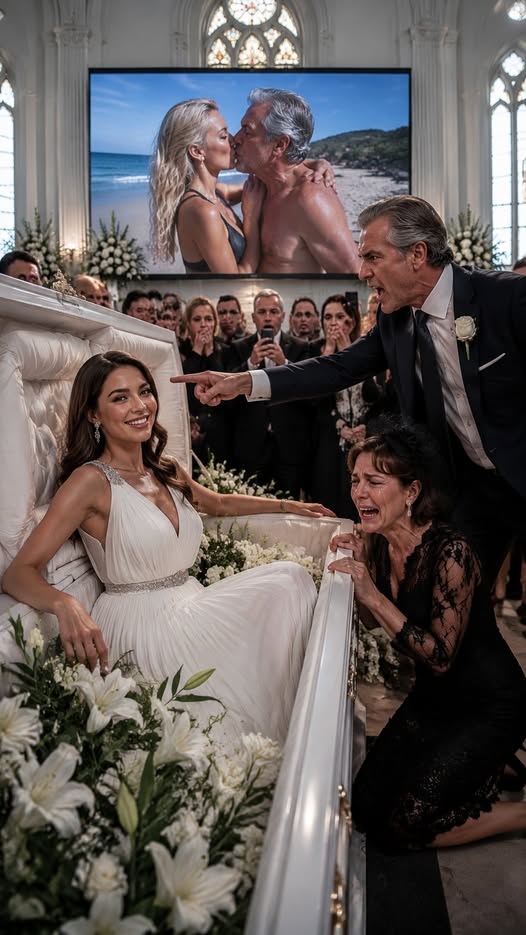
The Dallas Memorial Chapel was a monument to old money and ostentatious mourning. The stained-glass windows cast long, colorful shadows across the polished oak pews, which were currently packed with the city’s confused, whispering elite.
It was 10:00 AM.
At the front of the chapel sat a massive, closed mahogany casket, supposedly containing my sister’s ashes. And right next to it, set up on draped folding tables, was the most absurd, lavish spread of food the mourning elite had ever seen. Waiters in crisp white tuxedos moved silently through the aisles, passing out flutes of Dom Pérignon, silver spoons of Beluga caviar, and delicate cuts of seared wagyu beef.
People were eating, drinking, and looking profoundly uncomfortable. It was a grotesque juxtaposition of death and luxury, exactly as I had designed it.
I stood hidden in the vestibule at the back of the chapel, watching through the crack in the heavy oak doors.
Richard and Margaret stood together at the marble podium. They were giving the performance of a lifetime. Margaret was weeping elegantly into a silver-plated microphone, delicately dabbing her dry eyes with a lace handkerchief. Richard stood behind her, a stoic hand resting on her shoulder, looking suitably shattered.
“To lose our beautiful Harper to the fire…” Margaret sobbed, her voice echoing through the chapel, “…and then, just last night, to find my sweet, sensitive Harrison dead in his room, succumbing to his own unbearable grief…”
A collective, theatrical gasp rippled through the congregation. A grief-induced murder-suicide narrative. It was brilliant. It covered all their bases.
“It is a burden no mother should bear,” Margaret wailed, leaning heavily against the podium. “They are together now. And Richard and I are left alone, to manage the immense weight of their legacy.”
Cue the architect.
I placed my hand flat against the center of the double oak doors. I didn’t push them gently. I shoved them open with every ounce of physical strength I had.
The heavy doors swung outward with a resounding, thunderous CRASH that rattled the stained glass.
The entire chapel went dead silent. The clinking of champagne glasses stopped. The weeping ceased.
I walked slowly down the center aisle. I was impeccably dressed in my bespoke black suit, my hair perfectly styled, looking very much alive. In my left hand, I held a crystal flute of champagne. In my right, a small porcelain plate holding a perfectly seared slice of wagyu beef.
Margaret dropped the microphone. It hit the marble floor, emitting a piercing, agonizing screech of feedback that made the front row wince.
Richard stumbled backward, his legs giving out as he crashed into a massive floral arrangement of white lilies. His face drained of all color, turning the exact shade of the ashes he thought I was.
I didn’t rush. I walked with the measured, deliberate pace of a man who owned the room. The guests parted like the Red Sea, staring at me in terrified, breathless shock. I reached the front row, standing directly between my parents and the mahogany casket.
I popped the piece of wagyu into my mouth, chewed slowly, and swallowed.
“The beef is excellent, Mother,” I said, my voice echoing loudly in the silent chapel. I took a sip of champagne and raised the glass to her. “But I’m afraid the Blackwood estate won’t be paying the catering bill.”
Margaret’s mouth opened and closed like a suffocating fish. “Harrison… you’re… you’re dead.”
“I woke up,” I said casually. “Turns out, chamomile tea gives me terrible nightmares. Speaking of which…” I turned my gaze to Richard, who was trembling violently among the crushed lilies. “Caldwell froze the accounts at midnight, Dad. Every penny. Every property. The offshore routing numbers you thought were hidden? The Feds have them all.”
Richard let out a primal, guttural roar of absolute rage. The facade shattered completely. He lunged forward, his hands hooked into claws, aiming directly for my throat to finish the job he started.
“Oh, and by the way,” I added, stepping easily out of his path. “Harper says hello from Florida.”
Before Richard could recover his balance and lunge again, the side doors of the chapel burst violently open.
“FBI! Nobody move!”
A dozen federal agents, led by Arthur Caldwell in a sharp gray suit, flooded the room. Their badges gleamed in the stained-glass light. Tactical boots stomped onto the marble. Weapons were drawn and leveled directly at the grieving parents.
“Richard and Margaret Blackwood,” Caldwell announced, his voice booming over the chaos of the screaming socialites. “You are under arrest for conspiracy to commit murder, wire fraud, and the attempted assassination of an heir to the Blackwood Trust.”
Agents grabbed Richard, slamming him face-first onto the mahogany casket he had bought for me, violently ratcheting steel handcuffs onto his wrists. Margaret shrieked, fighting the female agent who grabbed her, her pearl necklace snapping and scattering across the marble floor like hail.
I took another sip of champagne, watching the empire burn.
As Margaret was hauled past me, her designer dress rumpled, her face twisted in feral hatred, she stopped resisting for a fraction of a second. She leaned toward me, a manic, sociopathic smile stretching her lips.
“Checkmate, Harrison,” she whispered, her eyes wide and dark. “But you think you found all the bodies?”
Before I could respond, the agent shoved her forward, marching her out the door to the waiting cruisers.
Chapter 5: The Sands of Survival
Three weeks later, the silence in Arthur Caldwell’s corner office in Manhattan was profound.
I sat in a leather wingback chair, nursing a glass of scotch that tasted significantly better than my father’s. On the massive flat-screen monitor mounted on the wall, I was watching silent, black-and-white security footage from the federal holding facility in Dallas.
On the split screen, Margaret was in one interrogation room, Richard in another.
They were tearing each other apart. Margaret was standing up, frantically screaming at her lawyer, pointing accusatory fingers at the wall separating her from her husband. According to Caldwell, she was entirely willing to testify that Richard was the sole mastermind, perfectly happy to send her husband of thirty years to a lethal injection gurney if it shaved five years off her own federal sentence. Richard was doing the exact same thing in his room, blaming Margaret’s greed for the hitmen.
They were rats in a sinking ship, cannibalizing each other to survive.
I told Caldwell to turn off the monitor. I felt no triumph. No joy. I just felt a cold, hollow, echoing pity for two people who had entirely traded their humanity for a bank ledger.
That afternoon, I boarded a private jet to Tampa, Florida.
The heat of the Gulf Coast was different from Texas. It was wet, heavy, and smelled of salt and life. I walked barefoot onto the blindingly white sand of a private, secluded beach. The sun beat down, warming the deep chill that had settled into my bones over the last month.
Sitting under a large blue umbrella, staring out at the rolling turquoise waves, was a woman with familiar, fiery red hair.
“Harper,” I said softly.
She turned. Her face was pale, her eyes carrying the heavy, shadowed weight of a survivor. When the local fixers had shown up at her cabin with a planted body, she had barely escaped out a back window, hiding in the woods while they set the blaze. She had been running ever since, terrified to contact me until she saw the news of the spectacular funeral sting on national television.
She stood up. We didn’t speak. We collided.
As my twin sister wrapped her arms around my neck, burying her face in my shoulder, the icy, architectural armor I had worn to survive finally cracked. The load-bearing walls of my emotional defense completely gave way.
I fell to my knees in the sand, pulling her down with me. I buried my face in her hair, and I finally, truly wept. I heaved with violent, shuddering sobs that tasted of sea salt and relief. I wasn’t crying for the parents I had lost; I had never really had them. I was weeping for the absolute innocence that had been stolen from us, and for the cold, calculating monster I had been forced to become to defeat them.
We sat there in the sand for hours, letting the tide wash up to our knees, rebuilding the foundation of our lives from scratch.
That night, back in the safety of my heavily secured luxury hotel suite, I ordered room service. I felt lighter. The nightmare was over.
But as I walked out of the bathroom, drying my hair with a towel, my blood ran cold.
Lying perfectly centered on the dark carpet, having been slipped under the locked door, was a plain, unstamped white envelope.
I approached it slowly, the architect’s paranoia flaring back to life. I picked it up. My name was written on the front.
I recognized the elegant, looping cursive immediately. It was my mother’s handwriting.
I tore the envelope open. Inside was a single piece of heavy cardstock. There was no greeting, just one chilling sentence:
You inherited more of my mind than you think, darling, and that is exactly why I know you won’t survive the final inheritance.
I stared at the paper, the sound of the ocean outside suddenly feeling very far away.
Chapter 6: Ashes to Ashes
One year later.
The relentless Texas sun beat down on the manicured lawns of the Blackwood Estate. But the suffocating silence of the grounds had been replaced by the glorious, deafening roar of diesel engines and grinding steel.
I stood on a small grassy hill, watching a massive yellow excavator swing its iron arm backward, then violently forward. The claw smashed through the mahogany pillars of the grand foyer, tearing down the walls of the mansion with a satisfying crunch of timber and shattering glass. Dust billowed into the blue sky like smoke from a pyre.
Harper stood right beside me, her hand gripping mine securely. The color had returned to her cheeks, the shadows banished from her eyes.
We hadn’t just legally reclaimed the estate; we were erasing it from the map. We had sold the sprawling acreage to a local developer with a strict, legally binding contract: the land was to be completely leveled and transformed into a public botanical garden and community center. The Blackwood name was being physically scraped from the earth.
I reached into the inner pocket of my tailored jacket and pulled out the crisp, white envelope that had haunted me for twelve months. My mother’s final note from the hotel.
Over the past year, Caldwell had overseen a microscopic forensic audit of the entire family legacy. We found offshore accounts, shell companies, and the dark, bloody money my parents had hoarded. We liquidated it all. We donated the illicit funds to charities, kept the legitimate tech trust, and I had started my own architectural firm in New York, dedicated to designing sustainable, affordable housing.
I had spent a year looking over my shoulder, wondering what her final, cryptic threat meant. Wondering if there was another assassin, another trap, another body buried in the foundation.
But as I watched the house fall, the roof caving in on the dining room where they used to coldly demand perfection, I finally understood.
The “final inheritance” wasn’t a hidden bomb or a cartel hitman. The final inheritance was paranoia. It was the fear that I was exactly like her—a sociopath capable of emotional detachment and ruthless strategy. She wanted me to spend the rest of my life looking in the mirror and seeing a monster.
I pulled a silver Zippo lighter from my pocket. I flicked the wheel, the flame springing to life.
I touched the fire to the corner of the heavy cardstock. I watched the flame consume the elegant, looping handwriting, eating away at the toxic words until the paper curled, blackened, and disintegrated. I let the ashes fall from my fingertips, blowing away into the Texas dirt, mixing with the dust of the demolished mansion.
I turned to Harper, feeling a genuine, unburdened smile break across my face for the first time in my adult life.
“She was wrong,” I said quietly over the roar of the bulldozers.
“About what?” Harper asked, squeezing my hand.
“I didn’t inherit her mind,” I replied, looking at the rubble of our past. “I just learned how to build a better trap.”
We turned our backs on the ruins and walked down the driveway toward our waiting car. The air smelled of crushed stone and fresh beginnings. As we drove away, leaving the demolition crew to bury the ghosts of the Blackwood legacy forever, I realized the greatest revenge wasn’t sending my parents to a federal prison.
The greatest revenge was proving that the blood in my veins, the mind in my head, and the foundation of my soul belonged entirely, and undeniably, to me.