Chapter 1: The Golden Cage
The air inside the Blackwell Estate tasted like vintage champagne and old blood. It was a suffocating blend of Chanel perfume, the ozone crackle of flash photography, and the underlying rot of a family that had learned to play God and monetized the outcome. I stood in the shadowed alcove of the grand ballroom, the heavy velvet drapes brushing my shoulder, nursing a glass of cheap, watered-down bourbon. It was the only thing in this room that wasn’t pretending to be something it wasn’t.
Tonight was the annual gala for the Blackwell Medical Charities, a dazzling philanthropic facade that laundered our family’s oil money and provided cover for something far darker. I watched my mother, Beatrice Blackwell, glide across the marble floor. She was impeccably dressed in an emerald-green gown that seemed to absorb the light from the crystal chandeliers overhead. Her smile was a practiced, ice-cold curvature of the lips as she auctioned off a million-dollar Monet to a crowd of oblivious Dallas socialites. The funds, she claimed, would go toward building state-of-the-art community clinics for the underprivileged.
I knew exactly what those “clinics” really were. They were butchery floors. Processing plants for human spare parts.
My chest tightened, a familiar knot of anxiety and disgust coiling in my gut. I was Caleb Blackwell, the acknowledged black sheep, the gritty stain on a pristine, blood-soaked legacy. I wore scuffed boots that tracked West Texas dust onto imported rugs, and I bore the permanent exhaustion of a man who had spent the last twenty-eight years living a lie.
Just a few more days, I told myself, the glass cool against my sweating palm. Just a few more days, and I burn this entire empire to the ground.
“Hiding in the dark again, Caleb?”
The voice was thin, reedy, yet dripping with a toxic arrogance that made my teeth grind. I turned to see my older brother, Preston, rolling his wheelchair into the alcove. He looked terrible. His skin was the color of parchment, pulled tight over a skull that seemed too large for his frail, wasting body. The severe heart failure was finally catching up to him, but his impending mortality hadn’t humbled him; it had only sharpened his cruelty. He was the golden child, the heir apparent, the son Beatrice would burn the world down to save.
Preston sneered, his sunken eyes dragging up and down my worn denim and scuffed boots. He reached out with a trembling, spider-like hand and tapped his knuckles hard against the center of my chest.
“Don’t wander too far, little brother,” Preston hissed, his breath smelling faintly of metallic medication and decay. “You’re carrying precious cargo in there.”
The implication was a cold knife slipping between my ribs. It wasn’t a joke. It was a biological insurance policy spoken out loud. I batted his hand away, my jaw tight.
“Worry about your own rotting chest, Preston,” I muttered, pushing past him. I needed air. I needed to wash the stench of my family off my skin.
An hour later, the oppressive glamour of the gala was replaced by the gritty reality of a rain-slicked alleyway behind a neon-lit dive bar on the edge of the city limits. The torrential Texas downpour soaked through my jacket in seconds, but the cold felt good. It felt real.
I leaned against the brick wall, waiting. A shadow detached itself from the gloom by the dumpsters. Ranger Hayes stepped into the dim glow of a flickering streetlamp. He was a mountain of a man, an undercover operative embedded deep within the local medical supply chains. His face was weathered leather, his eyes sharp and unforgiving. We had spent six agonizing months building the case against Beatrice’s black-market organ syndicate.
I reached into my pocket and pulled out a small, waterproof case. I tossed it to him. He caught it effortlessly in the dark.
“Encrypted flash drives,” I said, my voice barely audible over the hammering rain. “The latest shipping manifests. Dates, times, offshore routing numbers, and the surgical schedules for their underground facilities. It’s everything.”
Hayes pocketed the drives, his jaw setting grimly. “This is it, Caleb. We have the paper trail. The grand jury is already quietly assembled. We move on the final sting operation in three days. Once we breach that clinic, there’s no going back. You’re going to have to watch your mother and brother go away in chains.”
“I’ll bring the popcorn,” I said, though my stomach churned. It wasn’t hesitation; it was the sheer, terrifying weight of what was about to happen.
“Keep your head on a swivel,” Hayes warned, stepping back into the shadows. “Beatrice is getting desperate. Preston’s numbers are crashing. When cornered animals panic, they bite.”
I nodded, turning my collar up against the rain, and walked back to my truck. I felt a strange, buoyant sense of relief as I turned the key in the ignition. The end was finally in sight. The nightmare was almost over.
I pulled out onto the desolate, rain-washed highway, the windshield wipers frantically beating against the deluge. The radio hummed softly. I was thinking about what life would look like when I wasn’t a Blackwell anymore.
I never saw it coming.
The blaring, apocalyptic horn of an eighteen-wheeler shattered the silence of the cab. I whipped my head to the left. Blinding, demonic halogen headlights filled my entire field of vision, swerving violently and deliberately across the median, locked dead onto my driver’s side door.
I didn’t even have time to scream.
The world exploded in a deafening crunch of shearing metal, shattering glass, and a force so violent it felt as if a fault line had cracked open right through my chest, plunging me into a blinding, agonizing blackness.
Chapter 2: The Price of Blood
Consciousness returned not as a slow awakening, but as a violent, sensory nightmare.
The first thing I registered was the suffocating smell. Antiseptic, ozone, and the coppery tang of my own blood. Then came the sound: the rhythmic, mechanical beep-beep-beep of a heart monitor, pacing the frantic, terrified fluttering in my chest.
I tried to gasp, to pull air into my burning lungs, but my throat was obstructed by thick, ridged plastic. An endotracheal tube. Panic, cold and sharp, flooded my veins. I tried to thrash, to rip the tube out, but my limbs were leaden, pinned down by a paralyzing cocktail of heavy sedatives. I was trapped. Entombed within the broken shell of my own body.
The agonizing pain radiating from my shattered ribs was a relentless fire, but it was eclipsed by the sheer terror of my immobility. My eyes were slitted open just a fraction, blurred by ointment and swelling. Through the hazy, fluorescent glare of the ICU, I could see the sterile white tiles, the IV bags dripping clear fluids into my battered veins, and the bloody surgical instruments resting on a metal tray beside my bed.
Then, I heard it. The sharp, unmistakable click-clack of designer heels on the linoleum floor.
My mother.
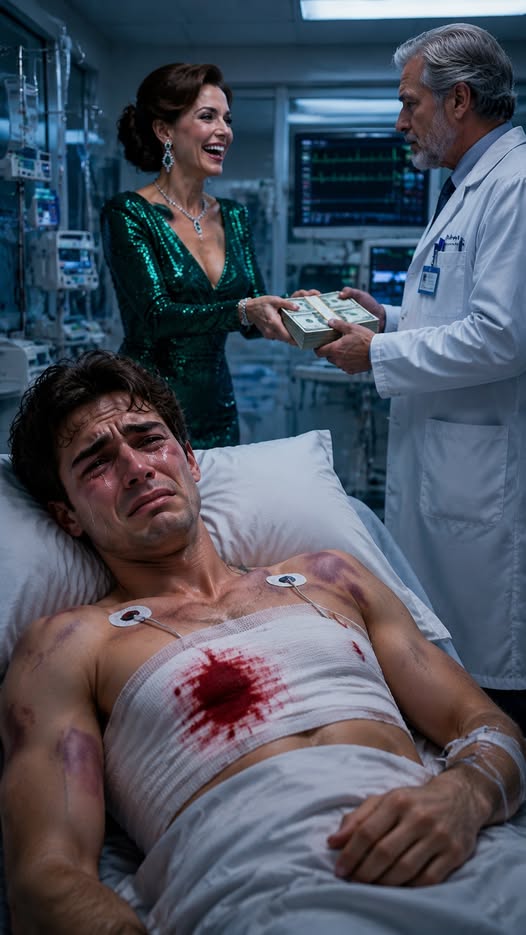
Beatrice stepped into my limited field of vision. She wasn’t wearing hospital scrubs or a visitor’s gown. She was still wearing the emerald dress from the gala, though a tailored black blazer was now draped over her shoulders. Her shadow fell across my face, cold and heavy.
I waited for the tears. I waited for the frantic, maternal touch against my forehead, the desperate pleas for my survival. Even after everything I knew she was, the primal, pathetic part of my brain—the little boy who just wanted his mother to love him—cried out for her comfort.
She didn’t touch me. She didn’t even look at my face.
She turned her attention to the man standing on the other side of the bed. The attending surgeon. He was garbed in blood-spattered blue scrubs, his face completely obscured by a surgical mask, a cap, and heavy magnifying loupes.
Beatrice reached into her designer handbag and pulled out a thick, leather-bound envelope. The sound of the heavy envelope slapping against the metal tray of bloody instruments was the loudest thing in the room.
“There’s two million in offshore accounts in there, Doctor,” Beatrice whispered.
Her voice wasn’t shaking. It wasn’t thick with grief. It was purely transactional. Ruthlessly efficient. It was the exact same tone she used to auction off paintings.
“Just let him bleed out.”
The words hung in the sterile air, freezing the blood in my veins. My heart monitor spiked—beep-beep-beep-beep—betraying my internal, screaming panic, but I couldn’t move a single muscle.
Beatrice looked down at me then. Her eyes were flat, devoid of any warmth, any hesitation, any humanity.
“His brother needs that heart tonight,” she continued, her voice echoing in the hollow canyon of my ruined chest. “And honestly… Preston is the son we actually love.”
No.
The syllable echoed in my mind, over and over. It was the ultimate, gut-wrenching betrayal of blood. She hadn’t just arranged the hit-and-run to silence me; she had orchestrated it to harvest me. I wasn’t her son. I was a biological repository. Spare parts for the child she deemed worthy.
The surgeon looked at the envelope. He looked at Beatrice. Then, slowly, silently, he nodded.
He reached out and took the leather envelope, slipping it into the pocket of his scrubs. Then, he grabbed the edge of the heavy privacy curtain and pulled it shut with a sharp, violent clack, sealing us off from the rest of the ICU.
Beatrice turned and walked out, her heels clicking away, leaving me to die.
I was drowning in my own despair. My mother had just ordered my execution. The monitor continued to beep, a countdown to my murder. The surgeon turned his back to the door and slowly looked down at me.
He reached up, pulling off the blood-spattered surgical mask. Then he stripped away the heavy surgical loupes.
My terrified, dilated eyes widened to their absolute limits.
It wasn’t a cartel doctor. It wasn’t a corrupt surgeon on the Blackwell payroll.
Looking down at me, his rugged face etched with a mixture of grim satisfaction and intense urgency, was Ranger Hayes.
He leaned in close to my ear, his breath warm against my freezing skin, his voice barely a murmur over the hissing of the ventilator.
“She just handed us the final piece of evidence, kid,” Hayes whispered, his eyes locked on mine. “Conspiracy to commit murder. Bribing a medical official. It’s an airtight life sentence.”
He reached toward the central line connected to my neck.
“But to make this stick, Caleb, the world has to believe you died on this table ten minutes ago.”
Hayes’s hand clamped down on a heavy syringe filled with a cloudy liquid, moving it toward my IV port. I tried to scream, but the world tilted on its axis, the beeping of the monitor stretching into a long, continuous tone as darkness rushed up to swallow me whole.
Chapter 3: Ghost in the Machine
I was a dead man sitting in a dusty, off-the-grid safe house in the barren wastes of the West Texas desert.
The heat outside was a shimmering, oppressive blanket, but inside, the air conditioning rattled aggressively, keeping the room cooled to a crisp sixty-five degrees. The only light came from the blue glow of six high-definition computer monitors stacked across a folding table.
I sat in a cheap swivel chair, my torso bound tight in stiff white bandages, heavily medicated but vibrating with a cold, terrifying clarity. The physical agony of my fractured ribs was nothing compared to the death of the boy I used to be. That boy died on the operating table. The man who woke up here, breathing borrowed air as a ghost, was entirely different. I felt no sorrow. I felt no yearning for a family. I felt only a chilling, calculated desire to rip the Blackwell empire apart brick by bloody brick.
On the center monitor, I watched a live, high-altitude drone feed of my own funeral.
It was a lavish, sickeningly opulent affair at the Dallas Memorial Gardens. The closed casket—filled with fifty pounds of sand and overseen by a medical examiner on Hayes’s covert payroll—was draped in a bed of white lilies.
I zoomed the camera in. There she was. Beatrice. She was wearing a stunning black veil, dramatically dabbing her perfectly dry eyes with a silk handkerchief for the benefit of the local press cameras. Next to her, Preston sat in his wheelchair beneath a black umbrella, looking less like a grieving brother and more like a man annoyed by the humidity.
You missed your payday, Mother, I thought, taking a slow, painful sip of black coffee. And now, you’re starving.
I shifted my attention to the adjacent monitors. Over the past seventy-two hours, operating as a ghost, I had completely infiltrated the Blackwell secure servers. I was in their bank accounts, their encrypted messaging apps, their logistics software.
I watched their empire begin to bleed.
With a few keystrokes, I had frozen three of their offshore accounts, triggering automatic money-laundering audits. I had subtly altered the shipping coordinates of their black-market surgical equipment, sending millions of dollars of hardware to an empty lot in Nebraska. I was watching them panic in real-time. The encrypted chatter I was intercepting was frantic. Beatrice was losing control.
Suddenly, a high-priority red alert flashed across my terminal.
I leaned in, my heart rate accelerating. I had set a specific algorithm to flag any medical logistics regarding Preston’s blood type and tissue match. I cracked the encryption on the incoming message in less than a minute.
My blood ran cold.
Subject acquired. Match confirmed. Transit to Refinery Sub-Level 4. Prep theater for 23:00 hours.
Since my heart was supposedly crushed in the staged hit-and-run, Preston’s biological clock was out of time. Beatrice hadn’t just accelerated her plans; she had bypassed the entire vetting process. She was desperate.
I hacked into the local transport feed and pulled up the GPS coordinates attached to the message. It was a Blackwell Foundation charity van, currently moving through the impoverished sector of South Dallas. They had abducted someone off the street. An undocumented immigrant, someone society wouldn’t immediately miss, whose only crime was having a heart that perfectly matched my rotting brother’s.
The surgery was scheduled for tonight at their primary underground clinic, hidden beneath an abandoned Blackwell oil refinery on the outskirts of town.
They were going to carve an innocent person open in less than three hours.
I picked up my burner phone, my fingers flying across the keypad to dial Hayes. He answered on the first ring.
“Tell me you have something,” Hayes barked, the sound of sirens wailing faintly in his background.
“We have a location. We have a victim,” I said, my voice steady as steel, devoid of any tremor. “Refinery Sub-Level 4. They’re moving the donor now. We breach the compound tonight.”
“I’ll scramble the tactical units,” Hayes said. “Stay put, Caleb. We’ll extract the victim and bag your mother. You’ve done your part.”
I looked at the monitor. The drone feed showed Beatrice’s black limousine pulling away from the cemetery, heading straight for the refinery. She thought she had won. She thought she was a god.
“The extraction won’t go as planned, Hayes,” I said, reaching over to the metal table beside me and picking up the heavy, black Glock 19 he had left for my protection. I racked the slide, chambering a round.
“What are you talking about? Caleb, stand down. You’re legally dead. You’re recovering from massive trauma.”
“I’m going in first,” I said, slipping the weapon into my holster and grabbing my keys. “She spent my whole life treating me like a ghost. Tonight, she’s going to see one.”
I hung up the phone, the silence of the safe house rushing back in. On the monitor, the GPS dot of the kidnapping van vanished into the underground network. The clock had struck zero.
Chapter 4: The Lazarus Gambit
The air beneath the abandoned refinery was thick with the smell of sulfur, old oil, and the sharp, terrifying tang of industrial bleach.
I moved through the dimly lit, concrete corridors of Sub-Level 4, leaning heavily on a steel cane I’d scavenged from the safe house. Every step sent a jolt of white-hot agony through my fractured ribs, but the pain was fuel. It was the only thing anchoring me to the earth.
Above me, all hell was breaking loose. Muffled explosions and the staccato popping of suppressed gunfire echoed down the elevator shafts. Ranger Hayes and the tactical units were breaching the upper levels, sweeping through the sterilized, white-tiled corridors, arresting the black-market surgeons and heavily armed cartel guards Beatrice had hired to protect her golden goose.
But I didn’t care about the guards. I didn’t care about the surgeons. I was making a beeline for the central operating theater.
Red emergency lights began to strobe furiously in the corridor, bathing the subterranean bunker in a hellish, pulsing glow. Alarms wailed, a deafening mechanical scream.
I reached the heavy, reinforced steel doors of the main operating room. The electronic keypad was locked down. I didn’t bother trying to hack it. I pulled back my heavy boot and kicked the magnetic release panel with every ounce of strength I had left. The mechanism sparked, groaned, and gave way.
The steel doors hissed open.
The room inside was a nightmare rendered in pristine, stainless steel. In the center of the room, strapped down and heavily sedated, was a young, terrified Hispanic man, his chest already swabbed with iodine, prepped for the first cut.
Standing on the far side of the surgical table, trapped like rats in a sterilized cage, were Beatrice and Preston.
Preston was cowering in his wheelchair, clutching his chest, his eyes wide with a pathetic, whimpering terror as the sounds of the Rangers battling in the hallways grew louder. Beatrice, however, was a portrait of cornered fury. Her hair, usually perfectly coiffed, was disheveled. She was screaming into a cell phone, threatening lawyers, politicians, anyone she thought her blood money still controlled.
The room fell dead silent as I stepped through the doorway.
The red emergency lights washed over my face. I was pale, sweating, my jaw covered in a dark scruff, the surgical bandages visible beneath my open jacket. I leaned on the cane, the Glock resting comfortably on my hip.
Beatrice’s jaw dropped. The cell phone slipped from her trembling fingers and shattered against the bloody tile floor. All the aristocratic composure, the untouchable arrogance, completely drained from her face. She was staring at a corpse.
“You’re… you…” Beatrice stammers, her voice cracking, her eyes darting to my chest and back to my face. “I saw you. You bled out on the table.”
Preston let out a high-pitched, reedy gasp, pushing his wheelchair backward until it slammed into the wall. “Ghost,” he whispered, coughing violently. “It’s a trick.”
I stepped fully into the light, my boots leaving bloody, dusty tracks on her pristine floor. I reached into my jacket with my free hand, pulled out the thick, leather-bound envelope she had given Hayes, and tossed it. It hit the floor at her feet, bursting open. Two million dollars in bearer bonds and banking codes scattered across the tiles, worthless paper soaked in the iodine that dripped from the table.
“I’m afraid I have a stronger heart than you thought, Mother,” I said, my voice echoing off the tile, cold and hollow. I pointed the tip of my cane at Preston, who was hyperventilating. “And right now, it’s the only one in this room that isn’t rotting.”
Beatrice looked at the money, then up at me. The realization of what I had done—the sabotage, the frozen accounts, the raid—crashed down on her. I hadn’t just survived; I was the architect of her absolute ruin.
“You did this,” she hissed, her shock curdling into a feral, rabid hatred. “You ungrateful, pathetic little parasite! Everything we built, the Blackwell legacy, you destroyed it because you were jealous of your brother!”
“I destroyed it because you’re a monster,” I replied evenly. “And because the world doesn’t need any more Blackwells.”
The heavy footfalls of tactical boots thundered down the hall outside. The Rangers were seconds away. Beatrice knew it was over. She knew she was going to spend the rest of her life in a concrete box.
Her eyes darted frantically around the room, wild and cornered. They locked onto a silver tray beside the operating table. Resting on it was a stainless steel surgical scalpel, razor-sharp and ready for the harvest.
With a feral, guttural scream that sounded less human and more like a dying animal, Beatrice lunged forward. She grabbed the scalpel, bypassing the sedated boy on the table, and launched herself directly at me, the blade aimed straight for my throat.
When cornered animals panic, they bite.
My training, the months of undercover survival, kicked in. I didn’t retreat. I dropped the cane.
My hand whipped to my hip, drawing the heavy firearm I swore I would never use against my own blood. I raised the Glock 19, thumbing off the safety, and leveled the tritium sights dead center between my mother’s eyes.
“Do it,” I whispered.
She froze. The tip of the scalpel was trembling violently, an inch from my jugular. We stood there in the flashing red light, a mother and a son, bound by nothing but violence and a loaded gun.
The silence stretched, heavy and suffocating, until the safety of the gun seemed to echo louder than a bomb.
Chapter 5: Echoes in Concrete
I didn’t pull the trigger.
I didn’t have to. The heavy steel doors behind me burst open, and Ranger Hayes stormed into the room, flanked by four heavily armored tactical officers. A barrage of laser sights immediately painted Beatrice’s chest.
“Drop the weapon! Drop it now!” Hayes roared, his rifle shouldered.
Beatrice looked into my eyes for one long, trembling second. She wasn’t looking for mercy; she was looking for the weak, desperate boy who used to crave her affection. But that boy was dead, buried in a closed casket in Dallas. She saw nothing but a void looking back at her. The scalpel slipped from her fingers, clattering loudly against the tiles. She fell to her knees among the scattered bearer bonds, sobbing not out of remorse, but out of absolute defeat.
Six weeks later, the West Texas wind was howling outside the reinforced concrete walls of the Federal Correctional Institution in Beaumont.
I sat in a hard plastic chair, the fractured ribs finally beginning to knit together, leaving deep, aching scars across my torso. But for the first time in my life, breathing didn’t hurt. The crushing weight of the Blackwell legacy had been lifted.
I looked through the thick pane of smudge-proof, reinforced glass.
Beatrice sat opposite me. She was unrecognizable. The emerald gowns and designer blowouts were gone, replaced by a scratchy orange jumpsuit. Her hair was entirely gray, brittle, and unkempt. Without her wealth, her makeup, and her power, the aristocratic venom that had defined her was entirely stripped away, revealing a pathetic, hollow shell of a woman.
Preston hadn’t fared any better. Stripped of his illegal donor access and the family’s blood money, he had been transferred to a standard state hospital. He was placed at the very bottom of the legal organ donor registry, facing the grim, natural consequences of his illness. He wouldn’t last the winter.
Beatrice picked up the heavy black receiver on her side of the glass. Her hands were shaking violently. I slowly picked up mine.
“Caleb,” she rasped, her voice a desperate, wheezing whisper. “Caleb, please. You have to talk to the judge. The cartel… the people I owed money to, they have connections inside here. I’m not safe. Tell them you lied. Tell them it was Hayes. I’m still your mother. We are family.”
I sat in silence, just looking at her. I waited for the pang of guilt. I searched my soul for that lingering thread of obligation, the trauma bond that had chained me to her for nearly three decades.
I felt nothing. Just a strange, profound emptiness. A peaceful, echoing quiet.
She wasn’t a monster of myth. She wasn’t an untouchable titan of industry. She was just a pathetic, greedy woman terrified of the dark she had created.
“Say something!” she shrieked, slamming her palm against the glass, leaving a greasy smear. “You owe me your life!”
“I paid for my life on the table, Beatrice,” I said quietly.
I didn’t hang up the receiver. That would have given her the satisfaction of an angry reaction. Instead, I simply reached forward and pressed my index finger firmly against the disconnect button on the metal console.
The line went dead with a sharp click.
I stood up, adjusting my jacket over my healing ribs, and turned my back on her. Through the thick glass, I could see her mouth wide open, screaming silently, banging her fists against the barrier as I walked away, her voice forever muted in my world.
I stepped out of the heavy prison doors into the blinding, beautiful Texas sunlight. I took a deep, dragging breath of free air. The scent of hot asphalt and sweet mesquite filled my lungs. I was finally, truly free.
But my moment of peace was abruptly shattered.
Tires squealed as a black, unmarked SUV aggressively hopped the curb, skidding to a halt inches from where I stood. The tinted passenger window rolled down. Ranger Hayes leaned out, his face paler and grimmer than I had ever seen it.
He kicked the passenger door open.
“Get in,” Hayes barked, his eyes scanning the prison parking lot with paranoid intensity. “Your mother made a deal with the cartel before we locked her up, Caleb. And they just put a two-million-dollar bounty on the man who took her down.”
I stared at him, the heat radiating off the black paint of the SUV, realizing the game wasn’t over. It had just leveled up.
Chapter 6: Dust and Badges
The sun was bleeding a deep, bruised purple over the sprawling, dusty cemetery on the outskirts of Austin. The cicadas were humming a low, electric drone in the stifling twilight heat.
It had been one year to the day since the hit-and-run. One year since Caleb Blackwell ceased to exist.
I stood in the dry grass, the wind tugging at the lapels of my dark suit. Pinned securely to my breast pocket, catching the fading sunlight, was the polished silver star of a Texas Ranger. I had earned it the hard way—surviving a six-month cartel manhunt, dismantling their network alongside Hayes, and proving that the blood in my veins didn’t dictate the man I chose to be.
I looked down at the polished marble headstone at my feet.
Caleb Sterling Blackwell.
Beloved Son and Brother.
May He Rest in Peace.
It was a beautiful lie carved into expensive stone. Beneath the dirt was nothing but fifty pounds of sand and the rotting remnants of a legacy I had burned to ash. Beatrice was serving three consecutive life sentences in solitary confinement. Preston had died quietly in a state ward eight months ago, his heart finally giving out, surrounded by strangers instead of the victims his mother would have slaughtered to save him.
I reached into my pocket and felt the cold, heavy metal of a gold signet ring. It bore the Blackwell family crest—a rearing stallion over an oil derrick. It was the ring Preston had always coveted. It was the ring my mother used to press into hot wax to seal her bloody, off-the-books contracts. The Bureau had released it to me as personal effects after the asset forfeiture.
I held it up to the dying light. It represented everything I was supposed to be: ruthless, wealthy, and dead inside.
With a swift, practiced motion, I tossed the heavy gold ring. It arced through the air and landed in the dry dirt directly in front of the headstone, disappearing into the dust of my own empty grave.
“Rest in peace,” I murmured to the frightened, unloved boy who used to crave his mother’s affection. He was gone, and he was never coming back.
I turned on my heel, the gravel crunching beneath my boots, and walked back up the hill.
Parked beneath the shade of a massive live oak was an unmarked cruiser. Ranger Hayes was leaning against the hood, a steaming cup of gas station coffee in his hand, watching the perimeter. He tossed the dregs of his coffee into the grass as I approached.
“You good, kid?” Hayes asked, his eyes searching my face for any lingering ghosts.
I looked back at the cemetery one last time, then adjusted the heavy leather holster at my hip. I felt the comforting weight of my sidearm, the badge on my chest, and the undeniable truth that family isn’t who bleeds for you; it’s who stands beside you when the bleeding stops.
“Never better,” I nodded, walking around to the passenger side. “Let’s go to work.”
As I pulled the heavy door shut, the cruiser roared to life, kicking up a thick cloud of Texas dust. We sped away from the graveyard, heading toward the flashing blue and red lights of a new crime scene painting the distant horizon. I looked at my reflection in the side mirror as the darkness swallowed the cemetery. I was a ghost to the world I left behind, but for the very first time in my entire life, I was finally, undeniably alive.
If you want more stories like this, or if you’d like to share your thoughts about what you would have done in my situation, I’d love to hear from you. Your perspective helps these stories reach more people, so don’t be shy about commenting or sharing.