Chapter 1: The Triage of Lies
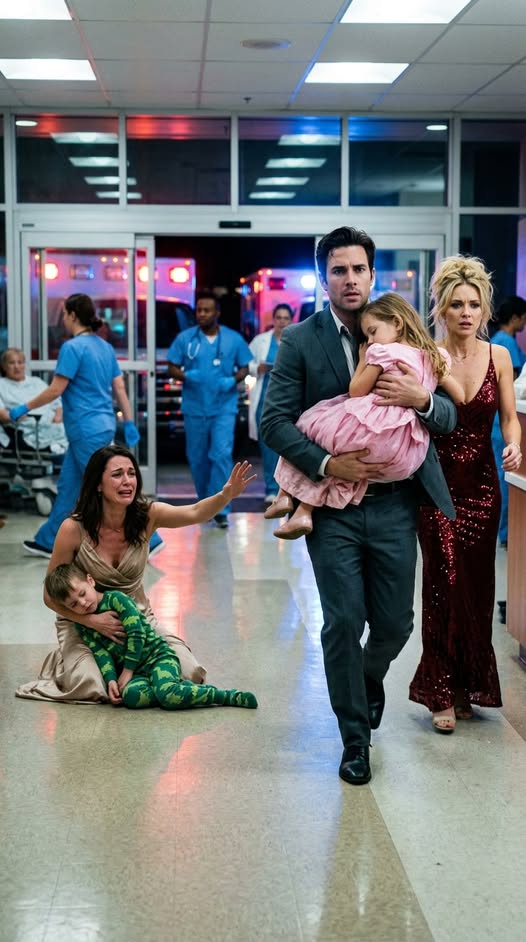
At exactly 2:17 a.m., the sliding glass doors of St. Augustine Medical Center parted like the jaws of a sterile beast. I bolted through them, my bare feet slapping against the polished linoleum, having lost a sandal somewhere in the dark asphalt of the parking lot. In my arms, I carried the epicenter of my universe: my five-year-old son, Noah James Whitmore.
His skin radiated a dry, terrifying heat that seeped through my thin cotton shirt. The thermometer at home had flashed an angry 104.2 degrees before he started vomiting violently in the backseat of my sedan. Then, just two blocks from the glowing red emergency sign, the nightmare escalated. His small, fragile frame went rigid. His eyes rolled back, and the seizing began.
“Please!” I screamed, the sound tearing at my vocal cords as I sprinted toward the triage desk. “Somebody help me! My son is seizing!”
Before the nurses could even stand, the heavy whoosh of the entrance doors sounded again. Heavy footsteps thudded behind me. I didn’t need to look to know who it was. My husband, Daniel, shoved past my shoulder. But he wasn’t reaching for our son. Clutched against his chest was another child.
Lily.
She was six years old, with flushed cheeks and a wet, rattling cough. She was also the daughter of Vanessa Reed—the woman Daniel had been sleeping with for the past year. I had uncovered the sickening truth of his infidelity three months prior, yet I had swallowed the bile and kept the peace. I did it for Noah. I did it to preserve the fragile architecture of our Sunday morning pancake breakfasts and the illusion of a home.
Daniel slammed his palm onto the intake counter, shoving himself ahead of me.
“She can’t breathe right,” Daniel barked at the triage nurse, his voice trembling with a manufactured panic. “Her mother is on the way. I’m her emergency contact.”
I froze, the weight of my convulsing child pulling down on my aching arms. I stared at the side of my husband’s face, a man I suddenly did not recognize. “Daniel,” I gasped, my voice fracturing. “Noah is convulsing. He’s dying.”
He didn’t flinch. He didn’t even turn his head.
The nurse, a woman with tight braids and overwhelmed eyes, looked between us. “Which child arrived first?”
Without a microsecond of hesitation, Daniel pointed to the coughing, conscious girl in his arms. “She did.”
The air in my lungs evaporated. My jaw unhinged, but the words bottlenecked in my throat. I looked at the man who had promised to protect us, watching him weaponize a falsehood while our child’s brain starved for air.
“That’s a lie,” I finally choked out, my voice sounding like broken glass. “He knows that’s a lie!”
Daniel threw a glance over his shoulder. His eyes were a horrifying paradox—brimming with desperate tears, yet fundamentally devoid of warmth. “Claire, Lily has severe asthma,” he hissed, as if I were being unreasonable. “Noah gets fevers all the time. He’ll be fine.”
Right at that moment, Noah’s body arched brutally in my arms, a violent spasm that nearly knocked me off balance.
A second nurse sprinted from the back, shouting for a gurney. But the first available intake slot, the first pediatric doctor on duty, and the only open trauma room went to Lily. Daniel had already slapped Vanessa’s insurance card onto the desk and scrawled his name on the consent forms.
I lost my mind. I screamed until the security guards began to close in, their hands hovering over their radios. “Take my son! God damn it, somebody take my son!”
By the time a resident finally bypassed the protocol and hauled Noah onto a stretcher, his lips had drained of color, turning a horrifying, translucent shade of blue. I ran alongside the gurney, the wheels clattering against the tiles, leaving Daniel behind in the waiting room. The medical staff shouted in a terrifying, clipped staccato around me.
Prolonged seizure. Respiratory compromise. Prepare for immediate intubation.
Twenty minutes later, Daniel’s silhouette appeared in the doorway of the trauma bay. I refused to look at him, but I could smell the sickeningly sweet ghost of Vanessa’s perfume clinging to his wrinkled collar. He opened his mouth to speak, but before he could form a single syllable, the heart monitor beside Noah’s bed emitted a long, shrill, uninterrupted scream.
Chapter 2: The Final Evaluation
At 3:22 a.m., they wheeled Noah into the Pediatric Intensive Care Unit.
Dawn bled through the narrow hospital windows, painting the sterile walls in bruised shades of purple and gray. Dr. Elena Marsh, the attending physician, guided me into a suffocatingly small consultation room. The fluorescent lights buzzed overhead like trapped hornets.
She looked at me, her face etched with the exhaustion of a hundred lost battles, and delivered the sentence that cleaved my existence into a ‘before’ and an ‘after’.
“Noah suffered catastrophic oxygen deprivation during the prolonged seizure,” Dr. Marsh said softly. “We are doing everything medically possible. But, Claire… the delay in treatment mattered.”
The following afternoon, Daniel came tearing down the ICU hallway. He looked feral. His hair was matted, his shirt unbuttoned at the collar, and his eyes were bloodshot from a night spent marinating in his own guilt. He lunged for the door to Noah’s room, begging loudly for forgiveness, demanding to see his boy.
Dr. Marsh stepped directly into his path, her small frame an immovable barricade.
“You’re too late,” she stated. Her voice was devoid of malice, but it rang with absolute, chilling finality.
Daniel blinked at her, his brow furrowing as if she were speaking ancient Greek. He instinctively twisted his gold wedding band—a ring I had slipped off my own finger and dropped into the bottom of my purse the second Noah was intubated.
“What the hell do you mean?” Daniel stammered, peering over the doctor’s shoulder. “I can see the machines through the glass. He’s alive. He’s breathing!”
I stepped out from the shadows of the corridor, my fingers gripping the back of a plastic waiting room chair so fiercely my knuckles ached. Noah was alive only in the most clinical sense of the word. A mechanical ventilator forced air into his lungs. Chemical paralytics kept his limbs motionless. Wires snaked from his pale chest and his tiny, perfect feet. The nurses had cut away his favorite dinosaur pajamas, stuffing the ruined fabric into a plastic belongings bag.
“Your son has no meaningful response to pain stimuli,” Dr. Marsh explained to Daniel, her professional detachment acting as a shield. “The latest scans show extensive, irreversible brain injury. We are waiting on one final evaluation from the neurologist, but you need to comprehend the gravity of this situation.”
Daniel shook his head, retreating a step. “No. No, that’s not right. I need to talk to him.”
A laugh clawed its way up my throat. It didn’t sound human; it sounded like metal scraping against stone. “Talk to him?” I whispered, stepping closer to my husband. “Now?”
He turned to me, his face collapsing in a pathetic display of panic. “Claire, please. I didn’t know it was this bad.”
“You watched him seize in my arms.”
“I thought—”
“You thought your mistress’s child was a priority over your own flesh and blood.”
Daniel’s chest heaved. “Vanessa called me, hysterical,” he pleaded, the words spilling out in a desperate rush. “She said Lily’s rescue inhaler wasn’t working. I panicked, Claire. I made a mistake.”
I closed the distance between us, my voice dropping to a lethal whisper. “Leaving the stove on is a mistake, Daniel. Forgetting an anniversary is a mistake. You looked at our son convulsing, suffocating in my arms, and you looked the triage nurse in the eye and lied so another woman’s child would go first. That is not a mistake. That is a choice.”
“I was terrified Lily was going to die!” he cried out.
“And Noah?” I asked.
Silence swallowed the hallway. For the first time in a year, Daniel had nothing to say. It was the only honest thing he had given me in months.
Footsteps echoed behind him. I looked up to see Vanessa Reed strutting down the ICU corridor. She wore designer athleisure wear, expensive sunglasses pushed back into her highlighted hair, and a perfectly arranged expression of tragic sympathy. Beside her stood Lily, happily clutching a stuffed pink rabbit from the hospital gift shop. Lily was breathing perfectly.
Daniel saw my eyes track them. He panicked. “Claire, please. Don’t do this here.”
“Do what?” I asked, my voice rising. “Acknowledge the truth?”
Vanessa had the audacity to step forward, her chin tipped up defensively. “Listen, Claire, this isn’t my fault.”
I turned my gaze on her. I didn’t yell. I didn’t cry. I wanted to destroy her. “You’re right,” I said methodically. “You didn’t take vows with me. You didn’t carry my dying child into this building and decide his life was worth less than a lie. You are just the symptom. He is the disease.”
Before Vanessa could retort, Dr. Marsh cleared her throat. “Mrs. Whitmore. The pediatric neurologist, Dr. Andrew Patel, will be here in ten minutes.”
Mrs. Whitmore. The name felt like a rotting garment I couldn’t wait to shed.
I looked at Daniel, memorizing the pathetic slump of his shoulders. “You are not going into that room,” I commanded.
“I am his father!” he yelled, stepping forward.
“You were his father at the triage desk!” I roared, the suppressed grief finally detonating. “You were his father when the nurse asked who was here first! You were his father when his brain was starved of oxygen!”
Daniel’s knees buckled. He sank toward the linoleum. “Please,” he sobbed. “I just need him to know I’m sorry.”
My eyes were hot with unshed tears, but my spine was steel. “He needed oxygen, Daniel. He needed a doctor. He needed his father long before you needed his forgiveness.”
When Daniel tried to physically push past Dr. Marsh, security finally intervened. They hooked his arms and dragged him backward. He screamed Noah’s name, the sound echoing off the sterile walls, a horrifying symphony of delayed regret. I didn’t cover my ears. I wanted every nurse, every doctor, every patient on that floor to hear what a murderer sounded like when the bill finally came due.
But the satisfaction was short-lived. Down the hall, the heavy doors swung open, and Dr. Patel walked toward us with a manila folder in his hand, his eyes already conveying the fatal truth.
Chapter 3: The Long Goodbye
The final neurological evaluation occurred at precisely 11:40 a.m.
I will forever remember the time because the cheap plastic wall clock ticked louder than the mechanical hum of the ventilator. Louder than the hiss of the oxygen lines. Louder than the frantic pounding of my own heart.
Dr. Marsh and Dr. Patel stood solemnly on opposite sides of Noah’s bed. A nurse named Monique stood slightly behind me, her hand resting gently on my elbow. She didn’t offer platitudes. She just anchored me to the earth, anticipating the moment gravity would cease to exist for me.
Noah looked impossibly small. His messy brown curls were matted flat against the stark white pillowcase. A piece of cruel medical tape secured the breathing tube to his cheek. His eyelashes were perfectly still, resting against his skin exactly the way they did when he used to fall asleep watching cartoons, claiming he was just resting his eyes.
Dr. Patel spoke with measured, devastating gentleness. “There is no brainstem response, Claire. There is no spontaneous breathing effort. The apnea test has confirmed what the imaging showed us last night.”
I nodded. My neck muscles executed the motion mechanically, though my mind had completely detached from my body.
Dr. Marsh wiped a tear from her own eye. “I am so deeply sorry, Claire.”
No mother ever imagines that the final room she shares with her child will smell of iodine and bleach. I had spent years painting mental pictures of his kindergarten graduation. I had imagined the smell of muddy soccer cleats by the front door. I had braced myself for teenage rebellion and the terrifying prospect of teaching him how to drive.
Instead, a woman in a grey suit handed me a clipboard, and I signed my son’s death certificate with a cheap pen bearing the logo of a pharmaceutical company.
When the respiratory therapist removed the ventilator later that afternoon, I didn’t hesitate. I climbed over the rails and settled into the narrow hospital bed beside him. The nurses silently adjusted the IV lines to make room for me. I pulled his small, limp body onto my chest, wrapping my arms around him just as I had when he was a newborn, back when he weighed less than a bag of flour.
His skin was still warm.
That was the psychological torture of it. That warmth nearly shattered me. He still felt like my little boy.
I pressed my lips into his hair and began to sing the lullaby I used to hum whenever he woke up from a nightmare.
“You are my moon, my morning light…”
My voice cracked, splintering on the last word. I couldn’t finish it.
Outside the room, framed by the glass window of the ICU door, Daniel stood. His palms were pressed flat against the glass, his face contorted in agony. Two security guards stood flanking him. He had begged me to let him in. He had called me cruel. He had called me a monster. And then, finally breaking down, he had called himself a murderer, sliding down the glass until he was a crumpled heap on the floor.
I didn’t blink. I didn’t look away from him. I wanted him to see my arms holding the child he had sacrificed.
When Noah’s heart finally stopped, the room shifted. Nothing changed visually—the curtains still hung in pale blue folds, the monitors were still mounted to the walls. But the atmosphere went dead. The universe possessed one less heartbeat, and the silence was deafening.
I kissed his warm forehead one last time. “Mommy stayed,” I whispered into the quiet room.
I climbed out of the bed, smoothed my wrinkled clothes, and walked out of the room without a backward glance. I bypassed Daniel, who was weeping on the floor, and marched straight through the sliding glass doors into the blistering, blinding Arizona heat. The sun was aggressive, unforgiving. As I stood in the parking lot, feeling the asphalt burn through my socks, the crushing weight of grief began to crystallize into something sharper, something far more dangerous. My sadness was metamorphosing into absolute, blinding rage. I reached into my pocket, pulled out my phone, and dialed the number of the most ruthless attorney in Phoenix.
Chapter 4: The Anatomy of Ruin
Two days later, I walked into the Maricopa County Family Court. I wore a sharp black dress, practical flats, and armor-like indifference. My older sister, Audrey, drove me, because I had stopped trusting my hands not to violently steer my car into oncoming traffic.
The divorce petition was filed and served before we even picked out Noah’s casket.
Daniel received the legal papers at the front door of our home—a home he had been locked out of since the night of the hospital. My father, a retired police sergeant who hadn’t spoken a single syllable to Daniel since learning the truth, had personally changed all the deadbolts.
The legal petition did not mince words. My attorney, Marissa Klein, was a shark in a tailored suit. She cited adultery, profound emotional cruelty, and the reckless, fatal endangerment of a minor. Daniel’s scrambling lawyers attempted to soften the verbiage, begging for a quiet, amicable split.
Marissa just laughed. “Your husband’s actions cross the threshold of family court, Claire,” she told me across her mahogany desk. “The ER has high-definition security footage. The triage desk has a 24/7 audio recording system. The staff heard him claim Lily arrived first. We have grounds for a massive wrongful death lawsuit based on delayed medical intervention.”
I looked out Marissa’s high-rise window, watching the tiny cars navigate downtown Phoenix as if the world hadn’t just ended.
“Do you want to pull the trigger on this?” Marissa asked, her pen hovering over the legal pad.
“Burn him to the ground,” I said, my voice hollow. “All of it.”
Noah’s funeral took place under a suffocatingly white sky. His casket was small, pristine white, draped in a massive spray of blue hydrangeas because blue was the only color he ever wanted to color with. His preschool teacher wept in the front row. The elderly neighbor who used to let Noah feed her stray cats sobbed into her hands.
Daniel arrived twenty minutes late. He wore a wrinkled dark suit and looked as though he had aged a decade in a week. Vanessa, unsurprisingly, was absent. I later found out she had dumped him the night Noah died—not out of a sudden strike of moral clarity, but because a leak in the ER had alerted local bloggers, and she couldn’t stomach the bad PR.
Daniel lingered at the edge of the cemetery, terrified to approach the chairs. But as the service concluded, he began to walk toward me. Audrey stepped forward, ready to physically throw him back, but I held up a hand.
He stopped three feet away. “Claire,” he rasped, his throat sounding ruined. “I know I don’t deserve to speak to you. I know it.”
“You don’t.”
“I just need you to know… I loved him, Claire. I really loved him.”
I studied his face. For a fleeting millisecond, I saw the ghost of the man who had wept tears of joy in the delivery room. The man who had spent three weekends building a crooked wooden train table.
But the ghost vanished, replaced by the memory of his hand slapping Vanessa’s insurance card on the hospital desk.
“You loved him when it was convenient,” I replied, my voice dropping the temperature of the air between us. “You loved him when it was easy. That is fundamentally different than choosing his life when it actually mattered.”
He slapped a hand over his mouth, suppressing a sob. “I can’t live with this in my head, Claire.”
“Then live with that too,” I whispered, turning my back on him.
Six weeks later, the civil litigation began. The facts, stripped of emotion, were damning. The hospital’s security cameras showed me carrying Noah through the doors precisely eighteen seconds before Daniel entered with Lily. The triage audio files crystallized Daniel’s betrayal, capturing my frantic screams overlaid with his calm, deliberate lie: “She did.”
Daniel’s deposition took place in a windowless conference room smelling of stale coffee and fear. I sat at the far end of the long mahogany table. Marissa had advised me not to attend, warning me it would re-traumatize me. But I needed to look into his eyes when he finally admitted it.
Daniel looked small, sunken, a hollow shell of an executive.
“Mr. Whitmore,” Marissa began, her voice perfectly modulated. “Did you know your son was actively convulsing when you approached the intake desk?”
Daniel swallowed hard. “Yes.”
“Did you explicitly state to the triage nurse that Lily Reed arrived before Noah Whitmore?”
“Yes.”
“Was that statement factual?”
“No.”
“Why did you lie, Mr. Whitmore?”
Daniel’s lawyer shifted nervously, throwing out a weak, “Objection to form.”
“He can answer the question,” Marissa snapped.
Daniel squeezed his eyes shut, as if doing so could block out my stare. “Because Vanessa called me on the way… she said if anything happened to Lily, she would ruin my life. I thought Noah would be okay. He had febrile seizures when he was a toddler. I thought… I thought we had time.”
Beneath the table, Audrey’s fingernails dug into my wrist.
Marissa leaned forward. “Had Noah ever seized for that duration before?”
“No.”
“Had he ever turned blue before?”
Daniel’s face twisted in agony. “No.”
“Did your wife scream that he needed immediate help?”
“Yes.”
“And did you choose to ignore her?”
A single tear cut a track down Daniel’s gaunt cheek. “Yes.”
That single syllable sealed his fate. It became the cornerstone of the settlement. The hospital, initially arrogant in their defense, rapidly capitulated when Marissa threatened to take the audio to the six o’clock news. They settled for an undisclosed, astronomical sum and were legally forced to overhaul their pediatric triage protocols.
Daniel, abandoned by his corporate firm and financially decimated by the divorce and the separate civil judgment, was stripped of the house, his savings, and his retirement. He was left with nothing but the clothes on his back and the ghosts in his head.
But as I sat in my new, quiet rental house in Tempe, looking at the zeros in my bank account, the victory tasted like ash. Money couldn’t buy back the sticky fingerprints on my refrigerator. Money couldn’t resurrect a heartbeat.
The legal war was over. The villains were punished. But as the dust settled, I realized the hardest part wasn’t destroying the man who killed my son; it was figuring out how to survive the silence he left behind.
Chapter 5: The Weight of Blue
A year to the exact date of Noah’s death, I drove my car back into the parking lot of St. Augustine Medical Center.
I didn’t come for closure. I didn’t come to absolve anyone. I came because the hospital administration, as part of their mandated settlement protocol, had invited me to be the keynote speaker at a mandatory retraining seminar for all emergency intake staff.
Audrey walked beside me, our heels clicking in unison against the linoleum floors I had run across barefoot twelve months prior. We entered a massive auditorium packed with nurses, residents, administrators, and security guards. Sitting in the front row was Dr. Marsh. Two seats down was Monique, the nurse who had anchored me when the world spun out of control.
I stepped up to the wooden podium. I unfolded a single piece of paper, my hands shaking so violently the paper rattled against the microphone. For ten agonizing seconds, I looked out at the sea of scrubs and white coats, completely mute.
Then, I pressed a button on the remote, and the projector illuminated the massive screen behind me. It was a photograph of Noah. He was wearing his bright red raincoat, grinning wildly, holding a muddy blue toy truck.
The room went instantly, deathly still.
“My son’s name was Noah James Whitmore,” I began, my voice echoing through the cavernous space. “He was five years old. He believed dinosaurs lived in the desert, he insisted on eating blueberry waffles for dinner, and he always asked me if the moon was following our car when we drove at night.”
I looked directly at the triage nurses sitting in the second row.
“He arrived at your emergency room in respiratory crisis. He was actively seizing. His father lied to your staff. And a system, built to save lives, chose to believe the adult who sounded the most confident, rather than visually assessing the mother holding a child whose body was literally failing.”
My voice wavered, threatening to break, but I forced the steel back into my spine.
“I am not standing here to call you evil,” I continued. “I am here to tell you that seconds are the difference between life and death. Assumptions are lethal. A child who cannot speak for himself still needs someone to actually look at him. Do not look at a clipboard. Do not look at an insurance card. Do not listen to the loudest adult in the room. Look at the patient.“
I saw Dr. Marsh pull a tissue from her pocket and press it to her eyes.
“Noah does not get a second chance,” I said, letting the finality of the words hang in the air. “But because of what happened here, the next child might.”
When I stepped back from the podium, there was no polite applause. The silence was heavy, reverent. Then, slowly, Monique stood up. Dr. Marsh stood next. Row by row, the entire auditorium rose to their feet in absolute silence.
I didn’t smile. But deep in my chest, a tight, suffocating knot that I had carried for a year finally began to loosen. It wasn’t healing. Not yet. But it was space to breathe.
Outside, the desert sun was blinding. Audrey hooked her arm through mine as we walked to the car. “You were incredible up there, Claire,” she murmured.
I reached up and touched the silver pendant resting against my collarbone. It held Noah’s thumbprint, pressed into the metal by the funeral director before they closed his casket. “I was his mother,” I replied. “That’s the only thing that matters.”
That evening, as the sky bruised into twilight, I drove out to the cemetery alone.
The grass around Noah’s headstone had grown in thick, violently green against the arid desert backdrop. As I approached, I noticed a small object resting on the granite base. It was a miniature, die-cast blue toy car.
I stopped. I knew exactly who had left it. Daniel occasionally visited, always sneaking in at dawn or dusk when he knew I wouldn’t be there. The groundskeeper had mentioned seeing a man matching his description, sitting in the dirt and crying for hours.
A year ago, I would have picked up that toy car and hurled it over the wrought-iron fence. I would have felt the venom rise in my throat. But today, I just looked at it.
Noah loved blue cars. That simple, innocent truth mattered infinitely more than Daniel’s pathetic attempts at penance.
I spread a blanket over the grass, sat down, and placed a fresh bundle of hydrangeas next to the stone.
“Hi, baby,” I whispered, tracing the engraved letters of his name with my index finger. “Mommy talked about you to a lot of people today.”
A warm evening breeze rustled the leaves of a nearby Palo Verde tree. Beyond the cemetery gates, the faint, distant sound of a child laughing echoed through the air. I closed my eyes, letting the sound wash over me.
The agonizing pain was still there. I knew it would always be there, woven into the fabric of my DNA. But it no longer felt like that chaotic, fluorescent-lit hospital hallway, echoing with Daniel’s frantic lies.
It felt different now. It felt like weight. It was a heavy, permanent stone I would carry for the rest of my life, but my legs were finally growing strong enough to bear it.
I looked up at the sky as the sun finally slipped behind the jagged Arizona mountains. The horizon ignited, fading into the exact, brilliant shade of blue Noah always reached for first in his box of crayons.
“I made sure they knew you came first,” I whispered into the twilight. “I made sure they knew.”