Chapter 1: The Ultimatum at Dawn
The digital clock on the nightstand flashed 7:13 a.m. when the phone began its aggressive, rhythmic vibration. I didn’t answer immediately. Instead, I stood frozen on the cold tile of the hotel bathroom, my tuxedo jacket hanging like a hollow ghost on the back of the door. I stared at the caller ID glowing with a deceptive simplicity: Dad.
It was a title that had masqueraded as safe for thirty-one years, even when the man wielding it used his voice like a gavel. I let the phone ring until the screen went black. Then, a second later, it flared to life again. A cold dread coiled in my gut, making my hands tremble as I finally swiped the green icon and brought the speaker to my ear.
“Caleb,” he said. His tone was perfectly flat, devoid of any morning warmth. “Your mother and I are not coming.”
For a prolonged, suffocating second, the only sound in the universe was the mechanical hum of the exhaust vent above my head. I looked at myself in the mirror, searching for the boy who used to shrink under this tone, but finding only a tired groom with dark circles under his eyes.
“Because of Mia?” I asked, though I already knew the answer.
“Because you are making a colossal mistake,” he dictated, his voice echoing the rigid certainty he used to run his construction empire. “A single mother is not a fresh start, Caleb. She is inherited baggage. An anchor wrapped in a veil. She will sabotage your potential, and one day, when the romance fades, you will remember that I stood here and warned you.”
My mouth went completely dry, tasting of ash and stale adrenaline.
Mia had never asked me for anything except honesty. She had never demanded me to be smaller, quieter, or more compliant—things my father required daily. And her daughter, Lily, a six-year-old hurricane of crooked pigtails and a charming gap where her front tooth had recently vacated, was the furthest thing from a burden. Only last week, Lily had carefully saved me the singular, slightly bruised strawberry from her school lunchbox. When I asked her why, she had patted my hand and whispered, “Because grown-ups get sad too, and strawberries fix it.”
“She’s going to be my wife,” I said, my voice hardening, forcing the tremor out of my throat.
“And that child will never be ours,” my father replied.
That sentence didn’t just cut; it felt as if a fault line had cracked open right through the center of my chest. There was no negotiation to be had with a wall of stone. I pulled the phone away from my face and ended the call without a goodbye, severing the line before he could hear my breathing hitch.
Five hours later, the historic chapel in Savannah, Georgia, was a sensory overload of blooming white roses, flickering candlelight, and heavy, suffocating anticipation. The pews were packed with friends and Mia’s extended family, but my eyes were locked on the second row on the groom’s side. It was a glaring, empty cavern. My younger sister, Hannah, sat at the far edge of that void, crying quietly into a crumpled tissue. She had defied his draconian orders to be here, but the empty space beside her screamed louder than the string quartet playing in the balcony.
I stood at the altar, my heart pounding a frantic rhythm against my ribs. Mia was sequestered behind the heavy mahogany doors at the back of the chapel, but Lily was already visible in the vestibule, looking like an angel in a tiered white dress and scuffed silver shoes. She was supposed to walk before the bride, elegantly scattering petals from a wicker basket.
The music shifted, swelling into a soft, melodic crescendo. Everyone turned in their seats, phones raised, smiles prepared.
The heavy doors opened fully, but Lily wasn’t holding the basket of petals. Instead, she was dragging something massive. The collective gasp that rippled through the congregation made my blood run instantly cold.
Chapter 2: The Sign That Stopped Time
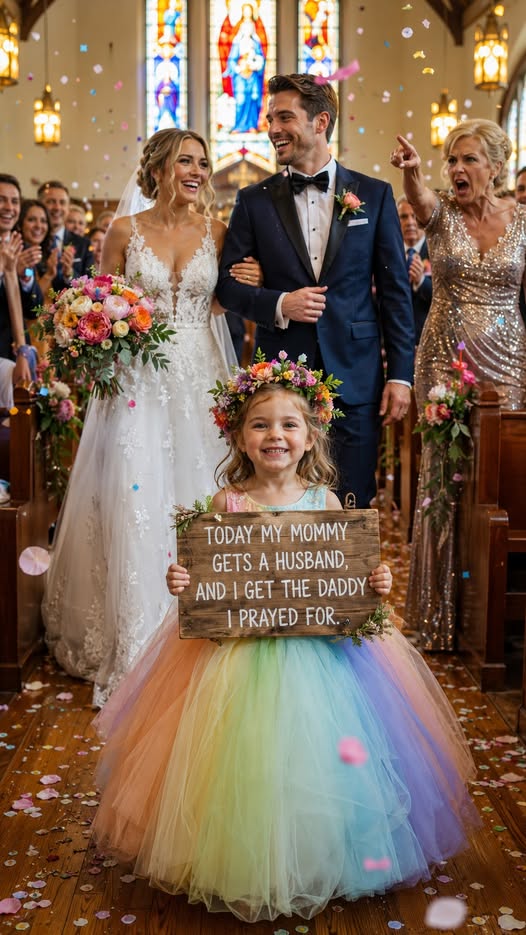
Lily stepped forward into the aisle. Her golden curls bounced with each deliberate, slow step. Her tiny, pale hands were gripping a large, reclaimed wooden sign that was nearly as broad as her chest. At first, a ripple of fond laughter washed over the back rows. She looked fiercely serious, marching forward like a tiny, uncompromising judge entering a courtroom.
But as she progressed, the front rows leaned in to read the words painted in slightly wobbly, purple cursive.
The atmosphere in the room shifted violently.
It wasn’t just a gasp; it was a physical wave of emotion, something vastly heavier and deeply visceral. I saw Hannah cover her mouth with both hands, her shoulders shaking. Beside me, my best man, Marcus, aggressively cleared his throat, turning his face toward the stained-glass windows as he hurriedly wiped his cheeks.
Then, she was close enough for me to read it.
The sign proclaimed:
“Today my mommy gets a husband. And I get the daddy I prayed for.”
My knees betrayed me, nearly buckling against the polished hardwood floor.
Lily stopped squarely in front of me, lowered the heavy wooden board to the ground, and tilted her chin up. Her massive, expressive eyes searched my face. “Can I call you Dad after this?” she whispered, her voice trembling just slightly, betraying the vulnerability beneath her brave march.
I forgot the meticulously planned schedule. I forgot the hired videographers, the staring guests, and the hauntingly empty pew on my right. I dropped into a deep crouch, heedless of the tailored tuxedo pants, and pulled her small, fragile frame into my arms, burying my face in her curls.
Someone in the third row filmed that exact, shattered moment.
Forty-eight hours later, that shaky, cell-phone footage had amassed eleven million views.
I had been entirely oblivious to the camera during the reception. By the time the sun set, I had married Mia under a canopy of soft gold light, with Lily aggressively refusing to sit in the front row, opting instead to stand directly between us during the exchange of rings. When the officiant finally declared, “You may kiss the bride,” Lily had urgently tugged on my sleeve, announcing to the entire room, “Me too!” The chapel had erupted in tearful laughter as I kissed Mia’s lips, then scooped Lily into my arms to kiss her cheek.
For one flawless, insulated hour, I had completely forgotten the phantom echo of my father’s voice.
Then, halfway through the plated dinner, my phone began vibrating continuously against my thigh. I ignored it, assuming it was a delayed flood of congratulatory texts. But Marcus leaned across the white linen tablecloth, his own phone illuminated in his hand, his expression uncharacteristically grave.
“Man,” Marcus said cautiously, sliding his device toward my plate. “You need to see this.”
It was a video uploaded to an app by my cousin’s wife. The caption was simple: “When a little girl explains what family really means.”
The footage was staggering in its raw intimacy. It captured the flash of Lily’s silver shoes, the exact, devastating moment the congregation read her sign, and the second my stoic facade broke wide open. It captured a man hugging a child as if he had been wandering a desert his entire life, only just now finding water.
By midnight, the counter hit 80,000. By our first breakfast as a married couple, it was at 1.6 million.
Thousands of strangers were pouring their hearts into the comment section. Construction workers admitted to weeping in their trucks; single mothers wrote that the video restored their shattered faith in finding love; men who had been raised by stepfathers penned long, agonizingly beautiful tributes to the men who chose them.
Mia sat on the edge of our unmade hotel bed, clutching her robe tightly around her waist, tears tracking silently down her face as she scrolled. “I didn’t want people to pity her,” she whispered, her voice thick with worry.
“They don’t, Mia,” I assured her, sitting beside her and pressing a kiss to her temple. “They see her. They see how incredibly brave she is.”
But the internet is a mirror that reflects the ugly alongside the beautiful. A few comments were venomous—faceless trolls accusing Mia of manipulating her child for clout, mocking me for being a naive savior, and dragging out the very words my father had used: baggage, mistake, ruined life.
Mia tried to lock the screen, but I saw the violent tremor in her fingers. I reached out, gently prying the device from her grasp.
“My dad said those exact things,” I told her, holding her gaze steadily. “That doesn’t make them gospel. It just makes them cruel.”
She looked up at me, her eyes clouded with a deep, paralyzing exhaustion. “What happens, Caleb… what happens when this gets back to him?”
Before I could formulate a comforting lie, my phone on the nightstand illuminated the darkened room. It wasn’t a notification. It was a call. And it wasn’t from my father.
It was from my mother.
Chapter 3: The Echo of an Empty Pew
I stepped out onto the wrought-iron balcony of our suite, pulling the glass door firmly shut behind me. Down below, Savannah moved at a glacial, humid pace. Horse-drawn carriages rolled past centuries-old brick facades, and Spanish moss hung from the live oaks like tattered gray lace swaying in the heat.
“Hello, Mom,” I said.
Her voice was miniature, hollowed out, almost completely unfamiliar. “Caleb… we saw the video.”
I gripped the black iron railing. “Okay.”
A heavy, suffocating silence stretched across the cellular network.
“Your father hasn’t said much about it,” she continued, her breathing erratic. “But I… I cried, Caleb. I watched it five times in the kitchen.”
I offered her no absolution. I stared out at the shimmering pavement below.
“I didn’t know she was going to ask you that,” she stammered.
“Neither did I, Mom. That’s the thing about genuine love. It isn’t scripted.”
Another painful pause. Then, she asked the question that was tearing her apart. “Was… was the empty pew visible to everyone?”
I closed my eyes, letting the midday sun burn against my eyelids. “Yes. It was the loudest thing in the room.”
She began to sob then, a wretched, muffled sound that told me she had been swallowing this grief for two agonizing days. “I am so sorry,” she wept. “I should have been there. I should have…”
A deeply buried part of my soul—the little boy who perpetually waited for his mother to defend him, to choose him over her husband’s wrath—wanted to forgive her instantly. But I was no longer just a son. I was a husband. I was a father.
“You hurt them too, Mom,” I said, my voice dangerously calm. “You didn’t just abandon me.”
“I know,” she whispered brokenly.
Suddenly, there was a scuffle of noise on the other end. A sharp, commanding voice barked in the background. “Give me the phone, Elaine.”
The muscles in my neck tightened.
“Caleb,” my father’s baritone voice boomed through the speaker.
I waited, letting the silence serve as my shield.
“Caleb,” he repeated. For the absolute first time in my thirty-one years of existence, Robert sounded fundamentally unsure of his footing.
Behind me, through the glass door, I could see Mia kneeling on the carpet, helping Lily decide between room-service waffles or pancakes. Lily was completely oblivious to the war happening outside, singing a fabricated, off-key song about being the “Flower Girl Champion of the Universe.” It was a symphony of ordinary, spectacular noise.
My father cleared his throat, trying to regain his manufactured authority. “I saw the video.”
“I heard.”
He exhaled heavily through his nose. “It seems everybody has seen this video. The entire country is watching our family business.”
There it was. Not an acknowledgment of my pain. Not an ounce of remorse for his absence. Just a paranoid obsession with how the public perceived his immaculate reputation.
“Dad,” I interrupted, cutting through his rising lecture. “I am standing on a balcony on my honeymoon morning with my wife and my daughter. Say what you actually called to say, or I am hanging up.”
The line went dead quiet. Then, he snagged on a single word. “Daughter?”
I looked through the glass. Lily had maple syrup smeared across her chin and one pink sock slipping halfway off her foot.
“Yes,” I stated, iron-clad. “Daughter.”
“She is not legally—”
“She will be,” I snapped, raising my voice over his. “When the time is right, when Mia says it’s right, and when Lily fully comprehends what a judge’s gavel means. But in every conceivable metric that matters to me, she is my daughter.”
My father weaponized his silence. All my life, I had been conditioned to fear this exact quiet. It was a silence that filled rooms and suffocated the oxygen. When I was seventeen and dared to suggest I wanted to study architecture instead of inheriting his construction firm, his silence had lasted three agonizing days. I had folded, changing my major just to make the coldness stop.
But standing in the Savannah heat, his silence felt utterly powerless. I had a kingdom on the other side of the glass.
Finally, he spat the venom. “You embarrassed us.”
I almost laughed, but the sound morphed into a harsh exhale. “No, Dad. You embarrassed yourselves. You chose the empty pew. Lily didn’t construct it. Mia didn’t buy it. I didn’t enforce it. You built your own monument to pride, and the whole world saw it.”
“You honestly think a six-year-old understands the gravity of what she did?” he challenged.
“She understands grace far better than you ever have.”
His voice turned lethal. “Watch your tone, boy.”
I stared down at the street, watching strangers carry iced coffees and walk their golden retrievers, completely unaware that a man three stories up was presently dismantling his own history.
“No,” I said.
It was a singular syllable, but it felt like kicking down a steel door.
“No?” he echoed, genuinely shocked.
“No. I will no longer monitor my tone while you blatantly insult my wife and my child. I shrank myself for decades so you could feel towering and respected. I allowed you to label your manipulation as ‘wisdom.’ That contract expired the second you told me Lily would never be yours.”
My father breathed in ragged, furious hitches. My mother’s faint, tearful voice pleaded in the background, “Robert, please, stop.”
He ignored her. “You are carelessly throwing away your own blood for another man’s abandoned child.”
I pivoted away from the glass, ensuring Lily couldn’t accidentally read the fury etched onto my features. “Her biological father vanished before she could speak in full sentences. He sends a generic text on her birthday if his calendar reminds him. Blood did not sit awake with her when she had a fever of 103. Blood did not check her closet for imaginary monsters. And blood was definitively not standing at the altar yesterday when she asked for a dad.”
The line went completely, unnervingly still. He had no counterargument, and I knew that terrified him far more than my anger did.
“You and Mom can request to meet us when we return to Atlanta,” I delivered my final terms. “You will apologize to Mia. Directly to her face. You will apologize to Lily in a vocabulary a child understands. You can attempt to start over, slowly. Or, you can remain comfortably outside this family. But you will not stand halfway in the doorway and shoot arrows at us from the threshold.”
I didn’t wait for his rebuttal. I pressed end.
The rest of the day was an exercise in enforced peace. We took Lily to Forsyth Park, watching her chase pigeons under the vast canopy of oaks. Mia walked beside me, her new wedding band catching the fractured sunlight.
“You don’t regret it?” she asked suddenly, watching Lily sprint ahead. “All of this. The viral attention. The war with your parents.”
I stopped and pulled her into my chest. “Mia, my life didn’t get ruined when I met you. It finally got honest.”
That night, as Lily slept horizontally across our hotel bed, I opened my phone. The video had surged past 13.4 million views. My inbox was a graveyard of media requests. But one unread message paralyzed my thumb.
It was from my father. No apology. No greeting.
“I need to see the full video.”
I stared at the glowing pixels for a long time. Then, I bypassed the edited viral clip and sent him the raw, thirty-minute file of the entire ceremony. I wanted him to see Hannah sitting utterly alone. I wanted him to see Lily’s purple crayon vows. I wanted him to witness the joy he chose to abandon.
Cliffhanger: The next morning, he replied with a simple, “I did not know she read vows too.” Hours of agonizing silence followed, until finally, my phone chimed with a message that felt like a loaded gun sliding across a negotiation table: “Your mother wants to invite you all to dinner.”
Chapter 4: The Architecture of Apology
Two weeks later, the intoxicating haze of the honeymoon had evaporated, replaced by the beautiful, grounding friction of reality in Atlanta. Bills arrived in the mail. Laundry cascaded from hampers. Lily spectacularly lost her other front tooth biting into an apple. The viral video’s momentum had plateaued, though we were still occasionally ambushed by kind strangers at the grocery store.
When Mia read my father’s dinner invitation, she placed the phone gently on the granite kitchen counter.
“What do you want to do, Caleb?” she asked, her eyes searching mine for any hidden fractures.
“I want parents who showed up to my wedding,” I admitted, the old grief flaring up. “But since I don’t possess a time machine, I want to see if the parents I am stuck with possess the capacity to evolve.”
Mia nodded slowly, her posture defensive but willing. “Then we set the terms of engagement.”
We dictated the rules via text. Dinner would be hosted at our house, our sanctuary; we would not walk into their museum of control. Lily would not be informed of the underlying conflict. My father was required to apologize before the first plate was served. If he slipped, if a single insult was lobbed at Mia or Lily, the dinner was over. No debates.
My mother replied with an immediate, desperate “Yes, of course.”
My father took eight agonizing hours to text a single word: “Fine.”
The following Sunday, the doorbell rang precisely at 5:58 p.m.
I opened the door to find them standing on my porch. My mother was clutching a bouquet of hydrangeas and a stuffed rabbit wearing a ridiculous pink sweater. My father held absolutely nothing. He stood in a navy button-down shirt, and the sight of him hit me like a physical blow. He looked jarringly older than he had three weeks ago. The unyielding, square shoulders that had carried the weight of a corporation now looked brittle, rigid rather than strong.
Before I could manage a greeting, Lily squeezed past my legs.
“Hi!” she beamed, entirely lacking self-preservation. “Are you Caleb’s dad?”
My father froze. He looked at the tiny human who had usurped his control over his son. Mia stepped up behind Lily, resting a protective, anchoring hand on her small shoulder.
“Yes,” Robert rasped, his voice sounding as though it had been dragged over gravel. “I am.”
Lily scrutinized him with open, unapologetic curiosity. “I’m Lily. I lost my tooth.” She pulled her lip back to proudly display the cavernous gap.
My mother immediately broke down, pressing her hand to her mouth to stifle a sob.
Lily looked alarmed, taking a half-step back. “Did you lose a tooth too?”
Mia let out a startled, involuntary laugh, and the unbearable tension in the air fractured just a fraction. Even my father’s jaw twitched—a micro-expression that was the closest he ever came to a smile.
Then, he looked directly at Mia. The porch fell into a deafening silence.
He swallowed hard, his Adam’s apple bobbing. “Mia,” he began, every syllable sounding excavated from deep within his chest, “I was fundamentally wrong about you. I spoke with profound cruelty about you, and about your daughter. I judged a life I had zero comprehension of. I missed my only son’s wedding because of my own blind pride. I am sorry.”
Mia did not offer him cheap grace. She stood perfectly still, her spine steel, her face pale but resolute.
“Thank you for saying that,” she replied evenly, accepting the apology without erasing the offense.
Then, Robert angled his gaze down to Lily. This was the precipice I had feared all week. Children possess an uncanny radar for adult bullshit; they know when someone is merely performing. Lily tilted her head, waiting.
“I also owe you an apology, Lily,” he said softly.
“For what?” she asked, genuinely perplexed.
He glanced up at me, his eyes begging for a lifeline I refused to throw, then looked back at her. “For not coming to see you walk down the aisle with your beautiful sign.”
Lily considered this confession with extreme gravity. “It was a very good sign,” she confirmed.
“I saw the video of it,” my father nodded, his voice cracking.
“You cried?” she asked, zeroing in on the emotional truth.
His rigid posture collapsed slightly. He looked away, out toward the street, then back to the little girl who was inadvertently dismantling him. “Yes. I did.”
Lily smiled, a radiant expression that seemed to officially pardon him. “It’s okay. You can look at the pictures inside.”
Without hesitation, she reached out, grabbed his large, calloused hand, and pulled the patriarch of the family across the threshold.
The dinner was not a magical cure. Trauma does not evaporate over roast chicken. Robert was painfully awkward around Mia, measuring his words with agonizing precision. Mia remained polite but heavily guarded. My mother overcompensated wildly, excessively praising the mashed potatoes, the table runner, and a crayon drawing taped to the refrigerator. Hannah, who had arrived late, spent the meal aggressively kicking my shin under the table because our father had spent a solid five minutes staring intensely at a framed wedding photo in the hallway.
After the plates were cleared, I found him standing alone in the dim hallway, his eyes locked on that specific picture. It was the shot of Lily holding the sign, Mia blurred in the background, and me, crouched on the floor, weeping.
“I always believed love was supposed to make a man’s life easier,” he murmured without turning around.
I leaned against the doorframe. “No. It just makes the hard parts worth showing up for.”
He nodded slowly. “I was ashamed, Caleb.”
“Of me?”
“At first.” His jaw clenched so tight I thought his teeth might crack. “Then… I was ashamed of myself.”
I stayed silent, letting him drown in his own admission.
“When she asked if she could call you Dad in that video,” he whispered, “I instantly thought about the morning you were born. You were so incredibly small. And I was utterly terrified. I had no idea how to be a father. And no one in my era ever told me that men were allowed to be scared. So, I masked the terror with rules. Rules for you. Rules for your mother. Rules to keep the world predictable.”
His voice shattered on the final word. It was not a total absolution of his sins, but it was the first piece of authentic truth he had ever handed me without demanding my submission in return.
“Your fear does not excuse the collateral damage you caused, Dad,” I said firmly.
“I know.”
“But honesty… honesty is a foundation we can build on.”
Cliffhanger: Before he could respond, a triumphant shout echoed from the living room. “Grandpa Robert, come look!” My father flinched violently at the title, his eyes darting to mine in sheer panic. He stood paralyzed at the threshold of the room, leaving me to wonder if he possessed the courage to step into the messiness of our lives, or if the fear would force him to turn and walk out the door forever.
Chapter 5: Building on the Ruins
I did not rescue him from the moment. I didn’t push him forward, nor did I offer an excuse to retreat. I simply watched as the internal war waged behind his aging eyes.
Slowly, deliberately, Robert stepped into the living room.
Lily was pointing a sticky finger at a highly unstable, mismatched tower of plastic blocks. “See?” she beamed.
My father crouched down beside her, his knees popping audibly in the quiet room. He studied the precarious structure with the critical eye of a retired contractor. “It is highly impressive.”
“Don’t breathe too hard,” Lily warned, shielding the tower with her hands. “It falls down when people breathe old.”
From the kitchen, Hannah choked on her glass of wine, coughing violently into a napkin.
For the absolute first time that evening—perhaps the first time in a decade—my father laughed. It wasn’t his usual polite, calculated chuckle. It was a rich, startlingly real laugh that echoed off the walls. Lily giggled wildly, thrilled by her own comedic genius. In the kitchen doorway, Mia stood drying her hands, watching the scene unfold with cautious, softening eyes.
Later that night, long after the taillights of my parents’ sedan had disappeared down the street, Lily climbed into my lap as we sat on the couch.
“Is Grandpa Robert shy?” she asked, tracing the pattern on my shirt.
I thought about the complex, fractured man who had just vacated my house. “A little bit,” I said.
“He needs practice,” she diagnosed confidently.
“Yes, sweetheart. He needs a lot of practice.”
She rested her head heavy against my chest. “I can help him.”
Over her head, Mia met my gaze. The silent communication was absolute: Lily’s heart was radically open, but it was our job to act as the sentinels guarding it.
We moved forward at a glacial pace. My parents did not magically transform into cinematic, perfect grandparents. Robert still occasionally issued blunt, unsolicited advice that made Mia’s spine stiffen. My mother still apologized so frequently it bordered on neurotic. There were still moments when my father’s tone would dip into that old, authoritarian register, and I would instantly feel seventeen again, fighting the urge to apologize for existing.
But, remarkably, the architecture of our relationship began to change.
Robert attended Lily’s chaotic first-grade school play, sitting dead-center in the front row. He brought a massive bouquet of lilies, despite the fact that she was playing “Tree Number Two” and didn’t utter a single line. He painstakingly learned that she despised peas but tolerated carrots, that she required her left foot to be outside the blanket to avoid nightmares, and that she asked rapid-fire questions whenever she felt anxious.
Three months after the wedding, Lily’s elementary school hosted a “Family Breakfast” in the gymnasium. She had enthusiastically invited me. Then, after chewing on her pencil for twenty minutes, she had meticulously written out a second invitation for Grandpa Robert.
Amidst the smell of industrial pancakes and spilling juice boxes, Lily proudly introduced us to her homeroom teacher.
“This is my dad, Caleb,” she announced, her hand gripping mine. “And this is my grandpa. He missed the wedding because he made a mistake, but he’s doing much better now.”
My father’s ears burned a spectacular shade of crimson.
The teacher smiled, amused but kind. “That’s wonderful to hear, Lily.”
As we sat at the undersized cafeteria tables, Robert leaned down and whispered to her, “You deliver the truth very directly, don’t you?”
Lily leaned in, whispering back conspiratorially. “Mommy says being direct is always better than being sneaky.”
Robert straightened up, looking across the sticky table at me. I raised my tiny styrofoam coffee cup in a silent toast. The corners of his mouth twitched upward into a genuine, albeit small, smile.
That night, as a thunderstorm rolled over the Atlanta skyline, my phone buzzed on the nightstand.
It was a text from my father.
“She is a truly good kid.”
I typed back, “Yes. She is the best.”
A full minute passed before a second bubble appeared.
“You are a good father, Caleb.”
I read the six words over and over until the letters blurred. I stood up, leaving the phone on the bed, and walked quietly into Lily’s bedroom. She was sprawled out under a blanket decorated with glow-in-the-dark constellations, snoring softly, one hand tightly gripping the pink-sweatered rabbit my mother had brought.
Mia drifted into the room a moment later, wrapping her arms around my waist from behind and resting her chin on my shoulder.
“What is it?” she whispered, sensing the shift in my posture.
I didn’t speak. I just handed her the phone. She read the glowing screen in the dark, let out a shaky breath, and squeezed me tighter.
I hadn’t shed a tear when millions of strangers on the internet proclaimed me a hero. I hadn’t cried when the news stations begged for interviews, or when the view count ticked past fifteen million.
But standing in the quiet dark of my daughter’s room, reading a belated blessing from the man who had confidently predicted this exact family would ruin my existence, I finally let the armor crack. I let myself break, just a little, because the breaking made room for the truth.
He had been profoundly wrong.
Mia had not ruined my life; she had resurrected it. Lily had not complicated my future beyond repair; she had given it a true north. They had marched into the hollow, echoing spaces I had tragically mistaken for peace, and they had filled them with chaotic noise, sticky fingerprints, endless questions, exhausting conversations, and a fierce, terrifying love that demanded profound courage every single morning.
The wobbly wooden sign Lily had carried down the aisle now hung permanently in our front hallway.
The purple paint had chipped on the bottom left corner. The white ribbon attached to the back was perpetually wrinkled. There was even a faint, sticky syrup fingerprint staining the wood from the chaotic morning after we returned from Savannah.
It wasn’t a pristine artifact. It was lived-in. But every single time I walked past it, picking up discarded shoes or carrying groceries, I remembered the exact moment the chapel fell silent. I remembered a six-year-old girl in silver shoes asking for something no child should ever have to petition for: a safe place to belong.
And every day, in a million quiet ways, I made sure my life was the answer she was looking for.
Yes.
Yes, you can call me Dad.
Yes, this is your forever home.
Yes, I choose you. Both of you. Every time.