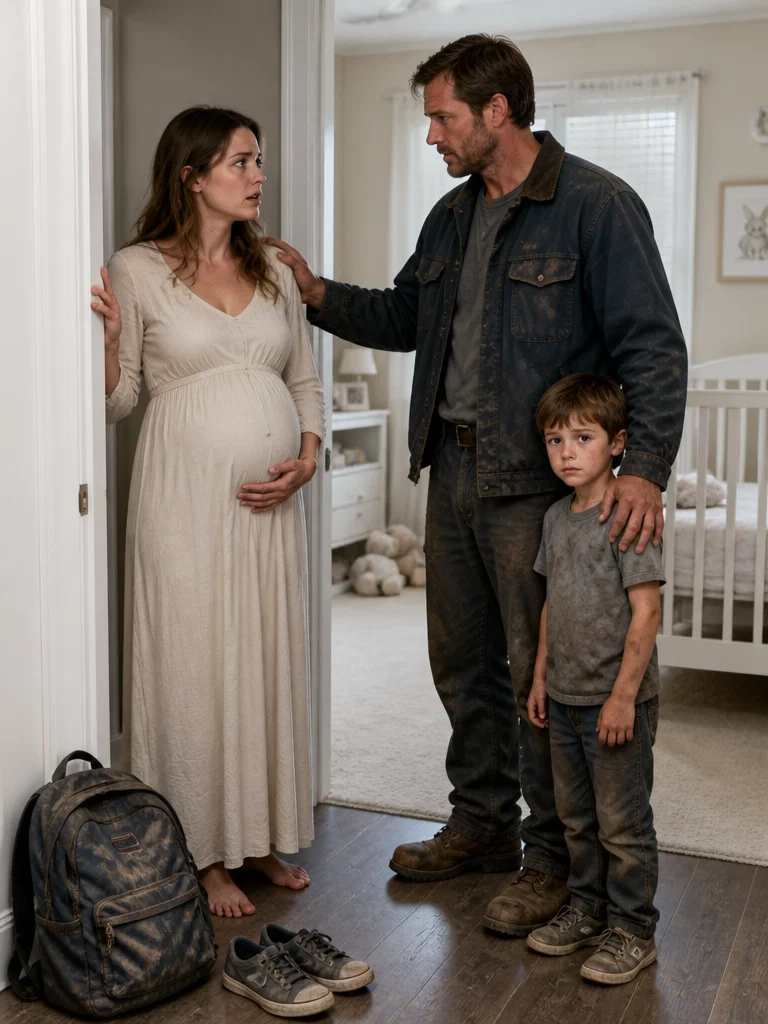
“Where on earth did you pick up that filthy child, Jonathan? I am nine months pregnant, and I absolutely do not need an infection brought into this house!”
Rebecca stood frozen in the doorway of their suburban home, one hand pressed firmly against her massive belly while the other gripped the frame of the door until her knuckles turned white. Her husband, Jonathan, had just walked through the front door after his shift at the regional hospital, but he was not walking alone. Trailing behind his tired legs was a boy no older than four, a child so thin he looked like a gust of wind might blow him away, wearing scuffed shoes and a jacket so caked in grime that it looked like he had been sleeping on the concrete for weeks.
The little boy looked up, his large, pale eyes wide with an animalistic fear, as if he fully expected to be kicked out back into the rain at any moment.
“His name is Finn,” Jonathan said with a maddeningly calm tone that Rebecca found deeply insulting given the circumstances. “He is staying here tonight, and that is not all, because he is actually going to be living with us from now on.”
“Excuse me, are you out of your mind?” Rebecca let out a sharp, dry laugh that sounded more like a bark of disbelief. “Our baby is due literally any minute now, and her nursery is perfectly ready, her clothes are freshly laundered, and her crib is waiting for her, yet you decide to drag a stray child off the street like he is some kind of abandoned puppy?”
Jonathan did not flinch, simply dropping the boy’s battered, empty backpack on the floor by the entryway.
“His mother passed away in the emergency room tonight, and he has absolutely no one left in this world to take care of him.”
“Then you should have taken him to the social services office, because that is exactly what those facilities are for,” she replied, lowering her voice but allowing the full weight of her contempt to color every word. “I am not running a shelter here, and I certainly have no intention of raising some stranger’s child while I am about to deliver my own.”
The boy immediately ducked his head, and Rebecca watched as his small, grimy hands tightened their grip on the hem of a shirt that was clearly three sizes too big for him. A strange, uncomfortable tugging sensation blossomed in her chest, but she ruthlessly crushed it down, telling herself that she could not afford to be weak or sentimental, not right now when her own life was reaching a breaking point.
“You are going to take him to the bathroom and get him cleaned up,” Jonathan ordered, his voice taking on a stern edge. “After that, he will eat a hot dinner and then sleep in the nursery crib.”
“Do not you dare even think about it!” she shouted, her voice echoing against the walls. “That room belongs to my daughter and I will not have it tainted.”
“It is big enough to be his room as well, Rebecca,” Jonathan said, ignoring her fury.
Rebecca felt the heat rising in her blood until she thought she might scream. While Jonathan went to fill the bathtub, she grabbed an old t-shirt and some spare socks, telling herself she was only doing it because she did not want the child to ruin her clean furniture, not out of any sense of pity. When Jonathan emerged with Finn, who now looked even more fragile and exposed in clothes that hung off his thin frame, the boy sat on his lap and began to eat with a desperate, frantic hunger that made Rebecca physically turn away to hide her face.
“Tomorrow we are going to go out and buy him proper clothes, new shoes, and I will take him to a barber for a haircut,” Jonathan stated, clearly unfazed by her glares. “Then we need to figure out a school district for him.”
“You will take him right back to wherever you found him tomorrow morning,” Rebecca snapped, her jaw set. “I am not keeping this child in my home under any circumstances.”
Jonathan clenched his jaw so tightly that his neck muscles stood out in rigid cords.
“Do not talk like that when he can hear you, Rebecca,” he warned.
“Let him hear me, because he deserves to know right now that he is not welcome here and that he is only a temporary inconvenience,” she retorted.
The boy abruptly stopped chewing, and the light in his eyes vanished, replaced by an overwhelming, hollow fear. Jonathan stood up without another word, picked the boy up gently, and carried him off toward the nursery while Rebecca stood in the kitchen, her lungs heaving as if she had just run a marathon. When her husband finally walked back into the room, she felt a dark, sharp suspicion pierce through her mind like a jagged knife.
“Tell me the truth right now,” she said, stepping directly into his personal space. “Is this child yours?”
Jonathan stared at her, his expression unreadable, and he did not respond for a long, heavy moment.
“Of course he is yours, isn’t he, which is exactly why you brought him here, because some woman you were seeing finally got tired of him and dumped him on your doorstep,” she continued, her voice trembling. “How many years have you been making a fool out of me, and how many times did you tell me you were working late shifts at the hospital when you were actually with her?”
“Rebecca, please just stop,” he whispered.
“Do not you dare tell me to stop, so just tell me if that child is your blood,” she demanded.
Jonathan looked at her, his eyes filled with a profound, aching sadness that made her stomach turn.
“He is not my son, Rebecca.”
“Then why on earth are you defending him like he is the most important person in the world?”
He took a deep, shaky breath before looking her directly in the eyes.
“Because he is yours.”
Rebecca felt the floor vanish beneath her feet, and for a terrifying second, she thought she might lose consciousness.
“Do not you ever say that to me again,” she breathed.
“He is your son, Rebecca, the child they told you had died in the hospital years ago.”
All the color drained from her face, leaving her feeling deathly cold as the world around her seemed to warp and bend. For several long seconds, she could hear absolutely nothing except for the thunderous, desperate beating of her own heart against her ribs.
“My son died,” she whispered, her voice barely audible. “They told me at the hospital, I mourned him, and I buried that entire life inside of me so I could move on.”
“Just go and see for yourself,” Jonathan said, his voice soft but insistent. “Look at him carefully and tell me you do not see it.”
Rebecca walked into the nursery as if she were walking toward a gallows, her legs feeling like lead. Finn was asleep in the new crib, one small hand tucked firmly under his cheek, and when she leaned over to look, she let out a sharp, ragged gasp of air. The way he slept, the shape of his chin, the small, almost invisible dimples on his cheeks, and the way his hair fell across his brow were all too familiar.
“No, it is not possible,” she murmured, bringing her trembling hands up to cover her mouth.
Jonathan stepped up and tried to hug her from behind, but she broke away from his touch, her entire body shaking uncontrollably.
“What did you do to my baby?” she screamed at him.
Suddenly, a searing, sharp pain shot through her lower abdomen, causing her to double over and clutch at her husband’s shirt for stability.
“Jonathan, something is wrong,” she gasped.
“What is happening, are you hurt?” he asked, his panic rising.
She looked down and saw the liquid starting to trail down her legs, a sign that could not be ignored.
“My water has broken, it is time,” she panted.
As Finn continued to sleep, completely unaware that his entire reality had shifted in the blink of an eye, Rebecca realized that the truth was only just beginning to unravel.
Chapter 2: A History of Deceit
Years ago, Rebecca Palmer had been the most ambitious and promising student at the Medical College of Oakridge. She was twenty years old, with striking blonde hair, a sharp smile, and a dangerous idea lodged firmly in her mind: she wanted nothing to do with boys her own age. She often complained to her friends that men her age were immature, lacking in vision, and completely incapable of offering her the kind of stable, high-status life she craved.
“I want a proper man, someone established,” she would tell her friends over coffee. “I want someone who already knows exactly what he wants and has the power to get it.”
That man appeared one Tuesday, wearing a crisp, white coat and speaking with an authoritative, deep voice while standing before the lecture hall blackboard. His name was Dr. Simon Hart; he was over forty, married, a father of two, and possessed an impeccable reputation as a prominent gynecologist and visiting professor. Rebecca saw him standing there and thought to herself that he was exactly what she needed.
At first, there were only polite questions at the end of class, then came coffee meetings “to clear up technical doubts,” and eventually, one rainy afternoon in the quiet corner of the campus library, their hands brushed over a medical textbook, and neither of them dared to pull away. Simon told her she was brilliant, uniquely suited to him, and exciting, and she, head over heels in love with the attention, chose to believe that this was what love felt like.
The romance took place in a small, rented apartment tucked away near the city center, where Simon would arrive after his late appointments, smelling of sterile hospital air and carrying the weight of a secret life he kept hidden beneath his expensive shirts. Rebecca never asked about his wife, preferring to exist in a bubble where that world simply did not happen to be real.
That was the case until one morning when she gave him the life-altering news.
“I am pregnant, Simon,” she told him.
Simon went pale, his composure cracking for the first time.
“No, Rebecca, you cannot have this baby, it is out of the question,” he said.
“He is our son, how can you say that?” she asked, tears welling in her eyes.
“My life is already perfectly set, and I am not going to destroy my family over a mistake like this,” he replied harshly.
She cried, she begged, and she promised that she would never ask him for anything, and seeing her so desperate, he changed his tactics to something more manipulative.
“Okay,” he said, his voice oozing a practiced, fake tenderness. “If the baby is born healthy, I will support you, but no one must ever know he is mine, no one.”
Rebecca agreed, dropping out of her university courses, moving into the private apartment he funded, and spending those long months caressing her belly and imagining a family that only existed in her own imagination. When the day came for the birth, they took her to a private clinic where Simon’s brother, Dr. Quentin Hart, worked, and they performed a cesarean section. Rebecca woke up from the anesthesia with her body aching and her heart overflowing with a fragile, new hope.
“Where is my baby, is he a boy or a girl?” she asked the moment she could speak.
Simon was standing by the bed, his face pale and his eyes fixed on the floor.
“It was a boy,” he said quietly, “but he was stillborn.”
Rebecca screamed until she lost her voice, demanding to see him, to speak with the lead surgeon, and to get an actual explanation for what had happened. Quentin came into the room, wearing a mask of cold professionalism, and told her that there had been an unexpected complication that nobody could have predicted. He told her it happened all the time, that she was still young, and that she could definitely have more children later.
But she did not want “more children,” she wanted that specific one, the one she had carried for nine months.
Days later, Simon said his final goodbye, leaving her a stack of cash and six months of rent paid in full.
“This simply cannot continue, I am sorry,” he said, and then he was gone.
Rebecca returned to her studies with a part of herself feeling permanently hollowed out, and since nobody knew the truth, she learned how to paint a smile on her face and keep moving. At a charity gala, she met Jonathan Hart, an EMT who was kind, hardworking, and possessed a calm gaze that made her feel safe. He knew absolutely nothing about her secret past, but he loved her without asking for anything in return, and they eventually married and planned a family of their own.
What Rebecca never suspected was that her son had actually been born perfectly healthy and alive.
That night at the clinic, Quentin had taken Rebecca’s infant and handed him over to a woman named Maria, a struggling, alcoholic patient whose own newborn had unfortunately passed away just hours earlier. He switched their identification bracelets, signed forged death certificates, and convinced the entire staff that it was all a tragic medical occurrence, all to protect his brother’s reputation and his family’s “honor.”
The child was legally registered as Finn, the son of Maria, and for four years, he grew up in a world of empty liquor bottles, loud shouting matches, and gnawing hunger. His grandmother tried to look after him for a while, but when she passed, the boy was left entirely at the mercy of a mother who sent him out to beg for pocket change on the street corners.
“Come on, my little king,” Maria would slur to him when he returned with a handful of coins. “You are finally good for something.”
Finn mistook her drunken affection for love, and on the nights when she held parties, she would throw him out into the hallway so he would not disturb her guests. He would sleep on the stairs, on a park bench, or anywhere he could find a sliver of warmth, and even though neighbors called the authorities, he always clung to his mother’s legs and cried that he did not want to leave her.
Last night, Maria arrived at the local hospital with a dangerously high fever, heavily pregnant again and drifting in and out of consciousness. Jonathan was the driver of the ambulance that brought her in, and Quentin Hart happened to be the doctor on duty, but despite their best efforts, both she and her unborn baby died on the operating table. After the surgery, Quentin found Finn asleep on a waiting room bench and recognized him instantly, the resemblance to the student he had betrayed four years prior hitting him like a physical blow.
Drunk with his own secret guilt, he confessed the entire history to Jonathan, never realizing he was speaking to the current husband of the woman from whom he had stolen a child.
“Her name was Rebecca Palmer, and she was just a student,” Quentin sobbed. “I took her baby to save my brother from a scandal.”
Jonathan stood frozen, his mind reeling as the pieces clicked into place.
“That was my wife’s maiden name,” Jonathan said, his voice cold as ice.
Quentin dropped his glass, the sound echoing in the silence. Jonathan did not wait for the sun to rise, choosing instead to pick up the sleeping Finn and whisper to him that they were going home to his mother, who had no idea he was still alive.
Chapter 3: A Long Road Home
Rebecca sat in the hospital emergency room, her body racked by the final stages of labor, her mind racing with a single, burning question: how many years of her son’s life had been stolen by those men? Jonathan did not leave her side for a single moment, and as she squeezed his hand with a ferocity she did not know she possessed, she felt a strange mix of terror and relief.
“Please, just promise me that nobody is going to take him away from us,” she pleaded.
“Finn is safe with my sister at the house,” Jonathan replied, kissing her forehead. “Nobody is going to take him away from you, I promise.”
“I did not reject him because he was a bad child,” she wept. “I rejected him because he terrified me, because seeing him alive opened a grave that I thought had been sealed shut years ago.”
“I understand,” Jonathan said.
“No, you do not understand, because I said such horrible, cruel things to him, and he heard every single word,” she sobbed.
Jonathan leaned down again, his expression softening as he looked into her eyes.
“You are going to have a lifetime to ask for his forgiveness and show him how much he is loved.”
Their baby girl was born in the quiet hours of the dawn, a tiny, healthy child with strong lungs and a cry that sounded like music to Rebecca’s ears. She held her close to her chest and wept, not just from the joy of the birth, but from the massive weight of guilt, grief, and long-buried love that finally had a place to land.
“Her name will be Grace, because she arrived when I thought my own world was going to shatter,” Rebecca whispered.
Two days later, when she was discharged from the hospital, their home was filled with flowers and family members, all of whom were focused on the new baby. Rebecca, however, could only look for one person. Finn stood near the doorway with Jonathan, looking clean in new clothes, his frame still thin and his eyes darting around the room with a lingering, guarded suspicion.
Rebecca let her mother hold Grace for a moment before she slowly walked across the room and crouched down until she was eye level with the boy.
“Finn,” she said softly.
The little boy immediately took a step backward, an action that hurt Rebecca more than the physical pain of her recent surgery.
“Please, can you ever forgive me?” she asked, her voice breaking. “I am so sorry for not recognizing you right away, and I am so sorry for the words I said to you when you first arrived, but I just did not know you were mine.”
The boy looked at Jonathan, silently seeking permission.
“She is your mother, Finn,” Jonathan said gently. “Your real mother.”
Finn pressed his lips together, his expression hardening.
“My mom died,” he said.
Rebecca nodded, swallowing the lump in her throat.
“Yes, she did, and I know that you loved her, and nobody is ever going to force you to forget her,” she said, reaching out a hand. “But I am your mother, too, and I carried you here, I waited for you, and when they told me you were gone, it broke my heart forever.”
Finn watched her for a long time, his eyes searching hers for the truth.
“Are you going to fire me now?” he asked, his voice a tiny, hopeful whisper.
Rebecca let out a jagged sob and shook her head.
“Never,” she said.
She opened her arms, and this time, the boy ran toward her, burying his face in her neck as if he had finally found a place where he could stop running and stop being afraid.
“I am hungry,” he murmured against her.
Rebecca smiled through her tears.
“Then let us go get some food, and in this house, you will never go to sleep hungry again.”
The truth did not simply stop there, as Jonathan insisted on filing a formal complaint that brought everything into the light. Quentin Hart, utterly consumed by the guilt of his actions, surrendered to the authorities and confessed to everything, including the baby swap and the pressure from his brother. Simon, who had spent decades building a comfortable life on a foundation of lies, tried to deny his involvement, but the hospital records, the testimony of the nurses, and the undeniable DNA evidence left him with no escape.
When Rebecca stood face to face with him in front of the local courthouse, she felt no love, no nostalgia, and no lingering attachment. She felt only a cold, hard disgust for the woman she had once been and a deep, burning compassion for the mother who had been forced to mourn a son who was still alive.
“I did not come here to ask you for money, for your name, or for any excuses,” she told him. “I came here so you could look at me and understand that your cowardice cost my son four years of his childhood.”
Simon lowered his gaze to the concrete.
“I am sorry,” he muttered.
Rebecca let out a bitter, sharp laugh.
“That sorry does not feed a hungry child, and it does not erase the nights he spent sleeping in the dirt because you were afraid of a scandal,” she replied.
Quentin lost his medical license and faced a long, public trial, while Simon lost his prestige, his career, and his family. None of that could give Finn back the years he had lost, but at home, the process of healing began in small, quiet ways. A hot, consistent meal, a warm bath, a bed of his own placed right next to Grace’s crib, and a bedtime story every single night.
Rebecca learned to love him without demanding that he give her his heart all at once, understanding that a wounded child needs safety more than he needs gifts. Jonathan, who had been the one to open the door that night, stepped into the role of the father Finn had never known. One afternoon, months later, Rebecca walked into the nursery and found Finn gently rocking Grace’s cradle.
“Do not cry, little sister,” he whispered to her. “Mom will be back soon.”
Rebecca stood at the door, silent tears streaming down her face. Finn looked up, spotted her, and immediately looked nervous.
“Did I do something wrong?” he asked.
She walked over, hugged him from behind, and kissed the top of his head.
“No, my love, you did something very beautiful.”
The boy stood perfectly still in her arms, and then, in a voice that was barely audible, he said the word Rebecca had been waiting for all her life.
“Mother.”
She closed her eyes, feeling the peace wash over her, knowing that motherhood does not always start on the day of a birth. Sometimes, it starts on the day you finally choose to stay, to mend, to protect, and to love even the parts of life that others have tried to destroy. Because while some truths come late, they eventually demand that everyone pays their share of the price.
THE END.