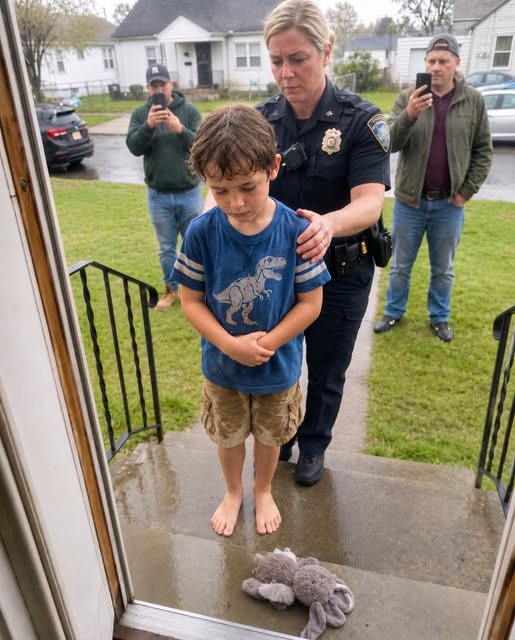
When an officer arrived, he discovered something unexpected inside the house. The clues suggested the mother hadn’t deliberately abandoned her little boy. And when the truth finally came out, the entire neighborhood would regret how quickly they had judged her…
“Mommy promised she’d be home in thirty minutes,” the little boy told the emergency dispatcher.
“Before she left, she hugged me and said, ‘Eli, whatever happens, remember that I love you. Everything I do is because I love you.’”
His voice trembled.
“But it’s been four days, and I’m still waiting.”
Hector, the overnight 911 dispatcher, immediately became concerned.
Outside the little boy’s home, heavy rain drummed against the porch roof.
“Buddy, what’s your name?” he asked gently.
“Eli. I’m seven.”
“Is there another adult at home with you?”
There was a long silence.
Then came a quiet sob.
“No. Mommy went to get my medicine and some food. She told me to stay inside because it was raining. But she never came back.”
Hector maintained a reassuring tone.
“Have you been able to eat anything, Eli?”
“A little soup. But it didn’t taste right, so I stopped eating it. I’ve been drinking water. I gave Buddy some too.”
“Who’s Buddy?”
“My stuffed puppy. He sleeps beside me every night.”
Hector immediately arranged for an officer to visit the house.
“Eli, Officer Lena is coming to check on you. You did the right thing by calling. Can you stay on the phone with me?”
“Okay,” he whispered.
A short time later, Officer Lena Brandt arrived at a modest house on Linden Street.
The porch was dark, the mailbox leaned toward the road, and rainwater streamed from the roof.
Lena approached the door and knocked softly.
“Eli? My name is Lena. I’m a police officer. Hector sent me to help you.”
A moment later, the door opened slightly.
A little boy peered through the narrow gap.
“Are you going to be angry with me?”
Lena knelt so they were at eye level.
“Of course not, sweetheart. You’ve done nothing wrong.”
Eli slowly opened the door.
He wore an oversized gray T-shirt that appeared to belong to his mother.
In one hand, he held a well-loved stuffed puppy with a floppy ear.
He looked tired and uncertain, as though he had been waiting for someone to tell him everything would be alright.
Lena smiled reassuringly.
“May I come inside?”
Eli nodded.
The small house was quiet and neatly arranged.
A blanket covered the living room couch, children’s books were stacked beside it, and a framed photograph showed a smiling man holding a younger Eli.
In the kitchen, Lena noticed that there were very few groceries left.
But something on the table caught her attention.
It was a handwritten shopping list.
Rice.
Chicken.
Electrolyte drinks.
Eli’s medicine.
Beside the telephone was another handwritten reminder.
Urgent appointment — pediatric kidney clinic. Call Monday morning.
Lena looked from the notes to the little boy standing in the doorway.
These weren’t the belongings of someone who had carefully planned to walk away from her family.
They suggested that someone had been preparing to return home with groceries and medication.
Someone who expected to be there for the next doctor’s appointment.
“Sweetheart,” Lena asked, “did Mommy tell you where she was going?”
Eli nodded.
“To the pharmacy and grocery store. She said she would buy my favorite grape drink too.”
“And did she say anything else?”
“She told me to lock the door and wait for three knocks. That’s how I’d know it was her.”
Lena glanced at the front door.
Four days had passed.
And those three knocks had never come.
Outside, the police vehicle had attracted several curious neighbors.
A woman in a yellow raincoat stood beside the fence.
“I always wondered whether Teresa could manage raising that little boy by herself,” she remarked.
Another neighbor began recording on her phone.
“Imagine leaving your son without telling anyone where you’re going!”
Someone else shook his head.
“Poor kid. His mother should have been here.”
Lena heard the comments but refused to jump to conclusions.
She looked once more at the shopping list.
At the reminder for Eli’s medical appointment.
At the photograph of the family on the wall.
Something wasn’t adding up.
Meanwhile, Eli seemed exhausted.
Lena gently guided him toward the porch while arranging for medical professionals to check on him.
“Can Buddy come with us?” Eli asked.
“Absolutely,” Lena replied. “He’s coming too.”
The little boy held his stuffed puppy close as Lena helped him outside.
Within minutes, medical responders arrived and began attending to Eli.
The neighbors watched in silence.
Then the woman in the yellow raincoat spoke again.
“I can’t believe his mother would just leave him.”
Lena turned toward the gathering crowd.
“I wouldn’t make that assumption yet.”
The woman frowned.
“What do you mean?”
Lena held up the handwritten shopping list.
“His mother left a list of things she intended to buy. She also scheduled medical care for her son.”
She paused.
“Eli says she promised to return in thirty minutes. The pharmacy is only a short distance away.”
The neighbors exchanged uncertain glances.
Lena continued.
“I think we need to find out what happened to Teresa before deciding why she hasn’t come home.”
As Eli was taken for a medical examination, Lena carefully placed Buddy beside him.
Then the officer looked down the rain-soaked road leading toward the pharmacy.
Somewhere along that route, a mother had vanished while trying to buy medicine and groceries for her son.
And Lena was determined to discover why.
“Mommy said she’d only be gone for thirty minutes,” the seven-year-old boy whispered to the 911 dispatcher. “But it’s been four days, and she still hasn’t come home.”
The dispatcher froze.
Then the little boy added something that made his heart sink.
“Before she left, Mommy hugged me really tight and said, ‘Whatever happens, Eli, remember that everything I do is for love.’”
When police arrived at the house, they found the child weak, sick, and completely alone.
Neighbors immediately accused his mother of abandoning him.
But one officer noticed a handwritten shopping list on the kitchen table.
And what she discovered afterward revealed a heartbreaking truth nobody had imagined.
Four days earlier, Teresa Hale had been standing in her tiny kitchen, counting her remaining money.
Forty-one dollars and sixty cents.
That was everything she had.
At thirty-four, Teresa was raising her seven-year-old son, Eli, alone after losing her husband, Dennis, two years earlier.
She worked night shifts loading trucks at a warehouse, barely earning enough to cover rent and groceries.
Life became even harder when Eli developed a kidney condition requiring regular medication and medical appointments.
Then his health insurance unexpectedly lapsed.
Teresa had already sold her broken-down car to pay rent. Now she relied on coworkers for transportation and sometimes walked miles to work.
That Thursday evening, Eli was curled beneath a blanket, clutching his favorite stuffed puppy, Buddy.
“Mommy, my tummy hurts,” he whispered.
Teresa looked at her remaining money.
It wasn’t enough for medicine and food.
Then she glanced at her wedding ring.
She had never removed it since Dennis died.
Slowly, she slipped it off.
A pawn shop nearby stayed open late. She could sell the ring, purchase Eli’s prescription, and return before he fell asleep.
She knelt beside him.
“Sweetheart, Mommy needs to get your medicine. I’ll be back in thirty minutes.”
Eli hugged Buddy.
“Can I come?”
“Not in this rain, baby. Stay warm and lock the door. I’ll knock three times when I return.”
She held him tightly.
“Remember something, Eli. Everything I do is because I love you.”
He repeated her words.
Then Teresa disappeared into the pouring rain.
Four days passed.
And she never returned.
By Monday night, Eli had eaten the last available food, become increasingly weak, and started vomiting.
Terrified, he finally dialed 911.
Dispatcher Hector Ruiz answered.
When he realized the little boy had been alone for four days, he immediately sent Officer Lena Brandt to the address.
Lena found Eli barefoot, trembling, and barely able to stand.
The refrigerator was almost empty.
On the kitchen table, however, lay a handwritten list.
Rice. Chicken. Electrolyte drinks. Eli’s medicine.
Nearby was a reminder about an urgent appointment at the pediatric kidney clinic.
Lena studied the careful handwriting.
Something didn’t make sense.
Why would a mother planning to abandon her son leave behind a shopping list and arrange his medical care?
Outside, several neighbors had gathered.
“I always knew that woman couldn’t raise a child alone,” one woman declared.
Another neighbor recorded the scene on her phone.
“His mother just disappeared and left him starving!”
But as Lena carried Eli outside, the little boy suddenly lost consciousness.
An ambulance rushed him to St. Mary’s Children’s Hospital.
Doctors diagnosed severe dehydration, dangerous electrolyte imbalance, and complications from his kidney condition.
Fortunately, they were able to stabilize him.
Meanwhile, Lena refused to believe Teresa had deliberately disappeared.
The following morning, she began tracing her movements.
At a nearby pawn shop, the owner confirmed Teresa had sold a plain gold wedding ring for sixty dollars.
“She asked me not to melt it,” the man recalled. “She wanted to buy it back after payday.”
At the pharmacy, an employee remembered Teresa arriving soaked from the rain.
She had purchased Eli’s prescription and electrolyte drinks.
When she came up a few dollars short, the pharmacist covered the difference.
Teresa had repeatedly thanked him, explaining that her son was sick and she needed to get home.
The grocery store confirmed she had purchased rice, chicken, crackers, and applesauce shortly afterward.
Then Lena searched the road between the store and Teresa’s house.
Near a drainage ditch, she spotted a torn grocery bag.
Inside were muddy groceries and a pharmacy package bearing Eli’s name.
Lena immediately contacted the county accident department.
One pedestrian had been struck by a vehicle on that road Thursday night.
The injured woman had been taken unconscious to Riverside General Hospital without identification.
Lena hurried there.
In intensive care, she found Teresa.
Her head was bandaged, her leg was broken, and doctors had performed emergency surgery to relieve pressure on her brain.
She had been unconscious for days.
A nurse explained that Teresa kept repeating the same mysterious words whenever she briefly awakened.
“Three knocks. I have to knock three times.”
Lena felt tears forming.
She sat beside the bed.
“Teresa, my name is Officer Brandt. Eli is safe. He called 911, and he’s receiving treatment.”
Her eyes slowly opened.
“Eli?” she whispered.
“He’s alive, Teresa. He’s going to be okay.”
Tears rolled down her face.
“I promised thirty minutes,” she murmured. “Oh God, he’s been waiting four days.”
Meanwhile, a neighbor’s video accusing Teresa of abandoning Eli had spread online.
Thousands of strangers condemned her without knowing what had happened.
Lena helped the police department release a statement explaining the accident.
But she also wanted the neighborhood to understand the truth.
She visited the woman who had publicly criticized Teresa.
When the neighbor learned she had sold her wedding ring to buy her son’s medicine, she broke down.
“I lived beside her for two years,” she whispered. “And I never once asked if she needed help.”
A few days later, Lena returned to Eli’s hospital room.
She brought Buddy and explained that his mother was alive.
Eli listened quietly until Lena mentioned the wedding ring.
“Mommy sold her ring?” he asked.
Then the little boy began crying.
“She never took it off. She loved Daddy so much.”
Lena held him close.
On Friday, doctors arranged a reunion.
Eli walked down the hospital hallway holding Buddy.
When he reached Teresa’s room, he raised his little hand.
Knock.
Knock.
Knock.
From inside, a weak voice answered.
“Eli?”
He rushed toward his mother.
Teresa stretched out her arms, and a nurse carefully helped Eli onto the bed.
They embraced, both crying.
“I’m so sorry, sweetheart,” Teresa whispered. “I tried to come home.”
“I waited for your three knocks every night,” Eli sobbed.
Then he reached into his pocket.
“Officer Lena brought something back for you.”
In his tiny palm lay her wedding ring.
The pawn shop owner had returned it after learning what happened.
Teresa slipped it onto her finger and held Eli close.
“Everything is for love,” he whispered.
“Everything is for love,” she answered.
Their story eventually spread throughout the community.
This time, people responded with compassion.
Neighbors organized meals, repaired Teresa’s house, helped arrange transportation, and volunteered to care for Eli while she recovered.
A social worker helped restore his medical coverage.
Her employer preserved her job during rehabilitation.
And the neighbors who had once judged her became the people she could depend on.
One year later, Eli’s kidney condition was in remission.
Teresa had returned to work and been promoted to a daytime supervisory position.
She still wore Dennis’s wedding ring.
And every evening, when she arrived home, she knocked on the front door three times.
Even though she had a key.
One afternoon, Lena asked Eli why his mother continued doing that.
The little boy smiled.
“So I always know it’s Mommy.”
Then he added softly:
“And so I know she made it home.”
On the refrigerator hung a drawing Eli had made.
It showed his mother, a police officer, and all the neighbors who had helped them.
Across the top, he’d written:
EVERYTHING IS FOR LOVE.
And underneath:
AND NOBODY DOES IT ALONE.
The Aftermath at the Hospital
The sterile scent of antiseptic and the rhythmic beep of the cardiac monitor filled the recovery suite as Teresa slowly adjusted to the harsh daylight filtering through the blinds. Outside, the autumn leaves of Riverside County drifted past the window, but inside, time felt suspended. Lena Brandt stood quietly near the doorway, watching the mother and son through the glass panel. The emotional weight of the past week hung heavily in the air.
Dr. Harrison, the senior neurologist overseeing Teresa’s case, stepped into the hallway to brief Lena. “She’s remarkably resilient, Officer Brandt,” the doctor said, reviewing a chart clipped to a heavy plastic board. “The subdural hematoma required immediate surgical intervention, and we were fortunate to relieve the intracranial pressure in time. But physical healing is only half the battle. The trauma of the accident combined with the psychological stress of being separated from her son has taken a severe toll.”
Lena nodded slowly, her hands resting on her utility belt. “She kept talking about knocking three times while she was under. The nurse told me it was a routine she and Eli shared—a secret code so he would know she was safe behind a locked door when she worked late shifts.”
“It’s a manifestation of her protective instincts,” Dr. Harrison replied, adjusting his wire-rimmed glasses. “When a parent is thrust into a life-threatening crisis, their subconscious remains anchored to their child’s safety. Even in a coma, her mind was trying to reach him.”
Lena walked back into the room as Teresa shifted against the propped pillows. Her bandaged head rested gingerly against the cotton case, and her fractured leg was elevated in a rigid brace. Seeing Lena, Teresa tried to sit up, a wince of pain crossing her pale features.
“Easy, Teresa,” Lena said gently, stepping forward to adjust the blankets. “You need to rest. The doctors say your body is still recovering from major trauma.”
“Eli,” Teresa whispered, her voice raspy from a prolonged intubation tube. “Is he… did he take his medication? His dosage schedule is so strict. If he misses a single day, his kidneys…” She trailed off, tears welling in her eyes again.
“He is completely fine, I promise you,” Lena reassured her, pulling up a chair and sitting close. “County social services stepped in right away after I found him. His routine has been stabilized, and the pediatric specialists at the county health center have taken over his care. He’s eating well, and as you saw yesterday, he brought you your wedding ring back.”
Teresa touched her left ring finger, where the gold band now sat securely. A bittersweet smile touched her lips. “I had to pawn it. It was the only thing of value I had left after the car repairs broke my budget. But when the pharmacist wouldn’t accept my short payment for Eli’s prescription refill, I didn’t care about the ring. I just cared about the pills.”
“You did what any devoted mother would do,” Lena said softly. “And the community is starting to realize that, too. The woman who posted that horrible video online—Mrs. Gable—came by the station yesterday. She was crying. She saw the police report detailing how you were struck by a hit-and-run driver while walking home from the pharmacy with groceries and medicine. She wants to make amends.”
Teresa stared out the window, watching a flock of birds scatter across the grey sky. “People are so quick to judge what they don’t see, Officer. They see a locked apartment and a scared child, and they assume the worst. They don’t see the double shifts, the unpaid bills, the constant fear of losing everything.”
“They see it now,” Lena promised. “And things are going to be different. You won’t have to carry this alone anymore.”
The Neighborhood Awakening
Across town, the quiet residential street where Teresa and Eli lived was undergoing a profound transformation. For years, the houses stood side-by-side like isolated fortresses—residents rushing to their cars in the mornings, closing their garage doors behind them, and ignoring the struggles unfolding behind closed curtains. But the viral controversy surrounding Eli’s abandonment, followed by the sobering truth of Teresa’s hit-and-run accident, acted like a lightning bolt through the neighborhood.
Mrs. Gable, the neighbor who had originally filmed and uploaded the accusatory video, sat at her kitchen table surrounded by poster boards and sign-up sheets. Her phone buzzed continuously with notifications from local community groups, but she ignored them, focusing entirely on a handwritten roster.
“We need a rotating schedule for hot meals,” Mrs. Gable announced to a small gathering of neighbors crowded into her living room. Among them was Mr. Henderson, a retired carpenter who lived two doors down from Teresa, and Sarah Jenkins, a local bakery owner with three children of her own.
“I’ve already spoken with the local grocery co-op,” Sarah said, adjusting her glasses. “They’ve agreed to donate fresh produce and pantry staples to Teresa’s household for the next six months. No charge. They also set up an anonymous relief fund that’s already raised over three thousand dollars from local families.”
Mr. Henderson crossed his arms, his weather-beaten face solemn. “I went over to Teresa’s house yesterday to check on the exterior locks and windows. The front porch steps are rotting, and the weather stripping is completely gone. I brought my tools. I’m going to rebuild that porch this weekend, and I don’t want a single penny for materials or labor.”
The collective guilt that had gripped the street after the police department’s press conference had dissolved into active, tangible solidarity. People who had lived next to Teresa for years without knowing her last name were now deeply invested in her recovery. They realized that the invisible barriers of modern suburban life had blinded them to the quiet desperation of a mother working herself to the bone to save her sick child.
Later that afternoon, a group of neighborhood children, including Eli’s classmates, gathered on the sidewalk near Teresa’s driveway. They carried chalk, construction paper, and get-well cards. One young boy named Lucas, who sat next to Eli in the third-grade classroom, held a bright yellow sign that read: WELCOME HOME, ELI AND TERESA!
“Do you think they’ll be back by next week?” Lucas asked his mother as she helped him tape a drawing of a superhero dog to a wooden stake.
“Soon, sweetie,” his mother replied, smoothing down his jacket. “And when they get back, we’re going to make sure they know they belong here. Nobody in this neighborhood is ever going to feel invisible again.”
The Workplace and the Employer
While the neighborhood organized its grassroots support, a parallel struggle was taking place in the corporate offices of Apex Logistics, where Teresa had worked as a senior inventory clerk for four years. Known for her unyielding punctuality and meticulous attention to detail, Teresa had been a quiet pillar of the warehouse operations. However, her frequent requests for schedule adjustments to accommodate Eli’s medical appointments had occasionally strained relations with middle management.
Mr. Sterling, the regional director of operations, sat at his mahogany desk reading the local newspaper article detailing Teresa’s accident. The headline read: LOCAL MOTHER STRUCK IN HIT-AND-RUN FIGHTS FOR RECOVERY AFTER SACRIFICING EVERYTHING FOR SICK SON.
A knock sounded at the door, and Sarah Vance, Teresa’s direct supervisor, stepped inside. She held a manila folder containing Teresa’s employee file and attendance records.
“Mr. Sterling, do you have a moment?” Sarah asked, her expression tight with concern.
“About Teresa Brandt?” Sterling asked, gesturing to the newspaper lying open on his desk. “I just read it. It’s a tragedy, Sarah. But we need to look at our staffing requirements for the upcoming quarter. Her position in inventory control is critical. With her extended medical leave, we’re looking at months of disruption.”
“She shouldn’t be terminated, sir,” Sarah said firmly, stepping closer to the desk. “In fact, I’m here to propose something different.”
Sterling raised an eyebrow. “Go on.”
“Teresa has been carrying an impossible burden,” Sarah explained, opening the folder to reveal Teresa’s performance evaluations. “Look at her metrics. Even while working the overnight shift to care for her son during the day, her error rate is less than 0.1%. She’s underpaid, overworked, and exhausted. If we let her go now, we’re not just losing a dedicated employee; we’re kicking someone when they’re already down.”
“Corporations aren’t charities, Sarah,” Sterling replied, though his tone softened slightly. “We have productivity benchmarks to maintain.”
“Which is why I’m proposing a restructuring,” Sarah countered. “We promote her. Move her out of the grueling night shifts and into the daytime supervisory role in quality assurance. It’s a salaried position with better pay, regular daytime hours, and predictable scheduling. It will allow her to manage her son’s medical treatments without sacrificing her health or her job.”
Sterling leaned back in his leather chair, tapping his pen against the blotter. He thought about the public relations nightmare of firing a recovering accident victim whose story had gripped the entire county. More importantly, he thought about fairness.
“Can she handle a supervisory role right now while recovering from a traumatic brain injury and a broken leg?” Sterling asked.
“She’s tougher than anyone in this building,” Sarah said without hesitation. “Give her six weeks of paid medical rehabilitation leave, followed by a phased return to the daytime supervisory desk. The team respects her, and the morale boost across the warehouse will be immeasurable.”
Sterling nodded slowly, closing the folder. “Make it happen, Sarah. And draw up a supplementary wellness grant from the company’s employee assistance fund. Let’s make sure she doesn’t have to worry about hospital bills while she heals.”
The Return Home
The crisp autumn air of late October brought vibrant shades of amber and crimson to the trees lining Teresa’s street. Exactly six weeks after the accident, a silver sedan pulled into the freshly paved driveway. Mr. Henderson had kept his promise: the front porch was entirely rebuilt with polished oak steps, a sturdy handrail, and a bright red welcome mat.
Lena Brandt helped Teresa out of the passenger seat, steadying her as she leaned on a pair of modern crutches. Her leg was still healing from the compound fracture, but the heavy cast had been replaced by a lightweight medical boot. Teresa’s head scar was largely hidden beneath her hair, and her eyes shone with a quiet, hard-earned strength.
Eli bolted out the front door, clutching Buddy the dog tightly under one arm. “Mommy!” he cried, skidding to a halt on the new porch before running carefully down the steps.
“Eli!” Teresa dropped her crutches against the car door, ignoring the sharp ache in her leg as she knelt down onto the grass, opening her arms wide.
The little boy launched himself into her embrace, burying his face in her shoulder. Buddy barked happily, wagging his tail and licking Teresa’s cheek. For a long moment, mother and son held onto each other, letting out all the accumulated fear, relief, and joy of the past month and a half.
“Look, Mommy,” Eli whispered, pulling back to point at the house. “Mr. Henderson fixed the steps. And Mrs. Gable brought us lasagna. And look at the refrigerator!”
Teresa stood up with Lena’s assistance, picking up her crutches, and walked slowly up the new wooden steps. As she opened the front door, a wave of warmth washed over her. The living room had been thoroughly cleaned; fresh curtains hung on the windows, and a bouquet of wildflowers sat on the coffee table with a card signed by twenty different families on the street.
In the kitchen, the refrigerator was stocked with groceries, fresh milk, and Eli’s specialized medication safely stored in the newly organized pantry.
“I still can’t believe all of this,” Teresa said, turning to Lena with tears glistening in her eyes. “I spent years thinking I had to fight every battle alone. I thought asking for help was a sign of weakness.”
“Asking for help is the bravest thing you can do, Teresa,” Lena replied, placing a hand on her shoulder. “You kept Eli alive through sheer force of will. But humans aren’t meant to live in isolation. We’re meant to carry each other.”
That evening, as the sun dipped below the horizon, painting the sky in strokes of purple and gold, Teresa tucked Eli into bed. His kidney condition was officially in stable remission, verified by his pediatrician’s check-up earlier that week.
“Mommy?” Eli asked, his eyelids growing heavy.
“Yes, sweetheart?”
“Are you going to work the night shift anymore?”
Teresa smiled, brushing a lock of dark hair from his forehead. “No, baby. I got a promotion. I work during the day now, and I’ll be home every single evening before dinner.”
Eli smiled contentedly and closed his eyes.
As Teresa walked out of the bedroom, she paused by the front door. Following her nightly habit, she raised her hand and tapped softly against the wood. Knock. Knock. Knock.
From the hallway, she heard Eli’s sleepy, reassuring voice call out from beneath the blankets: “I know it’s you, Mommy. You made it home.”
The Community Foundation
With Teresa’s recovery well underway and her new daytime supervisory role at Apex Logistics providing financial stability, the momentum of community goodwill did not fade. Instead, the neighbors who had rallied around her family decided to institutionalize their efforts. Led by Sarah Jenkins and Mr. Henderson, the neighborhood established the “Riverside Mutual Aid Network”—a grassroots organization designed to support single parents, medically vulnerable children, and families facing sudden economic hardship.
One Saturday morning in November, a community meeting was held in the spacious backyard of Mrs. Gable’s house. Over thirty residents sat on folding chairs and picnic blankets, discussing ways to expand the network.
Teresa stood at the podium—a makeshift wooden crate set up on the lawn—holding a microphone. Though she still walked with a slight limp and used a cane on long walks, her presence was commanding and radiant.
“When I was lying in that hospital bed, not knowing if my son was being cared for, I felt entirely invisible,” Teresa told the gathering, her voice steady and clear. “We live in a society that tells us to be self-reliant to a fault. We buy into the illusion that we can—and should—handle every crisis on our own. But my story proves how dangerous that illusion is.”
Applause rippled through the audience.
“Eli is healthy today because a police officer cared enough to look beyond a locked door,” Teresa continued, glancing at Lena, who stood smiling near the back fence. “And my family is whole today because this neighborhood chose compassion over judgment. The Mutual Aid Network isn’t just about delivering groceries or fixing broken steps. It’s about rebuilding the human connection that modern life tries to strip away.”
Following her speech, the community voted unanimously to appoint Teresa as the chairperson of the network’s family support committee. Her firsthand experience with bureaucratic hurdles, medical expenses, and social services made her uniquely qualified to guide others navigating similar crises.
That afternoon, Eli and his friends ran across the lawn, playing tag around the oak trees while Buddy chased a yellow tennis ball. For the first time in years, Teresa felt a profound sense of peace. The crushing weight of isolation had been replaced by a network of unbreakable bonds.
A Year of Healing
Seasons changed, bringing the crisp frost of winter, the blossoming renewal of spring, and finally the warm, golden sunlight of a new summer. Exactly one year after the harrowing night of the hit-and-run accident, Teresa’s life looked entirely transformed.
The scars on her forehead had faded into pale, barely noticeable lines, and her leg had healed completely, allowing her to walk, run, and play without restriction. At Apex Logistics, her transition into the daytime supervisory role had been a resounding success. Her leadership, empathy, and efficiency earned her the respect of both her subordinates and upper management, culminating in an employee-of-the-year nomination.
Eli had grown taller, his energy boundless. Routine check-ups at the pediatric nephrology clinic confirmed that his kidney condition remained firmly in clinical remission. The strict medication schedules and dietary restrictions were now seamlessly integrated into their daily routine, no longer a source of constant, paralyzing terror, but a manageable part of life.
On a warm Friday evening in late July, Teresa sat on the newly rebuilt front porch, sipping iced tea as the evening breeze rustled the leaves. Eli sat beside her on the wooden steps, carefully coloring a new drawing in his sketchbook.
Officer Lena Brandt pulled her patrol car up to the curb, stepping out and walking up the pathway with a friendly wave.
“Evening, Teresa. Evening, Eli,” Lena greeted them, leaning against the railing.
“Officer Lena!” Eli jumped up, holding out his sketchbook. “Look what I drew for the community center.”
Lena took the book, admiring the colorful illustration. It depicted Teresa standing proudly in her workplace, Lena in her police uniform, Mr. Henderson with his carpentry tools, and a circle of smiling neighbors holding hands beneath a bright yellow sun. Across the top, written in neat, careful second-grade handwriting, were the words:EVERYTHING IS FOR LOVE. And underneath:AND NOBODY DOES IT ALONE.
“This is a masterpiece, Eli,” Lena said, her eyes glistening slightly as she handed the book back. “I think we need to frame this and hang it on the wall of the station.”
“You can have a copy,” Eli bartered seriously, making both women laugh.
Later that night, after Lena had departed and Eli was fast asleep in his bed, Teresa walked through the quiet house. The air was filled with the scent of lavender and home-baked bread—a gift from Sarah Jenkins earlier that day.
She walked to the front door, her fingers brushing against the polished gold wedding ring on her left hand. Even though she carried her own set of keys in her pocket, she paused, raised her hand, and rapped her knuckles gently against the wood.
Knock. Knock. Knock.
From the hallway, she heard Eli’s sleepy, comforting voice echo back through the darkness: “I know it’s you, Mommy. You made it home.”
Teresa smiled, turned the key, and stepped inside her sanctuary, knowing deeply and truly that she would never walk alone again.
The Legacy of Compassion
The ripple effects of Teresa and Eli’s story extended far beyond their immediate neighborhood, eventually catching the attention of county officials and regional media outlets. A local documentary crew approached Lena Brandt and Teresa about producing a short feature on the importance of community mental health, emergency response transparency, and grassroots mutual aid networks.
Initially, Teresa hesitated. She was a private person who valued her quiet life above public recognition. However, after discussing it with Eli and Lena, she realized the platform could be used to help thousands of other struggling families who felt invisible in their own communities.
“If our story encourages even one person to check on a neighbor, or reminds a struggling parent that it’s okay to ask for help, then it’s worth sharing,” Teresa told the documentary producer during their initial interview at the kitchen table.
The resulting mini-documentary, titled The Three Knocks, aired on regional television and quickly went viral online, accumulating millions of views. It contrasted the destructive power of snap judgments on social media with the redemptive, life-changing power of human empathy.
In the wake of the broadcast, letters poured in from across the country. Some were from single parents sharing their own stories of quiet endurance; others were from people inspired to start mutual aid groups in their own towns. Teresa and the Riverside Mutual Aid Network established a correspondence program, answering letters and providing logistical guides for communities wanting to replicate their success.
Despite the attention, Teresa remained grounded. Her focus stayed fixed on what mattered most: Eli’s health, her career progression, and the quiet, sacred rituals of their daily life. The front porch, built by Mr. Henderson, became a gathering place on summer weekends where neighbors shared meals, laughed, and looked out for one another.
Looking Forward
As the years marched onward, Eli transitioned from a fragile, homebound child into a vibrant, athletic pre-teen. His medical condition, managed with precision and monitored closely by specialists, no longer cast a dark shadow over their household. He played soccer in the local community league—with half the neighborhood turning out on Saturday mornings to cheer him on from the sidelines—and excelled in his studies.
Teresa’s career at Apex Logistics continued to flourish. Promoted once more to operations manager, she became a vocal advocate for employee well-being, successfully lobbying corporate leadership to implement flexible scheduling and emergency childcare support for warehouse workers. Her voice carried weight because she had lived the reality of working-class struggle, and her leadership was defined by genuine empathy rather than detached authority.
Lena Brandt remained a fixture in their lives, no longer just as the investigating officer who had saved the day, but as a cherished family friend. Sunday dinners at Teresa’s house became a beloved tradition, where Lena, Mr. Henderson, Sarah Jenkins, and several other neighbors would gather around the dining table to share stories, debate local politics, and celebrate milestones.
One evening in late autumn, exactly three years after the night that changed everything, Teresa sat on the porch swing as the sun set behind the horizon. Eli, now twelve years old and towering over her in height, walked up the driveway carrying his soccer gear.
“Good practice?” Teresa asked, handing him a cold bottle of water.
“We won four to two,” Eli grinned, wiping sweat from his forehead. “Coach put me in as starting forward.”
“I’m so proud of you, sweetie,” Teresa said, wrapping her arm around his waist.
Eli looked up at the porch light, then down at his mother. “Mom? Do you remember when we used to worry about everything? When it felt like the world was closing in?”
“I remember,” Teresa nodded softly.
“I’m glad we didn’t give up,” Eli said quietly. “Even when it was hard.”
Teresa pulled him close, resting her chin against his hair. “We didn’t do it alone, Eli. Remember that. Nobody does it alone.”
She stood up to unlock the front door, but before inserting her key, she paused, raised her hand, and rapped her knuckles against the wood three times.
Knock. Knock. Knock.
From inside, Eli smiled, echoing the words he had spoken every night since they were reunited: “I know it’s you, Mommy. You made it home.”
Everything Is For Love
The story of Teresa and Eli became a cornerstone of the Riverside community—a living reminder that behind closed doors, beneath hurried commutes and silent facades, human beings carry complex worlds of struggle and resilience.
In the heart of the community center, framed securely on the main wall, hung Eli’s original drawing: the depiction of his mother, Officer Lena, the neighborhood volunteers, and the glowing sun. Above it, written in bold, permanent ink, remained the creed that had guided them through the darkest night of their lives:
EVERYTHING IS FOR LOVE.AND NOBODY DOES IT ALONE.
Teresa’s journey had taught her that vulnerability is not a weakness, but a bridge connecting us to one another. The harsh winter nights of fear and isolation were replaced by the enduring warmth of a community united by grace, compassion, and shared humanity.
As the years continued to turn, the tradition of the three knocks lived on—not out of fear, but out of gratitude. It was a celebration of survival, a testament to maternal sacrifice, and a daily acknowledgment that no matter how difficult the road may seem, love always finds a way home.
THE END..!