For seventeen years of marriage, my husband had slept on the same side of our bed. Then one Monday night, out of nowhere, he looked at me and said,
“I think we should switch sides.”
I laughed.
Not because it was funny.
Because David hated changing anything.
This was a man who had used the same chipped green coffee mug for ten years because, according to him, “the chip doesn’t stop it from holding coffee.”
So when he suddenly wanted my side of the bed, I knew something was strange.
I just didn’t know how strange.
My name is Ellen Carver. I’m forty-four, a high school librarian, and I’ve been with David for twenty years.
Our marriage has always been comfortable.
Predictable.
Stable.
Not boring—at least not to me.
The kind of predictable where you know exactly how your partner takes his coffee, where he leaves his keys, and which side of the bed he’ll be on when you wake in the middle of the night.
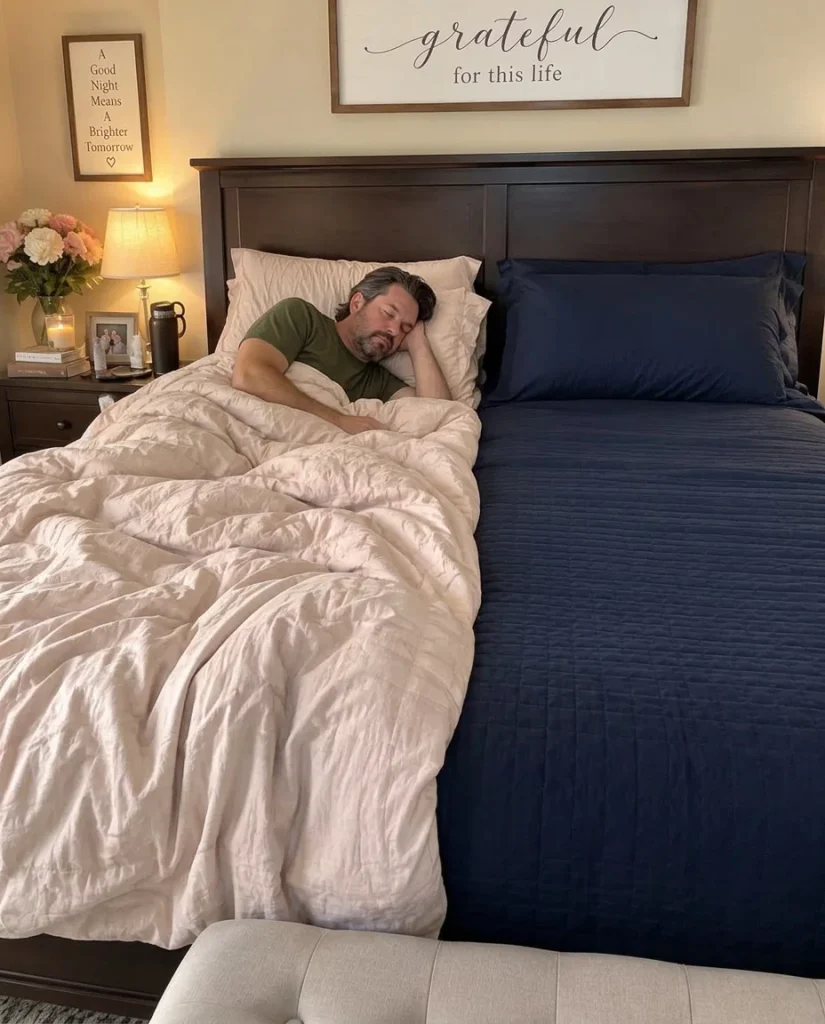
David had always slept on the right.
I had always slept on the left.
The arrangement started before we were married.
In our first apartment, his side was beside the window. He ran warm and liked the cool air.
My side was closer to the door, which made sense because I was more likely to get up during the night.
When we eventually bought our house, we kept the same arrangement without even discussing it.
Left was mine.
Right was his.
For seventeen years.
Until that Monday.
“I haven’t been sleeping well,” David explained. “Maybe switching things around will help.”
I studied him.
“You hate switching things around.”
He shrugged.
“The alarm clock bothers me. When I can see it, I start counting how many hours I have left to sleep.”
The alarm clock was on his nightstand.
“If that’s the problem,” I said, “just turn it around.”
“It wouldn’t be the same.”
That answer made absolutely no sense.
But David had that expression on his face.
The one he wore when he had already reached a conclusion.
So I agreed.
We switched.
I hated it immediately.
Everything felt wrong.
The nightstand was in the wrong place.
The bathroom seemed farther away even though it obviously wasn’t.
The light beneath the bedroom door looked different from that angle.
David, meanwhile, fell asleep almost immediately.
The next morning he asked,
“How did you sleep?”
“Terribly.”
“Give it a few nights.”
That bothered me.
Not the sentence itself.
The confidence behind it.
Why was he so determined to make this permanent?
The second night, I suggested switching back.
“No.”
Just that.
No explanation.
That was even stranger.
David was an engineer.
He explained everything.
If a kitchen faucet leaked, I received a five-minute explanation of pressure, seals, and why the manufacturer had chosen the wrong washer.
If traffic was heavy, he could explain the road design.
If our dishwasher made a strange noise, he had a theory before I had finished describing it.
But when I asked why we couldn’t return to our normal sides of the bed?
“No.”
That night, I began noticing something else.
He was watching me.
Not obviously.
But every time I shifted beneath the blankets, I could sense that he was awake.
There is a particular stillness to someone pretending to sleep.
Around midnight, I got up to use the bathroom.
When I returned, David was halfway sitting up.
“What?” I asked.
“Nothing.”
“You’re awake.”
“I thought you were going downstairs.”
I stared at him.
“Why would I be going downstairs at midnight?”
“I don’t know. I wasn’t really awake.”
Then he lay down.
He was lying.
David rarely lied to me.
And when he did, it was usually because he was protecting something.
That knowledge did not make me feel better.
The following afternoon, while he was at work, I searched the bedroom.
I felt ridiculous doing it.
I checked my old nightstand.
The drawer.
Under the bed.
Behind the furniture.
Nothing.
There were no mysterious letters.
No hidden phone.
No strange receipts.
Nothing that explained why my husband of seventeen years had abruptly rearranged one of the most established routines of our marriage.
The third night, I woke at 3:14 A.M.
David’s side of the bed was empty.
I touched the sheets.
Cold.
He had been gone for a while.
The bathroom was empty.
Then I heard something downstairs.
A cabinet door.
Then the back door opening.
I stood at the top of the stairs, listening.
A few minutes later, the back door opened again.
Footsteps.
David came upstairs.
When he saw me standing in the hallway, he froze.
“Where were you?” I asked.
“Downstairs.”
“You went outside.”
“Just for a minute.”
“Why?”
He didn’t answer.
He simply went back to bed.
I stayed awake for the rest of the night.
By the following evening, I was finished guessing.
After dinner, I sat across from him.
“Enough. Why did you make us switch sides of the bed?”
“I told you.”
“No. You gave me an excuse.”
He went quiet.
“You’ve slept on the same side for seventeen years,” I continued. “Suddenly you insist on taking mine. You check whether I’m asleep. You watch every time I get out of bed. And last night, you went outside at three in the morning.”
David said nothing.
Then I asked the question that had been building inside me.
“Is there something you’re not telling me?”
He looked directly at me.
“Yes.”
My stomach dropped.
“What?”
David stood.
“Stay here.”
“David—”
“Two seconds.”
He disappeared toward the back of the house.
I sat there imagining every possible disaster.
Then he returned.
He was carrying something wrapped carefully in a towel.
He sat across from me and placed it gently on the table.
Then he unfolded the towel.
Inside was a kitten.
A tiny gray kitten with little white paws.
She looked up at me with enormous eyes.
I stared at her.
Then at David.
“She was under the back steps,” he said.
I said nothing.
“I found her four days ago.”
Four days.
Exactly when the strange behavior had started.
“She was alone,” he continued. “I waited to see if her mother came back. She didn’t.”
“David…”
“She was too young to stay outside.”
I looked at the kitten again.
“I’ve been keeping her in the garage.”
Suddenly everything made sense.
The midnight trips.
The back door.
The watching.
The bed.
“You switched sides because of a kitten?”
“The door is closer to your side,” he explained. “I thought if I slept there, I could get up without waking you.”
“You have been sneaking out of bed to check on her?”
“Yes.”
“How often?”
He hesitated.
“At first? Every two hours.”
I stared at him.
“You were getting up every two hours?”
“She needed to be fed.”
“You were feeding her?”
“With kitten formula.”
Of course he was.
This was David.
Apparently, while I had been imagining secrets and betrayal, my mechanical engineer husband had been running a neonatal kitten operation in our garage.
He told me the entire story.
He had been putting tools away when he heard a faint sound beneath the back steps.
At first, he wasn’t even certain it was an animal.
Then he found her squeezed between the steps and the foundation.
Tiny.
Cold.
Alone.
He watched from inside for hours, hoping a mother cat would return.
None did.
Around nine that evening, he checked again.
The kitten was still there.
So David picked her up, carried her into the garage, made a bed from an old box and fleece blanket, and started researching what newborn kittens needed.
At nine-thirty that night, he drove to a pet store.
He bought kitten milk replacer.
A bottle.
Supplies.
Then he sat in the garage reading feeding instructions on his phone.
“You did all of this without telling me?”
“I was going to tell you.”
“When?”
“When she was stronger.”
That answer irritated me.
“You could have just asked me.”
“I know.”
“We have been married for seventeen years.”
“I know.”
“You can tell me things.”
“I know.”
I folded my arms.
“Then why didn’t you?”
David looked uncomfortable.
“You’re practical.”
“That’s your excuse?”
“No. I mean… you’re good at knowing what we can handle.”
He glanced at the kitten.
“And a kitten wasn’t in our plans.”
“So you assumed I would say no?”
“I thought you might.”
The kitten made a tiny sound.
I looked down.
She was so small that she barely seemed real.
“How old is she?”
“The vet thinks about four weeks.”
I looked back at him.
“You took her to a veterinarian?”
“Yesterday.”
He immediately added,
“I have the paperwork.”
Of course he had paperwork.
“Documentation,” he corrected.
“In case you had questions.”
I almost laughed.
“You expected questions?”
“You usually have questions.”
That was fair.
According to the vet, she was healthy but needed treatment for worms and would soon need vaccinations.
David had kept every document.
Every instruction.
Every feeding amount.
He had even researched two reputable rescue organizations.
“Why rescue organizations?”
“In case you said we couldn’t keep her.”
He called it contingency planning.
I called it the most David thing I had ever heard.
Then he admitted something even more absurd.
During the first nights, when the kitten needed feeding every two hours, David had worried his trips through the house would wake me.
So one night, he slept in the back seat of his car.
I stared at him.
“You slept in the car?”
“The back seat was adequate for several hours.”
“David.”
“Yes?”
“You slept in our car so you could feed a kitten every two hours without waking me?”
“At the time, it seemed efficient.”
I covered my face.
“And then?”
“She started eating better. She could go longer between feedings. That’s when I came up with the bed idea.”
“You switched sides so you could quietly reach the door.”
“Yes.”
“You actually thought this plan would work?”
He paused.
“The concept was sound.”
“The execution?”
“Flawed.”
“Because I noticed.”
“Because you notice everything.”
At least he understood that much.
I picked up the kitten.
She settled into my hands without hesitation.
David watched us carefully.
Then I asked,
“What were you going to name her?”
“I didn’t.”
“You didn’t?”
“I thought that should be a joint decision.”
I raised an eyebrow.
“That might be the first joint decision in this entire situation.”
“Yes.”
He looked genuinely embarrassed.
“I know.”
Then he became serious.
“Ellen, I should have told you.”
“Yes.”
“I handled this badly.”
“Yes.”
“I made the decision first and planned to tell you afterward.”
“Yes.”
“That wasn’t respectful.”
“No.”
“I’m sorry.”
That mattered.
Because the kitten wasn’t really the problem.
The problem was that David had decided what I would think without allowing me to actually think it.
I looked down at the tiny gray animal in my arms.
Then I asked,
“Why did you want to keep her?”
David was quiet.
“She was alone.”
“That’s not the whole answer.”
He thought for a moment.
“When I found her under the steps, she looked at me.”
“And?”
“She didn’t run.”
His voice changed slightly.
“She was cold. Alone. She had every reason not to trust me.”
He looked down at his hands.
“But she looked at me, and she didn’t run.”
Then he said,
“I didn’t know what else to do except stay.”
That sentence changed something in me.
Because it wasn’t really about a kitten anymore.
It was about David.
This stubborn, overly logical man who had slept in a car and set alarms every two hours because a tiny animal had looked at him from beneath our steps.
“What name were you thinking about?” I asked.
He hesitated.
“Scout.”
“Why?”
“Because she found me.”
He smiled faintly.
“She was out there alone, trying to find her way. Then she found me.”
I looked at the kitten.
“Scout.”
She blinked.
“It fits.”
David looked at me quickly.
“So…?”
“So what?”
“We’re keeping her?”
I smiled.
“Yes.”
His shoulders relaxed.
“You’re not going to explain why it’s impractical?”
“Oh, I’ll explain that tomorrow.”
“That seems fair.”
Then he apologized again.
This time, I stopped him.
“I understand why you did it.”
“You shouldn’t.”
“I do.”
“You found something small and alone, and you decided to stay.”
I looked at him.
“Then you tried to protect that decision.”
“Badly.”
“Very badly.”
He smiled.
“But you should have trusted me.”
“I know.”
“I’m not the person who says no to helpless kittens under back steps.”
“I wasn’t sure.”
That hurt more than I expected.
David seemed to realize it.
“I think I confused organized with rigid,” he said.
I stayed quiet.
“You plan everything. You think ahead. Somewhere along the way, I started thinking that meant you wouldn’t accept something unexpected.”
He shook his head.
“But that isn’t who you are.”
“No.”
“Planning ahead means you know how to handle things when the plan changes.”
“Yes.”
“I forgot that.”
We sat quietly.
Scout had fallen asleep in my hands.
Then David admitted something else.
He had wanted to handle the kitten himself.
Not because he didn’t trust me.
Not entirely.
But because he wanted to prove he could take care of something complicated and vulnerable without needing help.
“It sounds stupid when I say it aloud,” he said.
“No.”
“It was still wrong not to tell you.”
“Yes.”
“But wanting to do something yourself isn’t always wrong.”
He nodded.
“I got her through the worst part.”
“You did.”
That afternoon, he told me, Scout had batted at a piece of string for the first time.
He had sat on the garage floor for forty minutes watching her.
“I kept thinking you should see it,” he admitted.
“And every time I thought that, I told myself I’d tell you tomorrow.”
“Tomorrow does that.”
“Yes.”
“It keeps moving.”
He looked at me.
“I’m glad it’s tonight.”
“So am I.”
We moved Scout into the kitchen.
Not the garage.
David brought in her blankets, bottle, formula, and an extremely detailed notepad.
“She’ll need feeding around four,” he said.
“I’ll do it.”
“You don’t have to.”
“You’ve been doing it alone for four nights.”
He hesitated.
Then nodded.
“Thank you.”
That night, we returned to our original sides of the bed.
Mine on the left.
His on the right.
Everything immediately felt correct again.
The bathroom was the proper distance away.
The hallway light looked normal.
The room had returned to the geometry my body remembered.
David settled beneath the blankets.
“It’s good to be back.”
“You hated my side.”
“Yes.”
“You gave up your side for easier access to the door.”
“It seemed logical.”
“Everything seems logical to you.”
“That is occasionally a problem.”
“Especially when your logic forgets to include telling your wife things.”
He laughed softly.
“I’m adding that to the system.”
“Good.”
For a moment, neither of us spoke.
Then David said,
“She was so small when I found her.”
“I know.”
“I couldn’t walk away.”
“I know.”
I turned toward him.
“That’s one of the reasons I married you.”
“Because I rescue kittens?”
“No.”
I smiled.
“Because when you find something that needs you, you stay.”
He was silent.
Then he said,
“I stayed.”
“Yes.”
“Not only with Scout.”
I knew what he meant.
“No.”
“With you.”
“Yes.”
“For twenty years.”
“Yes.”
Then quietly:
“I love you, Ellen.”
“I know.”
“I should say it more.”
“You say it in other ways.”
“Like kitten formula at nine-thirty at night?”
“Yes.”
“And sleeping in the back seat?”
“Yes.”
“And contingency rescue organizations?”
“Especially those.”
He laughed.
Then he fell asleep.
At four in the morning, my alarm went off.
I went downstairs.
Scout was awake in her box, looking directly at me.
On the counter was David’s notepad.
Exact amount of formula.
Correct temperature.
Feeding instructions.
And one final note:
She likes to be held with her head slightly elevated.
I warmed the formula.
Then I picked her up exactly the way David had written.
She drank.
She was unbelievably small.
But there was something fierce about her tiny existence.
As if being alive was something she had already decided she was going to keep doing.
When she finished, I returned her to the box.
Within minutes, she was asleep.
I remained at the kitchen table.
I thought about David in the garage at two in the morning.
Then four.
Then six.
Every two hours.
Holding something small that had no one else.
I thought about all the things people carry alone because they are frightened that sharing them will somehow make them more fragile.
And how often those things would actually become easier if we simply allowed someone else to help us hold them.
I thought about seventeen years of sleeping on the same sides of the same bed.
The chipped green coffee mug.
The routines.
The habits.
The thousand tiny choices that slowly become a marriage.
And I thought about a tiny kitten beneath our back steps looking at David.
She needed someone.
He happened to be there.
So he stayed.
Sometimes that is what love looks like.
Not grand speeches.
Not perfect decisions.
Sometimes it is driving to a pet store at nine-thirty at night.
Setting an alarm every two hours.
Sleeping in the back seat of a car.
Leaving detailed feeding instructions on a kitchen counter.
And learning that the person beside you should have been trusted with the difficult thing from the beginning.
I went back upstairs.
David was still sleeping.
I returned to my side of the bed.
He remained on his.
Downstairs, Scout slept safely in her box.
She wouldn’t always be that tiny.
Soon she would grow strong enough that she wouldn’t need someone waking at four in the morning to feed her.
But that night, she was still small.
And we were there.
Together.
For that moment, it was enough.
Maybe that was the whole point.
Sometimes being there is everything.