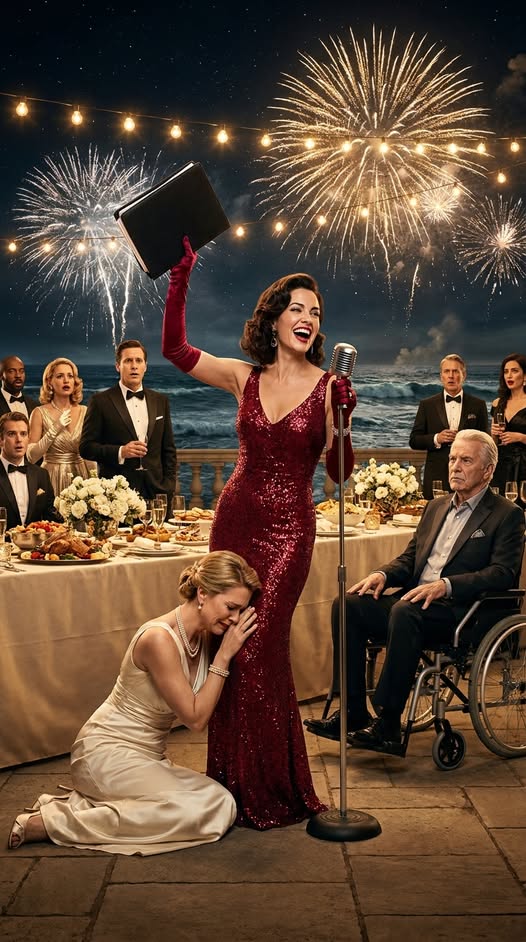
Chapter 1: The Audacity of the Uninvited
“We’re moving in tomorrow. Your dad said it’s perfectly fine.”
That was the exact phrase my stepmother delivered at 11:47 p.m. It was the very first night I was attempting to sleep in the oceanfront sanctuary I had spent twelve grueling years saving to acquire. The property on Sullivan’s Island cost $4.8 million. Every single penny of it was mine. And before my brain could even process the sheer audacity of her statement, she tacked on a casual ultimatum: “If you don’t like the arrangement, you can easily find a hotel.”
I didn’t scream into the receiver. I didn’t shed a single tear. My hands, gripping the phone, were trembling with a kinetic energy so violent I nearly dropped the device onto the hardwood floor. But in the dim light of my new bedroom, a slow, terrifying smile spread across my face. I knew exactly what kind of reception I was going to prepare for their arrival.
What Victoria completely failed to realize was that her late-night ambush wasn’t merely a rude imposition. It was the final, fatal miscalculation she would ever make under the Beckett family name.
To understand the sheer magnitude of the trap I was about to spring, you have to understand the invisible life I had led up until March of 2025.
My mother succumbed to ovarian cancer when I was just seventeen years old. Diagnosed in the damp chill of April, she was gone by the golden haze of September. My father, Gerald Beckett, a highly revered real estate attorney in Charleston’s elite legal circles, coped with the devastating loss the only way a man of his generation knew how: he buried himself in billable hours until he was entirely numb.
Two years later, Victoria swept into our lives. Initially, she played the part of the nurturing savior to perfection. She baked fresh lemon bars, remembered anniversaries, and called me “sweetheart” with a Southern drawl I naively believed was genuine. But the honeymoon phase expired six months after the wedding.
The erasure started subtly. Victoria gently suggested I vacate my childhood bedroom—the one featuring the custom window seat my mother had built with her own hands—so that her daughter, Paige, could utilize it as a walk-in dressing room. I had looked to my father, desperately waiting for him to object. Instead, he just patted my shoulder with exhausted eyes. “It’s just wood and drywall, kiddo.”
By the holidays of 2011, I had been effectively cropped out of the family portrait. Victoria orchestrated the pose by the grand fireplace, and when I walked into the parlor, there was mysteriously no physical space left. “Oh,” Victoria had sighed, adjusting her daughter’s silk collar. “I thought you mentioned you didn’t want to be photographed today.”
I paid my own way through the College of Charleston, juggling a full academic scholarship with two grueling part-time jobs. Paige, meanwhile, attended a private, exorbitant university in Savannah, her tuition checks signed cheerfully by my father. When I once summoned the courage to ask him about the stark financial disparity, Victoria had intercepted the question. “You always preferred being independent, Bonnie. I’m not being cruel; I’m just being practical.”
That was her favorite weapon. Practicality. For fifteen years, I allowed her to wield it.
But there is a distinct advantage to being treated as an invisible entity within your own home: it grants you absolute, unmonitored privacy. I graduated summa cum laude and accepted a junior analyst role at Meridian Strategy Group, a ruthless boutique consulting firm downtown. I spent the next decade climbing. I led massive corporate restructurings for companies with nine-figure revenues. By the time I submitted my resignation, my total compensation package was north of $340,000 annually.
Victoria knew nothing. She didn’t care to ask. At the rare family dinners I was permitted to attend, she would wave a dismissive, manicured hand. “Bonnie does something with spreadsheets,” she’d announce, before pivoting sharply. “Paige, tell everyone about your fabulous new marketing campaign!”
I drove a battered Honda. I wore clearance-rack sweaters to Thanksgiving. Meanwhile, I quietly funneled every spare dollar into aggressive index funds and lucrative real estate investments. By the spring of 2025, my secret net worth hovered around $5.2 million.
The only soul on earth privy to my reality was Marcus Trent, my fiercely intelligent attorney who specialized in financial fraud. And it was Marcus who had first planted the seed of suspicion eight months prior. He had been reviewing my father’s property records for a routine trust inquiry when he noticed an anomaly. “There’s a transfer deed for your dad’s Mount Pleasant estate,” Marcus had murmured over the phone. “Gerald’s signature on the bottom line… it looks completely wrong.”
At the time, I wasn’t prepared to detonate my family. But sitting in the dark on Sullivan’s Island, listening to Victoria casually claim my home as her own, the puzzle pieces violently locked into place. If she could forge my father’s verbal permission to steal my house, forging his signature to steal his assets was a terrifyingly logical next step.
I picked up my phone and dialed Marcus. It was 1:15 a.m., but I didn’t care. We had a paper trail to hunt.
Chapter 2: The Architecture of Deceit
“I need that notarized copy of the Mount Pleasant transfer deed,” I told Marcus the moment he answered his phone the next morning. “The one with the questionable signature. Send it immediately.”
Marcus didn’t waste time asking why. He could hear the glacial shift in my tone. Within an hour, a heavily encrypted email landed in my inbox. It contained a high-resolution scan of a deed dated April 12th, 2024. It legally conveyed my father’s historic $1.2 million estate to a corporate entity named Hail Premier Properties LLC.
I pulled up the South Carolina Secretary of State’s business registry. My heart hammered a cold, steady rhythm against my ribs as the search results populated. The LLC had been registered in November 2022. It listed a sole managing member: Victoria R. Hail. Her maiden name.
Applying the meticulous analytical skills that had made me a senior consultant, I pulled up known, verified copies of my father’s signature—his medical directives, his will, an old birthday card. The discrepancies on the transfer deed were glaring. The capital ‘G’ lacked his trademark fluid loop. The pen pressure was entirely mechanical, heavy where it should have been light. It wasn’t a man signing his name; it was someone drawing a picture of a signature.
“This is a simulated forgery,” Marcus confirmed over the phone later that afternoon. “But my word isn’t enough. We need Patricia Sloan. She’s an accredited forensic document examiner who has testified in federal court. If she stakes her reputation on it being a fake, it becomes indisputable.”
“Hire her,” I commanded.
“There’s something else, Bonnie,” Marcus added, his voice dropping an octave. “I dug deeper into Gerald’s accounts. I found three massive withdrawals from his IRA totaling $380,000. They were routed directly to a coastal bank account under the name V. Hail. We need a judge’s subpoena to get the full statements, but the bleeding is severe.”
This was no longer a domestic squabble about a bedroom. This was a multi-million dollar felony.
The invaders arrived the following morning at 10:00 a.m. sharp.
Two black luxury SUVs pulled into my crushed-shell driveway, packed to the absolute brim with designer luggage, silk throw pillows, and monogrammed linens. Victoria stepped out first, pushing her oversized sunglasses up into her platinum hair, evaluating the pristine cedar siding of my home like a real estate vulture inspecting roadkill.
“Not terrible,” she announced to the salty air. “For a starter home.”
A starter home. Four point eight million dollars.
She marched straight into the master suite as if she owned the title. Within sixty minutes, my carefully unpacked clothes were dumped in a humiliating pile in the hallway. Paige casually claimed the sprawling guest room with the ocean view. I was unceremoniously banished to a microscopic first-floor room that the original architects had designed for linen storage.
My father trailed behind them, carrying a single, battered duffel bag. He looked hollow, like a man who had been hypnotized and loaded into the wrong vehicle. Catching my eye in the corridor, he mouthed a silent, agonizing “I’m sorry.”
I offered a microscopic shake of my head. Not yet, Dad.
That evening, Victoria spontaneously invited three wealthy couples from her downtown social syndicate to “her” new beach house. I watched, silently washing dishes at the sink, as she gave them a grand tour. “Gerald decided we needed a change of scenery,” she boasted, running a hand over my quartz countertops. “So, I made this little oasis happen.”
Not a single person in that room knew I held the deed. And I played the part of the invisible, slightly pathetic stepdaughter flawlessly.
At 9:47 p.m., my phone vibrated in my pocket. An email from Marcus. Patricia Sloan had completed her preliminary forensic analysis. Her conclusion was absolute: the signature on the Mount Pleasant deed was a simulated forgery assessed at the highest possible probability level.
I dried a crystal wine glass, set it carefully in the cabinet, and retreated to my linen-closet bedroom.
The next morning, Marcus dropped the real bombshell. The subpoenaed bank records had arrived. In addition to stealing the $1.2 million house and the $380,000 from the IRA, Victoria had opened a shadow credit card using my father’s social security number, racking up $47,000 in luxury spa and fashion charges. Worse, she had systematically siphoned another $215,000 from their joint household account into a secret trust by categorizing the thefts as “utility and maintenance” expenses.
Grand total of the theft: $1.84 million.
“We have two choices,” Marcus told me over the phone while I stood barefoot in the wet sand, far away from the house. “We go to the police right now, Victoria gets arrested in her pajamas, and Gerald is completely blindsided. Or…”
“Or what?”
“The Low Country Bar Association’s annual charity gala is exactly eighty-four days from now. June 14th,” Marcus said softly. “Victoria is slated to receive the ‘Philanthropist of the Year’ award. If any of that stolen money funded her charitable donations, that entire award is a fraud.”
The choice was clear. A quiet arrest was too merciful. Victoria had spent fifteen years building a glittering monument to her own ego. I was going to detonate it while all her friends were watching.
But as I began compiling the ultimate dossier of her crimes, my phone chimed with a cryptic text message from an unknown number. The words sent a chill down my spine that had nothing to do with the ocean breeze.
Chapter 3: Ghosts and Revelations
“I know Victoria isn’t who you think she is. Meet me at Waterfront Park, 3:00 p.m. tomorrow. – HB”
I stared at the glowing screen until my eyes ached. For a moment, I considered ignoring it. I was meticulously orchestrating a flawless legal takedown; I didn’t have the bandwidth for mysterious informants. Yet, the absolute certainty radiating from those two sentences compelled me.
The Charleston heat the following afternoon was oppressive, baking the cobblestones of Waterfront Park. I sat on a wrought-iron bench near the famous Pineapple Fountain, scanning the crowd. A woman approached. She was tall, silver-haired, radiating the kind of practiced, icy composure that comes from old money and deep scars.
“Bonnie Beckett,” she said, extending a hand that flashed a modest wedding band. “My name is Helen Briggs.”
Helen sat beside me and methodically dismantled the foundational mythology of Victoria Hail. Long before Charleston, before my father, and before the philanthropist persona, Victoria had been married to a highly successful dentist in Savannah named Richard Briggs.
“They divorced in 2009,” Helen explained, her voice remarkably devoid of emotion. “After Richard discovered that Victoria had systematically funneled nearly two hundred thousand dollars from their joint accounts into a covert shadow account under her maiden name.”
My jaw tightened. She had run the exact same playbook sixteen years ago.
Helen slid a manila folder across the bench. “Richard wanted a quiet divorce to protect his practice’s reputation, so he never pressed criminal charges. I respected his silence. But when I saw your name mentioned in a local business blog, I knew I had to find you. Victoria is a parasite, Bonnie. She seeks out successful, trusting men, assumes control of their ledgers, and bleeds them dry.”
I opened the folder. Inside was a certified copy of the 2009 Savannah divorce decree. The phrase ‘dissipation of marital assets’ was highlighted in neon yellow.
“Will you be at the Gala?” I asked, looking up at her.
A ghost of a smile touched Helen’s lips. “I wouldn’t miss it for the world.”
I returned to the beach house armed with the final nail for Victoria’s coffin, only to find the atmosphere unnervingly tense. Victoria had spent the afternoon at a luxury spa, leaving my father alone in the house. When I walked through the door, he gestured for me to follow him into my cramped bedroom.
His face was ashen, his hands shaking as he held out a small, tarnished walnut box.
“I was looking for my reading glasses in her nightstand,” my father whispered, his voice cracking. “It was locked. I forced it open. I found this.”
Inside the box lay two pieces of paper, yellowed with age, folded neatly. I recognized the handwriting instantly. The looping ‘y’s, the upward slant of the ‘t’s. It was my mother’s penmanship.
“Bonnie, my brave girl,” the letter began, dated a mere three days before the cancer took her. “You do not need anyone’s permission to live your life. You are enough. You have always been enough. Do not ever let anyone make you doubt that.”
Victoria had intercepted my mother’s dying words. She had locked them in a dark drawer for seventeen years, ensuring I navigated my grief feeling entirely abandoned, all while she systematically erased me from my own family.
My father broke down, weeping into his hands. I wrapped my arms around his trembling shoulders, staring at the faded ink. I didn’t cry. The sorrow had been entirely replaced by a cold, crystalline fury.
“I’m going to end her, Dad,” I whispered into the quiet room.
My father looked up, his eyes red but suddenly fiercely clear. “Tell me what you need me to do.”
I briefed him on the entire forensic file—the forged deed, the drained IRA, the secret credit cards. He agreed to sign a sworn affidavit confirming the thefts, preparing himself for the storm.
Late that night, unable to sleep, I padded toward the kitchen for a glass of water. As I passed the living room, I noticed Victoria’s silhouette framed against the moonlight on the porch. She was on her cell phone, her voice carrying through the screen door.
“Don’t worry,” Victoria was purring into the receiver. “As soon as the Gala is over and the award is officially mine, I’ll have the lawyers transfer the deed to this beach house into the LLC. She’s so oblivious, she won’t even notice until the paperwork is filed.”
I backed away into the shadows, a dark chuckle dying in my throat. She thought she was playing chess with a pawn. She had no idea she was already in checkmate.
Chapter 4: The Gala of Glass Houses
June 14th arrived with the suffocating humidity typical of a Carolina summer. The grand ballroom of the Belmont Charleston Place was an ocean of ivory silk, towering crystal chandeliers, and the intoxicating scent of white peonies. Two hundred and twenty of the Low Country’s most powerful figures—circuit court judges, state legislators, and real estate moguls—mingled in bespoke tuxedos and designer gowns.
Victoria was holding court at Table One, radiating triumph in a custom, $8,200 champagne-colored gown that she had undoubtedly paid for with my father’s stolen retirement funds. She touched arms, whispered confidentially to politicians, and played the benevolent queen to absolute perfection.
I was seated at Table Eighteen, practically wedged against the kitchen service doors. It was exactly where Victoria had placed me—out of sight, out of mind. Beside me sat Marcus, his leather briefcase resting heavily against his wingtip shoes. Across the room at Table Twelve, Helen Briggs sat in quiet vigil. And tucked away in the press box was Dela Fairchild, a senior editor at the Charleston Society Review and my mother’s former college roommate, her notepad open and waiting.
At exactly 8:30 p.m., Judge Raymond Holt, the president of the Bar Association, approached the grand podium. Victoria straightened her spine, pasting on a practiced look of humble surprise, preparing to rise for her applause.
“Ladies and gentlemen,” Judge Holt’s voice boomed, heavy with unprecedented gravity. “Before we proceed with the honors, the Association must address a critical matter. Under Section 7.3 of our bylaws, any substantiated allegation of severe financial misconduct involving a nominee must be addressed immediately.”
A confused murmur rippled through the sea of taffeta and silk. Victoria’s flawless smile froze, brittle and strained.
“This evening,” the Judge continued, his eyes scanning the room, “we received a formally documented complaint, backed by forensic evidence and sworn testimony. The complaint was filed by a member of the nominee’s own family. Miss Bonnie Beckett, you have the floor.”
The collective gasp of two hundred people sucked the oxygen from the ballroom.
I stood up. I picked up the thick manila envelope Marcus had prepared. And I began the long, agonizingly slow walk from Table Eighteen to the main stage. I felt the weight of every stare, heard the frantic whispering. As I passed Table One, Victoria hissed, her composure fracturing.
“What are you doing? Raymond, stop her, she’s trying to ruin me!”
My father remained seated. He didn’t look at her. He didn’t move a muscle.
I ascended the stairs and took the podium. I didn’t tremble. I stared out at the glittering crowd of Charleston’s elite and leaned into the microphone.
“I did not come here tonight to destroy a reputation,” I stated, my voice echoing off the vaulted ceilings. “I came here because the truth could not afford to wait in the dark any longer.”
I opened the envelope. The massive projector screen behind me flared to life.
“On April 12th, 2024, a transfer deed was filed conveying my father’s $1.2 million estate to a shell company named Hail Premier Properties,” I announced. The deed appeared on the screen behind me. “The signature at the bottom belongs to Gerald Beckett. Or rather, it was meant to.”
I clicked the remote. A side-by-side forensic analysis filled the screen.
“According to Patricia Sloan, a federally accredited forensic document examiner, this signature is a simulated forgery at the highest probability level. It was executed by the sole managing member of that LLC. Victoria Hail.”
The silence in the room was absolute. It was the silence of a vacuum.
“Furthermore,” I continued, pulling the bank records, “between January and October, $380,000 was illicitly drained from my father’s IRA. Another $215,000 was siphoned into a secret trust account. A fraudulent credit card was opened, accruing $47,000 in luxury charges. The total financial exploitation of a vulnerable adult—a felony under South Carolina law—amounts to nearly 1.9 million dollars.”
Victoria lunged from her chair, her face contorted in panic. “Lies! She’s lying! Gerald, tell them she’s insane! Tell them you authorized the transfers!”
My father slowly stood up. He buttoned his suit jacket, turned to face the entire ballroom, and spoke with a voice that shook the crystal glasses on the tables.
“I did not sign that deed. I did not authorize those transfers. I have been robbed by my own wife.”
Before Victoria could unleash another shriek of denial, Helen Briggs stood up at Table Twelve.
“My name is Helen Briggs,” she declared, holding up a bound legal document. “And sixteen years ago, Victoria Hail executed the exact same financial scheme against my ex-husband in Savannah, Georgia. I hold the certified divorce decree citing the dissipation of marital assets to prove it.”
It was a total, unmitigated slaughter.
Judge Holt leaned into his microphone. “The ‘Philanthropist of the Year’ award is hereby permanently revoked. The Association will be turning all evidence over to the Charleston County Sheriff’s Office.”
Victoria stood in the center of the room, surrounded by the people whose approval she craved more than oxygen. Not a single person offered her a life raft. Whispers of disgust hissed from the tables.
Realizing she was entirely marooned, she grabbed her designer clutch, turned on her heel, and practically fled toward the grand exit. The heavy oak doors slammed shut behind her, echoing like a gavel striking wood.
The queen had been deposed. But the fallout was just beginning.
Chapter 5: The Ashes of an Empire
The drive back to Sullivan’s Island was bathed in a surreal, exhausted quiet. When my father and I pulled into the crushed-shell driveway, the beach house was dark. Victoria’s monogrammed luggage was gone. She had packed in a frenzy and vanished into the humid coastal night.
By 9:00 a.m. the following morning, the media storm made landfall.
Dela Fairchild’s investigative masterpiece hit the front page of the Charleston Society Review. It was a surgical, merciless piece of journalism. Dela published the forged deed, the forensic analysis, and the redacted bank statements. The headline read: The Philanthropist Who Stole: Inside Victoria Hail Beckett’s Double Life.
Within twelve hours, the article had amassed over a hundred thousand views. The local tabloids, which had initially tried to spin the story as a jealous stepdaughter’s tantrum, rapidly issued humiliating retractions as the sheer volume of undeniable evidence eclipsed any counter-narrative.
The professional dominoes fell with spectacular speed.
Three massive corporate sponsors formally withdrew their funding from Victoria’s charitable foundation. The Bar Association launched a deep-dive audit, discovering that Victoria had been reclassifying personal spa days and luxury catering as “administrative foundation expenses.”
On Monday morning, my father walked into the Charleston County Family Court, flanked by Marcus Trent, and filed for immediate divorce on the grounds of fraud and dissipation of assets.
That same afternoon, Marcus delivered the comprehensive evidence dossier to the Sheriff’s Office. By Wednesday, a Grand Jury returned a crushing indictment: four felony counts, including Forgery in the First Degree and Exploitation of a Vulnerable Adult.
Victoria surrendered herself to the county courthouse, her wrists in handcuffs, her face hidden behind designer sunglasses that could no longer protect her. She posted a $75,000 bail and was outfitted with a GPS ankle monitor. The judge granted an immediate, non-negotiable restraining order. She was legally barred from coming within two hundred feet of my father.
Amidst the legal chaos, my phone rang. It was Paige.
“Can we talk?” my stepsister asked, her voice trembling, devoid of its usual arrogant edge. “Not as enemies.”
We met at a quiet coffee shop on King Street. Paige looked exhausted, the weight of her mother’s sins visibly pressing down on her shoulders. She slid a cream-colored envelope across the table.
“I’ve known for fifteen years that she was treating you like a ghost,” Paige whispered, tears spilling into her coffee. “I watched her erase you, and I laughed along because it was comfortable. Comfort made me complicit. I’m not asking for forgiveness, Bonnie. I just need you to know that I saw it, and I was wrong.”
I looked at the girl who had usurped my childhood bedroom. For the first time, I didn’t see an adversary. I saw another casualty of Victoria’s narcissism.
“Let’s start slow,” I told her, taking the envelope. It wasn’t a fairy-tale reconciliation, but it was the foundation of something brutally honest.
Months later, the humid Charleston summer faded into a crisp, coastal December.
I sat on the wraparound porch of my Sullivan’s Island home, the very spot where this entire saga had ignited with a late-night phone call. The rhythmic crashing of the Atlantic Ocean was a soothing balm.
My father now lived in the cozy guest cottage on the property. His divorce had been finalized, the settlement aggressively clawing back every recoverable dollar Victoria had stolen. He was attending therapy weekly, finally unpacking the decades of passive avoidance that had cost us both so much. Last week, he attempted to cook dinner for the two of us. It was aggressively burnt, but we ate every bite while laughing until our sides ached.
I had officially launched my own firm, Beckett Advisory Group, leveraging the notoriety of my strategic takedown to secure massive corporate clients.
Victoria’s criminal trial was slated for the upcoming spring. With the sheer volume of evidence stacked against her, the district attorney was confidently predicting a sentence of five to fifteen years in state prison.
I took a sip of my wine and reached into my pocket, pulling out the fragile, yellowed paper that my father had rescued from the walnut box. I unfolded my mother’s dying words, tracing the ink with my thumb.
“You do not need anyone’s permission to live your life. You are enough.”
I looked out at the vast, darkened horizon of the ocean. For the first time in my thirty-four years, the invisible chains were completely shattered. I hadn’t just reclaimed my father’s stolen wealth; I had reclaimed my own existence.
I was no longer the silent, accommodating ghost in the corner of the family photograph. I was the architect of my own life. And my foundation was finally built on solid stone.
Like and share this post if you find it interesting! Let’s spread awareness that standing up to toxic family members and protecting your boundaries isn’t betrayal—it’s survival.