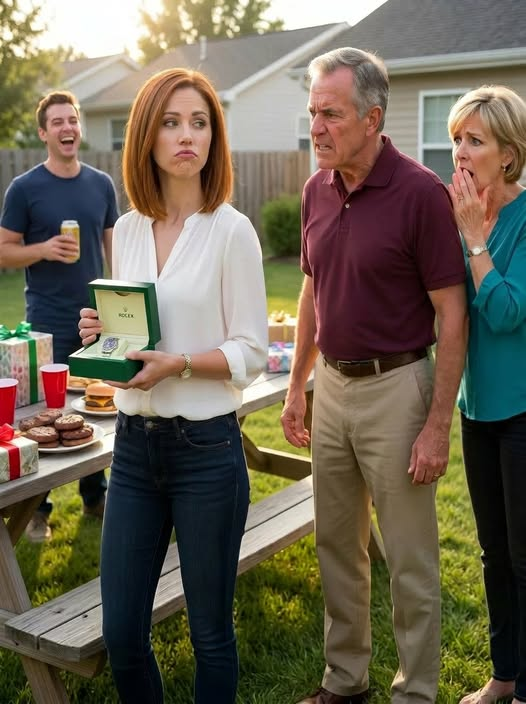
At my dad’s retirement BBQ, I handed him a $10,000 Rolex.
For about three seconds, everyone applauded.
Then Dad glanced at the watch, looked directly at me, and smirked.
“You’re still my disappointment.”
The backyard fell strangely still.
Not completely silent. Music still drifted from the patio speakers, burgers still hissed on the grill, and my uncle was still laughing too loudly because he couldn’t tell whether Dad was joking.
But I knew.
My name is Allison Reed. I’m thirty-five years old, a financial analyst living in Boston, and the oldest daughter of Frank Reed, a retired police captain who spent my entire life treating affection like a reward to be earned.
My younger brother Jason was always the favorite.
Jason wrecked cars, lost jobs, borrowed money, lied about rent, and somehow remained “a good kid who just needed help.”
I earned scholarships, purchased my own condo, helped cover Mom’s medical bills, paid off Dad’s truck loan, and quietly handled the property taxes on their house for three straight years.
Still, I was the disappointment.
Because I wasn’t married.
Because I didn’t have kids.
Because I moved away.
Because I learned how to say no.
That Saturday, I decided to try one last time.
Dad was retiring after thirty-eight years on the force, and Mom begged me to “put the past behind us for one day.” So I bought the Rolex he’d admired for years. Stainless steel. Black dial. Elegant, expensive, understated.
When he opened the box, I watched his eyes light up.
Then he remembered who bought it.
“You’re still my disappointment,” he said loudly enough for cousins, neighbors, and retired coworkers to hear.
Jason laughed first.
That part hurt the most.
Mom whispered, “Frank,” but she didn’t defend me. She never defended me when it actually mattered.
I smiled.
Not because I was okay.
Because something inside me finally became clear.
I leaned forward, removed the Rolex box from Dad’s hands, and shut it.
Mom’s face changed immediately.
“Allison, don’t you dare.”
I looked directly at her.
“Don’t I dare what?”
Dad’s smile vanished.
“That’s my gift.”
“No,” I said calmly. “It was.”
Jason stood beside the cooler holding a beer.
“Wow. Dramatic as always.”
I turned toward him.
“You want to buy him one?”
He suddenly found something else to look at.
Dad’s face turned bright red.
“You embarrassed me in front of everyone.”
I laughed softly.
“You handled that yourself.”
Then I picked up my purse and walked through the stunned crowd toward the backyard gate.
Mom hurried after me halfway across the lawn.
“Allison, come back here right now.”
I stopped, turned around, and said, “No. I’m done paying to be insulted.”
She froze in place.
Dad shouted from the patio, “Good. Keep your damn watch.”
I nodded once.
“I will.”
This morning, they discovered what else I’d taken away.
Not from their house.
From my name.
Their access…
Part 2
The following morning, my phone started ringing before seven.
Mom called first. Then Dad. Then Jason.
Then Mom again.
I ignored every single call while sipping coffee in my kitchen, the Rolex box sitting quietly on the counter like a polished silver monument to my final mistake.
At 7:42 a.m., Mom finally texted.
“Why did the mortgage company call your father?”
I took a slow breath.
Then another message arrived.
“The payment didn’t go through.”
A moment later Jason texted.
“Why is Mom’s pharmacy card getting declined?”
Then Dad finally wrote:
“What the hell did you do?”
I stared at the screen for a long moment.
What did I do?
I stopped.
That was all.
For years, I had been the invisible support beam holding my family upright. Nobody praised the beam. Nobody thanked the beam. Nobody even noticed it existed.
They only panicked when it disappeared.
Three years earlier, Dad fell behind on the house after Mom’s surgery and Jason’s latest “temporary emergency” drained their savings account.
Mom called me crying, terrified they might lose the home where I grew up.
So I helped.
First I paid the overdue property taxes.
Then I covered two mortgage payments.
Then the utilities.
Then Mom’s supplemental insurance.
Then Jason’s credit card that was supposedly “just for groceries and gas” but somehow also covered sports betting apps, steakhouse tabs, and expensive sneakers.
Every month, I told myself it was temporary.
Every month, my family treated my help like weather.
Constant. Expected. Invisible.
After the BBQ, I drove home and finally did what I should have done years ago.
I canceled the automatic mortgage transfers tied to my account.
I removed Mom from my medical expense card and arranged for direct payment only of her legitimate insurance premium through the provider itself.
I froze the credit card Jason had been using.
I changed passwords on every shared account.
Then I emailed the family one sentence.
“Effective immediately, I will no longer fund any household, personal, or emergency expenses for people who call me a disappointment.”
Apparently, they read it too late.
Dad called again.
This time I answered.
He didn’t bother saying hello.
“You cut off the mortgage?”
“I stopped paying your mortgage.”
“You know we depend on that.”
“No, Dad,” I replied. “You depended on me not respecting myself.”
His breathing grew heavier.
“You’re punishing your mother.”
“I’m protecting myself.”
Then Mom grabbed the phone.
“Allison, please. Your father was joking.”
“No, he wasn’t.”
“He says things.”
“And I paid things. Looks like we’re both stopping.”
She started crying.
That sound used to destroy me.
This time, I felt sad—but not responsible.
“You know how proud he is,” Mom whispered.
“I know how cruel he is.”
“He’s your father.”
“I know. That’s why I bought him a $10,000 watch.”
Silence.
Then she said quietly, “Jason’s card got declined at the gas station.”
“Good.”
“Allison.”
“Mom, he’s thirty-two years old. He can pay for his own gas.”
Jason must have been listening nearby because his voice suddenly exploded through the phone.
“You think you’re better than us because you make money?”
“No,” I said calmly. “I think money made it easy for you to avoid becoming better.”
He cursed at me.
I hung up.
Around noon, Aunt Karen called.
Unlike everyone else, she didn’t yell.
She simply asked, “Did Frank seriously say that after you gave him a Rolex?”
“Yes.”
She sighed deeply.
“Then he deserves the Casio he can afford.”
For the first time all morning, I laughed.
Part 3
The family narrative changed quickly.
At first, I was cruel for taking back Dad’s retirement gift.
Then I became selfish for ending the mortgage payments.
Then suddenly I was “financially abusive,” which was ironic coming from people who had treated my bank account like a household utility.
Aunt Karen shut that story down fast.
She was there at the BBQ. She heard Dad’s comment. She saw Jason laugh and Mom stay silent.
When Mom told relatives I had “abandoned the family out of nowhere,” Aunt Karen replied in the family group chat:
“No, she stopped funding insults.”
Nobody responded to that for a while.
The first real consequences arrived two weeks later.
The mortgage company called Dad again.
Then the utility bill came due.
Then Jason’s phone service got disconnected because apparently I had unknowingly been paying that too through a bundled family plan Mom never mentioned.
Dad called furious.
“You made your point.”
“No,” I replied. “My point is only beginning.”
“We need help.”
“You need a budget.”
Mom called later with a softer tone.
“Allison, can we at least talk?”
“We can talk if nobody asks me for money.”
She hesitated too long.
So I answered for her.
“Then we’re not ready.”
One month passed.
Then another.
Dad sold his fishing boat.
Jason got a job managing inventory at a hardware store after Aunt Karen told him nobody respected a grown man blaming his sister because his gas card stopped working.
Mom started working part-time at the local library.
And somehow, everyone survived.
That realization made me angrier than anything else.
They could have adjusted years earlier.
They simply chose not to because I was available.
In August, Dad asked me to meet him at a diner halfway between Boston and their town.
I almost refused.
But curiosity won.
He arrived alone wearing an old Red Sox cap and looking smaller somehow, less intimidating without a backyard audience applauding him.
For several minutes, we sat quietly with coffee between us.
Finally he spoke.
“I shouldn’t have said what I said.”
“No.”
He swallowed hard.
“And I shouldn’t have let you pay for everything while treating you like you didn’t matter.”
That surprised me enough to pause.
I studied him carefully.
“Did Mom write that for you?”
His mouth twitched slightly, almost becoming a smile.
“No. Karen yelled at me for forty straight minutes.”
“Good.”
He nodded slowly.
“I don’t know how to fix this.”
“You don’t start by fixing it,” I replied. “You start by not asking for anything.”
He looked down at his coffee.
“I’m not asking.”
For the first time in years, I believed him.
Not completely.
But enough to stay for lunch.
The Rolex stayed with me.
I never returned it.
I never sold it either.
I kept it in my desk drawer for six months before donating it to a charity auction benefiting a local domestic violence shelter. It sold for $9,200.
When the donation receipt arrived, I smiled.
Dad had called me his disappointment.
Fine.
My disappointment funded someone else’s escape.
By Thanksgiving, things weren’t healed, but they were honest.
Jason paid his own bills.
Mom stopped forwarding me invoices.
Dad called once a week and asked about my life before mentioning anything about his own.
I visited for dessert instead of dinner.
That boundary mattered.
When I walked into the house, Dad stood from his chair.
For one second, I saw the old version of him—sharp, proud, always ready to wound.
Instead, he simply said, “I’m glad you came.”
No joke.
No insult.
No audience.
Just four words.
I nodded.
“Me too.”
Maybe someday we would become more than careful strangers trying again.
Maybe not.
But I had finally learned something important.
Generosity without dignity is not love.
It is payment in exchange for permission to be hurt.
And I was done purchasing my place in a family that only valued me when the bill arrived.
Part 4: The Currency of Absence
The first winter after the barbecue was the quietest of my life.
In Boston, winter doesn’t just arrive; it settles into the brick and asphalt like a heavy, gray permanent fixture. For the previous seven years, December had been a month of acute financial anxiety—not for my own books, which I kept with the clinical precision of a senior analyst, but for the chaotic ledger of the Reed family.
In Decembers past, my phone would vibrate at odd hours with texts from Mom containing screenshots of past-due oil bills, or frantic, garbled voicemails from Jason about a car transmission that had “suddenly given up” just as property taxes loomed. I used to log into my banking portal from my desk, my chest tight, transferring chunks of my bonus before the money could even settle into my savings. I had viewed those transactions as shields. If I kept them warm, if I kept the lights on, they would eventually see me. They would see the competence and mistake it for something worthy of love.
This December, the silence was deafening. And expensive for them.
On a Tuesday afternoon, two weeks before Christmas, my phone buzzed on the blotter next to my keyboard. It was an alert from an old, linked utility portal I’d forgotten to delete from my password manager. The account was for the gas company servicing my parents’ house. The notification didn’t ask for money; it simply alerted me that the secondary authorized user—me—had been successfully removed from the profile.
I stared at the confirmation email. Account updated by: F. Reed.
He was doing it himself. Or rather, he and Mom were scraping together the figures without my login credentials. I felt a strange, brief phantom ache in my thumb—the muscle memory of clicking “Authorize Transfer”—and then it passed, replaced by a cold, clear stillness.
“Allison?”
I looked up. My managing director, Marcus, was leaning against my office doorframe, holding a stack of year-end performance reviews.
“You’ve got a look on your face like you just shorted a tech stock right before the crash,” he said, stepping into the room. He dropped a folder onto my desk. “Good news. Your portfolio variance is under two percent for the quarter. The partners approved the senior vice president track for you starting in Q1.”
“Thank you, Marcus,” I said, my voice steady, though my heart did a small, unfamiliar dance. “That’s… incredible.”
“You earned it. You’ve been focused. No distractions lately.” He paused, looking at me with the shrewd, observant eyes of a man who spent ten hours a day reading human tells. “Usually around the holidays, you look like you’re carrying the weight of a small municipal debt crisis on your shoulders. You look lighter this year.”
“I shed some non-performing assets,” I said.
Marcus laughed, assuming it was a joke about my investment strategy, and walked out. I leaned back in my chair, looking out the floor-to-ceiling glass at the gray Boston harbor. Non-performing assets. It was a cold way to describe a family, but from a purely analytical standpoint, it wasn’t incorrect. For over a decade, I had been pouring capital into a venture that yielded nothing but negative interest.
That evening, I did something I hadn’t done since my twenties: I went shopping for myself without calculating what the purchase would cost my family’s safety net. I bought a long, structured wool coat in camel—the kind of coat that didn’t invite casual hugs but commanded a room. When the cashier handed me the receipt, my hand didn’t shake. I didn’t think about Jason’s past-due insurance or Mom’s co-pays. I just put the bag over my arm and walked to the subway.
When I got back to my condo, there was a package sitting by my door. It was small, wrapped in brown butcher paper, with my address written in a stiff, jerky cursive I recognized immediately. Dad.
I carried it inside, set it on the kitchen island next to a glass of white wine, and looked at it for a long time before opening it. Part of me—the old, conditioned part— braced for a trap. A bill wrapped in a grievance. A demand disguised as a gesture.
I cut the tape with a paring knife. Inside was an old, battered wooden box. I recognized it instantly; it was the tackle box Dad had used when I was ten years old, back when he still took me to the pier before Jason was born and before the police department consumed whatever patience he had left.
Inside the box wasn’t fishing gear. It was a collection of papers.
I picked up the first one. It was a copy of my college acceptance letter from Boston College, dated fourteen years ago. The edges were yellowed, and there was a faint ring from a coffee mug on the bottom corner. Beneath it were my semester transcripts, every single one, printed out on old dot-matrix paper from his office terminal. He had kept them.
At the very bottom of the box was a small, torn piece of a ledger sheet. In Dad’s handwriting, there was a list of numbers.
- Taxes (2024): $4,200
- Mortgage assistance: $6,800
- Oil/Gas: $1,450
Beside each number, he had written a single word: Owed.
There was no note. No “I love you.” No “Merry Christmas.” Just the record. The acknowledgment that the ledger existed, and that for the first time in his life, he realized he was in the red.
I picked up my phone to call him, my fingers hovering over his name in my contacts. But then I stopped. I looked at the word Owed. To a man like Frank Reed, debt was a form of weakness. If I called him now and forgave it, I would be validating his shame. If I called and demanded it, I would be the transactional daughter he always claimed I was.
Instead, I took a picture of the ledger sheet, texted it to him, and wrote: Interest rate is 0%. Take your time.
Five minutes later, his response came back.
Understood.
Part 5: The Geography of Boundaries
By the spring of 2027, the new ecosystem of my family had settled into a fragile, functional routine. The dramatic outbursts had dried up, largely because I no longer provided the fuel of my reactions.
Jason had managed to keep his job at the hardware store for nine consecutive months—a personal record. Aunt Karen kept me updated via text, acting as a kind of neutral UN observer in our family dynamic.
“He hates it,” Karen wrote to me one Tuesday evening while I was prepping meal-preps for the week. “He actually has to wake up at five in the morning to count boxes of galvanized screws. He tried to complain to your father last week about the ‘toxic work environment,’ and Frank told him to buy cheaper beer if he didn’t like the hours. I almost fell off my stool.”
I smiled at the text, but it was a distant, intellectual kind of amusement. I was learning that distance wasn’t just about miles; it was about emotional real estate. I lived in Boston; they lived in a small, weathered suburb of Worcester. It was only an hour’s drive, but mentally, it felt like an ocean away.
The real test came in April, when Mom called me on a Friday afternoon. Her voice lacked the frantic, high-pitched register she used when she was trying to manage a crisis before Dad found out. She sounded tired, but clear.
“Allison? Are you busy?”
“I’m just finishing up some spreadsheets, Mom. What’s going on?”
“Your father’s sister, Clara, passed away this morning.”
I paused, setting my pen down. Aunt Clara had been a recluse who lived in Maine, a woman who had severed ties with Dad twenty years ago after a bitter dispute over their parents’ small estate. I had only met her twice, but I remembered her as a sharp-tongued woman who smelled of menthol cigarettes and didn’t suffer fools.
“I’m sorry to hear that, Mom. How is Dad taking it?”
“He’s… quiet,” Mom said. “You know how he is. He won’t say it, but Clara dying without them speaking for two decades… it’s hitting him hard. The funeral is up in Bangor on Tuesday. We’re going to drive up.”
There was a long pause. I knew what was coming, and I braced my feet against the floor under my desk, preparing my standard, polite refusal.
“We were wondering,” Mom continued, her voice dropping a fraction of an octave, “if you would want to go with us? We could pick you up on the way through Boston. Jason can’t go—he can’t get the time off work, and honestly, Frank doesn’t want him there making it about himself.”
I closed my eyes. The prospect of a four-hour car ride with Frank and Helen Reed, trapped in the cabin of a Ford Explorer, felt like a psychological experiment designed to test my remaining sanity.
“Mom, I don’t think that’s a good idea,” I said gently. “I have a quarterly review on Wednesday morning. I can’t take two days off to drive to Maine.”
“We would stay at a hotel, Allison. We’d pay for it,” she added quickly, and the sheer effort behind that sentence hit me like a physical blow. We’d pay for it. It was a massive concession for a woman who used to forward me her utility statements without a second thought.
“It’s not about the money, Mom,” I said. “It’s about the time. And… it’s about the space.”
“He asked for you, Allison.”
The silence that followed was heavy. My mother had never lied to me about Dad; she had omitted things, she had smoothed things over, but she had never invented an affection that wasn’t there.
“What exactly did he say?” I asked.
“He was sitting at the kitchen table looking at the obit Clara’s lawyer emailed him. He looked up at me and said, ‘Clara died alone because she was too proud to admit she was mean. Call Allison. See if she’ll come. She knows about pride.’”
I let out a short, dry laugh. “That’s not an invitation, Mom. That’s a diagnosis.”
“It’s the closest he can get to saying he doesn’t want to be alone in that car,” Mom whispered. “Please. Just think about it.”
I told her I would think about it, and I spent the weekend doing exactly that. I talked to my therapist on Saturday morning—a luxury I could now afford consistently since I wasn’t funding Jason’s lifestyle.
“What are you afraid will happen in that car?” Dr. Aris asked me through the screen.
“I’m afraid I’ll get pulled back into the old script,” I said, leaning back against my sofa. “I’m afraid he’ll say something small, something sharp, and I’ll spend the next three days trying to prove to him that I’m successful, that I’m stable, that I’m… not what he thinks I am.”
“Allison,” Dr. Aris said, her voice gentle but firm. “You already proved it. You proved it when you took the watch back. You proved it when you stopped the checks. The only person left who needs to see the proof is you. If you go in that car as a financial analyst who chooses to be there, rather than a daughter who needs to buy her way in, what changes?”
I looked at my hands. They were clean, well-manicured, unburdened by the physical weight of my family’s past. “If I go, I control the exit.”
“Exactly.”
On Monday evening, I called Mom back. “I’ll go. But I’m driving myself. I’ll meet you at the church in Bangor tomorrow at noon.”
There was a distinct intake of breath on the other end. “Okay. Okay, honey. Thank you.”
Part 6: The Bangor Ledger
The church in Bangor was a modest, white-steepled building that looked as though it had been beaten into submission by a century of Maine winters. The turnout was sparse—fewer than fifteen people sat in the pews, mostly elderly neighbors and a few distant cousins who looked like they had come out of a sense of grim obligation rather than grief.
I arrived twenty minutes early, wearing my camel wool coat and carrying a small, tasteful purse. I sat in the back row, my eyes fixed on the simple pine casket at the front.
When my parents walked in, I felt a familiar, instinctual tightening in my stomach. Dad walked with a slight limp now—his hip had been bothering him since his retirement, an injury from his days on patrol that he had ignored for too long because treating it would mean admitting vulnerability. Mom walked beside him, her hand tucked into his elbow, looking nervous.
Dad scanned the small crowd, his eyes passing over the few unfamiliar faces until they landed on me. He didn’t smile—Frank Reed didn’t smile at funerals—but his shoulders dropped perhaps half an inch. He nodded once. I nodded back.
The service was short, sterile, and entirely handled by a minister who clearly hadn’t known Aunt Clara beyond her name on a parish registry. He spoke of “peace” and “the end of earthly struggles,” euphemisms that everyone in the room knew translated to “she died angry and alone.”
Afterward, we gathered in the freezing churchyard, the wind off the Penobscot River cutting through our coats.
“You made good time,” Dad said, stepping up to me. He wasn’t looking at me; he was looking out at the gravel parking lot, his hands shoved deep into his overcoat pockets.
“The traffic on I-95 wasn’t bad,” I replied, keeping my voice level, conversational.
“Good car?”
“An Audi. It handles the highway well.”
He nodded, a brief, technical appreciation of German engineering. “Good. Safe.”
Mom came over, wrapping her arms around me in a brief, tentative hug that smelled of lavender soap and old wool. “I’m so glad you came, Allison. We’re going to a diner down the street to get some hot soup before we drive back. Will you join us?”
I looked at Dad. He still wasn’t looking at me, but his jaw was tight, his teeth visibly clenched against the cold—or against whatever words he was trying not to say.
“Sure,” I said. “Lead the way.”
The diner was called The Eagle’s Nest, a greasy-spoon type place with vinyl booths patched with duct tape and a waitress who called everyone “dear.” We sat in a corner booth—Dad and Mom on one side, me on the other. It was the same configuration we had used throughout my childhood, except back then, Jason would have been wedged between them, spilling his chocolate milk and taking up all the conversational oxygen.
We ordered clam chowder and coffee. For ten minutes, the only sound was the clinking of spoons against heavy ceramic bowls.
“Jason got a promotion,” Mom said eventually, breaking the silence with the frantic energy of someone trying to prevent a bomb from ticking. “Assistant shift supervisor. They gave him an extra two dollars an hour.”
“That’s good, Mom,” I said, genuinely meaning it. “Structure is good for him.”
“He paid his own car insurance this month,” Dad said suddenly. His voice was rough, like gravel shifting in a stream bed. He finally looked up from his soup, his gray eyes locking onto mine. “First time in five years he didn’t ask for a loan.”
“I’m glad to hear that, Dad.”
“He called me a hardass,” Dad continued, his mouth twitching into that familiar, cynical line. “Said I was turning into a tyrant because I wouldn’t let him borrow the truck when his registration lapsed.”
I took a sip of my coffee, keeping my gaze steady. “And what did you say to him?”
“I told him he was lucky he didn’t have a sister who knew how to balance a spreadsheet, or he’d be living in a tent,” Dad said.
The words hung in the air between us, heavy and potentially dangerous. In the old days, that would have been a jab—a way of framing my financial withdrawal as a cruel, punitive measure that had pushed the family to the brink.
I set my coffee cup down with a soft click. “Is that what you think I did, Dad? Punished him?”
Dad looked down at his rough, calloused hands—the hands of a cop who had spent thirty-eight years holding steering wheels, radios, and occasionally handcuffs. “No,” he said quietly. He didn’t look at Mom; he kept his eyes on his own knuckles. “I think you quit a bad job. I used to see it on the force. Some guys, they stay too long because they think if they leave, the shift will fall apart. Then they get shot, or they get cynical, or they just dry up and die. The smart ones… the smart ones know when to hand in the badge.”
He looked back up, and for the first time in my thirty-five years, I saw something resembling respect in his face. It wasn’t the soft, warm affection that parents in commercials give their children. It was the hard-won, begrudging respect of an old captain recognizing an independent operator who had successfully executed a tactical retreat.
“You weren’t a disappointment because you moved away, Allison,” he said, his voice dropping so low the waitress couldn’t hear it over the sizzle of the flat-top grill. “You were a disappointment because you made it look easy. Every time you succeeded, it made the rest of us look like we were failing. I was mad at you for being strong while the rest of them were… fragile.”
“Frank,” Mom warned softly, her face turning pale.
“No, Helen,” Dad said, cutting her off with a flick of his hand. “Let me say it. I’m seventy-two years old, my sister just died in a house full of cats and old newspapers because she couldn’t apologize to anyone, and my daughter is sitting across from me paying for her own damn coffee because I couldn’t keep my mouth shut at my own retirement party.”
He reached into his breast pocket and pulled out an envelope. It wasn’t a card. It was a standard, business-size security envelope, thick and heavy. He slid it across the Formica table toward me.
“What’s this?” I asked, not touching it.
“First installment,” he said. “Three thousand dollars. I sold the John Deere mower. We don’t need that big a rig for the yard anyway; I bought a push mower from the hardware store. Jason assembled it for me.”
I stared at the envelope. The paper was crisp, white, and completely out of place among the grease stains on the table.
“Dad, I didn’t ask for this,” I said, my voice suddenly tight.
“I know you didn’t,” he said. “That’s why I’m giving it to you. If you’d asked for it, I probably would have told you to go to hell. But I looked at that ledger box I sent you. I looked at the three years of property taxes you paid while I was buying fishing lures and pretending everything was fine. It’s a debt, Allison. And a Reed pays his debts.”
I looked at the envelope for a long time. The practical, analytical side of my brain immediately calculated the logistics: three thousand dollars didn’t even cover half of the property taxes I had absorbed, let alone the mortgage assistance or the utilities. But looking at the slight tremor in his hand as he held his coffee cup, I realized the math didn’t matter. This wasn’t a financial transaction. It was a surrender.
I reached out, took the envelope, and slid it into my purse.
“Thank you, Dad,” I said. “Account updated.”
He nodded once, a sharp, clean movement, and went back to his chowder.
Part 7: The Calculus of Grace
We parted ways in the gravel parking lot of the diner. Mom gave me another hug—this one longer, warmer, less afraid. Dad stood by the door of his Explorer, his hands in his pockets, watching me get into my Audi.
“Drive safe,” he called out over the wind. “Check your tire pressure before you hit the turnpike. The temperature’s dropping.”
“I will, Dad,” I said.
The drive back to Boston was different from the drive up. The gray sky had broken slightly, allowing long, pale shafts of afternoon sunlight to hit the pine trees along the highway. I didn’t play music. I just listened to the hum of the tires against the pavement, my mind working through the complicated calculus of what had just happened.
Had he apologized? Not in so many words. He hadn’t said I’m sorry for making you feel like trash for thirty-five years. He hadn’t said I love you more than Jason.
But as a financial analyst, I knew that words were cheap currency. They inflation-adjusted down to nothing over time. Actions, however—the sale of a beloved John Deere mower, the assembly of a push mower by a lazy brother, the delivery of crisp cash in a greasy diner—those were hard assets. They had real value.
When I got back to my condo, I didn’t put the three thousand dollars into my savings account. Instead, I opened my laptop and logged into the website of the domestic violence shelter where I had donated the Rolex six months prior.
I clicked the “Donate Again” button, entered the routing information for my personal account, and transferred exactly $3,000. Under the section for “In Honor of,” I paused for a moment, my fingers hovering over the keys.
Then I typed: Frank Reed (Retired).
I printed out the receipt, put it in an envelope, and mailed it to my parents’ house the next morning without a note.
Part 8: The Return
Two years later, in the summer of 2029, I went back to the house for my parents’ forty-fifth wedding anniversary.
It wasn’t a big BBQ. There were no retired cops, no gossiping cousins, no neighbors looking for free burgers. It was just the four of us: Mom, Dad, Jason, and me.
The backyard looked different. The grass was a little longer, cut with the uneven lines of a push mower rather than the pristine, golf-course finish of the old John Deere. The patio furniture was the same, but the old, rusted grill had been replaced by a small, efficient Weber model that Jason had bought with his employee discount.
Jason was different, too. He had lost twenty pounds, mostly from lifting crates at the hardware store, and he was wearing a clean polo shirt instead of his usual oil-stained tank tops. He didn’t look at me with the old, defensive smirk. When I walked through the gate, he actually stood up and offered me a bottle of water.
“Hey, Al,” he said, his voice quiet. “You look good. How’s Boston?”
“Busy, Jase. How’s the store?”
“Good. They’re making me store manager in September. Full benefits. I’m… actually looking at buying a small condo down by the Worcester line.” He looked down at his water bottle, his face reddening slightly. “Nothing fancy. Just… my own place.”
I looked at him, searching for the old resentment, the boy who used to laugh when Dad called me a disappointment. It wasn’t there. The lack of my money had forced him to grow a spine, and to my surprise, he seemed to prefer the weight of it to the softness of dependency.
“I’m really proud of you, Jason,” I said, and for the first time in my life, the words didn’t taste like ash in my mouth.
He looked up, surprised, and gave me a small, genuine nod. “Thanks. Me too.”
Mom and Dad came out of the house carrying platters of chicken and potato salad. Dad was walking slower now, using a cane with a carved wooden handle—another concession to reality he would have fought tooth and nail five years ago.
We sat around the small table, the late afternoon sun filtering through the oak trees. The conversation wasn’t brilliant or deep; we talked about the weather, the cost of groceries, the local baseball team. But there was no performance. There was no audience for Dad to play to, and there was no bill for me to pay.
Toward the end of the evening, as the light began to fade into that long, blue summer twilight, Mom went inside to get the coffee. Jason followed her to help carry the mugs.
Dad and I were left alone on the patio.
He leaned back in his chair, his cane resting against his knee. He looked out at the small yard, then turned his head to look at me. He wasn’t wearing his old police watch anymore; he was wearing a simple, black-strapped Timex—the kind of watch a man buys when he just needs to know what time it is, nothing more.
“You still got that receipt?” he asked suddenly.
I blinked, taken aback. “Which receipt, Dad?”
“The one from the shelter. For the three grand. The one you sent in the mail.”
“Oh,” I said, feeling a sudden, brief return of that old defensiveness. “Yes. I have it in my files.”
Dad reached into his pocket, pulled out a small, worn piece of paper, and laid it on the table between us. It was the receipt I had sent him. The ink had faded a bit, and the paper was creased from being folded and unfolded dozens of times.
“I called them,” he said.
My heart stopped for a beat. “You called the shelter?”
“Yeah,” he said, looking at the trees. “Talked to a woman named Sarah. She told me what they did with the money. Said they used it to pay the security deposit on an apartment for a woman and her two kids who had to leave their house in the middle of the night with nothing but their clothes.”
He turned his head and looked at me, his eyes clear and surprisingly bright in the twilight.
“She told me that the donation was made in my name,” he said. “She asked if I was the Captain Reed who used to handle the domestic calls on the North Side back in the nineties.”
“What did you say?” I whispered.
“I told her I was,” he said. “And then she told me that my daughter must think very highly of me to put my name on a gift like that.”
He paused, his mouth tightening into a thin, straight line. He reached out and touched the faded receipt with one thick, calloused finger.
“I didn’t deserve that, Allison,” he said, his voice cracking just a fraction. “I didn’t deserve to have my name on something good like that. Not after what I said to you.”
I looked at him—this man who had been the giant, terrifying arbiter of my worth for thirty-five years. He looked small now. He looked human. He looked like an old cop who had finally come home from a very long, very ugly shift and realized he had brought the dirt inside with him.
“You didn’t deserve it as a reward, Dad,” I said softly, leaning forward over the table. “You deserved it as an investment. I’m a financial analyst, remember? I don’t put capital into things that don’t have potential.”
He stared at me for a long, silent moment. Then, very slowly, his mouth softened. It wasn’t a smirk. It wasn’t a cynical line. It was a real, genuine smile—the first one I had ever seen directed entirely at me without a catch.
“You’re a tough negotiator, Allison,” he said, his voice returning to its normal, gravelly depth.
“I had a hard teacher,” I replied.
Mom and Jason came back out then, the screen door banging shut behind them, carrying the coffee and a small chocolate cake with two candles representing the decades they had survived together.
As Mom lit the candles, the little sparks throwing warm light across their faces, I looked around the table.
We weren’t a perfect family. We weren’t healed. The scars were still there, thick and white under the surface of our careful conversations. Jason would probably always be a little lazy; Mom would probably always be a little timid; Dad would probably always be a little gruff.
And I would always be the daughter who lived an hour away, who kept her accounts separate, who knew how to say no.
But as I reached out to take my coffee cup from my brother, my hand steady and my heart entirely light, I knew that the ledger was finally balanced. I hadn’t bought their love, and they hadn’t bought my submission. We were just four people sitting in a backyard, watching the candles burn down in the cool summer air, knowing exactly what we cost each other—and choosing to stay anyway.
Part 9: The Value of the Watch
Three months after the anniversary, I received a small, notification letter from a law firm in Worcester.
It wasn’t a summons, and it wasn’t a bill. It was a copy of a newly executed codicil to Frank Reed’s last will and testament. As always, my analytical mind went straight to the text, bypassing the legal preamble to find the core data.
“To my daughter, Allison Reed, who taught me the difference between a debt and a gift, I leave the sum of $10,000, to be paid from the liquidation of my remaining personal property. This sum is explicitly not to be considered an inheritance, but the final satisfaction of an outstanding balance, principal and interest, fully paid.”
I read the paragraph three times sitting at my desk in Boston.
Ten thousand dollars. The exact cost of the stainless-steel Rolex with the black dial. The exact price of the insult he had hurled at me across the smoky air of his retirement BBQ.
He had gone to a lawyer, paid a fee, and rewritten his final testament just to make sure that when he finally left this world, he wouldn’t leave it owing me a single cent of my dignity. He was using his will to have the last word, but for the first time in our history, the last word wasn’t a weapon. It was an validation.
I folded the legal document, placed it in the wooden tackle box next to my old college acceptance letter and his handwritten ledger sheet, and closed the lid.
The next morning was a Saturday. The air was crisp with the first hint of autumn, the sky a brilliant, sharp blue that reminded me of the day I had walked away from the backyard gate.
I put on my camel wool coat, picked up my purse, and walked out into the city. I didn’t check my banking app. I didn’t look at my portfolio. I just walked down to the harbor, watching the ferries cut white wakes through the dark water, my wrists bare, my time entirely my own.
I had spent thirty-five years believing that love was something you had to earn, a line item on a ledger that you had to fund with your own blood and achievement until the balance finally turned positive. But standing there on the pier, the cold wind in my face, I realized the absolute truth of the market:
The most valuable things are the ones you cannot buy. And the most powerful thing you can ever do with your wealth is use it to walk away from a table where respect is not being served.
I wasn’t my father’s disappointment anymore. I was his equal. And that was worth every single dollar it had cost to get here.