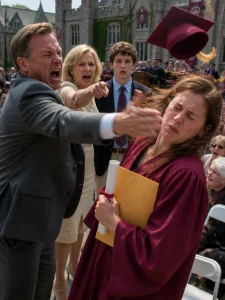
“You don’t deserve that degree,” my father hissed, a split second after hitting me with a slap so violent that my maroon graduation cap went flying across the university’s main quad.
The strike echoed sharply through the courtyard of Hudson Valley University. It wasn’t just a random noise; it was one of those definitive, bone-chilling sounds that slices straight through the atmosphere and forces everyone to freeze, as if someone had abruptly yanked the power cord on the entire ceremony.
My cap landed right beside the sleek leather case of my diploma, rolling unceremoniously across the stone floor. I stood there, my left cheek burning like ice, my hand trembling uncontrollably as I kept my eyes locked onto the man who had just publicly degraded me in front of hundreds of fellow students, professors, media photographers, and families.
My father, Arthur Vance, was completely crimson with unadulterated rage.
“You are an absolute embarrassment,” he muttered through his teeth, stepping closer. “Standing up on that stage acting as if you actually engineered something worth celebrating.”
Before I could even gather enough oxygen to respond, my mother, Victoria, marched forward, her features contorted into a mask of pure venom.
“A failure in a graduation gown, that’s exactly what you are!” she shrieked loudly. “Stop making this family look bad in public!”
A collective, horrified gasp rippled through the nearby rows of parents. A senior professor lowered his camera, his jaw open. A campus security officer immediately adjusted his belt and began marching purposefully toward our perimeter, but I calmly lifted my uninjured left hand, keeping my eyes fixed directly on my parents.
“No,” I said, my voice dropping to a terrifying, quiet register. “Let him finish his thesis.”
My best friend, Paige, who was standing just a few paces away in her own gown, rushed to my side, her face completely pale. “Audrey, are you okay? What is happening?”
I didn’t answer her. Not because I lacked the capacity to hear her, but because I had spent four grueling years calculating the exact metrics of this moment. Perhaps I hadn’t anticipated the physical strike, or the way my soul would feel tightly compressed under the heat of the crowd, but I had absolutely anticipated the day my parents would finally run out of shadows to hide behind.
For years, Arthur and Victoria had systematically distributed a meticulous lie to our extended family, claiming I had dropped out of the university. They told everyone I was fundamentally lazy, that I had run off with a toxic crowd, and lacked the cognitive discipline to finish my education. They played the roles of long-suffering, broken-hearted parents who simply didn’t know how to salvage an ungrateful daughter.
But the actual database told an entirely different story.
I had successfully secured a competitive partial academic scholarship. I pulled grueling double shifts every morning at a local diner near the historic district, managed private tutoring contracts in the afternoon, and studied until the early hours of dawn. There were weeks where I survived on three hours of sleep. Weeks where I budgeted my meals down to coffee and stale bread to protect my tuition balance. There were nights I locked myself inside the library restrooms, weeping silently in the dark just so nobody would witness me coming apart at the seams.
Yet on that beautiful morning, when the clinical dean announced my name with Summa Cum Laude honors, the entire courtyard erupted into a massive wave of applause.
And that was the exact fraction of a second my younger brother, Julian, stopped smiling.
Julian was standing right behind our parents, looking immaculate in a tailored designer suit, a luxury watch, and brand-new leather shoes. He had always been designated as the “pride of the legacy,” despite the proven fact that he had flunked out of the institute twice and entirely liquidated a logistics startup I had warned him was structurally unsound. For his life, there was always an endless flow of corporate capital—advanced courses, gas cards, flagship smartphones, and European vacations.
For my life, they flatly claimed the accounts were entirely dry.
When Arthur witnessed his independent daughter ascend the steps of the stage to collect her honors diploma, his features completely fractured. It wasn’t a look of hidden pride. It was pure, volatile fury—as if every single round of applause from the audience was a physical strike against his executive ego.
That was why he breached the crowd to confront me. That was why he hit me.
I bent down slowly, calmly retrieved my fallen cap, and wiped a trace of dust from my diploma case. My cheek was throbbing with pain, but my frequency remained dead calm.
“You’re entirely correct, Dad,” I said, my voice echoing clearly against the brick masonry. “Everyone in this courtyard deserves to hear the absolute truth.”
My mother’s eyes widened in sudden caution. “Audrey, don’t you dare create a scene.”
But I was already walking purposefully toward the main podium staircase. The university president stood near the microphone, looking deeply disoriented, entirely unsure whether to deploy security or terminate the broadcast.
I reached inside the hidden silk lining of my graduation gown and withdrew a heavy, wax-sealed manila folder. I had carried that weight against my chest all afternoon, like a silent, ticking asset waiting for the exact window to detonate.
“Dr. Sterling,” I said, stepping directly up to the live microphone, my voice filling the entire university PA system. “Before I formally exit this institution, I need to file an official compliance report against the individuals who systematically embezzled my tuition capital, forged federal signatures under my identity, and attempted to forensically delete me from my own family.”
From the center aisle below, Arthur let out a desperate, unhinged roar: “Shut your mouth, Audrey!”
But the system was already online. And the audio channel was wide open.
The entire multi-acre courtyard dropped into an absolute, terrifying silence.
The university president, Dr. Sterling, looked first at the thick legal dossier I was extending toward his hands, and then down at my parents, whose expressions shifted instantly from aggressive dominance to pure panic.
“Ms. Crestwood,” Dr. Sterling said, his tone turning clinical and careful over the microphone. “Are you logging a formal administrative and legal affidavit on the record?”
“I am,” I replied smoothly. “And I possess the complete forensic verification.”
My mother let out a sharp, theatrical laugh—the distinct kind of high-society chuckle designed to invalidate a claim before anyone can review the actual data.
“Do not entertain this absolute nonsense, Dr. Sterling,” Victoria announced loudly to the nearby parents. “Audrey has been severely unstable since childhood. She manufactures these grand, dramatic crises simply to force the family’s focus onto herself.”
I turned my head slowly to look down at her from the podium. “Did I also manufacture the three federal student loans that were cleared utilizing my social security number, my electronic footprint, and a systematically forged authorization signature?”
The artificial laughter died instantly in her throat.
A massive murmur rippled through the rows of spectators. The media photographers, who had previously lowered their lenses as the ceremony wound down, raised their cameras in a frantic wave—not to document a routine commencement, but the absolute disintegration of a prominent family legacy in real-time.
I took a slow, deep breath of the crisp morning air. “Four years ago, I entered this university on a partial merit scholarship. The remaining financial balance was my independent responsibility. I pulled double shifts from my very first semester to secure the tuition. I never requested a single cent of capital from my parents’ estate. But during the audit of my junior year, I uncovered three high-interest educational credit lines active under my legal identity. I had never executed those applications. The capital had been routed straight into a secondary banking vault controlled exclusively by my parents.”
Arthur took an aggressive step toward the platform steps. “This is a confidential family matter! Turn off that PA system!”
Two uniform campus security officers instantly stepped into his path, blocking his advance with absolute precision. “Sir, maintain your current coordinate marker and step back immediately.”
Julian’s gaze dropped straight to his designer shoes. The smug, golden-boy expression had completely evaporated from his face, leaving him looking like a child caught with his hands directly inside the vault.
I opened the manila folder and handed the contents to Dr. Sterling. The pages hosted certified bank ledgers, backdated routing numbers, fraudulent signature comparisons, electronic IP tracking files, and the formal summary compiled by a consumer protection attorney who had been quietly helping me assemble the archive for six months.
“When I forensically confronted them with the data,” I continued, my voice level and unyielding over the audio system, “my father stated that I owed them the equity for the cost of my upbringing. My mother informed me that no court would ever validate my word over hers because she had spent months telling our social circles that I was mentally incompetent. I was nineteen years old, completely isolated, terrified, and devoid of independent capital. So I executed the only logical strategy: I stayed silent, I finished the coursework, and I preserved every single receipt.”
Paige stepped up onto the platform right beside me, tightly locking her hand with mine. “Finish the audit, Audrey,” she whispered.
I swallowed past the remaining ache in my throat. “They didn’t merely skim my identity for capital. They systematically informed my extended family that I had dropped out due to substance abuse. They claimed I refused to maintain employment. They actively utilized my legal credit score to float the debt liabilities of Julian’s liquidated startup, while I was literally forced to sleep on a wooden bench at the transit terminal after locking up the diner at 3:00 a.m.”
A gasp echoed from the front VIP rows. An elegant older woman pushed her way through the security line, her features twisted in pure horror. It was Aunt Beatrice, my mother’s older sister. Her eyes were wide with a sudden, devastating realization as she stared at Victoria.
“Victoria… you explicitly swore to the estate trustees that Audrey refused to attend family functions because she was institutionalized!”
I felt a sharp hit to my chest. That piece of data hadn’t been in my files. They had used my name to block my access to the generational trust as well.
My mother took a frantic step toward the stage, real tears finally breaking through her makeup—but they weren’t tears of maternal remorse. They were the desperate, panicked tears of a corporate operator who had just been completely exposed.
“Audrey,” she pleaded, her voice dropping into a desperate whisper. “Please, think of your brother’s future. Think of Julian.”
I looked down at Julian. He offered no apology. No denial. No defense. His calculated silence answered every remaining question in the courtyard.
Arthur grabbed Victoria’s arm, his face twisted. “We are clearing the perimeter. Move.”
Dr. Sterling’s voice thundered over the secondary microphone with a weight that entirely froze the air. “You are not clearing the perimeter, Mr. Vance. The municipal police detail has already blocked the exit gates.”
And right when I believed the reality couldn’t cut any deeper, Julian finally lifted his chin, looking up at the podium with a cold, staggering selfishness.
“She knew the capital parameters were designated for my startup, Dr. Sterling,” Julian announced flatly. “She was always fully aware of the math.”
I felt the structural foundation of the podium shift beneath my heels.
It wasn’t the memory of my father’s roar, the burning physical trauma on my cheek, or the systematic lies my mother had distributed that finally broke the last remaining piece of my childhood. It was listening to Julian validate the theft with such total, casual entitlement—as if my identity, my credit, and my future were merely a secondary bank account engineered solely to fund his failures.
“What did you just log into the record, Julian?” I asked, my voice amplified by the PA speakers.
Julian tightened his jaw, his unearned corporate arrogance returning to the surface. “I said you knew the parameters. Everyone in the household understood that capital was required to stabilize my logistics platform. It was going to clear a massive return. I simply required a minor operational injection.”
“An operational injection?” I let out a short, trembling laugh that echoed over the quad. “I worked sixteen-hour split shifts. I liquidated my own father’s vintage watch just to pay the remaining balance on my sophomore semester. I lived out of the back seat of my sedan for three consecutive weeks because I lacked the capital to clear a rental security deposit. And you have the sheer audacity to define my life as your personal injection?”
Arthur made a volatile lunge toward the stairs. “That is quite enough of this performance!”
But the world no longer obeyed his directives. Not the campus security officers, not the university president, and certainly not the rows of families who had arrived with flowers and balloons to celebrate their own children, only to witness a absolute corporate extraction of the truth.
Aunt Beatrice stepped directly into my mother’s space, her posture unyielding. “You swore to me on your life that Audrey was a disgrace to the Crestwood name.”
Victoria completely lowered her head, unable to sustain the gaze. “I did what was required to protect my son’s legacy.”
That single sentence cut deeper than the physical blow. Standing on that stage, I finally accepted a reality that had taken me years to process: my mother hadn’t made a logistical error in judgment. She had willingly sacrificed her daughter on the altar of her son’s entitlement.
The municipal police cruisers breached the central plaza before the commencement could officially close. There was no triumphant processional music. No joyful throwing of caps. The graduating class collected their diplomas in a quiet, stunned solemnity, and the families began moving toward the parking decks in a low murmur, walking wide perimeters around our frame as if navigating the fallout of a toxic spill.
Arthur, Victoria, and Julian were escorted into the administrative complex for formal processing. Julian initially attempted to argue that his name wasn’t logged on the loan documentation, but the compliance officers didn’t allow him a single inch of movement. I remained outside, sitting on a concrete bench in the shade of the quad, my graduation gown still zipped to my throat, holding a chemical ice compress flat against my left cheek.
Paige sank down onto the bench right beside me, wrapping her arm around my shoulders. “You successfully completed the audit, Audrey.”
I looked down at the gold-embossed lettering on my diploma case. “I didn’t want the graduation to look like this, Paige.”
“I know,” she whispered. “But they chose the parameters.”
And she was entirely right. Nobody engineers a dream where they liquidate their own family on the afternoon of their commencement. Nobody dons a graduation gown imagining they will conclude the day entering formal statements to state detectives. Securing your own freedom doesn’t instantly feel like a glorious victory. Sometimes, it carries the profound, heavy grief of burying the very last hope that the people who gave you life would ever possess the capacity to love you correctly.
Within a business week, the financial fraud investigation shifted into a formal grand jury indictment.
The identity theft profiles, the systematic wire transfers, the intercepted tuition refund checks, the signatures meticulously traced from my old high-school forms—every single piece of the data materialized with a painful, geometric clarity. Arthur tried to claim on the record that I had issued verbal authorization for the credit lines. Victoria filed an affidavit alleging she was merely managing the capital because her daughter was “emotionally unstable.” Julian maintained he had zero knowledge of the origin of the investment rounds clearing into his startup.
But the servers preserved the actual tracking data.
Our legal team recovered the archived digital messages from their private server accounts. In one thread, Victoria wrote to Arthur:
“As long as Audrey doesn’t pull a certified credit report, the distribution line remains entirely invisible to her.”
In a secondary thread, Julian explicitly inquired:
“When does the next tuition allocation check clear from Audrey’s school account? My office lease is past due.”
Scanning those exact characters on the evidence sheet was the precise second I stopped crying completely. Not because the trauma had ceased to ache, but because I finally stopped doubting my own logic.
For four agonizing years, I had constantly asked myself if I was simply being overly sensitive. If maybe my parents had a valid structural reason for their coldness. If a proper daughter was simply expected to endure the weight, maintain the silence, smile brightly at family holiday dinners, and allow herself to be marginalized to protect the public image of a respectable household.
But a respectable household does not systematically liquidate the future of one child to feed the unearned vanity of another.
Six months later, Arthur and Victoria executed a formal plea agreement with the state prosecutors. They avoided an extended term in a maximum-security facility but were hit with massive civil judgments and ordered to pay full financial restitution to my accounts. The fraudulent student loans active under my identity were entirely expunged from the federal databases following a priority judicial review. Julian was held legally liable for his direct receipt of the embezzled corporate capital, and his technology firm—that grand, fragile illusion sustained entirely by theft—was completely dissolved by court order before the end of the fiscal year.
The extended family fractured along predictable fault lines. A few legacy aunts and uncles stated that I had executed the correct protocol to protect my autonomy. Others whispered behind closed doors that I should have handled the asset discrepancies “within the family perimeter.” They claimed that blood value should always supersede the law.
Aunt Beatrice was the single person who drove out to my new apartment, carrying a crate of kitchen essentials, a fresh wool blanket, and eyes that were heavily swollen from crying.
“Forgive me, Audrey,” she told me, her voice cracking as she stepped across the threshold. “Forgive me for trusting their narrative without ever looking for you on that bench.”
I didn’t move to offer her a comforting lie. It was the very first apology from a Crestwood that didn’t arrive with a hidden transactional debt attached to the margin.
With the leverage of my final academic stipend, a junior analyst position at a corporate consulting firm, and Paige’s unyielding operational support, I leased a compact, quiet apartment near the park district. It hosted nothing more than a folding workspace table, two chairs, a vintage espresso machine, and a wide window that framed a massive, blooming jacaranda tree.
To my eyes, it was an absolute palace.
Two months later, my formal, certified degree frame arrived via secure courier. I extracted the parchment with a slow, deliberate care, handling it as if it were a fragile, living breathing asset. I mounted the frame directly above my workspace desk—not because it served as an independent validation of my intelligence to strangers, and not because it proved I had successfully survived the impact of my parents’ malice.
I hung it there because it proved I had possessed the absolute courage to speak the truth.
Tucked directly behind the mounting wire of the frame, hidden from view, I taped a small photograph Paige had captured in the administration lounge minutes after the confrontation. In the image, my left cheek was a raw, deep crimson, my eyes were flooded with tears, and my honors diploma was clutched fiercely against my chest. I looked entirely shattered by the force of the strike.
But I also looked completely, undeniably free.
My father transmitted a restricted text message to my terminal late one evening:
“One day in the future, Audrey, you are going to deeply regret destroying the structural integrity of this family.”
I scanned the characters three times in the quiet room. Then, I looked up at my degree, my neat desk, my wide-open window, and the small, beautiful, independent life I was finally constructing with my own hands.
I typed back a single, definitive transmission:
“I didn’t destroy the family structure, Arthur. I simply stopped hiding what you executed in the dark.”
Then I blocked the frequency permanently.
That graduation morning was engineered by my parents to serve as the definitive day of my public humiliation. They wanted the elite circles of our city to remember Audrey Crestwood as the unstable drop-out, the ungrateful failure in a graduation gown, the daughter who didn’t possess the right to stand on that stage.
But the algorithm of reality inverted their parameters. It concluded as the exact day the market finally audited who they truly were.
And it served as the definitive moment I unlocked a truth that nobody had ever bothered to instruct me on within that brownstone estate: sometimes, honoring your name doesn’t require you to maintain a toxic silence for the people who damaged your life. Sometimes, it requires you to possess the absolute, unyielding courage to be the very first person in the room to stand up and call the data exactly what it is.