“Yes?”
“Try to be ready. We might need to go somewhere afterward.”
I paused.
“Where?”
“Just somewhere we need to discuss your future.”
Your future.
Those two words had become a warning.
“I’ll be here,” I said.
After hanging up, I placed the phone on the dresser and looked around the room.
Three weeks earlier, I had believed my greatest worry was growing old alone.
Now I understood that being alone was not necessarily the worst thing that could happen to a woman.
Sometimes the worst thing was discovering that the people you loved had been waiting for you to become powerless.
I had already signed the purchase agreement.
The Hendersons had completed their inspection. Their attorney had reviewed the paperwork. The closing date was scheduled for the following Friday.
The house was sold.
Stuart simply didn’t know it yet.
But before I could celebrate, I needed to protect everything else.
On Monday morning, I met with an attorney named Daniel Foster.
Daniel had handled Robert’s estate five years earlier. He was a serious man in his late fifties who rarely smiled, but he had always treated me with respect.
When I entered his office, he stood to greet me.
“It’s good to see you, Mrs. Hayes. What brings you in?”
“I need to change some things.”
I placed a folder on his desk.
Inside were copies of my financial documents, the power of attorney Stuart had been given, and notes about the conversations I had overheard.
Daniel read everything carefully.
When he finished, he removed his glasses.
“Are you certain about what you heard?”
“Every word.”
“And your son has access to your accounts?”
“Not directly. But he is listed as my agent if I become incapacitated.”
Daniel leaned back.
“Then we need to address that immediately.”
He explained that the power of attorney did not give Stuart unlimited authority to take my property simply because he wanted it. The document had specific conditions, and my legal rights remained intact.
We reviewed the paperwork.
I revoked Stuart’s authority and prepared new documents naming an independent professional fiduciary as my agent if I ever became unable to manage my affairs.
I also updated my will.
Daniel asked me whether I wanted to leave Stuart something.
I looked out the window.
For a moment, I saw him at eight years old, running through the garden with a wooden airplane.
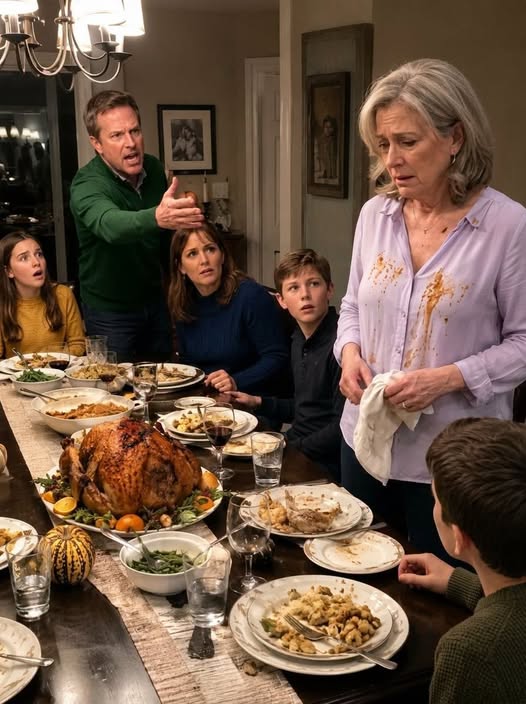
Then I remembered the turkey platter hitting my chest.
“I don’t want to make decisions out of anger,” I said. “I want to make them out of wisdom.”
Daniel nodded.
“That’s a good place to begin.”
I made arrangements for the children to receive education trusts that could not be accessed by their parents.
I also created a charitable fund in Robert’s name to support children who needed books, school supplies, and tutoring.
Robert would have liked that.
He had always believed education was the one inheritance nobody could steal.
By Wednesday, everything was in motion.
The house sale was scheduled.
My accounts were secure.
My legal documents had been updated.
And Stuart still believed he was coming to my house to persuade me to surrender my independence.
On Thursday evening, I received a message from Jennifer.
Looking forward to seeing you Sunday. We’ve found a lovely place for you. You’ll be much happier there.
I read it twice.
Then I put my phone down.
A lovely place.
How generous of her to choose my future without asking me.
On Friday, the Hendersons officially completed the purchase.
The money arrived in my account.
I stood in the empty living room and listened to the silence.
For forty-two years, Robert and I had filled that house with birthdays, arguments, Christmas mornings, school projects, and ordinary evenings.
I had imagined leaving it would break my heart.
It did.
But beneath the sadness was something I hadn’t felt in years.
Freedom.
I walked through every room one final time.
In the kitchen, I touched the counter where Robert used to sit while I cooked.
In the hallway, I stopped beside the height marks we had drawn on the wall as Stuart grew.
Then I took one final photograph.
I didn’t take the photograph of Stuart as a child.
I took one of myself standing in the doorway.
For the first time in a very long time, I wanted to remember what I looked like when I chose myself.
On Saturday morning, I moved into a beautiful apartment in a quiet community near the botanical gardens.
It had two bedrooms, a balcony, a small kitchen, and enough sunlight to make the mornings feel warm.
I had already arranged for my furniture to be delivered.
I placed Robert’s photograph on the mantel.
Then I bought fresh flowers.
White roses.
His favorite.
Sunday arrived.
At precisely 2:07 p.m., Stuart’s SUV pulled into the driveway of the house.
He parked, straightened his jacket, and walked toward the front door with Jennifer beside him.
He rang the bell.
No answer.
He knocked.
Nothing.
He tried his emergency key.
It didn’t fit.
He frowned.
Then he noticed the new brass lock.
“What’s going on?” Jennifer asked.
Stuart knocked harder.
“Mom!”
A neighbor walking her dog stopped near the gate.
“Can I help you?”
Stuart turned.
“I’m looking for my mother. She lives here.”
The neighbor looked confused.
“Not anymore.”
Stuart went still.
“What?”
“The new owners moved in yesterday.”
Jennifer’s handbag slipped slightly down her arm.
“New owners?”
The neighbor nodded.
“Lovely couple. They bought the house.”
Stuart stared at the front door.
Then he pulled out his phone.
He called me.
I answered on the fourth ring.
“Hello, sweetheart.”
“Mom, where are you?”
“At home.”
“What do you mean, at home? We’re standing outside your house!”
I looked around my apartment.
The afternoon sunlight fell across my balcony.
“Yes,” I said quietly. “I imagine that must be confusing.”
“Mom, the house is sold!”
“Yes.”
There was a long silence.
Then he shouted.
“WHAT HAVE YOU DONE?”
I took a slow breath.
“Something I should have done a long time ago.”
“Who authorized this?”
“I did.”
“You can’t just sell the house!”
“I believe I can. It belonged to me.”
Jennifer grabbed the phone.
“Listen to me, you selfish old woman. We had plans!”
I almost laughed.
“I’m sorry your plans didn’t work out.”
Then I ended the call.
For several minutes, I sat perfectly still.
I expected to cry.
Instead, I made myself a cup of tea.
And for the first time since Thanksgiving, I drank it without my hands shaking.
But I knew this wasn’t over.
Stuart had not lost his appetite for money.
And Jennifer had never been a woman who accepted disappointment gracefully.
I was about to discover just how far they were willing to go.
PART 3: THE GREEDY SON’S BIGGEST MISTAKE
The calls began the next morning.
First Stuart.
Then Jennifer.
Then Stuart again.
I didn’t answer.
At 10:30, my doorbell rang.
I looked through the peephole.
My son stood outside holding a bouquet of yellow flowers.
Jennifer stood behind him.
I considered pretending I wasn’t home.
But I decided I was finished hiding from people who had mistreated me.
I opened the door.
“Good morning.”
Stuart smiled nervously.
“Mom.”
He held out the flowers.
“These are for you.”
I looked at them.
“How thoughtful.”
He stepped inside without waiting for an invitation.
Jennifer followed.
She looked around my apartment with an expression that suggested she had expected something much worse.
“This is nice,” she said.
“Thank you.”
Stuart placed the flowers on the table.
“Mom, we need to talk.”
“I assumed that was why you came.”
He rubbed his forehead.
“Why didn’t you tell us you were selling the house?”
“Because it was my decision.”
“But we’re your family!”
I looked at him.
“Were you thinking about family when you threw Thanksgiving dinner at me?”
His expression changed.
“Mom, I’ve apologized for that.”
“No, Stuart. You said you lost your temper. That’s not the same thing as apologizing.”
Jennifer crossed her arms.
“We all make mistakes.”
“Some mistakes involve forgetting someone’s birthday. Others involve throwing a platter at your mother.”
She rolled her eyes.
Stuart sat down.
“Look, we were worried about you. That house was too much for you.”
“Interesting. You never mentioned that when you were discussing how much money you could get from selling it.”
His face turned pale.
Jennifer looked at him.
“What is she talking about?”
I smiled faintly.
“You don’t need to pretend. I heard you both in Robert’s study.”
Neither of them moved.
“The retirement community. The evaluation. The power of attorney. The house. The silver. The European vacation.”
Stuart stared at the floor.
Jennifer recovered first.
“You were eavesdropping?”
“I was in my own house.”
“You misunderstood the conversation.”
“I understood every word.”
Stuart stood.
“Mom, we were trying to plan ahead.”
“For whom?”
“For everyone!”
I shook my head.
“No. You were planning for yourselves.”
Jennifer stepped closer.
“You have no idea how difficult it is to raise children, maintain a house, and keep up with everything. We have expenses.”
I looked at her.
“Then you should manage your expenses without planning to take mine.”
Stuart sighed.
“Can we please start over?”
I considered him for a moment.
“Tell me something, Stuart. If I had no house, no investments, and no pension, would you still have been coming over every Sunday to help me?”
He opened his mouth.
Then closed it.
That silence told me more than any argument could.
Jennifer grabbed her handbag.
“This is ridiculous. Let’s go.”
Stuart didn’t move.
“Mom, you can’t punish us forever.”
“I’m not punishing you. I’m protecting myself.”
He looked at me with an expression I remembered from his teenage years.
The same expression he used whenever he wanted something and wasn’t getting it.
Then he said something that made my heart ache.
“Dad would never have wanted this.”
For a moment, the room seemed to grow colder.
I looked at Robert’s photograph on the mantel.
“Your father spent forty-two years loving me,” I said. “He trusted you because he believed you would love me too.”
Stuart looked away.
“Don’t use Dad against me.”
“I’m not. I’m remembering him.”
Jennifer walked to the door.
“Come on, Stuart.”
He followed her.
Before leaving, he turned around.
“You’re making a huge mistake.”
I nodded.
“Perhaps. But at least it’s my mistake to make.”
The door closed.
I stood there for a long time.
That afternoon, Daniel called.
“Mrs. Hayes, I wanted to let you know something.”
“What is it?”
“Your son contacted my office.”
I sat down.
“What did he want?”
“He asked whether your house sale could be challenged because he believes you may not have been mentally competent when you signed the documents.”
I closed my eyes.
There it was.
The next step.
“They’re trying to say I’m incapable?”
“Apparently. He also mentioned concerns about your financial decision-making.”
I almost smiled.
“Daniel, can I ask you something?”
“Of course.”
“If someone throws a Thanksgiving turkey at his mother, tries to put her in a nursing home, and then complains that she’s not making good decisions, does that sound convincing?”
Daniel chuckled.
“Not particularly.”
He told me that the sale had been properly documented, that I had been represented independently, and that there was no automatic basis for overturning it simply because Stuart disliked the result.
He advised me to keep every message and document.
I agreed.
Then he added something else.
“There’s another matter. Your former bank contacted us about a request for information from someone claiming to be assisting you.”
“Who?”
“Your son.”
My stomach tightened.
“What did he ask?”
“He wanted information about your accounts and investment holdings. The bank refused to release private information without proper authority.”
I thanked Daniel.
Then I called the bank myself.
I confirmed that Stuart had no authority over my accounts.
I also requested additional security protections.
That evening, I received a text from Jennifer.
You should think carefully about what you’re doing. Stuart is your only son. Don’t destroy your family over money.
I read it.
Then I replied.
I didn’t destroy this family over money. I discovered what money meant to you.
She never answered.
But the following week, something unexpected happened.
My granddaughter Lily called.
“Grandma?”
Her voice was small.
“Hello, sweetheart.”
“Are you mad at Dad?”
I closed my eyes.
“No, darling. Why?”
“Because he says you sold the house because you don’t love us anymore.”
My heart broke.
“Oh, Lily. That’s not true.”
“Then why did you leave?”
I sat on the sofa.
“Sometimes grown-ups have to make decisions to keep themselves safe and happy. I love you and Max more than anything.”
She was quiet.
Then she asked:
“Can we still visit you?”
“Always.”
I gave her my new address.
When we finished talking, I cried.
Not because I regretted selling the house.
But because my son had decided to use his children as weapons.
And that was something I could not forgive easily.
Two days later, Lily and Max arrived with their school backpacks.
They had come with my permission, and a neighbor had helped arrange the visit.
They hugged me so tightly that I almost lost my balance.
Max looked around the apartment.
“Grandma, this is cool.”
“Do you like it?”
“Yeah. Can we see the balcony?”
I smiled.
“Of course.”
For two hours, we baked cookies, played cards, and talked about school.
They didn’t ask about money.
They didn’t ask about the house.
They simply wanted to be with me.
When it was time to leave, Lily hugged me.
“Grandma?”
“Yes?”
“Dad says you’re being selfish.”
I brushed her hair away from her face.
“Lily, sometimes people call you selfish when you stop giving them things they believe they deserve.”
She thought about that.
Then nodded.
I kissed her forehead.
“Never let anyone make you feel guilty for protecting yourself.”
After they left, I sat on the balcony and watched the sunset.
I thought the hardest part of this story was behind me.
I was wrong.
Because a month later, Stuart made a decision that would cost him almost everything he had been trying to take from me.
And this time, he would have nobody to blame but himself.
PART 4: THE FINAL TWIST — WHAT MY SON NEVER KNEW
Three months after Thanksgiving, I received a letter from Daniel.
The envelope contained several documents and a handwritten note.
Please call me when you have read the attached information. I believe you’ll want to discuss it in person.
I opened the first document.
It was a copy of a financial inquiry Stuart had made through an investment company.
He had apparently been telling people that he expected to inherit a substantial estate and that he was making financial decisions based on that expectation.
I continued reading.
Then I found something that made my hands go cold.
Stuart had borrowed money.
A lot of money.
He and Jennifer had purchased a larger house two years earlier, renovated their kitchen, bought a luxury SUV, and taken several expensive holidays.
They had been living beyond their means.
The house they owned was heavily mortgaged.
And apparently, Stuart had been telling a lender that his mother would eventually sell her Victorian property and that he expected to receive part of the proceeds.
He had treated my inheritance as though it already belonged to him.
Daniel explained that the lender’s assumptions were not my responsibility.
I had never promised Stuart a share of my estate.
I had never guaranteed his debts.
I had never signed anything giving him rights to my money.
Yet he had built his financial future around money that wasn’t his.
The letter also included information about a complaint Jennifer had made to a relative.
She claimed I had become confused and was making irrational decisions.
Apparently, they were preparing to use that story to pressure me into another evaluation.
Daniel had already documented my independent legal consultation and the steps I had taken to manage my affairs.
He suggested that I arrange a formal assessment of my capacity with an independent professional if I wanted additional documentation.
I agreed.
Not because I needed to prove my worth to Stuart.
Because I wanted the matter settled.
The assessment was completed.
The professional found no evidence of cognitive impairment affecting my ability to manage my finances or make decisions.
I was sixty-five, healthy, independent, and perfectly capable of understanding my choices.
When the report arrived, I placed it in my fireproof box.
Then I went shopping.
I bought myself a beautiful red coat.
Robert had always loved seeing me wear red.
I wore it to lunch with Martha the following Saturday.
We sat by the window at a little restaurant and ordered soup and sandwiches.
Martha watched me stir my tea.
“Do you ever regret selling the house?”
I thought about it.
“I miss the kitchen.”
She smiled.
“Only the kitchen?”
“And the garden. And the sound of the old stairs. And Robert’s workshop.”
“What about Stuart?”
I looked down.
“I miss the boy he used to be.”
Martha reached across the table and squeezed my hand.
“That’s different.”
“Yes,” I said. “It is.”
That afternoon, I returned home and found three missed calls from Stuart.
I listened to the voicemail.
His voice sounded desperate.
“Mom, call me. We need to talk. Things are getting complicated.”
I didn’t call back.
An hour later, Jennifer sent a message.
Please. We need help. We’re family.
I stared at the screen.
Then I typed a response.
I hope you both find a way to resolve your difficulties. I cannot take responsibility for financial decisions I did not make.
I pressed send.
The next day, Stuart appeared at my apartment.
He looked exhausted.
His shirt was wrinkled. His eyes were red.
“Mom, please let me in.”
I opened the door but didn’t move aside.
“What do you need?”
He swallowed.
“Jennifer and I are having problems.”
“I see.”
“Our finances are a mess.”
I said nothing.
He continued.
“We borrowed too much. The bank is putting pressure on us. We thought the house would be worth more, and we expected—”
He stopped.
“Expected what?”
He looked down.
“You know.”
“No, Stuart. Say it.”
He looked at me.
“We expected you’d eventually help us.”
I nodded slowly.
“And did you ever ask me?”
“No.”
“Did you ever discuss it with me?”
“No.”
“Did you ever consider that I might want to enjoy my own money?”
He rubbed his face.
“Mom, I know I handled Thanksgiving badly.”
I waited.
“I shouldn’t have thrown the platter.”
“You threw the entire platter.”
“I know.”
“You called me useless.”
“I was angry.”
“You discussed putting me in a nursing home so you could sell my house.”
He lowered his head.
“I didn’t mean it like that.”
I looked at him for a long moment.
“Then how did you mean it?”
He had no answer.
Finally, he said:
“Can you lend us some money?”
There it was.
Not an apology.
Not an offer to make things right.
A request.
I stepped back from the doorway.
“Come inside.”
He looked relieved.
We sat at the kitchen table.
I made tea.
For several minutes, neither of us spoke.
Then I asked him a question.
“Stuart, if I had given you the money, what would have happened next?”
He frowned.
“What do you mean?”
“Would you have stopped wanting the house? Would Jennifer have stopped wanting my investments? Would you have apologized for Thanksgiving?”
He stared into his cup.
“I don’t know.”
“I do.”
I took a breath.
“You would have believed that your behavior had worked. You would have learned that if you frightened me enough, shouted loudly enough, or made me feel guilty enough, I would eventually give you what you wanted.”
He shook his head.
“That’s not fair.”
“Perhaps not. But it’s what I believe.”
He began to cry.
For the first time since Thanksgiving, I saw something in his face that resembled the little boy I had raised.
“Mom, I don’t know how things got this bad.”
I reached across the table.
“Neither do I, sweetheart.”
For a moment, we were simply a mother and son.
Then I pulled my hand back.
“I love you, Stuart. But love does not require me to finance your mistakes.”
He wiped his eyes.
“So you’re not going to help us?”
“I will help you find a financial counselor. I will help you understand your options. I will even help you make a sensible budget.”
He looked up.
“But I will not hand you my money.”
He stood.
“You’re choosing money over your son.”
I felt the familiar ache in my chest.
“No, Stuart. I’m choosing not to lose myself trying to keep my son happy.”
He walked out.
I watched him disappear down the hallway.
I didn’t chase him.
I didn’t call after him.
And I didn’t send money.
Over the following months, Stuart and Jennifer’s financial situation became worse.
They sold their luxury SUV.
They stopped taking expensive holidays.
They listed their house and moved into a smaller property.
Jennifer blamed Stuart.
Stuart blamed Jennifer.
Their marriage, which had been built around appearances and financial expectations, began to crack.
I heard most of this through relatives.
I didn’t celebrate their difficulties.
I simply refused to rescue them from consequences they had created.
But there was one more thing I needed to do.
Something that had been on my mind since the day Lily called.
I invited my grandchildren to spend a weekend with me.
Their parents agreed.
On Saturday morning, Lily arrived carrying a small gift bag.
“Grandma, I made you something.”
Inside was a photograph in a handmade frame.
It showed the three of us standing on my balcony.
I was wearing the red coat.
Lily and Max were smiling.
On the bottom, she had written:
Our new home with Grandma.
I held it against my chest.
“It’s beautiful.”
Max ran into the kitchen.
“Grandma, are we making pancakes?”
I laughed.
“Yes, we are.”
We spent the weekend together.
We baked, watched old movies, played board games, and walked through the botanical gardens.
On Sunday evening, before they left, I sat them down.
“There is something important I want you both to understand.”
They looked at me.
“You are never responsible for the arguments between your parents and me. You don’t have to choose sides. I love you both, and nothing that happens between adults will change that.”
Lily nodded.
Max leaned against my shoulder.
“Can we come back next weekend?”
I kissed the top of his head.
“Anytime.”
After they left, I opened the fireproof box.
Inside were my new will, my financial records, and the trust documents.
I had made one final decision.
My grandchildren would have access to education funds when they reached adulthood, provided those funds were used for their education or other approved opportunities.
Their parents would have no authority to withdraw the money.
I also left a significant portion of my estate to the children’s literacy charity I had established in Robert’s memory.
The rest would support my living expenses and future care.
Stuart would receive no automatic inheritance simply because he was my son.
If, someday, we rebuilt our relationship, I might reconsider what I wanted to leave him.
But I would never again make financial promises because someone frightened me into making them.
I signed the documents.
Then I placed them beside Robert’s photograph.
“That’s better, isn’t it?” I whispered.
The room was quiet.
But for the first time in years, the quiet felt peaceful.
PART 5: THE LAST THANKSGIVING — THE WOMAN WHO FINALLY CHOSE HERSELF
One year later, Thanksgiving came around again.
I woke early.
The sunlight slipped through the curtains, and the apartment smelled of cinnamon and coffee.
I had decided to host dinner.
Not because I needed to prove anything.
Not because I wanted to recreate the past.
But because Thanksgiving had always been my favorite holiday, and I refused to let one terrible afternoon take it away from me.
I prepared a smaller meal.
A roasted turkey breast.
Mashed potatoes.
Green beans.
Cranberry sauce.
Pumpkin pie.
And one pecan pie.
I invited Martha, two retired teachers from my old school, a neighbor named Eleanor, and my grandchildren.
I didn’t invite Stuart or Jennifer.
At least, not initially.
Around noon, the doorbell rang.
It was Lily and Max.
They rushed into my arms.
“Grandma!”
I hugged them both.
“Happy Thanksgiving!”
Lily handed me a bouquet of flowers.
Max held up a drawing.
It showed a large table with several people sitting around it.
At the top, he had written:
People who love Grandma.
I felt tears gather in my eyes.
“That’s going on the refrigerator.”
We spent the afternoon cooking together.
At four o’clock, everyone gathered around the table.
Martha said grace.
We laughed.
We shared stories.
Nobody complained about the size of the house.
Nobody asked how much money I had.
Nobody suggested that I was too old to make decisions.
Nobody treated me like an inconvenience.
For the first time in a long while, I felt surrounded by family.
Not because we shared blood.
Because we shared kindness.
Halfway through dinner, Lily asked a question.
“Grandma, do you miss the old house?”
I smiled.
“Sometimes.”
“Would you ever go back?”
I looked around the table.
“No, sweetheart. I think I needed to leave that house to understand that a home isn’t made of walls.”
Max nodded.
“It’s made of people.”
“Exactly.”
After dinner, we brought out dessert.
Martha cut the pecan pie.
Eleanor poured coffee.
The children laughed over something that happened at school.
And then my phone rang.
I glanced at the screen.
Stuart.
I stepped into the kitchen and answered.
“Hello?”
“Mom.”
His voice was quiet.
“Happy Thanksgiving.”
“Happy Thanksgiving, Stuart.”
There was a pause.
“Are the kids with you?”
“Yes.”
“That’s good.”
Another pause.
Then he said:
“I’ve been thinking about last year.”
I leaned against the counter.
“So have I.”
“I know I hurt you.”
“Yes, you did.”
“I was angry. I was selfish. I thought I knew what was best for everyone.”
I listened.
“I also know I made you feel like you were worth less because you were getting older.”
My eyes filled.
He continued.
“You weren’t a burden, Mom. You never were.”
I closed my eyes.
For a moment, I couldn’t speak.
Then he said something I had waited a long time to hear.
“I’m sorry.”
Not because he wanted money.
Not because he needed a loan.
Not because he wanted me to change my will.
Just sorry.
I took a breath.
“Thank you for saying that.”
“Could I come over sometime? Just to see you?”
I looked toward the dining room.
Lily was helping Martha stack plates.
Max was eating the last piece of pumpkin pie.
“Yes,” I said. “You can come over. But we need to be honest with each other.”
“I understand.”
“And Stuart?”
“Yeah?”
“I love you. But things cannot go back to the way they were.”
“I know.”
We ended the call.
I stood in the kitchen for another minute.
Then I returned to the table.
Martha looked at me.
“Everything all right?”
I smiled.
“I think so.”
That evening, after everyone left, I sat on the balcony with a blanket around my shoulders.
The city lights shimmered below.
I thought about the woman who had sat at the Thanksgiving table one year earlier, covered in gravy and stuffing, listening to her own son call her useless.
I wished I could reach back through time and tell that woman something.
I would tell her that she was not useless.
She was not helpless.
She was not too old.
She was not a burden.
She was a woman who had spent decades loving other people, and she deserved to be loved in return.
I would tell her that leaving was not the same as giving up.
That protecting herself was not cruelty.
That selling the house was not the end of her life.
It was the beginning of another one.
I stood, walked inside, and picked up Robert’s photograph.
“Remember when you told me I was stronger than I thought?” I whispered.
I smiled.
“You were right.”
Then I placed the photograph back on the mantel.
I turned off the lights.
And I went to bed.
For the first time in many years, I wasn’t worried about what Stuart wanted.
I wasn’t worried about Jennifer’s opinion.
I wasn’t worried about the house, the silver, the investments, or the inheritance.
I had a roof over my head.
I had money to care for myself.
I had grandchildren who loved me.
I had friends who respected me.
And I had finally learned something that no amount of money could have taught me.
The people who truly love you will never ask you to become smaller so they can feel bigger.
My son had thrown a turkey at me because he thought I was powerless.
He thought my age made me weak.
He thought my love made me easy to control.
And he thought my house was his future.
He was wrong about all three.
I didn’t leave him without a word because I had nothing left to say.
I left because I had spent too many years explaining my worth to people who benefited from pretending I had none.
Three weeks after Thanksgiving, I sold the house.
One year later, I had something much more valuable.
My peace.
And if I could give one piece of advice to every woman reading my story, it would be this:
Never let your children convince you that growing older means surrendering your right to live your own life.
You raised them.
You sacrificed for them.
You gave them your time, your love, and sometimes everything you had.
But you do not owe them the rest of your life.
You are still a person.
You are still worthy of respect.
And it is never too late to choose yourself.
THE END.