“Grandma Evelyn told Aunt Beatrice that we live here for free because you don’t know how to earn money, and that our apartment already belongs to Mr. Gregory.”
Phoebe said this while placing a red plastic cube on top of a yellow one. She was only four years old, and her voice was completely calm as she played.
Sitting on the rug next to her daughter, Nora froze with a green building block held tightly between her fingers.
“Mommy, give me that one because it’s the grass for my front yard,” Phoebe requested softly, reaching out her small hand.
Nora handed the block over without saying a word. Phoebe placed it in front of her little toy house and smiled brightly, saying, “Now it looks so pretty.”
At that precise moment, Nora felt something deep inside her that she had been holding together for months completely shatter.
Three months earlier, she would never have imagined that her life would turn out like this. It all started when a burst pipe from the apartment above flooded the kitchen and hallway of the place Nora shared with her husband, Mason, in the Quiet Oaks neighborhood of Atlanta.
Insurance covered part of the damage, but the contractor explained that the repairs would take several weeks to complete.
“Why would you waste good money on renting a temporary place when my house has three spare bedrooms? Come live with me until the crew finishes up,” suggested Evelyn, Mason’s mother.
Nora hesitated because she knew her mother-in-law could be controlling, but Mason accepted before she could voice her doubts.
“My mom is right about this, honey. It will only be a month, or maybe a month and a half at most,” Mason insisted warmly.
Nora eventually agreed to the arrangement. She was thirty-four years old, had a young daughter, and had been out of formal employment for almost three years.
Before Phoebe was born, Nora worked as a floral designer in a boutique shop in Midtown. She did not just put together simple bouquets, as she specialized in creating custom floral arrangements for weddings, anniversaries, and retirement parties. She still kept an old leather notebook full of sketches, flower species combinations, and notes written over nearly ten years, which was the one piece of her professional identity she refused to lose.
The very first night at Evelyn’s spacious home seemed comfortable enough. There was fresh drip coffee, warm pastries, Phoebe playing happily in the corner, and a mother-in-law who appeared delighted to have her granddaughter nearby.
However, everything shifted during dinner when Mason brought up an unexpected topic.
“Look, sweetie, my mom and I were thinking that we could rent out our damaged apartment while the construction gets finished,” Mason announced casually while taking a sip of water.
Nora put her fork down instantly and asked, “What did the two of you think?”
“Well, Don Gregory, an old acquaintance of my mother, needs a place to stay for a few months, and the money he pays us will cover our mortgage payments,” Mason explained.
Nora felt a sudden tightness in her chest as she asked, “And when exactly did you two discuss this plan?”
Mason avoided direct eye contact and muttered, “In the car while we were running errands earlier.”
“Without asking me first?” Nora pressed, her voice trembling slightly.
“Nora, please don’t complicate something that clearly benefits our family finances,” Mason replied with a sigh.
Evelyn continued chewing her food calmly as if nothing unusual was being discussed at the table. Nora took a slow, deep breath to steady herself.
Most of the down payment for that apartment had come directly from her personal savings. It was money she had built up long before she even met Mason, through years of working long weekend shifts among heavy flower boxes without taking vacations.
Now, her husband and mother-in-law were deciding who would occupy her home without even asking for her opinion.
“I don’t want to rent our home to a stranger,” Nora stated firmly.
Mason frowned and asked, “Does receiving extra income somehow bother you?”
“It bothers me that you make major decisions first and then inform me afterward,” Nora countered.
“Well, we are talking about it right now,” Mason argued defensively.
“No, you are not talking about it with me, you are just informing me of what you already decided,” Nora clarified coldly.
An awkward silence fell over the dining room table for the rest of the evening. Two weeks later, Nora was shocked to discover that Mr. Gregory already had the keys to her apartment.
When she asked where all her potted plants had been moved, Mason replied with complete indifference, “We moved them up to my mom’s storage room on the roof because Gregory has severe plant allergies.”
Nora stared at her husband, completely stunned into silence. Seven rare plants that she had nurtured for years had just been tossed aside so that a stranger could settle into her home comfortably.
Before she could process her frustration, Evelyn walked out of the kitchen and gave an order.
“Nora, remember to mop the hardwood floor early tomorrow morning because some of my church friends are coming over and the floor is dirty,” Evelyn said briskly.
Mason picked up his smartphone and scrolled through his messages without glancing up. Nora stared at him, desperately waiting for him to step in and defend her, but he remained silent.
For the first time, Nora understood that the main problem was not just living temporarily in her mother-in-law’s house. The real problem was that everyone in that family seemed to know their place, except for her, and she had no idea how much worse things were about to get.
PART 2
There were no screaming matches or loud arguments in Evelyn’s house, which made the living situation even more exhausting. Everything unpleasant came carefully hidden behind the mask of politeness and routine.
“Nora, make sure you wash Mason’s work shirts separately from the rest of the laundry,” Evelyn instructed one morning.
“Nora, please do not leave Phoebe’s toys lying around in the main living room,” came another reminder later that afternoon.
“Nora, use a coaster under your glass so you do not stain the wooden coffee table,” Evelyn added continuously.
“Nora, take this shopping list and buy these specific grocery items tomorrow morning,” her mother-in-law requested without offering any money.
Evelyn did not speak with overt cruelty. She simply spoke like a manager running a household who assumed that everyone else was an employee bound to follow instructions.
Little Phoebe began to change her behavior under the pressure as well. Back in their own home, she used to run freely through the hallway, leave her dolls on the sofa, and open the refrigerator whenever she felt thirsty. Now, she constantly looked at her grandmother with hesitation before doing anything.
“Can I please have a chocolate cookie?” Phoebe would whisper softly.
“You need to ask for permission properly first,” Evelyn would reply sternly.
“Can I play with my blocks right here?” Phoebe asked on another afternoon.
“Play in your bedroom, because the living room belongs to everyone in this house,” Evelyn stated flatly.
One evening, Nora tried to bring up her growing frustration with Mason while they were alone in their bedroom.
“I am so tired of how things are going here,” Nora confessed quietly.
“The renovation work on our apartment is almost finished, so just be patient,” Mason replied while relaxing on the bed.
“I am not talking about the apartment repairs, Mason,” Nora clarified, taking a seat beside him.
She explained how she spent every single day cleaning, cooking, running errands, and watching Phoebe, while he came home late from work, found his dinner prepared, and sat down to chat pleasantly with his mother.
Mason seemed to process her words for a brief moment and murmured, “You have a point, but you also need to understand my mother’s perspective because she is doing us a huge favor.”
Nora looked at him in disbelief and said, “I just told you that I am completely exhausted, and you still ended up explaining why your mother is right.”
“I never said she was entirely right,” Mason protested defensively.
“You always end up taking her side no matter what I tell you,” Nora pointed out sadly.
Mason let out a heavy sigh and muttered, “Just hold on a little bit longer.”
That specific phrase soon became a dark sentence that hung over Nora’s head every day. Just hold on a little longer.
The apartment repairs were delayed first because of shipping issues with the floor tiles, then because of faulty electrical wiring, and finally because of contractor scheduling. One month turned into two months, and then dragged on into three full months. Meanwhile, Mr. Gregory continued living comfortably in their private apartment.
One Sunday afternoon, Nora walked into the living room and sat down in a soft, empty armchair to rest her back.
Evelyn appeared in the doorway almost immediately and remarked, “That specific armchair belonged to my late husband, Thomas.”
“I am sorry,” Nora said quickly, standing up at once to vacate the seat.
Nobody insulted her directly, and nobody threatened to kick her out. Yet that night, Nora came to a painful realization: even a deceased man had a more defined place in that household than she did.
A few days later, an even more disrespectful incident occurred. Nora stepped out of the bathroom and overheard Evelyn showing Nora’s private floral design notebook to Aunt Beatrice in the kitchen.
“Look at these sketches,” Evelyn said while flipping through the delicate pages. “She used to make things with flowers a long time ago.”
She said the word “before” as if Nora had given up her passion and career forever.
“It doesn’t bother you that I am showing this to her, does it?” Evelyn asked carelessly when Nora walked into the room.
Nora forced a polite smile and replied, “No, it’s fine.”
However, as soon as night fell, Nora retrieved her notebook and hid it safely inside her personal folder with her legal documents. For the first time, she began seriously planning a way to leave.
The turning point came when Nora stumbled upon Evelyn’s household management ledger open on the dining table. Nora was not trying to pry, but the neat handwriting caught her attention instantly.
At the top of the page, Evelyn had written: “Utilities, groceries, house cleaning.”
Directly underneath, she listed: “Nora and Phoebe: accommodation without paying rent.”
Underlined twice below that was a calculated breakdown: “Compensated through daily domestic labor.”
There were specific monetary calculations detailing what it would cost to hire a maid, how much money Evelyn saved because Nora cooked every meal, and the calculated hourly rate for taking care of the house. Evelyn had even totaled it into a monthly balance sheet.
Nora felt a chill run down her spine. It was not just because her mother-in-law kept financial accounts, but because someone had assigned a cold monetary value to her daily presence, treating her like an unpaid servant working off a debt.
That night, Nora watched her daughter sleep peacefully and realized that Phoebe was internalizing everything happening around her. The child was learning that a mother must clean constantly to prove her worth, that a father comes home only to rest, and that a grandmother holds all the authority.
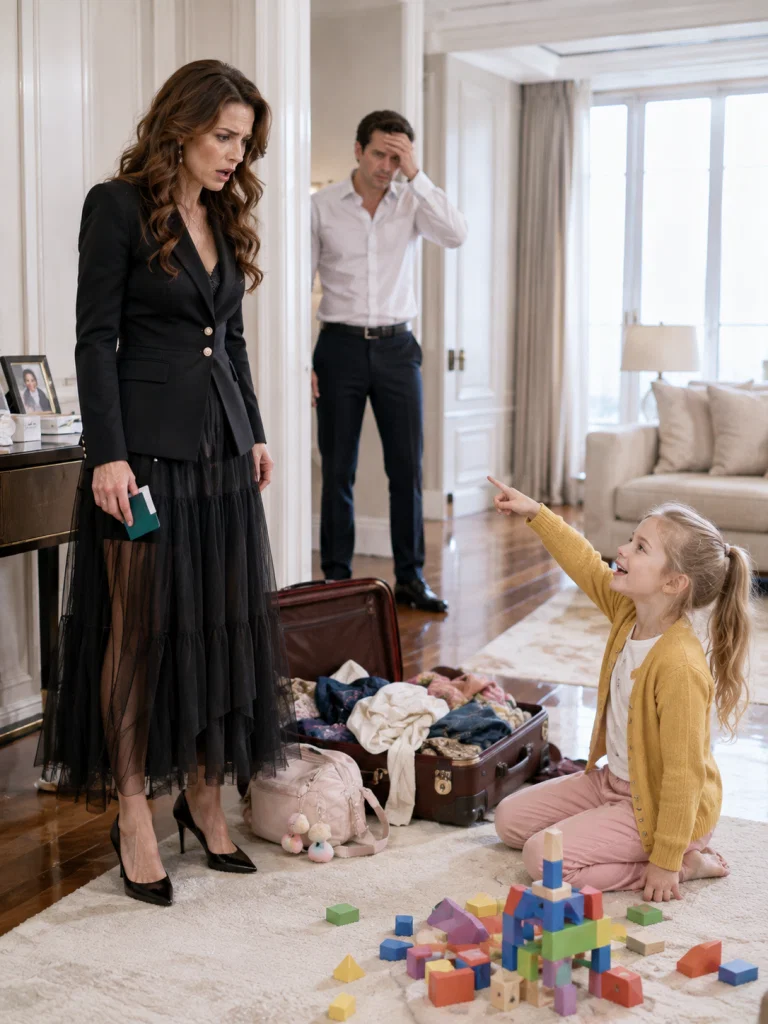
A week later, while they were building the small toy structure out of plastic blocks, Phoebe innocently uttered the sentence that changed everything:
“Grandma Evelyn told Aunt Beatrice that you live here for free because you don’t know how to earn money, and that our apartment already belongs to Mr. Gregory.”
Nora did not burst into tears, nor did she scream. She simply stood up from the rug, retrieved her floral notebook first, and packed it along with her legal documents, Phoebe’s clothes, phone chargers, and the stuffed toy horse her daughter cherished.
She called Mason immediately and said, “I am taking Phoebe to my parents’ house right now. Come there tonight because we need to talk.”
“Wait, what happened?” Mason asked, sounded confused over the phone.
“I will explain everything when you get there,” Nora replied firmly before hanging up.
Nora took Phoebe by the hand and walked toward the front entrance. As they reached the hallway, the front door swung open, and Evelyn walked in from her morning shopping.
Evelyn stared at the heavy suitcase, looked at her fully dressed granddaughter, and then locked eyes with Nora.
“Where do you think you are going with those bags?” Evelyn demanded sharply.
Nora held her mother-in-law’s gaze without flinching and answered, “To a place where my daughter will not learn that her mother has to pay with unpaid labor just for the right to feel welcome.”
Evelyn’s face turned pale instantly. Nora then bluntly revealed that she had read the financial breakdown in the household ledger. For the first time in four months, her mother-in-law was left completely speechless.
However, Mason still knew nothing about the ledger, and that night he would have to make a choice between remaining just his mother’s son or finally stepping up to be Nora’s husband.
PART 3
Nora’s parents lived in a quiet house in the suburban district of Roswell, far from the bustling traffic of central Atlanta. The house was not modern, the porch floor was weathered, and the window frames needed fresh paint, but the yard was filled with potted plants, blooming hydrangeas, and three ceramic garden ducks that Phoebe had loved since she was a baby.
As soon as the taxi pulled up, Phoebe hopped out and ran toward her grandfather in the yard.
“Grandpa Oliver! Are the little garden ducks feeling cold today?” Phoebe called out eagerly.
Oliver took the question with complete seriousness and replied, “We need to inspect them closely right away.”
The two of them walked toward the flower beds together, leaving Nora standing near her luggage. Her mother, Clara, appeared at the front doorway. She did not ask a single question about why Nora had arrived with suitcases; she simply said, “Come inside, sweetheart. The water is already hot for tea.”
Nora walked inside and sat down at the familiar kitchen table where she used to complete her school homework as a child. Clara placed a warm cup in front of her along with a plate of fresh biscuits.
“Have you had anything to drink today?” Clara asked softly.
Nora looked up at her mother. Years ago, when Nora was a teenager, Clara had shared a piece of advice that Nora never forgot: “When you are in a house where you feel too anxious to even pour yourself a glass of water, remember that you are not in a true home.”
Nora let out a weak, breathless laugh, and then tears finally began to spill over her cheeks. It was not a loud, dramatic breakdown, but rather quiet tears that had been waiting for permission to fall for months.
“I couldn’t take it anymore, Mom,” Nora whispered, wiping her face.
Clara sat down across from her and said gently, “Then you did the right thing by coming back here.”
“I don’t know what is going to happen with Mason,” Nora admitted nervously.
“That is entirely up to you to decide,” Clara responded calmly.
“Are you going to tell me to divorce him?” Nora asked.
“No,” Clara answered smoothly.
“Are you going to pressure me to go back to him?” Nora pressed further.
“Not that either,” Clara replied, taking a sip from her cup. “You have spent far too long listening to what other people think you should do with your life.”
Mason arrived at the house around nine o’clock that evening. His hair was damp from the light rain outside, and his face carried an expression of deep anxiety that Nora had not seen in months. Oliver and Clara discreetly excused themselves to their bedroom, while Phoebe was already fast asleep down the hall.
Mason and Nora were left entirely alone in the living room.
“Tell me everything that happened,” Mason requested, sitting down on the edge of the sofa.
Nora held nothing back. She told him about his mother forcing her out of the late father’s armchair, Evelyn showing off her private design notebook without asking, the abandon of her plants, the endless morning chore lists, and the unilateral decisions made about their own apartment.
Finally, she described the household ledger she had found on the table.
“Your mother calculated a financial cost for my presence,” Nora said coldly. “She wrote down my cooking and cleaning as payment for living under her roof.”
Mason frowned in disbelief and said, “What do you mean, a price tag?”
“She calculated how much money she saved by using me as an unpaid housekeeper instead of hiring help, and treated it as rent,” Nora explained clearly.
Mason sat completely motionless for a moment before muttering, “I honestly had no idea she did that.”
“I know you didn’t,” Nora acknowledged.
“I swear to you, Nora, I never knew about any ledger,” Mason insisted earnestly.
“Mason, the main issue isn’t just what you didn’t know,” Nora pointed out, taking a deep breath.
He looked at her with concern and asked, “Then what is it?”
“It’s everything that you did know,” Nora stated directly. “You knew that Mr. Gregory moved into our apartment without my consent. You knew that you and your mother made choices behind my back. You heard the daily chore lists she handed me, and you saw me running around doing everything while you rested. You told me repeatedly to just endure it, but you never once asked yourself what you could do to protect me.”
Mason lowered his head and did not offer a single defensive argument, which genuinely caught Nora off guard.
A long silence filled the room before Mason finally spoke up. “I would come home to my mother’s house and see that dinner was ready, Phoebe was happy, and the house was clean. I assumed that meant everyone was doing fine.”
Nora remained quiet, letting him reflect on his own words.
“It was comfortable for me to think that way,” Mason continued slowly. “Because if everything seems to be working, you don’t have to confront who is carrying all the burden. I was being lazy and selfish.”
Nora felt a pang of sadness hearing him admit it, but she also felt a sense of relief. It was the very first time Mason had not used the phrase “but my mother” to justify what had happened.
“I cannot just return to that house tomorrow and pretend everything is normal,” Nora warned him.
“I am not going to ask you to do that,” Mason replied softly.
“I am still very angry with you,” Nora added.
“I know you are,” Mason admitted.
“And I don’t know how much time I need to figure things out,” Nora finished.
“I understand,” Mason said. He leaned forward, looked into her eyes, and declared, “I am going to our apartment in person tomorrow morning. I am going to deal with the contractor directly. I am also going to inform Mr. Gregory that he must move out as soon as his temporary lease period expires. In the meantime, I will rent a short-term place for the three of us.”
Nora shook her head slowly and said, “I don’t want you to just complete a checklist of tasks to make me forgive you.”
“I am not doing it to earn quick forgiveness,” Mason corrected her. “I am doing it because it is what I should have done from the very beginning.”
That distinction mattered deeply to Nora.
Mason left the house alone that night, while Nora stayed behind with her parents. The following morning, Mason went directly to inspect the renovation work at their apartment. He was furious to discover that the delays were not inevitable; the contractor had been lazy simply because Mason had never bothered to check on the progress in person.
Mason fired the main contractor, hired a reliable flooring crew, and demanded a strict written schedule for completion. He also spoke directly with Mr. Gregory to set a firm move-out date.
Later that afternoon, Mason called Nora. He did not boast about fixing things; he simply reported the updates objectively and asked, “Is there anything specific from the apartment that you need right now?”
Nora thought for a moment and replied, “Yes, I want my potted plants back.”
That same evening, Mason brought the plants to Roswell himself. Out of the original seven plants, only four had survived the neglect in the storage space. One had yellowed leaves, and another was almost completely bare.
When Nora stepped out onto the porch and saw the damaged pots, a wave of sadness washed over her.
“I am so sorry about your plants,” Mason said softly, standing beside her.
Nora gently touched a surviving stem and replied, “It’s not just about the plants, Mason.”
“I know,” Mason answered quietly, and for the first time, he seemed to truly comprehend the depth of his mistake.
During the next few weeks, Nora and Phoebe remained at her parents’ house while Mason stayed in a rented temporary apartment near Phoebe’s preschool. Nora chose not to rush back to him immediately because she refused to treat a few days of effort as an instant cure for four months of disrespect. Mason accepted her boundary without complaining.
He visited Phoebe every afternoon, spent quality time playing with her, bought groceries independently, cooked meals for Nora whenever she accepted, and took full responsibility for his daily routines. It was not a sudden, dramatic transformation, but rather a slow build of consistent effort.
Meanwhile, Evelyn waited nearly two weeks before attempting to reach out. When she finally called, Nora was out in the yard watering her surviving plants.
“May I come over to speak with you?” Evelyn asked over the phone, her voice lacking its usual dominant edge.
Nora paused to think before answering, “Yes, you can come over.”
Evelyn arrived that afternoon holding a bag of fresh oranges and a small toy for Phoebe. Nora initially worried that her mother-in-law would use the child to smooth things over, but Evelyn greeted Phoebe briefly and then asked to speak with Nora in private.
They sat down at the kitchen table. For the first time, Evelyn appeared noticeably uncomfortable being a guest in someone else’s space.
“Mason told me that you are deeply upset with me,” Evelyn began, fidgeting with the handle of her teacup.
“It goes much deeper than just being upset,” Nora replied calmly.
Evelyn looked down and said, “I have been reflecting on the ledger you found.”
Nora stayed silent, waiting for her to continue.
“I honestly never intended for it to be offensive,” Evelyn claimed slowly. “I have managed financial logs my entire life, ever since I worked as an inventory supervisor. If an expense comes in, I log it. If value goes out, I record it as well.”
Nora met her eyes and said firmly, “I am a human being and part of your family, Evelyn, not an inventory line item.”
Evelyn closed her eyes briefly and admitted, “I realize that now.”
Nora was surprised by the admission, as Evelyn continued explaining herself. “In my mind, it made logical sense. You were staying in my home, my utility bills increased, and you were helping out around the house. I simply viewed it as balancing an equation.”
“The problem was never about helping out,” Nora clarified. “I would have willingly helped you clean and cook regardless.”
“Then what did I do wrong?” Evelyn asked, searching Nora’s face.
Nora chose to speak with complete honesty: “You turned my willing help into a mandatory debt that I never agreed to owe you. Every time I cooked dinner or mopped your floors, you treated it as if I were paying off a bill for my room.”
Evelyn lowered her eyes and murmured, “Perhaps I did.”
“And you made me feel as though I would never finish paying you back,” Nora added.
The kitchen fell quiet for a moment, with only the distant sound of Phoebe laughing with her grandfather out in the garden.
“What I said about you not knowing how to earn money was completely wrong,” Evelyn stated quietly.
Nora felt a lump form in her throat as she said, “My four-year-old daughter heard you say that.”
“I know she did, and I am ashamed,” Evelyn confessed softly.
“That is the part that broke me,” Nora explained. “If Phoebe had not repeated those words to me, I might have kept enduring your treatment. But my daughter was watching us. She was learning what it supposedly means to be a wife, a mother, and a daughter-in-law, watching everyone act like it was normal for me to exist solely to serve others.”
Evelyn took a long pause before speaking again. “That is exact way I lived my entire young life,” she revealed softly. “When I married Thomas, we lived with his mother for years. I cooked for the entire household, did all the laundry, worked my job, and then came home to do endless housework. Nobody ever asked me if I was tired or if I wanted that life.”
Her voice quieted down as she added, “I suppose I grew up believing that was simply how things had to be for every woman.”
Nora felt a flicker of empathy for the older woman, but she refused to confuse empathy with giving up her boundaries.
“Just because you were subjected to that unfair treatment does not mean I have to endure it too,” Nora stated clearly.
Evelyn nodded slowly and said, “You are right.”
“And my daughter certainly will not grow up believing that either,” Nora added firmly.
“No, she won’t,” Evelyn agreed.
It was the first genuine, unprompted apology Evelyn had ever offered. There were no dramatic tears or forced hugs, nor did Nora say “it’s totally fine,” because the damage had been real.
“I don’t hate you, Evelyn,” Nora said quietly. “But I require firm boundaries moving forward.”
“Tell me what you need,” Evelyn offered.
“Whenever you wish to visit us, you must inform us in advance,” Nora outlined clearly. “Our home will not be managed according to your rules. My past career is not a silly hobby, and all choices concerning our family will be made exclusively between Mason and me.”
Evelyn nodded respectfully and said, “I accept that.”
She then glanced toward the sunny window sill where the most damaged plant sat in a pot, displaying two tiny green shoots sprouting from a brown stem.
“It managed to survive after all,” Evelyn observed quietly.
Nora allowed a small smile to appear on her face and remarked, “Some plants are stubborn that way.”
Evelyn smiled slightly as well and said, “Sometimes the stubborn ones are the only ones that survive.”
Their relationship did not become magically perfect overnight after that conversation. Evelyn remained a opinionated woman by nature who sometimes offered unsolicited advice. Months later, when she tried to rearrange the utensil drawers in Nora’s new kitchen, Nora simply stepped in and said, “Leave them where they are, please.”
Evelyn opened her mouth to object, paused for a second, and then replied, “Alright.” Those two short words required breaking decades of controlling habits.
Mason did not transform into a perfect husband instantly either. One evening after a long day at work, he tossed his coat on the couch and asked what was available for dinner. Nora stopped what she was doing and simply stared at him in silence. Mason froze, realized his mistake, picked up his coat immediately, and opened the refrigerator himself, saying, “Got it, I’m on it.” Nora laughed aloud for the first time in months.
At the end of January, Nora, Mason, and Phoebe officially moved back into their fully repaired apartment. Mr. Gregory had vacated the premises, and the rooms smelled cleanly of fresh paint. Phoebe ran excitedly through the hallway, shouting, “My bedroom! Look at my room!”
Nora walked through the front door at a slower pace, running her hand along the hallway wall and admiring the restored kitchen. She stepped over to the living room window and pushed it open to let in the cool winter air.
Mason walked up behind her and asked gently, “How are you feeling?”
“I am good,” Nora replied with a soft smile.
“Are you sure?” Mason asked again.
“Yes, thank you for asking me,” Nora answered.
The four surviving potted plants were placed neatly along the wide window sill. Phoebe added a tiny terra-cotta pot she had picked out at the market, declaring, “This little one belongs to me.”
“Then you are responsible for taking care of it,” Nora reminded her.
“I will! But if I forget, please remind me, Mommy,” Phoebe requested sweetly.
“It’s a deal,” Nora agreed.
One afternoon in February, while sorting through storage boxes, Nora found her old floral design notebook tucked away at the bottom. She opened the cover to find that she had not drawn a single sketch in months, with the last entries representing a time in her life that felt distant.
She picked up a drawing pencil, felt her hand tremble slightly, and then began sketching delicate daisy petals, followed by calla lilies and eucalyptus stems.
Mason walked past the dining table, stopped in his tracks, and looked over her shoulder. “That is absolutely beautiful, Nora,” he said genuinely.
Nora looked up, briefly expecting a lecture about finding a job, but Mason simply added, “It makes me really happy to see you drawing again,” before walking toward the kitchen.
Two weeks later, an old client reached out to ask if Nora was available to design arrangements for an upcoming event. Nora initially hesitated and almost typed a polite decline, but she looked down at her open sketchbook and typed back: “Yes, I am taking client orders again.”
Her first order was small, consisting of a table centerpieces for an anniversary dinner. Soon after, another client hired her for a small wedding ceremony. Nora began assembling her arrangements right from her dining table, while Mason took full charge of watching Phoebe on weekend afternoons so Nora could visit the regional flower markets.
By April, she launched a dedicated social media page to display her custom floral work. By June, she had accumulated enough consistent orders to lease a small studio space shared with an event decorator. She was not earning a massive fortune, but she was rebuilding her independent identity.
The first time Nora brought home a large cash payment from a major wedding client, Phoebe was standing right beside her at the desk.
“Mommy, did those people pay you money for making flower art?” Phoebe asked, her eyes wide with curiosity.
Nora paused, knelt down until she was at eye level with her daughter, and said gently, “Listen to me, Phoebe. Mommy always knew how to work hard. When I stayed home to raise you, I was working every single day, even if nobody handed me a paycheck. Cooking meals, keeping a home, and raising children all have deep value.”
Phoebe nodded with the serious expression children adopt when processing an important truth. “And now you make flower designs because you want to?”
Nora smiled warmly and answered, “Exactly, sweetie. Because I choose to.”
Late that night, Nora opened her trusty leather notebook to the very first yellowed page. Underneath one of her oldest sketches, she picked up a pen and wrote a new sentence: “Never again call gratitude that which forces you to disappear.”
She closed the notebook gently. From the adjacent living room, she listened to Mason helping Phoebe organize her plastic building blocks before bedtime.
“Daddy, that red block doesn’t go in that box!” Phoebe instructed firmly.
“Where should I put it then?” Mason asked playfully.
“You have to ask me first, because these are my toys!” Phoebe declared.
Nora burst into warm laughter from her desk, and Mason joined in from the living room.
Nora finally understood that her journey had not ended on the day she packed her suitcases and left her mother-in-law’s house. It ended much later, when every person involved learned a different lesson. Evelyn realized that helping family members does not grant you the right to control their lives. Mason learned that staying passive while your spouse suffers is a choice that damages a marriage.
Most importantly, Nora learned the ultimate truth: a person does not need someone else to act like a monster before earning the right to leave a space where they are slowly fading away. Sometimes the deepest emotional wounds do not come from malicious enemies, but from relatives who love you yet have grown so accustomed to taking your effort for granted that they never stop to ask what it costs you to give. Setting a firm boundary in those moments does not destroy a family; sometimes, it is the only thing that can truly save it.
THE END.