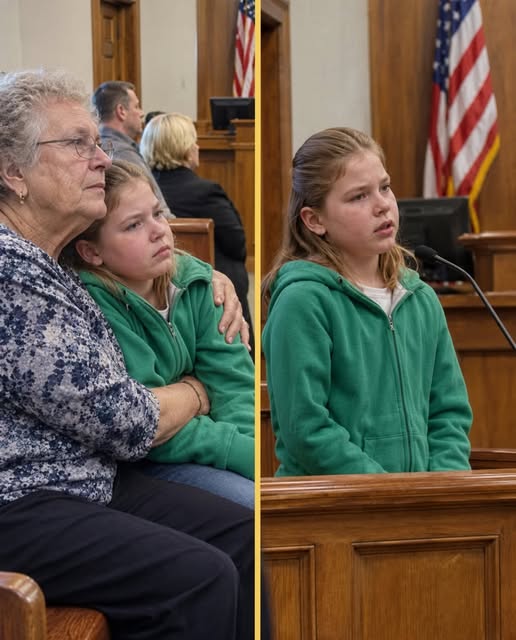
But Hazel looked at me for a moment and gave me a small, reassuring smile.
Then she turned toward the judge.
“Your Honor, I found this in my father’s car when he came to visit me last week.”
She placed a small black recording device on the table.
Brandon immediately stood up.
“That’s ridiculous! She doesn’t understand what she’s doing!”
His attorney quickly rose beside him.
“Your Honor, we object. This child has clearly been coached.”
The judge raised her hand.
“Mr. Brandon, please sit down. I will decide what is relevant.”
Hazel swallowed nervously.
“I didn’t take it to get my dad in trouble. I just wanted to understand why he suddenly wanted me after eleven years.”
My heart broke hearing those words.
She continued.
“When he came to see me, he kept asking questions about Grandma’s house. He asked whether she had any money, whether she owned the house, and whether my mother had left anything for me.”
Brandon shook his head.
“That’s not true!”
Hazel looked directly at him.
“You told me you wanted to give me a better life. But when you thought I wasn’t listening, you said something different.”
The judge leaned forward.
“What exactly did you hear, Hazel?”
Hazel took a deep breath.
“I heard my father talking to his lawyer on the phone. He said he didn’t really care about the house I lived in. He said he needed custody because of the money my mother had left behind.”
The courtroom went completely silent.
I felt my knees weaken.
Money?
What money?
My daughter had never been wealthy. She had worked at a small grocery store before she died. She had rented a tiny apartment and struggled to pay her bills.
As far as I knew, she had left nothing behind except a few photographs, some clothes, and the most precious gift of my life: Hazel.
The judge looked at the device.
“Do you know what’s on this recording?”
Hazel nodded.
“I recorded part of the conversation on my grandmother’s old phone. I also found some papers in my father’s car. I brought copies.”
She reached into her backpack again and pulled out several folded documents.
Brandon’s face changed.
For the first time since he had entered that courtroom, he looked genuinely frightened.
His attorney whispered something to him.
Brandon whispered back angrily.
The judge asked the court clerk to collect the documents.
I sat frozen.
I had no idea what was happening.
Then the judge examined the first page.
Her expression became serious.
She looked at Brandon.
“Mr. Brandon, can you explain why these documents contain your daughter’s name alongside a substantial inheritance account?”
Brandon said nothing.
I stared at the judge.
“Your Honor, I’m sorry, but I don’t understand. What inheritance?”
The judge turned toward me.
“Mrs. Eleanor, according to these documents, Hazel may be the beneficiary of a trust established by her late mother.”
I felt as though someone had pulled the floor out from beneath me.
My daughter?
A trust?
The judge continued.
“The documents indicate that the funds are intended to support Hazel’s education, housing, and general welfare. The trust was established to protect her until she reaches adulthood.”
I looked at Hazel.
She was staring at me with tears in her eyes.
“Grandma, I didn’t know either,” she whispered.
Then I noticed something else.
One of the documents had my daughter’s signature.
I recognized it immediately.
That beautiful handwriting.
The same handwriting she had used on birthday cards and little notes she left on my kitchen table.
My hands began to shake.
The judge asked for a short recess so the documents could be reviewed.
But before anyone could leave, Brandon suddenly spoke.
“Fine! Maybe I knew about the trust. But I’m her father! That money belongs to my daughter, and I have every right to manage it!”
The judge looked at him sternly.
“Being a biological parent does not automatically give you unrestricted control over a child’s inheritance.”
Brandon’s face turned red.
I finally understood why he had returned.
He hadn’t come back because he missed Hazel.
He hadn’t come back because he suddenly wanted to be a father.
He had come back because he had discovered that the little girl he abandoned was connected to something valuable.
And suddenly, the old house with peeling paint didn’t seem so embarrassing anymore.
Because inside that old house, I had raised a child who knew the difference between love and greed.
But the biggest surprise was still waiting.
During the recess, Hazel came over and whispered something that made my heart stop.
“Grandma, there’s one more thing.”
I knelt beside her.
“What is it, sweetheart?”
She reached into the smallest pocket of her backpack.
Then she pulled out a yellow envelope.
It was old, slightly wrinkled, and sealed with a piece of faded tape.
On the front, in my daughter’s handwriting, were four words:
“For my mother, someday.”
I started crying before I even opened it.
PART 3: THE LETTER HER MOTHER LEFT BEHIND
I recognized that envelope immediately.
It was my daughter’s handwriting.
I had not seen it in eleven years, but I would have recognized it anywhere.
Hazel handed it to me.
“Grandma, I found it inside the box where you keep Mom’s photographs. I didn’t open it because I thought it belonged to you.”
I held the envelope against my chest.
For eleven years, I had lived with the pain of losing my daughter.
There were days when I still expected to hear her keys turning in the front door.
There were nights when I looked at Hazel sleeping and wondered whether her mother would have been proud of the woman she was becoming.
And now, suddenly, my daughter had found a way to speak to me again.
The judge allowed me a moment to read the letter.
I carefully opened it.
Inside was a single sheet of paper.
The first sentence destroyed me.
My dearest Mom,
If you’re reading this, something has probably happened to me, and I wish more than anything that I could be there to watch my little girl grow up.
I covered my mouth.
Hazel held my arm.
I continued reading.
I know you have already sacrificed so much for me. I know you will probably try to tell yourself that you are too old to raise a baby again.
But if something happens to me, please don’t let anyone convince you that you are not enough for her.
You have always been the strongest person I know.
I have arranged for a trust to be established for Hazel. It is not a fortune, and it cannot replace a mother or a grandmother’s love. But I hope it will help with her education and give her opportunities that I never had.
I have also made arrangements for you to receive support for the expenses of raising her, provided the trustees approve the expenses and the arrangements remain consistent with Hazel’s interests.
I stopped reading.
I had to wipe my eyes.
My daughter had thought about me.
Even when she was gone, she had thought about how difficult things might become.
The letter continued.
Mom, there is something else I need you to know.
Brandon has never been ready to be a father. I hoped he would change, but I cannot build Hazel’s future around a promise that may never come true.
If he ever comes back, please don’t judge him only by his words. Watch what he does.
Does he show up when Hazel is sick? Does he remember her birthday? Does he comfort her when she cries? Does he care about her dreams?
Or does he only appear when there is something he wants?
I could no longer see the paper clearly.
Tears were falling onto the letter.
Then I read the final lines.
Mom, if you have to choose between keeping a roof over her head and keeping her heart safe, remember that a beautiful house cannot replace a loving home.
Please tell Hazel that I loved her every second of every day, even the days when I couldn’t be there.
And please tell her that she was never unwanted.
With all my love,
Your daughter.
I pressed the letter to my face.
For a moment, I forgot I was in a courtroom.
I could almost hear my daughter laughing in the kitchen.
I could almost see her sitting at the table, holding Hazel as a baby.
Then I heard a small voice.
“Grandma?”
Hazel was crying.
I wrapped my arms around her.
“Your mother loved you more than anything in this world, sweetheart.”
“I know,” she whispered.
Then she looked toward her father.
“But why didn’t he?”
Nobody answered.
Brandon sat with his arms crossed.
His attorney was speaking quietly to him, but he seemed distracted.
The judge called everyone back.
She reviewed the letter and the documents with the court clerk.
Then she addressed Brandon.
“Mr. Brandon, you have told this court that your primary concern is providing your daughter with a better standard of living. However, the evidence raises serious questions about your motives.”
Brandon stood.
“Your Honor, I made mistakes when I was young. I’m not denying that. But people change. I have a stable marriage, a good income, and a beautiful home. I can provide everything she needs.”
The judge looked at him.
“Providing material comfort is only one part of parenting.”
His attorney stood.
“Your Honor, my client acknowledges that he was absent during the child’s early years. However, the law recognizes the importance of a biological parent’s rights.”
The judge nodded.
“Yes. And the court must also consider the child’s safety, emotional well-being, established relationships, and best interests.”
Then she turned toward Hazel.
“Hazel, I would like to ask you a question. Do you understand that your father has asked to become your primary caregiver?”
Hazel nodded.
“Yes, Your Honor.”
“Do you want to live with him?”
Hazel looked at Brandon.
He gave her a forced smile.
For a moment, I thought she might be afraid to speak.
But she stood straight.
“No, Your Honor.”
Brandon’s expression hardened.
Hazel continued.
“I don’t hate my father. I wanted to know him when I was little. I used to ask Grandma when he was coming back.”
My heart broke.
“I made Father’s Day cards at school. Sometimes I wrote his name on them, even though I didn’t know where to send them.”
Brandon looked down.
“But he never came.”
Hazel wiped her cheeks.
“Grandma was there when I had nightmares. She was there when I got sick. She sat beside me when I cried because I missed my mother. When I had my first day at school, she held my hand because I was scared.”
She looked at me.
“And when I couldn’t afford the things other children had, Grandma never made me feel poor.”
Then she turned back to the judge.
“I don’t need a big house. I don’t need an expensive bedroom. I need the person who never left me.”
Nobody moved.
Hazel’s voice became quieter.
“I don’t want to be somebody’s daughter only because there is money involved.”
Brandon suddenly stood up.
“That’s enough! She’s eleven! She doesn’t understand these things!”
The judge struck the desk with her gavel.
“Mr. Brandon, sit down.”
He sat.
The judge looked at Hazel.
“Thank you, sweetheart. You’ve been very brave.”
Then she looked at me.
“Mrs. Eleanor, the court recognizes the years of care you have provided. However, given the financial documents and the disputed recording, I am not prepared to make a final decision today.”
My stomach dropped.
“Your Honor?”
“The court will order an independent review of the trust documents, the recording, and the circumstances surrounding the father’s request. We will also obtain an updated assessment of Hazel’s welfare and living arrangements.”
I squeezed Hazel’s hand.
The judge continued.
“Until that review is completed, Hazel will remain in your care under the existing temporary arrangements. No change in residence or control of her trust is permitted without further court authorization.”
I started crying.
Not because everything was over.
But because, for the first time in weeks, I could breathe.
Brandon looked furious.
His attorney leaned over and whispered something to him.
Then the judge added one final sentence.
“Mr. Brandon, I strongly suggest you begin thinking about what your daughter actually needs from you, rather than what you believe you are entitled to receive.”
The hearing ended.
As we walked out, Hazel held my hand.
I looked at her and whispered:
“You were so brave.”
She shook her head.
“No, Grandma. You were brave for eleven years.”
I stopped walking.
Then I hugged her right there in the courthouse hallway.
And I cried like I hadn’t cried since my daughter died.
But the story wasn’t finished.
Because three weeks later, an investigator made a discovery that changed everything.
THE FULL ENDING: THE HOME THAT MONEY COULDN’T BUY
Three weeks passed.
They were the longest three weeks of my life.
Every time the telephone rang, I jumped.
Every time a car stopped outside our house, I looked through the curtains.
I was afraid Brandon would return with another lawyer, another court order, or another accusation.
But Hazel tried to make our little home feel normal.
She still woke up early on Saturdays.
She still helped me make pancakes.
She still left her school shoes in the middle of the hallway, no matter how many times I reminded her to put them away.
And every evening, she asked me the same question.
“Grandma, do you think the judge will let me stay?”
I always answered the same way.
“I hope so, sweetheart. But whatever happens, I will never stop loving you.”
One afternoon, a woman named Mrs. Collins arrived at our house.
She introduced herself as the court-appointed family investigator.
She was in her fifties, with kind eyes and a notebook tucked under her arm.