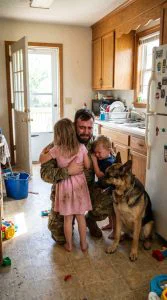
I survived twenty-two months overseas—desert heat that choked the lungs, mortar fire that shook the bones, and exhaustion so deep it rewired the way a man slept, breathed, and listened to silence.
Through every patrol, every sleepless night, and every satellite call that cut out before I could hear my children’s voices properly, one image kept me sane: my front porch in Oklahoma. My wife, Rachel, smiling at the doorway. My ten-year-old daughter, Emma, sprinting into my arms. My little boy, Caleb, burying his face in my uniform.
I came home on a blistering Tuesday afternoon with an olive duffel biting into my shoulder and a heart full of expectations.
I expected noise.
A happy kind of chaos.
Instead, the front door was unlocked, and the house was silent in a way that felt dead.
No dinner smell. No cartoons from the living room. No music from the kitchen. The air conditioner was off, and the stale air inside smelled like dust, old dishes, and something worse—neglect.
“Rachel?” I called. “Emma? Caleb?”
A low growl answered from the hallway.
Tank, our old German Shepherd, limped out of the shadows. The powerful dog I had left behind was almost unrecognizable. His ribs showed through his coat. His eyes were cloudy. He stood in the center of the hall, teeth bared, guarding the closed bedroom door like a soldier defending the last piece of ground he had left.
“Tank,” I whispered, dropping to one knee. “Hey, boy. It’s me. Stand down.”
His ears twitched. He sniffed the air, caught my scent, and let out a broken whine. His back legs gave out, and he collapsed onto the floor, his tail thumping weakly.
Then the bedroom door opened.
Emma stood there holding Caleb against her hip.
She wore a faded school uniform that looked too small. Her hair was tangled. Her face was thin. But her eyes destroyed me. They were not the eyes of a child. They were hollow, watchful, and terribly old.
My duffel slipped from my hand and hit the floor.
“Emma…” My voice nearly broke. “Sweetheart, where is your mom?”
She did not run to me. She did not cry. She looked down at my boots.
“She left, Dad,” she said quietly. “A long time ago. She said she couldn’t handle us anymore. She said she wanted a different life. I thought she might come back when she stopped being mad, but she didn’t.”
A numb coldness spread through my chest. I had seen war. I had heard men scream after explosions. But nothing had prepared me for my daughter’s cracked knuckles or the exhaustion on her small face.
I walked into the kitchen.
The sink was full of crusted plates. A pot of dried rice sat on the stove. Stale tortillas lay on the counter in cheap plastic. I opened the refrigerator and found spoiled milk, mustard, and one bruised apple.
On the dining table, beneath scattered junk mail, was Emma’s school notebook. It was open to a drawing titled My Family.
She had drawn herself in the center, arms stretched wide, holding Caleb on one side and Tank on the other. In the far corner of the page was a stick figure in an army helmet, separated from them by a wide blank space.
I pressed my fist against my mouth to keep from sobbing.
I would not fall apart in front of them.
“Emma,” I asked carefully, “who has been feeding you?”
She held Caleb tighter. “Sometimes Mrs. June next door brought beans. Sometimes I sold pudding cups at school. Tank scared away the men who knocked on the door asking for money.”
Caleb peeked out from behind her. “Mommy said Emma was big enough now.”
That sentence cut deeper than any shrapnel ever could.
The next few hours became triage.
I cleaned the bathtub and washed months of grime from my children’s skin. I ran to the corner store and bought groceries. I cooked eggs and toast and watched them eat like they were afraid the food might vanish. I changed their sheets, tucked them in, and sat beside their beds until dawn because every time Caleb moved in his sleep, he whimpered.
Tank slept across their doorway, finally relieved of his watch.
The immediate crisis was handled.
But the real war had only begun.
The next morning, after breakfast, I walked the children to school.
The principal saw me the moment I entered the office. Her face shifted into relief and anger at once.
“Staff Sergeant Miller,” she said, closing her office door behind us. “We’ve been trying to reach your wife for months. Emma has been arriving at school at six-forty-five every morning. She drops Caleb off at the preschool three blocks away, then comes here and falls asleep by third period. When we asked where her mother was, she said she was busy.”
She opened a drawer and slid a folder across the desk.
Inside were unpaid lunch notices, unsigned forms, late slips, and a folded piece of notebook paper.
“Emma gave this to the counselor three months ago,” the principal said softly.
I unfolded it.
In Emma’s careful handwriting, it read:
Please don’t tell my dad about the late slips. He is busy saving people from bad guys. If you tell him I’m messing up, he’ll be sad.
A tear slipped down my face. I wiped it away hard.
“It won’t happen again,” I said. “I’m home now.”
When I got back, a bright yellow envelope was taped to the front door.
I tore it open and felt the world drop under my feet.
It was an eviction notice. A writ of possession from the county sheriff. Seventy-two hours before removal, tied to a property lien I had never authorized.
I spent the afternoon tearing through every drawer and cabinet, pulling out the mail Rachel had hidden before disappearing. I spread everything across the kitchen table.
It was not one late bill.
It was financial slaughter.
Unpaid utilities. Defaulted loans. Missed payments on a luxury SUV I had never seen. Everything in my name.
At first, I thought it had to be a mistake.
Then I found copies of my military ID, forged signatures, and loan agreements dated months after I had already deployed.
Someone had been using my identity while I was fighting overseas.
At sunrise, I put on a clean shirt, left Emma and Caleb with Mrs. June, and drove straight to the bank.
The teller began sweating as soon as she opened my account records.
“Mr. Miller,” she said nervously, “according to the branch records, you approved these loans jointly with your wife, Rachel Miller.”
“I wasn’t in the country,” I said. “I didn’t sign anything.”
She swallowed. “There is also an external account connected to your military direct deposit. Bi-weekly transfers have been sent there for the last fourteen months. The withdrawals were made locally.”
Rage ignited in my chest.
Rachel had not simply broken under pressure and left.
She had drained my pay, forged my name, and funded her escape while my children survived on charity and stale food.
When I pulled back into the driveway, Mrs. June was waiting near the mailbox in her floral apron.
“Andrew,” she whispered, looking down the street. “I didn’t know what to do. I was scared if I called too much, they’d put those babies in foster care. But now that you’re home, you need to know.”
“Know what?”
“The man,” she said. “His name is Travis. He runs that used-car lot off the highway. At first, he picked Rachel up late at night. Then she started staying away for days.”
Mrs. June wiped her eyes. “The last night, she packed a suitcase. Emma begged her to stay. Caleb had a fever. Emma was crying on the porch, saying, ‘Mom, please, Caleb is sick.’ And Rachel just fixed her lipstick in the truck mirror and said, ‘Figure it out. You’re old enough.’ Then she drove away.”
For a moment, I forgot how to breathe.
“I called Child Protective Services,” Mrs. June admitted. “But when they came, Emma cleaned the house, dressed Caleb neatly, and told them everything was fine.”
I thanked her, went inside, and sat on the sofa.
I did not ask Emma why she lied.
I already knew.
My ten-year-old daughter had been protecting the last fragile piece of family she had left.
The next three weeks became a different kind of deployment.
I traded body armor for legal folders, police reports, hold music, and bank meetings. I filed identity theft claims. I pushed regional bank managers until they froze fraudulent accounts. I hired a fierce family lawyer to begin pulling Rachel’s mess off my name.
It was brutal. Rachel had used my deployment like cover fire. My absence explained the digital signatures. The redirected mail. The unpaid notices.
But while the paperwork war raged, something quiet and sacred began happening inside that tired house.
Life returned.
I built a routine like a perimeter. Breakfast at 0700. School drop-off. Homework at the kitchen table. Dinner every night. Bedtime stories. A promise that I would be there when the sun came up.
Slowly, Emma stopped flinching when cars passed. She stopped hiding pantry food. Caleb stopped tucking bread under his pillow. Tank gained weight, his coat grew glossy again, and he followed me from room to room like a shadow.
The house was still old and worn.
But it was no longer a tomb.
It was becoming a fortress.
One Friday evening, the heat finally broke, leaving the neighborhood cool and still. I was in the front yard fixing the rusted hinges on the driveway gate. Emma swept the porch. Caleb tossed a tennis ball for Tank.
For the first time since I came home, the peace felt real.
Then a black lifted pickup rolled slowly down the street and stopped in front of my driveway.
Emma froze.
The broom fell from her hands.
Caleb ran behind Tank and buried his face in the dog’s fur.
The passenger door opened.
Rachel stepped onto the asphalt.
She looked polished, rested, and well-fed. Designer purse. Fresh manicure. Dark sunglasses hiding her eyes.
From the driver’s side came Travis, wearing a tight polo shirt, too much cologne, and a smug smile.
Behind them stood a sharp-faced woman in a gray suit holding a legal folder.
Rachel removed her sunglasses and looked directly at me, not the children she had abandoned.
“Hello, Andrew,” she said coldly. “I’m here for my children. If you refuse, my lawyer will prove you’re unstable and violent.”
I wiped grease from my hands and stepped in front of the gate, placing myself between them and my children.
“You don’t have children, Rachel,” I said. “You have a boyfriend and a criminal investigation waiting for you. You aren’t taking them anywhere.”
The woman in gray stepped forward.
“Staff Sergeant Miller, my name is Laura Bennett. I represent your wife. We are here to execute a temporary emergency custody transfer.”
Travis leaned against his truck. “Just hand them over, man. Don’t make this ugly.”
Rachel tilted her head, performing sorrow. “A real mother always comes back. I had to leave to get established. You were gone almost two years, Andrew. Under the law, I can claim abandonment on your part.”
A humorless laugh left me.
“I was deployed under federal orders. You left a ten-year-old to raise a toddler while you stole my combat pay.”
Laura’s eyes narrowed. “My client’s finances are a separate matter. Regarding custody, we are prepared to argue that your return from combat makes you emotionally unstable and unfit to provide a safe home.”
There it was.
They were going to weaponize my service.
They were going to paint me as a dangerous veteran to steal the children she had left behind.
Rachel smirked.
“Come on, Emma,” she called. “Get your brother. Mommy’s taking you to a big house. You don’t have to live in this dump with a crazy man anymore.”
Emma did not move.
She stood on the porch, her fists shaking. Fear was still on her face, but something stronger was rising behind it.
“No, Mom,” Emma said. “You didn’t build a better life for us. You abandoned us. You said we were too much trouble.”
Rachel’s mask cracked.
“Be quiet,” she snapped. “You’re a child. You don’t understand adult problems. Get your brother.”
I started to move, but Emma looked at me.
“Dad,” she said, “let me.”
Then she turned and went inside.
A minute later, she came back carrying a battered shoebox.
Laura stared at it skeptically.
Inside was a messy archive of survival: receipts, notes, printed messages, and a cracked old smartphone.
Rachel’s old burner phone.
“I saved everything,” Emma whispered. “Because I knew Dad would come home one day, and nobody would believe a kid.”
She turned on the phone, opened the voice memos, and pressed play.
Rachel’s voice crackled from the speaker.
“Take care of your brother, Emma. I already gave up enough of my life for you two. Don’t call your father. He’d be embarrassed by you.”
Emma played another file.
“Travis, be patient. Moving money while Andrew is overseas is easy. We just need his deployment extended. The girl can figure out how to feed the toddler. That’s not my problem anymore.”
The recording ended.
The silence was absolute.
Laura’s pen fell onto the concrete.
Travis lunged toward the gate.
“Give me that phone, you little thief!”
Before I could move, Tank launched forward.
The old dog slammed against the iron gate with a thunderous bark, his teeth flashing inches from Travis’s hand. He did not bite. He didn’t have to.
Travis stumbled backward and fell against the curb.
Neighbors began stepping onto their porches. Mrs. June was already outside. At the end of the street, a police cruiser turned the corner, called by the school principal who had been warned something might happen.
Laura closed her folder and walked away without another word.
Rachel realized the performance was over.
She dropped to her knees, tears spilling down her face.
“Andrew, please. I was overwhelmed. I was lonely. I made a mistake.”
I looked at her and felt nothing.
“I was gone because I was serving this family,” I said. “You were here, and you still walked away.”
Rachel turned to Emma.
“Sweetheart, please. Forgive Mommy.”
Emma looked down at her for a long moment.
“I don’t hate you,” she said softly. “But I don’t want to live with you. I want to stay somewhere I don’t have to be the grown-up anymore.”
Rachel sobbed louder.
But by then, it did not matter.
Months later, the dust finally settled.
The legal fight was ugly, but we won. I received full custody of both children. The fraud investigation brought criminal charges against Rachel and Travis. The false life they built with my stolen money collapsed.
And inside our little house, peace became ordinary.
One Sunday afternoon, I sat at the kitchen table paying bills that were finally legitimate and fully paid.
Emma came in and placed a piece of construction paper in front of me. It was another school assignment. The prompt at the top read: My Family.
This time, the drawing showed four figures standing close together: me, Emma, Caleb, and Tank.
No one stood far away in the corner.
No one was missing.
I traced the crayon lines with my thumb.
“And your mom?” I asked gently.
Emma thought for a moment.
“She’ll always be my mom,” she said. “But family is the people who stay when life gets hard.”
I pulled both children into my arms and held them tightly.
That was when I understood the truth.
Coming home from the desert had not been the end of my tour.
It had been the beginning of the most important mission of my life.
Because blood is not always enough. Promises break. Apologies arrive too late. But the love that stays—the love that locks the doors, cooks the meals, listens to nightmares, protects the innocent, and refuses to walk away—
That is the only kind of love strong enough to rebuild a broken home.