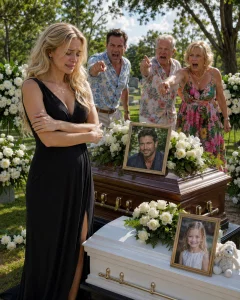
I buried my husband and my seven-year-old daughter beneath wet soil on a mercilessly gray Tuesday afternoon.
The clouds pressed low over the cemetery, as if the entire sky were carrying the same unbearable weight crushing my chest.
Two thousand miles away, my parents were lying beneath a brilliant Caribbean sun, carefully deepening their tans.
An hour before the mahogany caskets were lowered into the earth, my phone vibrated with one message.
Sorry, sweetheart. Flights are unbelievably expensive right now, and honestly, this is too small a reason to destroy your brother’s much-needed vacation. We’re with you in spirit.
I stood in the cemetery staring at the screen.
For three long seconds, I forgot how breathing worked.
My husband Michael’s casket was dark mahogany, polished to such a flawless shine that when I moved close, I could see my own pale, trembling reflection warped across the wood.
Beside him rested Sophie’s coffin.
Pure white.
Terribly small.
Cruelly small.
Its dimensions alone felt capable of breaking every bone in my body.
Sophie was seven.
She loved strawberry waffles with far too much syrup.
She wore ridiculous silver glitter sneakers that left sparkles everywhere.
And almost every evening, she begged Michael to dance with her in the kitchen while something burned in a pan behind them.
My parents should have been standing in the wet grass directly behind me.
They should have been gripping my arms when my knees threatened to collapse.
Instead, that evening, while I sat alone inside a silent house, my mother posted a photograph online.
Perfect white beach.
My older brother, Ryan, stood between our parents with his sunburned arms wrapped around their shoulders.
All three lifted fluorescent cocktails toward an orange Caribbean sunset.
The caption beneath the picture said:
Family is everything.
I sat on the living room floor and stared at those three words until the letters became a wet, meaningless blur.
After the funeral, the people around me treated me like I might shatter from a whisper.
Michael’s colleagues from his law firm cried openly.
They mourned him with more raw emotion than my own parents had managed to produce.
My elderly neighbor, Mrs. Delgado, arrived every evening with containers of warm chicken soup and silently placed them into my shaking hands.
At the cemetery, my pastor rested one hand on my shoulder.
“Grace, you don’t need to be strong today,” he murmured. “You only need to stay here.”
But strength had never been optional for me.
It was armor fitted onto my body long before I was old enough to refuse it.
In my family, I was the workhorse.
I earned academic scholarships so my parents wouldn’t have to pay tuition.
I cleaned up their debts.
Handled overdue utility notices.
Made polite excuses for people who treated parental affection like a bill that had to be earned and periodically renewed.
Ryan was different.
Ryan was the golden son.
A man who had failed upward with astonishing consistency.
Three collapsed businesses.
Two vicious divorces.
And an endless parade of temporary loans that somehow never became repayments.
Michael understood my family almost immediately.
“Grace,” he once told me after a particularly ugly Thanksgiving dinner, holding my face between his hands, “your family doesn’t ask for help.”
I had looked at him.
He continued quietly.
“They test how much of your soul they can remove before you finally stop functioning.”
I didn’t listen carefully enough.
I thought love could eventually balance the books.
Three days after I buried my husband and child, the doorbell rang.
My parents stood on my porch wearing pale resort clothes.
They still smelled faintly of coconut sunscreen and airport alcohol.
Ryan stood several feet behind them, scrolling aggressively through his phone.
He didn’t bother looking at me.
My mother didn’t hug me.
She didn’t say she was sorry.
Her eyes immediately moved over my shoulder and began assessing the interior of my house.
“Good Lord, Grace, you look awful,” she said, wrinkling her nose.
Then she adjusted her purse.
“Anyway, we can’t stay long. We need forty thousand dollars.”
I honestly believed grief had already hollowed me out completely.
I thought there was nothing left inside me capable of reacting.
I was wrong.
Something ancient and frozen remained.
“For what?” I asked.
My voice sounded almost mechanical.
Ryan finally looked up.
He sighed loudly.
“It’s an emergency, Grace. Please don’t turn everything into another dramatic situation.”
My father stepped forward.
“Your brother’s restaurant has a tax lien problem. The state is threatening to freeze the business accounts.”
His tone was firm.
Entitled.
“Family supports family. We need a cashier’s check today.”
I slowly turned my head.
The black dress I’d worn to the funeral still hung across the back of a dining chair.
Beside the staircase sat Sophie’s purple glitter backpack.
Exactly where she’d dropped it the afternoon before a drunk driver crossed the center line and destroyed my life.
“You missed their funeral,” I said.
The sentence landed without emotion.
A fact.
Cold as a morgue drawer.
My mother’s features immediately sharpened.
“Do not try to manipulate us with guilt, Grace.”
Her voice grew harder.
“After everything we’ve sacrificed for you, you owe this family. Now get your checkbook.”
I looked directly at all three of them.
And something inside me became completely calm.
I reached toward the entry table and picked up a thick navy folder.
For the first time in thirty-two years, my family had arrived at the wrong door asking the wrong woman for money.
The folder was plain.
Dark blue.
Heavy enough that my father’s eyes immediately moved toward it.
My mother noticed.
“What is that?” she demanded.
“A project Michael started several months ago.”
Ryan gave a cruel laugh.
“Your dead husband left you homework?”
My fingers tightened around the cardboard.
“Yes,” I said softly.
“You could call it that.”
Michael had been a senior corporate insurance attorney.
He was organized to the point of obsession.
Careful.
Patient.
Nearly impossible to frighten.
Six months before the crash, a letter arrived in our mailbox.
A rejection notice for a large commercial loan.
A loan I had never requested.
I remembered Michael sitting beneath the pendant lights at our kitchen island.
He read the page twice.
He wasn’t angry.
Anger would have been less frightening.
He was focused.
“Avery—Grace,” he had said, tracing one line with his pen, “your parents are connected to this loan application.”
His eyes lifted.
“And so is Ryan’s restaurant company.”
I laughed nervously.
I called it an administrative mistake.
Denial is sometimes the last thin blanket between you and a freezing truth.
Michael didn’t laugh.
He started investigating.
Over the following months, he gathered documents quietly.
Bank records.
Forensic signature reports.
Old wire transfers.
Copies of checks written from an account my parents had opened when I was nineteen.
An account created using my Social Security number and my mother’s maiden name to bypass identity verification.
They hadn’t simply borrowed money from me.
They had built an entire second financial existence using my identity.
Credit cards I never opened.
Defaulted business loans.
False tax documentation hiding Ryan’s losses.
Fraudulent insurance claims.
Every time I thought I had finally escaped them, they buried another hook somewhere beneath my financial skin.
Michael assembled everything.
He intended to confront them after Sophie’s spring recital.
He never returned home from that recital.
While I sat inside the funeral home choosing the lining for Michael’s coffin, my phone rang.
It was his senior paralegal, Thomas Bennett.
“Mrs. Dawson,” he said quietly. “I am deeply sorry.”
His voice broke slightly.
“But Michael left very clear written instructions. If anything happened to him before the family fraud matter was resolved, I was supposed to contact you immediately.”
Family fraud matter.
Those three words became solid ground beneath my collapsing life.
Michael hadn’t stopped with bank documents.
He’d hired an independent forensic accountant.
Her report was devastating.
My parents and Ryan had forged Michael’s signature.
They listed him as the primary guarantor on Ryan’s latest restaurant loan.
When the lender began questioning the missed payments, my father created fake revenue documents using Michael’s law firm’s letterhead.
Then I found the final insult.
Two days before the funeral, while my parents were taking sunset pictures on a Caribbean beach, my mother emailed Michael’s firm.
She created a false email address.
Pretended to be me.
And requested immediate access to Michael’s life insurance paperwork.
Her message claimed:
Grace is emotionally unstable and heavily medicated and cannot properly manage financial matters at this time.
My mother was trying to intercept my husband’s death benefits while his body was still at the morgue.
I looked at the three people standing outside my house.
“Come in,” I said.
They moved eagerly into the foyer.
They misunderstood me.
They thought I had surrendered.
They believed the exhausted family workhorse was preparing to carry them again.
My mother entered the living room and immediately studied the vaulted ceiling.
“Honestly, Grace, this house is too big for one person now.”
She waved one hand.
“It’s depressing. Sell it. Give Ryan the equity to solve the tax problem, and move somewhere smaller.”
Ryan dropped into Michael’s favorite leather chair.
He placed his phone on the side table.
“Grief in a mansion is still grief, Grace. Don’t be selfish.”
My father pointed toward the folder.
“Enough emotional nonsense. We have deadlines. Write the check.”
I sat on the sofa opposite them.
Then I placed the navy folder on the glass coffee table.
Every page inside was organized by date.
What they didn’t know was that notarized duplicates had already been delivered that morning to Ryan’s lender, the IRS Criminal Investigation division, the county fraud prosecutor, and Michael’s probate attorney.
“Before we talk about money,” I said, “I want an answer.”
My mother rolled her eyes.
“Why didn’t you come to the funeral?”
She exhaled theatrically.
“Oh, Grace, for God’s sake. Death happens. Standing in the rain couldn’t bring them back.”
My hands remained folded.
“The living still have problems that can actually be fixed,” she continued.
“Sophie was seven.”
“And Ryan is alive!” Mother snapped.
Her voice became shrill.
“He is here, and his business can still be saved if you stop acting selfish!”
Something inside my chest finally stopped trembling.
The grief moved backward.
Steel took its place.
I leaned forward.
Then I opened the navy folder.
Ryan smirked.
“What is this? Your grief diary?”
His laugh was ugly.
“Are you going to read us poetry?”
“No.”
I looked at him.
“It’s evidence.”
The room seemed to become colder.
I lifted the cover page.
The first exhibit was a commercial loan contract.
Michael’s signature appeared at the bottom.
Except the signature wasn’t his.
My father’s eyes locked onto the document.
His mouth opened slightly.
I turned the page.
“This is an independent forensic handwriting report confirming the signature is forged.”
Another page.
“These are still images from bank surveillance footage showing Ryan depositing the fraudulently obtained funds.”
Ryan’s face changed.
I continued.
“And here is an email transcript.”
I looked at my mother.
“This is where you impersonated me and attempted to gain access to Michael’s life insurance payment while drinking cocktails on the beach.”
I removed one final sheet.
Then I slid it across the glass until it stopped in front of my father.
“And this is the official case intake number issued by the county prosecutor’s fraud division.”
My mother stared at the page.
Ryan jumped from the chair.
“You’re bluffing!”
His forehead was already shining with sweat.
“You can’t prove intent. It’s circumstantial!”
I didn’t look at him.
“You sent Dad a text three months ago.”
Ryan stopped.
“Michael’s investigators recovered it.”
I quoted the message.
“Just use Grace’s name again. She never checks anything. She’s too busy playing house.”
Ryan turned completely pale.
My father lunged forward.
His hands reached for the folder.
I moved it back slightly.
“Don’t touch that.”
He froze.
“If you do, the deputy parked outside will come through my front door.”
All three turned toward the large window.
A marked sheriff’s vehicle idled at the curb.
The passenger door opened.
Thomas Bennett stepped out holding several manila envelopes.
My mother’s voice became thin.
“Grace…”
She swallowed.
“You called the police on your own family?”
“No, Mom.”
I looked at her.
“Michael did.”
A pause.
“I only completed what he started.”
The front door opened.
Thomas entered with a uniformed sheriff’s deputy.
He approached the coffee table without offering anyone a greeting.
Then he handed each family member a legal packet.
“You are being formally served,” Thomas said.
His voice was calm.
“Current allegations include multiple counts of wire fraud, aggravated identity theft, illegal conversion of assets, and felony financial exploitation.”
My father stared at him.
Thomas continued.
“Particularly the unauthorized liquidation of Mrs. Dawson’s grandmother’s trust estate.”
Dad’s knees buckled.
He fell onto the sofa.
Ten years earlier, when my grandmother Margaret died, my parents sat beside me and explained that she had left no money.
They gave me a worn Bible.
A box of cheap jewelry.
That was supposedly everything.
Michael’s accountant found the trust.
Grandma Margaret had left $280,000.
The money was designated for my education.
A down payment on my first property.
And any future child I might have.
When Sophie was born, she was legally added as a secondary beneficiary.
My mother was trustee.
And she stole every dollar.
The trust funded Ryan’s weddings.
My parents’ Caribbean vacations.
And the dying restaurant that now needed forty thousand dollars to survive.
“That money was ours to administer,” Mother whispered.
Her voice trembled.
“We had legal discretion.”
“It was Sophie’s money.”
The ice finally broke.
Rage moved through my voice.
Ryan backed toward the wall.
“Grace, come on.”
He raised both hands.
“We’re family. We can settle this privately.”
I looked at my brother.
The man who drank neon cocktails while my daughter’s small white coffin disappeared into cold earth.
“No, Ryan.”
My voice was clear.
“We aren’t family.”
I pointed toward the legal packet in his hand.
“You’re defendants.”
Mother’s face collapsed.
Then came the tears.
Her final weapon.
She covered her face.
“Grace, please!”
She looked at me through wet lashes.
“Your daughter wouldn’t want this! Sweet Sophie loved us!”
I stood so quickly that Ryan flinched.
“Never say her name again.”
My voice dropped to almost a whisper.
Mother immediately stopped crying.
The room became silent.
Their collapse happened faster than I expected.
Within a month, the state tax authority closed Ryan’s restaurant.
News cameras filmed chains being wrapped around the front entrance.
The lender seized his personal and business accounts.
My father lost his executive position after his employer’s board learned about the felony fraud investigation.
My parents’ heavily mortgaged suburban house was eventually sold through a court-supervised process to satisfy part of the civil judgments against them.
Then came the criminal cases.
Grand jury indictments.
Plea negotiations.
Ankle monitors.
Mugshots.
My mother’s face printed in the local newspaper beside the word fraud.
It was the kind of public disgrace she’d always believed happened only to inferior people.
I didn’t celebrate.
There was no satisfaction in watching their lives collapse.
I testified.
Signed documents.
Sat beneath fluorescent courtroom lights.
Endured sentencing hearings.
Michael’s gold wedding ring hung on a silver chain around my neck.
Sophie’s cheap glitter bracelet stayed around my wrist.
They became my armor.
Six months later, winter finally loosened its grip.
Spring returned.
Through court-ordered asset recovery, investigators managed to reclaim a significant portion of Grandma Margaret’s stolen trust.
I didn’t keep the money.
Instead, I created the Sophie Dawson Memorial Foundation.
The foundation funded educational scholarships for children in the county who had suddenly lost a parent or primary caregiver.
Our first recipient was eight years old.
Quiet.
Brilliant.
Her mother had died from cancer.
When she walked onto the stage during the foundation launch, I noticed her shoes.
Bright purple.
Covered in glitter.
Completely ridiculous.
I nearly lost my breath.
Her eyes were brave.
After the event, when the guests were gone, I drove to the cemetery.
I didn’t bring flowers.
I carried an insulated container filled with warm strawberry waffles.
Sophie had always insisted that heaven probably had terrible cafeteria food.
She believed in emergency snacks.
I sat on the damp grass between the two granite headstones.
I opened the container.
Then I touched Michael’s polished marker.
My other hand rested against the carved angel on Sophie’s stone.
“I did it,” I whispered.
The cemetery was quiet.
“I finished your work, Michael.”
My voice broke.
“They can’t hurt us anymore.”
A warm spring wind moved through the branches above me.
For the first time since the gray Tuesday when I buried my world, a tear slipped down my cheek.
But I wasn’t drowning.
The tear felt different.
Like rain touching black earth after a forest fire.
The rotten trees were gone.
The ground had been burned.
Scarred.
But underneath the ash, the soil was still capable of growing something new.
I sat between the two people I’d loved most and made them one promise.
I was still alive.
And from that moment forward, no one would ever be permitted to steal my life from me again.