“No.”
That was my answer.
I did not tell the officers my husband was a good father.
I did not call what happened a mistake.
I looked at my daughter wrapped in the blanket beside me and said:
“He hurt her because she broke a necklace.”
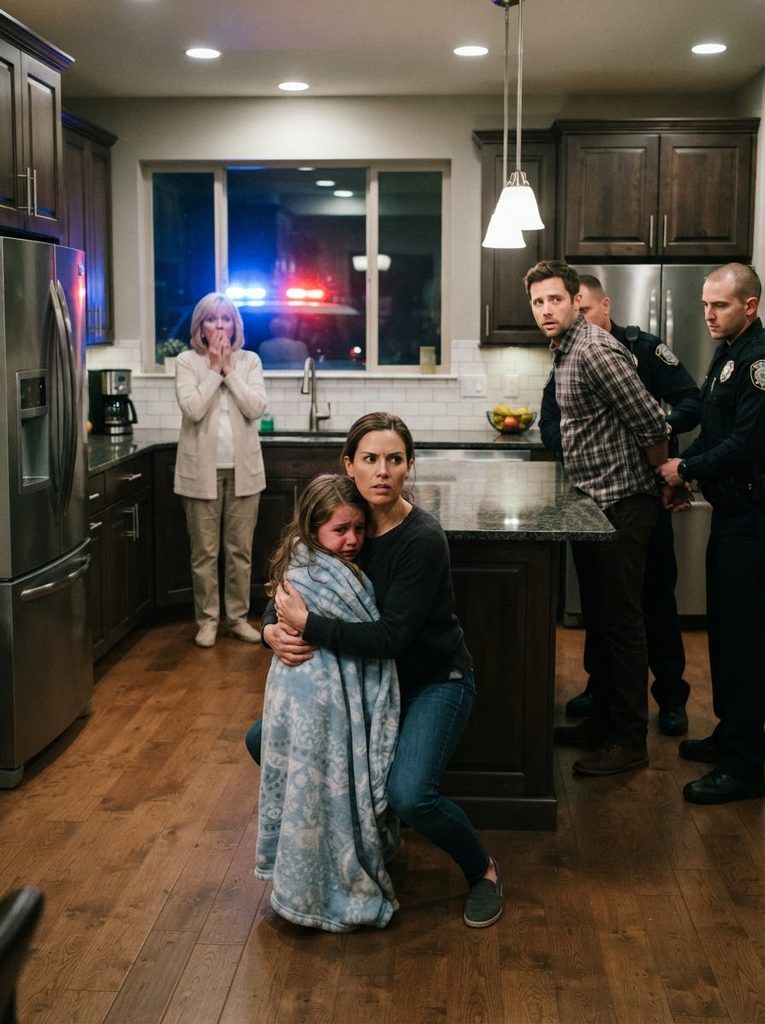
For once, nobody asked me to soften it.
The officers separated everyone immediately.
My husband, Michael, was taken outside.
His mother, Diane, was kept in another room.
Paramedics focused on my daughter, Ava.
That was the only part I cared about.
Not the gold chain.
Not the shouting.
Not whether Michael thought I had betrayed him.
Ava.
At the hospital, doctors treated the injury on her shoulder and monitored her carefully.
They asked questions I hated hearing.
Had anything like this happened before?
Had Michael ever used objects during punishment?
Had Diane participated?
Had Ava ever been afraid to go home?
I wanted to answer no.
Instead, I had to stop lying to myself.
Not this exact thing.
But there had been other punishments.
Long periods standing in corners.
Meals taken away for talking back.
Being made to repeat apologies until Michael liked the tone.
Diane telling Ava that crying made punishments last longer.
Michael taking toys away for accidents he called “carelessness.”
I had always argued afterward.
Sometimes loudly.
Sometimes privately.
But I had also accepted explanations.
He was stressed.
His mother had old-fashioned ideas.
He was trying to teach discipline.
Ava was sensitive.
I had been too permissive.
There was always a sentence available if I needed one.
The hospital took those sentences away.
A social worker named Melissa sat beside me.
“Does Ava understand why she was punished today?”
I stared at her.
“She broke a chain.”
“That wasn’t my question.”
I looked through the glass toward my daughter.
Ava was sitting on the bed with a nurse.
Small.
Exhausted.
Terrified.
“No,” I said.
“She probably thinks the accident made this happen.”
Melissa nodded.
“That belief will need to be corrected.”
I swallowed.
“It was an accident.”
“I know.”
Then she asked:
“What chain was it?”
I almost laughed.
Because suddenly the heirloom seemed ridiculous.
It had belonged to Michael’s grandmother.
A thin gold chain with a small engraved locket.
Valuable.
Sentimental.
Kept in a velvet box.
Diane treated it like a family relic.
That afternoon, she had brought it over because she said Ava was finally old enough to “learn what family responsibility means.”
Ava was allowed to hold it.
She caught the chain on the corner of a chair.
The clasp snapped.
That was all.
An old clasp.
A seven-year-old child.
One accident.
Michael reacted as if she had destroyed the family itself.
At least that was what I believed.
Until the police recovered the house audio.
The smart system had not actually sent every word directly to the precinct in some magical automatic stream.
That was how I had explained it in the kitchen because I needed Michael to believe help was already coming.
The truth was simpler.
Weeks earlier, I had configured an emergency shortcut after one of Michael’s outbursts.
One press on the silver remote activated the home’s security alert, opened an emergency communication channel through the monitored neighborhood system, and preserved a rolling buffer of recent audio from common areas.
The security service contacted emergency dispatch.
The outdoor speakers had come on because I had deliberately included them in the emergency scene.
I wanted witnesses.
I wanted neighbors to hear.
Most of all, I wanted Michael and Diane to stop.
It worked.
But the preserved audio caught more than the final confrontation.
It included several minutes before I pressed the button.
That became important.
On the recording, Diane entered the kitchen before Ava broke the chain.
Her voice was clear.
“So this is the one?”
Michael answered:
“Yes.”
Then Diane:
“And you’re sure she’s supposed to touch it?”
Michael:
“She needs to learn.”
There was a pause.
Then:
“Let her.”
At first, I did not understand why those words mattered.
Detective Aaron Blake did.
He replayed them.
“Do you remember Michael normally allowing Ava to handle the chain?”
“No.”
“Ever?”
“No.”
“Did Diane?”
“No.”
“Who gave it to her?”
“Diane.”
Blake wrote something down.
Then he played the next section.
Ava’s voice:
“It’s pretty.”
Diane:
“Hold it carefully.”
Michael:
“Don’t help her.”
That line bothered me.
Don’t help her.
Before anything happened.
Before the chain broke.
They were already treating the moment like a test.
Then came a faint metallic snap.
Ava gasped.
Michael cursed.
Everything after that became chaos.
But the recording had changed the question.
This was no longer simply:
Why did Michael react so violently to a broken heirloom?
Now it was:
Why had they deliberately placed a fragile family object in Ava’s hands and told me not to help?
The answer came from Michael’s laptop.
Police secured it separately.
Unlike the spoon, unlike the damaged chain, unlike the kitchen itself, the laptop held months of planning.
Not a plan to injure Ava that day.
Nothing that simple.
Something broader.
A folder called:
DISCIPLINE.
Inside were notes.
Dates.
Incidents.
Responses.
What worked.
What failed.
Ava cried — consequence extended.
Ava asked for Mom — remove Mom from room.
Mom interfered — restart later.
Grandma present — better compliance.
The language turned parenting into a behavioral experiment.
One file was titled:
RESPONSIBILITY TRAINING.
I felt sick reading it.
The idea was simple.
Give Ava objects she was told were important.
Watch how she handled them.
If she made a mistake, impose a consequence significant enough that she would “remember carelessness.”
There were examples.
A ceramic serving dish.
An old watch box.
A fountain pen.
None had been particularly valuable.
None had broken.
Then came the chain.
Diane had written in a message:
Use something that actually matters this time.
Michael replied:
The necklace?
Diane:
Exactly.
There was no message saying:
We will hurt her if she breaks it.
No proof they knew the clasp would fail.
No evidence anyone sabotaged it.
That distinction mattered.
The accident was still an accident.
What they had planned was the test.
The response was shaped by a philosophy they had already discussed.
A mistake should hurt enough to teach permanence.
Diane used that phrase more than once.
Michael agreed.
I asked Detective Blake:
“Did they plan this?”
He answered carefully.
“They planned to use the chain as a responsibility test.”
“And what happened after?”
“That is being investigated based on the evidence and witness accounts.”
That precision frustrated me.
Then I realized why it mattered.
If I exaggerated one thing, Michael could attack everything.
So I stopped needing the story to be worse than it was.
It was already bad enough.
The laptop contained another folder.
My name.
LAURA.
I stared at the screen.
Inside were notes about me.
Not personal memories.
Documentation.
Laura undermines consequences.
Laura comforts too soon.
Laura tells Ava accidents are okay.
Laura calls discipline excessive.
Laura threatens to leave after arguments.
I looked at my attorney.
“What is this for?”
She answered:
“Possibly preparation.”
“For what?”
“Separation. Custody. Control. We need more context.”
We got it.
Michael had emailed a family-law attorney months earlier.
He asked general questions.
How do courts view inconsistent discipline between parents?
Can one parent’s interference with household rules matter in custody disputes?
How should a parent document emotional volatility?
The attorney responded with generic information and a warning:
Do not manufacture incidents or create records for the purpose of making the other parent appear unstable.
Michael saved the email.
Then kept documenting anyway.
That did not mean a court would automatically believe him.
That did not mean he had filed anything.
He had not.
But it told me something important.
He had already imagined a future where I left.
And he wanted records ready.
His mother knew.
Diane messaged:
She’ll eventually turn Ava against you.
Michael:
She already thinks I’m too strict.
Diane:
Then start writing everything down.
Another:
If Laura runs, you need proof she’s the unstable one.
That line sat in my head for days.
The unstable one.
Michael screamed.
Michael intimidated Ava.
Diane encouraged punishment.
But they were building a file about me.
Why?
Because I cried after arguments.
Because I sometimes slept beside Ava when she was frightened.
Because I threatened separation.
Because I called his discipline cruel.
Everything that showed I was resisting their system could be rewritten as instability.
Then I found the worst note.
Not physically worst.
Psychologically.
It was attached to the day of the heirloom incident.
FAMILY LEGACY TEST.
Underneath:
No rescue.
Let her experience full consequence.
Grandma present.
Observe Laura response.
Observe Laura response.
I read those three words twice.
They were testing me too.
The chain was not only about Ava.
Michael wanted to know whether I would intervene.
Whether I would leave.
Whether I would “overreact.”
Whether Diane could later say I became hysterical over discipline.
That was why his face changed when I walked toward the dining room.
He thought I was retreating.
He thought the pattern was working.
I was supposed to disappear.
Cry privately.
Return later.
Apologize for making the situation tense.
That had happened before.
Not that day.
The smart-home records added another layer.
The silver remote had been installed six weeks earlier.
Michael did not know I had programmed the emergency function.
I had done it after an argument where he punched a hole in a pantry door while Ava was upstairs.
He later apologized.
Said he would never hurt either of us.
I wanted to believe him.
But I created the shortcut anyway.
That small act mattered.
Not because technology saved us.
Because somewhere inside me, I already knew I might need outside help quickly.
The security company’s logs showed the alert transmitted normally.
The neighborhood hub received it.
Emergency dispatch was contacted through the monitored system.
The preserved audio was downloaded afterward under proper process.
No magical direct police wire.
No secret surveillance network.
Just a system doing what it had been configured to do.
The neighbors heard the outdoor broadcast too.
Two came outside.
One called 911 independently.
Another recorded part of the shouting from across the street.
That meant the case did not depend on my word alone.
Or Ava’s.
Or even the house audio.
There were independent witnesses.
Hospital records.
Digital notes.
Messages.
The damaged chain.
The smart-system logs.
Multiple pieces.
That became important because Michael’s family immediately started rewriting the story.
It was an accident.
Ava was never in danger.
I overreacted.
Diane was only trying to teach respect.
The spoon had not been that hot.
The injury was being exaggerated.
Then one relative said:
“Michael would never intentionally hurt his daughter.”
I stopped responding.
Intent was not a family popularity contest.
The evidence could speak.
Ava’s interview happened without me coaching her.
That was hard.
I wanted to know everything.
Instead, professionals asked me to let trained interviewers handle it.
Later, Ava volunteered pieces on her own.
One night, she asked:
“Did Grandma know?”
“Know what?”
“That Daddy was going to do a punishment.”
I hesitated.
“Why do you ask?”
“She told me before the necklace that if I messed up, I had to remember forever.”
My stomach tightened.
“When did she say that?”
“In the dining room.”
I did not press.
I wrote down her exact words afterward and gave them to the appropriate professional.
That became my new rule.
Listen.
Do not interrogate.
Ava also told me something else.
The heirloom was not the first “test.”
The ceramic dish.
The fountain pen.
The watch box.
She remembered them.
Each time Michael or Diane emphasized how important the object was.
Each time Ava became nervous.
Each time they watched closely.
Nothing broke.
So there was no dramatic punishment.
But the anxiety remained.
She had learned that valuable objects were traps.
Touch carefully.
Move slowly.
Do not make mistakes.
Do not ask Mom for help.
That explained something I had noticed for months.
Ava hated carrying anything breakable.
At restaurants, if a server handed her a glass, she passed it to me.
At school, she refused to bring home a class terrarium.
Once she cried because a teacher asked her to hold a ceramic bowl.
I thought she was overly cautious.
Now I understood.
The heirloom day was escalation, not an isolated event.
Family court moved separately from the criminal case.
That distinction mattered.
Safety decisions did not wait for every criminal question to be resolved.
Michael’s contact with Ava became supervised.
Diane had no unsupervised contact.
At first, Ava said she never wanted to see either of them again.
A week later, she asked whether Daddy missed her.
Then she became angry at herself for asking.
Her therapist told her:
“You can miss someone and still be afraid of what they did.”
That helped.
I repeated it too.
I never wanted Ava to believe she had to hate Michael to prove loyalty to me.
That would still make her feelings serve an adult.
The first supervised visit was short.
Michael cried.
Ava did not.
According to the supervisor, he said:
“I made a terrible mistake.”
Ava asked:
“Which one?”
Michael stopped.
The question was simple.
But it exposed the problem.
He wanted one terrible mistake.
One awful moment.
One day.
Ava remembered a pattern.
He eventually said:
“A lot of things.”
That was closer.
She asked:
“Was the necklace more important than me?”
He shook his head.
“No.”
“Then why did you act like it was?”
The supervisor recorded a long pause.
Michael answered:
“It wasn’t.”
That did not repair anything.
But Ava needed to hear it.
The chain was evaluated by a jeweler.
That became unexpectedly important.
The damage was minor.
A broken clasp.
One stretched link.
Repairable.
The jeweler said the clasp was old and worn.
It could have failed under normal tension.
I stared at him.
“So she didn’t destroy it?”
He almost smiled.
“No.”
“It can be fixed?”
“Easily.”
I laughed.
Then I cried.
For weeks, the entire family had spoken as if Ava had ruined an irreplaceable treasure.
She had not.
The physical object could be restored in less than an hour.
The punishment had never matched the damage because the damage was never really the point.
Obedience was.
Memory was.
Fear was.
Diane wanted Ava to associate mistakes with pain.
That was the philosophy.
Later, through her attorney, Diane insisted she had never intended serious injury.
She said she was raised in a household where harsh consequences were normal.
She said parents today allowed children to escape accountability.
Then she wrote me a letter.
One sentence stood out.
I only wanted Ava to understand that precious things cannot always be replaced.
I did not answer.
The chain had been replaced with a repaired clasp almost immediately.
The irony was unbearable.
The object could be repaired.
Ava needed months to stop flinching near the stove.
That was the part Diane never understood.
Therapy moved slowly.
Ava learned practical things first.
Accidents do not require punishment just because someone is angry.
Pain is not a teaching tool.
Asking for Mom is allowed.
Crying does not add time to anything.
If an adult tells her a punishment has to stay secret, she can tell another safe adult.
We also had to make ordinary consequences feel ordinary again.
If Ava refused to clean her room, she still had to clean it.
If she deliberately threw something, she lost access to it.
If she lied, we talked about the lie.
Safety did not mean no rules.
It meant rules were connected to behavior.
Not humiliation.
Not fear.
Not pain.
The kitchen was hardest.
For weeks, Ava would not go near the stove.
I did not force it.
Eventually, she stood beside me while I made pancakes.
Then one Saturday she asked:
“Can I flip one?”
I handed her the spatula.
She missed.
The pancake folded in half.
She froze.
I looked at it.
Then at her.
“That one’s ugly.”
She stared.
I smiled.
“I’m eating it.”
She started laughing.
That became our first good kitchen memory after everything happened.
Months later, we baked cookies.
Ava dropped a tray.
Several broke.
She started crying immediately.
“I ruined them.”
I crouched beside her.
“Some broke.”
“Grandma said important things—”
I interrupted gently.
“Cookies aren’t people.”
She looked at me.
“Things can break.”
She nodded.
“People matter more.”
That became the sentence we repeated.
Not as a slogan.
As a correction.
The gold chain eventually came back to me after the evidence process ended.
It had been repaired.
Diane wanted it.
Michael wanted it returned to the family.
I did not.
Legally, ownership was handled through the separation agreement.
Eventually it went back to Michael.
I was relieved.
I did not want Ava growing up with the object in our home.
Not because the chain was evil.
Because it had already carried enough meaning.
Years later, Ava asked me about it.
“Was it actually expensive?”
“Yes.”
“How expensive?”
“I don’t remember.”
“Did I really break it?”
“The clasp broke while you were holding it.”
“Was that my fault?”
“You were seven.”
“That’s not an answer.”
She had become sharp.
I smiled.
“It was an old clasp.