I was five thousand miles away from home when a nurse called me sobbing and said that they had broken both of my wife’s legs. A man took the phone from her hands, laughed directly into the receiver, and whispered for me to come do something about it, boasting that his father owned the police force. Fourteen hours later, I landed on American soil, only to find two sheriff’s cruisers already waiting for me on the tarmac.
My name is Mason Vance. For twelve long years, I kept the darkest parts of my military career separated from my wife, Laurel. I had always tried to shield her from the harsh realities of my world, until someone decided to bring the war right to our front door.
That night, heavy rain hammered relentlessly against the canvas roof of our overseas operations tent when my personal cell phone suddenly lit up on the table. It was Laurel calling, and she almost never rang my line during active duty hours unless a crisis was taking place.
I picked up the call, and her voice came through as a trembling whisper. “Mason,” she said, and the pure terror in those two syllables made me stand up instantly from my chair.
“What’s wrong, Laurel?” I asked, holding the phone tightly to my ear.
“They’re outside again,” she whispered, her breathing fast and shallow.
For three agonizing weeks, she had been telling me about a suspicious black sedan parked across the street from our house outside Roanoke, Virginia. Then a local sheriff’s cruiser began appearing nearby at strange hours. Someone had even followed her home from the local grocery store, and she later found a handwritten note slipped beneath her windshield wiper that simply said: STOP ASKING QUESTIONS.
“Call nine one one right now,” I instructed her, trying to keep my voice steady.
“I already did,” she replied, her voice shaking violently.
“What did the dispatcher say?” I asked.
“They transferred my call directly to the county sheriff’s department,” she whispered, and I could hear the faint sound of curtains rustling in the background. “Mason, I’m looking through the upstairs window right now, and there’s already a cruiser parked outside.”
My blood ran ice cold as I pictured the lonely street outside our home. “Laurel, listen to me carefully. Lock yourself inside the master bedroom and push the heavy wooden dresser against the door immediately.”
Before she could answer, three slow, heavy knocks echoed from the front door downstairs, followed by a harsh male voice shouting, “Sheriff’s department!”
Laurel whispered frantically into the receiver, “Maybe they actually came here to help us.”
“No,” I yelled back into the phone. “Do not open that door under any circumstances!”
A fraction of a second later, the sound of splintering wood exploded through the line. Laurel screamed at the top of her lungs as heavy combat boots rushed up the stairs, followed by men shouting aggressive orders. The bedroom door crashed inward with violent force.
“Mason!” she screamed out my name.
A sickening crack resonated over the phone, immediately followed by another sharp scream of agony from Laurel. Another terrible crack echoed a moment later, and then I heard the distinct sound of men laughing in the room. I kept shouting her name repeatedly into the receiver until the line suddenly went completely dead.
For the next two frustrating hours, I desperately dialed every emergency authority I could find. County dispatch claimed they had no record of any incident at our address, while the sheriff’s office rudely told me to stop tying up their phone lines. Finally, someone at Saint Anthony General Hospital picked up the line.
“Your wife is alive,” the attending nurse said, her voice filled with heavy emotion.
I nearly collapsed against the wooden table in relief, but then she began to cry quietly into the phone.
“What is it?” I demanded. “Tell me what happened!”
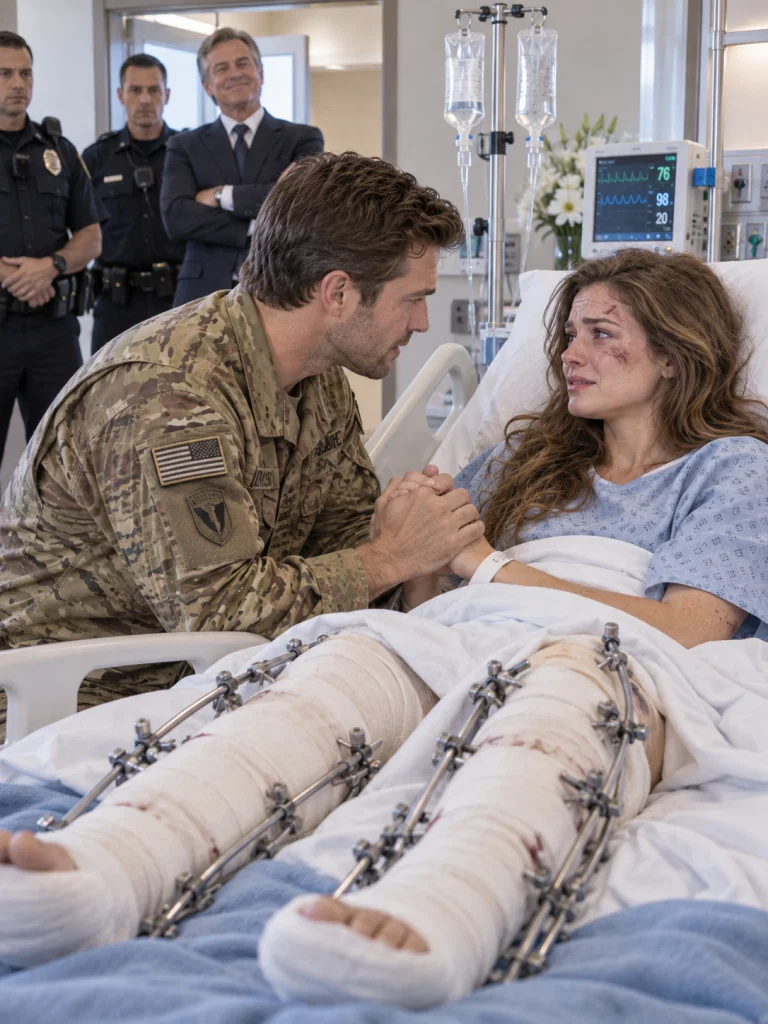
“Both of her legs have sustained multiple severe fractures,” the nurse sobbed.
Before I could ask another question, the faint sound of heavy footsteps approached her in the hallway, and a man’s firm voice interrupted her, saying that he wasn’t allowed back there.
Then I heard that same terrible, arrogant laugh from earlier over the line. A man aggressively pulled the phone away from the nurse.
“Are you Mason?” the man asked with an easy, cruel tone.
“Who the hell are you?” I shouted back.
“It doesn’t matter who I am,” he chuckled, sounding completely unbothered by my anger. “Your wife was a whole lot tougher than I expected her to be.”
My hand tightened around the edge of the table so hard my knuckles turned white.
Then he lowered his voice to a whisper. “Your wife walks funny now, soldier. Why don’t you come do something about it?”
In the background, someone firmly ordered the man to leave the restricted medical area, but he just laughed again. “My dad owns the police around here,” he bragged right before the line went dead.
Twenty minutes later, I stood inside Colonel Victor Ramsey’s command tent, laying out every piece of evidence Laurel had sent me over the preceding weeks. I showed him photographs of the black sedan, the mysterious cruiser, recorded badge numbers, license plates, the threatening note, and the single name driving the entire nightmare: Trenton Sterling.
Trenton was twenty-eight years old, the arrogant son of billionaire industrialist Arthur Sterling, and he held deep personal ties to Sheriff Donald Burke. Three weeks earlier, Laurel had witnessed Trenton physically assaulting a young woman in a downtown parking garage and immediately called the police to report it. However, the victim later withdrew her formal complaint out of fear, which was precisely when the heavy surveillance on our home had begun.
Colonel Ramsey studied the evidence in total silence for several minutes. Eventually, he unlocked a small desk drawer, retrieved a dark security clearance card, and placed it firmly on the table between us.
“This is your emergency transit authorization,” Colonel Ramsey stated calmly.
I stared at the black card in disbelief. “You’re actually sending me home right now?”
“I am ordering you home,” Colonel Ramsey corrected me, his grey eyes hardening as he looked up. “But you need to understand that I am not sending you back for revenge.”
He explained that federal authorities were already being discreetly notified of the situation, and then he offered one more detail. “Three men from your former specialized unit are rotating back to the states tomorrow morning.”
I looked up at him quickly. “You mean the Vanguard team?”
“They volunteered the moment they heard what happened,” Colonel Ramsey replied.
Fourteen hours later, our military transport plane touched down on the wet runway back home. As soon as cellular signal returned, my phone received a text stating that Laurel was stable following her extensive emergency surgery. But a second message arrived from an unknown number right after, containing a photo of Laurel’s hospital room door taken from the hallway outside, followed by the text: WELCOME HOME, SOLDIER.
One of my former teammates leaned across the aisle to check on me. “Is there a problem, Mason?”
I turned the phone screen toward him so he could see the picture for himself. Then I glanced out the small airplane window and spotted two official sheriff’s cruisers idling right beside the terminal. The aircraft had not even stopped moving yet, meaning Trenton somehow already knew I had landed.
PART 2
The transport plane was still taxiing toward the gate when Jonah Reyes leaned across the narrow aisle to examine the two cruisers parked outside in the steady rain. Jonah had spent nine years operating alongside me in environments where exits mattered far more than comfort, and he had a natural habit of assessing every environment as if a threat were waiting underneath it.
“Could just be a coincidence,” Jonah remarked quietly.
Sitting directly behind him, Malik Turner let out a soft snort of disbelief. “Two county cruisers waiting beside a private military terminal at five in the morning right after someone texts Mason a picture of his wife’s hospital room?”
Jonah kept his eyes fixed on the window. “I said it could be, not that it is.”
Owen Shaw, the youngest member of our four-man team, looked at the threatening text message on my phone once more. The simple words seemed to taunt us from the illuminated screen.
Part of me wanted to walk down the aircraft stairs, march straight across the wet tarmac, and force the deputies to give me immediate answers. Twelve years of rigorous military discipline told me that taking aggressive action right now would be a massive mistake. My wife needed a supportive husband at her bedside far more than she needed a man trying to prove how dangerous he could be.
Colonel Ramsey’s final words echoed in my mind once again. Not for revenge.
Jonah seemed to read the heavy internal conflict written across my face. “We handle this the smart way, Mason,” he said firmly.
“We head straight to the hospital,” I replied.
“Hospital it is,” Jonah agreed with a quick nod.
When the aircraft finally came to a complete stop, my phone began to ring from an unknown number. Malik raised his eyebrows in anticipation, and I quickly pressed the answer button.
“Is this Mason Vance?” a calm, highly professional female voice asked over the line.
“Yes, speaking,” I answered.
“My name is Special Agent Dana Price with the FBI field office,” she explained. “Colonel Ramsey passed your contact information to me through official command channels, but I wanted to reach out directly before you exited the aircraft.”
I shifted my position to look out the window toward the waiting patrol cars. “Do you know where I am right now?”
“I am currently looking at your plane,” Agent Price replied smoothly.
“Then you see the company waiting for me down here,” I stated.
There was a brief pause on the line before she spoke again. “I am looking at that exact same company right now.”
I looked past the cruisers toward the far edge of the terminal service road and spotted an unmarked grey SUV. A woman in a dark raincoat stood beside the driver’s door holding a large umbrella.
“Is that you by the SUV?” I asked.
“That’s me,” Agent Price confirmed.
“What are those county deputies doing here?” I asked, keeping my voice low.
“That is something I would prefer they explain to me before you engage with them,” Agent Price stated clearly. “Stay right where you are for a moment.”
She hung up the phone, and Jonah gave me an approving nod. “That is definitely a better scenario.”
The heavy rear exit door of the transport plane opened, filling the cabin with the cold morning air and the sharp scent of jet fuel. The four of us descended the metal stairs together, and the two waiting deputies immediately stepped out of their vehicles to approach us. One deputy was an older, heavy-set man with rain dripping off the brim of his official hat, while the second deputy appeared to be barely thirty years old. Neither man reached for their sidearms, nor did they raise their voices as they closed the distance.
The older deputy walked forward carrying a standard Manila folder. “Are you Mason Vance?”
Agent Dana Price reached our group before the deputies could close the remaining distance. She showed her federal credentials to the officers with a practiced motion.
“I am Special Agent Dana Price,” she announced firmly. “Mr. Vance is currently assisting with an active federal inquiry. What is the nature of your business here today?”
The older deputy looked noticeably uncomfortable under her sharp gaze. “We were dispatched to speak with him directly.”
“Regarding what topic?” Agent Price demanded.
“A formal complaint,” the deputy replied shifting his weight.
“What kind of complaint?” she asked.
The officer’s eyes flicked over to me for a brief second. “Threatening communications made against Mr. Trenton Sterling.”
For a brief moment, I thought I had completely misheard his statement. Malik looked away toward the runway as if he found the wet asphalt deeply fascinating, while Agent Price remained entirely unbothered by the deputy’s claim.
“Do you possess an arrest warrant for Mr. Vance?” Agent Price asked directly.
“No, ma’am, we do not,” the older deputy admitted.
“Is Mr. Vance currently being detained by your department?” she continued.
“No,” the officer grumbled softly.
“Then he has somewhere else he needs to be right now,” Agent Price stated calmly.
The younger deputy looked visibly relieved by her statement, while the older officer appeared thoroughly frustrated with the turn of events. He pulled a business card from his folder and handed it over to the agent.
“Sheriff Burke would certainly appreciate his full cooperation in this matter,” the deputy grumbled.
Agent Price accepted the card without hesitation. “Then Sheriff Burke is welcome to call my office directly.”
We walked away toward her unmarked vehicle without looking back at the deputies. Avoiding that confrontation was perhaps the single hardest thing I had to do all morning, not because I felt any sense of fear, but because every operational instinct I possessed demanded absolute certainty, and certainty was the one thing nobody could offer me yet.
Saint Anthony General Hospital stood under the pale morning sky, its glass facade reflecting the heavy rain clouds above. I had spent time in medical facilities across half a dozen countries throughout my career, and I disliked every single one of them. They all shared the same artificial warmth in the corridors, the same quiet rubber-soled shoes, and the same electronic monitors that beeped as if human pain could be managed by polite sounds.
Before we walked through the sliding glass doors, Agent Price stopped our group in the entryway.
“Your teammates are welcome to come inside,” she said, turning to look at Jonah, Malik, and Owen. “But I need to establish clear boundaries before we step onto the floor.”
Jonah folded his arms across his chest. “We’re listening, Agent Price.”
“You are not operating as a military unit today,” she warned them.
“We understand,” Jonah replied quietly.
“You are not acting as independent investigators either,” she added.
Malik raised one hand slightly in a defensive gesture. “We are simply three friends who care about Mason and happen to have a very strong tolerance for terrible hospital coffee.”
Agent Price allowed a small smile to break her professional demeanor. “That is fine.”
Then she turned her attention back to me with a serious expression. “And you are strictly a husband today. Keep it that way.”
“That was always my intention,” I answered her softly.
Inside the facility, a floor nurse led me down the long corridor toward the orthopedic wing. Every single step down that hall felt immensely heavy. I had mentally prepared myself to see complex monitoring equipment, heavy plaster casts, severe bruising, and deep emotional trauma. I had not prepared myself to find Laurel sitting fully upright in her hospital bed, actively arguing with a staff nurse about the quality of the breakfast tray.
“You cannot honestly call this substance oatmeal,” Laurel was saying with complete conviction. “It possesses the structural integrity and taste of damp wallpaper paste.”
The attending nurse let out a soft laugh, but then Laurel happened to look up toward the doorway and caught sight of me standing there. Everything about her posture changed instantly. Her confident smile faded away first, and then her eyes rapidly filled with tears. My own eyes welled up just as quickly.
Neither of us said a word for several long seconds. I walked straight to the side of the bed, and she reached her arms out toward me as far as she could. I took her hands with extreme care, mindful of the intravenous lines taped to her skin.
“Hi,” she whispered softly, her voice breaking.
“Hi there,” I replied, sitting gently on the edge of the mattress.
She managed a weak tearful smile. “You look absolutely terrible.”
“So do you,” I answered back without thinking.
Laurel opened her mouth in dramatic, exaggerated offense. “That is definitely not what husbands are supposed to say after traveling thousands of miles to see their wives.”
“I’m out of practice,” I admitted.
That simple exchange broke the overwhelming tension that had gripped us both. She let out a short laugh that quickly turned into quiet crying, and I leaned down carefully to hold her tight. Laurel wrapped her arms tightly around my shoulders, and for the very first time since receiving that horrific phone call overseas, the chaos around me completely stopped moving.
I could smell the familiar scent of her favorite shampoo beneath the sharp hospital antiseptic. I could feel the steady rhythm of her breathing against my chest. She was alive, and in that moment, that fact had to be enough for us.
“I am so sorry,” I whispered into her hair.
She pulled back slightly to look at my face. “What on earth are you apologizing for?”
“For not being here when they came to the house,” I answered, looking down.
“Mason, no,” she said firmly, her fingers tightening around my hand. “You were exactly where your duty required you to be.”
My gaze drifted down toward the heavy blanket elevated by support frames over her legs. She noticed where I was looking right away.
“The doctors assured me that the physical recovery process is going to take some time,” she offered gently.
“I know,” I replied softly.
“They also explicitly informed me that I am not allowed to participate in any road marathons this month,” she added, trying to lighten the heavy mood.
“That seems like an incredibly restrictive medical opinion,” I commented.
“I am strongly considering filing a formal complaint against the staff,” she joked weakly.
There she was. That was my Laurel, the brilliant woman who had once spent six straight hours debating an airline manager because they lost her mother’s luggage, only to apologize to the agent afterward for keeping him past his shift. She was the same person who routinely labeled leftovers in our refrigerator with increasingly detailed warning notes because I kept forgetting to eat them before they spoiled.
Despite the severe injuries hiding beneath the bedding, she could clearly see the deep guilt consuming me.
“Come closer,” she requested softly.
I shifted closer to her side.
“You do not have to solve every single problem in the world this morning,” she told me quietly.
“I know that,” I insisted.
“No, you really don’t,” she countered, looking directly into my eyes. “You’re doing that thing right now.”
“What thing am I doing?” I asked.
“The thing where you completely stop blinking and decide that the entire world has suddenly turned into a complex tactical operation that you have to control,” she explained.
Despite the heavy atmosphere, a small smile forced its way onto my face. She reached up and touched my cheek softly.
“I need my husband here with me right now,” she said quietly. “I don’t need you thinking five moves ahead.”
Her words resonated deeply within me because she was entirely right. For twelve years, I had operated under the belief that loving someone meant anticipating every potential danger before it could ever arrive. Laurel believed that love meant simply being present with each other after the danger had already done its damage. We had never truly discussed that fundamental difference before.
Agent Price waited nearly an hour before asking Laurel for a formal statement about the events leading up to the attack. She walked into the room without bringing a recording device or notebook and pulled a plastic chair over by the window.
“You are welcome to ask me to leave at any point,” Agent Price offered politely.
Laurel shook her head. “I want to help you understand what happened.”
Agent Price glanced over at me. “Do you want Mason to step outside while we talk?”
Laurel looked genuinely surprised by the question. “Of course not. I want him here.”
Then she paused for a second. It was a very small hesitation, but I picked up on it instantly, and so did Agent Price.
“Actually,” Laurel corrected herself slowly, “there are a few specific details I need to share that I haven’t told Mason yet.”
I turned to stare at her in complete disbelief.
She quickly looked down at her hands. “They aren’t bad things, Mason.”
“Laurel,” I said, my tone dropping.
“Please do not use that specific tone with me right now,” she requested gently.
“What tone?” I asked.
“The tone where my first name suddenly sounds like the start of an official interrogation,” she explained.
Agent Price began to stand up from her chair. “I can step outside into the hallway and give you two a private moment.”
“No,” Laurel insisted, holding out a hand. “Please stay. This needs to be brought out into the open anyway.”
Her fingers twisted the edge of the crisp white sheet. “I didn’t tell you everything that was happening because you were deployed thousands of miles away on an active assignment.”
I felt a familiar, uncomfortable pressure building behind my ribs. “What exactly didn’t you tell me, Laurel?”
“The young woman from the parking garage contacted me a few days after the incident,” Laurel revealed softly.
Agent Price’s attention sharpened immediately. “What was her name?”
“Her name is Hannah Lee,” Laurel answered. “She was employed as an internal accountant for the Sterling Family Foundation.”
I recalled the original story Laurel had passed along to me weeks ago. She had been leaving a downtown pharmacy when she observed Trenton Sterling arguing aggressively with a distressed young woman outside a parking structure. The woman was clearly frightened and asking him to leave her alone, prompting Laurel to call the local authorities to report the disturbance. That was supposed to have been the entirety of the interaction.
“Hannah located me about four days later,” Laurel continued, explaining the real timeline. “She came directly to the university library where I work. She wanted to thank me for making the police report, but then she admitted that what I witnessed in the garage wasn’t the only reason she was terrified of Trenton.”
Agent Price leaned forward slightly. “What was the main reason?”
“She had uncovered severe financial irregularities within the foundation’s accounts,” Laurel stated clearly. “There were unauthorized payments moving through their community outreach funds. Small amounts initially, listed as consulting fees, vehicle leases, and private security contracts. Hannah realized those payments were being processed using administrative override codes belonging to senior executives who had no knowledge of the transactions.”
“Was Trenton behind those transfers?” I asked.
“She was almost certain he was,” Laurel answered.
I stood up from my chair and walked over toward the window to process the information. “Why on earth didn’t you inform me about this when it happened?”
Laurel closed her eyes briefly. “Because you were halfway across the world, Mason.”
“You managed to tell me about the black sedan,” I pointed out.
“Eventually I did, yes,” she conceded.
“And you told me about the cruiser watching the house,” I added.
“Yes, I did,” she whispered.
“So why hide the rest of it?” I asked, turning back to face her.
Her eyes flashed with sudden emotion. “Because I knew with absolute certainty exactly how you would react!”
“How I would react?” I repeated, bewildered.
“You would do precisely what you are doing right now,” she stated, her voice trembling slightly though she was not angry. “You would stop sleeping entirely. You would start calling every contact you have in the military. You would try to single-handedly solve a complex criminal situation that you physically could not handle from an overseas deployment. And every single time we spoke on the phone, I would have to listen to that awful silence.”
“What silence are you talking about?” I asked quietly.
“The heavy silence where you systematically decide exactly how much of the truth I am allowed to handle,” she answered softly.
The hospital room became completely still. Agent Price quietly looked toward the exit door, preparing to give us privacy, but Laurel motioned for her to stay.
“For twelve years, Mason, you have aggressively protected me from every single detail of your military career,” Laurel explained, her voice soft and heavy with emotion.
“I never wanted you to have to carry the weight of that life,” I argued back gently.
“I know that,” she acknowledged. “I knew you just wanted our home to remain a safe, peaceful space.”
“Then what is wrong with wanting that for us?” I asked.
She took a moment to carefully formulate her answer. “There is nothing wrong with protection, right up until that protection turns into making fundamental decisions for another person without their input.”
I looked away toward the floor, unable to counter her point.
“You never tell me when you are genuinely terrified,” she continued gently. “You never share the memories that haunt you. You just come home, fix things around the house, take out the trash, and ask me polite questions about my day. I love that man with all my heart, Mason. But sometimes I feel like I am married to the front porch of a beautiful house that I am never actually allowed to step inside.”
I stood there without a single word to offer in response. There were certainly aspects of my career that had been kept secret because they were strictly classified by the government. There were other experiences I kept to myself simply because I loved her and wanted to spare her the horror. But there was a third category of things I had hidden purely because I lacked the courage to share my own vulnerabilities. I had bundled all three categories together under the blanket term of protection, and now I had to confront how much of that choice had been driven by my own fear.
Laurel offered me a faint, understanding smile. “So yes, Hannah spoke with me, and I made the choice to keep that detail to myself for a while.”
I gave her a quiet nod of understanding. “I suppose neither of us handled things fairly.”
“No, we didn’t,” she agreed softly, extending her hand toward me.
I took her hand back into mine. “We are apparently both quite awful at this.”
“At marriage?” she asked with a small smirk.
“At keeping secrets,” I corrected her.
That brought a genuine laugh to her face, easing the heavy atmosphere in the room. Agent Price waited a few moments for the emotion to settle before steering the conversation back to the investigation.
“Did Hannah happen to provide you with any hard evidence during your meeting?” Agent Price asked.
Laurel nodded. “She gave me a short list of specific transaction reference numbers.”
“Where are those numbers located now?” the agent asked, pulling out a small notepad.
“I memorized them,” Laurel replied simply.
I stared at my wife in total disbelief. “You memorized financial transaction codes?”
“I am a professional research librarian, Mason,” she reminded me with a gentle smile.
“That still doesn’t fully explain memorizing raw data,” I countered.
“It explains a lot more than you think,” she teased lightly.
She clearly recited six complex alpha-numeric transaction codes from memory while Agent Price carefully noted every digit.
“And where are the original documents Hannah brought to you?” Agent Price inquired.
“Hannah kept the original paper files,” Laurel explained.
“Do you happen to know where Hannah is staying right now?” Agent Price asked.
“No,” Laurel answered, her expression darkening slightly. “She completely stopped responding to my text messages four days ago.”
By early afternoon, Laurel needed to rest, so I walked downstairs to the hospital cafeteria with Agent Price while Jonah kept watch in the hallway above. The cafeteria coffee tasted just as terrible as Malik had warned, but it provided a necessary distraction.
Agent Price sat across from me at a laminate table. “You’re angry with her for keeping that secret.”
“I am worried about her safety,” I replied, staring down into the paper cup.
“That wasn’t what I asked you,” she noted gently.
“I am feeling both,” I admitted.
“That is entirely understandable,” she said.
“She really should have told me right away,” I insisted.
Agent Price offered a quiet shrug. “You don’t need a federal agent giving you advice on your marriage, but people naturally make imperfect choices when they are under intense stress.”
I leaned back in the plastic chair. “What can you tell me about the Sterling family?”
“Which one specifically?” she asked.
“Both of them,” I replied.
“Arthur Sterling built a massive logistics and transport enterprise into a multi-industry conglomerate over forty years,” Agent Price explained. “Commercial real estate, regional shipping, private security firms, municipal infrastructure contracts. He is also a prominent financial donor to local hospitals, universities, police foundations, and political organizations.”
“And his son Trenton?” I asked.
“Trenton has spent the majority of his adult life holding various executive titles within his father’s parent companies without ever remaining in one position long enough to bear real operational responsibility,” she stated cleanly.
“That is a very diplomatic way of putting it,” I noted.
“I am a career federal employee,” she replied with a dry smile. “Official documentation trains us to eliminate unnecessary adjectives.”
She slid a thin blue file folder across the table toward me. “Our team managed to verify something quite unusual regarding your initial reports.”
I opened the folder to find a high-resolution photograph Laurel had taken of the county sheriff’s cruiser parked near our driveway weeks ago.
“The license plate matches official records,” I observed.
“The plate is valid, yes,” Agent Price agreed. “But the vehicle itself is the problem.”
“What do you mean?” I asked, scanning the page.
“That specific vehicle has not belonged to the county sheriff’s department for over seven months,” she revealed, tapping the document with her pen. “It was officially decommissioned from municipal service and sold off at a public auction.”
“Who purchased it?” I asked.
“A private fleet vehicle reseller,” she replied. “And shortly after that transaction, a private security firm called Sterling Tactical Solutions acquired the vehicle.”
I read the line twice to ensure I understood it correctly. “They were actively driving a decommissioned law enforcement vehicle around my neighborhood?”
“Not quite,” Agent Price clarified. “Federal standards require that all official department markings, decals, and emergency lighting arrays be completely removed prior to private sale.”
“And were they removed?” I asked.
“According to the official paperwork filed with the county, the vehicle was fully stripped,” she said. “Obviously, the photographic evidence proves otherwise.”
I pictured Laurel standing alone behind our upstairs window, watching that marked car linger in the shadows outside, a false symbol carefully chosen to convince her that she had nowhere safe to turn for help.
“So the person sitting outside my home wasn’t actually a county deputy,” I stated.
“We cannot confirm that conclusion yet,” Agent Price cautioned. “The vehicle belongs to a private firm, but anyone can wear a uniform or replicate police decals. That does not automatically rule out the involvement of actual active-duty personnel.”
“What about the county dispatch logs from that night?” I asked. “Why did they claim no calls were made?”
“Those electronic logs are currently under formal federal review,” she answered.
“And Sheriff Donald Burke?” I asked.
“His office is also part of the ongoing review,” she stated neutrally.
I leaned forward over the table. “Trenton Sterling specifically bragged over the phone that his father owned the police force in this county.”
Agent Price maintained a calm, neutral expression. “Individuals under stress or pursuing control often say dramatic things to make their victims feel entirely helpless.”
“Do you believe he was simply bluffing?” I asked.
“I believe our immediate responsibility is to carefully distinguish between a person boasting and an actual corrupt system,” she explained.
Her statement caused a noticeable shift in my perspective. For days, I had envisioned an entire municipal government conspiring against my family. But keeping someone isolated worked best when the victim was convinced that every single legitimate institution was compromised.
Jonah managed to arrange a short-term rental house twenty minutes away from the medical center. Malik handled buying basic groceries, while Owen quietly brought me a replacement phone charger after discovering I had left mine behind overseas. None of us referred to ourselves by our former tactical designation, nor did we discuss past military operations. We were simply four long-time friends standing around a kitchen counter at midnight trying to understand why Malik had purchased such an absurd quantity of produce.
“Why on earth did you buy eight pounds of raw potatoes?” Owen asked, staring at the brown paper bags on the table.
“They were marked down fifty percent,” Malik defended himself smoothly. “Basic food security is an essential aspect of any prolonged operation.”
Jonah opened an overhead pantry cabinet. “There are also fifteen cans of black beans in here.”
“Also on sale,” Malik pointed out without missing a beat.
I sat at the small wooden kitchen table listening to their mindless banter. For the first time in several days, the suffocating tension in my chest eased slightly.
Jonah eventually pulled up a chair across from me. “How is Laurel doing tonight?”
“She is spending all her energy trying to take care of everyone else in the room,” I answered.
“So, she is acting like Laurel,” Jonah observed with a soft chuckle.
“Pretty much,” I agreed.
He paused, looking at me carefully. “And how are you holding up, Mason?”
“I’m doing fine,” I replied automatically.
All three men stopped what they were doing immediately. Malik slowly lowered the box he was holding, Owen stopped unwrapping a cereal box, and Jonah looked almost personally offended by my response.
“What is it?” I asked, looking around at them.
“You have known the three of us far too long to lie that poorly,” Jonah stated plainly.
I rubbed my tired eyes with both hands. “Laurel told me earlier today that I actively keep major parts of myself hidden from her.”
Malik resumed placing cans in the cabinet. “Because you absolutely do.”
“Thank you for the insightful contribution, Malik,” I said dryly.
“You are very welcome,” he replied smoothly.
Owen leaned against the kitchen counter, taking a tone that was unusually serious for him. “You used to do the exact same thing with us when we were deployed, Mason.”
“Do what, exactly?” I asked.
“You decided what everyone around you needed without actually asking them,” Owen explained.
“That was quite literally my operational job as team leader,” I argued back.
“Sometimes it was your job,” Jonah corrected me gently. “And other times, you simply preferred believing it was your sole responsibility so you didn’t have to share the burden.”
I looked around the small kitchen at the three men who had flown across an ocean without hesitation the moment I called. “Did you three travel thousands of miles just to analyze my personality flaws?”
Malik nodded solemnly. “That, and to ensure we had adequate potato inventory.”
The light humor faded quickly, and Jonah’s tone became grounded and respectful. “You kept us all alive for years by tightly controlling every single variable in dangerous environments. That mindset is absolutely essential in places where uncertainty gets people killed.”
He gestured toward the quiet suburban street visible outside the window. “But coming home isn’t a military tactical mission, Mason.”
His words brought back Laurel’s exact phrase from earlier in the day: the front porch of a house I’m not allowed inside.
“I don’t know how to easily share the things I spent over a decade learning to carry completely alone,” I admitted quietly.
Jonah gave a simple shrug. “You don’t have to dump every heavy memory on her all at once.”
“Then what am I supposed to do?” I asked.
“You simply let her know that you are carrying something heavy,” Jonah advised gently. “That’s all.”
It was a remarkably simple piece of advice, deeply uncomfortable to consider, but entirely true.
The following morning, Laurel asked me to hand over her personal laptop from her bag.
“No,” I answered reflexively.
She stopped and stared at me with an unimpressed look.
I caught myself immediately and corrected my tone. “What specific task would you like to use your laptop for right now?”
A small smile touched her lips. “Much better phrasing.”
She explained that she wanted to run a search through a professional university research database to track down Hannah Lee’s past activities.
“Hannah once asked me a very specific question about non-profit financial compliance,” Laurel recalled. “She wanted to know if legally restricted donor funds could be funneled into private security arrangements.”
“Can they?” I asked.
“It depends entirely on how the initial donation covenants were written,” she explained.
I retrieved the computer and set it up on her bed tray. Laurel spent the next forty minutes carefully navigating complex non-profit financial disclosures related to the Sterling Family Foundation.
Suddenly, her typing stopped. “Take a look at this, Mason.”
She rotated the screen toward me. A public foundation annual report displayed a major program titled the Safe Communities Initiative, which had received nearly two million dollars in funding over a three-year window. The listed recipients included local youth programs, community organizations, and a private law enforcement foundation.
“That foundation is tied directly to the sheriff’s department,” I noted, reading the small text.
“Only in part,” Laurel clarified, scrolling down the document.
One specific commercial vendor appeared repeatedly across multiple transaction lines: Blue Ridge Administrative Solutions. The name meant nothing to me initially, so Laurel opened the public state corporate registry to pull the business filing. The listed principal address belonged to a modest commercial office park in town, and the primary corporate officers were hidden behind a third-party registration firm. However, an older annual filing revealed a previous managing director: Victor Drake.
Agent Price walked into the hospital room moments later, and her eyes widened when she saw the name on the screen. “Captain Victor Drake?”
“Is he with the sheriff’s office?” I asked immediately.
“He is the senior operations commander for the entire county department,” Agent Price confirmed grimly.
Laurel looked over at me, her point proven. That document represented the first direct, verifiable financial link between the suspicious foundation transactions and a high-ranking official within Sheriff Burke’s administration.
However, Agent Price maintained her professional caution. “A historic corporate document is not conclusive legal proof of a crime, Mr. Vance.”
“Then what does it represent?” I asked.
“It represents a very solid reason for federal agents to start pulling bank records,” she answered cleanly.
Late that afternoon, we received an unexpected visitor at the hospital. Sheriff Donald Burke arrived at the facility entirely alone, without an escort or deputies. Agent Price met with him in a private staff room before allowing me to step inside.
Sheriff Burke was a broad-shouldered man in his late fifties with silver hair and visible dark circles under his eyes. He did not look like an all-powerful official who controlled the region. He looked like an exhausted administrator who had not slept in days.
When I entered the room, he immediately stood up from his chair. “Mr. Vance.”
He extended his hand toward me, but I made no motion to accept it, leaving his hand hanging in the air. He quietly lowered it back to his side.
“That is fair enough,” he acknowledged quietly.
“Why did your dispatch desk tell me that no emergency calls were ever recorded from my home address that night?” I demanded, remaining standing.
His jaw tightened. “I am actively trying to find the exact answer to that question right now.”
“I suggest you find it much faster,” I replied coldly.
Agent Price gave me a brief warning glance, prompting me to take a seat at the table.
Sheriff Burke removed his hat and slowly turned it over in his hands. “My department received an internal administrative request roughly three weeks ago to route all incoming calls originating from your specific residence to a supervisory desk for review.”
“Who generated that administrative request?” I asked directly.
“That detail is currently under formal internal investigation,” he answered cautiously.
“Was it Captain Victor Drake?” I pressed.
Sheriff Burke looked over at Agent Price, then back to me, his mouth set in a tight line. “I did not state that name.”
“You didn’t need to say it out loud,” I countered.
He let out a heavy sigh and leaned his hands on the table. “I have known Arthur Sterling personally for over thirty years.”
There it was, out in the open.
“My dad owns the police,” I quoted Trenton’s arrogant phone call back to him.
Sheriff Burke’s expression shifted instantly, showing genuine humiliation rather than anger. “Arthur Sterling does not own me, son.”
“His charitable foundation has funneled massive amounts of money into your department’s private support funds,” I pointed out sharply.
“They donated to a non-profit foundation that supports law enforcement operations,” Sheriff Burke corrected me firmly. “Equipment grants, community outreach programs, and tactical gear.”
“And his son’s associate happens to manage private companies tied directly to your senior operations captain,” I added.
Sheriff Burke frowned in confusion. “What manager are you referring to?”
“Blue Ridge Administrative Solutions,” I stated clearly.
He looked genuinely taken aback by the reference, a reaction that Agent Price noted immediately.
“Were you unaware of Captain Drake’s historical involvement with that entity?” Agent Price asked him directly.
“I had no knowledge of that connection whatsoever,” Sheriff Burke insisted.
A brief silence fell over the room.
Sheriff Burke set his hat down on the table. “When I ran for county sheriff, Arthur Sterling contributed to my campaign. He contributed to my reelection campaign as well, just like dozens of other local business leaders in this county.”
I kept my eyes fixed on him without responding.
“That financial support does not excuse a single thing that happened to your wife,” he continued, his tone sincere. “But it also does not mean that every single deputy wearing a badge in this county is corrupt.”
“Someone inside your department deliberately erased my wife’s desperate calls for help,” I stated coldly.
His face hardened. “Yes, someone did.”
“And that occurred directly under your operational command,” I reminded him.
“Yes, it did,” he admitted without hesitation.
“And you are the elected sheriff of this county,” I added.
“Yes, I am,” he repeated softly.
He offered no excuses or deflection, which caught me completely off guard. I had prepared myself for political spin, but his blunt admissions left no room for an argument.
Sheriff Burke looked toward the closed door. “My younger deputies operate under the assumption that I am aware of every single detail occurring within my department.” He offered a brief, bitter smile. “The voters in this county likely assume the exact same thing.”
Then he looked me directly in the eyes. “I swear to you that I had zero knowledge of your wife’s emergency calls being intercepted.”
“Do you honestly expect me to believe that assertion?” I asked.
“No, I do not expect you to take my word for it,” he answered immediately. “I expect you to wait for the federal investigation to reveal the hard evidence.”
I let out a short, disbelieving laugh. “That sounds remarkably familiar.”
Agent Price leaned forward in her chair. “Sheriff Burke, why were two of your department’s cruisers dispatched to the airport terminal to meet Mr. Vance’s transport plane yesterday morning?”
Sheriff Burke stared at her in complete confusion. “What cruisers are you talking about?”
Agent Price picked up her phone, opened a photograph she had taken on the tarmac, and handed the device across the table. Sheriff Burke studied the image carefully, and all the color slowly drained from his face.
“That vehicle bears the marking for Unit Two-Fourteen,” he stated quietly.
“Do you recognize that specific vehicle assignment?” Agent Price asked.
“I recognize the unit number, yes,” he answered, enlarging the photo with his fingers. “Unit Two-Fourteen was completely written off and destroyed in a multi-vehicle accident last winter.”
I looked at Agent Price, who was already taking notes.
Sheriff Burke pointed directly at the side panel displayed on the screen. “Those vehicle decals are outdated. Look at the silver striping beneath the lettering. Our department updated all fleet graphic standards six months ago.”
Agent Price stood up from her chair immediately. “I need to secure the airport authority’s perimeter security camera footage right away.”
Sheriff Burke stood up as well. “I will personally pull our complete official fleet registry for you.”
I instinctively stepped forward to block the doorway before he could exit the room. He stopped dead in his tracks, looking at me. I forced my tactical instincts to yield and stepped aside, making a conscious choice to let the process work.
“Sheriff Burke,” I called out as he reached the handle.
He turned back around. “Yes, Mr. Vance?”
“If your investigation reveals that officers inside your command were actively involved in harming my wife,” I said, keeping my voice steady, “what will you do?”
His expression transformed into one of absolute resolve. “I will personally hand every shred of evidence over to the federal prosecutor’s office to ensure they spend years in prison.”
“Even if doing so completely ruins your political career?” I asked.
The exhausted look returned to his eyes. “Mr. Vance, if I were to protect criminals hiding behind a badge, I wouldn’t have a career worth saving in the first place.”
Two hours later, Agent Price called me with the results of their initial investigation into the vehicles. The cruisers parked at the airport were entirely fraudulent. One was registered to a shell vehicle leasing company, while the other identification number belonged to a retired municipal sedan sold off two years prior. Both cars had been modified with custom decals to look like official law enforcement vehicles from a distance.
Whoever was targeting us had carefully constructed an elaborate illusion. It was realistic enough to make Laurel believe that local law enforcement was actively hunting her, convincing enough to make me expect an entire corrupt department waiting at the airport, and sophisticated enough to exploit administrative vulnerabilities within county dispatch. Someone with internal system access had clearly assisted the operation, but the actual network of bad actors was far smaller than the vast conspiracy we had initially envisioned.
I returned to Laurel’s hospital room after the sun had set. She was awake, gazing out the window at the distant city lights.
“How much of the update did Agent Price share with you?” I asked, sitting beside her.
“She told me about the fake patrol cars,” Laurel answered softly.
“Does knowing that make you feel any safer?” I asked, taking her hand.
“No,” she admitted quietly. “Not really.”
“Me neither,” I agreed.
She squeezed my fingers gently. “But it makes the entire problem feel much smaller.”
I understood precisely what she meant. Facing a vast, shadowy institution was an overwhelming, terrifying prospect. But investigating a small group of specific individuals who committed crimes meant names could be uncovered, records could be subpoenaed, and actual legal responsibility could be enforced.
After a few quiet minutes, Laurel looked over at me. “There is one more detail I need to share with you.”
I closed my eyes briefly and groaned softly.
She smiled teasingly. “You are fully permitted to groan.”
“Thank you for the permission,” I replied, opening my eyes.
“Hannah gave me a physical key during our first meeting,” Laurel revealed.
I sat up straight in my chair. “What kind of key?”
“A small brass key with a three-digit number stamped into the metal,” she explained.
“Where is this key right now, Laurel?” I asked, trying to keep my voice calm.
“I hid it in a safe place,” she answered.
“Laurel,” I warned gently.
“I know, I know,” she said, holding up a hand. “Do you remember that terrible cookbook your mother gave us years ago?”
“We own at least thirty different cookbooks,” I pointed out.
“The green vegetarian one,” she specified.
“I dislike several vegetarian cookbooks in our kitchen,” I countered.
“The bright green one with the damaged cover,” she clarified with a small laugh.
“Okay, that narrows it down,” I admitted. “Where in the book is it?”
“Inside the hollowed-out spine,” she confessed.
I stared at her in shock. “You intentionally cut open a book?”
“The binding was already completely falling apart,” she defended herself.
“You are a professional librarian!” I reminded her, amazed.
“I contain complex multitudes, Mason,” she teased with a wide grin.
Despite the serious circumstances, I couldn’t help but laugh out loud. She joined in, but the movement caused a sharp pain in her ribcage, prompting her to stop and glare at me as if the sudden discomfort were entirely my fault.
“Do you know what that key actually opens?” I asked once she recovered.
“No,” she admitted softly. “Hannah didn’t tell me.”
The following morning, Agent Price obtained formal consent to send a federal evidence team into our home. I opted not to join them, honoring a specific request Laurel had made the previous evening.
“I don’t want your very first memory of being back inside our home to involve watching agents tear the place apart looking for evidence,” she had told me.
Instead, Owen accompanied the federal team to the house, not in an official investigative capacity, but because he was the only one who could reliably locate the specific green cookbook Laurel had described. Three hours later, Agent Price returned to the medical center holding a clear plastic evidence bag containing a small brass key stamped with the number 317. Attached to the top was a small, worn blue plastic tag.
Laurel examined the object through the clear plastic. “I never noticed that blue tag when Hannah handed it to me.”
Agent Price held the bag up toward the fluorescent light. Beneath several deep scratches, a faint corporate logo became visible: three stylized curved lines printed above the letters JRS.
Laurel raised her eyebrows. “What does JRS stand for?”
Before Agent Price could respond, her phone rang. She answered quickly, listened intently for a few seconds, and stepped toward the far window. When she finally turned back around to face us, her professional composure was entirely rigid.
“Federal agents have located Hannah Lee,” Agent Price announced clearly.
Laurel sat up as far as her injuries allowed. “Is she unhurt?”
“She is safe and uninjured,” Agent Price confirmed.
I let out a long breath of relief. “Where was she found?”
“At a small hotel outside Charlottesville,” Agent Price revealed.
“Why hasn’t she been answering any of our calls?” Laurel asked, hurt evident in her voice.
“Because she checked into the room under her mother’s maiden name and completely powered off her mobile devices,” Agent Price explained.
“Why would she go into hiding like that?” Laurel asked.
Agent Price lowered her phone. “According to Hannah’s initial statement, an internal contact within the Sterling Family Foundation warned her that Trenton had discovered she copied confidential internal financial ledgers.”
I looked at the small key sealed inside the plastic bag. “What does any of this have to do with locker number 317?”
Agent Price looked directly at Laurel. “Hannah claims she provided you with the key to a private document storage locker at James River Storage.”
JRS.
Laurel whispered, “What is stored inside that locker?”
“Hannah claims she does not know the specific contents,” Agent Price answered.
“That doesn’t make any sense,” I interjected. “Why wouldn’t she know?”
“Because she never placed any items inside it herself,” Agent Price explained.
“Then who rented the locker?” I asked.
Agent Price took a quiet breath before answering. “According to Hannah, the storage unit was opened personally by Arthur Sterling.”
The hospital room went completely silent. Laurel stared at the agent in utter disbelief. “Trenton’s father?”
“Yes,” Agent Price confirmed.
“Why on earth would Arthur Sterling provide Hannah with access to his private storage unit?” Laurel asked.
“He didn’t give it to her directly,” Agent Price clarified, checking her notes. “The key mysteriously appeared on Hannah’s office desk the morning after she formally reported the accounting discrepancies to Arthur Sterling.”
The entire narrative shifted once again. Arthur Sterling had initially been presented to us as the absolute center of the corruption—the untouchable billionaire patriarch using his vast wealth to shield his criminal son from justice. But if the key to the evidence had originated from Arthur himself, then the situation was far more complex than a father simply covering up his son’s crimes. Someone had deliberately left a clear trail of evidence to be found, leaving us to figure out whether Arthur was attempting to expose Trenton’s illegal activities, or if we were being carefully led into a trap.
PART 3
James River Storage was situated behind a row of industrial warehouses on the eastern outskirts of town. It was certainly not the high-security facility I would have expected a billionaire to use for hiding sensitive records. There were no armed guards, no complex surveillance systems, and no marble entrance. The facility consisted of basic beige metal garage doors, a humming commercial vending machine, and an elderly manager named Patricia who seemed annoyed that federal agents were disrupting her morning routine.
I chose to remain outside the facility, a decision that visibly surprised Agent Price and caught me off guard as well. But I had made a firm promise to Laurel the night before: I would stop automatically charging through every open doorway first.
When Agent Price asked if I wanted to accompany the evidence team inside, I simply shook my head. “Just call me the moment you confirm what is inside.”
Jonah and I walked across the street to a small diner to wait. He poured syrup over a stack of pancakes and looked across the table at me with a smirk. “Look at you, evolving as a human being.”
“Do not make this awkward, Jonah,” I replied dryly.
“I am genuinely proud of your self-control,” he teased.
“Now you’ve made it awkward,” I noted.
He took a bite of food while I kept my eyes fixed on my cell phone lying on the table between us. Jonah watched me for a moment before speaking up. “You realize that staring at the screen doesn’t make the cellular signal travel any faster, right?”
“I am well aware of how technology works,” I answered.
“You have checked that screen sixteen times in five minutes,” he pointed out.
I flipped the phone facedown on the Formica table. A minute later, it vibrated loudly with an incoming call from Agent Price. I picked it up instantly.
“What did the team locate inside the locker?” I asked.
“Paper,” Agent Price answered simply. “A massive amount of documentation.”
“What kind of documentation?” I pressed.
“Copies of internal corporate audits, bank wire transfers, vendor contracts, and private email threads,” she listed off. “Most of them involve Trenton, but there are other names as well.”
I stood up from the diner booth, and Jonah immediately set his fork down.
“Is there anything else in there?” I asked.
“There is a personal letter,” Agent Price revealed.
“Written by Arthur Sterling?” I inquired.
“We believe so, yes,” she confirmed.
“Who is the letter addressed to?” I asked.
Agent Price paused briefly over the line. “You and Laurel should listen to the contents together.”
By early afternoon, Hannah Lee agreed to return to town under federal protection. Agent Price conducted a detailed interview with her at the federal building alongside her legal counsel, and Laurel requested to meet with her afterward in her hospital room.
I had anticipated Hannah would be extremely nervous, and while she certainly appeared anxious, she was far from fragile. She was a composed woman in her early thirties wearing practical glasses, with a nervous habit of folding the edge of any paper within reach.
When she walked into Laurel’s hospital room, she stopped a few feet from the bed, looking down at the floor. “I am so deeply sorry, Laurel.”
Laurel looked at her warmly. “What are you apologizing for, Hannah?”
“For disappearing when things became dangerous,” Hannah whispered. “For dragging you into this nightmare.”
“You didn’t cause this,” Laurel assured her gently. “You simply shared information that needed to be brought to light.”
“And then I panicked and stopped answering your calls,” Hannah added, her voice filled with guilt.
“You were terrified for your life,” Laurel said softly, holding out her hand. “I completely understand.”
Hannah crossed the room and took Laurel’s hand, tears filling her eyes. There were no dramatic speeches, just two women acknowledging the immense fear they had both survived.
I remained standing quietly near the window. Hannah glanced over in my direction. “You must be Mason.”
“Is it that obvious?” I asked with a faint smile.
“Laurel spoke about you quite a lot,” Hannah revealed.
I looked over at my wife with raised eyebrows. “Oh really?”
Laurel offered a guilty grin. “I was extremely complimentary, I assure you.”
Hannah hesitated for a second. “She did mention that you organize the dishwasher in a very illogical manner.”
I stared at Laurel in absolute disbelief. “You shared my private dishwasher loading techniques with a key federal witness?”
“The topic came up entirely naturally during our conversation,” Laurel defended herself smoothly.
“There is zero natural context for discussing dishwasher loading,” I countered dryly.
Hannah let out a genuine laugh, breaking the remaining tension in the room. Moments later, Agent Price entered carrying a printed copy of the letter recovered from the storage unit.
“Are we ready to review this document?” Agent Price asked.
Laurel nodded, and Agent Price handed the pages to Hannah. “Please read it aloud.”
Hannah took a quiet breath and began reading the letter, which was dated nine days prior to the attack on our home.
Ms. Lee, the letter began, If you are reading these words, it means my deep fears have been confirmed, and the financial discrepancies you brought to my attention were not simple accounting mistakes.
Hannah’s hands began to shake slightly, so Laurel reached out to steady her wrist. Hannah continued reading aloud. Arthur Sterling wrote that immediately following his initial conversation with Hannah, he had quietly ordered a confidential internal audit of the foundation’s accounts. That private review uncovered a sophisticated network of unauthorized payments routed through secondary foundation accounts and fake vendor invoices.
Some transactions had been directly executed using Trenton’s administrative credentials, while others used forged signatures of senior corporate directors. But Arthur’s letter contained an even more painful admission: he admitted that he had suspected his son was misusing corporate resources long before Hannah ever approached him. He had deliberately chosen not to ask hard questions, convincing himself that Trenton was merely immature, then simply troubled, and then surrounded by bad influences. Each excuse had allowed Arthur to avoid confronting the terrifying reality that his son’s destructive behavior could no longer be managed internally.
The letter contained no grand justifications or attempts to minimize the damage. Instead, it revealed a grieving father confronting the devastating consequences of confusing unconditional protection with actual love.
I have spent the majority of Trenton’s life actively preventing natural consequences from ever reaching him, Arthur had written. I foolishly believed this grace would give him the necessary time to mature into a better man. I now confront the reality that I merely taught him that consequences were things that belonged exclusively to other people.
Laurel looked up at me as Hannah read that specific sentence aloud, and I knew instantly what she was thinking. Her warning from earlier echoed in my mind: protection becomes deciding for someone else. They were different families operating under entirely different circumstances, but the underlying truth was identical.
Arthur had compiled complete copies of the fraudulent financial records and secured them inside the storage unit, intending to hand everything over to federal prosecutors. However, before he could act, someone within his corporate security team discovered that an audit was underway. Unsure of who he could safely trust within his own organization, Arthur had placed the storage key on Hannah’s desk, creating an independent path for the truth to emerge if he lost his nerve.
If I prove too weak to take these records to the authorities, Arthur concluded, please ensure they reach someone who will not hesitate to do what is right.
Hannah lowered the paper, her voice barely a whisper. “He knew what his son was doing.”
“He knew parts of it, yes,” Agent Price agreed gently.
“Did he know Trenton was planning to attack me?” Laurel asked quietly.
“There is zero evidence suggesting he had any knowledge of the physical threats against you,” Agent Price clarified.
I asked the one question that still remained unanswered. “Where is Arthur Sterling right now?”
Agent Price turned to me. “He has formally requested a private meeting with our investigative team.”
Arthur Sterling looked nothing like the powerful images published in business magazines over the years. In public photographs, he always appeared commanding—silver hair, bespoke suits, standing confidently at ribbon-cutting ceremonies and charity galas. In person, he was simply an exhausted seventy-year-old man sitting at the end of a federal conference room table, his hands wrapped tightly around a cold paper cup of coffee.
His senior legal counsel sat beside him, while Agent Price sat directly opposite. Laurel joined the meeting via a secure video feed from her hospital room, and I sat right next to the monitor.
Arthur looked at Laurel’s image on the screen first. “Mrs. Vance,” he said, his voice low and raspy.
Laurel offered no greeting in return, keeping her face completely neutral.
“What happened to you was an absolute atrocity,” Arthur said softly. “It should never have occurred.”
Laurel maintained her steady gaze. “Did you know your son was actively placing me under surveillance?”
“No, ma’am, I did not,” Arthur answered truthfully.
“Did you know he had access to private security personnel through your corporate subsidiaries?” she asked.
Arthur hesitated for a brief second. “Yes, I was aware of that access.”
“Did you know he had previously utilized those security resources for personal matters?” Laurel pressed.
Arthur’s attorney shifted uncomfortably in his chair, but Arthur raised a hand to stop his lawyer from speaking. “I am going to answer her question directly.”
He turned back to the screen. “Yes, I knew he had used them before. He used them to monitor a former partner, and to track down individuals he was involved in personal disputes with. At the time, I foolishly categorized those actions as severe boundary issues rather than dangerous warning signs.”
“Why did you choose to ignore those signs?” Laurel asked, her voice calm but heavy.
The simple question hit Arthur harder than an outright accusation. He looked down at the table. “Because he is my son.”
Laurel waited in silence, forcing him to continue.
“That is not a valid justification,” Arthur added softly. “It is merely the pathetic excuse I used to convince myself to do nothing.”
I had spent days building up an image of Arthur Sterling in my mind—the untouchable villain pulling every string behind Sheriff Burke and the local government. The reality standing before us was far less cinematic and far more human. He was not an evil mastermind, nor was he entirely innocent. He was simply a father who had used his immense wealth, legal influence, and social status to delay accepting what his son had become, creating a vacuum where bad people made horrific choices.
Agent Price opened an official file. “Mr. Sterling, what can you tell us about Captain Victor Drake?”
Arthur looked up. “I know Captain Drake through his brother, Grant Drake, who managed regional security operations for Sterling Logistics for six years.”
The complex web finally collapsed into a clear structure. The corruption did not stem from Sheriff Burke himself, but through a direct bridge connecting the private corporate security apparatus to senior personnel within the sheriff’s department.
“Grant Drake left our employment last year,” Arthur explained.
“Under what circumstances?” Agent Price asked.
“He was terminated following severe disagreements with our compliance director,” Arthur revealed. “Grant insisted that security expenditures should not be subjected to standard corporate auditing standards.”
Agent Price made a quick note. “And Captain Victor Drake?”
“I interacted with Captain Drake at various social events and charity functions,” Arthur answered.
“Was your son close with both Drake brothers?” Agent Price inquired.
Arthur closed his eyes briefly. “Yes, Trenton was very close with both of them.”
From that moment on, the federal investigation moved with incredible speed. Truth rarely arrived like a sudden thunderstorm; it emerged like a room slowly being illuminated.
Investigators quickly established that Grant Drake had provided Trenton with access to the decommissioned security vehicles owned by Sterling Tactical Solutions. Meanwhile, his brother, Captain Victor Drake, used his administrative credentials within the county sheriff’s department to manipulate the emergency dispatch system, ensuring that any incoming calls originating from our residence were diverted away from active duty units. No official investigation had ever existed; the administrative block had been fraudulently entered into the system.
Furthermore, financial audits revealed that Blue Ridge Administrative Solutions had funneled hundreds of thousands of dollars out of foundation accounts under the guise of security consulting contracts, with payments authorized directly by Trenton and Grant Drake.
Trenton Sterling had never truly owned the police department, nor had his father. He had simply exploited personal relationships, historical favors, an unethical private security director, and a corrupt senior officer willing to manipulate administrative systems for personal gain. The illusion of absolute power had been constructed from ordinary, pathetic compromises.
When Agent Price explained these findings to Laurel two days later, Laurel shook her head sadly. “That explanation almost makes it feel worse.”
“Why does it feel worse?” Agent Price asked.
“Because I spent weeks imagining some unstoppable, sinister machine,” Laurel explained, looking over at me. “When in reality, it was just a few broken people choosing to say yes when they should have had the courage to say no.”
Sheriff Donald Burke immediately suspended Captain Victor Drake from duty, and two days later, Drake was formally placed on administrative leave pending state and federal criminal indictments. Sheriff Burke personally called my cell phone that evening.
“Mr. Vance, I owe your wife a profound personal apology,” he stated quietly.
“You owe her complete accountability,” I corrected him.
“Yes, I do,” he agreed.
“Then you should deliver that apology to her in person,” I told him.
Sheriff Burke accepted the invitation without hesitation and arrived at the hospital wearing plain clothes rather than his official uniform, a gesture that Laurel deeply appreciated. He sat quietly in the chair near the door.
“My department completely failed to protect you, Mrs. Vance,” he said directly.
Laurel folded her hands in her lap. “Did you personally fail me, Sheriff Burke?”
The unexpected question caught him off guard. “I am the head of the department, ma’am.”
“I am aware of your position,” she replied gently. “That was not my question. Did you have personal knowledge of what was happening to me?”
“No, I did not,” he answered firmly.
“Did you ignore obvious red flags that should have alerted you to the corruption?” she pressed.
Sheriff Burke’s expression darkened with regret. “Yes, I did.”
“How did that happen?” she asked.
He took a long, slow breath. “Captain Drake had been with our department for over twenty years. He was exceptionally efficient at solving administrative problems—staffing, logistics, handling public complaints. Over time, I placed complete trust in his management.”
“That sounds like a natural administrative choice,” Laurel observed.
“It became an excuse for convenience,” Sheriff Burke admitted candidly. “I stopped performing proper oversight on his work simply because he had always handled those tasks without issue.”
“Did Arthur Sterling ever ask you for political or personal favors?” Laurel asked.
Sheriff Burke looked visibly embarrassed. “Minor ones over the years. Expediting event permits, coordinating traffic detail for warehouse openings, or reviewing minor property disputes.”
“Were any of those requests illegal?” she asked.
“No, none of them were illegal,” he answered.
“But were they unusual?” she continued.
“On occasion, yes,” he conceded.
“And each small favor made the next request seem entirely normal,” Laurel noted softly.
Sheriff Burke looked at her for several seconds before giving a slow nod. “Yes, that is exactly how it happened.”
Laurel nodded back. “That is precisely what I needed to understand.”
He appeared somewhat confused by her calm demeanor. “Are you not furious with me?”
“I am angry about what happened,” she answered, her voice remaining steady. “But I do not need you to sit here feeling miserable. I need you to completely overhaul how emergency calls are handled in this county so no one else ever suffers like I did.”
Sheriff Burke nodded firmly. “I have already formally requested the State Police to conduct a complete audit of our dispatch systems.”
“That is a necessary step,” she agreed.
“And I am recusing myself from any direct involvement in the prosecution of the Sterling family,” he added.
“Also a wise decision,” she noted.
He stood up to leave, but as he reached the door, Laurel spoke up once more. “Sheriff Burke.”
He turned back around. “Yes, Mrs. Vance?”
“Do not resign your position simply because you feel deep shame over this failure,” she advised him calmly.
His eyebrows rose in surprise.
“Resign only if you lack the capability to fix the broken system,” she told him firmly. “Stay in office if you have the strength to repair it.”
He stared at her in silence for a moment before giving a respectful nod.
Laurel glanced over at me with a soft smile. “So far, every single person in this story has been busy deciding what everyone else ought to do. Perhaps it is time we all stopped doing that.”
I offered no counterargument, pretending to be deeply interested in my phone.
That evening, after the visitors had cleared out, I sat beside Laurel’s bed and shared a memory from my military past that I had never spoken aloud to anyone. It wasn’t classified intelligence or a dramatic combat action, just a quiet moment of intense vulnerability.
Years earlier, during my second overseas deployment, our transport convoy had been stalled for hours on a remote dirt road following a sudden engine failure. Absolutely nothing happened during that delay—no enemy contact, no mechanical explosions, no heroic actions. But I had spent forty agonizing minutes convinced beyond a shadow of a doubt that a devastating attack was imminent.
For years afterward, whenever our personal car broke down, whenever heavy traffic ground to a halt under an overpass, or whenever I couldn’t immediately understand why a situation was unfolding, a part of my mind instantly reverted back to that helpless feeling on that dirt road.
“I never shared that memory with you,” I admitted quietly, holding her hand.
Laurel listened intently, her eyes filled with warmth. “Why did you choose to share it with me tonight, Mason?”
“Because you reminded me yesterday that I can let you know I’m carrying something heavy without forcing you to carry the entire weight of it for me,” I explained softly.
She remained quiet for a moment, resting her head back against the pillow. “That sounds remarkably like something Jonah would say to you.”
“He did say something very similar, yes,” I admitted with a small smile.
“Jonah is frustratingly wise sometimes,” she teased gently.
“Please do not tell him I agreed with that assessment,” I requested.
“I am absolutely going to tell him at the very first opportunity,” she laughed softly.
She reached over and squeezed my hand tightly. “Thank you for sharing that with me, Mason.”
“Thank you for what?” I asked.
“For finally opening the front door,” she answered warmly.
Trenton Sterling formally surrendered to federal authorities through his defense attorneys six days after I returned to the states. There was no dramatic tactical confrontation, no high-speed vehicle pursuit, and no tense standoff in a courtroom hallway. Agent Price ensured the arrest was handled with complete professional efficiency, and I made a deliberate choice to stay far away from the proceedings.
Trenton was indicted on multiple federal and state charges, including conspiracy, illegal surveillance, wire fraud, obstruction of justice, and his direct involvement in the brutal assault that left Laurel severely injured. Grant Drake was charged separately under a federal indictment, while the prosecution of Captain Victor Drake involved extensive legal arguments regarding system access logs, administrative authority, and digital evidence trails.
Hannah provided prosecutors with the complete original financial ledgers, while Arthur Sterling turned over corporate email archives, security operational budgets, and internal communication logs. Despite strong advice from his corporate defense team to remain silent, Arthur released a public statement announcing his immediate resignation from all executive positions within his parent companies pending the outcome of the independent audits.
He made no excuses for his son, nor did he attempt to frame Trenton as a misunderstood youth. He issued a single statement that appeared on the front page of every regional newspaper the following morning: My deep love for my son does not grant me the right to protect him from the truth of his actions.
Laurel read the quote from her hospital bed. “What is your assessment of his statement, Mason?”
“What do you think about it?” I countered.
She pondered the question for a moment. “I think making public statements is far easier than executing real internal change.”
“That sounds like classic librarian skepticism,” I noted with a smile.
“It absolutely is,” she agreed, folding the newspaper. “But perhaps public statements are the initial step toward actual change.”
Laurel was officially discharged from the hospital three weeks later. When we arrived home, the front entrance looked noticeably different. Malik, Jonah, and Owen had spent the previous weekend constructing a sturdy, beautifully finished wooden ramp leading up to the front porch, complete with secure handrails installed by Malik. Owen had replaced all the exterior lighting, while Jonah had completely reorganized our kitchen pantries to ensure items were easily accessible.
Laurel stood near the kitchen island, looking at the lowered spice racks with her hands on her hips. “You moved my favorite teas, Jonah.”
Jonah pointed calmly toward a lower shelf. “I moved them so you can reach them comfortably without stretching your injuries.”
“I had a very specific organizational system,” she argued playfully.
“Your system was placed six feet off the floor on a top shelf,” Jonah pointed out smoothly.
“It was still my system,” she countered, trying not to smile.
Malik leaned over and whispered to me, “She is clearly recovering well.”
Laurel turned her sharp gaze on him instantly. “I am currently recovering from physical injuries, Malik, not suffering from hearing loss.”
I stood near the doorway, watching my closest friends interact with my wife, and a profound sense of peace finally settled over me. For twelve years, I had viewed our home as a fragile sanctuary that needed to be aggressively shielded from the harsh realities of the outside world. I had treated it like a museum piece—static, protected, and isolated.
Real homes were dynamic spaces that adapted to life’s challenges. Love did not mean trying to preserve an ideal, undamaged version of existence; it meant having the courage to build a new, stronger reality together whenever life disrupted the old one.
The physical recovery process moved slowly over the following months. There were incredibly frustrating mornings, painful physical therapy appointments, and days when Laurel felt deeply discouraged by her physical limitations. But she steadfastly refused to rely on empty motivational phrases.
When a well-meaning physical therapist urged her to embrace the long journey of recovery, Laurel dryly responded, “I would greatly prefer it if this journey picked me up in a comfortable taxi instead.” The therapist laughed so hard she had to take a seat.
I attended every medical appointment Laurel asked me to join, and I stayed home whenever she preferred to handle things independently. Learning to step back was a major adjustment for me, but I replaced my instinct to take total control with a simple question: “Would you like my help with this?”
In turn, Laurel replaced her habit of hiding her struggles with a simple admission: “I am feeling overwhelmed today.” That simple exchange became our shared language of trust, mutual respect, and clear communication.
Hannah visited every other Saturday. At first, she and Laurel mostly talked about the investigation, but eventually they stopped. They discussed books, bad television, and work. Hannah took a new accounting position at a non-profit hospital network, while Laurel returned to the university library part-time as soon as her doctors approved it.
The first morning she went back, she spent twenty minutes choosing shoes she could not yet wear. I found her sitting at the edge of the bed with one shoe in each hand.
“What are you doing?” I asked.
“Planning,” she answered.
“For what?” I inquired.
“For the future,” she replied, setting them back in the closet. “Not today, though.”
I waited a moment. “Do you want help?”
She smiled warmly. “Yes.”
That simple word meant more to me than it should have.
Sheriff Donald Burke did not step down from office immediately. He oversaw the comprehensive external audit of the department’s systems, implemented strict procedural controls, and stripped administrative overrides from individual command staff. Once those essential structural reforms were fully operational, he formally announced that he would not seek reelection for another term.
When a local journalist asked him to explain his decision to step aside, Sheriff Burke stated that true institutional accountability required leaders to recognize when their presence was necessary to repair damage, and when their departure was required to restore public trust. Laurel carefully clipped the news article and saved it, respecting his decision to take personal responsibility.
Arthur Sterling eventually sold off his private security holdings, funneling the full proceeds into an independent legal defense fund dedicated to supporting corporate whistleblowers and witnesses.
The U.S. Army offered me a permanent training assignment at a major military installation forty minutes from our house. For over a decade, I had assumed my military service would only conclude when command forced me to retire. Laurel never once pressured me to leave active operational status, which made the decision entirely mine to evaluate.
On a quiet, rainy Sunday afternoon, roughly a year after the terrifying event that had brought me home, Laurel and I sat together on the front porch. She no longer required her cane for short distances, though she kept it resting beside her chair.
“What thoughts are running through your head right now, Mason?” she asked softly.
“That is a dangerous question to ask me,” I joked gently.
“I am your wife, so I freely accept the operational risks,” she teased back.
I retrieved the assignment paperwork from my folder and handed the documents to her. She reviewed the pages carefully.
“This assignment is located just forty minutes away?” she asked, looking up.
“On a smooth traffic day, yes,” I answered.
“There are zero smooth traffic days on that highway,” she noted with a grin.
“That is entirely true,” I conceded.
She looked at me intently. “Do you truly want to accept this position, Mason?”
I watched the steady rain dripping off the wooden railing Malik had built. “Yes, I believe I do.”
“Are you taking it primarily because of my recovery?” she asked, her tone serious.
I took a moment to ensure my answer was completely honest. “Partly, yes. But not because I believe you are fragile or unable to manage without me.”
Her posture relaxed instantly.
“I want to teach younger operators,” I explained. “I want to help prevent them from having to learn heavy operational lessons the hard way.”
Laurel smiled warmly. “That is quite literally the most Mason Vance career path imaginable.”
She carefully folded the assignment papers and handed them back to me. “You do not need my formal permission to take this step, Mason.”
“I know I don’t,” I agreed. “But I value your perspective above all else.”
She leaned her head comfortably against my shoulder. “Take the assignment.”
So I accepted the new role, not out of fear or guilt, but because trying to maintain two entirely separate lives no longer made sense. I wanted a single, unified life—one that was complex, fully shared, and imperfectly communicated, but completely honest.
The final judicial hearing for Trenton Sterling took place eighteen months after that terrible night. Laurel and I sat together in the front row of the courtroom, with Hannah sitting two rows behind us, while Arthur Sterling sat quietly on the opposite side of the aisle.
None of us looked triumphant or angry. The waiting journalists outside were eager for a sensational story of revenge and drama, but inside the courtroom, the reality was simply heavy and quiet.
Trenton accepted a formal plea agreement that included a lengthy prison sentence, substantial financial restitution, and permanent post-release restrictions. Other co-defendants faced separate legal proceedings.
When the judge asked if Laurel wished to present a victim impact statement to the court, she stood up calmly and walked to the podium. She did not focus on the physical pain she had endured, nor did she demand harsh retribution or address Trenton directly.
Instead, she spoke clearly about the fundamental nature of public trust.
“Every single day, we live our lives placing immense trust in people we will never personally meet,” Laurel stated, her voice carrying clearly across the quiet courtroom. “We trust emergency dispatchers to record our cries for help accurately. We trust corporations to oversee their employees responsibly. We trust public leaders to ask uncomfortable questions when something appears wrong. And we trust families to love their children without enabling them to evade accountability.”
I looked over at Arthur Sterling, who lowered his head in quiet shame.
“What happened to me did not begin on the night my home was invaded,” Laurel continued smoothly. “It began months earlier through small, compromising decisions that individuals convinced themselves did not matter.”
The room remained completely motionless.
“I do not want anyone to remember this situation as a grand story about a powerful family or a frightened victim,” she said, pausing to look around the room. “I want people to remember that small, ethical choices matter immensely before a crisis occurs, not merely after the damage has already been done.”
She returned to her seat beside me without fanfare. There was no applause or dramatic outcry, just my hand reaching out to find hers, and her fingers lacing tightly around mine.
As we prepared to exit the courthouse, a large crowd of reporters waited outside the main glass doors. Agent Price offered to escort us through a private rear exit to avoid the media frenzy.
I turned to Laurel. “Would you prefer to use the side exit?”
Laurel considered the offer for a moment before shaking her head. “No, Mason.”
“Do you want to answer their questions?” I asked.
“No, I do not,” she answered clearly.
“Then why use the front entrance?” I inquired.
She wrapped her arm securely through mine. “Because it is the front entrance.”
We walked out through the main doors together. Cameras flashed instantly, and reporters began shouting questions over one another.
“Mrs. Vance!”
“Mason, over here!”
“Do you forgive Trenton Sterling for what he did?”
“Do you hold Sheriff Burke personally responsible?”
Laurel paused briefly at the top of the stone steps. I felt my muscle memory instantly kick in—every tactical instinct urging me to step in front of her, control the environment, and shield her from the noise. But I caught myself, took a quiet breath, and stepped alongside her, choosing to support her leadership rather than control the moment.
Laurel turned to face the crowd of reporters calmly. “My husband and I are going home now,” she stated simply.
That was the entirety of her statement. We walked down the steps together and entered our vehicle without looking back.
By the following spring, our home was once again filled with life. Hannah came over for dinner every other weekend, Jonah brought his wife and children, Malik brought far more food than four families could ever consume, and Owen arrived late, blaming local traffic.
Laurel stood at the kitchen counter preparing food entirely without her cane, and no one made a fuss about it, which was precisely how she wanted it. She carried a heavy serving bowl over to the dining table, catching me watching her from across the room.
“What are you staring at, Mason?” she asked with a raised eyebrow.
“Nothing at all,” I replied with a small smile.
“Mason,” she warned playfully.
“You look genuinely happy,” I admitted softly.
Her expression softened completely. “I really am happy.”
The house was filled with warmth, overlapping conversations, and laughter. Someone managed to slightly burn a loaf of garlic bread, while Jonah’s youngest child spent twenty minutes explaining complex dinosaur facts to Malik, who listened with the intense focus of a military briefing.
Outside, the warm evening sun lit up the front porch. The black sedan was a distant memory, the fraudulent patrol cars were gone, and the damaged front door had been fully repaired. Laurel had firmly insisted on keeping the original wooden door after the repairs were completed.
“It is our door,” she had explained simply. “It belongs to our home.”
I understood her reasoning completely. Healing did not require erasing every physical reminder of past trauma; sometimes true healing meant allowing an ordinary object to simply become ordinary once again.
Later that night, after our guests had departed, Laurel and I sat together on the front porch. The night air was pleasant, filled with the soft sounds of crickets and distant traffic. She rested her feet comfortably on a cushion.
“Do you ever think back to that terrible phone call overseas?” she asked softly.
“Yes, I think about it often,” I admitted.
“Me too,” she whispered, looking out toward the quiet street. “For a very long time, I believed that night permanently split our entire lives into a clear before and after.”
“Doesn’t it feel that way?” I asked gently.
“Perhaps it does,” she pondered, leaning her head against my shoulder. “But I don’t believe that the after part automatically has to be worse than what came before.”
I looked down at her. “What does it mean to you then?”
She smiled warmly into the dark. “It simply means after.”
That was Laurel—never using more words than necessary once she arrived at the right concept. I took her hand in mine.
For twelve long years, I had operated under the assumption that true strength meant carrying heavy burdens in complete silence without letting anyone see the strain. Laurel had taught me a far more profound truth: real strength meant having the courage to speak openly about the burdens you carried. Sometimes strength meant allowing the person you loved to decide for themselves if they could help you carry the weight, and accepting that love cannot prevent every single painful day in life, but it can ensure that those difficult days are never faced alone.
Inside the quiet house, my cell phone vibrated on the kitchen counter. I made no move to get up and check it.
Laurel noticed my inaction and raised an eyebrow. “Are you not going to check who is calling?”
“No,” I answered smoothly. “It can wait until tomorrow.”
She grinned, leaning closer against my side. “Who on earth are you, and what have you done with my tactical husband?”
I laughed softly in the quiet night. “It can wait.”
She settled comfortably against me, and for the first time in years, nothing demanded an immediate tactical response, and no complex problems required solving before morning. There was only our house, our porch, her hand held securely in mine, and the quiet, honest understanding that the life we had so nearly lost was not the exact same life we had rebuilt. It was far more honest than our past, entirely open, far less guarded, and infinitely safer because of it.